

SUBSCRIBE TO OUR FREE NEWSLETTER
Daily news & progressive opinion—funded by the people, not the corporations—delivered straight to your inbox.
5
#000000
#FFFFFF
To donate by check, phone, or other method, see our More Ways to Give page.
Daily news & progressive opinion—funded by the people, not the corporations—delivered straight to your inbox.

In the end, the Saudi-born terrorist's role in the victory he sought turned out to be vanishingly small.
I can still remember the smell. But I’m at a loss to accurately describe it to you. It wasn’t the unmistakable odor of death, although that must have been some tiny part of it. It wasn’t like burning tires or plastic or even metal. It was all that, but it was more.
In the quarter century since, I’ve been all over the world, but I’ve never experienced anything like the smell near the rubble pile at Ground Zero in September 2001. The air was acrid and thick, a swirl of toxins and carcinogens made possible by turning two large, jet-fuel laden planes into cruise missiles and aiming them at gigantic office towers. As it burned, we all inhaled a haze of pulverized cement, glass fibers, asbestos, lead, dioxins, polycyclic aromatic hydrocarbons, polychlorinated biphenyls (better known as PCBs), and whatever else. It remains a part of us still.
The 9/11 attacks — which killed almost 3,000 Americans, toppled New York City’s Twin Towers, wrecked the Pentagon, and took down a plane near Shanksville, Pennsylvania — marked the most devastating intelligence failure in U.S. history and sent the United States into a paroxysm of self-induced catastrophes from which it has never emerged. Al Qaeda leader Osama bin Laden’s spectacular coordinated assault supercharged what had been a slow-motion imperial decline, trapping the U.S. in a death spiral of ruinous intertwined economic debacles, foreign policy failures, democratic backsliding, authoritarianism, and debilitating wars and military interventions.
Bin Laden’s plan was to trap the U.S. in expensive, foreign quagmire wars that would trigger a domestic economic collapse. It was patterned on the strategy that the local mujahideen, he and other foreign fighters, and the U.S. and its allies had used to defeat the Soviet Union in Afghanistan.
Not only does bin Laden’s strategy continue apace long after his 2011 death, but it also spawned an even more effective means of destroying America from within. Bin Laden’s attacks turned the U.S. government into an engine for the destruction of America, inducing it to implement policies that have devastated the country and immiserated its people. That includes unrestrained spending while cutting taxes on the rich, closer ties with despotic regimes, the sneak-and-peek warrants and roving wiretaps of the Patriot Act and other domestic surveillance programs, and the ruinous failed forever wars in Afghanistan, Iraq, and elsewhere.
This swirl of toxic policies and governmental overreach opened the door to something beyond bin Laden’s wildest dreams, the rise of an even more effective terrorist who has crippled the U.S. in countless ways and sought to strangle the best of the country: President Donald Trump.
The so-called Pearl Harbor of the 21st century was no surprise. Long before President George W. Bush, while vacationing at his ranch in Crawford, Texas, received a classified intelligence memo titled “Bin Laden Determined to Strike in U.S,” the Al Qaeda leader had been honest about his plans. “The call to wage war against America was made because America has spear-headed the crusade against the Islamic nation,” he announced in a 1998 TV interview, castigating the U.S. for stationing troops in the Middle East and its support of Israel. “The Western regimes and the government of the United States of America bear the blame for what might happen. If their people do not wish to be harmed inside their very own countries, they should seek to elect governments that are truly representative of them and that can protect their interests.”
When bin Laden made good on his threats, slaughtering thousands on 9/11, he knew it was bound to trigger a response. One possibility was a measured law-enforcement action that would end with arrests and legitimate legal proceedings. The other was a president standing on a rubble pile, vowing revenge, a never-ending fruitless war against a tactic (terror), a secret torture gulag, a forever prison, and a kangaroo court. One would be ruinous for bin Laden. The other, an answer to his prayers.
Bin Laden’s masterstroke was to attack the U.S. after it had elected a lightweight nepo-baby president and a power-mad vice president who had cut his teeth in Richard Nixon’s criminal-packed White House. While he came to be an enemy of Donald Trump, it was Dick Cheney who paved the way for America’s current would-be tyrant, with the vice president’s relentless campaign to concentrate power in the White House, creating an imperial presidency predicated on the “unitary executive theory,” a misbegotten notion that the Constitution grants the president unrestrained authority over domestic and foreign policy, such as unilaterally removing government officials and waging wars.
In both style and substance, Cheney prefigured Trump. In the immediate wake of 9/11, Cheney went on TV to announce the government would now operate on the “dark side,” as he put it, claiming “a lot of what needs to be done here will have to be done quietly, without any discussion.”
America has never emerged from those sinister shadows. Cheney was arguably the leading cheerleader for the ruinous war on terror, which began in Afghanistan, spread across the globe, and grinds on a year after his death; a prime architect of the disastrous Iraq War and the faulty, unverified, and cherry-picked intelligence that underpinned it; an enthusiastic supporter of torture, calling the waterboarding of detainees “a no-brainer”; a vocal supporter of domestic surveillance; a promoter of undemocratic, unprecedented, and unparalleled secrecy; and a belligerent bully.
“In our nation’s 246-year history, there has never been an individual who was a greater threat to our republic than Donald Trump,” Cheney said in a 2022 ad for his daughter, Liz, one of 10 House Republicans who voted to impeach Trump at the end of his first term. He might have been right — and he was certainly responsible. Trump has built on Cheney’s accomplishments and pushed America toward autocracy at an unprecedented rate.
After weakening American democracy during his first term, Trump launched a full-scale assault — literally — on it. Despite knowing he lost the 2020 presidential election, Trump refused to concede, worked to subvert vote counts and undermine the certification process, pressured state officials to “find” votes, and orchestrated what special counsel Jack Smith’s final report on it called an “unprecedented criminal effort” to remain in power.
Bin Laden was never able to raise an army in America, lead an insurrection, and launch an attack on the U.S. Capitol. (The plane meant to carry out that attack on 9/11 crashed in rural Pennsylvania.) But on January 6, 2021, with Trump’s encouragement, his supporters stormed the Capitol. The House Select Committee that investigated the “domestic terrorist attack upon the United States Capitol Complex and issues relating to the interference with the peaceful transfer of power” concluded that Trump engaged in a “multi-part conspiracy to overturn the lawful results of the 2020 Presidential election.” It found that Trump, for hours, deliberately failed to act to stop his followers from attacking the Capitol. Smith said that the evidence gathered by his team “was sufficient to obtain and sustain a conviction at trial,” had the American people not reelected Trump.
Bin Laden would have no doubt cheered the attack on the Capitol and endorsed Trump’s reelection run, had he been alive. And he would not have been disappointed by the results. Upon returning to office, Trump unleashed a coordinated assault on American democracy, undermining the rule of law and fundamental freedoms by pardoning and rewarding insurrectionists; weaponizing the Justice Department, regulatory agencies, and the military against American citizens; firing government watchdogs; attacking the free press; engaging in naked and unrestrained corruption, such as violating the Constitution’s emoluments clause; engaging in due process violations, immigration lawlessness, and unconstitutional executive power-grabs; and launching a disastrous war with Iran and a murder-spree on the high seas amid a host of other foreign and domestic policy fiascos.
Since January 2025, there have been nearly 4,000 separate authoritarian acts by the Trump administration including around 1,050 undermining democracy, more than 940 suppressing dissent, over 650 aggressive or destabilizing foreign policy efforts, about 600 acts weakening civil rights, around 500 centered around controlling information or spreading misinformation, and more than 320 acts of corruption, according to the Trump Action Tracker, which documents acts and statements of Trump and his administration that echo those of other authoritarian regimes.
A startling global analysis also discovered “autocratization” in America rose at a speed “unprecedented in modern history” last year. Under Trump, the researchers found, the U.S. has ceased to be a functioning liberal democracy after the largest one-year drop in democratic principles in American history. This took the country back to 1965 levels, when Jim Crow racial discrimination in voting — including violence and intimidation, poll taxes, and literacy tests — were still commonplace. These results are bolstered by research by the nonprofit group Protect Democracy, which finds that the corrupting of elections, quashing of dissent, spreading of disinformation, and aggrandizing of executive power are all “escalating” in Trump’s second term, while both authoritarian actions and the politicizing of independent institutions in the U.S. are “rapidly escalating.”
In 2001, the U.S. government recorded a budget surplus of about $128 billion and was projected to pay off the national debt by 2009. But after miring the U.S. in forever wars in Afghanistan, Iraq, Somalia, and elsewhere, bin Laden looked upon the fruits of 9/11 and took a victory lap in 2004, bragging that his strategy of “bleeding America to the point of bankruptcy” had helped to push the U.S. deficit to “more than a trillion dollars.”
“All that we have to do is to send two mujahidin to the furthest point east to raise a piece of cloth on which is written al-Qaida, in order to make the generals race there to cause America to suffer human, economic, and political losses without their achieving for it anything of note,” bin Laden announced.
He could not have imagined just how closely and how long America’s leaders would hue to his plan, conducting commando raids, drone strikes, armed interventions, and outright wars in Afghanistan, Central African Republic, Cameroon, Egypt, Iran, Iraq, Kenya, Lebanon, Libya, Mali, Niger, Pakistan, the Philippines, Somalia, Syria, Tunisia, Yemen, and elsewhere. Nor could Al Qaeda’s leader have foreseen how deep into financial ruin the U.S. would sink as a result.
Bin Laden’s 2004 trillion-dollar boast wasn’t actually accurate. The U.S. federal deficit was just $413 billion in 2004. But it wouldn’t remain that low for long. America’s post-9/11 wars have now cost or caused long-term obligations to taxpayers of an astonishing $8 trillion, according to a 2021 analysis by Brown University’s Costs of War Project.
And Trump has continued to expand America’s ruinous foreign interventions from Ecuador to Iran. An Intercept analysis found that Trump has presided over more than 20 armed conflicts and wars during his two terms in office. And the costs continue adding up. Linda Bilmes, a former assistant secretary and chief financial officer of the U.S. Department of Commerce and currently a public policy professor at the Harvard Kennedy School, previously told The Intercept that the excessive expenses of the Iran war, alone, would likely reach into the trillions of dollars. And Trump is also currently pushing for a post-World War II record $1.6 trillion Pentagon budget for next year.
In case you hadn’t guessed, the pre-9/11 projection that the national debt would be paid off in 2009 never came to pass. Instead, the Bush and Trump presidencies were marked by massive tax cuts that mostly benefited corporations and the wealthiest Americans, depriving the Treasury of almost $10 trillion in expected revenue.
So after bin Laden’s attack; the forever wars of Bush, Barack Obama, Trump, and Joe Biden; and Trump’s contributions in disastrous conflicts and gross fiscal mismanagement, the $5.8 trillion national debt of 2001 has now ballooned by 590 percent to a staggering $40 trillion. That’s $1 million, 40 million times over.
About 50 percent of the debt has been accrued since Donald Trump was first elected. This week, Trump pledged to pay every American adult $5,000 if Republicans keep control of Congress in November, which would cost more than $1 trillion. And that $128 billion budget surplus from 2001? It’s been replaced by a projected federal budget deficit for this fiscal year of $2.1 trillion. This debt and deficit spiral is also occurring during a time of near-full employment when the government’s finances should actually be improving.
If bin Laden made it to paradise, as was his hope, he is no doubt smiling as the Trump administration dismisses the ballooning debt and the president peddles nonsensical claims that “growth will take care of that very easily.” The U.S. will actually spend more than $1 trillion this year just paying interest on the debt. The Peterson Foundation projects that total interest payments will more than double over the next decade — and that may be an undercount. And even if the debt remained steady at $40 trillion and the United States were to pay down $1 million per day, it would take almost 110,000 years to pay it off.
All this debt is also likely to keep interest rates high, raising the cost of mortgages, auto loans, credit cards, and small business credit, hurting ordinary Americans. High deficits and debt — particularly if coupled with high inflation or interest rates — make it harder for the government to respond to crises like a recession, depression, pandemic, or other emergency.
Then there is the weakened safety net that comes from deficits and debt. Bin Laden doesn’t need to worry about his golden years, and Trump is living them right now at taxpayer expense. But in 2032 — just six years from now — the Social Security trust fund is on track to go bust, to take one example of shortfalls on the horizon. By law, when the trust fund hits zero, all retirees’ benefits are mandated to drop by more than 20 percent.
Looking back, I’ve come to think of the acrid odor of the collapsed Twin Towers as more than a mélange of burning paper, glass, concrete, and around 70 carcinogens. It was, instead, a harbinger of something even darker than the nearly 3,000 Americans who died on 9/11 — a long road of death and destruction stretching out into the future, beyond the vanishing point.
Even Bin Laden couldn’t have imagined long-term lethality of his attacks. Close to 9,700 first responders, survivors, and those who helped to clear nearly 1.8 million tons of debris at the World Trade Center have died of illnesses tied to 9/11, according to the September 11th Victim Compensation Fund. And more than 57,000 first responders and others have been diagnosed with 9/11-linked cancers. Around 155,000 people have enrolled in the World Trade Center Health Program, which provides care and health monitoring to people who were exposed to toxic air after 9/11. And an estimated 400,000 people were exposed to toxic contaminants, the risk of physical injury, and physically and emotionally stressful conditions in the days, weeks, and months following the attacks, according to the Centers for Disease Control and Prevention.
The vengeful war on the world that bin Laden managed to provoke has proved even more devastating than the effects of the toxic stew we inhaled near Ground Zero. An estimated 940,000 people were killed by direct post-9/11 war violence in Afghanistan, Iraq, Pakistan, Syria, Yemen, and elsewhere between 2001 and 2023, alone. Another 3.6 to 3.8 million people are estimated to have died indirectly in post-9/11 war zones, bringing the toll to at least 4.5 million dead and counting. This quarter century of carnage and all that it unleashed has left the U.S. hollowed out and rotting from within; a deterioration in every conceivable measure from economics to democratic ideals to the spiritual health of the nation.
Bin Laden’s bleed-until-bankruptcy plan was designed to sink America’s economy — and it continues to work to great effect. And by ushering in the presidencies of Donald Trump, bin Laden left the United States morally bankrupt, too. Twenty-five years after 9/11, the country is a pale shadow of the superpower that emerged from World War II having been laid low not by the Soviet Union — the nuclear-armed power it long considered an existential threat — but by two trust-fund terrorists: the scions of a Saudi construction empire, and an outer borough New York City real estate developer, respectively.
“The wise man doesn’t squander his security, wealth, and children for the sake of the liar in the White House,” bin Laden said in 2004, referring to Bush. He likely couldn’t have imagined America choosing an even more inveterate liar, an even greater intellectual lightweight, and an even more ruinous president. A quarter century after 9/11, it’s clear that bin Laden won. But the victory was not his alone. And, in the end, his role in it turned out to be vanishingly small. Bush, Cheney, Obama, and Biden, as well as a raft of politicians, government functionaries, and all who went along with the madness unleashed by the attacks, played key roles in helping hobble the U.S. in the 25 years since the September 11. But it’s been Trump, more than anyone else, who has made bin Laden’s lofty 9/11 dreams America’s never-ending nightmare.
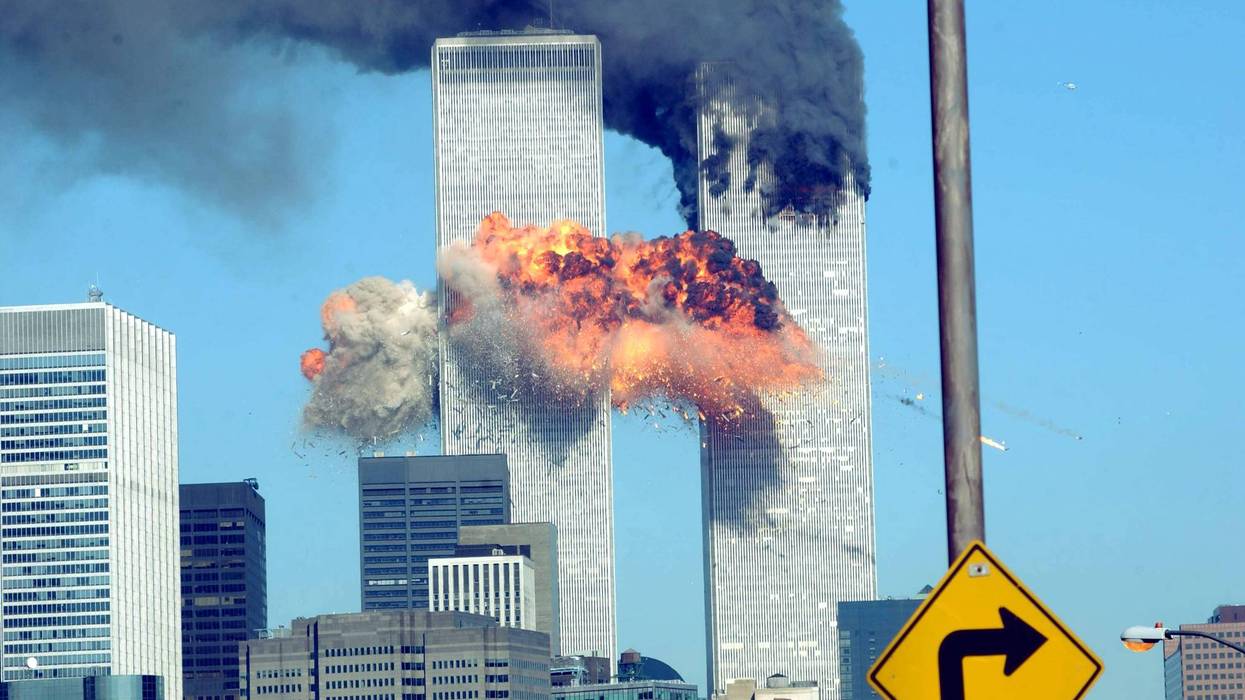
The crusade that George W. Bush launched 25 years ago to “rid the world of evil” only compounded it.
Three days after terrorists killed almost 3,000 people in the United States on September 11, 2001, President George W. Bush stood behind a pulpit at the Washington National Cathedral and spoke to a nation in shock. “Our responsibility to history is already clear,” he proclaimed, “to answer these attacks and rid the world of evil.” The vow was, of course, preposterous. Yet the “war on terror” that followed was scarcely more realistic.
“Terrorism is not an enemy. It cannot be defeated. It’s a tactic,” retired US Army General William Odom told C-SPAN viewers in 2002. “It’s about as sensible to say we declare war on night attacks and expect we’re going to win that war. We’re not going to win the war on terrorism.” But the American military crusade became more about persisting than winning. The ultraviolent momentum became its own reason. The destructive search for enemies created more. As years went by and the “war on terror” label faded, US warfare was so normal in so many places that it no longer needed a name or much of a rationale.
But 25 years ago, the impulse to avenge the horrors of 9/11 was instant. Fear and rage blended into high octane for war machinery. Suddenly, overwhelming public emotions were fully in sync with the psychology of a military-industrial complex set for large-scale killing.
Even as the trauma of the terrible day eased for the general public, 9/11 continued to serve as a political license to kill without an expiration date.
None of the 19 hijackers were Afghan, and Al Qaeda leader Osama bin Laden’s ties were much tighter with Saudi Arabia, but his presence in Afghanistan put that country in the Pentagon’s gunsights. The question in US media was not about whether, but when, to attack. The answer came on October 7 when American missiles began to explode in Afghanistan. Hours later, a Gallup poll found that “90 percent of Americans approve of the United States taking such military action, while just 5 percent are opposed, and another 5 percent are unsure.”
The air war remained quite popular in the United States. Defense Secretary Donald Rumsfeld held daily live televised briefings that catapulted him to national adulation. A pattern set in, taking for granted that American warfare was beneficent in intent and benign in meaningful impact. People dying under American bombs and less directly didn’t count for much. “The targeting capabilities, and the care that goes into targeting, to see that the precise targets are struck, and that other targets are not struck, is as impressive as anything anyone could see,” Rumsfeld asserted. And he added, “The weapons that are being used today have a degree of precision that no one ever dreamt of.”
Rumsfeld’s style went over big. “Everyone is genuflecting before the Pentagon powerhouse,” exclaimed the Washington Post’s media reporter, Howard Kurtz, who called Rumsfeld “America’s new rock star.” That winter, after the Taliban government fell, the host of NBC’s Meet the Press program congratulated Rumsfeld on the air: “Sixty-nine years old and you’re America’s stud.”
The war in Iraq, launched with a March 2003 invasion, relied on massive air power and more than 150,000 US ground troops. The Saddam Hussein dictatorship fell quickly, but the promised “cakewalk” turned into year after year of combat and slaughter. Mainstream US media outlets were more than comfortable with above-it-all bombing that signified American air prowess. But the toll of American deaths and severe injuries gradually depleted enthusiasm as soldiers were called back for two, three or even more tours of duty. For many, the images of glory days turned into real-life nightmares.
The ongoing war effort that began in autumn 2001 had an implicit throughline in dominant media and politics: while American lives really matter, the victims of American firepower really don’t.
President Bush could not accept defeat in Iraq, and later Barack Obama could not countenance defeat in Afghanistan. Early in his presidency, Obama—in deed and word—made the “war on terror” expressly bipartisan. Less than a year after he received the Nobel Peace Prize in late 2009, the American troop level in Afghanistan reached 100,000, triple the number when he had entered the White House. During a visit to Bagram Air Base near Kabul, Obama provided the service members with star-spangled oratory that could be heard as uplifting or perhaps macabre: “I’ve been humbled by your sacrifice in the solemn homecoming of flag-draped coffins at Dover, to the headstones in section 60 at Arlington, where the fallen from this war rest in peace alongside the fellow heroes of America’s story.”
In effect, even as the trauma of the terrible day eased for the general public, 9/11 continued to serve as a political license to kill without an expiration date. Through it all, the ongoing war effort that began in autumn 2001 had an implicit throughline in dominant media and politics: while American lives really matter, the victims of American firepower really don’t.
* * *
Faraway uses of Pentagon air power had human consequences that hardly registered on political scales back home. For officialdom, tech innovations like drones were unalloyed marvels. The people who experienced terror had no voices, no faces, no names. On the rare occasions when that wasn’t the case, general interest was scant. After seven months in Taliban captivity, New York Times reporter David Rohde escaped from rugged terrain in Pakistan and later recounted what it was like to have US drones constantly hovering overhead: “The drones were terrifying. From the ground, it is impossible to determine who or what they are tracking as they circle overhead. The buzz of a distant propeller is a constant reminder of imminent death.”
The proclaimed war on terror had also become a war of terror.
A few days into his presidency, Obama sent Predator drones into Pakistan, killing three children and a dozen adults. A week later, a former “whiz kid” at the Pentagon during escalation of the Vietnam War in the 1960s, Pierre Sprey, appeared on the PBS program hosted by Bill Moyers. Sprey saw where US officials were headed with their air war. “I’d be astonished if one in five people they kill or wound is in fact a militant,” he said. “You can’t tell with a camera or an infrared sensor or something whether somebody’s a Taliban…. Most likely, you’re relying on some Afghani of unknown veracity and unknown motivation and who may, may very well be trying to settle a blood feud rather than give you good information.” But, Sprey added, “bombing is always politically popular, relative to sending infantry and killing our boys.”
Obama officials were enamored with the American air war, in spite of evidence that it was routinely killing many bystanders. In 2022, Phyllis Bennis at the Institute for Policy Studies offered this assessment: “The so-called ‘global war on terror’ has, from its origins, been characterized by attacks by US Special Forces, by airstrikes, by armed drones, and more, that routinely kill far more civilians than the targets identified on the ‘kill lists’ prepared by presidents and top White House officials. The routine recitation of ‘there is no military solution to terrorism’ has always been an anodyne rhetorical ploy, never an actual guide to what actions might actually work to change the conditions that give rise to terrorism.”
Ironically and tragically, the conditions giving rise to terrorism included the US war waged in the name of ending it. The process was foreseeable. In 1998, the Pakistani-American political scientist Eqbal Ahmad wrote: “A superpower cannot promote terror in one place and reasonably expect to discourage terrorism in another place. It won’t work in this shrunken world.”
Killing from the skies fueled desires for retribution. "For every 10 to 15 people killed, maybe they get one militant," Pakistani photographer Noor Behram said in 2011. For three years, he had been documenting the immediate aftermath of drone attacks in the mountainous Waziristan region near the Afghan border. "There are just pieces of flesh lying around after a strike. You can't find bodies. So the locals pick up the flesh and curse America. They say that America is killing us inside our own country, inside our own homes, and only because we are Muslims.” As a result, Behram said, “The youth in the area surrounding a strike gets crazed. Hatred builds up inside those who have seen a drone attack."
Many thousands of miles away, military personnel in the US were peering at blurry images on computer screens and firing the drone missiles. “The truth is that we could not differentiate between armed fighters and farmers, women or children,” former tech sergeant Lisa Ling recalled. For several years, she had trained Air National Guard members on how to operate Air Force drones. Ling was among the drone whistleblowers who went public during the terror war’s second decade. One of them, the young intelligence analyst Daniel Hale, spent nearly three years in prison because he disclosed facts about the drone program’s human toll. “With drone warfare, sometimes nine out of ten people killed are innocent,” he said. “You have to kill part of your conscience to do your job. But what possibly could I have done to cope with the undeniable cruelties that I perpetuated? The thing I feared most was the temptation not to question it. So I contacted an investigative reporter… and told him I had something the American people needed to know.”
Hale provided The Intercept with classified documents that led to a landmark expose in October 2015. It reported, “Documents detailing a special operations campaign in northeastern Afghanistan, Operation Haymaker, show that between January 2012 and February 2013, US special operations airstrikes killed more than 200 people. Of those, only 35 were the intended targets. During one five-month period of the operation, according to the documents, nearly 90 percent of the people killed in airstrikes were not the intended targets. In Yemen and Somalia, where the US has far more limited intelligence capabilities to confirm the people killed are the intended targets, the equivalent ratios may well be much worse.”
Early in his second term, at the National Defense University, Obama gave a much-ballyhooed speech that addressed downsides of the terror war, then in its twelfth year. “Our systematic effort to dismantle terrorist organizations must continue,” he said. “But this war, like all wars, must end. That’s what history advises. That’s what our democracy demands.” Unlike the men who immediately preceded and followed him in the Oval Office, Obama seemed aware that perpetual war had negative effects on US society. Yet he didn’t proceed to do much about it. During the 44 months that followed his speech, through his last year in office, Obama maintained bombing of Afghanistan at about half the rate of his first term while drastically escalating the attacks in Iraq and Syria, with 30,743 bombs and missiles dropped on those two countries in 2016 alone.
* * *
Like Obama, both Donald Trump and Joe Biden ordered air strikes on Afghanistan, Iraq, Somalia, Syria and Yemen. In his second term, Trump has widened US bombing missions to also include Iran, Nigeria and Venezuela along with targeting nonmilitary boats and killing more than 225 civilians during the last year in international waters.
The withdrawal of all US troops from Afghanistan in the late summer of 2021 seemed to mark a turn away from nonstop warfare. “I stand here today, for the first time in 20 years, with the United States not at war,” President Biden declared weeks later at the United Nations. He added, “We’ve turned the page.” But actually, America was bound into a high volume of war. The “war on terror” was morphing and continuing on several continents. In fact, during the same month as Biden’s UN speech, the Costs of War Project at Brown University released a new report documenting that “counterterrorism operations have become more widespread in recent years.” The project’s co-director, Catherine Lutz, said: “The war has been long and complex and horrific and unsuccessful… and the war continues in over 80 countries.”
Throughout the last 25 years, since the first missiles struck Afghanistan, a racial aspect of the terror war has been hidden in plain sight.
The day after the Hamas-led attack in Israel on October 7, 2023, the Israeli ambassador to the United Nations stood outside the Security Council chambers and said, “This is Israel’s 9/11. This is Israel’s 9/11.” During the next six weeks, the New York Times later revealed, Israel “routinely” used 2,000-pound bombs in Gaza “in areas it designated safe for civilians.” Within nine months, Reuters reported, the large quantities of munitions supplied to Israel by the Biden administration included “more than 10,000 highly destructive 2,000-pound bombs.” Speaking to the UN General Assembly as the war in Gaza neared the end of its second year, Prime Minister Benjamin Netanyahu said: “We’re wiping out the terror regime of Hamas and ensuring that its savagery will never threaten Israel again.” By then, the US government had provided more than $21 billion in military aid to Israel since October 7. Amnesty International, Human Rights Watch and the Israeli organizations Physicians for Human Rights—Israel and B’Tselem unequivocally concluded that what has happened in Gaza is genocide. It was enabled by the United States.
Throughout the last 25 years, since the first missiles struck Afghanistan, a racial aspect of the terror war has been hidden in plain sight. While institutional racism is widely understood to exist inside the United States, an unexamined assumption is that its pernicious aspects stop at the water’s edge. But public discourse about the “war on terror” has eluded a fact well worth pondering: virtually every man, woman and child killed by Pentagon firepower in this century has been a person of color. This is not to say that they were attacked because of their racial identity. But racial biases in the US, unconscious and otherwise, have made it politically easier to launch and sustain wars bringing horrors to their lives.
Current findings from the Costs of War Project include: “An estimated over 940,000 people were killed by direct post-9/11 war violence in Iraq, Afghanistan, Syria, Yemen, and Pakistan between 2001-2023. Of these, more than 432,000 were civilians. The number of people wounded or ill as a result of the conflicts is far higher, as is the number of civilians who died ‘indirectly,’ as a result of wars’ destruction of economies, healthcare systems, infrastructure and the environment. An estimated 3.6-3.8 million people died indirectly in post-9/11 war zones, bringing the total death toll to at least 4.5-4.7 million and counting.”
In foreign countries, the overall “reverberating effects” have crushed countless lives. However, the only casualties of the “war on terror” that have really resonated in US politics are American losses. Yet many of the casualties are far from obvious. While “over 7,053 US service members died in the post-9/11 wars,” the Costs of War Project notes, “at least four times as many US service members and veterans of the post-9/11 wars died by suicide than in combat.” In addition, “An estimated 8,189 contractors for the US military died during the post-9/11 wars. Foreign workers for US contracting firms often do not have their deaths recorded or compensated.”
Such figures don’t include the Iraq and Afghanistan veterans with post-traumatic stress disorder. The Veterans Administration now says that 15 percent of those wars’ veterans were suffering from PTSD “in the last year” and 29 percent “at some point in life.” Meanwhile, traumatic brain injury (TBI) from the two wars often afflicts veterans who were violently jolted by explosions and other wartime events. Analyzing Pentagon data, the Centers for Disease Control and Prevention concluded that “more than 450,000 US service members were diagnosed with a TBI from 2000 to 2021.” Four years ago, the American Medical Association’s journal JAMA published an in-depth study of TBI among Iraq and Afghanistan veterans. “Our study suggests that post-9/11 military veterans face a higher mortality burden across multiple causes of death than the total US population,” the study said. “We also found that exposure to moderate to severe TBI was associated with even higher mortality rates and excess mortality from accident, suicide, cancer, CVD [cardiovascular disease], homicide, and other causes.”
* * *
One day in mid-December 2002, three months before the “shock and awe” bombardment of the city began, I sat at a picnic table in a Baghdad park with the middle-aged Iraqi man who was my driver. There was no one around, no walls or fixtures that might conceal listening devices. He said that he wished Iraq had no oil, because then there would be no reason to fear an invasion.
Whatever people’s beliefs about the goals behind US warfare during the last quarter-century, there can be no doubt of its immense profitability.
During the last 25 years, while plenty of public discourse has faulted policymakers for tactical mistakes and dubious judgment in war policies, more nefarious motives have received little attention. The rallying cry “No blood for oil” was common among those actively opposing war in Iraq but a nonstarter in mainstream media and politics. “The slogan is neither intelligent nor honorable,” Washington Post columnist George Will said in a commentary for ABC News shortly before the Iraq invasion began. “Intelligent people can honorably differ about the wisdom and morality of war against Iraq. But we should be able to agree that oil, an economic motive, is not driving US policy.”
Four years later, General John Abizaid, former head of US Central Command and military operations in Iraq, said: “Of course it’s about oil, we can’t really deny that.”
In his memoir, former Federal Reserve chairman Alan Greenspan wrote: “I am saddened that it is politically inconvenient to acknowledge what everyone knows: the Iraq war is largely about oil.”
Before becoming Defense secretary, Senator Chuck Hagel said in 2007: “People say we’re not fighting for oil. Of course we are.”
Whatever people’s beliefs about the goals behind US warfare during the last quarter-century, there can be no doubt of its immense profitability. The start of the Afghanistan War in October 2001 began supercharged bonanzas for Pentagon contractors. The 20 years of that war overlapped with upward of $2 trillion in government funds going to the biggest contractors—Lockheed Martin, Raytheon, General Dynamics, Boeing and Northrop Grumman—an increase of 188 percent. “Those five firms spent over $1.1 billion on lobbying between 2001 and 2021,” Quincy Institute senior advisor Eli Clifton wrote. “That number seems like a staggering sum to spend on influencing policymakers but it may have been the most financially prudent decision these companies have made in the past 20 years.”
Investing in war stocks was likewise prudent for stock-market players. As the war in Afghanistan came to a close, journalist Jon Schwarz did the math: “If you purchased $10,000 of stock evenly divided among America’s top five defense contractors on September 18, 2001—the day President George W. Bush signed the Authorization for Use of Military Force in response to the 9/11 terrorist attacks—and faithfully reinvested all dividends, it would now be worth $97,295. This is a far greater return than was available in the overall stock market over the same period. $10,000 invested in an S&P 500 index fund on September 18, 2001, would now be worth $61,613. That is, defense stocks outperformed the stock market overall by 58 percent during the Afghanistan War.”
* * *
The “war on terror” brand has gone out of fashion, but underlying military boosterism remains intact. Midway through Trump’s first term, the Democratic Party’s leaders in the House and Senate saluted when the commander in chief proposed an 11 percent Pentagon budget increase over two years. “In our negotiations, Congressional Democrats have been fighting for increases in funding for defense,” Representative Nancy Pelosi boasted. “We fully support President Trump’s Defense Department’s request,” Senator Chuck Schumer proclaimed. “US taxpayers spend far more on the military and war than most people realize,” says a recent report from the Project on Government Oversight, which documents that “there are several ways to calculate the true cost of our military” and “all add up to at least $1.5 trillion.” A two-year 11 percent military spending increase now looks almost dovish in comparison to the outlays on the near horizon. Even without enactment of Trump’s proposed half-a-trillion-dollar increase for the 2027 fiscal year military budget, the status quo is deeply mired in what Martin Luther King Jr. called “the madness of militarism.” If budgets are moral documents, America has been plunging into one moral abyss after another.
The “war on terror” brand has gone out of fashion, but underlying military boosterism remains intact.
With a very different style, Donald Trump’s basic lawless approach to international conflict is akin to Bush’s “war on terror” approach. Rhetoric aside, the actions have been clear: if the USA wants to attack another country, it will. This year’s unprovoked bombings of Iran signify how America’s foreign policy comes full spiral.
The crusade that George W. Bush launched to “rid the world of evil” only compounded it. Now, as the nation’s military juggernaut advances, the mindsets that propel it are in dire need of direct challenge.
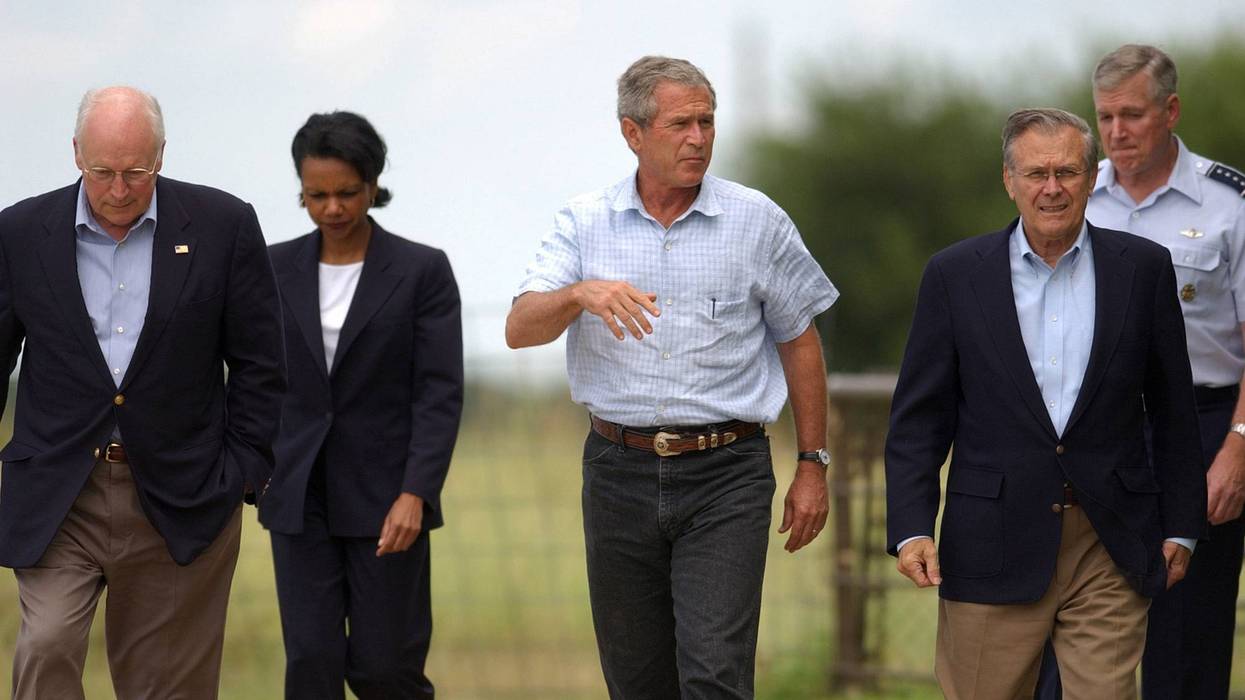
Stop throwing money at a broken, destructive war machine. Stop threatening and blockading our neighbors. Close overseas bases and bring our troops home. Tax the wealthy and start rebuilding our country.
The lesson of 9/11 should be that war is not the answer to any of the problems facing the United States. After inflicting violence and chaos on country after country for twenty-five years in a “global war on terror” that has evolved into a Zionist genocide and a revived Cold War against Russia and China, the widespread public opposition to Trump’s war on Iran suggests that most Americans have finally learned that lesson.
Unfortunately, powerful sections of our corrupt business and political elites have not.
Most Americans old enough to remember September 11, 2001, can still recall the horrifying images played endlessly on our TV screens as the scale of the mass murder became clear. But we also remember something else: the sinking feeling that the hopes and dreams of billions of people, in the US and around the world, would be pushed to the back-burner for the foreseeable future, as our leaders and corporate media all too predictably embraced a new agenda of revenge, fear-mongering, jingoism and military violence.
As Rumsfeld made clear to his subordinates from the outset, the 9/11 crisis provided an open-ended pretext for endless wars against enemies who had nothing to do with the attacks...
We found out later that only hours after the attacks—less than six hours after the first plane struck the World Trade Center and barely five hours after the Pentagon was hit—the planning for America’s military response to the 9/11 massacre was already under way.
At 2:40 pm, Defense Secretary Rumsfeld convened a meeting at the Pentagon. Notes taken by Undersecretary Stephen Cambone, later obtained by CBS News, recorded Rumsfeld demanding the “best info fast. Judge whether good enough hit S.H.”—meaning Saddam Hussein—“at the same time” as Osama bin Laden. Then came the chilling instruction: “Go massive. Sweep it all up. Things related and not.”
Twenty-five years later, we can look back and see how the US government used September 11 to unleash a crusade of violence, war crimes and chaos across the world. Experts like Nuremberg prosecutor Ben Ferencz and military historian Michael Howard warned from the beginning that declaring a “war on terror” made no sense and would make matters worse.
They were right, of course. But when the State Department’s annual Patterns of Global Terrorism report for 2004 showed an unprecedented increase in global terrorism following the US invasion of Iraq, Secretary of State Condoleezza Rice simply cancelled and discontinued the report, replacing it with a new one with different criteria to prevent comparison with previous years.
But, as Rumsfeld made clear to his subordinates from the outset, the 9/11 crisis provided an open-ended pretext for endless wars against enemies who had nothing to do with the attacks, and for the remilitarization of the United States after the small reduction in its military spending after the end of the Cold War.
Total US military spending for the past 25 years has exceeded $21 trillion (in 2024 dollars), surpassing the combined spending of the other 18 largest military powers in the world. During that time, China has built a whole new civilization and infrastructure, and leapfrogged the US economy to become the world leader in clean energy, high-speed rail and technological sectors in which the US was once preeminent.
Both Democrats and Republicans are responsible for these counter-productive choices, and the appalling human costs of these wars on the countries the United States has attacked, bombed or invaded make this an especially atrocious way to squander our nation’s wealth.
The history of the United States during this period calls to mind an old Greek myth. Croesus, the famously wealthy king of Lydia, asked the Oracle at Delphi what would happen if he invaded Persia. The Oracle told him, “If you cross the Halys river, a great empire will fall.” Encouraged, Croesus launched the invasion. But he lost the war, and the empire that fell was his own.
In pursuing their global imperial ambitions, our leaders and ruling classes have discounted and betrayed the real sources of America’s prosperity and security: the well-being of the American people and peaceful relations with our neighbors around the world.
They have led us into war, poverty and extreme inequality, and hollowed out a system of government that was slowly becoming more democratic. At home, decades of political struggle by labor, civil rights and other social movements produced enormous advances, including Social Security, Medicare and Medicaid, major investments in public infrastructure and education, and a highly progressive tax system—with the top income tax rate at 91% until 1963—that helped finance those public goods and narrow the gap between rich and poor.
Contrary to the “End of History” theory embraced by many policymakers after the Cold War, and Margaret Thatcher’s famous insistence that “there is no alternative” to the extreme neoliberal capitalism that she and Ronald Reagan ushered in, societies always have political and economic alternatives. It is only a transparently self-serving choice by America’s corrupt ruling classes that saddles us with a system that keeps all decision-making power in their own hands in order to build their own wealth to the detriment of the country we all share.
We can see one alternative today in New York City, where Mayor Zohran Mamdani is pursuing a different set of priorities: expanding free childcare, making major investments in affordable housing, improving public transportation, and freezing rents for tenants in rent-stabilized apartments. Electoral politics can be part of the solution, but only if it reflects what ordinary people really want, instead of limited choices between oligarchic “lesser evils.”
Americans are demanding a renewal of social progress, with universal healthcare, quality public education, and all the things we need but can’t afford as long as this bloated, destructive war machine remains our government’s top priority. As Martin Luther King lamented in 1967, “I knew that America would never invest the necessary funds or energies in rehabilitation of its poor so long as adventures like Vietnam continued to draw men and skills and money like some demonic, destructive suction tube.”
Twenty-five years is a long time to keep moving in the wrong direction, especially when that direction involves endless war and the destruction of other countries. We are a long way from where most Americans would like our country to be. But we have a pretty good idea of what is wrong and what we need to do:
Stop throwing money at a broken, destructive war machine. Stop threatening and blockading our neighbors. Close overseas bases and bring our troops home. Tax the wealthy. Start rebuilding our country, and replace war and militarism with cooperation and problem solving. Take public ownership and responsibility for things we all need and use, like education, healthcare, housing, infrastructure, and utilities. Abolish ICE, and other militarized institutions that waste our national resources and do not serve the public good. Insist that the military be scaled back to its legitimate role of defending the United States against a possible, but very unlikely, foreign military attack.
If we have truly learned the lesson of the past twenty-five years, then we must translate it into policies that reflect that. The real test is not whether we can finally see what went wrong after 9/11. It is whether we are able to change course.
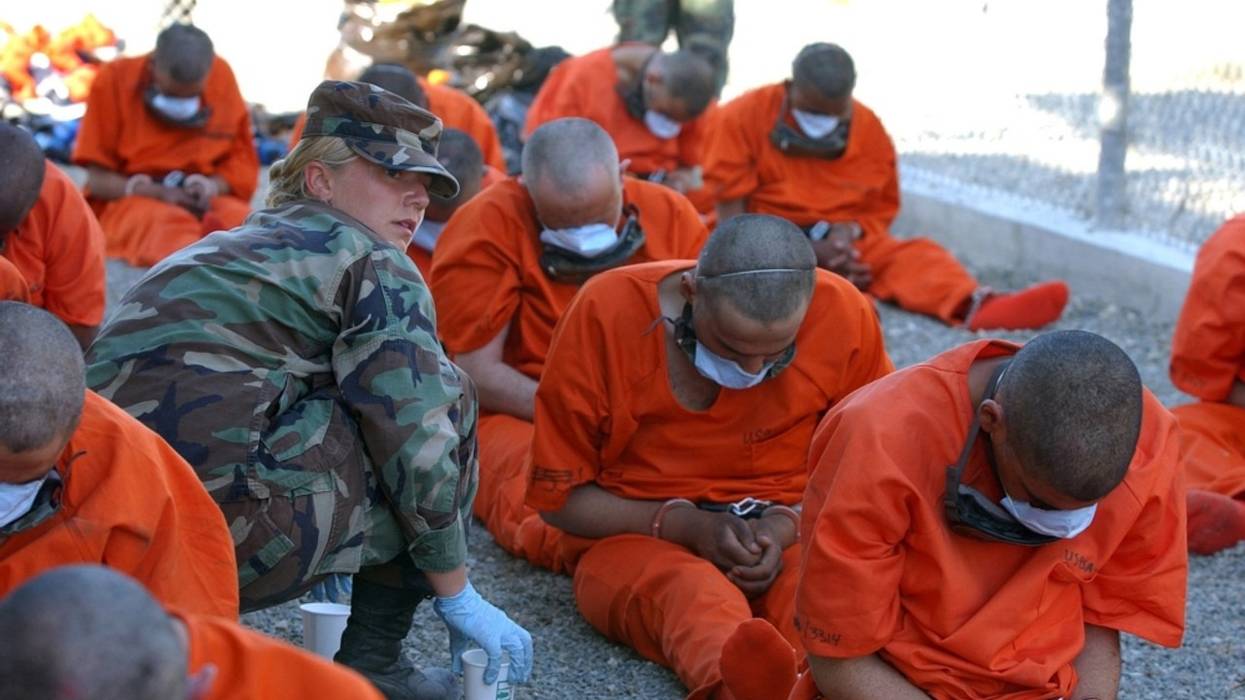
"This decision will ensure nothing but a continued lack of justice and accountability for everyone involved in the 9/11 military trial at Guantánamo," said one critic.
Human rights defenders on Friday condemned a federal appellate panel's decision upholding former U.S. Defense Secretary Lloyd Austin's withdrawal of pretrial plea agreements for three men accused of plotting the September 11, 2001 attacks on the United States.
Austin, who served under former President Joe Biden, "indisputably had legal authority to withdraw from the agreements; the plain and unambiguous text of the pretrial agreements shows that no performance of promises had begun," the D.C. Court of Appeals panel ruled in a 2-1 decision.
Under the proposed deal, accused 9/11 mastermind Khalid Sheikh Mohammed and alleged co-conspirators Mustafa al-Hawsawi and Walid bin Attash would have been spared execution in return for pleading guilty. The agreement came amid years of stalled legal proceedings in a case complicated by the U.S. government's torture of the defendants and efforts to cover it up.
Austin withdrew the plea agreements last August, explaining that he "long believed that the families of the victims, our service members, and the American public deserves the opportunity to see military commission trials carried out in this case."
However, attorneys for the defendants called the legally dubious military commission regime established at the Guantánamo Bay prison—notorious for detainee torture and indefinite detention—during the George W. Bush administration "obviously corrupt and rigged." During the 2000s, several military prosecutors resigned from the commissions in protest over what some of them called a rigged system designed to ensure there were no acquittals.
"The 9/11 case will never be resolved through a contested trial because the defendants were tortured by the CIA."
Last November, Air Force Col. Matthew McCall, a military judge, ruled that Lloyd "did not have the authority to do what he did, asserting that the plea deals "remain valid, and are enforceable," prompting the government's appeal. The following month, a military appeals court also ruled against Austin's bid to ditch the plea deals.
The Center for Constitutional Rights (CCR)—which has long represented Guantánamo detainees—called Friday's decision "a betrayal of justice."
"This decision will ensure nothing but a continued lack of justice and accountability for everyone involved in the 9/11 military trial at Guantánamo," CCR senior staff attorney Wells Dixon said in a statement. "The Biden administration's invalidation of plea agreements that would have resulted in convictions and life sentences for the 9/11 defendants is a painful betrayal of 9/11 victims' families."
"The 9/11 case will never be resolved through a contested trial because the defendants were tortured by the CIA," Dixon added. "The only way to resolve this case is for the Trump administration to succeed where every prior administration has failed and negotiate new deals with the 9/11 defendants that will finally close the 'War on Terror' prison at Guantánamo."
There are still 15 men currently imprisoned in Guantánamo, which is located on Cuban land leased to the U.S. in perpetuity by a dictatorship overthrown in 1959. Multiple detainees have been cleared for release, one of them for 15 years.
Some legal experts doubted whether the U.S. government would ever be able to try, let alone convict, the 9/11 suspects. Military judges and prosecutors have cited defendants' torture in declining to proceed with cases against them. Many men and boys were tortured at CIA "black sites," Guantánamo, and military prisons including Abu Ghraib. At least dozens of detainees died.
The three co-defendants were all captured in Pakistan during late 2002 and early 2003. After being turned over the United States, they were sent to CIA black sites, including the notorious "Salt Pit" outside Kabul, Afghanistan, where suspected militant Gul Rahman was tortured to death in November 2002. In 2006, the men were transferred to Guantánamo.
Mohammed was subjected to interrupted drowning, commonly called "waterboarding," 183 times, as well as other torture and abuse approved under the Bush administration's "enhanced interrogation" program. Hawsawi suffered a shredded rectum resulting from sodomization during so-called "rectal hydration" and has had to manually reinsert parts of his anal cavity to defecate. Bin Attash said he was placed in stress positions for extended periods, beaten, and doused in cold water.
The co-defendants must now decide whether to appeal the ruling to the full D.C. appeals court, the U.S. Supreme Court, or both.
"Putting aside the fantasy that this case is ever going to go to trial—assuming it does go to trial and that there's a conviction—you get to sentencing, and they have a right to put forward evidence... that they were tortured," Dixon told CNN Friday. "That's never going to happen."
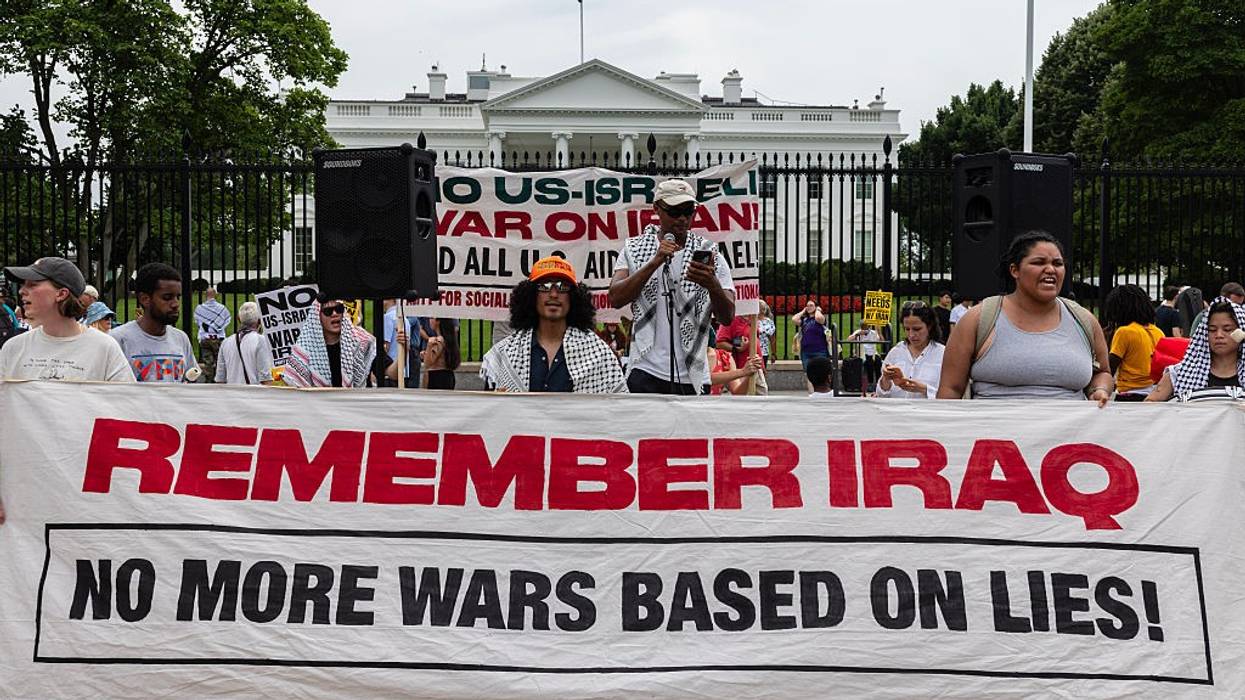
Despite the failure and destruction of the war against Iraq, the United States is once again bombing a Middle East nation with no regard for the consequences.
“Iran, the bully of the Middle East, must now make peace. If they do not, future attacks will be far greater and a lot easier,” said President Trump as he addressed the American people shortly after announcing he was bombing Iran. I was too young to watch my political leaders spiral themselves into the war in Iraq – I was only old enough to be able to comprehend the final toll: one million Iraqis died because my country couldn’t help itself from another power grab in the Middle East. I can’t help but feel that the same thing is happening all over again.
Myself, and countless other Americans, are ashamed at how many people have been killed in our name or with our tax dollars. The comfy politicians in Washington condescend to us — that our concern for human life actually goes against our own interests — as if Palestinians and Iranians do more to hurt Americans than the politicians and billionaires who gutted out industry, automated our jobs, privatized education, and cut social services. In our daily life, the people who actually hate us only become more obvious.
Last week before it was absolutely clear that the US would formally enter the war, public opinion polls came out that a vast majority of Americans did not want the US to go to war. This was not the case in the lead up to the war in Iraq. Times and opinions have changed amongst the masses, but that didn’t seem to matter to anyone in the White House this weekend.
In the aftermath of 9/11, our leaders were awfully good at convincing Americans that they needed revenge for what happened. Even if it wasn’t logical, even if it didn’t make sense — we invaded two countries that had nothing to do with 9/11. Revenge is often carried out in a blind rage, and I would say that characterized US actions in Iraq, given the barbaric nature of how the war was carried out, how many civilians died, and with a fallout that’s done very little for “strategic security interests”. I would say that it was a “blind rage” if its violence wasn’t so calculated — specifically to enrich a handful of Americans. It did succeed in that endeavor, and American families had their sons and daughters sent home in body bags so Haliburton's stock could skyrocket. The Iraqi people, with unsolicited promises to be “liberated” from Saddam, got nothing but grief and trauma that continues twenty years later. It was perhaps hard to justify all of that to the public; American public opinion has changed a lot, and so has US-led warfare as a result of that shift.
So, Donald Trump has made it obvious (in case it wasn’t before) that the consent of the governed doesn’t hold any weight in the United States of America. However, it’s still an interesting thing to examine in our current context. Despite a barrage of lies about nuclear weapons (like Saddam’s WMDs) and images of scary, oppressive mullahs (like the ‘dictator Saddam’) Americans still opposed a US war on Iran. If Americans were to leverage this public opinion against war in a meaningful way, by taking some sort of step past having a stance in their heads, what would it challenge? What would it look like? Will Americans oppose – at a large enough scale, US warfare that looks slightly different than it did in 2003?
US warmaking is more subtle to the American public, but not less deadly to the countries we impose it on. Trump insisted in his address to the nation that he has no plans to keep attacking Iran as long as they “negotiate”. This is after Israel killed Iranian negotiators with US approval, and after Iran had made clear their terms of negotiating that the US just couldn’t accept. There’s no definition about what Iranian compliance would look like, setting the stage for further bombing campaigns whenever Trump decides. There might not be troops on the ground or a US military occupation, but a war they refuse to call one is still functionally a war. It still kills people. It still destabilizes countries.
The US fights wars with money, private contractors, and “offensive support.” Only pouring into the streets to oppose sending troops to fight on behalf of Israel against Iran might not be the demand that becomes most pressing in the coming days and weeks. For example, will Americans oppose a war with Iran if it’s primarily conducted from the air?
There’s also a large sector of the American public that still morally supports Israel’s military in one way or another, whether it be overtly or with silence on the subject. Some of them might also make up the large portion of society that opposes the US going to war. For the last two years, as Israel has carried out its genocide campaign against Palestinians in Gaza, the US has been building up Israel’s military, sending off billions of our tax dollars to make sure Israel was perfectly poised for the moment it decided to kill Iranians. Whether the public who opposes war with Iran likes it or not, their support for Israel as a military ally will directly contradict their opinion opposing war with Iran. You can’t have your cake and eat it too, if we want to put it simply.
On the other side, Israel’s war crimes in Gaza also might have something to do with why opposition to the war on Iran is so prevalent. Because the back-up justification for attacking Iran, made by the ruling class, in case the nuke lies didn’t work, was portraying Iran’s leaders as scary, irrational, and evil boogeymen. The ruling class, decrying an evil Hitler-esque foreign leader in Iran, is now the boy crying wolf. We were told the same things about the leaders in Libya and Iraq to justify our country bombing of theirs. The result was Libyan, Iraqi, and to a lesser extent, American blood pooling in the streets. On top of that collective memory, we’ve seen our government entrench itself with Netanyahu — a commander of a military that’s killed countless Palestinians and a handful of Americans without any condemnation from our government. If there are murderous and unjust dictators in the Middle East, one of them is named Benjamin Netanyahu, and we are told he’s our greatest ally, and acting on behalf of Israel is acting in the best interest of Americans. Now, even if the US wanted the war on Iran all along, it appears to the world that Israel pulled us into the war – people do not like that, rightfully so.
If Americans who are against the war can reject these new forms of hybrid warfare as much as they reject the traditional forms of warfare, and the sectors of the public still sympathetic to Israel see the blatant contradictions in front of their eyes — then perhaps this public opinion could mean something real. Furthermore, it’s been made clear that the American ruling class will not change course solely because the people they “serve” oppose what they are doing. They’ve also demonstrated that they are willing to jail and deport people who disagree with them and their foreign policy escapades. The genocide in Gaza has made it clear that Americans standing against the actions of their government do so at great personal risk. Do Americans disagree with US involvement in the war enough? Do they disagree to the point where they are willing to experience threats, jail time, repression, physical harm, or other forms of violence? In the case of a war that could turn nuclear with an untethered Israel and Trump Administration at the helm, I sincerely hope so.
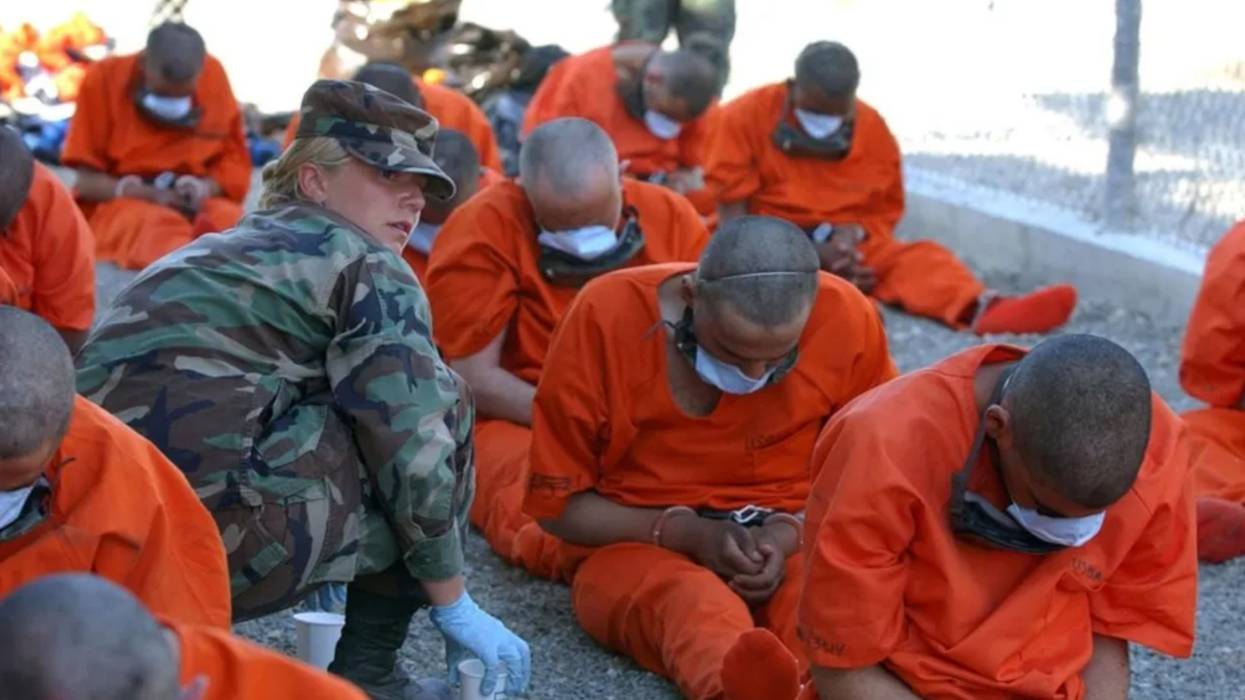
"We have had an unprecedented act by a government official to pull back what was a valid agreement," said an attorney representing tortured 9/11 suspects imprisoned at Guantánamo Bay.
Attorneys representing alleged 9/11 planners imprisoned at Guantánamo Bay argued Wednesday that U.S. Defense Secretary Lloyd Austin's move to block plea deals for three defendants violated Pentagon rules and belied the corruption of the military commission system established during the George W. Bush administration.
"We have had an unprecedented act by a government official to pull back what was a valid agreement," Walter Ruiz, who represents defendant Mustafa al-Hawsawi, said at a hearing at Guantánamo, according to CNN.
"For us, it raises very serious questions about continuing to engage in a system that seems so obviously corrupt and rigged," Ruiz added.
Last week, the Department of Defense announced that Brig. Gen. Susan Escallier, the convening authority for the Guantánamo military commissions, "has entered into pretrial agreements" with al-Hawsawi, alleged 9/11 mastermind Khalid Sheikh Mohammed, and Walid bin Attash.
The long-anticipated agreement—under which the three men would be spared execution by pleading guilty—came amid years of stalled legal proceedings in a case complicated by the U.S.' torture of the defendants and government efforts to cover it up.
While welcomed by advocates of closing the prison and some victims' families, Escallier's move also sparked a firestorm of criticism from numerous U.S. lawmakers, 9/11 first responders, and victims' relatives.
Last Friday, Austin withdrew the plea agreements. Speaking at a press conference on Tuesday, he explained that he has "long believed that the families of the victims, our service members, and the American public deserves the opportunity to see military commission trials carried out in his case."
"I'm deeply mindful of my duty to all those whose lives were lost or changed forever on 9/11, and I fully understand that no measure of justice can ever make up for their loss," Austin added. "So this wasn't a decision that I took lightly."
Eugene Fidell, a military law professor at Yale University and co-founder of the National Institute of Military Justice, told CNN that Austin's move "was illegal."
According to the network:
One of the primary issues pointed to on Wednesday by defense counsel was a regulation laid out in the military's Manual for Military Commissions, which says the convening authority can withdraw a pretrial agreement before the accused begins "performance of promises" or if the accused does not hold up their end of the deal. Gary Sowards, a defense attorney for Mohammad, said in court that Austin did not have authority under that regulation because his client had "begun very important, substantive, specific performance.'"
Sowards acknowledged that motions for discovery on the issue of potential unlawful influence by Austin, which would "seek to explore how he was coerced and influenced," could take a year or two to litigate. But the issue of the Manual for Military Commissions regulation is "a simple reading of about 12 lines of text," he said, and a decision on it should be able to be expedited.
Prosecutor Clayton Trivett Jr. told the commission Wednesday that the government needed to "work through the issues raised in these motions" so that the prosecution's position can be "fully articulated."
Sowards retorted, "'We want to consult with people'—that sounds like, 'We want to get our stories together.'"
Some legal experts doubted whether the government would ever be able to try, let alone convict, the 9/11 suspects. Military judges and prosecutors have cited defendants' torture in declining to proceed with cases against them. Many men and boys were tortured at CIA "black sites," Guantánamo, and military prisons including Abu Ghraib. At least dozens of detainees died.
Wells Dixon, a lawyer with the Center for Constitutional Rights who represented convicted terrorist Majid Khan, told CNN that the prosecution's unwillingness "to allow evidence about the defendants' torture and abuse to be aired in court" will make it extremely difficult to secure death sentences for the men.
"If Secretary Austin says that a 9/11 case is going to proceed to trial, and a verdict, and possibly a sentencing, then he is either hopelessly ill-informed or is lying to victims' family members," he added.
Accusations of military commission corruption go back decades.
In 2004, three military prosecutors—Maj. Robert Preston, Capt. John Carr, and Capt. Carrie Wolf—requested transfers from the commissions after concluding they were rigged.
"They were told by the chief prosecutor at the time that they didn't need evidence to get convictions," Clive Stafford Smith, an attorney who represented more than 70 Guantánamo detainees, told The Nation in 2008.
That year, former Guantánamo chief prosecutor Col. Morris Davis said that then-Pentagon General Counsel William Haynes told him that "we can't have acquittals."
Atlantic staff writer Graeme Wood asserted this week that "there is a way to clean up this mess."
"Now that Austin has assumed the power of the convening authority, he can restore the agreement he tore up on Friday—to reverse the reversal and bring these sordid proceedings to the end they were until recently already destined for," he wrote. "If he instead wants to extend the life of the commissions, slouching toward a trial that will never happen, then the pointless sacrifice of money and time will continue."
"For the families in search of finality, each minute of delay is a minute stolen, and for the defendants, each is a minute gained," Wood added. "The defendants have already cheated the hangman. The best way to end their run is to take that bitter deal, and bring these commissions to a well-deserved end."

One lawyer warned it will not only "push 9/11 victim family members over an emotional cliff," but likely lead "prosecutors to resign and defendants to seek dismissal of all charges for unlawful command influence."
U.S. Defense Secretary Lloyd Austin on Friday withdrew plea agreements the Pentagon had reached with three men accused of planning the September 11, 2001 terrorist attacks and detained in Guantánamo Bay, the American military prison in Cuba infamous for torture.
"I have determined that... responsibility for such a decision should rest with me," Austin wrote to Brig. Gen. Susan Escallier, the convening authority for the legally dubious Guantánamo Bay military commissions. "Effective immediately, in the exercise of my authority, I hereby withdraw from the three pre-trial agreements that you signed on July 31."
The U.S. Department of Defense confirmed Wednesday that Escallier "entered into pretrial agreements" with Khalid Sheikh Mohammed, Walid bin Attash, and Mustafa al-Hawsawi. The Pentagon did not share details of the deal, but it was reported that in exchange for ruling out the death penalty, the suspects agreed to plead guilty and spend the rest of their lives in prison.
The Center for Constitutional Rights (CCR), which has represented detainees at the prison, stressed that the deals were not only "a substantial step toward ending military commissions and the extralegal nightmare of Guantánamo," but also "inevitable because the 9/11 case was never going to be tried" through a process that has "never provided justice or accountability for anyone."
Others had also emphasized that point. U.S. Senate Judiciary Committee Chair Dick Durbin (D-Ill.) said on social media Wednesday that "after all these years, the victims of 9/11 and their families deserve justice and closure. The Bush administration's disastrous decision to torture detainees and set up untested military commissions made a fair trial impossible."
As The New York Times reported Thursday:
Valerie Lucznikowska, whose nephew was killed in the World Trade Center, said she had been to the Guantánamo Bay prison several times to watch pretrial hearings, but had stopped going out of frustration with the legal process.
"The plea agreements should have been done a long time ago," she said. "The system has not worked for a long time."
Ms. Lucznikowska belongs to the group September 11th Families for Peaceful Tomorrows, many of whose members oppose the death penalty. Her own opposition was both moral and practical, she said.
"If the death penalty stayed as the prime object of the trial, there was no way it would come to a conclusion within my lifetime," she said.
She added: "Guantánamo Bay prison is a stain on America. How are we going to get rid of the stain? We're not going to. But let's get it over with."
However, other relatives of victims and U.S. lawmakers, as well as the union representing New York City firefighters, had criticized the agreements. House Committee on Oversight and Accountability Chair James Comer (R-Ky.) even launched an investigation into "what involvement the White House had in negotiating and/or approving the recently announced plea deal."
After the Pentagon's Friday announcement, September 11th Families for Peaceful Tomorrows released a statement calling out Austin for canceling deals that, while "not the justice originally hoped for," had "offered a path to finality, and a modicum of justice and accountability for the crimes of 9/11."
"That the secretary has now overreached and undertaken direct oversight of the 9/11 commission is cause for enormous concern," the group said. "While we understand there are family members who are opposed to plea agreements, the reality stands that the 9/11 accused were tortured and several were sodomized. If any entity is at fault for the inability to prosecute this case with a slam dunk, it's the torturers. Because of the torture, the 9/11 accused will not be put to death. And any administration official or member of Congress who says otherwise is either uninformed, or politically pandering."
"The men who perpetrated the death of thousands on September 11th; men who have never uttered a word of remorse, should be justly punished. But what happened this week to 9/11 families is emotional whiplash," the group continued. "We will recover. We have been working for justice for the death of our loved ones for 23 years. Our larger concerns today are for this country, for the future of our children and grandchildren when legal principles are compromised. We ask that Secretary Austin meet with the 9/11 prosecution team, learn the deep complexities and flaws in the case, and come to his own conclusion that pretrial agreements will provide the finality and accountability we all deserve."
J. Wells Dixon, a senior staff attorney at CCR who specializes in challenging unlawful detentions at Guantánamo, decried the "dirty move" by Austin and accused him of "robbing victim family members of their only chance for justice and accountability for 9/11."
The Pentagon chief's "astounding decision" will not only "push 9/11 victim family members over an emotional cliff," but likely have legal consequences, Dixon warned. "Wait for prosecutors to resign and defendants to seek dismissal of all charges for unlawful command influence."
Daphne Eviatar, director of Amnesty International USA's Security With Human Rights program, similarly said Saturday that "this is a terrible development. The victims of the 9/11 attacks deserve accountability for the horrendous crimes committed after waiting more than 20 years."
"The defendants, who were brutally tortured and mistreated by U.S. agents and then detained without trial for more than 20 years, deserve a fair judicial resolution of their cases," Eviatar argued.
"The death penalty should have been taken off the table long ago," she added. "It is shameful for the defense secretary after all these years to intervene now to prevent the resolution of this case, at a time when the United States should be making every effort to acknowledge, account for, and finally end the abuses of the post-9/11 'war on terror.'"
John Knefel, a senior writer at Media Matters for America, also responded critically to Friday's news, saying that "this development is 100% in alignment with the history of Gitmo in general and the military commission system specifically—ad hoc, arbitrary, capricious. A repulsive apparatus, and one wholly fitting of U.S. empire."
This post has been updated with comment from Amnesty International September 11th Families for Peaceful Tomorrows.
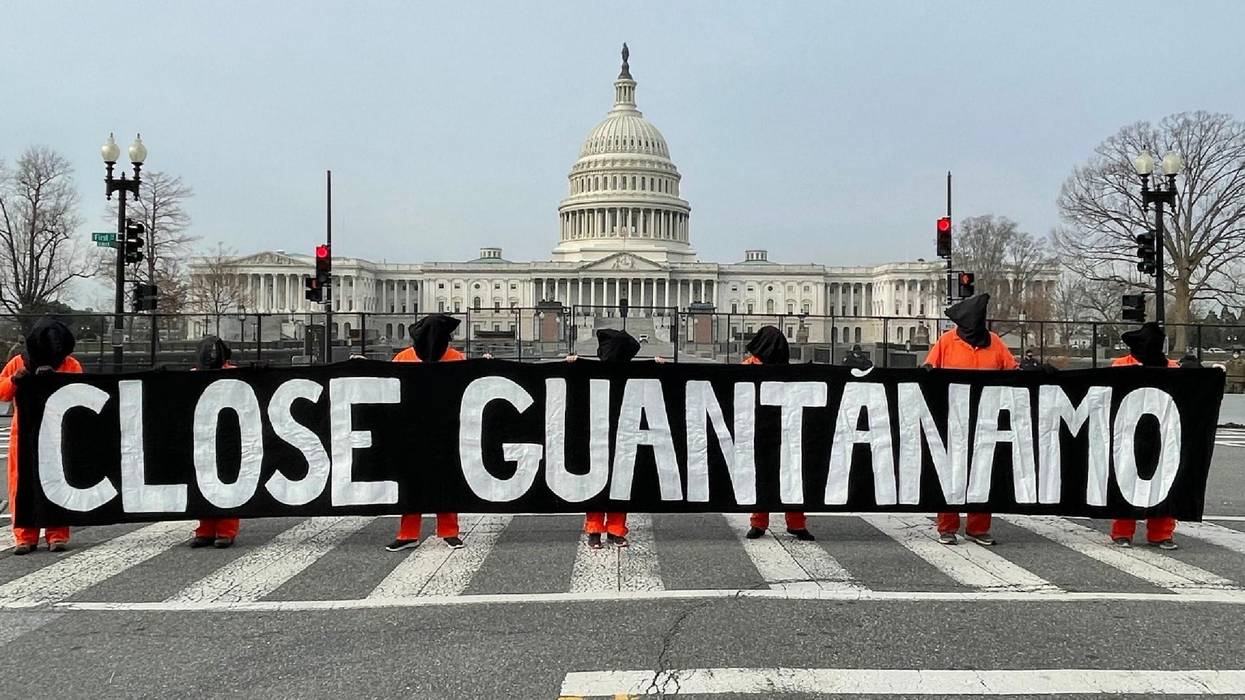
"This should be the beginning of the end of the Guantánamo Bay detention center," said one Amnesty International campaigner.
Forced into a legal corner due to the torture of men accused of planning the September 11, 2001 attacks on the United States, the Pentagon on Wednesday announced it has reached plea agreements with three top 9/11 suspects, who will spend the rest of their lives in prison and avoid execution.
The U.S. Department of Defense said in a statement that Brig. Gen. Susan Escallier, the convening authority for the legally dubious Guantánamo Bay military commissions, "has entered into pretrial agreements" with alleged 9/11 mastermind Khalid Sheikh Mohammed, Walid bin Attash, and Mustafa al-Hawsawi.
Although the Pentagon statement said that "the specific terms and conditions of the pretrial agreements are not available to the public at this time," The New York Times reported that news of the deal was revealed in a recent letter from military prosecutors to relatives of 9/11 victims.
"In exchange for the removal of the death penalty as a possible punishment, these three accused have agreed to plead guilty to all of the charged offenses, including the murder of the 2,976 people listed in the charge sheet," the letter, which was signed by Rear Adm. Aaron C. Rugh, explained.
Responding to the news, the Center for Constitutional Rights (CCR)—which has represented and advocated for Guantánamo detainees—said that "these plea agreements are a substantial step toward ending military commissions and the extralegal nightmare of Guantánamo."
"They were also inevitable because the 9/11 case was never going to be tried before a military commission," CCR continued. "The military commissions at Guantánamo have never provided justice or accountability for anyone. Rather, for the last two decades, they have provided a veneer of legal process that serves only to maintain the unacceptable status quo and cover up the torture and abuse of detainees."
"But as illustrated by the military commission cases of our clients David Hicks and Majid Khan, they have also been a way out of Guantánamo," the group added. "Ironic, because it is ultimately men like our clients Guled Duran and Sharqawi Al Hajj, who committed no offense and are approved for transfer, who remain in detention indefinitely. This has been a central, ugly truth of Guantánamo since it opened in January 2002."
The case against the plea deal trio and other 9/11 defendants—who have been imprisoned by the U.S. military for more than 20 years—was mired in pretrial delays. Defense lawyers asserted that the defendants' torture in CIA "black sites" and at Guantánamo, and the government's subsequent cover-ups, invalidated prosecution evidence against them.
The five 9/11 defendants—the three who struck plea deals plus Ammar al-Baluchi and Ramzi bin al-Shib—were all captured in Pakistan in late 2002 and early 2003 before being turned over to the United States and transferred to CIA black sites, including the notorius "Salt Pit" outside Kabul, Afghanistan, where suspected militant Gul Rahman was tortured to death in November 2002. In 2006, the five were transferred to Guantánamo Bay.
All five men were tortured. Mohammed was waterboarded 183 times and subjected to other tortures approved under the George W. Bush administration's euphemistically named "enhanced interrogation" program. Al-Hawsawi suffered a shredded rectum resulting from sodomization during so-called "rectal hydration" and has had to manually reinsert parts of his anal cavity to defecate.
In 2012, Col. James L. Pohl, then the presiding military commission judge, prohibited all testimony related to the defendants' capture, imprisonment, and torture. According to a May 2016 court filing, Pohl conspired with military prosecutors to destroy evidence in Mohammed's case.
Over the years, numerous Guantánamo prosecutors resigned over what they called a corrupt military commission system designed to guarantee convictions. In 2008, former lead prosecutor Col. Morris Davis blasted the 9/11 trials as "rigged from the start," claiming he was told by a top Bush administration lawyer that acquittals were unacceptable. At least four other military prosecutors asked to be removed from the commissions over perceived unfairness.
This isn't the first time that U.S. torture has stymied military plans to prosecute 9/11 suspects.
In 2004, then-Guantánamo prosecutor Col. Stuart Crouch—whose Marine Corps buddy initially piloted one of the planes that was hijacked and crashed into the World Trade Center on 9/11—refused to prosecute Mohamedou Ould Slahi, who allegedly helped organize the plane's hijacking, citing his torture.
Five years later, Susan J. Crawford, the top Bush administration official in charge of deciding which Guantánamo detainees to bring to trial, declared that the U.S. "tortured" Mohammed al-Qahtani, the alleged would-be 20th 9/11 hijacker, and blocked his prosecution.
More recently, in 2021, all but one member of the military jury convened to hear the case against Guantánamo detainee and alleged terrorist plotter Majid Khan recommended total clemency after the accused testified how he endured torture including rape, being hung from a ceiling beam, and being waterboarded while he was held at a CIA black site in Afghanistan.
Military prosecutors and defense lawyers had been in talks about a possible plea deal for the 9/11 suspects since at least last year. In recent years, people including U.S. Senate Judiciary Chair Dick Durbin (D-Ill.), 9/11 survivors and victims' relatives, and Ted Olsen—the former Bush solicitor-general who once defended the indefinite detention and torture of Guantánamo prisoners—have called for plea agreements and the prison's closure. However, President Joe Biden reportedly balked at the idea of sparing the defendants' lives.
While many Republican U.S. lawmakers condemned Wednesday's plea agreements as a betrayal to relatives of 9/11 victims, rights groups called the deals a big step toward justice and closure.
"This is an incredibly welcome and long-overdue step," Yumna Rizvi, a senior policy analyst at the Center for Victims of Torture, said on social media. "The Biden administration can and should #CloseGuantanamo."
Daphne Eviatar, director of the Security with Human Rights program at Amnesty International USA, said in a statement: "This is welcome news. Finally, after more than 20 years, there will be some accountability for the 9/11 attacks, and justice for the victims and survivors of those horrific crimes. We are also pleased that there is finally an outcome for at least some of the accused, who were tortured and then languished in detention without trial for more than two decades."
"This should be the beginning of the end of the Guantánamo Bay detention center," she added. "We urge the Biden administration to release the remaining detainees who have not been charged with crimes, and close the facility once and for all."
There are 19 men still imprisoned without charge in Guantánamo. Sixteen have been cleared for release, some of them for many years.

Once powers previously outlawed or at least restrained in the name of fair, just, and responsible laws and norms become codified and implemented, the road back to normalcy is tantamount to impossible.
This week marks the 22nd anniversary of the opening of the Guantánamo Bay detention facility, the infamous prison on the island of Cuba designed to hold detainees from this country’s Global War on Terror. It’s an anniversary that’s likely to go unnoticed, since these days you rarely hear about the war on terror — and for good reason. After all, that response to al-Qaeda’s 9/11 attacks, as defined over the course of three presidential administrations, has officially ended in a cascade of silence. Yes, international terrorism and the threat of such groups persist, but the narrative of American policy as a response to 9/11 seems to have faded away. Two and a half years ago, the Biden administration’s chaotic withdrawal from the 20-year-long Afghan War proved to be a last gasp (followed the next summer by the killing of Ayman al-Zawahiri, successor as al-Qaeda’s leader after Osama bin Laden was killed in 2011).
But Guantánamo, a prison that, from its founding, has violated U.S. codes of due process, fair treatment, and the promise of justice writ large isn’t the only unnerving legacy of the “war” on terror that still persists. If indefinite detention at Guantánamo was a key pillar of that war, defying longstanding American laws and norms, it was just one of the steps beyond those norms that still persist today.
In the days, weeks, and even years following the attacks of September 11th, the U.S. government took action to create new powers in the name of keeping the nation safe. Two of them, more than two decades after those attacks, are now rife with calls for change. Congress created the first just a week after 9/11 (with but a single no vote). It authorized unchecked and unending presidentially driven war powers that could be used without specified geographical limits — and, strangely enough, that power still remains in place, despite recent congressional efforts to curtail its authority. The second, the expansive use of secret surveillance powers on Americans, is currently under heated debate.
War Powers
The very first new authority created in the name of the war on terror was the Authorization for the Use of Military Force, or AUMF, passed by Congress one week after the 9/11 attacks. It gave the president the power “to use all necessary and appropriate force against those nations, organizations, or persons he determines planned, authorized, committed, or aided the terrorist attacks that occurred on September 11, 2001, or harbored such organizations or persons, in order to prevent any future acts of international terrorism against the United States by such nations, organizations, or persons.”
Unlike past declarations of war or authorizations for war in American history, it was staggeringly vague. It named no actual enemy or geographical locations. It made no reference to what conditions would end the hostilities and the power of that authorization. It was in essence “a blank check” for presidential war powers, as Congresswoman Barbara Lee (D-CA), the single member of Congress to vote no on its passage, warned at the time and has reiterated over the years.
It was also a game-changing authorization. Not only did it lack specifics, but it stripped Congress of its constitutionally authorized power to declare war. In the war on terror, Congress would defer to the president who could decide on his own when and where to launch attacks.
Over the course of the last two-plus decades, that 2001 AUMF has been used repeatedly to do exactly what Barbara Lee feared — namely, broaden the president’s power to commit acts of war against not just the terrorist groups who conspired in the 9/11 attacks, but groups in countries far and wide. According to the Costs of War Project at Brown University’s Watson Institute, as of 2021, it had been used in at least 22 countries, including Afghanistan, Djibouti, Eritrea, Ethiopia, Georgia, Iraq, Kenya, Niger, Pakistan, the Philippines, Somalia, and Yemen.
Twenty-two-and-a-half years later, in April 2023, Congressman Gregory Meeks, (D-NY), ranking member of the House Foreign Affairs Committee, acknowledged that the 2001 AUMF had indeed become, in the words of fellow Democrat Annie Kuster (D-NH), “a blank check for presidents from both parties to wage war around the world.”
Over the course of the last two-plus decades, that 2001 AUMF has been used repeatedly to do exactly what Barbara Lee feared — namely, broaden the president’s power to commit acts of war against not just the terrorist groups who conspired in the 9/11 attacks, but groups in countries far and wide.
There have been calls for the repeal of that AUMF over the years, including from — you undoubtedly won’t be surprised to learn — Representative Lee (repeatedly). This past fall, several such bills were introduced in both the House and Senate, including a bipartisan version by Senator Rand Paul (R-KY).
In the spring of 2023, Representative Meeks submitted his bill to replace the 2001 AUMF with a new one. In doing so, he sought to reestablish Congress’s constitutionally granted power to declare war, emphasized the statutory obligation of the president to brief Congress after launching any attack, and added that the president must brief Congress on a regular basis as to the uses of the AUMF.
In addition, he inserted language aimed at curtailing the Act’s expansiveness, including a requirement that the enemies to whom it could be applied be specifically named. He suggested three: the original al-Qaeda; the Islamic State Khorasan, based in Afghanistan and known as IS-K; and the Islamic State in Iraq and Syria, or ISIS. Moreover, his bill called for an annual reconsideration of those enemies and added provisions designed to end the president’s right to authorize the AUMF’s use for new groups by claiming they were just extensions of, or forces associated with, the already named groups. Furthermore, his bill prohibited its use against any unnamed enemy, “whether or not the entity is involved in an armed conflict against a force of a United States ally or partner or is an affiliate, associated force, or successor entity of an entity described in such subsection.”
To further constrain the broadness of that 2001 authorization, Meeks included a sunset clause at the end of four years unless it was reauthorized by Congress.
In a world where wars have broken out in Ukraine and now the Middle East, and where additional hostilities are simmering when it comes to the U.S., Iran, China, and Russia, such language would ensure that a separate congressional declaration of war would have to be approved for any enemy the U.S. decided to attack.
In these many ways, the new version of the AUMF would rein in the aberration of those war powers that came into being in the aftermath of 9/11.
And yet the time to redesign the authority of presidential war powers, as created more than 22 years ago by the war on terror, has still not arrived. Meeks’s bill, like Rand Paul’s, gained remarkably little traction. Likewise, a bill from those relatively few congressional representatives calling for a full repeal of that AUMF rather than a replacement of it failed to make it to a vote.
Surveillance
In addition to indefinite detention at Guantánamo and the authorization of endless, expansive war-making, ever more expansive intelligence collection, at home as well as abroad, has been a foundational pillar of the war on terror — and, like the AUMF, bringing it under some control has been mired in debate and controversy in recent months. In 2023, some members of Congress tried to put limits on part of a controversial law, Section 702 of the Foreign Intelligence Surveillance Amendments Act, passed in the summer of 2008 in the waning months of George W. Bush’s presidency. It authorized the collection and sharing of foreign intelligence for the purpose of deterring national security threats.
The problem was not the stated purpose of Section 702 — to acquire information on foreigners abroad who might pose a threat to the United States — but the domestic uses to which it’s been put. The act allows foreigners abroad to be surveilled without a warrant. But since its inception, it’s also been used for warrantless investigations of Americans whose communications have been caught up in sweeping searches of the communications of foreigners — investigations that have become known as “back-door searches.”
The problem was not the stated purpose of Section 702 — to acquire information on foreigners abroad who might pose a threat to the United States — but the domestic uses to which it’s been put.
Constitutional scholars and civil liberties advocates have fought against Section 702 from its inception, arguing that such searches violate the Fourth Amendment’s guarantee against unreasonable searches and seizures without a warrant based on probable cause of criminal activity. As Elizabeth Gotein of the Brennan Center for Justice explains, “Section 702 lets the government collect the communications of non-Americans located abroad without a warrant. But because Americans talk to people outside the country, the surveillance inevitably sweeps in our private phone calls, emails, and text messages, too — information that the government would normally need a warrant to access.”
In addition, experts note that, over time, the broad authority to collect the communications of Americans has been abused in alarming ways by the authorities. Gotein points out that 702-based warrantless searches have scrutinized the “communications of Black Lives Matter protesters, members of Congress, a local political party, a state court judge, journalists, and in one case, more than 19,000 contributors to a congressional campaign.” For their part, intelligence officials seeking a continuation of Section 702 point out that recent reforms have led to more responsible use of the authority.
Now, for the third time since its passage, Section 702 is up for renewal. December 31, 2023, was the legal deadline for a vote on it. Unlike the two prior times, however, the renewal date came and went without a vote. Instead, substantial opposition by legal experts and others led to several competing bills calling for Section 702’s reform.
One of the proposed bills, the Government Surveillance Reform Act, introduced by Democratic Senator Ron Wyden of Oregon and Republican Senator Mike Lee of Utah, as well as representatives Warren Davidson (R-OH) and Zoe Lofgren (D-CA) in the House, proposed that a warrant requirement be added to the search requirements when looking at the location data of Americans, web browsing and search records, vehicle data, and the like. In Lee’s version, any queries about the communications collected in a 702 search would, in accordance with the Fourth Amendment, require a warrant for material involving Americans. The new bill would amount, in Gotein’s words, to closing “the backdoor search loophole.”
The Biden administration has, however, taken a notably aggressive stance against changes to the law, especially when it comes to the introduction of the warrant requirement. Numerous high-ranking officials have spoken out publicly, insisting that the warrant requirement would imperil their ability to keep the nation safe. In his written testimony before Congress, FBI Director Chris Wray insisted that it was “an essential tool” in the counterterrorism toolbox. In fact, he told Congress, it was potentially “the critical link that allows us to identify the intended target or build out the network of attackers so we can stop them before they strike and kill Americans.” Andrew McCabe, acting director of the FBI after Donald Trump fired Director Jim Comey, put it even more starkly in a podcast devoted to the issue, labeling Section 702 “arguably the most significant national security tool in the intelligence community.” He then insisted that the requirement for a warrant was “completely unworkable.”
So fraught was the congressional loggerhead over Section 702 that the deadline for a decision proved unworkable. Instead, Congress inserted an extension to mid-April 2024 in this year’s defense spending bill, signed into law by President Biden three days before Christmas.
It’s likely that, as with the 2001 AUMF, the attempt to change Section 702 will fail. Powers once given, it seems, only prove ever harder to relinquish and, all too sadly, the overreach engendered by the war on terror has by now become an accepted part of the American (and congressional) way of life.
Guantánamo
And then there’s the most glaring symbol of the never-ending, often extralegal legacy of the war on terror, the continued existence of that grim prison at Guantánamo Bay, Cuba. Twenty-two years ago, the Bush administration set up that offshore detention facility for war-on-terror detainees, placing it beyond the reach of military, federal, or international law. Since then, on numerous occasions, new protections for the rights of prisoners there have been put into place, but none of them have addressed one fundamental wrong — namely, the decision that the federal court system was incapable of prosecuting those accused of engaging in terrorism against the United States, including those who conspired in the 9/11 attacks.
Despite candidate Biden’s assertion that, unlike Donald Trump, he would support the closure of Guantánamo, his appointment of a special representative to oversee the transfer of its prisoners to federal prisons, and the actual transfer of 10 detainees, substantial efforts to finally shut down the prison have been noticeably absent. Once a facility that held 780 men captured in the war on terror, it now holds 30 individuals, 16 of whom have been cleared for transfer elsewhere, pending appropriate security arrangements. Another 10 are scheduled for trial by military commissions but their trials are not expected to begin anytime soon.
Whether it’s an endlessly expansive authorization for eternally conducting war around the world, the redefinition of surveillance powers to include Americans under the guise of a foreign threat, or the seemingly lackadaisical acceptance of Guantánamo as an institution, there is certainly one lasting lesson from the war on terror. Once powers previously outlawed or at least restrained in the name of fair, just, and responsible laws and norms become codified and implemented, the road back to normalcy is tantamount to impossible.
Perhaps the best we can hope for is that wiser heads will prevail in the days to come. It is, however, a terrifyingly fragile approach, given the outlook for the 2024 election.

Although this week's deadly bombing in Kerman turns out not to implicate Israel, it certainly has a context in Tel Aviv’s reduction of Gaza to rubble and its murder of over 20,000 civilian noncombatants.
The responsibility for the bombing in Kerman, Iran, on Wednesday that killed at least 84 people and wounded another 284, has been claimed by the ISIL (Daesh, ISIS) terrorist group. The worst terrorist bombing in Iran since the Mojahedin-e Khalq (MEK) blew up the Iranian leadership in 1981 struck at a commemoration of the assassination by Donald Trump of Iranian Revolutionary Guards Corps General Qasem Soleimani.
Initially, figures on the Iranian government blamed Israel, and threatened retaliation. Iran opposes the Israeli total war on the civilians of Gaza, and leads a loosely organized Alliance of Resistance (against Israeli militarism) comprising Lebanon’s Hezbollah, Iraqi Shiite militias, and Yemen’s Houthis. The modus operandi of the Kerman bombing, however, with its targeting of civilian crowds in the service of inflaming conflict, better suits ISIL. The ISIL leadership had taken over northern Iraq and eastern Syria 2014-2018 by fomenting Sunni-Shiite civil war.
The Gaza conflict is having the effect of strengthening Iran’s Alliance of Resistance on the one hand, and of raising jealousies among and galvanizing Sunni radicals on the other.
Although the bombing turns out not to implicate Israel, it certainly has a context in Tel Aviv’s reduction of Gaza to rubble and its murder of over 20,000 civilian noncombatants.
Osama Bin Laden gave three reasons for undertaking the 2001 terrorist attacks on New York and Washington, D.C. — the US military presence in the Muslim holy land of Saudi Arabia, the excess civilian deaths caused by the US sanctions on Iraq in the 1990s, and the Israel occupation of Jerusalem and the threat it posed to the al-Aqsa Mosque complex (Islam’s third holiest shrine).
The Palestine piece is crucial. I wrote in 2010, “Last winter during the Gaza War, an audio tape attributed to Bin Laden did not neglect to mention the need to recover al-Aqsa Mosque (the Muslim holy site in Jerusalem) for Islam. Before 9/11, in early 2001, Bin Laden was penning odes to the liberation of Jerusalem and reading them at his son’s wedding.”
The US and European press never gave the Palestine issue its due in explaining Muslim radicalism twenty years ago, because facing the truth was too painful.
The longer the Biden administration allows this savage carnage on the part of Israel to continue before the eyes of the world, the more likely it is that the whole Middle East and perhaps the Muslim world more widely will be destabilized.
If ISIL did strike Iran, it may well have done so to take the shine off Iran’s current street cred in the Muslim world over Gaza. As the major Sunni Muslim countries have fallen silent or secretly cooperated with the Israeli onslaught, Iran has vigorously denounced the Israeli campaign against the Palestinians of Gaza. Its proxy militias in Iraq and Syria have repeatedly attacked US military personnel at Tanf in Syria and at Ain al-Asad base in Iraq. The Houthis have closed the Red Sea to traffic by international container ship companies.
ISIL hates Shiites and sees them as wretched heretics, and has made attempts to establish itself among Palestinians. It would want credit for resistance to the Israeli campaign to go to Sunni radicals. This strike at Kerman was revenge for the Iranian role in defeating ISIL in Syria, an effort directed by Soleimani.
Indirectly, then, the Gaza conflict is having the effect of strengthening Iran’s Alliance of Resistance on the one hand, and of raising jealousies among and galvanizing Sunni radicals on the other.
The longer the Biden administration allows this savage carnage on the part of Israel to continue before the eyes of the world, the more likely it is that the whole Middle East and perhaps the Muslim world more widely will be destabilized. The US and its allies will not be left untouched by such a development, as the Red Sea debacle already demonstrates. But that interruption of container ship traffic could be a minor consequence of the Israeli genocide against Gaza compared to what is coming.