

SUBSCRIBE TO OUR FREE NEWSLETTER
Daily news & progressive opinion—funded by the people, not the corporations—delivered straight to your inbox.
5
#000000
#FFFFFF
To donate by check, phone, or other method, see our More Ways to Give page.
Daily news & progressive opinion—funded by the people, not the corporations—delivered straight to your inbox.

An impeachment built on war powers and the laws of war would be a historic breakthrough for accountability—a step toward removing officials for abuses too often treated as part of the job.
Pete Hegseth still needs to be run out of town. And when he goes, he should make history. But it matters what kind.
History has a habit of remembering scapegoats as footnotes, a name attached to a failure the system quietly outlived. Hegseth shouldn't be that. For waging war without congressional authorization and presiding over grave violations of humanitarian law, let's make him a precedent, not a sacrificial lamb.
On Tuesday evening, House Republicans voted to prevent even that first step toward accountability. By 211 to 204, the House sent the impeachment resolution to the Judiciary Committee, effectively shelving it. Rep. Thomas Massie (R-KY.), who brought the charges, was the only Republican to oppose the maneuver.
Tuesday's vote postponed accountability. It did not answer the charges, and it should not end the organizing.
The campaign must continue now, with a demand that the new Congress revive impeachment in January. And it must reach beyond Hegseth. Removing him would deserve celebration. But a victory like this can arrive dressed as an ending. You stand in the kitchen after the guests have gone, the plates still out, and think: How nice, but now that's over...
It isn't.
Only two Cabinet secretaries have been impeached: William Belknap in 1876 and Alejandro Mayorkas in 2024. Neither case was about war.
Massie's articles are different. They concern Hegseth's conducting of the Iran War without congressional authorization, his continuation of hostilities after Congress directed an end to them, and his dismantling of safeguards meant to protect civilians. Another article concerns extrajudicial killings in the campaign against suspected drug boats, including attacks on shipwrecked survivors.
An impeachment built on war powers and the laws of war would be a historic breakthrough for accountability—a step toward removing officials for abuses too often treated as part of the job.
The effort to impeach Hegseth must become a sustained campaign to block anyone who would continue the same abuses. Florida Gov. Ron DeSantis and US Ambassador to the United Nations Mike Waltz are already being floated as possible successors. If the principles behind impeachment vanish at the next confirmation hearing, accountability becomes a politically important but ultimately skin-deep showpiece.
Democrats and everyone else demanding Hegseth's removal need to start talking now about the standards they will apply to his successor. What conduct disqualifies someone from running the Pentagon? What decisions will senators examine? We should not wait for a nomination to discover that the coalition had agreed on a departure, but not a change of direction.
Think of Mike Waltz's record as a bill of particulars. Count one is Yemen. As national security adviser, he convened the Signal group where officials discussed the March 2025 strikes. Airwars documented reports of at least 224 civilians killed during the campaign in less than two months. Most people remember the chat for the journalist accidentally included. The killing of civilians was the bigger crime.
Count two is the law of war. Asked in April about President Donald Trump's threat to destroy every Iranian power plant and bridge, Waltz defended such attacks as “perfectly acceptable in the rules of land warfare.” Legal experts writing in Just Security explained the distinction he obscured: Individual facilities may qualify as military targets, but destroying an entire category of infrastructure would be unlawful and “most likely is a war crime” by some of those involved.
Someone who helps organize war, supplies excuses for unlawful attacks, and resists public scrutiny is not a clean break from Hegseth.
Count three is accountability. Asked in a Foreign Policy interview whether Americans deserved a fuller accounting of US losses and mistakes, Waltz replied, “I don't know a country that exposes its military's mistakes.” Exposing them during a conflict, he added, would be “quite foolish.”
Someone who helps organize war, supplies excuses for unlawful attacks, and resists public scrutiny is not a clean break from Hegseth.
The war DeSantis is most famous for is the culture war. An appeals court found his restrictions on university teaching about race and gender violated professors' free-speech rights. His “Alligator Alcatraz” detention site drew a federal watchdog's finding that it failed to meet numerous federal and state standards. These things matter when considering who should run an agency as sprawling as the Department of Defense.
There is also Guantánamo. As a Navy lawyer there, DeSantis advised a commander that hunger-striking detainees could be force-fed. Providing legal permission for coercion is not the human-rights qualification we should want in a defense secretary.
His Cuba record extends the concern beyond the prison. In Congress, DeSantis cosponsored legislation that would have barred easing travel and trade restrictions. UN Special Rapporteur Alena Douhan has warned that US sanctions substantially worsen Cuba's humanitarian situation, affecting food security, healthcare, and education.
In 2021, DeSantis also encouraged Cuba's military to overthrow its government, telling younger officers they could “live in the history books.” That was a clear endorsement of regime change.
The point isn't which party a nominee belongs to or how they present themselves on TV. Did they help wage unauthorized wars, enable attacks on civilians, or give legal cover for cruelty? Those questions should organize a campaign: public demands, pressure on senators, and confirmation hearings that examine decisions rather than simply reward a more polished tone less likely to be lampooned on Saturday Night Live.
That standard has no party exemption. Biden-era officials who armed and defended Israel's devastation of Gaza must face it too. The UN's independent Commission of Inquiry has found that Israel committed genocide and called on states to stop transferring weapons that may be used for genocidal acts. Congress must refuse to confirm nominees whose records include egregious violations of human rights or the laws of war.
Tuesday's vote postponed accountability. It did not answer the charges, and it should not end the organizing.
Impeachment would establish the principle. The confirmation fight tests whether anyone intends to enforce it. The peace movement's task is to build a campaign strong enough to do both.

Macklemore's Free Palestine Tour helped create something that is often missing from the way Palestine is discussed: a space where people could encounter Palestinian culture and voices and turn their concern into action.
Macklemore says he is struggling to find arenas willing to host the US leg of his Free Palestine Tour. The news is a jarring contrast to the packed arenas I have just returned from across Dublin, Paris, and London—and a reminder of how contested the space for Palestinian expression remains in the United States.
That contrast is familiar to Palestinians. For years, being Palestinian in public has felt like an exercise in bracing. You stand in the cold behind barricades, and you wait to see who's going to get filmed, flagged, or fired just for asserting that children deserve to live. Your advocacy is routinely treated as a crime or a threat, until the anxiety of speaking out feels like the baseline cost of caring that children shouldn't be killed.
Then, in the space of one week, I stepped out of that cold and into three roaring arenas for the Free Palestine tour. For once, we weren't at the periphery asking to be heard. We were right in the middle of it, surrounded by joyous sound and a sea of keffiyehs. Palestine wasn’t an uncomfortable subject being squeezed into the conversation. It was the reason 20,000 people turned up in London, night after night.
We’ve seen an entire people be reduced to the images of their suffering. Humanitarian aid and bearing witness to those atrocities is essential. But Palestinians are not simply people to be rescued or mourned.
When the tour was announced, I was excited because I knew what it could mean for the cause that I've dedicated my life to. I work with UNRWA USA, and I co-founded Gaza Soup Kitchen, two of the organizations that the shows were raising money for. We all got an early heads-up, and the excitement was real. Part of it was the proceeds; part of it was finally being attached to something culturally relevant, exciting, and, I'll be honest, cool. After years of working to keep Gaza in the conversation, it was extraordinary to see what happened when a musician with a mic and a genuine willingness to take a risk brought that conversation into the center of popular culture.
Macklemore’s own story is part of why the tour mattered. He was dropped from Ed Sheeran's US tour after he'd spoken up for the Palestinians on stage. Rather than retreat, Macklemore built his own stage, invited others onto it, and sold out shows in cities worldwide. That's the power of solidarity.
In Dublin, Palestinian flags, keffiyehs, and an Irish audience with a long tradition of standing with those fighting for their freedom filled the room. In Paris, some of the people from the day's street protests spilled into the arena. Francesca Albanese, the United Nations special rapporteur on the occupied Palestinian territory, spoke to a room of music fans. That combination was part of what made the tour so unusual. Music wasn’t simply the entertainment between political speeches. It was what brought people together in the first place. It created a space where political engagement didn’t have to feel like an obligation or an argument. You could participate, learn, listen, and celebrate at the same time.
This is also the thinking behind UNRWA USA's upcoming What We Carry: Music, Memory, Home tour. This month, we’re bringing Palestinian music and storytelling to Los Angeles, New York, and Washington, DC. The events will feature artists including MC Abdul and Alana Hadid, with comedian Mo Amer being honored at the New York show for using his platform to transform how audiences see Palestinians, refugees, and immigrants. The tour is designed to do more than tell people about the emergency in Gaza. It invites them to encounter Palestinian stories through music, memory, and lived experience, and then gives them a direct way to support UNRWA's humanitarian relief.
That connection between culture and action is deliberate. Humanitarian organizations are often asked to make the case for support through statistics, urgent appeals, and descriptions of need. Those things matter. But people also need to encounter the human beings behind the numbers: their voices, their humor, their music, their memories, and their determination to remain connected to home. Culture can open a door that an appeal for donations alone might not. And once people walk through it, there must be a meaningful way to turn solidarity into support.
At the Gaza Soup Kitchen table in London, I handed out stickers until we ran out. People kept coming up to ask how they could donate. They came from all walks of life and different generations. They wanted to do something, and suddenly a door opened. This is what cultural moments can do that traditional advocacy sometimes struggles to achieve. They can take people from feeling something to doing something. A concert can bring people into the work of activism that might never otherwise have found their way there. And it can give them a community in which to stay.
We’ve seen an entire people be reduced to the images of their suffering. Humanitarian aid and bearing witness to those atrocities is essential. But Palestinians are not simply people to be rescued or mourned. We are people with a culture, a history, a future, and a right to live full lives. Our children deserve to see that reflected back at them.
I pulled my daughter into the arena through a video call. She's 12, into music, and into advocacy work. She's hardly ever seen those two things in one place. She was taking every second in, her all-caps reaction to everything telling me I'm officially cool now.
She's the reason I went, and a night like that gave us something to share that wasn't just grief. I want Palestinian kids to grow up seeing their identity in the music, the art, the clothes, and the humor they already have. Palestine can be edgy. Palestine can be rebellious. It can be funny, creative, and joyful. It doesn't have to be seen through rubble.
Macklemore didn't solve Palestine's problems. No concert will. But he helped create something that is often missing from the way Palestine is discussed: a space where people could encounter Palestinian culture and voices and turn their concern into action. At a time when even finding a venue for that kind of expression in the United States is proving difficult, the importance of creating and protecting these spaces feels even greater.
That’s what I want my daughter, and all Palestinian children, to remember—the sound of thousands of people singing, dancing, and celebrating alongside them. The knowledge that their identity belongs in the world and they have every right to take up space in it.

Collins has proved to be President Donald Trump’s worst VA Secretary ever; his main goal is faster privatization of the nation’s largest public healthcare system.
If any Trump appointees lose their posts, as part of a midterm cabinet reshuffling, Secretary of Veterans Affairs Doug Collins is not likely to be among them.
Unlike controversial former colleagues, already sacked as the heads of the Homeland Security, Justice, and Labor Departments—or Pete Hegseth, the next to go?—Collins keeps his own head down. He does the president’s bidding, without personal drama or political scandal.
This low-profile Air Force Reserve chaplain is a clean-living Southern Baptist minister, small-town lawyer, and former congressman from Georgia. When the Senate confirmed him last year, there was no need for a tie-breaking vote like the one JD Vance cast to push Pete across the finish line as secretary of defense.
VA defenders, inside and outside the Beltway, need a damage control agenda that will restrain—rather than enable—further White House attempts to defund and dismantle our best working model of socialized medicine.
The far more affable Collins won Senate approval with the bipartisan support of 22 Democrats! They included Richard Blumenthal (D-Conn.), a military veteran whose own son is a VA patient and, sadly, were joined by Bernie Sanders (I-Vt.), former chair of the Senate Veterans Affairs Committee (SVAC).
Collins has proved to be President Donald Trump’s worst VA Secretary ever; his main goal is faster privatization of the nation’s largest public healthcare system. The likelihood that he will control the third largest federal agency budget and second largest departmental workforce, for another two years, is not good news for 9 million VA patients.
By the time any Democrat replaces Trump in January, 2029, Collins will have diverted far more than $46 billion annually from the VA's direct-care budget to a network of 1.7 million private sector providers and four healthcare companies who administer it.
Just two months ago, he awarded new contracts to the latter worth $1 trillion, over the next decade (if not cancelled or curtailed by a future administration). As a result, industry giants like United Healthcare and Humana will be profiting from further outsourcing of VA care that is costly, unnecessary, and not favored by veterans themselves.
VA defenders, inside and outside the Beltway, need a damage control agenda that will restrain—rather than enable—further White House attempts to defund and dismantle our best working model of socialized medicine. Otherwise, more VA staffing and budget cuts, plus facility closings, in the VA’s own system of 1,380 public hospitals and clinics around the country will be happening soon.
Those most motivated to lead the charge against Secretary Collins on Capitol Hill in 2027 are newly elected pro-labor progressives, with personal experience in public healthcare systems, either as patients, their family members, caregivers, or administrators
Thanks to their successful campaigns against MAGA supporters, these VA defenders now include: former Army paratrooper Richard Ojeda in North Carolina; former Marine drill instructor JoAnna Mendoza in Arizona who has been treated for military sexual trauma at the VA; former Army surgeon Adam Hamaway, a Gaza war critic from New Jersey, who once operated on a helicopter pilot injured in Iraq named Tammy Duckworth, now Senator from Illinois; and Fred Wellman from Missouri, a West Point graduate who began rallying fellow vets against Trump six years ago through the Lincoln Project.
Last but not least is VA privatization critic Mitch Berman, “who spent over a decade serving veterans, active duty service members, and their families as a VA nurse”—and now represents conservative Republican Paul Ryan’s old district in Wisconsin. Any of the above could help energize a House Veterans Affairs Committee, where playing footsie with Collins (and his Biden administration predecessor) has gone on for too long, to the detriment of real agency oversight.
On the SVAC, the Democrats’ defense of our nation’s largest public healthcare system would be much improved by adding new Senators from either Michigan, Maine, and Iowa. Dr. Abdul El-Sayed, the just elected Michigan public health specialist and Medicare for All advocate, would be following in the footsteps of his big financial backer, Sen. Bernie Sanders.
Or El-Sayed could be joined by Troy Jackson, the former logger who ousted five-term Senator Susan Collins with Sanders’ support; as a state legislator, Jackson long championed the cause of Maine National Guard members who suffered Agent Orange exposure during their Vietnam-era training but were later deemed ineligible for compensation and healthcare.
In Iowa, its newly elected Sen. Josh Turek is not only the son of a Vietnam veteran but one who suffered birth defects due to his father’s Agent Orange exposure. As a wheelchair athlete, Turek played alongside disabled vets and worked with them in sports rehabilitation programs. He has pledged to “end unnecessary wars that put American lives at risk” and insure that “veterans exposed to toxic substances during their military service get the care and benefits they need.”
A recent report from Democracy Forward—by two former VA officials—provides plenty of ammo for new members of Congress to use in a long-overdue counteroffensive against Collins. As Josh Jacobs, a former VA undersecretary under former President Joe Biden, and Nicole Nedd, a past director of the agency’s national workforce management program, report:
The VA has lost approximately 30,000 employees through attrition, early retirements, deferred resignations, firings, and other departures. These staff had institutional knowledge and skills that cannot be quickly replaced. The staff who remain are bearing an unsustainable burden. Morale has deteriorated, and there is growing evidence that employees feel unable to raise safety concerns without fear of retaliation—a condition linked to more errors and worse patient outcomes.
In their indictment of Collins, entitled "Ready, Fire, Aim," the authors warn that “the choices being made now by the Trump-Vance administration—at the White House and within VA’s own leadership—will adversely shape veterans’ care for a generation.”
Nobody new or old inside the Beltway—whether in Congress or veterans’ advocacy organizations—will get much done by themselves, without the pressure of grassroots opposition to cuts in VA care and benefits.
Paul Reickhoff, an Iraq War veteran who helped found Iraq and Afghanistan Veterans of America (IAVA) two decades ago, believes that “both parties are looking for quiet ways to control VA disability spending, which now tops $118 billion a year for 5.1 million disabled veterans.”
This fall, Reickhoff’s new group, Independent Veterans of America (IVA), backed candidates like Navy Veteran and former National Guard member Dan Osborn, who distanced themselves from both major parties. Unfortunately, Osborn suffered a second narrow defeat running as a labor-backed independent candidate for the US Senate from Nebraska.
Reickhoff fears that “career political operatives” in Washington are still floating “budget options” which include “cutting benefits and raising minimum disability rating thresholds.” To stop these changes, veterans have to “build the media and organizing muscle to mobilize fast when veterans’ benefits are on the line.”
Fortunately, veterans’ groups, across the political spectrum, had a major victory earlier this year when they blocked the misleadingly named “Take Care of America’s Veterans Act” (TACVA). Veterans Service Organizations (VSOs) like the Veterans of Foreign Wars, Disabled American Veterans, and Progressive Veterans of America all sounded the alarm about this Collins-backed bill pushed by Republican House Speaker Mike Johnson (La.).
TACVA would have helped 50,000 former service members—whose careers were cut short due to medical problems—collect both their military pensions and VA disability benefits. But, as Common Defense political director Naveed Shah warned last summer, this multi-part bill was heavily booby trapped. If enacted, hundreds of thousands of other veterans would have been adversely affected.
According to Shah, an Army veteran who served in Iraq, it would have “cut $57 billion from our future tinnitus and sleep apnea claims, tripled the VA home loan fee, allow disability appeals to be decided in bulk rather than on the merits of each veteran’s record, enable more layoffs that threaten the quality of VA care, and lay the groundwork for handing VA facilities over to private operators.” (Lame-duck Republicans may make a second attempt to pass TACVA, in similarly problematic form, before January.)
Veterans for Peace (VFP) has long been the most reliable first responder whenever veterans’ care has been threatened. VFP’s “Save Our VA” campaign has generated thousands of letters to members of Congress about privatization-related problems, too often downplayed or ignored by VSOs which take healthcare industry donations. VFP members have personally lobbied many members of Congress or their staffers on VA issues.
A newer Common Defense campaign—called “VA Not For Sale”—has sponsored VA-focused lobby days in DC and town hall meetings in Iowa, Wisconsin, Illinois, and other states. CD and the Veterans Healthcare Policy Institute (VHPI) also collaborated on a just-issued report called "The Privatization Playbook," which documents the whole sorry history of bipartisan support for costly and unnecessary VA outsourcing since 2014.
In California, members of the Vietnam Veterans of America (VVA) and VFP have joined forces with active and retired VA caregivers to conduct weekly anti-privatization pickets and rallies at their local facility in Sonoma County.
Next year, there should be hundreds of events like this, in far more locations around the country. And, before it’s too late, more protests should target the costly and defective overhaul of VA medical recordkeeping hat’s occurring on Collins’ watch.
As Ace Allen, a now retired VA medical oncologist, warned last spring in The Kansas City Star, in every place where the VA’s existing system has been “modernized” by Oracle-Cerner, the result has been serious disruption of patient record handling and widespread demoralization among VA caregivers forced to use an inferior system. As a result, “huge numbers have quit or retired early.”
During the president’s first term, Trump’s son-in-law Jared Kushner helped Oracle-Cerner get a no-bid contract to replace what Allen calls a “custom built, publicly owned electronic health record (EHR) system that was refined over decades by VA clinician-coder teams to support clinical care, not maximize revenue.”
A contract originally estimated to cost $10 billion has now ballooned to $32 billion in the same “cost-over-run” fashion as infamous Pentagon projects like the F-35 Joint Strike Fighter. That’s why Steve Friday, an Air Force veteran, VFP member, and former VA social worker in Michigan, is helping to rally foes of Oracle-Cerner around the country through StopTheRollout.org.
According to Friday, this grassroots initiative “brings together clinicians, VA employees, veterans, advocates, union members, and others who understand what is happening and are willing to act.” They are scouring contracting records; publicizing inspector general and GAO reports on Oracle-Cerner system failures; and sharing whistleblower information, from patients and providers, with members of Congress willing to hold Collins responsible for already occurring patient safety threats.
As Friday explains his involvement—and the stakes for everyone—“the VA, for all its problems, still demonstrates that we can publicly fund and deliver healthcare rather than turning every patient into a source of profit. Losing that,” he says, “would hurt veterans, workers, and the larger struggle for healthcare as a human right.” Thanks to last week’s midterm election results, this caregiver perspective will soon be much better reflected on Capitol Hill.

A populist class agenda is badly needed. And the only way it breaks through will be when working people build their own political organization and demand it.
“The biggest divide in this country is not left vs. right. It’s top vs. bottom. Billionaires want us looking left and right at each other instead of looking up at them.” —Senator-elect James Talarico
Why does Texas Democrat Talarico see left politics as different from class politics?
After all, if left has meant anything at all historically, it has meant meant fighting for the bottom against the top. The 19th-century Populists envisioned a new economy built around cooperatives instead of the Robber Barons. The Socialist Party, in the first decades of the 20th century, called for public ownership of a range of private enterprises. The Nonpartisan League in North Dakota called for state ownership of grain elevators and banks during and after WWI.
As my colleague, historian Michael Merrill puts it, radical class politics is about moving to a “people-first rather than a profit-first economy.”
The left also has been in the forefront on the battle to end to segregation and secure full equality for women, but its central project was always a significant transformation of the capitalist economic system—one that would shift power away from concentrated wealth and toward working people.
But now Talarico, along with millions of voters, view the left as something other than class politics. When voters say the Democrats have moved too far to the left, they are often thinking about abortion, transgender athletes in sports, affirmative action, calls to abolish the police, guns, enforcement of the southern border, and abortion. These voters generally are not defining economic populism as “too left.”
Or as Talarico writes:
The people at the top work so hard to keep us angry and divided because our unity is a threat to their wealth and power. So their cable news networks and their social media algorithms tear us apart.
They divide us by party, by race, by gender, by religion so we don’t notice they’re defunding our schools, gutting our healthcare, and cutting taxes for themselves and their rich friends. It’s the oldest strategy in the world: Divide and conquer.
Over the past 40 years, the Democratic Party, with a few prominent exceptions such as Sen. Bernie Sanders (I-Vt.), has shown little commitment to dramatically changing capitalism.
They have not even united around prohibiting elected officials from trading stocks and bonds while in office—a reform that polls have consistently shown attracts broad public support. One would think the Democratic attacks on corruption (“accountability”) would start at home.
Because of the choices the Democratic Party has made in the last 40 years, it is no accident that the public meaning of “the left” has increasingly come to be defined by liberal positions on social issues rather than focused on programs to transform economic power.
The party also has shown little desire to curtail the power of Wall Street, create publicly owned banks, or break up large corporate monopolies and cartels. And it makes no calls for building cooperatives or nationalizing key pieces of our infrastructure like utilities, or even prohibiting private equity companies from buying up single-family homes.
Most importantly, Democrats have not embraced a guarantee of a job at a living wage for everyone who wants to work, with public employment available when the private sector falls short. Nor have they succeeded in raising the federal minimum wage above $7.25 an hour, where it has stood since 2009. And they have repeatedly failed to reform labor law so that working people can more readily join unions.
Rather, the Democrats, led by the Clintons, become identified with pro-corporate trade deals that ripped apart the industrial heartland, leaving struggling workers and broken communities behind.
Because of the choices the Democratic Party has made in the last 40 years, it is no accident that the public meaning of “the left” has increasingly come to be defined by liberal positions on social issues rather than focused on programs to transform economic power.
Even in this landslide congressional election, 59% of white non-college graduates supported the Republican candidates while only 40% favored the Democrats.
Identity politics has also changed how economic issues are framed within the Democratic Party. Top operatives and liberal donors embedded a new “race-class narrative” into policy discussions.
Evan Barker, in Nothing Left, her revealing account of life inside the Democratic Party’s progressive wing, describes how universal economic policies came to be framed through racial categories. A proposal to improve Social Security, for example, would be presented as a way to help low-income Black and Latino workers, rather than simply as a universal policy that benefits all working people.
As Barker puts it:
RCN is inherently divisive because it racializes economic problems. It pisses off people who aren’t included in the struggling category because they might be struggling just as much as the group deemed as struggling. Bernie didn’t racialize economic issues when he ran in 2016, which is why he won a lot of WWC people over who later converted to becoming Trump voters.
Economic policies should not ignore racial inequality, of course, but a problem arises when universal economic demands are presented in ways that appear to divide working people into competing categories of deserving and less-deserving groups.
Add in the controversies over pronouns and the use of “Latinx” as political litmus tests, then even universal policies such as Medicare for All can be viewed not as programs that benefit everyone, but rather as part of an agenda that puts the interests of minorities and immigrants ahead of everyone else, paid for by white working-class taxes.
The failure of Democrats to make the protection of working people from corporate power its central political mission has opened the door for Republicans to seriously claim that they—not the Democrats—are the champions of working people.
Senator Josh Hawley (R-Mo.), who is widely discussed as a potential presidential candidate, has become a vocal supporter of raising the minimum wage, strengthening workers’ rights to collective bargaining, and changing the tax system to benefit wage earners. It is striking that issues once identified so strongly with the Democrats are now championed by a Republican.
Talarico showed that top-bottom politics can be heard in Texas. Here’s his vision:
We must get big money out of our politics so no billionaire or trillionaire can buy our elections.
We must unrig this economic system that only benefits the top 1%.
We must pass universal healthcare so no one goes bankrupt just because they get sick.
We must invest in our teachers and our students so every underdog has a fighting chance.
We must end these corrupt forever wars that are driving up prices and killing our brave men and women in uniform.
And here’s my check-list of pro-working-class legislative actions:
Even if the Republicans filibuster each of these into the ground, or Trump vetoes all of them, the effort would demonstrate to working people that the Democrats have the guts to take on the corporate elite in their behalf.
One would hope these people-first policies would now become central to tackling the “affordability” crisis, but already there is much talk about the need for the Democrats to be seen as moderates.
The centrists will certainly try to lower fuel prices by ending the war in Iran, and they will try to contain health insurance costs by renewing the Obamacare and Medicaid subsidies. But an anti-corporate economic crusade to attack the root causes of “affordability” is likely a bridge too far. It will make their wealthy backers uncomfortable.
It is far easier to go after the Republican criminals and hucksters. You can subpoena, investigate, and impeach.
It’s so much harder to go after the oligopoly of power. It will take an enormous fight to modify the Wall Street-corporate wealth extraction system that produces endless job precarity, making it nearly impossible to lead a decent life. It’s safety to focus on “accountability.”
But that populist class agenda is badly needed. And the only way it breaks through will be when working people build their own political organization and demand it.
Many, many progressives would love to see the Democrats become the party of Talarico, and Bernie, and AOC. I fear they will be heartbroken…. yet again.
(You can hear me rant and rave on Jason Small’s Blue Collar News Podcast. And you can catch my version of building a working-class political movement in A Party of Our Own.)

Armistice Day, November 11, is a day for solemn reflection, prayer, and the ringing of bells—a day to recommit ourselves to ending the wars at home and abroad.
Armistice Day, a national holiday on November 11, is now celebrated as Veterans Day. Understanding why requires us to recall World War I and its aftermath.
World War I was an international conflict, 1914-18, that embroiled most of the nations of Europe, along with Russia, the United States, the Middle East, and other regions. The war pitted the “Central Powers”—mainly Germany, Austria-Hungary, and Turkey—against the “Allies”—mainly France, Great Britain, Russia, Italy, and—from 1917—the United States. The war was unprecedented in its slaughter, carnage, and destruction. Over 15 million people were killed, both soldiers and civilians, and over 25 million were wounded.
The fighting between Germany and the “Allies” ended in November 1918 when an armistice was declared at the “11th hour of the 11th day of the 11th month.” This was a moment of hope for world peace. There was also a sense of great tragedy. Many people prayed that Armistice Day would serve as an eternal warning never to repeat the past. Then came the even greater carnage of World War II (1939-1945) and the Korean War (1950-1953).
“Veterans want an end to endless wars.”
In 1954, national veterans’ organizations American Legion and Veterans of Foreign Wars (VFW) successfully pushed the Congress to change Armistice Day to Veterans Day, a day to honor those who fight in war, thus turning the holiday’s original meaning on its head. It is notable that that the American Legion and the VFW have a well-established records of cheerleading for US wars.
The national organization Veterans For Peace (VFP), in contrast, is dedicated to “exposing the true causes and costs of war,” and to “restraining our government from intervening, overtly or covertly, in the internal affairs of other nations” (from VFP Statement of Purpose).
For over a decade, the 41-year-old veterans’ organization has been working to Reclaim Armistice Day as a day dedicated to ending war once and for all. Veterans For Peace chapters lead Armistice Day activities all around the country, many incorporating the ringing of bells at the “11th hour of the 11th day of the 11th month.”
“The US-Israeli war on Iran is illegal, immoral, and dangerous for the whole world. It must end immediately,” said Michael McPhearson, executive director of Veterans For Peace. “Veterans want an end to endless wars,” McPhearson continued. “Here in the US, we want ICE [Immigration and Customs Enforcement] and the military out of our communities. We want peace at home and abroad.”
Veterans For Peace is calling for an end to US arms shipments to Israel. The Trump administration plans to deliver powerful 2,000-pound bombs to Israel as part of an upcoming arms deal, weapons that prompted such concerns about the possibility of mass casualties in Gaza that the Biden administration paused their delivery two years ago.
“When US bombs stop dropping on Palestinian children, the genocide will end” said VFP vice president Joshua Shurley.
Two nuclear-armed states, the US and Israel, are waging war against a non-nuclear-armed state, claiming without evidence that Iran is developing a nuclear weapon. Now there is talk about whether the US or Israel may actually use nuclear weapons against Iran. The possibility of nuclear war is being normalized. What is wrong with this picture?
Veterans For Peace has developed a “toolkit” of useful Armistice Day resources and provides resources for military personnel and families who are looking for legal alternatives to participating in illegal wars or war crimes.
Armistice Day, November 11, is a day for solemn reflection, prayer, and the ringing of bells—a day to recommit ourselves to ending the wars at home and abroad. Let’s reclaim Armistice Day!

The next two years will either be the last, desperate gasp of fascism in America or the pivot to the point of no return. And that outcome is going to be dependent on what we do now—together—as moral, patriotic, and clear-eyed Americans.
Well that was an awesome 48 hours of joy and relief.
While no surprise, the ascent of Stephen Miller to chief of staff, sitting sidesaddle with Office of Management and Budget Director Russell Vought, ushers in a new and dangerous moment for America. At this point, President Donald Trump is simply their useful idiot.
My take: Miller saw the numbers—the writing on the wall for the midterms. The margins were too wide, too significant to try to overturn or fight.
The American public must see strength and “fight” from the leaders they elected to put down this fascist threat once and for all.
So time to shift strategy—and just ignore the outcome altogether.
A smart person once told me that power in America is not given, it’s taken.
If I were Stephen Miller, this would be my plan:
While I realize this doesn’t paint a rosy picture and we have barely recovered from our champagne-induced hangovers—to be honest, what other play does Mr. Miller have?
So how do we fight back?
The next two years will either be the last, desperate gasp of fascism in America or the pivot to the point of no return. And that outcome is going to be dependent on what we do now—together—as moral, patriotic, and clear-eyed Americans.
Put down the champagne and buckle up.

We’re not just fighting Trump and MAGA. To keep the promises candidates made in the 2026 elections, we’ll have to take on the Democratic establishment, corporate greed, and powerful institutions.
We’ve spent most of the last decade under MAGA occupation or the threat of it. Donald Trump removed any pretense that our government works as it is, or that our checks and balances are enough. So voters keep asking for fighters: people who’ll stand up for them, demand affordability and accountability, and restore democracy. The problem is, if you don’t know who you’re fighting, it’s easy to mistake opponents for friends.
That confusion is rearing its ugly head right now in the fight over who’ll lead Democrats in the House and Senate. On one hand, you have Hakeem Jeffries and Chuck Schumer: deeply unpopular, mistrusted, the face of a broken Democratic brand. On the other, you have insider logic that says they’re not to be questioned. They’re the next leadership.
In late October, before the election, we ran 30 polls in 11 states. In every one, more voters wanted someone else than wanted Jeffries as Speaker or Schumer as leader. Schumer never topped 14% of likely voters. Jeffries never topped 23%. Even among Democrats, 59% want someone other than Schumer.
Now we’re going to run another set to show that support for Jeffries and Schumer is still nearly non-existent, especially where seats flipped. The new members and the Progressive Caucus need to know their districts are behind them. These polls, these petitions, this is how we tell them we’ve got their back.
Among newly elected members like Darializa Avila Chevalier, Melat Kiros, Donovan McKinney, Claire Valdez and Chris Rabb, and progressive leaders like Maxwell Frost, Ro Khanna, AOC and Rashida Tlaib, the worry is palpable. This is the first of many fights, and the first test of whether we’ve actually sent fighters to Washington. We’re not just fighting Trump and MAGA. To keep the promises these candidates made, we’ll have to take on the Democratic establishment, corporate greed and powerful institutions. People with power and money don’t want to give it up. Unless we pull it from their death grip, we won’t get this country back on the right path.
A healthcare system that works, enough housing, modern infrastructure built at speed and scale, a foreign policy that stops participating in genocides and blowing up children’s schools: that’ll take courage, it’ll take conviction, it’ll take risk. Some people will probably lose their seats.
When I first worked for Alexandria Ocasio-Cortez, she took that risk. She did a sit-in in the Speaker’s office. Now she’s doing whiteboards telling us why standing up to leadership isn’t reasonable. That’s not because the people in these jobs are bad. The jobs are built to be pressurized containers. They’re built for conformity: wait your turn, keep your head down, keep your mouth shut. They’re built to make you forget you represent 700,000 people back home, that you’re their voice, and that you matter.
It makes no common sense to put two deeply unpopular people in charge who won’t embrace the solutions most likely to help Americans quickly and show we have bigger, bolder ideas than Republicans. You can’t negotiate leadership into being different people. As long as they hold that power, people with bigger and better ideas will be subservient to it.
That’s why I’m excited to see people and organizers all across this country begging the people they just elected to stand up and fight for them, even against their own party’s establishment. I hope they get brave enough. We need a united party, but not one united behind people who want to time travel back to 2014 or 2015. That’s the road that led us here: Donald Trump, a strongman wannabe dictator, elected twice because people are rejecting the status quo in ways too few understand.
You might hear there aren’t enough of us, that we need to elect more progressives first. But there are nearly a hundred members in the Congressional Progressive Caucus. If even half of them said no, not this Speaker, we want someone like Ayanna Pressley, Joe Neguse or Maxine Waters, someone else, that’d be plenty to block Hakeem Jeffries. The Progressive Caucus is one of the biggest caucuses in the House. It just doesn’t act like one. It doesn’t vote like one. It doesn’t pressure like one. It doesn’t fight like one.
So when we say we need fighters, this is what we mean. This is that time.
I know it’s exhausting. I’m finishing this email at 1:30 in the morning. Trust me, I hear you. But this is a fight that matters. And even if we don’t win it, we’re building the muscles. This exercise is worth the effort. I think it’s a fight worth having.
Help support the effort to do the polling and organizing work necessary to wage this battle. Visit A Fight Worth Having today.

The voters have spoken. They want more than a change in which party controls Congress—they want a change in direction, a break from politics as usual, and leaders willing to challenge entrenched power.
Democrats have just won back control of Congress, delivering a major rebuke to Donald Trump and his policies. But now comes another critical question: Who should lead the new Democratic majority? Let’s look at the Senate.
Chuck Schumer has been in Congress for nearly 46 years—18 in the House and almost 28 in the Senate. He has led Senate Democrats since 2017 and is already declaring that he expects to be reelected majority leader.
But the public is clamoring for new leadership. A recent NBC News poll found that just 13% of voters view Schumer favorably! While most sitting senators seem reluctant to oppose him, eight newly elected Democratic senators—Abdul El-Sayed, Peggy Flanagan, Troy Jackson, Juliana Stratton, Adam Hamilton, James Talarico, Chris Pappas, and Annie Andrews—have either openly opposed Chuck Schumer or withheld their support. And there is a possibility that Senator Van Hollen will put his hat in the ring.
In addition to 10 reasons that Hakeem Jeffries should not be the next Speaker of the House, here are 10 reasons why Schumer should not lead Democrats in the US Senate.
Few issues demonstrate the growing divide between Democratic leaders and their progressive base more clearly than Israel.
Schumer has described himself as a Shomer Yisrael, a guardian of Israel, pledging to fulfill that role “unflinchingly, unstintingly and with all of my strength.” In a March 2024 Senate speech, delivered as Israel's assault on Gaza was provoking worldwide outrage, Schumer declared, “We love Israel in our bones,” and described establishment of the state of Israel as one of the most heartfelt causes of his life.
He has condemned the Boycott, Divestment and Sanctions (BDS) movement and encouraged states to take action against boycotts of Israel.
According to OpenSecrets, Chuck Schumer has received more than $1.7 million in campaign contributions from pro-Israel interests over his congressional career, placing him among the largest recipients of such funding.
In July 2025, as images of starvation and mass civilian suffering in Gaza horrified the world, Bernie Sanders forced Senate votes on resolutions blocking certain weapons sales to Israel. In an extraordinary shift, a majority of Senate Democrats supported restrictions on those transfers. Schumer voted against both resolutions.
Schumer has criticized Netanyahu and Israeli settler violence, yet he continues to support weapons sales to Israel and has not called for ending the nearly $4 billion in annual U.S. military aid—something that, ironically, both Trump and Netanyahu have suggested. Nor has he publicly opposed Section 1217 of the National Defense Authorization Act, which would deepen U.S.-Israeli military integration through joint weapons research, technology development, and defense production.
There’s no way Schumer would lead the Senate in carrying out what the voters want: An end to support for Israel.
Schumer's relationships with wealthy donors are among the most consequential features of his political career. Representing New York, the center of American finance, he has cultivated close ties with Wall Street executives, major banks, investment firms, and powerful corporate interests. His 2022 reelection campaign raised nearly $38 million, including hundreds of thousands of dollars from PACs and employees associated with financial giants Blackstone, KKR, and BlackRock.
These connections go far beyond campaign contributions. Between 1989 and 2010 alone, Schumer received nearly $9 million from the securities and investment industry. In 2007, he helped obstruct efforts to close the notorious carried-interest loophole, which allows wealthy private-equity managers to pay preferential tax rates on certain earnings. That same year, he championed proposals to ease Wall Street regulations—just before the financial crisis devastated millions of American families.
These corporate donors aren't giving money out of charity. They have billions at stake in congressional decisions on taxes, healthcare, financial regulation, and military spending. Schumer may talk about standing up for working people, but how can Democrats credibly challenge corporate greed and Wall Street power when their leader has spent decades cultivating the very industries they claim to confront?
Millions of Americans struggle with medical debt, insurance denials, enormous deductibles, and the constant fear that illness could destroy their financial security. Schumer identified healthcare affordability as one of five major priorities for the new Democratic Congress. Yet he has refused to embrace the real solution: Medicare for All.
In April 2025, Bernie Sanders introduced legislation to establish such a comprehensive national health program that could save an estimated $1 trillion a year by cutting out private insurance companies while guaranteeing healthcare for everyone. Among its original cosponsors were Elizabeth Warren, Cory Booker, Jeff Merkley, and Schumer's fellow New York senator, Kirsten Gillibrand.
Schumer was conspicuously absent and never brought the bill to a Senate floor vote, even when Democrats controlled the chamber.
Instead, he has focused on expanding the Affordable Care Act, providing subsidies to make private insurance more affordable, and lowering prescription drug costs. But those policies preserve a system in which private insurance companies retain enormous power over patients' access to healthcare.
It’s no mystery why. Schumer has received millions in campaign contributions from pharmaceutical and insurance industry interests.
The Democrats–indeed the country–need a leader who will start laying the groundwork for Medicare for All now so it can become a reality in 2029 under a new president.
At a time when voters are demanding bold new leadership, Chuck Schumer has repeatedly failed to embrace progressive candidates who are energizing the Democratic Party.
Perhaps the most glaring example is Zohran Mamdani. Even after Mamdani won the Democratic primary for New York City mayor and inspired an extraordinary grassroots movement, Schumer NEVER endorsed him. Even on Election Day, he refused to say whether he had voted for his own party's nominee. What an astonishing failure by New York's senior senator to support such an exciting new leader!
In Michigan, Schumer backed establishment favorite Haley Stevens over progressive Abdul El-Sayed, who defeated her in the Democratic Senate primary. Just two days before the general election, Stevens shocked Democrats by endorsing Republican Mike Rogers. Schumer condemned her betrayal, but the episode raised serious questions about his political judgment.
In Florida, progressive Angie Nixon proved to be a remarkable candidate, coming within three percentage points of defeating Republican Senator Ashley Moody in a state Trump had won by 13 points. Bernie Sanders held four rallies for Nixon, but the Democratic Senatorial Campaign Committee provided no financial assistance. Schumer failed to champion a candidate who, with stronger national support, might have delivered one of the election's most stunning victories.
In Mississippi, Scott Colom mounted an extraordinary challenge to Republican Cindy Hyde-Smith in a state that hasn't elected a Democratic senator since 1982. Yet national party support came only late in the campaign, despite Colom's unexpectedly strong showing.
These races raise a fundamental question: Why does Schumer repeatedly fail to recognize and invest in dynamic candidates who could transform the Democratic Party? Instead of nurturing emerging talent, he has too often backed establishment favorites or stood on the sidelines while grassroots movements lead the way..
While Americans struggle with soaring living costs, Washington continues pouring extraordinary sums into the Pentagon and the military contractors that profit from war.
For fiscal year 2027, Trump proposed an astonishing $1.5 trillion military budget. Schumer opposed the increase but has not made significant cuts to military spending a central Democratic priority.
Schumer has also been an unwavering defender of NATO and a leading advocate for military assistance to Ukraine. He has repeatedly attacked Trump for being “soft on Russia,” demanding tougher sanctions against Moscow and greater military support for Ukraine. He helped push through tens of billions of dollars in military aid and opposed interruptions in weapons shipments. Rather than making negotiations to end the war his central priority, Schumer has consistently emphasized military assistance, economic pressure, and strengthening NATO.
The next Democratic majority should challenge the enormous power of the military-industrial complex and redirect resources toward healthcare, housing, education, and other urgent needs. This is unlikely to happen with Chuck Schumer at the helm.
6. He won’t call for ICE to be dismantled
While Trump has escalated his immigration crackdown, Schumer has focused primarily on calls to reform ICE rather than abolish the agency. Senator Ed Markey has explicitly demanded that ICE be defunded and abolished, while Bernie Sanders has called for eliminating tens of billions in additional funding. Senator Andy Kim has repeatedly visited detention facilities, spoken directly with detainees, and fought to shut down Newark's notorious Delaney Hall. Senator Chris Van Hollen even traveled to El Salvador to fight for the return of a wrongfully deported Maryland resident.
Schumer has spoken out against ICE abuses, opposed a new detention facility in New York, and helped advocate for the release of Bronx student Dylan Lopez Contreras. But as Senate Democratic leader, his approach has centered on reforming ICE rather than dismantling it.
That is simply not enough. With Stephen Miller, the architect of Trump's mass deportation agenda and one of the most virulently anti-immigrant figures in American politics, now elevated to White House chief of staff, the danger to immigrant communities has only intensified. This is no time for timid reforms or half-measures. Democrats need Senate leadership willing to demand the abolition of ICE.
In October 2002, Schumer voted to authorize President George W. Bush to invade Iraq.
In the lead-up to the Iraq War, millions of Americans took to the streets in protest, including hundreds of thousands in New York City on February 15, 2003, in one of the largest anti-war demonstrations in U.S. history. Despite this massive outpouring of opposition from his own constituents, Schumer had voted to authorize the disastrous war and went on to support billions of dollars in additional war funding.
The invasion, launched on the basis of lies about weapons of mass destruction, became one of America's greatest foreign policy disasters. It killed enormous numbers of Iraqis, displaced millions, destabilized the region, and cost the United States trillions of dollars and thousands of American lives.
The historical record matters, especially as Congress again confronts questions of war, presidential power, and military intervention. His vote to authorize that disastrous war remains an essential part of evaluating his foreign policy judgment.
In 2015, Schumer broke with President Barack Obama to oppose the Iran nuclear agreement, widely regarded as Obama's signature foreign policy achievement. The deal was a major diplomatic breakthrough, designed to prevent Iran from developing nuclear weapons without resorting to war. Yet Schumer sided with Republicans and hardline opponents of the agreement, provoking a fierce backlash from progressives and supporters of diplomacy.
His opposition raises an important question today: Does Schumer genuinely support a diplomatic resolution to the war with Iran, or is his opposition primarily driven by the fact that it is Trump's war? His record of opposing one of the most significant diplomatic opportunities with Iran casts doubt on his commitment to pursuing diplomacy over military confrontation.
In March 2025, Democrats faced one of their first major confrontations with Trump's second administration. Republicans pushed through a government funding bill that Democrats had little role in writing, while Trump and Elon Musk were dismantling federal agencies and threatening essential public services.
Democrats had leverage in the Senate, where Republicans needed their votes to overcome a filibuster. But rather than insist on concessions, Schumer announced he would help advance the Republican bill.
The backlash was enormous. Progressive organizations called for his resignation, House Democrats erupted in anger, and even Nancy Pelosi publicly broke with Schumer.
Schumer argued that a government shutdown would give Trump and Musk even more freedom to dismantle the federal government. But his critics saw a fundamental failure of leadership: Democrats had an opportunity to confront the administration and instead helped pass its funding legislation.
The episode became a defining moment in Schumer's leadership—and a source of lasting doubts about how aggressively he will confront Trump in future battles.
Schumer's record reflects the limits of an establishment Democratic Party that too often compromises with powerful corporate interests.
In 2022, Schumer struck a deal with Senator Joe Manchin to fast-track energy projects, including fossil fuel infrastructure, provoking outrage from environmental justice groups. In 2024, he championed a bipartisan immigration bill that would have sharply restricted asylum protections.
And now, in November 2026, Schumer voted to advance legislation that environmental groups have dubbed the “dirty data center deal.” The bill would accelerate permitting for massive AI data centers, pipelines, and other energy infrastructure while weakening environmental protections. Tribal leaders warn that it would also undermine tribal sovereignty by weakening consultation requirements and making it harder for Indigenous communities to protect their ancestral lands, cultural heritage, and sacred sites. Despite protests by environmental and Indigenous rights groups, Schumer voted to move the legislation forward, arguing that the bill could lower energy costs.
Democrats face a fundamental choice between accommodating powerful industries and protecting communities, workers, and the environment.
Schumer’s incremental reforms in areas such as climate investments, prescription drugs, and infrastructure legislation are no substitute for confronting the enormous power of corporations and billionaires.
The voters have spoken. They want more than a change in which party controls Congress—they want a change in direction, a break from politics as usual, and leaders willing to challenge entrenched power.
Will Democrats in the Senate embrace the change voters demanded, or return to the same old leadership that has failed to deliver it?

Congress has the mandate to abolish ICE and must avoid squandering public trust by trampling on the will of the people.
The blue tsunami of Tuesday’s midterm elections signals the advent of the end of President Donald Trump’s despotic choke hold on our democracy and an unequivocal repudiation of his regime, characterized by economic deprivation we naively call an unaffordability crisis, a war unauthorized by Congress, and xenophobic violence by Immigration and Customs Enforcement. Of the top concerns midterm voters trafficked to the polls, democracy and immigration rounded out the top three, according to CNN exit polls, not just the question of personal and collective economics. Accented by the cratering support from Latino voters garnered two years ago, the political massacre the Republicans sustained signals a mandate for the new Congress to end ICE terror on our streets.
Since the activation of Trump’s long-promised deportation machine, federal bullets have ripped through the flesh of at least 24 human beings, ending the lives of at least three US citizens and three noncitizens. Unconscionably, over 52 people have died in our nation’s immigration detention centers. At the expense of the true promise of public safety, ICE, now coordinating with approximately 2,000 local and state law enforcement agencies due to section 287(g), snakes its way through our streets, airports, school parking lots, and grocery stores under a now grossly unpopular presidential mandate to squelch “migrant crime”—a criminological category equally as hyperbolic and racist as Black-on-Black crime. Despite the dramatic claims and overblown press conferences, by all metrics, immigrants—documented or otherwise—actually participate in criminal activity at lower rates than US-born citizens. Facts notwithstanding, the anti-crime saviorism increasingly targets noncitizens without criminal convictions.
According to the United States Department of Homeland Security, in a year of staggering numbers of immigrant detainments, August alone accounted for more than 50,000 ICE arrests—the highest single monthly total on record. On average, 2,000 people a day are currently sucked into this black hole of menacing uncertainty and predictably substandard accommodations for months and months. Last month, agency leadership deputized their agents to increase immigration arrests to 3,000 daily arrests nationwide.
Only 23 years old, ICE is a creature of post-9/11 panic and collective grief. We managed, though imperfectly, for two centuries without it and can again.
The normalization of the mass detainment and deportation of our undocumented neighbors exists alongside this republic’s heritage of racialized policing and punishment, namely the overpolicing and hyper-incarceration of Black lives and the egregious overfunding of local police departments, jails, and state prisons. Mass deportations are to the immigration system what mass incarcerations are to the criminal legal system. The detention center, prison, and jail, and police, ICE, and Customs and Border Protection may as well be one. In fact, in many cities throughout the United States, they are one. We must end this expansion of Blue power and Blue privilege. As white privilege is not about individual white people, Blue privilege refers to the systems, logics, and patterns that insulate a culture of law enforcement violence and unaccountability, not individual law enforcement officers. It’s an unearned, advantaged way of being. Blue privilege dupes those of us without it into believing the police state is normal, necessary, and unchangeable.
Our criminal legal system draws oxygen from the disproportionate over-surveillance and custodial control over Black, brown, and poor bodies—documented and undocumented alike. In fact, immigration detention centers and public and private prisons rhyme politically and economically in our nation, warring to reckon with a seemingly inconvenient truth of its decreasing demographic whiteness. Fueled by police and ICE zealotry, both systems reflect two branches of a single meta-system of retributive whiteness. The popular notion of crimmigration—the violent intersection of our white supremacist criminal legal system and the immigration system—disabuses us of the fiction of national innocence about the structural violence by which we “thingify” and demonize a plethora of distinct non-white communities unwelcomed into the narrow definitions of Americanness. As I say in Outing Blue Privilege, we are living through a war on the image of God as law-and-order enthusiasm empties homes of parents and breadwinners, the media amplifies the criminalization of certain races and the racialization of certain crimes, and the predominance of police firepower indiscriminately walls Black flesh into poverty-racked neighborhoods drained of opportunities.
The unprecedented surge in arrests extends the specter of Blue power—law enforcement resources, personnel, sovereignty—all too familiar to descendants of chattel slaves and those who share our many shades of melanin. The Southern police forces originally emerged as slave patrols designed to surveil and contain Black bodies, preventing them from running off to freedom or congregating for unsanctioned purposes. In 1838, the first professionalized US police department started in Boston to control poor Irish immigrants. According to the same logics, the Midwest constabulary formed to intimidate Indigenous Americans into a unique form of segregation. Odiously, the originating anti-Black, anti-immigrant, anti-poor ethos of our policing systems keeps these histories alive in ICE—the wealthiest law enforcement agency in US history.
Dangling the carrots of financial incentives in front of law enforcement institutions, our government invents reasons to dispatch Blue power to enforce social closures for immigrant communities, not unlike the ones we manufactured against Black people during the five-decade-long war on drugs. Despite the visually documented death of Renée Nicole Good and the climbing number of deaths and abuses at detention centers, nearly no ICE officer has been held accountable—a desert of meaningful oversight. The cardinal rule of any law-and-order regime: ICE merely investigates itself. James Baldwin excoriated, “This arrogant autonomy, which is guaranteed the police… by the most powerful forces in American life… creates a situation which is as close to anarchy as it already, visibly, is close to martial law.” That’s one of the public hazards of Blue privilege.
Under the detainment theatrics of our federal government, a father unsuspectingly disappears during a routine outing to purchase diapers in New Jersey, while a 19-year-old Babson College student unwarrantedly loses her freedom in Boston’s Logan Airport en route to celebrate one of America’s uniquely treasured traditions, Thanksgiving. Even if no other person is shot on our streets or dies in a cell, our spirits cry out for balm for the psychic wounds borne by those who have been, or have watched others be, tear-gassed, spat on, pushed to their hands and knees, flattened on the hood of a car, shoved to the bottom of stairwells, or starved, neglected, and brutalized in the care of the government. This is what public safety looks like under Blue privilege. It amounts to a tool that reserves safety for some publics, while doling out terror in the name of “justice” to other publics.
Desensitization threatens a far graver danger: the shriveling of our souls. Our very humanity is at stake if we cannot dare to build new practices that foster safety and flourishing for all. This mass panic, inordinate anxiety, immobilizing fear, looming outrage, and bewildering despondency teeming across the nation cannot signify anything we'd expect as public safety. Perhaps public safety is not enough after all. Only 23 years old, ICE is a creature of post-9/11 panic and collective grief. We managed, though imperfectly, for two centuries without it and can again. Viewed unfavorably by more voters than favorably in every poll this year, ICE was most certainly on the ballot. Congress has the mandate to end the terror and must avoid squandering public trust by trampling on the will of the people. The survival of our humanity requires ending ICE itself.
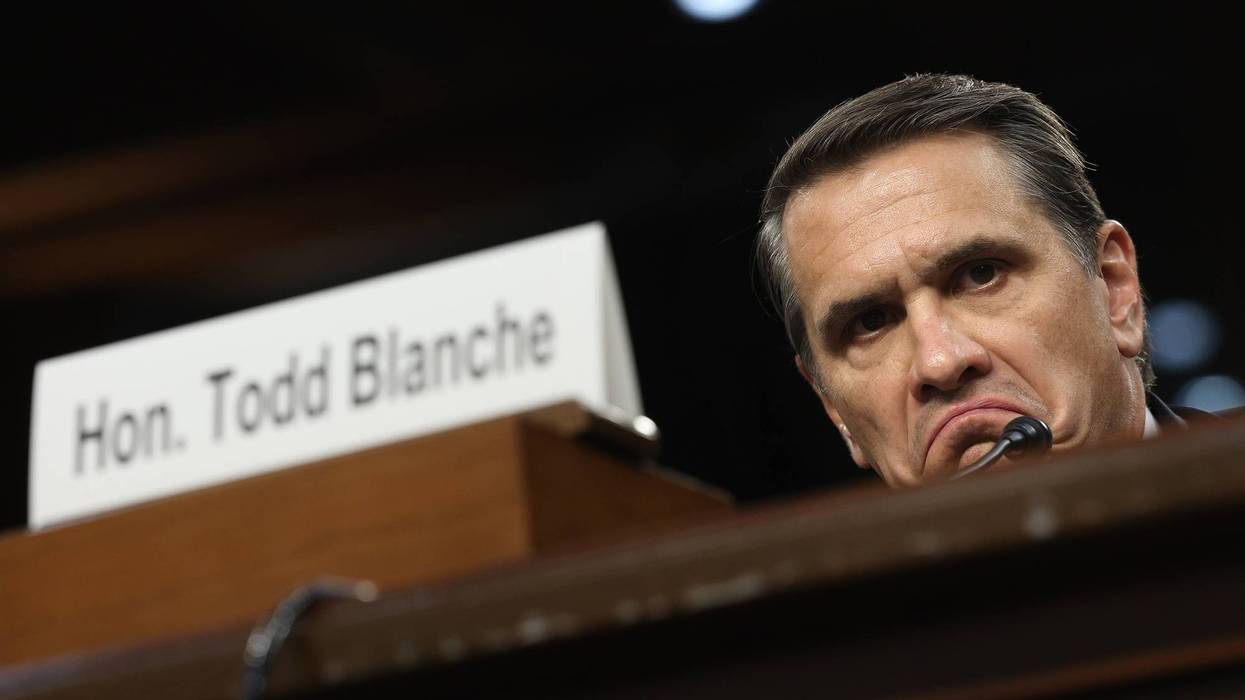
Blanche’s malfeasance should transcend partisan politics: He has abandoned his responsibilities under the Constitution; he has forsaken his country and his oath as an attorney; and he has earned impeachment, conviction, and removal from office.
President Donald Trump is running scared. And he has Attorney General Todd Blanche running with him.
For years, Democrats have campaigned on the promise to root out the Trump administration’s corruption and incompetence. He must have thought they were kidding.
On November 7, the same day that he named Stephen Miller his new chief of staff, Trump issued a long social media screed. He complained that the incoming Democratic Congress was going to utilize its power under the Constitution to investigate his administration. Trump wrote:
The Democrats are going around threatening a lot of people, including the Attorney General of the United States, and others, with Impeachment and many other forms of punishment… This is extortion at the highest level, and they should be held accountable for this.
It is not extortion to investigate executive branch malfeasance or to call for the impeachment of the worst attorney general in US history. But Blanche is Trump’s enforcer, so Trump knew how to handle his unpleasant new situation. He concluded his diatribe with a direction to Blanche:
Threatening letters have been sent to many people, all innocent, from Democrat Political Leaders. By copy of this statement, I am ordering the Department of Justice to look into this criminal act, immediately!
Like Trump, Blanche knows that sometimes the best defense is a good offense. It took him less than 24 hours to follow Trump’s lead.
During an interview on CNN’s "State of the Union" on November 8, he singled out incoming House Oversight Committee Chair Rep. Robert Garcia (D-Calif.), who had posted a two-word message on election night (“LAWYER UP”).
“I would be very worried if I were a member on that committee,” Blanche said. He also asserted that the Justice Department would defend all executive branch members against impeachment, although it has no constitutional obligation to do so. (E.g., The department did not defend Trump in his impeachment trials.)
Blanche is the one who should be worried. Repeating Trump’s threat is more evidence that he is unfit to serve as the nation’s top law enforcement officer. The record against him was already overwhelming. During his brief tenure as deputy, acting, and now permanent attorney general, many of his accomplishments for Trump were already the subject of a New York Bar Association complaint signed by a bipartisan group of more than 100 former federal and state judges.
His worst actions have been his abuse of the nation’s law enforcement apparatus to target Trump’s political opponents—as he did again in his CNN interview. It’s a classic move in a would-be dictator’s playbook and antithetical to democracy. It aims to punish and deter.
The litany of Blanche’s other impeachable offenses include:
It will take years for the department to recover from his carnage. And Congress should make Blanche’s impeachment a warning for future generations.
Blanche’s confirmation as attorney general was by the thinnest of margins in the Senate: 50-to-49. That put him in the same company as Secretary of Defense Pete Hegseth (50-to-50 vote with JD Vance supplying the tie-breaking 51st vote.)
If the Democratic House starts the process in January, Blanche will be impeached by the requisite simple majority (218). That’s what it means to have 255 Democrats (and counting) in the House of Representatives.
The Senate is a more interesting story. A two-thirds supermajority is necessary to convict him. Even if Democrats get to 56 members with the two outstanding races in Alaska and Mississippi, at least 11 Republicans would have to join them.
At that point, Senate Republicans would face a dilemma: If they vote to acquit, they will give Democrats another issue for the 2028 campaign; if they vote to convict, they’ll risk the ire of Trump. Although wildly unpopular, Trump still has millions of supporters.
Blanche’s malfeasance should transcend partisan politics. He has abandoned his responsibilities under the Constitution. He has forsaken his country and his oath as an attorney. He has earned impeachment, conviction, and removal from office.
And every day—with his own words and deeds—Blanche proves the case against himself over and over again.
He should lawyer up.

Americans should support existing legislation and call for more US lawmakers to propose and endorse restrictions and ethical protocols in AI development.
During the recent street protests in France, thousands of people marching to demand better conditions were met by riot police, far-right rhetoric that criminalizes progressive politics and Black and Arab youth, and AI surveillance. This combination of technology and brutality are not a coincidence; they are part of a fascist playbook.
In their new book, End Times Fascism, Naomi Klein and Astra Taylor outline an apocalyptic alliance of Christian nationalists, tech-bro billionaires, and populist survivalists who are defining the far-right and accelerating global collapse. This book coincides with warnings from former AI tech bros that the end is coming, including a former Anthropic employee saying there is a greater than 10% chance AI could end humanity within the next decade by producing bioweapons that destroy the Earth.
As we navigate these warnings, AI embeds itself in the very infrastructure of our daily lives, from email summaries to predictive texting to Flock cameras, while simultaneously advancing surveillance, policing, and war technologies. Society is being groomed to depend on external technology to think for us while our movements and interactions are monitored and policed.
We should all be alarmed at the rate AI is advancing and how an overwhelming amount of our tax money is being allocated to war technology instead of human life.
As a university professor for over a decade, I deeply believe in empowering students to engage with the world’s issues by asking questions that get to the roots of problems and centering dialogue to transform the world. When the ability to think critically is taken away from us, we lose the fundamental human capacity to ignite change. As we increasingly outsource our ability to think critically and creatively, there is a risk that we dull our human capacity to overcome challenges, trust ourselves, communicate, and imagine new worlds. This sets us up for a dangerous future, one in which humanity is told what to think and how to act and pays for it financially, emotionally, and mentally.
Critical and creative thinking is one of the most potent tools humans have to understand our conditions and has larger implications for democracy and freedom. What happens when our humanity is stripped away and replaced by a machine? In his 2018 bestseller, How Fascism Works, philosopher Jason Stanley highlights 10 key strategies of fascism, including anti-intellectualism, unreality, and hierarchy. All three are playing out now.
AI has begun to replace teachers in the classroom. The federal government is dismantling the Department of Education and cutting funding to higher education. AI companies are acquiring and destroying antique books to feed and train its machines, while books about race, gender, class, and sexuality are being banned. AI hallucinations and deepfakes seed distrust of a shared reality, increase conspiracy thinking, and make evidence-based debate almost impossible. As for hierarchy, AI models reinforce biases already embedded within society, including racism, sexism, classism, and homophobia, and then reproduce them through algorithms that allow authoritarian leaders to sharpen societal divisions. Meanwhile, the proliferation of AI buttresses the hierarchy of tech billionaires and government officials profiting off it, while the public experiences brain drain that accelerates fascist control.
"Brain drain" typically evokes a massive migration of highly educated and skilled professionals from their home country to another. But I use it here to refer to the very depletion of the brain's capacity to become educated or skilled. Researchers at MIT’s Media Lab last year found that prolonged use of AI, particularly ChatGPT, over several months eroded critical thinking skills and resulted in users becoming progressively unable to generate original ideas. An EEG recording brain activity across 32 regions revealed that ChatGPT users “consistently underperformed at neural, linguistic, and behavioral levels.”
People are also turning to AI for therapy instead of talking to a professional or having conversations with their friends and family. According to a study RAND, Brown University School of Public Health, and Harvard University conducted between February and March 2025, 1 in 8 young adults use AI chatbots for mental health advice. Open AI is currently facing seven lawsuits because their chatbot responses led users to delusions, murder, and suicide. Research from Sentio University in California warns that “ChatGPT may be the largest mental health provider in the US” with 49% of Californians reporting the use of AI for mental health support. An overreliance on AI strips away our ability to feel difficult emotions unmediated by a screen and cultivate real connections and communication with other people, which according to tech justice advocate YK Hong is key for collective resistance against authoritarian regimes.
In May, the Pentagon reached deals with seven tech companies to advance military and surveillance technology. Among them, Scale AI, an artificial intelligence infrastructure and software company, was awarded $500 million, Open AI was awarded $200 million, and Google was awarded $200 million to develop war technology in the name of national security, money that could have gone instead for public services such as education and healthcare. For FY2027, the Pentagon is asking for $54 billion for AI-powered war, which includes AI surveillance, military operations, and weapons.
Some legislators are fighting back. In September, Sen. Bernie Sanders (I-Vt.) and Rep. Greg Casar (D-Texas) introduced the Ban Artificial Superintelligence Act, which would pause advanced AI development until there is rigorous federal testing and oversight to ensure it does not harm humanity. The same month, Sens. Mark R. Warner (D-Va.), Brian Schatz (D-Hawaii), and Andy Kim (D-NJ) proposed the Artificial Intelligence Risk Management and Security Act of 2026 to enforce safety and security standards. Americans should support this legislation and call for more US lawmakers to propose and endorse restrictions and ethical protocols in AI development.
We should all be alarmed at the rate AI is advancing and how an overwhelming amount of our tax money is being allocated to war technology instead of human life. We must work together to combat the deterioration of our human capacity to AI and resist fascism and authoritarianism, while we still can.