

SUBSCRIBE TO OUR FREE NEWSLETTER
Daily news & progressive opinion—funded by the people, not the corporations—delivered straight to your inbox.
5
#000000
#FFFFFF
To donate by check, phone, or other method, see our More Ways to Give page.
Daily news & progressive opinion—funded by the people, not the corporations—delivered straight to your inbox.
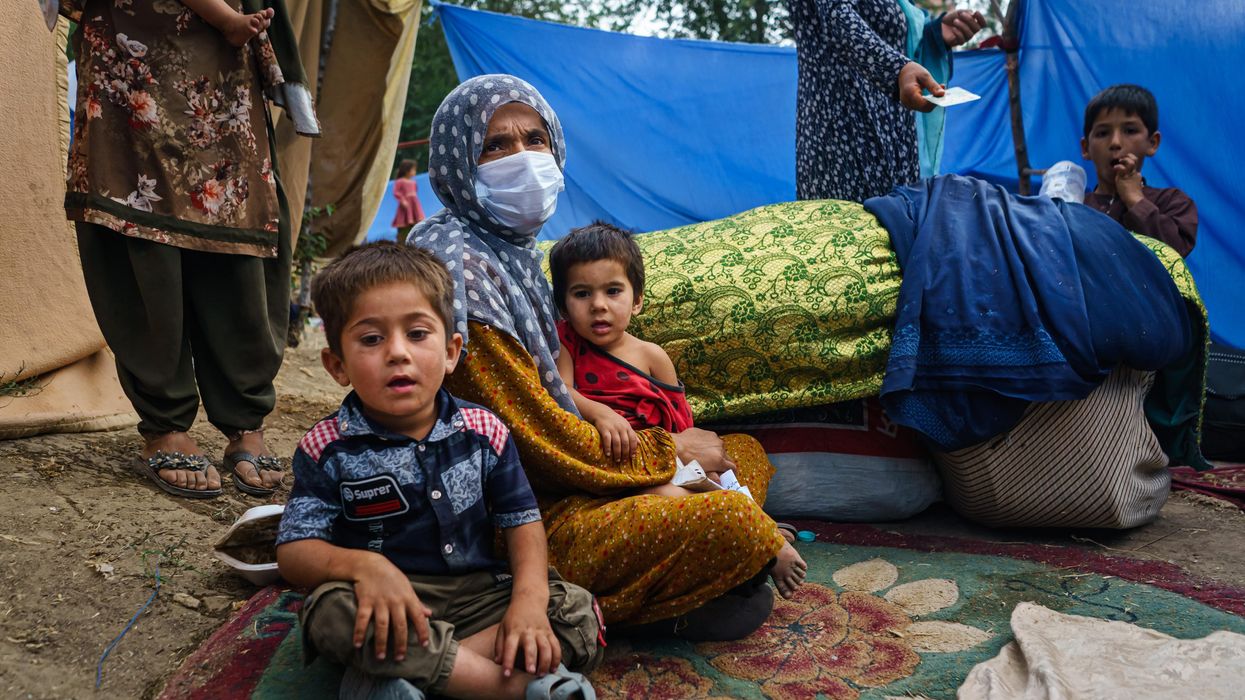
Refugees and immigrants are one of the reasons that the U.S. is the only western country to count among the top 10 populous countries in the world. However, the population grew at the slowest rate in the U.S. in 2021 since the country's founding. Reduced refugee and immigration intake has much to do with it. Even though the Biden administration set the limit to 125,000 refugees a year, the actual intake was fewer than 26,000 refugees.
There seems to be a lack of awareness and education in the U.S. about the level of scrutiny refugees go through compared to other immigrants.
Refugees contribute a range of skills and diverse experiences to their host countries, but unfortunately, there are many misperceptions and a lack of understanding about the refugee journey. Refugees go through more scrutiny, contribute substantially to the U.S. economy and are more committed than any other immigrants to make America their home. These false assumptions negatively affect refugee intake and integration into American society. We need more refugees, not less.
A common myth is that refugees have had a miserable life and should therefore feel grateful to be here. Undoubtedly, refugees go through a difficult, often tragic, journey fleeing for their lives as they are forced out of their country. Most refugees spend approximately 17 years in a refugee camp before they are accepted by another country and are grateful to have a new home and safe life. However, adjusting to a new country and new culture brings new and different kinds of challenges.
Many refugees have had happy, successful lives in their own countries. Several who once thrived as doctors, engineers, chefs, and similar qualified professions are stuck in minimum wage jobs after arriving in the U.S. Their degrees are either not accessible or recognized in the U.S., leading them to start their life from scratch in every sense of the word. Having to deal with a new environment including culture, food, and work is hard enough for anyone, but without understanding the local language and a proper support structure in place, these challenges can be debilitating. Refugees (and immigrants) are often criticized for living in high-poverty neighborhoods and interacting only with each other, but often these are the only people who understand their plight and can provide cultural and social support.
Another common misbelief is that Western countries host the majority of refugees. This is not surprising, given that much of the news and media coverage focuses on refugees flooding into Europe and the perceived ongoing immigration crisis at the US southern border. It is a lesser-known fact that approximately 83 percent of refugees are hosted by low and middle-income countries and 72 percent live in neighboring countries. Currently, Turkey hosts the highest number of refugees.
There seems to be a lack of awareness and education in the U.S. about the level of scrutiny refugees go through compared to other immigrants. I've heard completely false statements like, "Did you know that refugees get a car and a house when they arrive in the U.S.?" The United Nations High Commission for Refugees (UNHCR), the international agency responsible for refugees, determines if an individual qualifies as a refugee. Once granted refugee status, they become eligible to be considered for admission into a country that is accepting refugees. Each country determines the total number of refugees that they are willing to accept. They are, however, not allowed to choose refugees from one country over another.
Each US administration sets a number of refugees they will accept. That number has ranged between 60-100,000 refugees a year, except under the Trump Administration when that number was reduced to 18,000 refugees. It is important to remember that this is just a limit. It does not mean that the U.S. actually receives that many refugees in a year. Refugees themselves do not get to choose their destination country, although an effort is made to reunite them with their family members. Once accepted, refugees must go through a rigorous background and medical checkup as well as obtain security clearance. The U.S. security process involves several agencies including the State Department and Homeland Security. The entire process can take upwards of two years.
Host countries have their own processes to help refugees integrate into their new society. In the U.S., the State Department works with nine resettlement agencies, who in turn work with their partners and state and local governments across the country to help resettle refugees. Refugees are received at the airport by these agencies and provided housing and other basic support for a period of 90 days after which they are supposed to become self-sufficient. These agencies not only set up housing, but also provide English language classes, help them find employment, and provide other necessary information needed to survive in a new country. However, unless there is a medical need, such support is only provided for a three-month period, after which refugees have to navigate the system on their own. Comparatively, the US spends less time and money on refugee resettlement than other countries like Canada (where refugees receive a full year of support).
There are definitely those who are sympathetic to the plight of the refugees, but most incorrectly assume the extent of benefits and support provided to the refugees and view them as a strain on the social and economic system. Research shows that refugees overall have a positive impact on the U.S. economy.
While they do receive initial financial assistance, they see a sharp income increase in subsequent years, contributing 20.9 billion in taxes in 2015 alone and display more entrepreneurship than any other immigrant group. A recent study found that a 10% reduction in refugee intake relative to 2019 cost the US economy upwards of 1.4 billion dollars.
Refugees have contributed to American society in many other meaningful ways. Did you know that Albert Einstein, Marlene Dietrich, and Gloria Estefan were all refugees? Supporting refugees is the right thing to do, not just for humanitarian reasons, but also because refugees make our economy strong and enrich our society with new ideas and culture.

President Joe Biden on Monday afternoon unveiled the fully operational online portal for his student loan debt forgiven program that will cancel up to $20,000 in federal loans for some borrowers.
"This is a game changer for millions of Americans," said Biden in remarks from the White House, "and it took an incredible amount of effort to get this website done in such a short time."
While the administration launched a beta version of the site Friday, the official online portal (which can be accessed at https://studentaid.gov/welcome/) is now available to all eligible borrowers who want to apply for federal student loan debt forgiveness.
According to the White House, more than 8 million people accessed the beta website over the weekend to explore the information or fill out the application. The welcome page states that eligible borrowers can apply starting today, but must do so "no later than Dec. 31, 2023."
The site also says: "Time to Complete: About 5 Minutes[...] No Login or Documents Required."
Rep. Ilhan Omar (D-Minn.) was among congressional lawmakers saying that she has already had many constituents applaud the forgiveness program and the application process.
"If you haven't yet," tweeted Rep. Pramila Jayapal (D-Wash.), "today is a great day to apply for student loan cancelation!"
Borrowers who make less than $125,000 a year are eligible to have up to $10,000 in federal student loans forgiven while recipients of federal Pell Grants are eligible for up to $20,000 in forgiveness.
While progressives continue to push for full cancellation of all student loan debt, the Biden program will impact an estimated 40 million U.S. borrowers.
Mike Pierce, executive director of the Student Borrower Protection Center, which advocates for debt relief, welcomed the development.
"Today, President Biden took a major step forward to help free millions of American workers and families from the weight of the student loan debt crisis--an extraordinary achievement in its own right and a clear reminder of the work that remains to be done," Pierce said in a statement.
"The door to transformational debt relief is now officially open, millions have already walked through it and we must ensure no borrower is left behind," he added. "Make no mistake, this would not have been possible without the millions of borrowers who spoke out and the Biden Administration who demonstrated the power of a government that listens and centers the people. We applaud the Administration's efforts thus far and look forward to working towards a future where no borrower has to bear the burden of student debt."
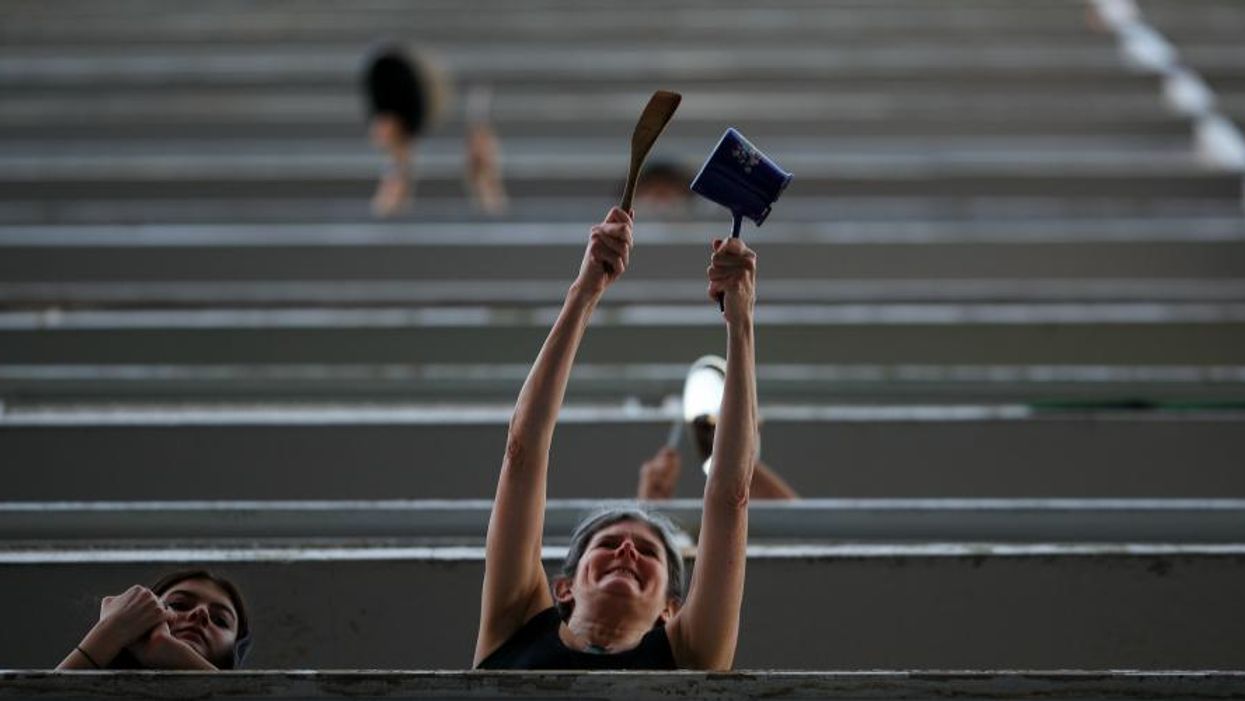
Amid a horrific human tragedy of sickness and death, much of it taking place in hospitals staffed by brave but overworked and under-equipped doctors and nurses, we are all learning once again what it feels like when economic growth comes to a shuddering stop and the economy goes into reverse--shrinking and consuming itself. Millions have been thrown out of work, untold numbers of businesses shuttered. The St. Louis Federal Reserve estimates that Q2 unemployment could clock in as high as 32.1 percent (for comparison, unemployment at the depths of the Great Depression was 25 percent, and during the Great Recession of 2008-2010 it peaked at 10 percent). Though radical measures must now be adopted to slow the spread of the coronavirus, those measures are having toxic side effects on the economy.
Yet, economic growth was bound to end at some point, with or without the virus. A few moments of critical thought confirm that the exponential expansion of the economy--whose physical processes inevitably entail extracting natural resources and dumping polluting wastes--is destined to reach limits, given the obvious and verifiable fact that we live on a finite planet.
However, we also happen to live in a human social world in which a decades-long spurt of economic and population growth, based on the snowballing exploitation of a finite supply of fossil fuels, has become normalized, so that world leaders have come to agree that growth can and must continue forever. In response to this situation, clear-eyed systems and environmental scientists have, during the past few decades, proposed policies either to transition the global economy away from its near-suicidal requirement for infinite growth, or to cushion the impact when growth limits are finally reached.
At first, this post-growth train of thought was so marginalized by mainstream economists that few educated people were even aware of its existence. In other words, it lay entirely outside the Overton window of acceptable public discourse.
Then, in 2008, the wheels of the financial bus that we were all riding fell off, and there was an opening for discussion about different ways of organizing the economy. During the early recovery period after the global financial crisis, I presented a natural-limits-based view of economics in my book The End of Growth, in which I summarized heterodox policy proposals for getting society on a sustainable track without destroying livelihoods. However, central banks and national governments managed temporarily to bail out the wizards and quants who had precipitated the crisis, restarted the growth machine, and thereby narrowed the Overton window once again.
Still, during the decade that followed, a seed of post-growth economic thinking was planted and began to sprout. In Europe, ecological economists and environmental activists organized "degrowth" conferences. The tiny nation of Bhutan, which had been experimenting since the 1970s with Gross National Happiness (GNH) as an alternative to Gross Domestic Product (GDP), tallied up its findings and argued at the United Nations that other countries should likewise aim for widespread social satisfaction rather than growth in monetary exchange. Groups promoting public banking mushroomed across the U.S., and articles about Modern Monetary Theory (MMT) and Universal Basic Income (UBI) appeared in major news outlets; the latter was even promoted by an early contender for the Democratic Party presidential nomination.
Still, the economic priesthood held tight to its dogma. Although it was patently illogical, the demand for endless growth continued to be defended using tortured reasoning and cherry-picked statistics. We can grow in green ways, the orthodox economists insisted--ways that don't impact the environment. Well, it's true that we can use resources more efficiently, we can recycle more, and we can find ways to reduce the toxicity of the wastes we produce. But the fact remains: over time, a growing economy will eventually and inevitably take up more ecological space than one that does not grow. Even the richest man in the world, who made his hundreds of billions of dollars from consumers, came to the conclusion that there are limits to energy and gains in efficiency, and that we face a future on this planet of limits. (He, less surprisingly, came to a different solution than I and other "limits to growthers" would offer, his being that we should harvest the moon and colonize space.)
Now, the coronavirus pandemic has seismically shifted the discussion once again. The Overton window is broken and the wall that held it has caved in. Suddenly the first priority of world leaders is no longer economic growth; instead, it is public safety. Lives must be saved and health care systems salvaged regardless of the short-term hit to profits, employment, and investment returns. This sea change in priorities requires entirely different thinking and policies--ones much more closely aligned with heterodox post-growth thinking than with pro-growth economic orthodoxy.
Here is a quick survey of the post-growth economic policies recently introduced by sustainability theorists, and a brief discussion of how and whether each is relevant to our new pandemic-obsessed moment.
Universal Basic Income (UBI)
UBI is a government plan for providing all citizens with a given sum of money, regardless of their income or employment status. The purpose is to prevent or reduce poverty and inequality. However, UBI would also be useful in a post-growth scenario. Suppose, for example, that a nation decided to lower its greenhouse gas emissions by restructuring its economy so as to substantially reduce energy usage and material throughput. Eventually, many people could transition from jobs in airlines and other energy-intensive industries to become food producers and small-scale manufacturers within more localized economies (see below). But, over the short run, substantial numbers would be thrown out of work; how to avoid widespread economic hardship and social instability in the interim? Answer: UBI.
The U.S. federal government's just-passed stimulus plan includes the equivalent of a nascent UBI: It mandates one-time cash payments of $1,200 for each adult and $500 per child. It also sets aside $367 billion to help small businesses and $500 billion for loans to larger industries. (The Fed is meanwhile buying corporate bonds and securities from hedge funds, to the tune of trillions, putting the Treasury on the hook for them.) There is ongoing discussion among policy wonks about longer-term cash payments to individuals; if this indeed happens, the U.S. will be officially experimenting with UBI.
But where's the money to come from? For the time being, it's being conjured through a cozy arrangement between Congress and the Federal Reserve: Congress issues debt, which the Fed buys--without requirement for interest payments. This brings us to:
Modern Monetary Theory (MMT)
MMT says that monetarily sovereign countries like the U.S., U.K., Japan, and Canada are not limited by tax revenues or borrowing when it comes to federal government spending. They can create as much digital or paper money as they need, and are (or should be) the legal monopoly issuers of their currency. Therefore, they should be able to create and spend as much energy as needed to create full employment.
I must confess some skepticism with regard to MMT. It's obvious how it would be useful in a crisis; but, over the longer term, if the money supply is growing faster than energy and materials, the result must be inflation. In fairness, Modern Monetary Theorists have given considerable thought to the problem of inflation, and have come up with ways of limiting it--such as by levying deficit-reducing taxes, during times of full employment, to reduce aggregate demand. Yet, in my experience, most Modern Monetary Theorists follow conventional economists in mistakenly assuming that energy and natural resources are effectively infinite, rather than finite and depleting. By focusing just on employment, they miss the essential basis of all economic productivity.
In any case, a crisis is what we have: Governments and central banks are being forced to resort to a form of MMT because of a sudden, dramatic spike in unemployment. And, over the short term, money printing is an essential economic tonic. However, over the longer term, the best outcome would be achieved if the current crisis forces economists to think anew about the nature of money itself--what it is, how it is created, and what are is social effects. Most economists still think of money as simply a medium of exchange, but it is better understood as storable, quantifiable, and transferrable social power. Renegade economist Steve Keen points out that conventional economic theory does a surprisingly poor job of explaining money and debt. Alternative currency theorists like Thomas Greco do a much better job of it.
Ecological and biophysical economists--the vanguard of post-growth economists--go even further. They start with realistic assessments of finite energy sources and natural resources, then explore how economic systems could fairly harvest and distribute resources without depleting nature's stores over time. For starters, they propose taxing all financial transactions and requiring banks to hold 100 percent reserves. They also tend to hold to the principle, first propounded by American economist Henry George (1839-1897), that each person should own what he or she creates, but that everything found in nature, most importantly land, should belong equally to all humanity.
Today most money is created by private banks through the process of issuing loans. Digital money is called into existence when a loan is granted; when the loan is repaid, that money vanishes. The problem is, interest must be paid on the loan, and the money needed to pay that interest isn't created when the loan is issued. The borrower must earn or borrow money for interest payments from elsewhere. As long as the overall economy is growing, that's usually possible. But if the economy isn't growing, defaults ensue. Lending slows to a dribble, with more money disappearing than is being created. That's called a deflationary depression, and it's something to be avoided if possible--though it's an inevitable feature of debt-based economies in a finite world.
As a solution, why not create government-run public banks that loan money at no interest, at least in the cases of businesses that are operating for the public good? For example, if a state decided that it was in the public interest to promote renewable energy, its state bank could make zero-interest loans to solar installers.
Public banks have a long history, and operate in many nations. In the U.S., the prime example is the Bank of North Dakota, which partners with private banks to loan money to farmers, schools, and small businesses.
The idea of public banks is closely tied to MMT; think of public banks as MMT at the retail level. So far, the pandemic has not provoked wide interest in public banking; but, as the incipient recession deepens and lengthens, expect this to be a subject of increasing discussion.
Gross National Happiness (GNH)
In 1972, Bhutan's 16-year-old King Jigme Singye Wangchuck used the phrase "Gross National Happiness" to describe the economy that would serve his country's Buddhist-influenced culture. The label stuck, and soon the Centre for Bhutan Studies set out to develop a survey instrument to measure the Bhutanese people's general sense of well-being. That survey instrument measures nine domains:
Bhutan's efforts to boost GNH have led to the banning of plastic bags and re-introduction of meditation into schools, as well as a "go-slow" approach toward the standard economic development pathway paved by costly infrastructure projects paid for with huge loans from international banks.
There's nothing in the recent stimulus package that resembles GNH, but policy makers increasingly could be forced into considering something like it, out of necessity. As people are stuck at home for long periods, some are descending into loneliness and depression brought on by isolation; others are filling their time with art, music, home schooling, and gardening. Leaders will eventually realize they must do something to discourage the former and encourage the latter. They may eventually conclude that gauging their success using GDP is pointless, and that directly measuring safety, health, and life satisfaction makes a lot more sense.
The Sharing Economy
The last time the U.S. suffered through an economic depression, in the 1930s, government economists and leaders of industry responded by creating a new economic paradigm--consumerism. Henceforth American citizens would be termed consumers, whose duty is to buy and discard products at an ever-accelerating rate so as to steadily increase overall employment levels, the size of the economy, returns on investments, and government tax revenues. Two key strategies of consumerism were planned obsolescence, in which products were designed to have limited useful lifetimes, or to soon become aesthetically undesirable in comparison with new versions of the same product; and redundant consumption, in which individuals were encouraged through advertising to prefer owning their own products (such as cars and lawn mowers) rather than sharing them with family members, neighbors, or friends.
Unfortunately, while consumerism succeeded in overcoming the problem of overproduction (which was one of the causes of the Great Depression), it resulted in the steady ramping up of resource consumption. At the same time, it had a negative impact on many people's psychological health, as they spent more time viewing advertising messages and shopping, and less time engaging with family, friends, and nature.
The idea of the sharing economy took hold around the time of the Great Recession of 2008; it proposed a peer-to-peer (P2P) way of organizing the economy in which the sharing of goods and services is facilitated by community-based online platforms. Many pioneers of the sharing economy were motivated by the ecological ideal of reducing overall consumption levels.
Unfortunately, however, the sharing economy quickly became equated with the gig economy, and with ride-sharing apps like Uber and Lyft--which promised to eliminate the perceived need for everyone to own a car, and thereby reduce carbon emissions from transportation. Unfortunately, it turned out that Uber and Lyft generate more carbon emissions than the trips they displace, and aren't always model employers.
Nevertheless, the original ideals of the sharing economy persist among advocates of the maker movement, collaborative consumption, the solidarity economy, open source software, transition towns, open government, and social enterprise--as well as bridging organizations like
Shareable, whose founder, Neal Gorenflo, has some ideas on why sharing is even more important during the pandemic, and how we could seize the current moment this as an opportunity to come together in cooperation and mutual aid even though we remain separated physically.
Green New Deal (GND)
GND proposals circulating in the U.S. prior to the pandemic aimed to provide 100 percent renewable energy in 10 to 20 years while supporting job retraining and aiding communities impacted by climate change. Some proposals also included a carbon tax (often with a fee-and-dividend structure that would rebate funds to low-income people so they could afford more costly energy services), incentives for green investment, public banks, measures to re-regulate the financial system, and the first steps toward a global Marshall Plan.
While GND advocates seldom publicly acknowledge that economic growth is both ephemeral and antithetical to a livable environment, their proposals are nevertheless largely consistent with policy advice post-growth thinkers.
The coronavirus pandemic cuts both ways with regard to climate change. Emissions are down, because businesses are closed and people are staying home. But the transition to renewable energy has slowed to a crawl. If we're to move to a post-carbon economy, we'll need massive investment in post-carbon transportation, building heating, manufacturing, and agriculture. President Trump has signaled he wants Congress to appropriate a couple of trillion dollars for infrastructure spending, but what he has in mind are subsidies for existing fossil fuel-dependent industries. MMT notwithstanding, the nation's money pot is not bottomless. If we are to have a Green New Deal, it must come soon.
Resilience
We have made the world more economically efficient by lengthening supply chains to take advantage of the cheapest labor and raw materials anywhere they exist, and by minimizing inventories with just-in-time supply strategies; but the result has been a withering of resilience--the ability to recover and adapt to a crisis or disruption. Post-growth thinkers tend to agree that the structural unsustainability of modern industrial economies has created a series of crises that are lined up to bite--from climate change to the threat of global pandemics. Therefore, preparing for the post-growth era requires building resilience--particularly at the community level.
Suddenly, in this moment of broken supply chains, and shortages of toilet paper, masks, and ventilators, the argument for resilience is easier to make: there are perfectly obvious reasons to shorten supply chains, and establish strategic stockpiles that are distributed locally. Trump's ham-fisted attempt to renegotiate globalization via tariffs hardly counts as a step in that direction. Unfortunately, because world leaders previously didn't listen to resilience advocates sooner, we will all be paying a price for some time to come.
Localism
The lengthening of supply chains is the essence of globalization; if this has made us more vulnerable to crisis, then it stands to reason that we should re-localize some of our economic activity.
Post-growth thinkers have been advocating localism for decades. Naturally there are objections and questions: What about xenophobia? What about sharing knowledge and best practices across cultures? What about global cooperation to meet global challenges like climate change? In answer, localists say we needn't view the recovery of local knowledge, local culture, and local economic vitality as all-or-nothing. Think of it as the rebalancing of a system that has become lopsided and dangerously unstable.
Meanwhile, in nations like the United States, where national leadership during the pandemic is absent or inept, citizens are being forced into thinking and acting more locally. Localism can have either a welcoming or an exclusionary face; it's up to us to choose. Fortunately, many people so far seem to be choosing to be neighborly.
* * *
The end of growth is painful. We had a foretaste of it in 2008, but the current crisis promises to be much worse. Our leaders are flying blind, just as they were during the Global Financial Crisis over a decade ago. We were unprepared for it, just as we were for the pandemic and the economic carnage that is accompanying it.
However, there are people who have been anticipating a moment like this for decades. If we are willing now to listen and learn from post-growth thinkers, the crisis and its aftermath can be a process of adaptation that leaves us more locally resilient, happier, and more connected.
That's not to downplay the immensity of the task. Redesigning national economies in the midst of crisis is a challenge perhaps comparable to redesigning an airplane in mid-air, while attempting to make a safe landing. Navigating the end of growth will require courage, new thinking, flexibility, and a willingness to make mistakes. It's understandable why, during "normal" times, people want to stick with what's familiar. But we're no longer in normal times. We are in a moment that requires us to undertake bold changes that have been put off for far too long.
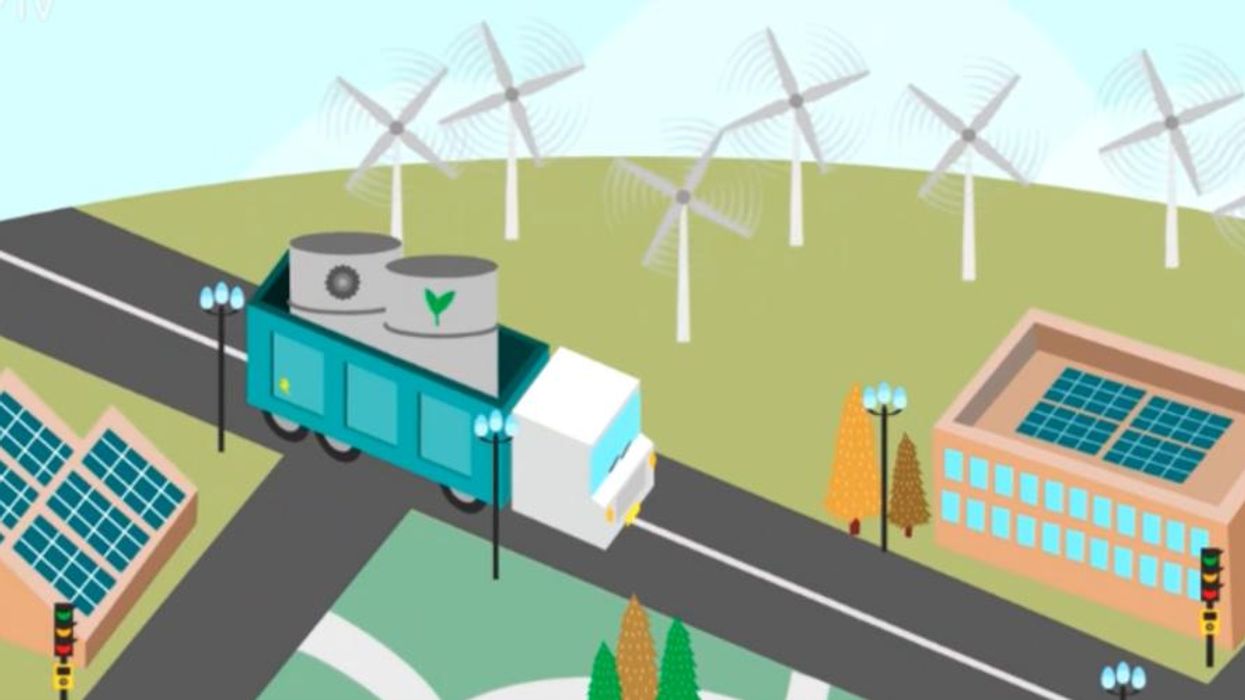
There are actions that we must insist the federal government do now to help the people and communities that have been devastated by the effects of the COVID-19 epidemic. Then there are actions that we are tempted to do right now because they would seem to be helpful--but will deeply regret doing if we do them wrong.
When it comes to infrastructure--especially in the throes of climate change--it's more important to do it right than to do it fast.
That's why it was encouraging to hear House Speaker Nancy Pelosi late last week put the brakes on a push for a massive infrastructure bill through Congress. A rushed bill is more likely to perpetuate policies that have been bad for years and will prove worse in the future, such as overemphasizing highway construction and underfunding public transportation, just to name one.
Instead, those of us who care passionately about putting people back to work rebuilding America should be using the next few weeks to build a broad, powerful coalition for a "Green Stimulus." It will take a massive, multi-issue, multistakeholder coalition to change the traditional trajectory of infrastructure policymaking in Congress.
"A Green Stimulus to Rebuild Our Economy" was released in late March by 11 leading experts and activists in the climate movement. (Disclosure: One of the authors is Johanna Bozuwa, a colleague at The Democracy Collaborative.) It outlines a $2 trillion plan that would promote the goals of putting millions of people back to work in critical rebuilding efforts, transition quickly and equitably to a fossil-fuel-free economy, and putting people in control of a larger share of the economy.
Even without a Donald Trump in the White House, we know from past experience what an infrastructure bill coming out of Congress would look like absent overwhelming grassroots pressure. Simply put, a disproportionate share will be spent on perpetuating fossil-fuel dependency in a regulatory framework designed to bulldoze over community concerns about environmental and economic effects.
Powerful lobbies for the construction, shipping, automotive and airline industries have deep channels of influence in Congress, particularly with the pivotal House Transportation and Infrastructure Committee, once of the largest committees in Congress and one in which members are anxious to greenlight actions that will lead to ribbon-cutting ceremonies in their districts. The transportation industry alone spent $68 million in congressional campaign contributions in 2018 and more than $260 million in lobbying in 2019, according to Open Secrets. It's a big reason why public transportation options get slightly less than one dollar for every four dollars the federal government spends on highways. It's also a big reason why the regulatory emphasis has been to move projects quickly and cheaply (for the private contractors involved) than to act in ways that protect the environment, promote sustainability and safeguard the needs of affected communities.
Add to that the woefully inadequate and often poorly spent funding on other forms of public infrastructure--from water systems to public buildings and facilities--and the picture becomes one of a series of missed opportunities to use public dollars to build a more sustainable, resilient and equitable backbone for the economy.
The next wave of infrastructure spending cannot be business as usual. The Green Stimulus plan offers a necessary framework for getting this right. That framework includes:
Included in the Green Stimulus plan is one action that organizers can take now to make it the framework for any future infrastructure plan that emerges from Congress. "We can do all the preparatory work now to make green projects 'shovel ready,'" the authors write, through community deliberation and planning work, "done safely through online channels," to "ensure that physical projects can commence as soon as it is feasible to restart major in-person work across the economy."
Communities across the country are still suffering from federal infrastructure spending mistakes made as far back as the 1960s. At a time when we have at most a decade to make massive economic and lifestyle shifts to avoid a cataclysm that will be more devastating than today's COVID-19 epidemic, we simply cannot let the inertia from the past drive the future.
The following is an excerpt of a piece published as part of a recent forum--titled "Corporations in the Crosshairs: From Reform to Redesign"--by the Great Transition Initiative. For the series discussion presented at the forum, see here.
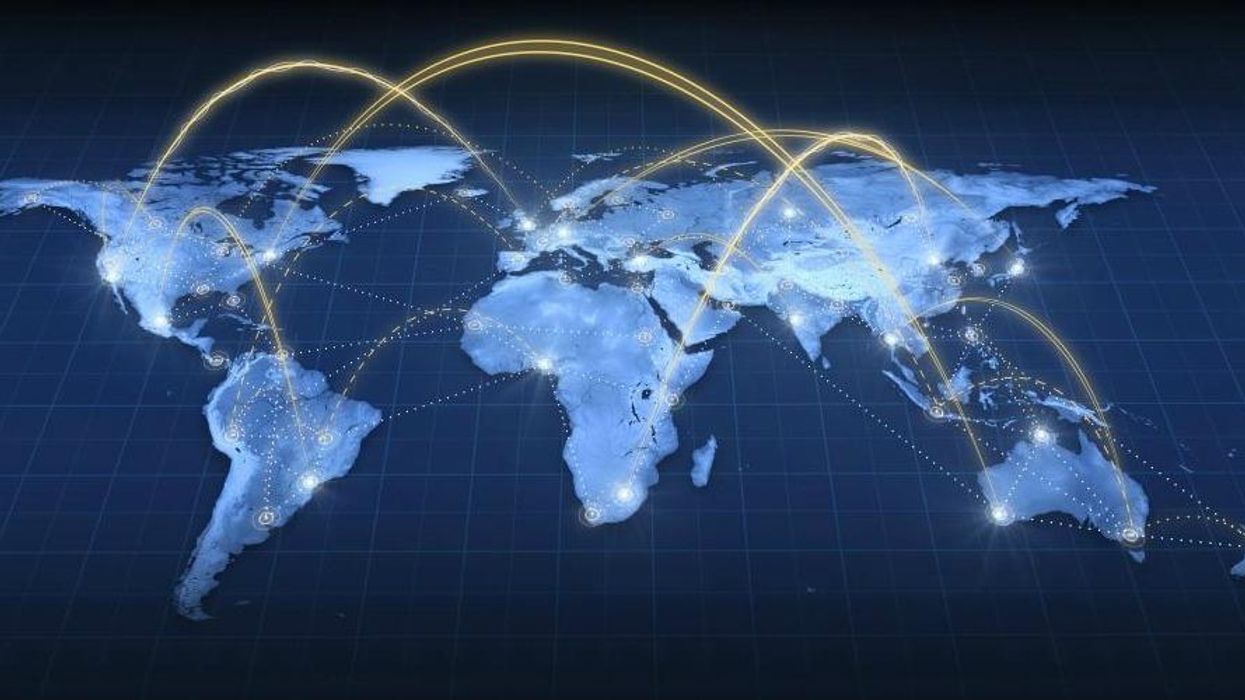
The omnipresence of corporations--as resource extractors and processors, employers and developers, lobbyists and campaign donors--has spawned countless initiatives to tame their excesses and steer their activities in the direction of the common good. Now the challenge is to transform shared grievance into joint action among disparate campaigns. Greater strategic and organizational coordination is critical for confronting corporations commensurate with their scale of operation and influence. The seeds of a transformative redesign movement, already sown, have sprouted and are ready to spread across geographic scales.
In the political sphere, an essential step is the reconfiguration of the legal status and purpose of the corporation. This work can build on the pioneering work of B Lab and the consensus among legal scholars that the principle of shareholder primacy, wielded by defenders of finance capital, is baseless. Northern Europe has been a leader on this front, as "codetermination" structures, which mandate worker representation on the boards of large companies, are widespread in Germany, Austria, the Netherlands, and the Nordic countries. And the model is spreading. In the US, presidential candidates are calling for employee-elected members on the boards of large companies, and for corporate boards to consider the interests of all stakeholders, not just the shareholders. A natural extension would be to create corporate board seats for representatives of all stakeholder groups.
These country-by-country efforts to alter corporate governance help break the grip of shareholder interests. Yet, a basic incongruity constrains the potential to achieve this aim: corporate activities are transnational, but the corporate chartering process is national (or subnational). This fundamental mismatch allows corporations to "charter-shop," obtaining authorization licenses in jurisdictions with the most shareholder-friendly requirements, a gaming of the system analogous to shopping for tax havens.
With global capitalism superimposed on the traditional nation-based political order, the world lacks overarching governance capacity, in general, with the chartering mismatch a key case in point. The global-national contradiction suggests an important strategic prong for the redesign movement: transnational control of transnational corporations. One approach would be to advocate for a new multilateral organization, a World Corporate Charter Organization (WCCO).5 An enlightened WCCO would set requirements for a corporation's purpose statement, multi-stakeholder board structure, and employee ownership. It would mandate integrated reporting that accounts for human, social and ecological as well as financial capital, along with adherence to broadly accepted global norms. With pressure from civil society groups, labor organizations, and kindred multilaterals, a WCCO could be launched as a voluntary program with the aim of evolving mandatory status as it gains legitimacy.
Another significant front for the redesign movement is to strengthen corporate reporting by mainstreaming systems-based reporting. Performance goals set at the individual enterprise, without reference to aggregate impact, have led to a situation in which a multitude of firms are doing incrementally better while the system, in aggregate, remains increasingly unsustainable. Systems-based reporting, by contrast, would embed systems boundaries in performance goals so that they reflect a firm's proportionate responsibility for muting risks.
In parallel, long-term investors, such as mutual funds and pension funds, are key to advancing systems-based strategies. In a virtuous circle scenario, investors guided by holistic analysis channel funds to worthy corporations which, in turn, manage them for the enrichment of social, human, and natural capital while achieving a satisfactory financial return. This dynamic would foster more resilient social-ecological systems, while reducing volatility--the bane of institutional investors--associated with climate disruption, mass migration, and popular uprisings against government incompetence and corruption.
The prospect for implementing redesign innovations hinges on the readiness of disparate actors, particularly civil society movements, to converge under the banner of corporate redesign. The primacy of shareholders and finance capital will not dissolve without a compelling counter-vision, strategy, and action plan. Indeed, all social and environmental movements and campaigns that understand the profound perils inherent in the prevailing corporate model should embrace corporate redesign as part of their agenda.
To its credit, the CSR movement spawned public discourse about the role of corporations in building--and undermining--just and sustainable societies, and inspired reforms in countless corporations. But the movement has failed to deter the dire consequences for people and the planet of corporate capitalism's growth in scale, market power, and financialization. With the shortcomings of incrementalism so evident, it is time to close the CSR chapter and embrace the next chapter of the movement to reshape the corporation: corporate redesign.
Internet service providers like Comcast and Verizon are free to slow down, block or prioritize internet traffic as they wish, without interference by the federal government. That's the effect of an October ruling by the D.C. Circuit Court of Appeals, upholding a 2017 ruling by the Federal Communications Commission that reversed rules requiring what is called "net neutrality"--treating all internet traffic equally, regardless of where it's from or what kind of data it is.
Giving corporate telecom giants this power is wildly unpopular among the American people, who know that these companies have overcharged customers and interfered with users' internet access in the past.
"The emerging patchwork of local- and state-level net neutrality legislation could help ensure that millions of Americans have access to an open internet. However, people living outside of these enclaves will still be vulnerable to the whims of for-profit internet service providers."
However, people who advocate for an open internet, free of corporate roadblocks, might find solace in another aspect of the court's ruling: States and local governments may be able to mandate their own net neutrality rules.
The effort is underway
Governors in six states--Hawaii, Montana, New Jersey, New York, Rhode Island and Vermont--have already signed executive orders enforcing net neutrality by prohibiting state agencies from doing business with internet service providers that limit customers' online access. Four states have passed their own laws requiring internet companies to treat all online content equally: California, Oregon, Washington and Vermont. A New Hampshire bill is in the works.
More than 100 mayors representing both large urban centers such as San Francisco and small cities such as Edmond, Oklahoma, have pledged not to sign contracts with internet service providers that violate net neutrality.
These mayors are leveraging the lucrative contracts that their municipalities have with internet providers to wire public schools, libraries and local government buildings to pressure these companies into observing net neutrality throughout the city.
The emerging patchwork of local- and state-level net neutrality legislation could help ensure that millions of Americans have access to an open internet. However, people living outside of these enclaves will still be vulnerable to the whims of for-profit internet service providers. In our new book, "After Net Neutrality: A New Deal for the Digital Age," we argue that the best way to protect the public interest is to remove internet service from the commercial market and treat broadband as a public utility.
Corporations focus on profits
Broadband giants have spent millions of dollars lobbying against federal open internet regulations since 2006. Industry-backed efforts even included funding a network of far-right online trolls to spam the FCC's website with anti-net neutrality propaganda. These companies continue to want the power to manipulate online traffic, such as charging users and content providers like Netflix to access each other - even though both are already paying for connections to the internet.
This history of manipulation highlights a recurring challenge to the ideal of net neutrality: Governments seek to reconcile the public's interest in open, nondiscriminatory online communication with the profit interests of large internet service providers. The resulting policies only narrowly target corporations' manipulative practices, while letting the companies continue to own and control the physical network itself.
Cities build their own
A different vision of how the internet could operate is already taking shape across the United States. In recent years, many cities and towns around the country have built their own broadband networks. These communities are often seeking to provide affordable high-speed internet service to neighborhoods that the for-profit network providers aren't adequately serving.
One of the best-known efforts is in the city of Chattanooga, Tennessee, which built its own high-speed fiber-optic internet network in 2009.
Chattanooga's experiment has been an unequivocal success: According to a 2018 survey conducted by Consumer Reports, Chattanooga's municipal broadband network is the top-rated internet provider in the entire U.S.
More than 500 other communities around the country operate publicly owned internet networks. In general, these networks are cheaper, faster and more transparent in their pricing than their private sector counterparts, despite lacking Comcast and Verizon's gigantic economies of scale. Because the people operating municipal broadband networks serve communities rather than large shareholders on Wall Street, they have a vested interest in respecting net neutrality principles.
Thinking bigger
A number of much larger-scale public broadband initiatives have also been proposed to combat the power of the giant internet companies. In the 2018 election cycle, Democratic gubernatorial candidates from Vermont and Michigan proposed building publicly owned statewide internet networks.
Several Democratic presidential candidates have announced plans to build thousands of miles of publicly owned high-speed internet connections. They vary in the details, but all are responses to the concentration of corporate control over internet access--both in terms of who gets high-speed service in what locations at what price, and what content those connections carry.
Together, these initiatives reflect a growing understanding that Americans need a more expansive vision of an open internet to truly realize the democratic promise of an internet that reaches everyone.
High-quality, affordable, restriction-free internet access can come from publicly owned providers that answer directly to the people. In our view, and in the eyes of a growing number of Americans, the broadband industry uses its entrenched market power to serve itself, not the public.
Finally, it seems that the urgency of the climate crisis has become impossible for decision-makers--especially in the global North--to ignore. In the past few months, hundreds of local governments as well as a handful of national governments in the global North have declared a climate emergency.
Make no mistake--this is a direct result of grassroots action by groups such Fridays For Future, Extinction Rebellion, and Ende Gelande, not to mention the decades-long fights for climate justice led by movements in the global South. As we enter another intense season of strikes, summits, mobilisations and negotiations, we expect to see further declarations making headlines.
World leaders insist that they are doing their best. Unfortunately for them, we have read the terrifying findings of the landmark IPCC 1.5 degree special report, we see the cyclones and hurricanes devastating lives and livelihoods and we know just how deep and fast action on climate must be.
"Declaring a climate emergency must not be an empty gesture, it must go hand-in-hand with action at a scale and pace that matches the urgency of the crisis."
Declaring a climate emergency must not be an empty gesture, it must go hand-in-hand with action at a scale and pace that matches the urgency of the crisis. But we see rich countries continuing to fund fossil fuel infrastructure at home and abroad while the ink still dries on their emergency declarations.
Despite the new promises, governments in the global North aren't doing anywhere near their 'fair share' of climate action. Nations that have been polluting since the Industrial Revolution are most responsible for the heating we are experiencing today, and as they have grown rich in the process, they are more able to act. So what's stopping them?
These governments are acting within the boundaries of so-called 'economic feasibility'. They want to be seen to curb emissions while maintaining infinite growth on a finite planet. This explains why money is being poured into dodgy schemes such as offsetting and carbon markets; towards inefficient and dangerous energy technologies such as mega-hydro, nuclear and bioenergy; and towards developing high-risk, unproven techno-fixes such as geoengineering and carbon-capture and storage.
We call these 'false solutions'--because an alleged 'solution' that is chiefly designed to secure profit for the corporate elite is not a solution at all. False solutions allow dirty energy giants like Shell to continue exploiting fossil fuels and further expanding their operations.
As a global movement for environmental justice, we will not allow the pursuit of profit to restrict our collective imagination. We are demanding real solutions. The climate crisis necessitates a different economic and political system altogether--one which serves to address the needs of people, not to further enrich corporations.
A system change approach compels us to demand energy as a human right. Wind and sunlight--like seeds, food, our forests and ecosystems--are common goods, not commodities to be bought and sold. Such resources should be controlled by the people, not corporations, for the people, in the public interest--in such a system, we would end over-consumption and secure energy and food sufficiency for all.
"A system change approach compels us to demand energy as a human right. Wind and sunlight--like seeds, food, our forests and ecosystems--are common goods, not commodities to be bought and sold."
Demanding that nations do their fair share means ending fossil fuel and harmful extractive projects, and fast. It means removing those obstacles to progress that have suffocated a people-led energy revolution. And yes, for rich countries, it means coughing up the money required, so that countries with less capacity can take the same measures (let alone adapt to existing changes and compensate their populations for irreparable climate damage).
To achieve 100% renewable energy for all, we need to demand a just transition that protects and strengthens the rights of workers, their communities and their livelihoods. Plans for 'Green New Deals' in various countries might honour this demand, but they threaten to further exacerbate the neo-colonial scourge of resource extraction from the global South. Renewable energy is by no means unproblematic, but all the more reason to let communities--not corporations--decide where their energy comes from, and how their resources are managed.
The global environmental justice movement will answer the call of young climate justice activists. We will support the global climate strikes in September. We will keep resisting, mobilising, and transforming, through to the UN climate talks in Chile in December, and beyond. We invite everyone to do the same.
Another world is not only possible, it is inevitable. We have a choice--that 'other world' will either be climate-just, or it will be a world of injustice, suffering, and species collapse. Faced with that choice, let us reject the neoliberal mantra of 'economic feasibility', and put an end to the system it protects. Let us choose climate justice.

With the ring of a bell, controversial former Uber CEO Travis Kalanick became a billionaire on Friday when the ridesharing company made its debut on the New York Stock Exchange. But while Uber execs former and current cashed in on the IPO, the drivers that actually build the company's wealth won't see nearly that kind of payout.
"On a bad day -- and there's too many of those bad days -- you make less than minimum wage after expenses," says Vincent Suen, a rideshare driver based in Los Angeles. That's why Suen -- along with drivers around the world -- went on strike ahead of the public offering to show who actually generates Uber's wealth.
Suen is a member of Los Angeles Rideshare Drivers United, one of the labor groups behind the strike. Members of the organization, along with other California-based drivers, previously went on strike in March in protest of a change in Uber's pay structure that effectively meant wage cuts for workers.
Pay cuts are all the loathsome given how the company has recruited its drivers -- a model Lenny Sanchez, a rideshare driver and co-founder of Chicago Rideshare Advocates, calls predatory. Among the company's misdeeds was a controversial subprime car loan program, which garnered comparisons to indentured servitude. Sanchez says he's seen Uber "targeting low-income minority neighborhoods -- people who specifically do not have credit, do not have co-signers, do not have a job, do not have a car, but people that are about as desperate as can be," Sanchez says. "They're just in a deep hole. So Uber and Lyft present the solution to these people."
Uber's entire business model is based on undercutting drivers at every turn. Perhaps most notably, the Uber characterizes drivers as independent contractors, which means they don't receive the same workplace regulations or benefits, including healthcare.
The independent contractor classification is at the heart of "Uber's hyper aggressive nature of disrupting workforces," as Sanchez calls it. "Their main objective is to skate around regulations so that they don't have to comply with everything that exists -- the protections that an employee, or union-protected employees have. If they can redefine any workforce as independent contractors, they will."
The lack of benefits is particularly troubling given the low pay -- which studies have found to be poverty wages -- and high expenses for Uber drivers. "You give passengers a discount, but for drivers? We don't get a discount on maintenance," Suen says.
Poor working conditions for drivers made the payout for people like Kalanick all the more galling. "I would emphasize the billion to the groups of drivers I was talking to," Sanchez says, when telling other Uber workers how much the disgraced CEO stood to make, "and then say 'not million, billion.'"
"I just wish I could somehow express to [Kalanick] all the reactions that I've gotten from the drivers when I tell them that," Sanchez says. "They're like, 'I have to work. I'm away from my home for 14 hours, six to seven days a week...and this guy is going to make $9 billion overnight."
Sanchez has been organizing with other Chicago drivers for months, and connected with drivers in California after he saw their strike earlier this year. Drivers used WhatsApp and Signal to coordinate with each other across the world, all culminating in what became an international day of action. Originally, Sanchez said, not all the cities involved intended to strike. But early media reports ahead of the day of action were fuel to an already quickly burning fire, and interest in striking from drivers around the world grew organically.
While drivers have the most at stake, the public at large has good reason to hold Uber accountable. Both Sanchez and Suen pointed to the safety concerns posed by poor working conditions. Drivers often work long, potentially dangerous hours in order to make ends meet. And, given their poor wages, Sanchez says, some might have to make a choice between providing necessary car maintenance and meeting other obligations, from healthcare to housing.
Others are concerned about the growing inequality posed by big-dollar IPOs like Uber's. That's why San Francisco Supervisor Gordon Mar unveiled an "IPO tax" last month. IPOs are particularly likely to widen already massive wealth gaps in the city, which is home to not only Uber but a slew of other tech companies likely to go public this year.
Mar's proposal would restore the employer payroll tax on stock-based compensation from its current .38 percent to 1.5 percent, the same level as it was in 2011. Mar says he's got the seven required votes from the city's Board of Supervisors to get the proposal on the ballot in November, where it would need the backing of two-thirds of the city's voters to pass.
And ahead of the strike, drivers and allies from People's Action -- including Sanchez -- delivered a letter to Uber offices, demanding the company meet with drivers and couriers around the world to discuss how to "equalize the disparities in wealth and income."
"We demand that a company valued at over $100 billion treat those who are the backbone of its business model fairly," the letter states. "We demand living wages that can pay our bills and support our families. We demand transparency on policies, wages, tips and fare breakdowns. We demand benefits so that we can have a guarantee of safety and security on the job. We demand the right to join an independent, driver-led organization of our choosing."
Does the rocky start to Uber's IPO, debuting on the heels of the strike, mean that investors might see through a business model that basically depends on shortchanging drivers as much as possible? That's yet to be determined, but drivers certainly won't let Uber forget that they're the backbone of the company. The strike is only one step in a growing movement.
"We're a lot more organized now than we were even a month ago at the national and even international levels," Sanchez says. "We have people from all over the world now."

Journalist Avery Thompson of Popular Mechanics reports that in the month of April--and for the first time in U.S. history--the country produced more electricity with renewables than with coal.
Part of the solution to this puzzle is economic. In much of the U.S., Thompson notes, you could actually make more money building and running a wind farm than you could just keeping an existing coal plan open.
Coal has many drawbacks, including being expensive compared to free sunshine and wind. It is a major cause of lung cancer and heart attacks, as well as of deadly mercury poisoning.
In April, renewables produced 2,322 thousand megawatt hours per day. Coal only did 1,997 thousand megawatt hours.
Back in 2010, burning coal provided the world 45 % of its power generation.
In 2018, that figure had drooped to 27 percent.
At the same time, the share of renewables in power generation in the US has grown to 18% (including hydro).
Washington governor and Democratic party candidate for the presidency Jay Insleee and Democratic candidate has pledged to get rid of coal plants entirely by 2030 if he wins the presidency
As capitalism drives itself into ever-greater inequality, instability and injustice, its critics multiply. Worried defenders react in two ways. Many dismiss the criticisms. After all, capitalism has been around a long time and weathered ups and downs before. They presume or hope that criticism will fade as little really changes despite the critics, and frustrations set in. It's just losers who complain. The winners will surely carry the system forward. Some defenders insist that there simply is no alternative to capitalism, so criticism becomes pointless.
A second sort of defenders takes a different approach. They place adjectives in front of the word capitalism and argue for some and against other such adjectives. Thus we get criticisms of statist or state-interventionist capitalism in favor of "free-market" capitalism and of "regressive" capitalism in favor of "progressive" capitalism. Greedy capitalism, we are told, must give way to "sharing" capitalism. Similarly it is said that "Crony" capitalism or capitalism without a social conscience should be dissolved.
Capitalism's defenders of both types clearly want the basic system to continue. But exactly what is the system? It turns out that its defenders are neither agreed nor clear about the definition of what they are defending. So to get at what the real debate here is requires a short detour through the thicket of un-worked-out definitions.
"Modern society's systemic problem is capitalism, not this or that kind of capitalism."
Is capitalism a "market" system? If that means markets are the institutional mechanism whereby resources and products are distributed--by voluntary exchanges between owners of goods and services--then the problem is that capitalism is hardly the only "system" that utilizes markets. Slavery certainly did (think slaves and cotton in the US south). Feudal plantations often did too. And both Soviet and contemporary Chinese socialisms have made use of markets.
Is capitalism a "private enterprise" system versus a "state enterprise" system? Such a definition is also problematic. Slavery and feudalism exhibit co-existences of enterprises owned and operated by private individuals holding no position within any state apparatus alongside those owned and operated by state officials. There have been private and state enterprises within slave, feudal, and capitalist systems. The presence of state enterprises, like the presence of markets, is thus not system-specific. Few observers removed the label socialist from the USSR, PRC, etc., because private enterprises (collective farms, private plots, etc.) co-existed there with state enterprises.
In short, markets and private enterprises do not work as definitions because they inadequately differentiate among capitalism, slavery, feudalism, and socialism. Yet definitions' purpose is to enable clear discussion and debate.
An adequate definition exists that focuses on the organization of production and distribution within enterprises: the human relations governing their internal structures of authority and responsibility. Slavery is thus defined in terms of the master-slave organization of its workplaces. Workers there are the owned property of those who take the product. Feudalism names the quite different relationship of lord and serf (personal, mutually obligational, non-ownership of persons) inside workplaces. Serfs work and deliver one agreed portion of their product to the lord: the portion above what serfs get to keep for themselves.
Capitalism entails an altogether different workplace organization: instead of ownership of persons or personal obligation quid-pro-quo exchange. Employers buy the labor power of employees and combine it with other means of production owned by the employers. The product is divided among (1) wages paid to workers, (2) replacement of used up means of production, and (3) employers' net revenues. Capitalist enterprises can be owned and operated by private persons, state officials or both. Resources and products can be distributed via markets or non-market mechanisms such as planning.
This definition of capitalism dissolves notions of "socialism" into varieties of state capitalism when state enterprises--like their private counterparts--are organized around the employer-employee dichotomy. This definition of capitalism points clearly toward a system beyond the employer-employee dichotomy of capitalism (and likewise the other dualistic dichotomies).
What defines such a post-capitalist economic system is that employers and employees merge into one. Individually, each is an employee. Collectively, all employees comprise the employer. Each employee/employer has an equal voice in democratic business decisions governing what, how, and where production occurs and what is done with the net revenues.
Capitalism's basic problems are intrinsic. They comprise the employer-employee relationship at its core and that relationship's results for the broader economy, politics and culture. Modern society's systemic problem is capitalism, not this or that kind of capitalism. Reforms have replaced one kind of capitalism with another. Beside the problems that reforms could not solve, the reforms themselves proved temporary and insecure. Usually won by employees' long battles, the reforms get lost because capitalists have the incentives (profits) and resources (profits) to evade, weaken or repeal them. For example, progressive give way to regressive taxes, once-separated commercial investment banking are allowed to recombine, minimum wages are not adjusted to inflations, and so on. Struggles for reforms proposed today increasingly get the response: been there, done that.
Today's central political question: are contemporary capitalist societies ready to embark on transitions to genuinely non- or post-capitalist societies? Such transitions' central strategy is to displace the hierarchical, undemocratic, employer-employee organization of capitalist enterprises with democratized workplaces. Notions of economies built on workers' self-governing cooperatives existed throughout human history. They rise now again as small and medium-sized capitalists retire and realize that selling their businesses to their workers is their preferred next step. Building out its worker cooperatives made Spain's Mondragon Cooperative Corporation famous across the world. Sustaining a huge sector of worker coops brought exceptional economic well-being to Emilia-Romagna in Italy.
Other kinds of coops--those that buy, sell, or own collectively--can and should be way stations to democratizing the work itself. There are welcome signs that is happening. By democratizing our workplaces, we can do better than capitalism. One step in that process is getting on the same page about what capitalism is and what its alternatives were and are.