SUBSCRIBE TO OUR FREE NEWSLETTER
Daily news & progressive opinion—funded by the people, not the corporations—delivered straight to your inbox.
5
#000000
#FFFFFF
To donate by check, phone, or other method, see our More Ways to Give page.
Daily news & progressive opinion—funded by the people, not the corporations—delivered straight to your inbox.
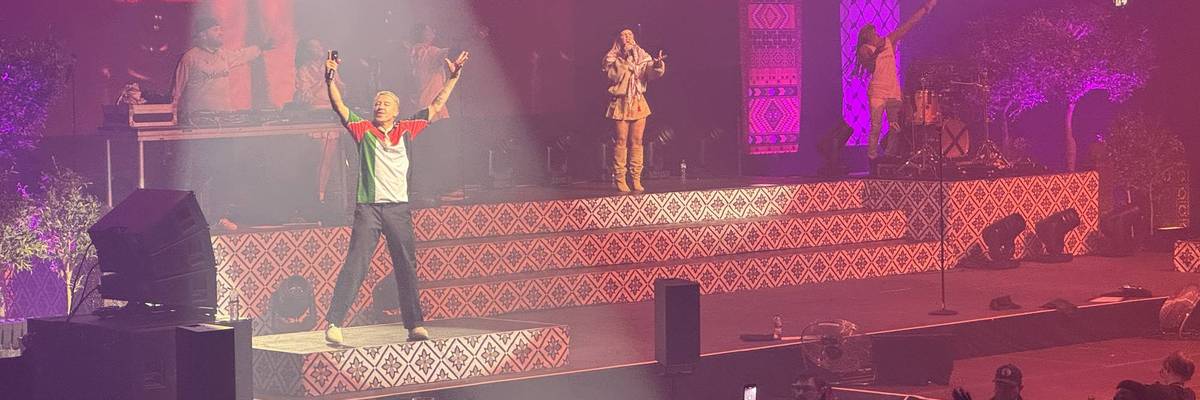
American rapper Macklemore, who was removed from British singer Ed Sheeran's tour over his statements in support of Palestine, performs the final concert of his Free Palestine Tour in London, United Kingdom on October 30, 2026.
Macklemore's Free Palestine Tour helped create something that is often missing from the way Palestine is discussed: a space where people could encounter Palestinian culture and voices and turn their concern into action.
Macklemore says he is struggling to find arenas willing to host the US leg of his Free Palestine Tour. The news is a jarring contrast to the packed arenas I have just returned from across Dublin, Paris, and London—and a reminder of how contested the space for Palestinian expression remains in the United States.
That contrast is familiar to Palestinians. For years, being Palestinian in public has felt like an exercise in bracing. You stand in the cold behind barricades, and you wait to see who's going to get filmed, flagged, or fired just for asserting that children deserve to live. Your advocacy is routinely treated as a crime or a threat, until the anxiety of speaking out feels like the baseline cost of caring that children shouldn't be killed.
Then, in the space of one week, I stepped out of that cold and into three roaring arenas for the Free Palestine tour. For once, we weren't at the periphery asking to be heard. We were right in the middle of it, surrounded by joyous sound and a sea of keffiyehs. Palestine wasn’t an uncomfortable subject being squeezed into the conversation. It was the reason 20,000 people turned up in London, night after night.
We’ve seen an entire people be reduced to the images of their suffering. Humanitarian aid and bearing witness to those atrocities is essential. But Palestinians are not simply people to be rescued or mourned.
When the tour was announced, I was excited because I knew what it could mean for the cause that I've dedicated my life to. I work with UNRWA USA, and I co-founded Gaza Soup Kitchen, two of the organizations that the shows were raising money for. We all got an early heads-up, and the excitement was real. Part of it was the proceeds; part of it was finally being attached to something culturally relevant, exciting, and, I'll be honest, cool. After years of working to keep Gaza in the conversation, it was extraordinary to see what happened when a musician with a mic and a genuine willingness to take a risk brought that conversation into the center of popular culture.
Macklemore’s own story is part of why the tour mattered. He was dropped from Ed Sheeran's US tour after he'd spoken up for the Palestinians on stage. Rather than retreat, Macklemore built his own stage, invited others onto it, and sold out shows in cities worldwide. That's the power of solidarity.
In Dublin, Palestinian flags, keffiyehs, and an Irish audience with a long tradition of standing with those fighting for their freedom filled the room. In Paris, some of the people from the day's street protests spilled into the arena. Francesca Albanese, the United Nations special rapporteur on the occupied Palestinian territory, spoke to a room of music fans. That combination was part of what made the tour so unusual. Music wasn’t simply the entertainment between political speeches. It was what brought people together in the first place. It created a space where political engagement didn’t have to feel like an obligation or an argument. You could participate, learn, listen, and celebrate at the same time.
This is also the thinking behind UNRWA USA's upcoming What We Carry: Music, Memory, Home tour. This month, we’re bringing Palestinian music and storytelling to Los Angeles, New York, and Washington, DC. The events will feature artists including MC Abdul and Alana Hadid, with comedian Mo Amer being honored at the New York show for using his platform to transform how audiences see Palestinians, refugees, and immigrants. The tour is designed to do more than tell people about the emergency in Gaza. It invites them to encounter Palestinian stories through music, memory, and lived experience, and then gives them a direct way to support UNRWA's humanitarian relief.
That connection between culture and action is deliberate. Humanitarian organizations are often asked to make the case for support through statistics, urgent appeals, and descriptions of need. Those things matter. But people also need to encounter the human beings behind the numbers: their voices, their humor, their music, their memories, and their determination to remain connected to home. Culture can open a door that an appeal for donations alone might not. And once people walk through it, there must be a meaningful way to turn solidarity into support.
At the Gaza Soup Kitchen table in London, I handed out stickers until we ran out. People kept coming up to ask how they could donate. They came from all walks of life and different generations. They wanted to do something, and suddenly a door opened. This is what cultural moments can do that traditional advocacy sometimes struggles to achieve. They can take people from feeling something to doing something. A concert can bring people into the work of activism that might never otherwise have found their way there. And it can give them a community in which to stay.
We’ve seen an entire people be reduced to the images of their suffering. Humanitarian aid and bearing witness to those atrocities is essential. But Palestinians are not simply people to be rescued or mourned. We are people with a culture, a history, a future, and a right to live full lives. Our children deserve to see that reflected back at them.
I pulled my daughter into the arena through a video call. She's 12, into music, and into advocacy work. She's hardly ever seen those two things in one place. She was taking every second in, her all-caps reaction to everything telling me I'm officially cool now.
She's the reason I went, and a night like that gave us something to share that wasn't just grief. I want Palestinian kids to grow up seeing their identity in the music, the art, the clothes, and the humor they already have. Palestine can be edgy. Palestine can be rebellious. It can be funny, creative, and joyful. It doesn't have to be seen through rubble.
Macklemore didn't solve Palestine's problems. No concert will. But he helped create something that is often missing from the way Palestine is discussed: a space where people could encounter Palestinian culture and voices and turn their concern into action. At a time when even finding a venue for that kind of expression in the United States is proving difficult, the importance of creating and protecting these spaces feels even greater.
That’s what I want my daughter, and all Palestinian children, to remember—the sound of thousands of people singing, dancing, and celebrating alongside them. The knowledge that their identity belongs in the world and they have every right to take up space in it.
This country and this world are at a monumental crossroads. US voters have an opportunity to beat back the forces of fascism and confront the billionaires who are rigging the economy, our media system, and our democracy, making it increasingly impossible for ordinary people to get by. We’re not just talking about the election. We’re talking about what must be done once these fascist elements are vanquished from power. We need a bolder set of solutions than what either major party has so far been willing to offer and a working-class movement ready to fight like hell for it. Trump didn't emerge from nowhere. The conditions that fueled MAGA authoritarianism were created by decades of radical neoliberal economic policies and a corrupt political system dominated by corporate interests. They slashed taxes on the super-rich, promising that the benefits would trickle down. They said giveaways to the corporate titans would make life more affordable for the rest of us. It was all bullshit. And when a bitter, betrayed populace searches for someone to blame, right-wing demagogues have little trouble finding scapegoats. People know when they're being lied to, but you won't hear any of this from the corporate media. Only independent journalism—powered and funded by people who believe in building a better world—can deliver truly trustworthy daily news. If you share our vision, please contribute whatever you can to sustain our work. |
Macklemore says he is struggling to find arenas willing to host the US leg of his Free Palestine Tour. The news is a jarring contrast to the packed arenas I have just returned from across Dublin, Paris, and London—and a reminder of how contested the space for Palestinian expression remains in the United States.
That contrast is familiar to Palestinians. For years, being Palestinian in public has felt like an exercise in bracing. You stand in the cold behind barricades, and you wait to see who's going to get filmed, flagged, or fired just for asserting that children deserve to live. Your advocacy is routinely treated as a crime or a threat, until the anxiety of speaking out feels like the baseline cost of caring that children shouldn't be killed.
Then, in the space of one week, I stepped out of that cold and into three roaring arenas for the Free Palestine tour. For once, we weren't at the periphery asking to be heard. We were right in the middle of it, surrounded by joyous sound and a sea of keffiyehs. Palestine wasn’t an uncomfortable subject being squeezed into the conversation. It was the reason 20,000 people turned up in London, night after night.
We’ve seen an entire people be reduced to the images of their suffering. Humanitarian aid and bearing witness to those atrocities is essential. But Palestinians are not simply people to be rescued or mourned.
When the tour was announced, I was excited because I knew what it could mean for the cause that I've dedicated my life to. I work with UNRWA USA, and I co-founded Gaza Soup Kitchen, two of the organizations that the shows were raising money for. We all got an early heads-up, and the excitement was real. Part of it was the proceeds; part of it was finally being attached to something culturally relevant, exciting, and, I'll be honest, cool. After years of working to keep Gaza in the conversation, it was extraordinary to see what happened when a musician with a mic and a genuine willingness to take a risk brought that conversation into the center of popular culture.
Macklemore’s own story is part of why the tour mattered. He was dropped from Ed Sheeran's US tour after he'd spoken up for the Palestinians on stage. Rather than retreat, Macklemore built his own stage, invited others onto it, and sold out shows in cities worldwide. That's the power of solidarity.
In Dublin, Palestinian flags, keffiyehs, and an Irish audience with a long tradition of standing with those fighting for their freedom filled the room. In Paris, some of the people from the day's street protests spilled into the arena. Francesca Albanese, the United Nations special rapporteur on the occupied Palestinian territory, spoke to a room of music fans. That combination was part of what made the tour so unusual. Music wasn’t simply the entertainment between political speeches. It was what brought people together in the first place. It created a space where political engagement didn’t have to feel like an obligation or an argument. You could participate, learn, listen, and celebrate at the same time.
This is also the thinking behind UNRWA USA's upcoming What We Carry: Music, Memory, Home tour. This month, we’re bringing Palestinian music and storytelling to Los Angeles, New York, and Washington, DC. The events will feature artists including MC Abdul and Alana Hadid, with comedian Mo Amer being honored at the New York show for using his platform to transform how audiences see Palestinians, refugees, and immigrants. The tour is designed to do more than tell people about the emergency in Gaza. It invites them to encounter Palestinian stories through music, memory, and lived experience, and then gives them a direct way to support UNRWA's humanitarian relief.
That connection between culture and action is deliberate. Humanitarian organizations are often asked to make the case for support through statistics, urgent appeals, and descriptions of need. Those things matter. But people also need to encounter the human beings behind the numbers: their voices, their humor, their music, their memories, and their determination to remain connected to home. Culture can open a door that an appeal for donations alone might not. And once people walk through it, there must be a meaningful way to turn solidarity into support.
At the Gaza Soup Kitchen table in London, I handed out stickers until we ran out. People kept coming up to ask how they could donate. They came from all walks of life and different generations. They wanted to do something, and suddenly a door opened. This is what cultural moments can do that traditional advocacy sometimes struggles to achieve. They can take people from feeling something to doing something. A concert can bring people into the work of activism that might never otherwise have found their way there. And it can give them a community in which to stay.
We’ve seen an entire people be reduced to the images of their suffering. Humanitarian aid and bearing witness to those atrocities is essential. But Palestinians are not simply people to be rescued or mourned. We are people with a culture, a history, a future, and a right to live full lives. Our children deserve to see that reflected back at them.
I pulled my daughter into the arena through a video call. She's 12, into music, and into advocacy work. She's hardly ever seen those two things in one place. She was taking every second in, her all-caps reaction to everything telling me I'm officially cool now.
She's the reason I went, and a night like that gave us something to share that wasn't just grief. I want Palestinian kids to grow up seeing their identity in the music, the art, the clothes, and the humor they already have. Palestine can be edgy. Palestine can be rebellious. It can be funny, creative, and joyful. It doesn't have to be seen through rubble.
Macklemore didn't solve Palestine's problems. No concert will. But he helped create something that is often missing from the way Palestine is discussed: a space where people could encounter Palestinian culture and voices and turn their concern into action. At a time when even finding a venue for that kind of expression in the United States is proving difficult, the importance of creating and protecting these spaces feels even greater.
That’s what I want my daughter, and all Palestinian children, to remember—the sound of thousands of people singing, dancing, and celebrating alongside them. The knowledge that their identity belongs in the world and they have every right to take up space in it.