SUBSCRIBE TO OUR FREE NEWSLETTER
Daily news & progressive opinion—funded by the people, not the corporations—delivered straight to your inbox.
5
#000000
#FFFFFF
To donate by check, phone, or other method, see our More Ways to Give page.
Daily news & progressive opinion—funded by the people, not the corporations—delivered straight to your inbox.
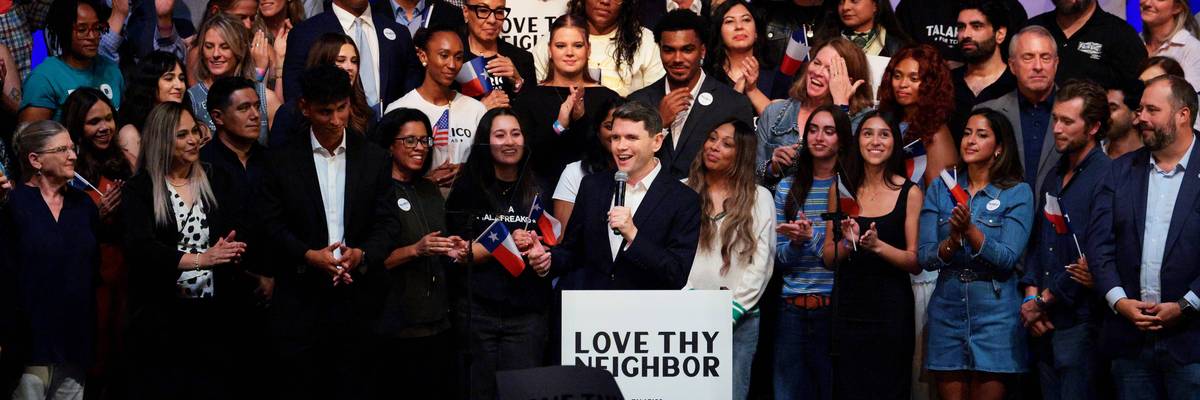
US Sen.-elect James Talarico (D-Texas) speaks during a midterm election night event at the Long Center for the Performing Arts on November 3, 2026 in Austin, Texas.
A populist class agenda is badly needed. And the only way it breaks through will be when working people build their own political organization and demand it.
“The biggest divide in this country is not left vs. right. It’s top vs. bottom. Billionaires want us looking left and right at each other instead of looking up at them.” —Senator-elect James Talarico
Why does Texas Democrat Talarico see left politics as different from class politics?
After all, if left has meant anything at all historically, it has meant meant fighting for the bottom against the top. The 19th-century Populists envisioned a new economy built around cooperatives instead of the Robber Barons. The Socialist Party, in the first decades of the 20th century, called for public ownership of a range of private enterprises. The Nonpartisan League in North Dakota called for state ownership of grain elevators and banks during and after WWI.
As my colleague, historian Michael Merrill puts it, radical class politics is about moving to a “people-first rather than a profit-first economy.”
The left also has been in the forefront on the battle to end to segregation and secure full equality for women, but its central project was always a significant transformation of the capitalist economic system—one that would shift power away from concentrated wealth and toward working people.
But now Talarico, along with millions of voters, view the left as something other than class politics. When voters say the Democrats have moved too far to the left, they are often thinking about abortion, transgender athletes in sports, affirmative action, calls to abolish the police, guns, enforcement of the southern border, and abortion. These voters generally are not defining economic populism as “too left.”
Or as Talarico writes:
The people at the top work so hard to keep us angry and divided because our unity is a threat to their wealth and power. So their cable news networks and their social media algorithms tear us apart.
They divide us by party, by race, by gender, by religion so we don’t notice they’re defunding our schools, gutting our healthcare, and cutting taxes for themselves and their rich friends. It’s the oldest strategy in the world: Divide and conquer.
Over the past 40 years, the Democratic Party, with a few prominent exceptions such as Sen. Bernie Sanders (I-Vt.), has shown little commitment to dramatically changing capitalism.
They have not even united around prohibiting elected officials from trading stocks and bonds while in office—a reform that polls have consistently shown attracts broad public support. One would think the Democratic attacks on corruption (“accountability”) would start at home.
Because of the choices the Democratic Party has made in the last 40 years, it is no accident that the public meaning of “the left” has increasingly come to be defined by liberal positions on social issues rather than focused on programs to transform economic power.
The party also has shown little desire to curtail the power of Wall Street, create publicly owned banks, or break up large corporate monopolies and cartels. And it makes no calls for building cooperatives or nationalizing key pieces of our infrastructure like utilities, or even prohibiting private equity companies from buying up single-family homes.
Most importantly, Democrats have not embraced a guarantee of a job at a living wage for everyone who wants to work, with public employment available when the private sector falls short. Nor have they succeeded in raising the federal minimum wage above $7.25 an hour, where it has stood since 2009. And they have repeatedly failed to reform labor law so that working people can more readily join unions.
Rather, the Democrats, led by the Clintons, become identified with pro-corporate trade deals that ripped apart the industrial heartland, leaving struggling workers and broken communities behind.
Because of the choices the Democratic Party has made in the last 40 years, it is no accident that the public meaning of “the left” has increasingly come to be defined by liberal positions on social issues rather than focused on programs to transform economic power.
Even in this landslide congressional election, 59% of white non-college graduates supported the Republican candidates while only 40% favored the Democrats.
Identity politics has also changed how economic issues are framed within the Democratic Party. Top operatives and liberal donors embedded a new “race-class narrative” into policy discussions.
Evan Barker, in Nothing Left, her revealing account of life inside the Democratic Party’s progressive wing, describes how universal economic policies came to be framed through racial categories. A proposal to improve Social Security, for example, would be presented as a way to help low-income Black and Latino workers, rather than simply as a universal policy that benefits all working people.
As Barker puts it:
RCN is inherently divisive because it racializes economic problems. It pisses off people who aren’t included in the struggling category because they might be struggling just as much as the group deemed as struggling. Bernie didn’t racialize economic issues when he ran in 2016, which is why he won a lot of WWC people over who later converted to becoming Trump voters.
Economic policies should not ignore racial inequality, of course, but a problem arises when universal economic demands are presented in ways that appear to divide working people into competing categories of deserving and less-deserving groups.
Add in the controversies over pronouns and the use of “Latinx” as political litmus tests, then even universal policies such as Medicare for All can be viewed not as programs that benefit everyone, but rather as part of an agenda that puts the interests of minorities and immigrants ahead of everyone else, paid for by white working-class taxes.
The failure of Democrats to make the protection of working people from corporate power its central political mission has opened the door for Republicans to seriously claim that they—not the Democrats—are the champions of working people.
Senator Josh Hawley (R-Mo.), who is widely discussed as a potential presidential candidate, has become a vocal supporter of raising the minimum wage, strengthening workers’ rights to collective bargaining, and changing the tax system to benefit wage earners. It is striking that issues once identified so strongly with the Democrats are now championed by a Republican.
Talarico showed that top-bottom politics can be heard in Texas. Here’s his vision:
We must get big money out of our politics so no billionaire or trillionaire can buy our elections.
We must unrig this economic system that only benefits the top 1%.
We must pass universal healthcare so no one goes bankrupt just because they get sick.
We must invest in our teachers and our students so every underdog has a fighting chance.
We must end these corrupt forever wars that are driving up prices and killing our brave men and women in uniform.
And here’s my check-list of pro-working-class legislative actions:
Even if the Republicans filibuster each of these into the ground, or Trump vetoes all of them, the effort would demonstrate to working people that the Democrats have the guts to take on the corporate elite in their behalf.
One would hope these people-first policies would now become central to tackling the “affordability” crisis, but already there is much talk about the need for the Democrats to be seen as moderates.
The centrists will certainly try to lower fuel prices by ending the war in Iran, and they will try to contain health insurance costs by renewing the Obamacare and Medicaid subsidies. But an anti-corporate economic crusade to attack the root causes of “affordability” is likely a bridge too far. It will make their wealthy backers uncomfortable.
It is far easier to go after the Republican criminals and hucksters. You can subpoena, investigate, and impeach.
It’s so much harder to go after the oligopoly of power. It will take an enormous fight to modify the Wall Street-corporate wealth extraction system that produces endless job precarity, making it nearly impossible to lead a decent life. It’s safety to focus on “accountability.”
But that populist class agenda is badly needed. And the only way it breaks through will be when working people build their own political organization and demand it.
Many, many progressives would love to see the Democrats become the party of Talarico, and Bernie, and AOC. I fear they will be heartbroken…. yet again.
(You can hear me rant and rave on Jason Small’s Blue Collar News Podcast. And you can catch my version of building a working-class political movement in A Party of Our Own.)
This country and this world are at a monumental crossroads. US voters have an opportunity to beat back the forces of fascism and confront the billionaires who are rigging the economy, our media system, and our democracy, making it increasingly impossible for ordinary people to get by. We’re not just talking about the election. We’re talking about what must be done once these fascist elements are vanquished from power. We need a bolder set of solutions than what either major party has so far been willing to offer and a working-class movement ready to fight like hell for it. Trump didn't emerge from nowhere. The conditions that fueled MAGA authoritarianism were created by decades of radical neoliberal economic policies and a corrupt political system dominated by corporate interests. They slashed taxes on the super-rich, promising that the benefits would trickle down. They said giveaways to the corporate titans would make life more affordable for the rest of us. It was all bullshit. And when a bitter, betrayed populace searches for someone to blame, right-wing demagogues have little trouble finding scapegoats. People know when they're being lied to, but you won't hear any of this from the corporate media. Only independent journalism—powered and funded by people who believe in building a better world—can deliver truly trustworthy daily news. If you share our vision, please contribute whatever you can to sustain our work. |
Les Leopold is the executive director of the Labor Institute and author of the new book, “The Billionaires Have Two Parties, We Need a Party of Our Own” (2026). His previous books include: “Wall Street’s War on Workers: How Mass Layoffs and Greed Are Destroying the Working Class and What to Do About It" (2024); "Runaway Inequality: An Activist's Guide to Economic Justice" (2015); and “The Man Who Hated Work and Loved Labor: The Life and Times of Tony Mazzocchi” (2007). Read more of his work on his substack here.
“The biggest divide in this country is not left vs. right. It’s top vs. bottom. Billionaires want us looking left and right at each other instead of looking up at them.” —Senator-elect James Talarico
Why does Texas Democrat Talarico see left politics as different from class politics?
After all, if left has meant anything at all historically, it has meant meant fighting for the bottom against the top. The 19th-century Populists envisioned a new economy built around cooperatives instead of the Robber Barons. The Socialist Party, in the first decades of the 20th century, called for public ownership of a range of private enterprises. The Nonpartisan League in North Dakota called for state ownership of grain elevators and banks during and after WWI.
As my colleague, historian Michael Merrill puts it, radical class politics is about moving to a “people-first rather than a profit-first economy.”
The left also has been in the forefront on the battle to end to segregation and secure full equality for women, but its central project was always a significant transformation of the capitalist economic system—one that would shift power away from concentrated wealth and toward working people.
But now Talarico, along with millions of voters, view the left as something other than class politics. When voters say the Democrats have moved too far to the left, they are often thinking about abortion, transgender athletes in sports, affirmative action, calls to abolish the police, guns, enforcement of the southern border, and abortion. These voters generally are not defining economic populism as “too left.”
Or as Talarico writes:
The people at the top work so hard to keep us angry and divided because our unity is a threat to their wealth and power. So their cable news networks and their social media algorithms tear us apart.
They divide us by party, by race, by gender, by religion so we don’t notice they’re defunding our schools, gutting our healthcare, and cutting taxes for themselves and their rich friends. It’s the oldest strategy in the world: Divide and conquer.
Over the past 40 years, the Democratic Party, with a few prominent exceptions such as Sen. Bernie Sanders (I-Vt.), has shown little commitment to dramatically changing capitalism.
They have not even united around prohibiting elected officials from trading stocks and bonds while in office—a reform that polls have consistently shown attracts broad public support. One would think the Democratic attacks on corruption (“accountability”) would start at home.
Because of the choices the Democratic Party has made in the last 40 years, it is no accident that the public meaning of “the left” has increasingly come to be defined by liberal positions on social issues rather than focused on programs to transform economic power.
The party also has shown little desire to curtail the power of Wall Street, create publicly owned banks, or break up large corporate monopolies and cartels. And it makes no calls for building cooperatives or nationalizing key pieces of our infrastructure like utilities, or even prohibiting private equity companies from buying up single-family homes.
Most importantly, Democrats have not embraced a guarantee of a job at a living wage for everyone who wants to work, with public employment available when the private sector falls short. Nor have they succeeded in raising the federal minimum wage above $7.25 an hour, where it has stood since 2009. And they have repeatedly failed to reform labor law so that working people can more readily join unions.
Rather, the Democrats, led by the Clintons, become identified with pro-corporate trade deals that ripped apart the industrial heartland, leaving struggling workers and broken communities behind.
Because of the choices the Democratic Party has made in the last 40 years, it is no accident that the public meaning of “the left” has increasingly come to be defined by liberal positions on social issues rather than focused on programs to transform economic power.
Even in this landslide congressional election, 59% of white non-college graduates supported the Republican candidates while only 40% favored the Democrats.
Identity politics has also changed how economic issues are framed within the Democratic Party. Top operatives and liberal donors embedded a new “race-class narrative” into policy discussions.
Evan Barker, in Nothing Left, her revealing account of life inside the Democratic Party’s progressive wing, describes how universal economic policies came to be framed through racial categories. A proposal to improve Social Security, for example, would be presented as a way to help low-income Black and Latino workers, rather than simply as a universal policy that benefits all working people.
As Barker puts it:
RCN is inherently divisive because it racializes economic problems. It pisses off people who aren’t included in the struggling category because they might be struggling just as much as the group deemed as struggling. Bernie didn’t racialize economic issues when he ran in 2016, which is why he won a lot of WWC people over who later converted to becoming Trump voters.
Economic policies should not ignore racial inequality, of course, but a problem arises when universal economic demands are presented in ways that appear to divide working people into competing categories of deserving and less-deserving groups.
Add in the controversies over pronouns and the use of “Latinx” as political litmus tests, then even universal policies such as Medicare for All can be viewed not as programs that benefit everyone, but rather as part of an agenda that puts the interests of minorities and immigrants ahead of everyone else, paid for by white working-class taxes.
The failure of Democrats to make the protection of working people from corporate power its central political mission has opened the door for Republicans to seriously claim that they—not the Democrats—are the champions of working people.
Senator Josh Hawley (R-Mo.), who is widely discussed as a potential presidential candidate, has become a vocal supporter of raising the minimum wage, strengthening workers’ rights to collective bargaining, and changing the tax system to benefit wage earners. It is striking that issues once identified so strongly with the Democrats are now championed by a Republican.
Talarico showed that top-bottom politics can be heard in Texas. Here’s his vision:
We must get big money out of our politics so no billionaire or trillionaire can buy our elections.
We must unrig this economic system that only benefits the top 1%.
We must pass universal healthcare so no one goes bankrupt just because they get sick.
We must invest in our teachers and our students so every underdog has a fighting chance.
We must end these corrupt forever wars that are driving up prices and killing our brave men and women in uniform.
And here’s my check-list of pro-working-class legislative actions:
Even if the Republicans filibuster each of these into the ground, or Trump vetoes all of them, the effort would demonstrate to working people that the Democrats have the guts to take on the corporate elite in their behalf.
One would hope these people-first policies would now become central to tackling the “affordability” crisis, but already there is much talk about the need for the Democrats to be seen as moderates.
The centrists will certainly try to lower fuel prices by ending the war in Iran, and they will try to contain health insurance costs by renewing the Obamacare and Medicaid subsidies. But an anti-corporate economic crusade to attack the root causes of “affordability” is likely a bridge too far. It will make their wealthy backers uncomfortable.
It is far easier to go after the Republican criminals and hucksters. You can subpoena, investigate, and impeach.
It’s so much harder to go after the oligopoly of power. It will take an enormous fight to modify the Wall Street-corporate wealth extraction system that produces endless job precarity, making it nearly impossible to lead a decent life. It’s safety to focus on “accountability.”
But that populist class agenda is badly needed. And the only way it breaks through will be when working people build their own political organization and demand it.
Many, many progressives would love to see the Democrats become the party of Talarico, and Bernie, and AOC. I fear they will be heartbroken…. yet again.
(You can hear me rant and rave on Jason Small’s Blue Collar News Podcast. And you can catch my version of building a working-class political movement in A Party of Our Own.)