

SUBSCRIBE TO OUR FREE NEWSLETTER
Daily news & progressive opinion—funded by the people, not the corporations—delivered straight to your inbox.
5
#000000
#FFFFFF
To donate by check, phone, or other method, see our More Ways to Give page.
Daily news & progressive opinion—funded by the people, not the corporations—delivered straight to your inbox.
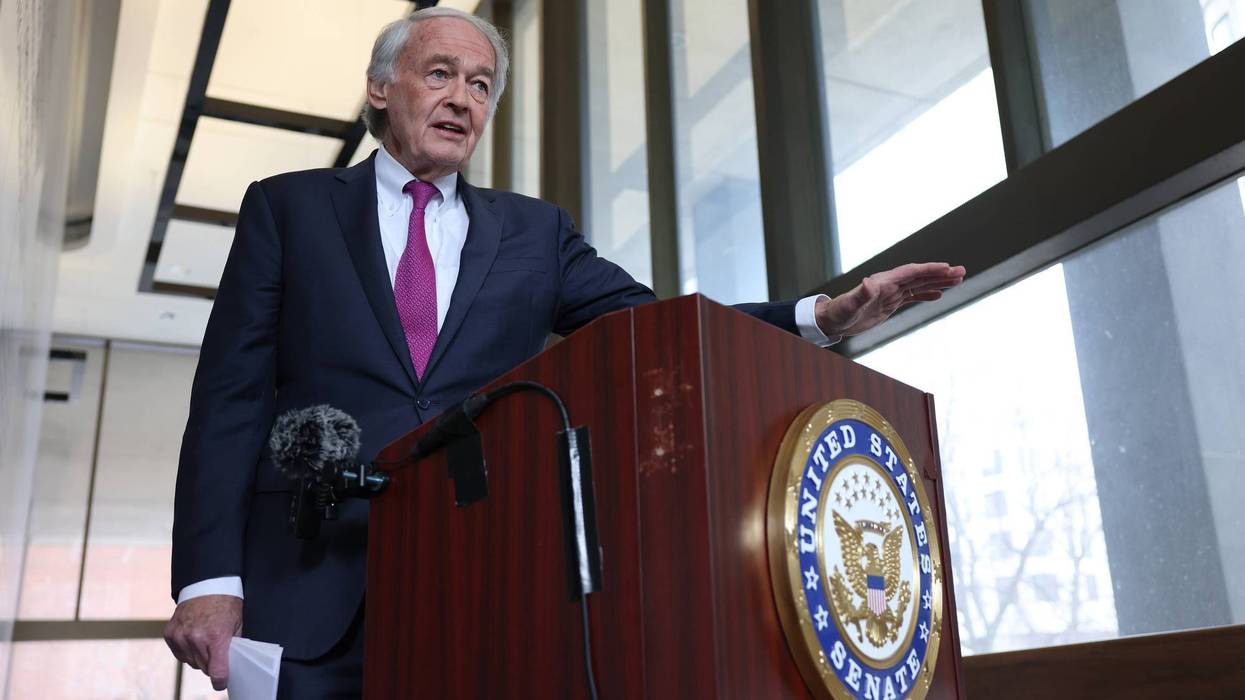
"We can't sleepwalk into a decision this consequential. The law gives Congress the power to review and block a deal like this, and the Senate will now have the chance to fulfill its statutory responsibility before it's too late."
US Sens. Ed Markey and Jeff Merkley on Thursday continued to push back against President Donald Trump's proposed nuclear energy agreement with Saudi Arabia, setting up a vote on legislation that could block the deal before it takes effect.
"Giving Saudi Arabia access to US civilian nuclear energy technology without ironclad protections to make sure it doesn't provide a foundation for a nuclear bomb is unacceptable," declared Merkley (D-Ore.), a senior member of the Senate Foreign Relations Committee who co-chairs the Nuclear Weapons and Arms Control Working Group with Markey (D-Mass.).
Under Section 123 of the Atomic Energy Act, Congress has 90 days of continuous session to review the deal. The pair of senators introduced a joint resolution of disapproval, on which the Senate is set to vote after November 29. The JRD would need to pass both GOP-controlled chambers by veto-proof majorities to actually block the agreement.
I refuse to let the U.S. sleepwalk into a dangerous nuclear deal with Saudi Arabia. The law gives Congress the power to review and block a deal like this.@markey.senate.gov and I are making sure the Senate fulfills that responsibility before it’s too late.
[image or embed]
— Senator Jeff Merkley (@merkley.senate.gov) October 15, 2026 at 12:37 PM
The senators are alarmed that Trump's agreement lacks a "gold standard" provision barring Saudi Arabia from reprocessing spent fuel or enriching uranium. They are also alarmed that the proposal doesn't require allowing International Atomic Energy Agency investigators to confirm that the nation is not trying to develop a nuclear weapon.
"It is essential that nations pursuing civilian energy programs agree to the 'gold standard' of restrictions on fuel reprocessing and enrichment and rigorous inspections to ensure that a nuclear energy program doesn't become a covert nuclear weapons program," Merkley argued. "We can't sleepwalk into a decision this consequential. The law gives Congress the power to review and block a deal like this, and the Senate will now have the chance to fulfill its statutory responsibility before it's too late."
The details of the agreement have concerned not only progressive senators, but also nuclear nonproliferation experts.
"The US-Saudi nuclear deal is about megatons, not megawatts. Trump should not be sharing nuclear bomb technology with a nation that US intelligence says may want nuclear weapons," said Markey. "This deal is the starting gun for a Middle East nuclear arms race. Congress must reject it."
The introduction came roughly a month after Markey and Merkley partnered with Sen. Bernie Sanders (I-Vt.) for another JRD designed to block a $5 billion conventional weapons sale to Saudi Arabia, which includes over 10,000 joint direct attack munition guidance kits and a similar number of "dumb bombs" that can be combined to create precision weapons.
"I am deeply concerned by the kingdom's human rights abuses, the security of the region as the war in Iran rages on, and the proxy war that is escalating between Iran and Saudi Arabia in Yemen," Markey said at the time. "Further escalation in the Saudi-Iran proxy war will worsen an already dire humanitarian catastrophe in Yemen and risks setting off a nuclear arms race between Iran and Saudi Arabia."
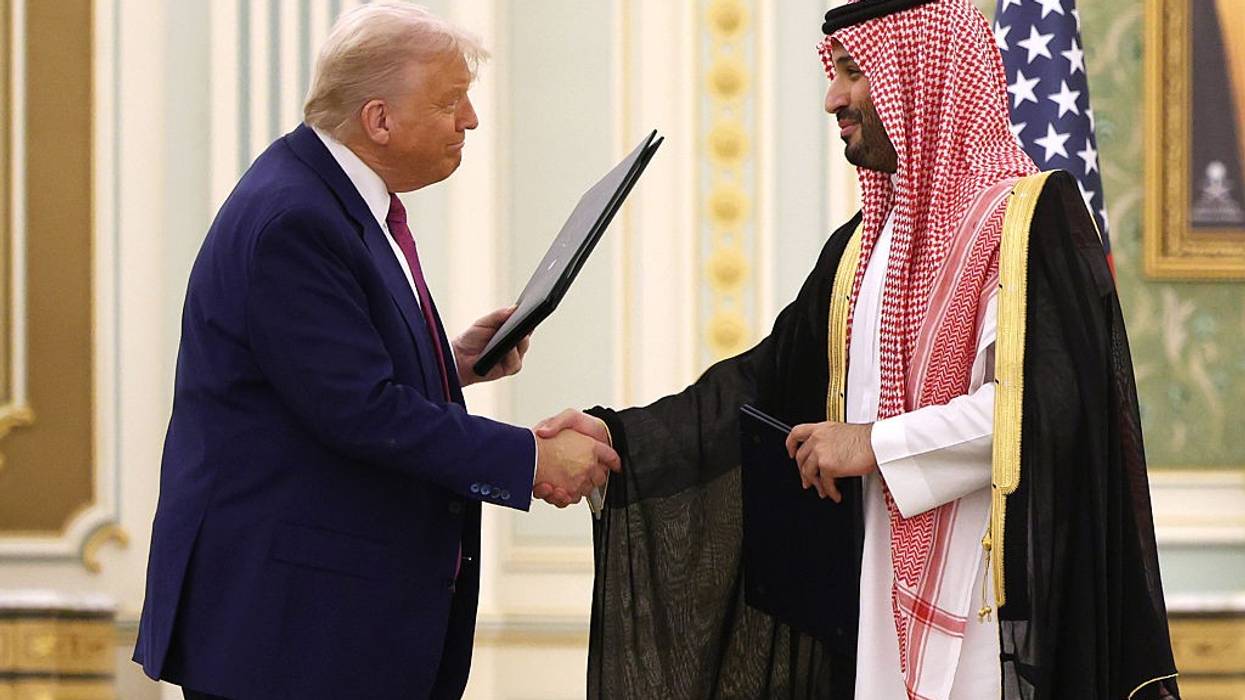
The effort comes as senators also sound the alarm about a possible nuclear energy agreement and the administration continues to greenlight arms sales to the kingdom.
A trio of progressive US senators this week introduced legislation to block a $5 billion conventional weapons sale to Saudi Arabia while also pushing for the release of more details about President Donald Trump's proposed nuclear cooperation agreement with the Middle Eastern kingdom.
"The United States must not send thousands of conventional weapons to Saudi Arabia or allow it to develop a nuclear program," said Sen. Ed Markey (D-Mass.) in a Thursday statement—a day after he partnered with Sens. Jeff Merkley (D-Ore.) and Bernie Sanders (I-Vt.) to introduce the joint resolution of disapproval, which was referred to the Senate Foreign Relations Committee.
"I am deeply concerned by the kingdom's human rights abuses, the security of the region as the war in Iran rages on, and the proxy war that is escalating between Iran and Saudi Arabia in Yemen," Markey explained. "Further escalation in the Saudi-Iran proxy war will worsen an already dire humanitarian catastrophe in Yemen and risks setting off a nuclear arms race between Iran and Saudi Arabia."
The resolution targets a sale approved by the US State Department on September 4 that includes over 10,000 joint direct attack munition (JDAM) guidance kits. As Breaking Defense detailed, "The prospective transaction includes a similar number of dumb bombs—split almost evenly between 500 lb. and 2,000 lb. munitions—which, when equipped with a JDAM, can be used as a precision weapon."
The bill does not apply to the other possible sale to Saudi Arabia endorsed by the department that same day—$750 million for AGT-1500 engines and related equipment—or the $24.3 billion deal for F-35 Lightning II fighter jets, which the Trump administration greenlit Thursday, after the resolution was introduced.
The latest approval "comes nearly two months after Saudi Defense Minister Khalid bin Salman traveled to Washington to lobby senior Trump administration officials on the sale, with Riyadh hoping to advance the deal ahead of the midterms," Semafor noted. The upcoming US elections could lead to Trump's Republican Party losing control of Congress.
The warplanes sale could also face pushback from Congress. According to Politico, Rep. Raja Krishnamoorthi (D-Ill.), who sits on the House Intelligence Committee, warned that "it could put the crown jewels of American military technology within reach of the Chinese Communist Party."
US approves $24.3 billion sale of 48 F-35 stealth warplanes to Saudi Arabia.US intelligence analysts have raised the possibility that China could acquire F-35 technology through its partnerships with Saudi. Israel had been the only country in the Middle East to operate the jetsu.afp.com/SjRn
[image or embed]
— AFP News Agency (@en.afp.com) September 17, 2026 at 9:41 PM
In addition to unveiling their resolution about the JDAMs and bombs on Wednesday, Markey and Merkley, co-chairs of the bicameral Nuclear Weapons and Arms Control Working Group, led a bipartisan group of senators—including Sanders—in urging a pair of Trump Cabinet members to declassify two side letters associated with the administration's proposed nuclear deal.
The administration submitted the pending 30-year agreement—which would allow US companies to share nuclear power technology with the kingdom—to Congress after it was signed by US Energy Secretary Chris Wright and Saudi Energy Minister Prince Abdulaziz bin Salman in July.
Under Section 123 of the Atomic Energy Act, Congress has 90 days of continuous session to review the deal and either move to block it or let it take effect. The senators' new letter to Wright and Secretary of State Marco Rubio notes that "in previous 123 agreements, the executive branch publicly released the agreement along with side letters and related documents."
"Access to the full text is required for the Senate and the public to have a clear understanding of the commitments being made on the nation's behalf and those being made by Saudi Arabia to the United States," the senators argued. "Their public release would also allow civil society, independent experts, and other affected stakeholders to scrutinize the deal."
"Transparency and open debate are cornerstones of our democracy," they emphasized. "Congress and the American public must have a meaningful opportunity to review and debate the key components of the US-Saudi nuclear deal before it potentially enters into force. To that end, we call on you to declassify and release the two side letters without delay."
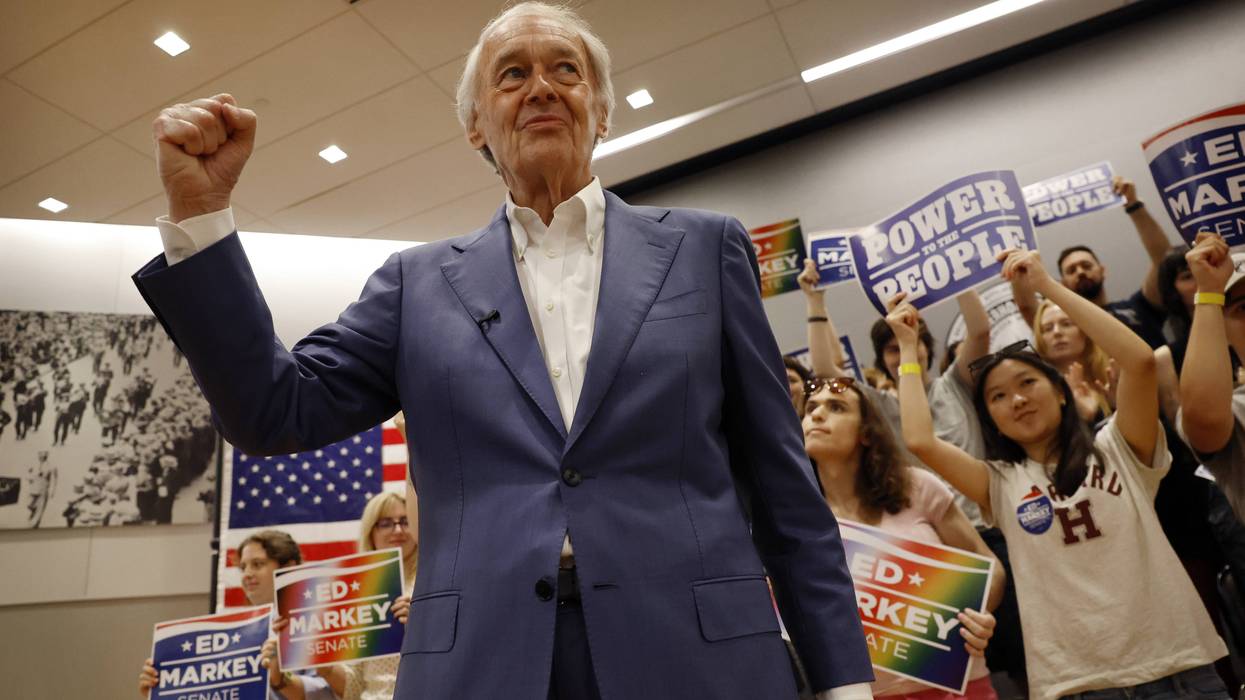
One Markey supporter called his victory "a rejection of the idea that generational change has to come at the expense of bold, progressive leadership."
Progressive US Sen. Ed Markey, a champion of Medicare for All and the Green New Deal, decisively fended off a Democratic primary challenge from his right on Tuesday, defeating Rep. Seth Moulton by nearly 30 percentage points in a contest that focused heavily on the incumbent senator's age.
Markey, 80, and his supporters—including prominent young Democrats such as Rep. Alexandria Ocasio-Cortez (D-NY)—rejected the notion that "generational change" necessarily means electing the youngest candidate in the race. Markey said in his victory speech Tuesday night that "generational change isn’t about compromising to do the small things better—it’s about fighting to do the big things best."
“Tonight is a testament to the power of the progressive movement,” Markey added. “It is a progressive movement fueled by young people, demanding more from their leaders, and it’s your voices that are the ones we need to hear right now.”
Moulton, a 47-year-old member of the conservative New Democrat Coalition, attempted to capture momentum that has propelled other younger candidates to victory over entrenched incumbents by making Markey's age and lengthy tenure in Congress—rather than his policy agenda—a central focus of Tuesday's contest. In a recent interview with MS NOW, Moulton removed ideology and policy from the equation completely, lumping Markey in with Sen. Mitch McConnell (R-Ky.) and late Sen. Lindsey Graham (R-SC) as well as elderly Democrats such as former President Joe Biden.
The Democratic representative, who opposes Medicare for All and attacked Sens. Bernie Sanders (I-Vt.) and Elizabeth Warren (D-Mass.) from the right during his ill-fated 2020 presidential bid, also falsely claimed in a campaign ad that he and Markey "want the same things."
Moulton's age-centric message failed, according to Markey's backers, because voters in Massachusetts and elsewhere are hungry for progressive politics, not just younger politicians.
"We don’t want younger politicians with older politics,” Tyler Hack, the 21-year-old executive director of the Christopher Street Project, a trans rights group, said at a rally for Markey over the weekend.
Joseph Geevarghese, executive director of Our Revolution, said in a statement that "tonight's victory isn't just a win for Ed Markey or for our progressive movement. It's a rejection of the idea that generational change has to come at the expense of bold, progressive leadership."
"Massachusetts voters understood the difference between changing the age of our leaders and changing the politics of our country," said Geevarghese. "Ed Markey has never settled for the moderate Democratic establishment or accepted the status quo simply because Washington said change was impossible. From staking his political capital on the Green New Deal, to fighting for Medicare for All, abolishing ICE, and taking on corporations and billionaires rigging our economy, Ed has consistently been willing to go where the Democratic Party needs to go—often before the rest of Washington gets there."
"That's the lesson from Massachusetts tonight," he added. "The future doesn't belong to the youngest politician in the room. It belongs to the people with the courage to fight for it."
Markey, who is heavily favored to win the general election in November, has said a new six-year Senate term would be his last.
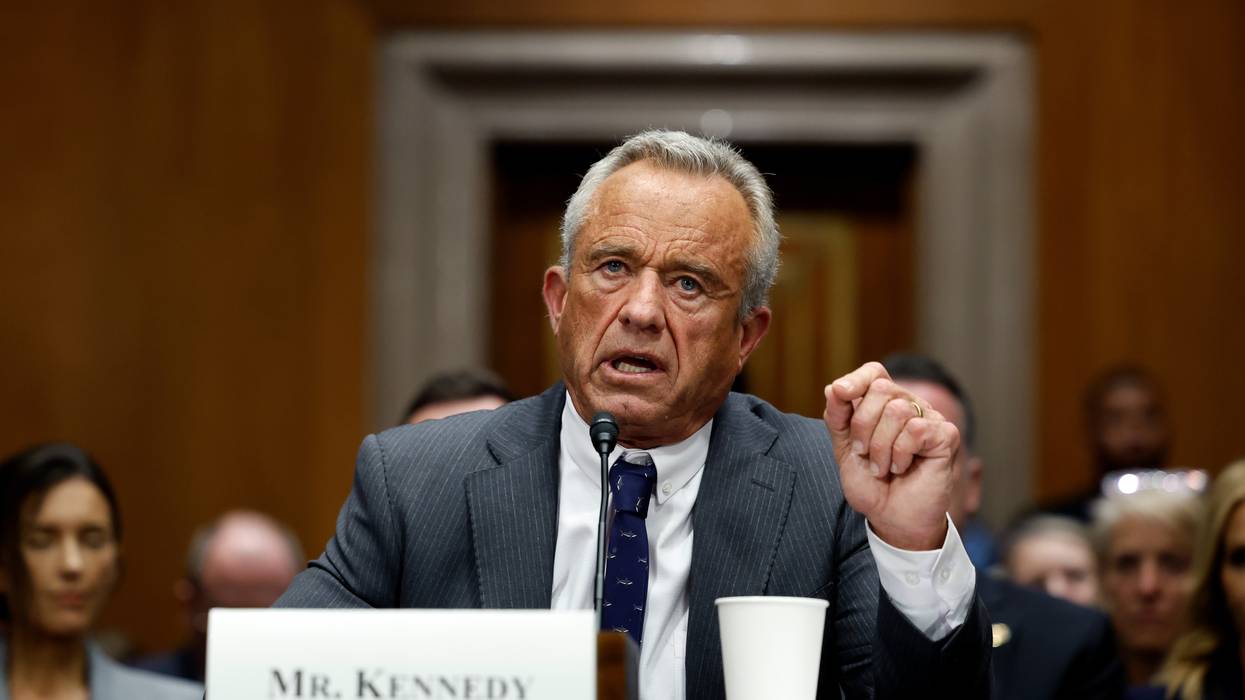
"He told us his Samoa trip had nothing to do with vaccines—now this letter shows that was false," Sen. Ed Markey said of President Donald Trump's health and human services secretary.
US Health and Human Services Secretary Robert F. Kennedy Jr. on Thursday faced calls for a criminal investigation after newly published documents appear to contradict his repeated testimony during Senate confirmation hearings that his 2019 trip to Samoa, which is linked to 83 measles deaths, “had nothing to do with vaccines.”
The advocacy group American Oversight on Thursday asked the US Department of Justice to investigate whether Kennedy knowingly made materially false statements during his 2025 Senate confirmation hearings. The request follows the publication of a January 2019 letter, signed by Kennedy and addressed to Samoa’s then-prime minister, Tuilaʻepa Saʻilele Malielegaoi, that explicitly proposed a vaccine-focused assessment of the Pacific island nation’s measles, mumps, and rubella (MMR) program.
“Robert F. Kennedy Jr. repeatedly testified before two separate Senate committees that his trip to Samoa had nothing to do with vaccines. But a letter he wrote to Samoa’s prime minister six years earlier appears to contradict that testimony,” American Oversight executive director Chioma Chukwu said Thursday in a statement.
“Congress relies on truthful testimony to do its job, particularly on matters as consequential as public health," Chukwu added. "If Kennedy lied to the Senate while seeking confirmation as the nation’s top health official, the Justice Department must investigate and hold him accountable.”
Questioned by Sen. Ron Wyden (D-Ore.) before the Senate Finance Committee, Kennedy said his trip had “nothing to do with vaccines,” describing it instead as an effort to introduce a medical informatics system to digitize the nation's health records.
The following day, when Sen. Ed Markey (D-Mass.) pressed him on the same issue before the Senate Health, Education, Labor, and Pensions Committee, Kennedy again said his trip had “nothing to do with vaccines.”
Markey's office released a statement Thursday noting that Kennedy "traveled to Samoa in 2019 to promote disinformation about the measles vaccine. Shortly after his trip, Samoa experienced a deadly outbreak of measles that killed over 80 people and has been attributed to mass vaccine disinformation."
My statement on new reporting that RFK Jr. lied to me in his Senate confirmation hearing.
[image or embed]
— Senator Ed Markey (@markey.senate.gov) August 27, 2026 at 1:47 PM
Of the 83 measles deaths during the outbreak, 72 were children under the age of 5. More than 1,860 hospitalizations in Samoa have been linked to the outbreak.
“New documents confirm what we already knew: RFK Jr. lied to Congress," Markey said. "He told us his Samoa trip had nothing to do with vaccines—now this letter shows that was false, just like it was false when he denied his role in the deadly outbreak that followed."
"This is a pattern, not a slip," he added. "RFK Jr. has lied to the Senate, lied to the American people, and jeopardized the health of children to advance his anti-vaccine agenda. He should never have been confirmed, and he cannot be trusted to run [the US Department of Health and Human Services] for even one more day."
Democratic Hawaii Gov. Josh Green, who is a physician, was invited by the Samoan government to help lead the measles response and recovery in the South Pacific archipelago.
“Misinformation and measles are a deadly combination—I saw that firsthand in Samoa," Green said on Thursday. "The truth is, this is a disease we know how to prevent. The MMR shot is the only proven and effective way to prevent the spread of measles."
"Vaccines save lives," he added. "Our public health decisions must be guided by doctors, scientists, and evidence—not conspiracy theories or political convenience. We owe it to every family to protect our children and communities, and make sure no one else dies from a preventable disease.”
The group 314 Action, which recruits, trains, and works to elect Democrats with expertise in science, published a statement Thursday noting that "now, America is facing its worst measles crisis in decades, and two more Americans have lost their lives to a disease we have long known how to prevent."
Public health experts have warned that the US is on track to lose its measles elimination status, which the country achieved in 2000, and blame the regression on declining vaccination driven by misinformation and conspiracy theories, including that vaccines are dangerous and even deadly.
Earlier this month, President Donald Trump signed an executive order overhauling federal recommendations for children that calls for separating the MMR vaccine into three individual shots.
"The only thing ‘lethal’ about vaccines is listening to RFK Jr.’s lies about them," said 314 Action. "America needs more leaders like Gov. Green who are willing to stand up to Trump and RFK Jr. and put public health over politics. We won’t stop fighting until RFK Jr. is fired or removed from office.”
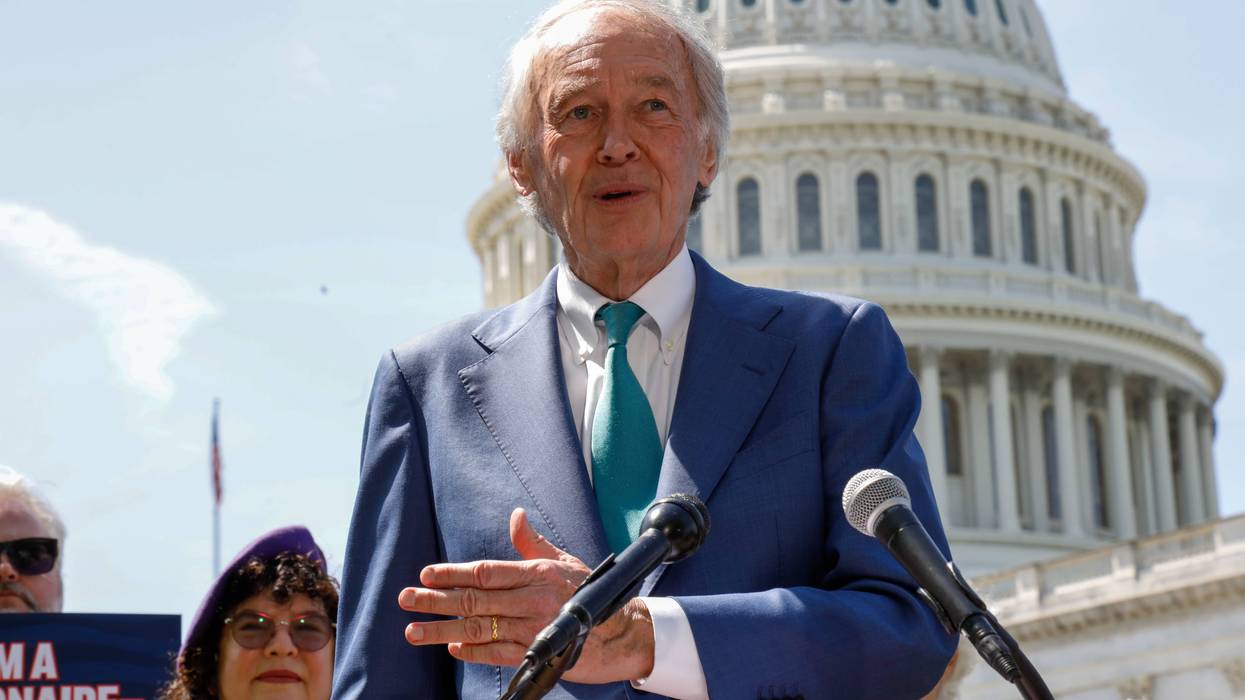
"This is not diplomacy; this is corruption at the expense of US national security."
US President Donald Trump on Monday sent his proposed nuclear agreement with Saudi Arabia to Congress, and a leading Senate Democrat responded on Wednesday with a call for his colleagues to "block this dangerous deal."
That call came from Sen. Ed Markey (D-Mass.), co-chair of the bicameral Nuclear Weapons and Arms Control Working Group.
The 30-year deal was reached in July. It would allow US companies to share nuclear energy technology with Saudi Arabia, without safeguards to ensure that the Middle East kingdom would not use the materials to build nuclear weapons.
Following the White House submission to Congress, first reported by The Wall Street Journal, lawmakers have 90 days of continuous session to review the pact—as required by Section 123 of the Atomic Energy Act—and either object or let it take effect.
Since US Energy Secretary Chris Wright and Saudi Energy Minister Prince Abdulaziz bin Salman signed the deal in July, nonproliferation experts have expressed concerns. Kelsey Davenport from the Arms Control Association said at the time that the "inadequate" deal "sets a terrible precedent" because it "goes against long-standing bipartisan support for negotiating nuclear cooperation agreements that prohibit enrichment and reprocessing," and "Congress should vote to disapprove it."
Markey echoed expert concerns on Wednesday. He said that "as a US senator, Marco Rubio once understood that handing Saudi Arabia the technology to produce nuclear weapons was a terrible idea. But now, as secretary of state, Rubio is doing exactly that, and he and Trump are pursuing the most reckless nuclear deal in US history."
"This giveaway to Saudi Arabia is the starting gun for a Middle East nuclear arms race," he argued. "Congress must reject it."
Markey also said that "if the Trump administration wants to stop a Saudi bomb, it should require the nonproliferation gold standard, which would ban enrichment and reprocessing and require International Atomic Energy Agency additional protocol safeguards in Saudi Arabia. If Riyadh did not want a bomb, it would accept the gold standard. But the opposite is happening."
"Why? Maybe we should ask Saudi ruler Mohammed bin Salman, who has said repeatedly that he wants a nuclear bomb," the senator suggested, before taking aim at the president's son-in-law. "Or maybe we should ask Jared Kushner, who accepted a $2 billion investment from a Saudi sovereign wealth fund after leaving the White House at the end of the first Trump administration."
"This is not diplomacy; this is corruption at the expense of US national security," Markey concluded. "Congress must stop this dangerous agreement before it triggers a new nuclear arms race in the Middle East."
Even if the Republican-controlled Congress doesn't heed warnings from Markey and nonproliferation experts and block the deal, Trump may ultimately do so himself.
Administration officials have confirmed to journalists this week that the president will only let the pact move forward if Saudi Arabia agrees to a condition he imposed only after negotiations: joining the Abraham Accords, an initiative from Trump's first term that led to various countries normalizing diplomatic relations with Israel.
As CNN reported Wednesday:
Wright, speaking at a Wednesday press conference with the head of the International Atomic Energy Agency, said that the nuclear agreement and Abraham Accords negotiations "will be worked in parallel."
A Saudi official responded to a CNN query saying, "Saudi-US relations are ever-evolving and have continued to broaden and to deepen over the years."
"Saudi Arabia is looking forward to working closely with the US administration and Congress on ways to strengthen our partnership," the official added.
Congressional consideration of the agreement comes amid an illegal US-Israeli war on Iran. Trump continues to claim the military campaign is aimed at stopping the Iranian government from building nuclear arms—even though he tore up the Obama administration's related agreement during his first term, and the American intelligence community concluded before the current conflict that Tehran wasn't pursuing such weapons.
Last week, former Republican Georgia Congresswoman Marjorie Taylor Greene claimed that members of Trump's administration "are discussing using nuclear weapons on Iran in strategy meetings." In response, Jamal Abdi, president of the National Iranian American Council, said that "we must shut the Pandora’s box of the Iran War before more horrors are unleashed—including the possible use of nuclear weapons. The longer this catastrophic war of choice continues, the more horrors we risk unleashing that many of us would have previously found unthinkable."
In addition to the United States and Israel, the countries known to have nuclear weapons are China, France, India, North Korea, Pakistan, Russia, and the United Kingdom. According to the Stockholm International Peace Research Institute, as of January, the estimated global inventory of warheads is 12,187—about 9,745 of which are in military stockpiles for potential use.

"We need him in the Senate to help pass Medicare for All and guarantee health care as a human right," Markey added.
Sen. Ed Markey on Wednesday joined the growing list of senators backing Dr. Abdul El-Sayed in next week's critical Democratic primary in Michigan.
“Abdul El-Sayed is the bold progressive leader Michiganders need fighting for them in the Senate. As a doctor and public health leader in Detroit, Abdul has seen firsthand how our broken health care system leaves working families behind, and we need him in the Senate to help pass Medicare for All and guarantee health care as a human right,” Markey (D-Mass.) said.
“Abdul refuses to take corporate PAC money and has earned the support of organized labor because working people know he will put their interests ahead of the billionaires, private equity, and corporate interests that have rigged the system against them," added the senator. "I am proud to endorse Abdul El-Sayed.”
Markey, who is gearing up for his own competitive primary in Massachusetts against the centrist Democratic Rep. Seth Moulton, is now the fifth US senator to endorse El-Sayed, who already has the backing of Sens. Bernie Sanders (I-Vt.), Elizabeth Warren (D-Mass.), Chris Van Hollen (D-Md.), and Tina Smith (D-Minn.).
Other stars of the progressive movement have also put their support behind El-Sayed, including potential 2028 presidential candidate Rep. Alexandria Ocasio-Cortez (D-NY), who has campaigned with him in Michigan in recent weeks.
“Ed Markey has dedicated his life to making government work for the people of Massachusetts,” El-Sayed said in response to the endorsement. "He’s led on bringing climate justice to the forefront of our politics while rejecting money from corporations who want to stop him. His leadership in Congress is unparalleled, and I look forward to joining him in the Senate to get money out of politics, put money in people’s pockets, and pass Medicare for All."
The Michigan primary has grown increasingly contentious in recent weeks as affiliates of the American Israel Public Affairs Committee (AIPAC) have spent a record of at least $30 million running ads boosting Stevens and bashing El-Sayed.
Another dark money group with undisclosed donors and ties to a well-known corporate lobbyist, A Stronger Michigan, has reported spending over $17 million so far to back Stevens, according to Federal Election Commission filings.
With less than a week before Michiganders head to the polls, there remains little clarity about who is favored to face former Republican Rep. Mike Rogers for the seat in a general election that could determine control of the Senate and—perhaps even more critically—serve as proof of concept for an insurgent progressive movement’s ability to win competitive elections in purple states.
A survey published on Wednesday by the Democratic polling firm Tavern Research showed El-Sayed leading 48%-37% over Stevens. This is consistent with polls commissioned earlier this month by pro-El-Sayed groups, which showed similar double-digit leads.
A Detroit News/WDIV-TV poll earlier this month by the Glengariff Group showed Stevens leading El-Sayed by seven points, though it coincided with a previous Tavern poll that showed Stevens edging out El-Sayed by a point, suggesting there could have been a shift toward El-Sayed in recent weeks.
The Tavern polls show a decline in net favorability for both candidates among Democratic voters, but the decline is dramatically worse for Stevens.
While the poll released on July 8 showed Stevens with a net favorability of +40 among Democratic voters, that had deteriorated to just +18 by July 29. El-Sayed's favorability also shrank during that time, but by much less—from +45 to +40.

“Yesterday, we were reminded who the Republicans are: a group of millionaires working for billionaires who will rip healthcare away from those who need it most," said one campaigner.
In what critics called a troubling sign of where US healthcare policy is headed, Senate Republicans on Thursday torpedoed an effort by their Democratic colleagues to block a Trump administration pilot program under which private companies will use artificial intelligence to review—and possibly deny—healthcare to patients seeking certain Medicare services.
Senators voted 50-46 along party lines against a Congressional Review Act resolution introduced by Sen. Ron Wyden (D-Ore.) and supported by 20 Democratic colleagues and Sen. Bernie Sanders (I-Vt.). The resolution was aimed at overturning the Trump administration's final rule establishing the US Centers for Medicare and Medicaid Services’ (CMS) so-called Wasteful and Inappropriate Service Reduction (WISeR) Model.
"Yesterday, I voted to block [President Donald] Trump’s plan to let AI decide whether Medicare will approve or deny your medical care. Every Senate Republican supported Trump’s scheme," Sen. Ed Markey (D-Mass.) said Friday on social media. "Doctors should be deciding what care seniors need—not a computer program."
The AFL-CIO, the nation's largest labor union federation, said on X: "No senior should have to wait weeks to see a doctor because a flawed AI system won’t authorize it. The Trump [administration's] WISeR program is delaying treatment for Medicare patients and putting tech companies’ interests first. Congress must end it."
Alex Jacquez, senior vice president of policy, advocacy, and research at the Groundwork Collaborative, highlighted the "horrendous" WISeR rollout, which, according to KFF, "has created confusion, errors, long wait times, and stress" and has left many patients "ensnared in the same red tape as those with private insurance."
CMS claims WISeR “helps protect American taxpayers by leveraging enhanced technologies, such as artificial intelligence (AI) and machine learning, along with human clinical review, to ensure timely and appropriate Medicare payment for select items and services.”
However, critics warn that AI will make it easier and faster to deny or delay care and have raised concerns that AI would likely be used as a cost-cutting tool to fulfill financial incentives.
“Yesterday, we were reminded who the Republicans are: a group of millionaires working for billionaires who will rip healthcare away from those who need it most," Alex Lawson, executive director of the advocacy group Social Security Works, told Common Dreams on Friday.
"The White House leaned on the Republican senators and they folded like the cheap suits they are," he continued. "Cowards to a person."
Singling out Sen. Josh Hawley, Lawson said the Missouri Republican "pretends he would oppose Medicare delays and denials by algorithm or AI, but when the vote is called dutifully dances to the tune his master calls."
"Their goal is to destroy Medicare, to destroy guaranteed healthcare, to ensure that every facet of the 'healthcare system' serves only one purpose, profit," Lawson said of Republican lawmakers.
Private Medicare Advantage healthcare profiteers have been using AI to deny care for years. Consumers are aware of—and outraged by—the practice.
“I don’t know any senior, Republican or Democrat, who asked President Trump to let AI decide if their doctor-recommended treatment was necessary," Sen. Patty Murray (D-Wash.) said on Thursday.

In a searing rebuke of Trump's self-dealing lawsuit against the IRS, Judge Kathleen Williams wrote that "a court should not be a forum for a party that cynically views a lawsuit as a vehicle to achieve a predetermined outcome."
A progressive US senator on Monday welcomed a federal judge's ruling that found President Donald Trump's $10 billion lawsuit against the Internal Revenue Service was an illegal act of self-dealing, while calling for the Republican to be impeached for a third time.
Trump and his two eldest sons, Donald Trump Jr. and Eric Trump, "acted in bad faith and for an improper purpose by 'collusively filing a lawsuit with claims subject to multiple dispositive defenses solely to provide cover for a collusive settlement,'" US District Judge for the Southern District of Florida Kathleen Williams—who was appointed by former President Barack Obama—wrote in her 56-page ruling.
Sen. Ed Markey (D-Mass.) called Williams' order "a scalding, blistering judicial opinion calling out Trump’s sham litigation, striking down his corrupt IRS immunity, and holding his sycophant lawyers to account."
"That’s a good start," the senator said. "Impeachment is next."
Finding that "sanctions are appropriate here," Williams referred Trump's personal attorney Alejandro Brito to the Florida Bar for "its consideration, review, and determination as to whether any disciplinary action is appropriate in light of the findings and rulings made in this order."
Williams also banned another one of the president's personal lawyers, Daniel Epstein—who is not related to Jeffrey Epstein, the late convicted child sex criminal and former close friend of Trump—from seeking admission to practice law in the Southern District of Florida for one year.
The judge further found that acting US Attorney General Todd Blanche's "apparent capacity to speak for both plaintiffs and defendants, sign a 'settlement' document on behalf of all parties to this action, and then repudiate part of that agreement, demonstrates that there was only one party whose interests were being represented throughout this case."
In January, Trump and his sons sued the Internal Revenue Service and US Treasury Department for $10 billion over the leak of the president's tax returns by a former IRS contractor. Trump’s own Department of Justice (DOJ) then settled the case in May by agreeing to exempt the plaintiffs from future IRS audits and create a roughly $1.776 billion settlement slush fund for people claiming they were unfairly targeted by the government.
Beneficiaries of the so-called "Anti-Weaponization Fund" were expected to include January 6, 2021 Capitol insurrectionists, roughly 1,500 of whom were pardoned by Trump and dozens of whom have since been charged or convicted for serious crimes, including child sex crimes, rape, grand larceny, burglary, home invasion, gun violations, death threats against public officials, and fatal DUI incidents.
Blanche has signaled that the DOJ will no longer pursue the creation of the slush fund.
Williams wrote in her ruling that "certainly, a court should not be a forum for a party that cynically views a lawsuit as a vehicle to achieve a predetermined outcome: 'I’m suing myself."
"President Trump did not pursue his claims until he once again occupied the White House and had appointed his former lawyer, and the former lawyer of persons who are putative beneficiaries of the 'Anti-Weaponization Fund,c' to prominent positions in the DOJ," she continued. "These officials then negotiated on behalf of the United States, with his current lawyers, including his former White House counsel, to reach a 'settlement.' It is risible to suggest that there was ever adverseness between the parties."
“Even the fund amount—$1.776 billion—speaks of a ‘branding’ effort rather than a deliberate and thoughtful calculation of damages,” the judge added.
A spokesperson for Trump's legal team responded to Monday's order in a statement asserting that “the IRS wrongly allowed a rogue, politically motivated employee to leak private and confidential information about President Trump, his family, and the Trump Organization to The New York Times, ProPublica, and other left-wing news outlets, which was then illegally released to millions of people."
"President Trump continues to hold those who wrong America and Americans accountable," the statement added.
Defenders of the rule of law welcomed Monday's ruling, with Robert Weissman and Lisa Gilbert, co-presidents of the consumer advocacy group Public Citizen, taking a swipe at Trump's "brilliant idea of suing the government he runs and resolving the lawsuit with the creation of an illegal and unconstitutional nearly $1.8 billion slush fund, paid for at taxpayer expense and likely to be distributed to January 6 insurrectionists, among others, as well with as an immunity deal protecting Trump and his family from IRS investigation."
"Acting Attorney General Todd Blanche was a willing participant in this fraud on the court and the American people," the pair added. “If the Senate needed an additional reason not to confirm Todd Blanche as attorney general, it just got it.”

"Trump’s dangerous... boondoggle will not protect Americans. It’s just a giveaway to defense contractor buddies like Elon Musk," said US Sen. Ed Markey.
Democratic lawmakers are taking aim at President Donald Trump's proposed “Golden Dome” missile defense system, which the Congressional Budget Office projected last month would cost $1.2 trillion to create, deploy, and operate over the first 20 years of its existence.
Ten members of Congress, led by Sens. Ed Markey (D-Mass.) and Jeff Merkley (D-Ore.) and Reps. John Garamendi (D-Calif.) and Don Beyer (D-Va.), sent a letter to US Defense Secretary Pete Hegseth on Wednesday demanding information on the proposed project's cost to taxpayers and its projected effectiveness.
The letter begins by noting that officials working on the Golden Dome still have not shared key details about the project with the CBO, which the independent agency said has made it "impossible to estimate the long-term cost" of the system.
"It is one thing to withhold design details or performance specifications of certain systems," the letter says, "but it is quite another to withhold the entire system architecture that you expect Congress to approve and fund. Congress and the American public have a right to know what they are paying for."
The letter says that transparency about the system's architecture is particularly important given the questions that have been raised about how successful it would be at halting missile attacks. This is especially true, the letter emphasized, given the administration's insistence that the true cost of the system will be less than one-fifth of the CBO's projections.
"Simply put, there is no way that a Golden Dome system that costs $185 billion could possibly live up to the promise of 'forever ending the missile threat to the American homeland,'" the letter states. "According to CBO’s calculations, even a system that would cost $3 trillion would not meet that ambitious goal, which would need to be able to engage hundreds of missiles. If the administration has not scaled back its goals for the system, the current official price tag is woefully unrealistic."
The letter concludes by asking several questions about the project, including the administration's estimated 20-year cost, the type of system architecture being planned, and the anticipated responses to the missile shield from rival nations including China and Russia.
"We urge you to halt this dangerous plan," the letter says, "and return to the more limited missile defense policies that have earned bipartisan support in the past."
In a separate social media post, Markey pointed out that the project is being used to funnel money to administration allies such as SpaceX CEO Elon Musk, who last week became the world's first trillionaire and is promoting racist far-right political parties throughout the world.
"Trump’s dangerous $1.2 trillion 'Golden Dome' boondoggle will not protect Americans," Markey wrote. "It’s just a giveaway to defense contractor buddies like Elon Musk. We’re demanding answers from Hegseth on Trump’s trillion-dollar scam."
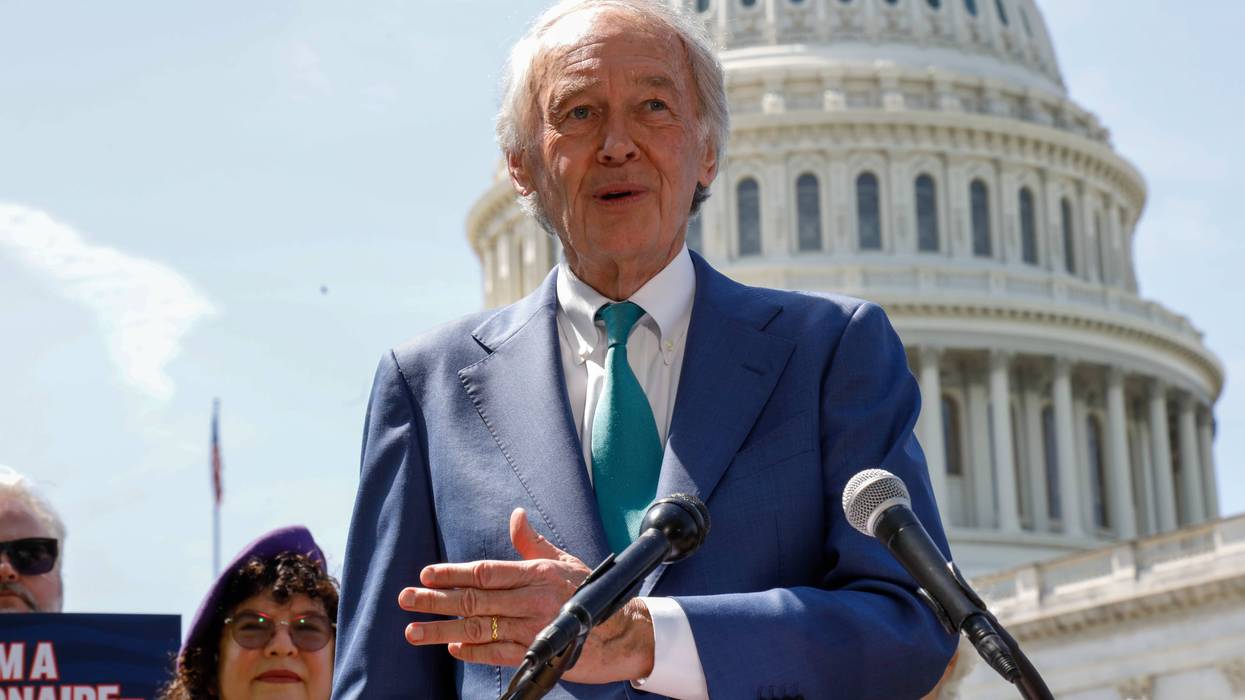
"It’s time to put people before the Pentagon and make major cuts to Trump’s bloated and wasteful defense spending," said Sen. Ed Markey, who introduced the bill.
Democratic US Sen. Ed Markey of Massachusetts took aim Monday at President Donald Trump's illegal war of choice on Iran and request for a record $1.5 trillion in total military-related spending authorization by introducing legislation that would cap the Pentagon budget at half that amount.
Markey introduced the Slash the Pentagon Act at a Capitol Hill press conference that took place "as Americans struggle to pay for healthcare, rent, electricity, groceries, and gas, while Trump has spent over $100 billion on his expensive, dangerous, and unnecessary war with Iran."
“Instead of funding Medicaid and education or investing in veterans’ care, Republicans want to pad the pockets of gold-plated defense contractors with billions more dollars for weapons and wars we do not need,” Markey said at the press conference.
“Just before SpaceX’s IPO made Elon Musk a trillionaire, Trump gave SpaceX billions in contracts for his expensive and ineffective ‘Golden Dome’ system," Markey continued. "Coincidence? No, corruption."
"It’s time to put people before the Pentagon and make major cuts to Trump’s bloated and wasteful defense spending," the senator added. "We should invest in our hospitals, schools, affordable housing, and the real security American families need right now—not expensive wars and weapons that make us less safe.”
Markey's bill comes just days after the Senate Armed Services Committee voted 18-9 to advance the $1.15 trillion National Defense Authorization Act (NDAA) for fiscal year 2027, and the House Appropriations Defense Subcommittee approved the Fiscal Year 2027 Defense Appropriations Bill during a closed-door markup. The House bill provides $1.072 trillion for the Pentagon and other military-related activities, a $234 billion increase from this year’s enacted level.
The Trump administration’s broader national security proposal requests nearly $1.5 trillion in total defense-related spending for 2027, which includes $350 billion in supplemental funding for munitions production, shipbuilding, missile defense, drones, artificial intelligence, and other long-term military programs.
During his press conference, Markey highlighted "better ways to use a $750 billion cut from Trump’s $1.5 trillion military budget":
“For decades we’ve been told there is always enough money for weapons and war but never enough for the challenges our communities face day to day,” said Shayna Lewis, deputy director of Win Without War.
“Now, as families grapple with rising costs, President Trump is demanding an unthinkable $1.5 trillion Pentagon budget—all while brushing aside the concerns and struggles of the American people," Lewis added. "Thankfully, a growing coalition of lawmakers is listening, and gearing up to bring spending back into line with people’s needs.”