

SUBSCRIBE TO OUR FREE NEWSLETTER
Daily news & progressive opinion—funded by the people, not the corporations—delivered straight to your inbox.
5
#000000
#FFFFFF
To donate by check, phone, or other method, see our More Ways to Give page.
Daily news & progressive opinion—funded by the people, not the corporations—delivered straight to your inbox.
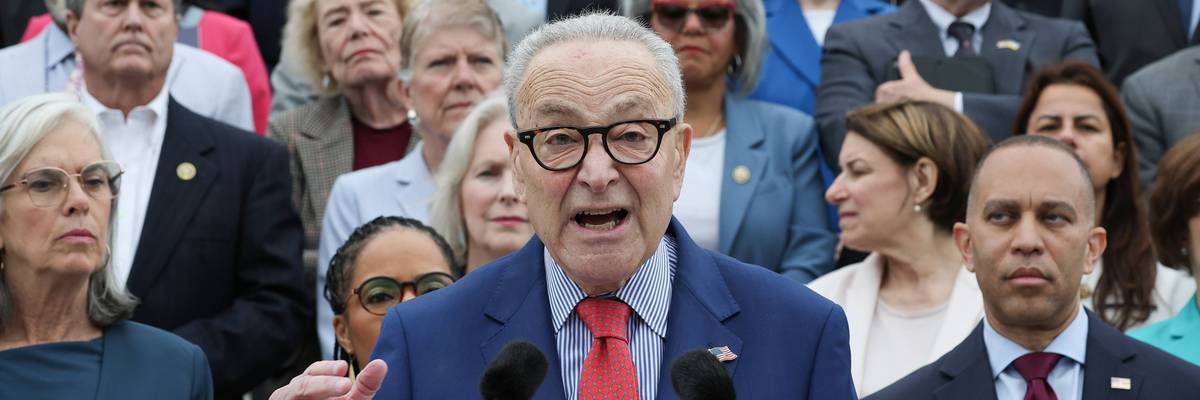
Senate Democratic Leader Chuck Schumer (D-NY) speaks on the steps of the U.S. Senate during an event with congressional Democrats on May 21, 2026 in Washington, DC.
The voters have spoken. They want more than a change in which party controls Congress—they want a change in direction, a break from politics as usual, and leaders willing to challenge entrenched power.
Democrats have just won back control of Congress, delivering a major rebuke to Donald Trump and his policies. But now comes another critical question: Who should lead the new Democratic majority? Let’s look at the Senate.
Chuck Schumer has been in Congress for nearly 46 years—18 in the House and almost 28 in the Senate. He has led Senate Democrats since 2017 and is already declaring that he expects to be reelected majority leader.
But the public is clamoring for new leadership. A recent NBC News poll found that just 13% of voters view Schumer favorably! While most sitting senators seem reluctant to oppose him, eight newly elected Democratic senators—Abdul El-Sayed, Peggy Flanagan, Troy Jackson, Juliana Stratton, Adam Hamilton, James Talarico, Chris Pappas, and Annie Andrews—have either openly opposed Chuck Schumer or withheld their support. And there is a possibility that Senator Van Hollen will put his hat in the ring.
In addition to 10 reasons that Hakeem Jeffries should not be the next Speaker of the House, here are 10 reasons why Schumer should not lead Democrats in the US Senate.
Few issues demonstrate the growing divide between Democratic leaders and their progressive base more clearly than Israel.
Schumer has described himself as a Shomer Yisrael, a guardian of Israel, pledging to fulfill that role “unflinchingly, unstintingly and with all of my strength.” In a March 2024 Senate speech, delivered as Israel's assault on Gaza was provoking worldwide outrage, Schumer declared, “We love Israel in our bones,” and described establishment of the state of Israel as one of the most heartfelt causes of his life.
He has condemned the Boycott, Divestment and Sanctions (BDS) movement and encouraged states to take action against boycotts of Israel.
According to OpenSecrets, Chuck Schumer has received more than $1.7 million in campaign contributions from pro-Israel interests over his congressional career, placing him among the largest recipients of such funding.
In July 2025, as images of starvation and mass civilian suffering in Gaza horrified the world, Bernie Sanders forced Senate votes on resolutions blocking certain weapons sales to Israel. In an extraordinary shift, a majority of Senate Democrats supported restrictions on those transfers. Schumer voted against both resolutions.
Schumer has criticized Netanyahu and Israeli settler violence, yet he continues to support weapons sales to Israel and has not called for ending the nearly $4 billion in annual U.S. military aid—something that, ironically, both Trump and Netanyahu have suggested. Nor has he publicly opposed Section 1217 of the National Defense Authorization Act, which would deepen U.S.-Israeli military integration through joint weapons research, technology development, and defense production.
There’s no way Schumer would lead the Senate in carrying out what the voters want: An end to support for Israel.
Schumer's relationships with wealthy donors are among the most consequential features of his political career. Representing New York, the center of American finance, he has cultivated close ties with Wall Street executives, major banks, investment firms, and powerful corporate interests. His 2022 reelection campaign raised nearly $38 million, including hundreds of thousands of dollars from PACs and employees associated with financial giants Blackstone, KKR, and BlackRock.
These connections go far beyond campaign contributions. Between 1989 and 2010 alone, Schumer received nearly $9 million from the securities and investment industry. In 2007, he helped obstruct efforts to close the notorious carried-interest loophole, which allows wealthy private-equity managers to pay preferential tax rates on certain earnings. That same year, he championed proposals to ease Wall Street regulations—just before the financial crisis devastated millions of American families.
These corporate donors aren't giving money out of charity. They have billions at stake in congressional decisions on taxes, healthcare, financial regulation, and military spending. Schumer may talk about standing up for working people, but how can Democrats credibly challenge corporate greed and Wall Street power when their leader has spent decades cultivating the very industries they claim to confront?
Millions of Americans struggle with medical debt, insurance denials, enormous deductibles, and the constant fear that illness could destroy their financial security. Schumer identified healthcare affordability as one of five major priorities for the new Democratic Congress. Yet he has refused to embrace the real solution: Medicare for All.
In April 2025, Bernie Sanders introduced legislation to establish such a comprehensive national health program that could save an estimated $1 trillion a year by cutting out private insurance companies while guaranteeing healthcare for everyone. Among its original cosponsors were Elizabeth Warren, Cory Booker, Jeff Merkley, and Schumer's fellow New York senator, Kirsten Gillibrand.
Schumer was conspicuously absent and never brought the bill to a Senate floor vote, even when Democrats controlled the chamber.
Instead, he has focused on expanding the Affordable Care Act, providing subsidies to make private insurance more affordable, and lowering prescription drug costs. But those policies preserve a system in which private insurance companies retain enormous power over patients' access to healthcare.
It’s no mystery why. Schumer has received millions in campaign contributions from pharmaceutical and insurance industry interests.
The Democrats–indeed the country–need a leader who will start laying the groundwork for Medicare for All now so it can become a reality in 2029 under a new president.
At a time when voters are demanding bold new leadership, Chuck Schumer has repeatedly failed to embrace progressive candidates who are energizing the Democratic Party.
Perhaps the most glaring example is Zohran Mamdani. Even after Mamdani won the Democratic primary for New York City mayor and inspired an extraordinary grassroots movement, Schumer NEVER endorsed him. Even on Election Day, he refused to say whether he had voted for his own party's nominee. What an astonishing failure by New York's senior senator to support such an exciting new leader!
In Michigan, Schumer backed establishment favorite Haley Stevens over progressive Abdul El-Sayed, who defeated her in the Democratic Senate primary. Just two days before the general election, Stevens shocked Democrats by endorsing Republican Mike Rogers. Schumer condemned her betrayal, but the episode raised serious questions about his political judgment.
In Florida, progressive Angie Nixon proved to be a remarkable candidate, coming within three percentage points of defeating Republican Senator Ashley Moody in a state Trump had won by 13 points. Bernie Sanders held four rallies for Nixon, but the Democratic Senatorial Campaign Committee provided no financial assistance. Schumer failed to champion a candidate who, with stronger national support, might have delivered one of the election's most stunning victories.
In Mississippi, Scott Colom mounted an extraordinary challenge to Republican Cindy Hyde-Smith in a state that hasn't elected a Democratic senator since 1982. Yet national party support came only late in the campaign, despite Colom's unexpectedly strong showing.
These races raise a fundamental question: Why does Schumer repeatedly fail to recognize and invest in dynamic candidates who could transform the Democratic Party? Instead of nurturing emerging talent, he has too often backed establishment favorites or stood on the sidelines while grassroots movements lead the way..
While Americans struggle with soaring living costs, Washington continues pouring extraordinary sums into the Pentagon and the military contractors that profit from war.
For fiscal year 2027, Trump proposed an astonishing $1.5 trillion military budget. Schumer opposed the increase but has not made significant cuts to military spending a central Democratic priority.
Schumer has also been an unwavering defender of NATO and a leading advocate for military assistance to Ukraine. He has repeatedly attacked Trump for being “soft on Russia,” demanding tougher sanctions against Moscow and greater military support for Ukraine. He helped push through tens of billions of dollars in military aid and opposed interruptions in weapons shipments. Rather than making negotiations to end the war his central priority, Schumer has consistently emphasized military assistance, economic pressure, and strengthening NATO.
The next Democratic majority should challenge the enormous power of the military-industrial complex and redirect resources toward healthcare, housing, education, and other urgent needs. This is unlikely to happen with Chuck Schumer at the helm.
6. He won’t call for ICE to be dismantled
While Trump has escalated his immigration crackdown, Schumer has focused primarily on calls to reform ICE rather than abolish the agency. Senator Ed Markey has explicitly demanded that ICE be defunded and abolished, while Bernie Sanders has called for eliminating tens of billions in additional funding. Senator Andy Kim has repeatedly visited detention facilities, spoken directly with detainees, and fought to shut down Newark's notorious Delaney Hall. Senator Chris Van Hollen even traveled to El Salvador to fight for the return of a wrongfully deported Maryland resident.
Schumer has spoken out against ICE abuses, opposed a new detention facility in New York, and helped advocate for the release of Bronx student Dylan Lopez Contreras. But as Senate Democratic leader, his approach has centered on reforming ICE rather than dismantling it.
That is simply not enough. With Stephen Miller, the architect of Trump's mass deportation agenda and one of the most virulently anti-immigrant figures in American politics, now elevated to White House chief of staff, the danger to immigrant communities has only intensified. This is no time for timid reforms or half-measures. Democrats need Senate leadership willing to demand the abolition of ICE.
In October 2002, Schumer voted to authorize President George W. Bush to invade Iraq.
In the lead-up to the Iraq War, millions of Americans took to the streets in protest, including hundreds of thousands in New York City on February 15, 2003, in one of the largest anti-war demonstrations in U.S. history. Despite this massive outpouring of opposition from his own constituents, Schumer had voted to authorize the disastrous war and went on to support billions of dollars in additional war funding.
The invasion, launched on the basis of lies about weapons of mass destruction, became one of America's greatest foreign policy disasters. It killed enormous numbers of Iraqis, displaced millions, destabilized the region, and cost the United States trillions of dollars and thousands of American lives.
The historical record matters, especially as Congress again confronts questions of war, presidential power, and military intervention. His vote to authorize that disastrous war remains an essential part of evaluating his foreign policy judgment.
In 2015, Schumer broke with President Barack Obama to oppose the Iran nuclear agreement, widely regarded as Obama's signature foreign policy achievement. The deal was a major diplomatic breakthrough, designed to prevent Iran from developing nuclear weapons without resorting to war. Yet Schumer sided with Republicans and hardline opponents of the agreement, provoking a fierce backlash from progressives and supporters of diplomacy.
His opposition raises an important question today: Does Schumer genuinely support a diplomatic resolution to the war with Iran, or is his opposition primarily driven by the fact that it is Trump's war? His record of opposing one of the most significant diplomatic opportunities with Iran casts doubt on his commitment to pursuing diplomacy over military confrontation.
In March 2025, Democrats faced one of their first major confrontations with Trump's second administration. Republicans pushed through a government funding bill that Democrats had little role in writing, while Trump and Elon Musk were dismantling federal agencies and threatening essential public services.
Democrats had leverage in the Senate, where Republicans needed their votes to overcome a filibuster. But rather than insist on concessions, Schumer announced he would help advance the Republican bill.
The backlash was enormous. Progressive organizations called for his resignation, House Democrats erupted in anger, and even Nancy Pelosi publicly broke with Schumer.
Schumer argued that a government shutdown would give Trump and Musk even more freedom to dismantle the federal government. But his critics saw a fundamental failure of leadership: Democrats had an opportunity to confront the administration and instead helped pass its funding legislation.
The episode became a defining moment in Schumer's leadership—and a source of lasting doubts about how aggressively he will confront Trump in future battles.
Schumer's record reflects the limits of an establishment Democratic Party that too often compromises with powerful corporate interests.
In 2022, Schumer struck a deal with Senator Joe Manchin to fast-track energy projects, including fossil fuel infrastructure, provoking outrage from environmental justice groups. In 2024, he championed a bipartisan immigration bill that would have sharply restricted asylum protections.
And now, in November 2026, Schumer voted to advance legislation that environmental groups have dubbed the “dirty data center deal.” The bill would accelerate permitting for massive AI data centers, pipelines, and other energy infrastructure while weakening environmental protections. Tribal leaders warn that it would also undermine tribal sovereignty by weakening consultation requirements and making it harder for Indigenous communities to protect their ancestral lands, cultural heritage, and sacred sites. Despite protests by environmental and Indigenous rights groups, Schumer voted to move the legislation forward, arguing that the bill could lower energy costs.
Democrats face a fundamental choice between accommodating powerful industries and protecting communities, workers, and the environment.
Schumer’s incremental reforms in areas such as climate investments, prescription drugs, and infrastructure legislation are no substitute for confronting the enormous power of corporations and billionaires.
The voters have spoken. They want more than a change in which party controls Congress—they want a change in direction, a break from politics as usual, and leaders willing to challenge entrenched power.
Will Democrats in the Senate embrace the change voters demanded, or return to the same old leadership that has failed to deliver it?
This country and this world are at a monumental crossroads. US voters have an opportunity to beat back the forces of fascism and confront the billionaires who are rigging the economy, our media system, and our democracy, making it increasingly impossible for ordinary people to get by. We’re not just talking about the election. We’re talking about what must be done once these fascist elements are vanquished from power. We need a bolder set of solutions than what either major party has so far been willing to offer and a working-class movement ready to fight like hell for it. Trump didn't emerge from nowhere. The conditions that fueled MAGA authoritarianism were created by decades of radical neoliberal economic policies and a corrupt political system dominated by corporate interests. They slashed taxes on the super-rich, promising that the benefits would trickle down. They said giveaways to the corporate titans would make life more affordable for the rest of us. It was all bullshit. And when a bitter, betrayed populace searches for someone to blame, right-wing demagogues have little trouble finding scapegoats. People know when they're being lied to, but you won't hear any of this from the corporate media. Only independent journalism—powered and funded by people who believe in building a better world—can deliver truly trustworthy daily news. If you share our vision, please contribute whatever you can to sustain our work. |
Democrats have just won back control of Congress, delivering a major rebuke to Donald Trump and his policies. But now comes another critical question: Who should lead the new Democratic majority? Let’s look at the Senate.
Chuck Schumer has been in Congress for nearly 46 years—18 in the House and almost 28 in the Senate. He has led Senate Democrats since 2017 and is already declaring that he expects to be reelected majority leader.
But the public is clamoring for new leadership. A recent NBC News poll found that just 13% of voters view Schumer favorably! While most sitting senators seem reluctant to oppose him, eight newly elected Democratic senators—Abdul El-Sayed, Peggy Flanagan, Troy Jackson, Juliana Stratton, Adam Hamilton, James Talarico, Chris Pappas, and Annie Andrews—have either openly opposed Chuck Schumer or withheld their support. And there is a possibility that Senator Van Hollen will put his hat in the ring.
In addition to 10 reasons that Hakeem Jeffries should not be the next Speaker of the House, here are 10 reasons why Schumer should not lead Democrats in the US Senate.
Few issues demonstrate the growing divide between Democratic leaders and their progressive base more clearly than Israel.
Schumer has described himself as a Shomer Yisrael, a guardian of Israel, pledging to fulfill that role “unflinchingly, unstintingly and with all of my strength.” In a March 2024 Senate speech, delivered as Israel's assault on Gaza was provoking worldwide outrage, Schumer declared, “We love Israel in our bones,” and described establishment of the state of Israel as one of the most heartfelt causes of his life.
He has condemned the Boycott, Divestment and Sanctions (BDS) movement and encouraged states to take action against boycotts of Israel.
According to OpenSecrets, Chuck Schumer has received more than $1.7 million in campaign contributions from pro-Israel interests over his congressional career, placing him among the largest recipients of such funding.
In July 2025, as images of starvation and mass civilian suffering in Gaza horrified the world, Bernie Sanders forced Senate votes on resolutions blocking certain weapons sales to Israel. In an extraordinary shift, a majority of Senate Democrats supported restrictions on those transfers. Schumer voted against both resolutions.
Schumer has criticized Netanyahu and Israeli settler violence, yet he continues to support weapons sales to Israel and has not called for ending the nearly $4 billion in annual U.S. military aid—something that, ironically, both Trump and Netanyahu have suggested. Nor has he publicly opposed Section 1217 of the National Defense Authorization Act, which would deepen U.S.-Israeli military integration through joint weapons research, technology development, and defense production.
There’s no way Schumer would lead the Senate in carrying out what the voters want: An end to support for Israel.
Schumer's relationships with wealthy donors are among the most consequential features of his political career. Representing New York, the center of American finance, he has cultivated close ties with Wall Street executives, major banks, investment firms, and powerful corporate interests. His 2022 reelection campaign raised nearly $38 million, including hundreds of thousands of dollars from PACs and employees associated with financial giants Blackstone, KKR, and BlackRock.
These connections go far beyond campaign contributions. Between 1989 and 2010 alone, Schumer received nearly $9 million from the securities and investment industry. In 2007, he helped obstruct efforts to close the notorious carried-interest loophole, which allows wealthy private-equity managers to pay preferential tax rates on certain earnings. That same year, he championed proposals to ease Wall Street regulations—just before the financial crisis devastated millions of American families.
These corporate donors aren't giving money out of charity. They have billions at stake in congressional decisions on taxes, healthcare, financial regulation, and military spending. Schumer may talk about standing up for working people, but how can Democrats credibly challenge corporate greed and Wall Street power when their leader has spent decades cultivating the very industries they claim to confront?
Millions of Americans struggle with medical debt, insurance denials, enormous deductibles, and the constant fear that illness could destroy their financial security. Schumer identified healthcare affordability as one of five major priorities for the new Democratic Congress. Yet he has refused to embrace the real solution: Medicare for All.
In April 2025, Bernie Sanders introduced legislation to establish such a comprehensive national health program that could save an estimated $1 trillion a year by cutting out private insurance companies while guaranteeing healthcare for everyone. Among its original cosponsors were Elizabeth Warren, Cory Booker, Jeff Merkley, and Schumer's fellow New York senator, Kirsten Gillibrand.
Schumer was conspicuously absent and never brought the bill to a Senate floor vote, even when Democrats controlled the chamber.
Instead, he has focused on expanding the Affordable Care Act, providing subsidies to make private insurance more affordable, and lowering prescription drug costs. But those policies preserve a system in which private insurance companies retain enormous power over patients' access to healthcare.
It’s no mystery why. Schumer has received millions in campaign contributions from pharmaceutical and insurance industry interests.
The Democrats–indeed the country–need a leader who will start laying the groundwork for Medicare for All now so it can become a reality in 2029 under a new president.
At a time when voters are demanding bold new leadership, Chuck Schumer has repeatedly failed to embrace progressive candidates who are energizing the Democratic Party.
Perhaps the most glaring example is Zohran Mamdani. Even after Mamdani won the Democratic primary for New York City mayor and inspired an extraordinary grassroots movement, Schumer NEVER endorsed him. Even on Election Day, he refused to say whether he had voted for his own party's nominee. What an astonishing failure by New York's senior senator to support such an exciting new leader!
In Michigan, Schumer backed establishment favorite Haley Stevens over progressive Abdul El-Sayed, who defeated her in the Democratic Senate primary. Just two days before the general election, Stevens shocked Democrats by endorsing Republican Mike Rogers. Schumer condemned her betrayal, but the episode raised serious questions about his political judgment.
In Florida, progressive Angie Nixon proved to be a remarkable candidate, coming within three percentage points of defeating Republican Senator Ashley Moody in a state Trump had won by 13 points. Bernie Sanders held four rallies for Nixon, but the Democratic Senatorial Campaign Committee provided no financial assistance. Schumer failed to champion a candidate who, with stronger national support, might have delivered one of the election's most stunning victories.
In Mississippi, Scott Colom mounted an extraordinary challenge to Republican Cindy Hyde-Smith in a state that hasn't elected a Democratic senator since 1982. Yet national party support came only late in the campaign, despite Colom's unexpectedly strong showing.
These races raise a fundamental question: Why does Schumer repeatedly fail to recognize and invest in dynamic candidates who could transform the Democratic Party? Instead of nurturing emerging talent, he has too often backed establishment favorites or stood on the sidelines while grassroots movements lead the way..
While Americans struggle with soaring living costs, Washington continues pouring extraordinary sums into the Pentagon and the military contractors that profit from war.
For fiscal year 2027, Trump proposed an astonishing $1.5 trillion military budget. Schumer opposed the increase but has not made significant cuts to military spending a central Democratic priority.
Schumer has also been an unwavering defender of NATO and a leading advocate for military assistance to Ukraine. He has repeatedly attacked Trump for being “soft on Russia,” demanding tougher sanctions against Moscow and greater military support for Ukraine. He helped push through tens of billions of dollars in military aid and opposed interruptions in weapons shipments. Rather than making negotiations to end the war his central priority, Schumer has consistently emphasized military assistance, economic pressure, and strengthening NATO.
The next Democratic majority should challenge the enormous power of the military-industrial complex and redirect resources toward healthcare, housing, education, and other urgent needs. This is unlikely to happen with Chuck Schumer at the helm.
6. He won’t call for ICE to be dismantled
While Trump has escalated his immigration crackdown, Schumer has focused primarily on calls to reform ICE rather than abolish the agency. Senator Ed Markey has explicitly demanded that ICE be defunded and abolished, while Bernie Sanders has called for eliminating tens of billions in additional funding. Senator Andy Kim has repeatedly visited detention facilities, spoken directly with detainees, and fought to shut down Newark's notorious Delaney Hall. Senator Chris Van Hollen even traveled to El Salvador to fight for the return of a wrongfully deported Maryland resident.
Schumer has spoken out against ICE abuses, opposed a new detention facility in New York, and helped advocate for the release of Bronx student Dylan Lopez Contreras. But as Senate Democratic leader, his approach has centered on reforming ICE rather than dismantling it.
That is simply not enough. With Stephen Miller, the architect of Trump's mass deportation agenda and one of the most virulently anti-immigrant figures in American politics, now elevated to White House chief of staff, the danger to immigrant communities has only intensified. This is no time for timid reforms or half-measures. Democrats need Senate leadership willing to demand the abolition of ICE.
In October 2002, Schumer voted to authorize President George W. Bush to invade Iraq.
In the lead-up to the Iraq War, millions of Americans took to the streets in protest, including hundreds of thousands in New York City on February 15, 2003, in one of the largest anti-war demonstrations in U.S. history. Despite this massive outpouring of opposition from his own constituents, Schumer had voted to authorize the disastrous war and went on to support billions of dollars in additional war funding.
The invasion, launched on the basis of lies about weapons of mass destruction, became one of America's greatest foreign policy disasters. It killed enormous numbers of Iraqis, displaced millions, destabilized the region, and cost the United States trillions of dollars and thousands of American lives.
The historical record matters, especially as Congress again confronts questions of war, presidential power, and military intervention. His vote to authorize that disastrous war remains an essential part of evaluating his foreign policy judgment.
In 2015, Schumer broke with President Barack Obama to oppose the Iran nuclear agreement, widely regarded as Obama's signature foreign policy achievement. The deal was a major diplomatic breakthrough, designed to prevent Iran from developing nuclear weapons without resorting to war. Yet Schumer sided with Republicans and hardline opponents of the agreement, provoking a fierce backlash from progressives and supporters of diplomacy.
His opposition raises an important question today: Does Schumer genuinely support a diplomatic resolution to the war with Iran, or is his opposition primarily driven by the fact that it is Trump's war? His record of opposing one of the most significant diplomatic opportunities with Iran casts doubt on his commitment to pursuing diplomacy over military confrontation.
In March 2025, Democrats faced one of their first major confrontations with Trump's second administration. Republicans pushed through a government funding bill that Democrats had little role in writing, while Trump and Elon Musk were dismantling federal agencies and threatening essential public services.
Democrats had leverage in the Senate, where Republicans needed their votes to overcome a filibuster. But rather than insist on concessions, Schumer announced he would help advance the Republican bill.
The backlash was enormous. Progressive organizations called for his resignation, House Democrats erupted in anger, and even Nancy Pelosi publicly broke with Schumer.
Schumer argued that a government shutdown would give Trump and Musk even more freedom to dismantle the federal government. But his critics saw a fundamental failure of leadership: Democrats had an opportunity to confront the administration and instead helped pass its funding legislation.
The episode became a defining moment in Schumer's leadership—and a source of lasting doubts about how aggressively he will confront Trump in future battles.
Schumer's record reflects the limits of an establishment Democratic Party that too often compromises with powerful corporate interests.
In 2022, Schumer struck a deal with Senator Joe Manchin to fast-track energy projects, including fossil fuel infrastructure, provoking outrage from environmental justice groups. In 2024, he championed a bipartisan immigration bill that would have sharply restricted asylum protections.
And now, in November 2026, Schumer voted to advance legislation that environmental groups have dubbed the “dirty data center deal.” The bill would accelerate permitting for massive AI data centers, pipelines, and other energy infrastructure while weakening environmental protections. Tribal leaders warn that it would also undermine tribal sovereignty by weakening consultation requirements and making it harder for Indigenous communities to protect their ancestral lands, cultural heritage, and sacred sites. Despite protests by environmental and Indigenous rights groups, Schumer voted to move the legislation forward, arguing that the bill could lower energy costs.
Democrats face a fundamental choice between accommodating powerful industries and protecting communities, workers, and the environment.
Schumer’s incremental reforms in areas such as climate investments, prescription drugs, and infrastructure legislation are no substitute for confronting the enormous power of corporations and billionaires.
The voters have spoken. They want more than a change in which party controls Congress—they want a change in direction, a break from politics as usual, and leaders willing to challenge entrenched power.
Will Democrats in the Senate embrace the change voters demanded, or return to the same old leadership that has failed to deliver it?

