

SUBSCRIBE TO OUR FREE NEWSLETTER
Daily news & progressive opinion—funded by the people, not the corporations—delivered straight to your inbox.
5
#000000
#FFFFFF
To donate by check, phone, or other method, see our More Ways to Give page.
Daily news & progressive opinion—funded by the people, not the corporations—delivered straight to your inbox.
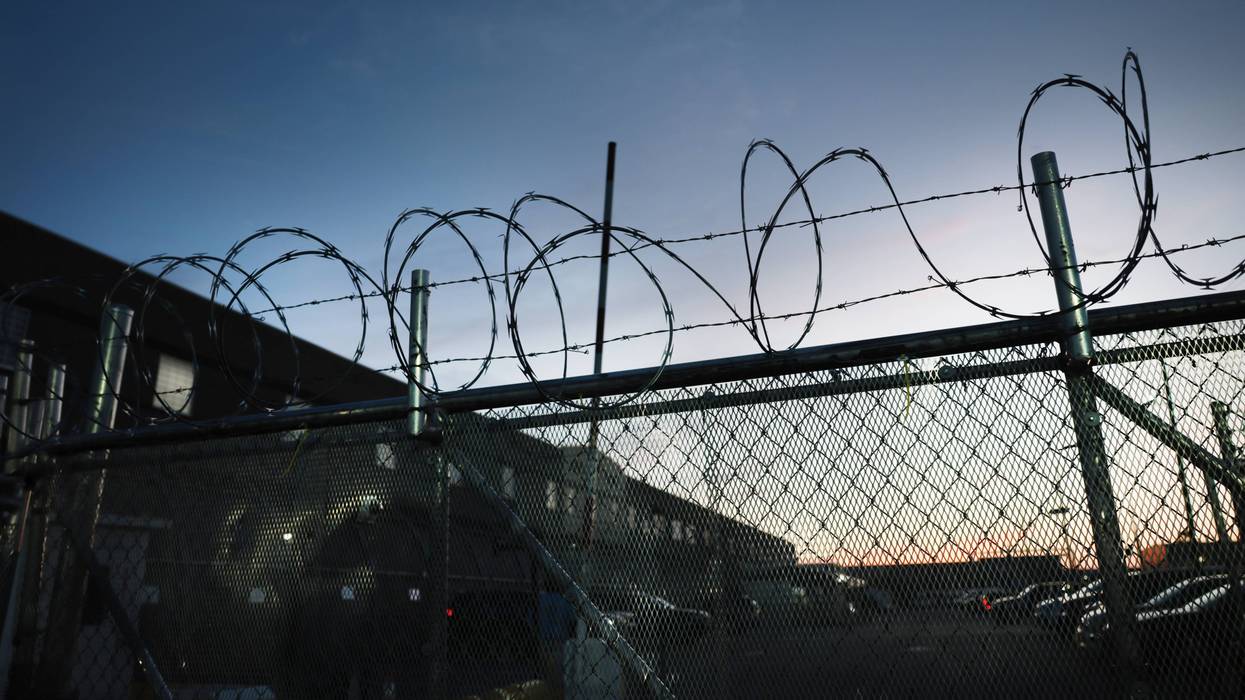
"Without knowing their client’s detention location, attorneys cannot file time-sensitive habeas petitions... This policy change therefore raises deep concerns regarding violations of immigration, legal, and civil rights."
Following multiple recent reports of people who have been detained by federal immigration agents under the Trump administration disappearing from the government's tracking system, the progressive lawmaker who is pushing to become the leader of the Democratic Party's new majority in the US Senate was among those demanding on Monday that officials investigate how thousands of names have vanished—and warned that the administration is depriving those detainees of their constitutional rights.
Sen. Chris Van Hollen (D-Md.)—who is challenging Senate Minority Leader Chuck Schumer (D-NY) for the leadership role—joined Sens. Elizabeth Warren (D-Mass.) and Ben Ray Luján (D-NM) in leading 21 Democrats and Independents in a letter to Joseph Cuffari, the inspector general of the US Department of Homeland Security (DHS).
Their letter, dated Sunday, came two months after The Associated Press reported that US Immigration and Customs Enforcement (ICE) had abruptly stopped listing people with final deportation orders in its Online Detainee Locator System (ODLS).
The locator system, which was created by ICE, has been "critical in allowing detainees access to legal representation and their loved ones," said the senators, who also included Sens. Bernie Sanders (I-Vt.), Ed Markey (D-Mass.), and Tina Smith (D-Minn.).
But suddenly, “an official government policy of disappearing people," as one senior fellow at the Center for American Progress said, appeared to emerge in September when the names of people with final removal orders were no longer visible in the ODLS, and the locations of newly arrested people were hidden from view.
Legal experts warned that failing to make detainees' locations known to their legal representatives and families could violate their habeas corpus rights. The senators said in their letter that with the new practice, ICE is not "meeting its stated policy of updating its database “within eight hours of the release, removal, or transfer of detainees."
In a Monday statement, Warren's office noted that ICE appeared to have "deliberately changed its policy to exclude people with final removal orders from the locator system," and said the senators wanted Cuffari "to determine when the change was made and how many detainees have been affected."
Warren noted that she has led numerous investigations into the Trump administration's immigration enforcement practices, while Van Hollen was lauded last year for traveling to El Salvador to advocate for the release of his constituent, Kilmar Ábrego García, who had been wrongly deported.
The recent news reports about the absence of detainees' names and locations in the ODLS "suggest that the problem is not just one of delays or glitches but instead, DHS appears to have made an intentional policy change—without any warning to the public," wrote the senators.
"Without knowing their client’s detention location, attorneys cannot file time-sensitive habeas petitions in the proper venue and cannot intervene to challenge third-country removals," they continued. "Families and attorneys are now left scrambling to find out where the affected detainees have been taken. This policy change therefore raises deep concerns regarding violations of immigration, legal, and civil rights by the US government."
The lawmakers noted that the apparent policy change began as ICE arrests were at a "record high," with more than 50,000 people arrested in August and nearly 500,000 arrests in the 2026 fiscal year. In July, ICE was detaining more than 65,000 people in hundreds of detention centers across the country, and an estimated 30% of those people faced final removal orders.
The names also disappeared at a time when deaths in ICE detention are at a 20-year high, with at least 32 people having died while in the agency's custody this year, and the senators warned that removing people from the ODLS could put many at grave risk of physical harm.
"In one reported case, a woman with epilepsy and a history of seizures was transferred across the country without notifying her family and legal counsel," said the senators. "She became seriously ill and required oxygen during transit, but her treatment was delayed because ICE failed to inform the receiving facility about her medical conditions despite its stated transfer policy. Amid growing reports of medical neglect in detention, ICE’s failure to notify facilities and attorneys can be deadly."
"Many more lives could suffer in silence because help cannot reach them," they added.
The lawmakers demanded to know how many people's names have been removed from the ODLS, whether ICE has instructed personnel not to provide detainees' names and locations to family members and lawyers, and whether detainees have been transferred, deported, or faced medical emergencies since their records disappeared from the system.
"Your investigation," the lawmakers told Cuffari, "would help inform legislative efforts to pursue immigration reform and would
be consistent with your mission to 'provide independent oversight and promote excellence, integrity, and accountability within DHS.'"

"Workers should never have to choose between a healthy pregnancy and keeping their jobs," said one critic.
Advocates for workers' and women's rights are crying foul after a federal court last week struck down a landmark bill providing protections for pregnant employees.
In a Friday ruling, the 5th Circuit Court of Appeals declared that Congress violated the US Constitution when it passed the Pregnant Workers Fairness Act in 2022 without a majority of members physically present during the vote.
At the time, the US House of Representatives was operating under rules adopted during the Covid-19 pandemic that allowed lawmakers to vote by proxy.
The court's ruling invalidates the law in Texas, Louisiana, and Mississippi, and "could imperil" protections elsewhere, according to a Sunday report in The Associated Press.
Among other things, the Pregnant Workers Fairness Act mandates that employers "make reasonable accommodations to the known limitations related to the pregnancy, childbirth, or related medical conditions," while also making it unlawful to deny employment opportunities if "such denial is based on the need... to make reasonable accommodations" for pregnant workers.
Inimai Chettiar, president of worker advocacy group A Better Balance, said the 5th Circuit's ruling "effectively erases essential rights to pregnancy accommodations for workers," while putting "the health, livelihoods, and economic security of millions of American women and their families at risk."
"Workers should never have to choose between a healthy pregnancy and keeping their jobs," Chettiar emphasized. "This decision could force countless women out of the workforce at a moment and is made even worse by the fact that the Trump administration is already poised to gut the regulations governing the law."
The New York Times reported earlier this month that the Trump administration is planning to roll back some protections guaranteed in the law.
Although the administration is "not expected to eliminate requirements that most directly protect women during pregnancy," it could "eliminate explicit protections for conditions" related to fertility treatments, abortion, and menstruation, according to the Times.
Jessica Lee, co-director of the Center for WorkLife Law at UC Law San Francisco, spelled out the impacts that the law's invalidation will have on workers, noting that "it frees the state to deny pregnant women it employs a water bottle, a stool, or time off after a miscarriage."
"This ruling tips the first domino," Lee warned. "Some employers in Texas, Louisiana, and Mississippi, home to about 20 million women, will try to use this ruling to escape legal liability for saying no when a pregnant woman asks for a break from heavy lifting or time off for a prenatal appointment."
California Secretary of Business and Consumer Services Rohit Chopra noted that he wasn't surprised by the 5th Circuit's ruling because it "has a reputation for routinely siding with corporate lobbyists at the expense of consumers, workers, and small businesses across the country."
"As we think about ways to root out corruption in our country," Chopra added, "we need to make sure that courts at every level uphold the rule of law, rather than side with special interests."

Joe Kasper, who served Hegseth for three months at the start of the Trump administration, said he'd "overindulged in ego, in attitude, and in entitlement."
Defense Secretary Pete Hegseth’s former chief of staff is calling for the top Pentagon official to resign over what the aide described as a “shitshow” in Iran and Hegseth’s “belligerent” leadership of the department.
Joe Kasper, who served as Hegseth’s chief of staff during the first three months of the Trump administration, told Politico in an interview published Monday that the self-styled “secretary of war” has “overindulged in ego, in attitude, and in entitlement.”
Over the course of nearly an hour, Kasper savaged Hegseth over his purges of senior military personnel, his blocking of promotions for Black and female leaders, and his obsession with “distractions” like measuring soldiers’ testosterone levels.
EXCLUSIVE: The former chief of staff to Defense Secretary Pete Hegseth, Joe Kasper, is calling on him to resign, telling me he has badly mismanaged both the Pentagon and his “shitshow” war in Iran. He said Hegseth has prioritized showmanship over his job. https://t.co/QK5YIcLIiL
— Daniel Lippman (@dlippman) November 23, 2026
“There’s quite an emphasis on the showmanship,” he said. “The virtues of humility and basically service before self and those things have disappeared. I didn’t see those at the start, and see them ever less so now.”
Kasper said he realized within his first week on the job in early 2025 that it was “all about Pete rather than the institution and the men and women who support it.”
That spring, Kasper was embroiled in a bitter power struggle with three other Pentagon officials—senior adviser Dan Caldwell, Hegseth’s deputy chief of staff Darin Selnick, and Colin Carroll, chief of staff to Deputy Defense Secretary Stephen Feinberg. All three were fired in April 2025 after they were accused of leaking sensitive information, including details of US military planning to “reclaim” the Panama Canal.
Kasper, who led the charge for their ouster, also left his full-time post that month. Hegseth has insisted that Kasper was not fired and has publicly defended him as a “great guy.”
Kasper now says there was no evidence that the men he accused had leaked information. An internal investigation also found no evidence of leaks by the three men, according to The New York Times. Caldwell later rejoined the administration in the Office of the Director of National Intelligence.
A senior Pentagon official dismissed Kasper’s criticism on Monday as “gossip” from a “disgruntled former staffer—someone who could barely survive 90 days in the building.”
“Secretary Hegseth is laser-focused on restoring lethality to the force and supporting our warfighters, while Mr. Kasper is more focused on rewriting history to cover for his own failed tenure,” the official said.
Kasper, however, suggested that Hegseth’s power is already waning. Democrats are preparing to inundate the Pentagon with subpoenas over Hegseth’s role in launching the unauthorized war on Iran, now in its ninth month despite early promises that it would last mere weeks. Other targets include his campaign of extrajudicial boat strikes, which have killed over 200 people in the Caribbean and Pacific, and the department’s award of military contracts to members of President Donald Trump’s family and to his allies.
“Pete’s ability to be effective has been constrained, and very soon he’ll have lost any ability to be effective,” Kasper said. “For that reason and others, it’s time for Pete to call it quits.”
Exclusive: Sen. Ernst rebukes lack of "transparency" from Pentagon on Iran https://t.co/g0Cn1QCyME
— Axios (@axios) November 19, 2026
Lawmakers in both parties have criticized Hegseth. Earlier this month, the House narrowly rejected a bid to advance eight articles of impeachment against him brought by Rep. Thomas Massie (R-Ky.), a leading GOP critic of Trump’s foreign policy. Massie said Hegseth would “remain a threat to the Constitution if allowed to remain in office.” He dismissed the idea that Hegseth’s problem was a lack of effectiveness.
"In fact, he was very effective at killing schoolchildren in Iran," Massie said.
Even some Republicans who support the broad outlines of the Trump administration’s aggressive foreign policy have criticized Hegseth’s extreme secrecy and hostility toward congressional oversight. Hegseth has excluded Democratic members of Congress from classified briefings, withheld information about the costs, casualties, and objectives of the war on Iran, and repeatedly denied requests for evidence in investigations into the boat strikes.
In a memoir released in October, outgoing Sen. Thom Tillis (R-NC) said his vote to confirm Hegseth was his “biggest regret.” In a separate interview, Tillis said the secretary “takes [Congress] for granted, and... treats us more like a manufacturing line in his company than his board of directors.”
Sen. Joni Ernst (R-Iowa), who is also retiring, said last week that “a lot of people would be able to guess” that she regretted voting to confirm Hegseth. She added that there is “very little transparency right now with what is being discussed between the White House and the Department of War.”
Kasper suggested Hegseth has nobody to blame but himself for the rupture with Congress.
“He’s not just burned bridges up on the Hill,” he said. “He’s napalmed them… He’s going to be suffocated, and it’s not like it’s going to be a slow suffocation. It’s going to be a quick asphyxiation.”
Should Hegseth remain in office, the incoming Democratic majority in the House could revive the impeachment effort. If the House impeaches him, it would take a two-thirds vote of senators present to remove him. With Democrats expected to hold 56 Senate seats beginning in January, potentially as few as 11 Republicans may be needed to remove Hegseth from office.
"The goal, for me, is to get Pete Hegseth removed as the head of the Department of Defense," Rep. Jason Crow (D-Colo.), who sits on the House Armed Services and Intelligence committees, told The Atlantic last week. "Every day he sits atop the DOD is a day that our service members don’t have the leadership, they don’t have the competency, they don’t have the direction and the support that they need, and they are being put at great risk."

"Our new Democratic majority must act immediately to end Trump's fuel blockade, block military action, and finally end the embargo that has inflicted economic warfare against Cuba for over half a century."
As President Donald Trump renews his threats to invade Cuba, US Rep. Rashida Tlaib said Friday that the incoming Democratic majority in Congress must move to block military action, end Trump’s fuel blockade, and lift the US embargo that has inflicted decades of suffering on the Cuban people.
"The Trump administration is strangling the Cuban people," Tlaib (D-Mich.) wrote on social media Friday. "Our new Democratic majority must act immediately to end Trump's fuel blockade, block military action, and finally end the embargo that has inflicted economic warfare against Cuba for over half a century."
The Trump administration is strangling the Cuban people. Our new Democratic majority must act immediately to end Trump's fuel blockade, block military action, and finally end the embargo that has inflicted economic warfare against Cuba for over half a century.https://t.co/eyakBu2p90
— Congresswoman Rashida Tlaib (@RepRashida) November 20, 2026
The US embargo has stifled Cuba’s economic growth for more than six decades. In January, Trump imposed a fuel blockade as part of his effort to oust Cuba's communist government. The blockade has deepened the suffering of the island’s roughly 9.4 million residents.
Power outages were already frequent on Cuba’s aging electrical grid. Since the fuel blockade began, they have become catastrophic. The country has suffered at least seven major blackouts this year alone.
The United Nations reported in May that more than 100,000 patients, including 11,000 children, were still waiting for surgery. In June, Cuban state media reported that nearly 3,000 dialysis patients had experienced disruptions to their treatment.
About 3.5 million people have faced water shortages as electric pumps lose power, prompting the US embassy to warn of an increase in diarrheal illness. Energy shortages have also disrupted food production and transportation, left families unable to refrigerate food, and forced hospitals to operate without reliable electricity.
Cuba’s embassy in Washington, DC has called the fuel blockade “collective punishment,” and human rights organizations have said it violates international law.
Earlier this month, Trump tightened the blockade further, expanding sanctions to any country or individual that operates within Cuba's electronics, manufacturing, maritime, or technology sectors.
Trump has described his blockade as part of an effort to bring about a “friendly takeover” of Cuba by the United States. After launching the blockade in January, he said he believed he would have the “honor” of “taking Cuba” and hinted at military action against the island once the war with Iran ended.
Earlier this month, days after Republicans suffered a resounding midterm defeat in large part thanks to his Iran War, Trump said he’d “certainly consider” using military force to overthrow the government of Cuba, which he called a “failed” state.
He said he wanted to “get Cuba done” before leaving office in 2029, adding that Secretary of State Marco Rubio, a longtime Cuba hawk who has pushed for the government’s overthrow, “would love to do it.”
HEWITT: Will you order military force to free Cuba?TRUMP: I want to get Cuba done before I leave, yeah https://t.co/ApdFutnbog
— Aaron Rupar (@atrupar) November 12, 2026
In an op-ed for the Los Angeles Times, Michael Galant, a senior research and outreach associate at the Center for Economic and Policy Research, argued that congressional Democrats should make ending the blockade a priority when they take power.
"This fuel blockade is cruel. It is illegal. It is an act of war. It is unpopular—on the world stage and among US voters. It may even be a national security risk," Galant wrote. "With the new balance of power, Congress has the tools to confront it."
Galant urged Congress to start by voting on a war powers resolution barring the unauthorized use of military force against Cuba, including the blockade.
Gallant wrote that, “Come 2027, the new Congress could pass this and other discrete measures to help end the deprivation: terminating the January national emergency declaration, on which many of the recent sanctions rest; removing Cuba’s baseless ‘State Sponsor of Terrorism’ designation, which effectively cuts off the country from the global financial system; and suspending Helms-Burton Title III authorities, which allow third parties to sue individuals who ‘traffic’ in property confiscated by the Cuban government.”
He added that Democrats could make it harder for Trump to veto these measures by attaching them to “must-pass” legislation such as the annual defense authorization bill.
Ending Trump’s strangulation of Cuba was the immediate priority, but Democrats “should not stop at rolling the clock back to 2024,” Galant wrote. He argued that “it is well past time to end the embargo that has been intentionally harming Cuban civilians for more than 60 years.”
Trump’s illegal blockade is inflicting a humanitarian catastrophe on the Cuban people. It’s Gaza in slow motion.And now he’s threatening to invade, too?! Let’s let the Cuban people write their own future—NOT politicians in Washington. https://t.co/E3gliEgrpJ
— Rep. Jim McGovern (@RepMcGovern) November 19, 2026
In a rousing speech Wednesday, Rep. Jim McGovern (D-Mass.) urged his colleagues to end both Trump’s fuel blockade and the US embargo. Earlier this year, he cosponsored a Cuba war powers resolution introduced by Rep. Nydia Velázquez (D-NY).
“Cuba is our neighbor. Our histories are intertwined. Our futures are, too. The 10 million Cubans on the island are just like us. They go to school and work, raise families, and live their lives. They crave freedom and justice," McGovern said. "The Trump administration is trying to starve them out, like Leningrad in 1942 or Gaza in slow motion."
"We hear of plans for military attack, an Iran war in the Caribbean. Cuba belongs to the Cuban people, not to Marco Rubio’s cabal of ideologues," he continued. "Rubio, the viceroy of Venezuela, wants to be the caudillo of Cuba. True liberation demands that we drop the US embargo, whose 60 years of inefficacy is matched only by its cruelty."
“If Trump and Rubio want to invade Cuba, they must come to Congress and seek its approval," he said. "They must explain to the American people, who just voted resoundingly against endless war, why they must pay for another. Trade and diplomacy, not war, will liberate the people of Cuba.”
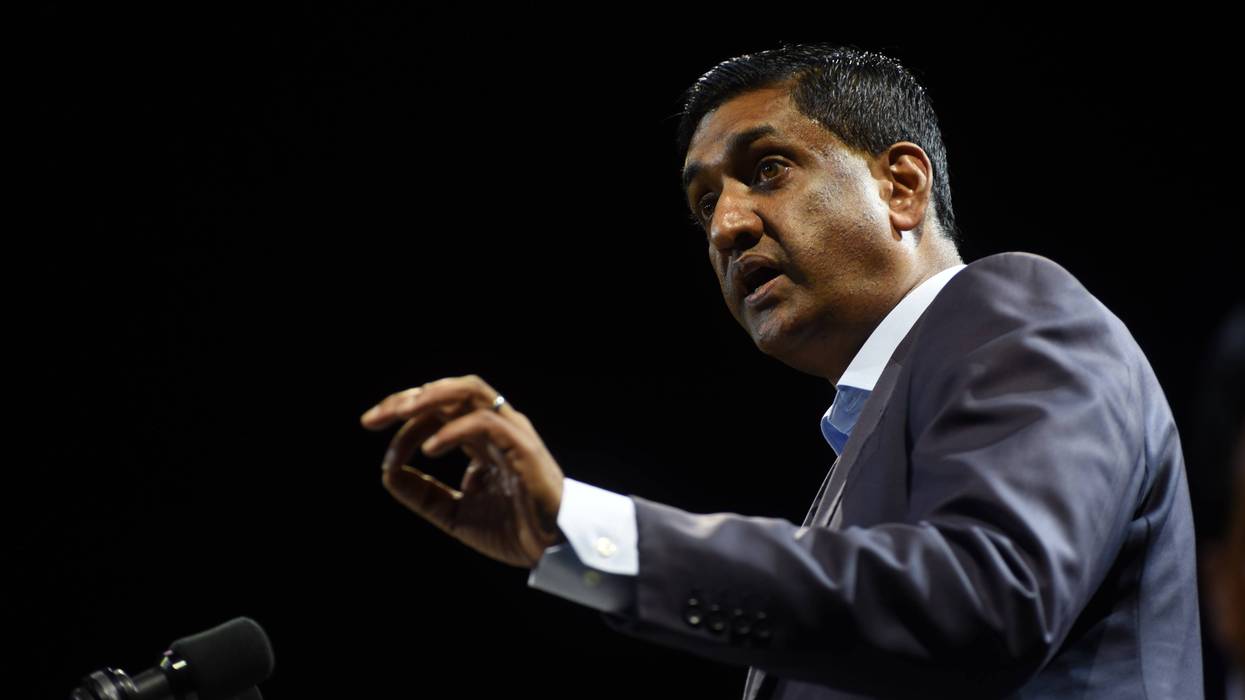
Rep. Ro Khanna pointed fingers at President Donald Trump's administration for being caught flat-footed by the outages and not explaining their cause to voters.
With a number of outages hitting American aviation systems and banks over the last week, Rep. Ro Khanna took to social media to explain what's been going on.
In a video posted on Thursday, the California Democrat pointed to the recent release of a Chinese open-source artificial intelligence model called GLM 5.3, which he noted "does not have safeguards and can be used to have cyberattacks," which has led to many institutions rushing to upgrade their systems.
"The rate of patching... has increased dramatically since GLM 5.3 was released," he said. "When you have this increasing in patching, you have many more chances for outages. That's why we're seeing all of these outages across the country."
There is a cloud of confusion about the tech outages.Here is what’s really going on: https://t.co/vH8is7o3oT
— Ro Khanna (@RoKhanna) November 19, 2026
Khanna pointed fingers at President Donald Trump's administration for being caught flat-footed by the outages and not explaining their cause to voters.
"The president of the United States needs to direct... [the Cyber Infrastructure Agency] to take charge," Khanna said. "That agency has been totally cut. They need to restaff it, they need to have a director... and that director needs to coordinate with all of the companies and agencies to have a plan for how we increase our patching."
Khanna then said either the president or one of his deputies should give daily briefings updating the country about cybersecurity threats, while also gathering a broad coalition of government, business, and technology leaders to "upgrade our patching system against the increased AI threat."
"This is not a time for slogans," Khanna said. "This is not a time for politics. It's a time that we actually understand the issue and provide leadership."
Khanna's claims about GLM 5.3 being the primary driver of system upgrades mirrored an analysis published earlier in the week by investment firm Bridgewater Associates.
As reported by MarketWatch on Thursday, Bridgewater's analysis found that a surge in cyberattacks coincided with the release of GLM 5.3, which is far cheaper to use compared to AI models developed by OpenAI and Anthropic.
"We are in the middle of an arms race where malicious actors are using agents to find exploitable bugs and defenders are using agents to preemptively find and patch vulnerabilities," the firm explained. "While models have significantly accelerated work on both sides of the ledger, the defenders have the much heavier burden of patching all bugs before they can be exploited."

"Israel has a long record of deceiving Washington," said one foreign policy analyst. "Yet American officials and media still treat Israeli intelligence as gospel... The American people have paid for that credulity in blood."
CNN’s disputed report on Monday that Iran could be plotting a chemical attack or a “dirty bomb” attack in Washington, DC, came amid a broader effort by Israeli intelligence officials to persuade President Donald Trump to escalate his unpopular war with Iran, according to The New York Times.
Iranian officials condemned CNN’s reporting that Iran was developing plans for a possible attack on members of the Trump administration, calling it a “fabricated narrative” and part of a “calculated disinformation campaign” by a pro-Israel media outlet.
As the Times reported on Wednesday, Israel shared intelligence alleging that Iran had plotted to use chemical agents against senior US officials as Israeli Prime Minister Benjamin Netanyahu pressed Trump to join him in launching a “four- to seven-day campaign of airstrikes against Iran.”
Near the end of the article, the Times reported:
In seeking to convince the United States to join in another round of major attacks, Israel has highlighted what it contends are a variety of threats from Tehran. Israeli officials have been asserting that Iran continues to possess significant chemical and biological weapon capabilities that pose a regional threat—and that could be used in terrorist attacks against the US and Europe…
The Israelis have shared intelligence claiming that Iranians have plotted to use chemical agents against senior US officials. One person briefed on the intelligence, who was not authorized to speak publicly, said that type of threat was related to the decision in recent weeks to move Treasury Secretary Scott Bessent from his home.
The detail about Bessent suggests the two outlets may have been describing the same chemical threat. CNN reported that “threats from Iran also prompted the Secret Service to move Treasury Secretary Scott Bessent into military housing last week.” The Times passage did not explicitly identify the source of the dirty bomb allegation.
*President Trump is weighing plans for another round of extensive military strikes on Iran, taking into account new intelligence about Iranian capabilities and intensifying pressure from Israel to move quickly and aggressively, U.S. and Israeli officials briefed on the discussions said.*Trump has yet to make a decision, they said. But he has been considering warnings from Israel about Iran’s success in rebuilding its missile and drone arsenals and advancing its chemical and biological weapons programs.And he is taking into account that the United States now has a window in which it has significant military firepower in the region.W\ @julianbarnes @EricSchmittNYT @maggieNYT @jonathanvswan via @nytimes https://t.co/ztvId1lX6h
— Ronen Bergman (@ronenbergman) November 19, 2026
CNN treated the purported threat with grave seriousness, writing that US officials had characterized it as “a signal of an alarming willingness to escalate by Iran” and saying it “shows that Tehran is now actively planning for potential attacks inside US territory.”
Trump responded to CNN’s report with yet another threat of mass destruction against Iran, warning that if the country attacked Washington, it would “pay a price the likes of which no country has ever paid before.”
CNN acknowledged that some US officials, including Homeland Security Secretary Markwayne Mullin, viewed the alleged Iranian planning as “aspirational” rather than a “new threat.”
But the network quoted no weapons experts by name. In the wake of the report, many have questioned how effective a dirty bomb would be as an assassination weapon and what Iran would gain by using one. A dirty bomb uses conventional explosives to disperse radioactive material. Such devices are often called “weapons of mass disruption,” rather than destruction.
"A dirty bomb is not typically what you would use to assassinate someone," David Albright, a physicist and president of the Institute for Science and International Security, told Iran International. "In terms of an assassination method, I wouldn't consider it very effective."
Tallha Abdulrazaq, an independent defense and security consultant, told Al Jazeera that Iran has little incentive to use such a weapon. Doing so, he said, “would instantly destroy Iran’s remaining diplomatic credit” and would likely lead to an invasion that would topple its government. “I highly doubt Iranian strategists are unaware of this reality, so the likelihood of a dirty bomb remains infinitesimally remote,” he said.
That utterly preposterous CNN story on chemical weapons and dirty bombs, which scared Scott Bessent into a bunker, is revealed by the NYT to have been fed to us by Israel. CNN must have known that but clearly left that detail out because it would have completely undermined the story. Everyone assumed it anyway.
— Ryan Grim (@ryangrim) November 20, 2026
Investigative journalist and Drop Site News co-founder Ryan Grim argued that the Times’ reporting showed that CNN’s “utterly preposterous” story had been “fed to us by Israel.”
Israeli intelligence officials have repeatedly tried to influence Trump with warnings about Iran that US officials could not independently corroborate or later found had been exaggerated.
Grim said “CNN must have known” that Israel was behind the warnings “but clearly left that detail out because it would have completely undermined the story. Everyone assumed it anyway.”
Despite its well-documented role in pushing this sort of intelligence to US officials to further foment tension between the US and Iran, CNN's chemical weapons report this week includes no mention of Israel at all.
CNN's report even cited what it called "another stream of intelligence" reported earlier this month by The New York Times about possible chemical weapons attacks against US troops in the Middle East, mentioning that military personnel lacked "adequate protective equipment or training to guard against such an attack."
What it did not mention was that this intelligence also came from Israel and that US allies in the Persian Gulf found the claims to be "unserious." Many US officials also doubted the warnings, with some comparing them to the false intelligence about “weapons of mass destruction” (WMD) that the George W. Bush administration used to justify invading Iraq in 2003.
“Israel has a long record of deceiving Washington and feeding it false intelligence that pulls America toward war,” said Reza Nasri, an Iranian international lawyer and foreign policy analyst. “Its latest Iranian WMD alarm must be read against that record.”
“There is a clear pattern here…” Nasri said. “Yet American officials and media still treat Israeli intelligence as gospel, repeating it before verifying it. The American people have paid for that credulity in blood. They should not pay again.”

"The US government should defend the deep, not fast-track its destruction," said one opponent.
Flouting a federal judge's recent finding that the Trump administration's approval of deep-sea mining lease sales violated the Endangered Species Act, the US government on Thursday opened more than 31 million acres of ocean floor near American Samoa to potential mineral exploration that opponents say will devastate marine habitats.
The deep-sea mining lease auction—held by the Department of the Interior's Marine Minerals Administration—marks a major step in President Donald Trump's push to accelerate seabed extraction of minerals including nickel, cobalt, copper, and manganese, which are used in batteries, electronics, and other critical products.
The Associated Press reported that the auction covered two areas of seabed, each spanning millions of acres northeast of American Samoa's Manua Islands. Startup Wetstone US Ventures, the only firm to submit bids, won both leases at the $3 million minimum threshold.
"This is the first time the United States has held an offshore critical minerals lease sale in the Pacific and a historic step for America's energy and mineral security," Interior Secretary Doug Burgum said in a statement. "Today's sale opens a path to learn more about the resources off the coast of American Samoa and assess whether they could contribute to a more reliable domestic supply."
The 20-year leases authorize surveys and other exploratory activities, not commercial extraction, which would require additional approval before mining could begin.
However, the auction and the administration's wider deep-sea mining policy have drawn opposition from environmental organizations, marine scientists, and Pacific Island communities concerned about potentially irreversible damage to fragile marine ecosystems and traditional ways of life.
“These lease sales will open the floodgates to the exploitation of our deep seas,” Oceana Defense Campaign manager Julia Singer said in a statement. “The message from American Samoa, and people across the United States, could not be clearer: Stop deep-sea mining before it starts."
"Thousands of scientists, local leaders, and community members have warned of the danger that deep-sea mining poses, yet the Trump administration is continuing to ignore widespread opposition to this proposal," Singer added. "The US government should defend the deep, not fast-track its destruction.”
The lease sale proceeded despite a Monday ruling by US District Judge Jill Otake in Hawaii that invalidated the government's environmental review of the proposed leases. Otake—a Trump appointee—found that the National Marine Fisheries Service (NMFS) violated the Endangered Species Act (ESA) by reviewing only the sale of the leases and not any potential subsequent mining activity.
"The court’s conclusion that NMFS’ acceptance of the limited definition of agency action was arbitrary and capricious also ensures that the purpose of the ESA—to prevent harm to vulnerable species—is served," Otake wrote in her 41-page ruling. "As extinction is permanent, caution and foresight before acting are necessary and 'caution can only be exercised if the agency takes a look at all the possible ramifications of the agency action.'"
“The message from American Samoa, and people across the United States, could not be clearer: Stop deep-sea mining before it starts."
Thursday's auction took place at the Ventura County Fire Department headquarters in Thousand Oaks, California, where dozens of demonstrators rallied outside.
“We had hoped it would never come to this,” said Sabrina Suluai-Mahuka, founder of the American Samoan youth environmental organization Finafinau. "Yet here we are, watching our ocean being auctioned to the highest bidder. As a mother, I cannot accept that my daughter's future, and the futures of generations yet to be born, are being treated as accseptable risks for an industry we never asked for."
Arlo Hemphill, Oceans Are Life campaign lead at Greenpeace USA, said: “The US just gave the deep-sea mining industry its first foothold in US waters after a court found it failed to consider the full scope of potential harm to endangered species. The industry will push to move from surveys to exploration to extraction, putting profits ahead of marine life and trampling the culture, livelihood, and objections of communities that have said no again and again."
"Once mining strips away habitat that took millions of years to form, no amount of money can bring it back," Hemphill added. "Congress should press the administration to suspend these leases before work begins.”
David Henkin, deputy managing attorney at Earthjustice, said Otake's ruling made Thursday's auction illegal because the government must comply with the ESA prior to any lease sale.
“We will use the full extent of the law to vigorously push for the leases to be voided,” he said.
Three separate lawsuits are challenging the Trump administration's deep-sea mining plans, including one brought by the Samoan council of chiefs Faleula o le Manu'atele, which questions the federal government's authority to lease waters surrounding the islands.
Meanwhile, a study published last week in the peer-reviewed journal Scientific Reports found that polymetallic nodules—the rock-like formations coveted by mining companies for their valuable mineral content—are important habitats for tiny organisms living inside their crevices.
“Our findings point out that commercial mining may result in an irreversible loss of undescribed and unique biodiversity associated with nodules,” said Sabine Gollner, a professor at the Royal Netherlands Institute for Sea Research and study co-author. “This needs to be considered in the environmental management of deep-sea mining.”
In an October opinion piece for Common Dreams, Suluai-Mahuka said the ocean is central to her people's identity and traditions.
"Our history and our culture are tied to this ocean," she wrote. "Yet, none of this was valued by the companies, and we, the people of American Samoa, were not meaningfully included in the decision-making process."
Suluai-Mahuka said her community and allies submitted more than 75,000 comments opposing the proposed auction.
"Almost all of us oppose deep-sea mining," she wrote.

"Spare us the Iraq War-style propaganda, especially with Israeli fingerprints all over it," said Iran's foreign minister. "Nobody is buying it."
Iranian officials on Tuesday condemned speculative reporting by CNN that Tehran is plotting a chemical or "dirty bomb" attack on Washington, DC, and by The New York Times that Iran may be building dams to supply underground missile sites with water, while critics noted the US corporate media's history of amplifying unsubstantiated claims to manufacture consent for war.
Iran's United Nations Mission in New York said on social media that "the recent preposterous allegations published by The New York Times concerning Iran’s dams, alongside CNN’s fabricated narrative about an alleged 'dirty bomb,' are part of a calculated disinformation campaign designed to manufacture pretexts for further aggression and war crimes."
The mission told CNN that "Iran considers the use of chemical weapons under any circumstances to be wholly illegitimate," remarks that came from the representative of a country that suffered frequent chemical attacks by US-backed Iraqi forces that killed and wounded hundreds of thousands of Iranian soldiers and civilians in the 1980s.
Iranian Foreign Minister Seyed Abbas Araghchi also took to social media, writing: "In the past 72 hours, pro-Israel media have 'reported' that Iran is supposedly plotting to use chemical weapons in DC while building missile bases under dams. RUBBISH."
"Spare us the Iraq War-style propaganda, especially with Israeli fingerprints all over it," Araghchi added. "Nobody is buying it."
Iranian Foreign Ministry spokesperson Esmaeil Baqaei accused "those who initiated the aggression against Iran" of "now seeking to lay the media groundwork for their sinister designs by manufacturing and disseminating baseless allegations, including the recent claims published by The New York Times and the fabricated media narrative surrounding an alleged 'dirty bomb' propagated by CNN."
"Step by step, they are attempting to manufacture a veneer of legitimacy for further aggression and atrocities," he added.
Iranian Parliamentary Speaker Mohammad Bagher Ghalibaf also responded to the Times article on social media.
"Cool," he wrote. "New rule: Any dam, port, or power plant near a US or Israeli base is dual-use. We’ll apply your logic consistently and even-handedly."
The Times article—written by Sanam Mahoozi, a London-based Iranian journalist, and Erika Solomon, the newspaper's bureau chief in Iran and Iraq—acknowledges in its third paragraph that "any connection" between Iran's missile program and its "ambitious, decades-old initiative to develop water infrastructure remains speculative."
"No conclusive evidence—but questions worth asking," Mohoozi wrote in a social media post promoting the piece.
CNN's "exclusive" article cites seven unnamed US officials who claim American intelligence agencies believe Iran is developing plans to potentially target senior Trump administration officials in Washington with a radioactive or chemical weapon.
The report describes the alleged planning as an effort by Tehran to give itself options, rather than evidence of an imminent attack.
As US corporate media outlets amplified the speculative reports, the White House itself appeared to undercut the alarmist framing, with spokesperson Lauren Bis tsaying Monday that "at this time, there are no credible threats to the homeland.”
Experts on the subjects covered in the CNN and Times articles joined critics and analysts of the corporate media in condemning the pieces.
Kaveh Madani, director of the United Nations University's Institute for Water, Environment, and Health in Canada, told Al Jazeera, “I’m one of the people quoted in the [Times] article, but my comments had nothing to do with dams or missiles!”
"Speculation is not evidence. Spatial proximity is not causality," Madani said on social media. "Even those who attacked Iran have not made such claims linking dams to missiles!"
"This reductionist, sensational narrative is irresponsible journalism with potentially dangerous consequences for civilian water infrastructure," he added. "The New York Times should know better."
"I’m one of the people quoted in the article, but my comments had nothing to do with dams or missiles!”
Addressing Mahoozi, Pakistani journalist Mahlia S. Lone said: "You are advocating for war crimes to be committed. This is not journalism."
Samira Moyheddin, founder of the independent digital journalism outlet On The Line Media, also replied to Mahoozi, saying, "This is shameful journalism and you know it."
Lebanese-American journalist and political analyst Rami Khouri called the Times article troubling, arguing that it reflected the complicity of US mainstream media in American and Israeli military aggression, as during the Iraq War and the ongoing Israeli genocide in Gaza.
"The telltale sign of noncredible wobbly journalism is when conditional words like 'speculative', 'suggestive', 'may have developed', 'may shed light', 'suspect', and 'long-term riddle' occur more often than any definitive, evidence-based facts," Khouri told Al Jazeera.
"Another sad day for US mainstream journalism," he added.
At the independent progressive news site Truthout, editor-in-chief Negin Owliaei said on Bluesky that the Times story "broke" her, with its "pure speculation about whether dams in Iran are powering missile cities with absolutely no evidence, proof, or logical explanation."
Owliaei added that she was "actually shocked it got published, even in the Judith Miller outlet."
Dubbed "woman of mass destruction" by Times colleague Maureen Dowd, an opponent of both the Iraq and Iran wars, Miller and other US journalists infamously regurgitated Bush administration lies about Iraq's nonexistent weapons of mass destruction in the run-up to the illegal war that killed hundreds of thousands of people and wrecked much of the country.
Miller subsequently resigned in disgrace, and Times editors later published an extraordinary mea culpa, but by that time, Iraqi casualties numbered tens of thousands killed or wounded, and those of US-led coalition troops in the thousands.
Laila Al-Arian, executive producer of Al Jazeera’s “Fault Lines,” said Monday that the CNN dirty bomb article is "giving Iraq WMDs reporting.”
New York Times spokesperson Nicole Taylor defended the newspaper's reporting on Iran's dam program, saying that the article "accurately cited research and analysis by seven international experts," and "provided readers with a deeper understanding of Iranian infrastructure investment and the effects of US and Israeli attacks on civilians."
"Framing the independent reporting as a pretext for violence is dangerous," Taylor added.
As for CNN—which had not yet publicly commented on the dirty bomb piece—its own employees have alleged a pro-Israel editorial bias in coverage of the Gaza genocide, which one staffer called "journalistic malpractice."
Trump has demonstrated that he does not need much pretext to wage his illegal war of choice on Iran and bomb civilian infrastructure, including oil facilities, power plants, water reservoirs, bridges, hospitals, and other sites—including an elementary school where 156 students and staff were massacred on the first day of the war.
However, the CNN and Times articles come amid fears of renewed US-Israeli attacks on civilian targets in Iran, and Trump responded directly to the reports during a Tuesday press conference in which he was asked whether there was any imminent threat from Tehran.
"Well, if there is, they will pay a price the likes of which no country has ever paid before," Trump said. "I hope it's not, but... we take it very seriously because they happen to be crazy."

“We’ve witnessed network outages at the FAA, a major airline, and banks; a cyberattack targeting payment data across 180 websites; and... the outage of the internal communication network at the National Security Agency."
Citing mounting digital disruptions affecting US government agencies, airlines, banks, and other critical institutions, Congresswoman Delia Ramirez on Tuesday called for investigations and accountability, while warning that the Trump administration's cuts to federal cybersecurity protections could leave the country increasingly vulnerable.
“Over the past week, we've witnessed network outages at the [Federal Aviation Administration], a major airline, and banks; a cyberattack targeting payment data across 180 websites; and now the outage of the internal communication network at the National Security Agency," Ramirez (D-Ill.) said in a statement.
“As we demand transparency and investigations into what is happening, [US Homeland Security Secretary] Markwayne Mullin continues to attempt to shift the focus away from the Trump administration's reckless cuts and layoffs in CISA," she continued, referring to the Cybersecurity and Infrastructure Security Agency, the federal body responsible for preventing and mitigating cyber threats.
My statement following reports of coordinated cyberattacks.
[image or embed]
— Congresswoman Delia C. Ramirez (@ramirez.house.gov) November 17, 2026 at 11:34 AM
On Tuesday, NSA Net—the National Security Agency's classified internal communications system—went offline, an outage that reportedly affected multiple agency locations, including its headquarters at Fort Meade, Maryland, and a facility in Georgia, according to CNN.
Citing current and former US government officials, The Washington Post reported that the cause of the outage was initially unclear. The NSA subsequently said it had experienced “temporary degradation during scheduled routine maintenance,” adding that “mission-critical capabilities remain fully operational and our ability to defend national security continues.”
Officials stressed that there was no immediate evidence that the NSA outage was caused by a cyberattack.
In recent days, the FAA issued a nationwide ground stop that lasted more than four hours after officials said network traffic overwhelmed aging equipment. Microsoft Outlook and other 365 services experienced an outage, United Airlines briefly delayed departing flights, and many JPMorgan Chase customers experienced problems accessing banking services.
Meanwhile, cybersecurity experts said that hackers exploited a vulnerability in Optimizely—a third-party website experimentation platform—to embed malicious JavaScript into websites associated with 178 organizations, including media outlets BBC and CNN; international banking giant HSBC; global home furnishing retailer IKEA; enterprise software titan Salesforce; and the online meeting platform Zoom.
Administration officials, including President Donald Trump, have come under fire for their dismissive attitude toward the incidents.
“It’s life," Trump said Monday when asked if he was concerned about the disruptions. "When you’re big and powerful, and you have all the money, things like that happen. It’s fine.”
Ramirez said she would use a potential leadership position on the House Homeland Security Committee to investigate the administration's handling of the disruptions.
“As I pursue the Homeland Security Committee Oversight gavel, I will hold the [Department of Homeland Security] and the Trump administration accountable for endangering the safety of our communities," she vowed.
"I am committed to protecting our people by returning CISA, [the Federal Emergency Management Agency], and the Coast Guard to their mission," Ramirez added. "Together, we will pass my Reimagining Safety Act to dismantle DHS, abolish [Immigration and Customs Enforcement], and strengthen the agencies that keep us safe!”
Congresswoman Pramila Jayapal (D-Wash.) also weighed in Tuesday on the disruptions, posting on social media, "We don’t know the full story yet, but the chaos makes one thing obvious: Letting a handful of tech giants control this industry is just too dangerous."
"My National AI Charter framework would separate [artificial intelligence] from Big Tech's digital empire and ban the surveillance that fuels these dangerous capabilities," she said. "It would hold companies and executives strictly liable when their models unleash harm and put the government in charge of safety at every step."
"Congress and our leaders need to treat this as a wake-up call," Jayapal added, "and step in before things get much worse."

By passing up on a shutdown fight in December, one anti-war advocate said, "Democrats would be voting to fund additional weeks of war, risking further escalation, prolonging high gas prices, and the starvation of civilians."
US House Minority Leader Hakeem Jeffries indicated on Tuesday that he may be willing to support a temporary government funding extension without provisions restricting President Donald Trump's war with Iran.
As he seeks to cement himself as the next House speaker, Jeffries (D-NY) has faced pressure from within his caucus to hold up government funding legislation needed to prevent a shutdown by December 11 unless it contains language denying the Trump administration more funds for the war.
Asked about the prospect of a government shutdown if the GOP refuses to budge, Jeffries raised the possibility of a temporary funding extension, which could push negotiations into next year.
He said the top Republicans and Democrats on the House and Senate appropriations committees were "in active conversation" about reaching a government funding agreement before the December 11 deadline or passing a temporary funding extension that would push negotiations until "some point next year," when Democrats will control both chambers of Congress.
"We'll see what happens. I don't want to get out ahead of that process," Jeffries continued, adding that the "reckless and costly war of choice in Iran needs to end. It should end today."
While Democrats have said ending the war would be among their top priorities when they retake Congress in January, it's unclear when they'll next have comparable leverage to force Trump to sign legislation limiting funding.
The anti-war group Just Foreign Policy said that refusing to use the funding bill as leverage as soon as possible "would be a huge betrayal of voters by Democratic leadership."
A Reuters/Ipsos poll published last week found that 71% of US adults, including 93% of Democrats and 51% of Republicans, supported Congress passing legislation to end the war.
During an exchange with Adam Jentleson, a Democratic consultant and former chief of staff to pro-war Sen. John Fetterman (D-Pa.), Erik Sperling, Just Foreign Policy's executive director, argued that postponing the fight until January or later would be a "mistake," both morally and tactically.
I think there are several reasons why postponing the fight would be a mistake:1. Democrats would be voting to fund additional weeks of war, risking further escalation, prolonging high gas prices and the starvation of civilians. There's a significant moral cost to doing that unnecessarily.2. Even with control of both chambers in January, Trump's veto power remains. Democrats would still need the leverage of a funding deadline. Meanwhile, Republicans could pursue alternative funding mechanisms through reconciliation.3. Why would Democrats want their first act upon taking power to be a shutdown fight, rather than forcing Republicans to confront this issue while they still control both chambers?4. The holiday timing actually increases Democrats' leverage. Republicans shutting down the government over Christmas because they insist on continuing an overwhelmingly unpopular war would be politically toxic. Why give them the gift of moving the confrontation to a less politically sensitive moment?5. Some Democrats genuinely want to end the war but are risk-averse. Others, particularly those aligned with pro-war, pro-Israel groups, have little interest in ending it. Postponement gives the latter more time and opportunities to undermine the efforts of the former.6. The political upside of winning now is enormous. Imagine Democrats delivering on a central demand of midterm voters before even taking power, with gas prices potentially beginning to fall over the holidays. For a party that struggles to convince Americans it can deliver meaningful results quickly, this would be an extraordinary opportunity to rebuild its brand.It would also free Democrats to pursue additional priorities immediately upon taking control of Congress, rather than spending their first weeks fighting a battle they could have already won.I understand the instinct toward risk aversion, but we should weigh those risks against the enormous moral and political benefits of actually delivering on what voters demanded.
— Erik Sperling (@ErikSperling) November 17, 2026
"Democrats would be voting to fund additional weeks of war, risking further escalation, prolonging high gas prices, and the starvation of civilians," he wrote on social media Tuesday. "There's a significant moral cost to doing that unnecessarily."
While some Democrats have expressed wariness of waging a shutdown fight weeks before the holiday season, Sperling argued that this timing "actually increases Democrats' leverage."
"Republicans shutting down the government over Christmas because they insist on continuing an overwhelmingly unpopular war would be politically toxic," he said. "Why give them the gift of moving the confrontation to a less politically sensitive moment?"
Sperling also warned that delay would give Democrats "aligned with pro-war, pro-Israel groups" time to undermine efforts to cut off funds, but argued that "the political upside of winning now is enormous."
"Imagine Democrats delivering on a central demand of midterm voters before even taking power, with gas prices potentially beginning to fall over the holidays," he said. "For a party that struggles to convince Americans it can deliver meaningful results quickly, this would be an extraordinary opportunity to rebuild its brand."