SUBSCRIBE TO OUR FREE NEWSLETTER
Daily news & progressive opinion—funded by the people, not the corporations—delivered straight to your inbox.
5
#000000
#FFFFFF
To donate by check, phone, or other method, see our More Ways to Give page.
Daily news & progressive opinion—funded by the people, not the corporations—delivered straight to your inbox.
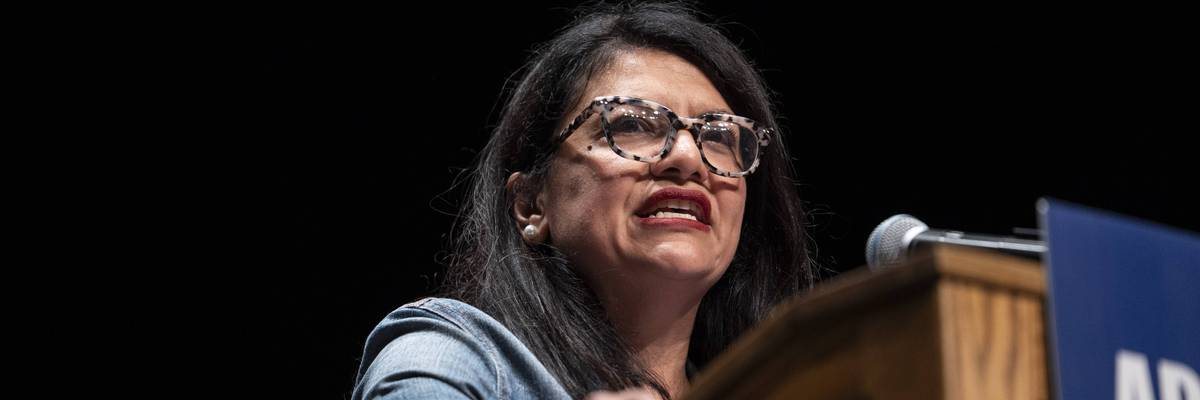
US Rep. Rashida Tlaib (D-Mich.) speaks at a rally at the Detroit Opera House on July 18, 2026, in Detroit, Michigan.
"Our new Democratic majority must act immediately to end Trump's fuel blockade, block military action, and finally end the embargo that has inflicted economic warfare against Cuba for over half a century."
As President Donald Trump renews his threats to invade Cuba, US Rep. Rashida Tlaib said Friday that the incoming Democratic majority in Congress must move to block military action, end Trump’s fuel blockade, and lift the US embargo that has inflicted decades of suffering on the Cuban people.
"The Trump administration is strangling the Cuban people," Tlaib (D-Mich.) wrote on social media Friday. "Our new Democratic majority must act immediately to end Trump's fuel blockade, block military action, and finally end the embargo that has inflicted economic warfare against Cuba for over half a century."
The Trump administration is strangling the Cuban people. Our new Democratic majority must act immediately to end Trump's fuel blockade, block military action, and finally end the embargo that has inflicted economic warfare against Cuba for over half a century.https://t.co/eyakBu2p90
— Congresswoman Rashida Tlaib (@RepRashida) November 20, 2026
The US embargo has stifled Cuba’s economic growth for more than six decades. In January, Trump imposed a fuel blockade as part of his effort to oust Cuba's communist government. The blockade has deepened the suffering of the island’s roughly 9.4 million residents.
Power outages were already frequent on Cuba’s aging electrical grid. Since the fuel blockade began, they have become catastrophic. The country has suffered at least seven major blackouts this year alone.
The United Nations reported in May that more than 100,000 patients, including 11,000 children, were still waiting for surgery. In June, Cuban state media reported that nearly 3,000 dialysis patients had experienced disruptions to their treatment.
About 3.5 million people have faced water shortages as electric pumps lose power, prompting the US embassy to warn of an increase in diarrheal illness. Energy shortages have also disrupted food production and transportation, left families unable to refrigerate food, and forced hospitals to operate without reliable electricity.
Cuba’s embassy in Washington, DC has called the fuel blockade “collective punishment,” and human rights organizations have said it violates international law.
Earlier this month, Trump tightened the blockade further, expanding sanctions to any country or individual that operates within Cuba's electronics, manufacturing, maritime, or technology sectors.
Trump has described his blockade as part of an effort to bring about a “friendly takeover” of Cuba by the United States. After launching the blockade in January, he said he believed he would have the “honor” of “taking Cuba” and hinted at military action against the island once the war with Iran ended.
Earlier this month, days after Republicans suffered a resounding midterm defeat in large part thanks to his Iran War, Trump said he’d “certainly consider” using military force to overthrow the government of Cuba, which he called a “failed” state.
He said he wanted to “get Cuba done” before leaving office in 2029, adding that Secretary of State Marco Rubio, a longtime Cuba hawk who has pushed for the government’s overthrow, “would love to do it.”
HEWITT: Will you order military force to free Cuba?TRUMP: I want to get Cuba done before I leave, yeah https://t.co/ApdFutnbog
— Aaron Rupar (@atrupar) November 12, 2026
In an op-ed for the Los Angeles Times, Michael Galant, a senior research and outreach associate at the Center for Economic and Policy Research, argued that congressional Democrats should make ending the blockade a priority when they take power.
"This fuel blockade is cruel. It is illegal. It is an act of war. It is unpopular—on the world stage and among US voters. It may even be a national security risk," Galant wrote. "With the new balance of power, Congress has the tools to confront it."
Galant urged Congress to start by voting on a war powers resolution barring the unauthorized use of military force against Cuba, including the blockade.
Gallant wrote that, “Come 2027, the new Congress could pass this and other discrete measures to help end the deprivation: terminating the January national emergency declaration, on which many of the recent sanctions rest; removing Cuba’s baseless ‘State Sponsor of Terrorism’ designation, which effectively cuts off the country from the global financial system; and suspending Helms-Burton Title III authorities, which allow third parties to sue individuals who ‘traffic’ in property confiscated by the Cuban government.”
He added that Democrats could make it harder for Trump to veto these measures by attaching them to “must-pass” legislation such as the annual defense authorization bill.
Ending Trump’s strangulation of Cuba was the immediate priority, but Democrats “should not stop at rolling the clock back to 2024,” Galant wrote. He argued that “it is well past time to end the embargo that has been intentionally harming Cuban civilians for more than 60 years.”
Trump’s illegal blockade is inflicting a humanitarian catastrophe on the Cuban people. It’s Gaza in slow motion.And now he’s threatening to invade, too?! Let’s let the Cuban people write their own future—NOT politicians in Washington. https://t.co/E3gliEgrpJ
— Rep. Jim McGovern (@RepMcGovern) November 19, 2026
In a rousing speech Wednesday, Rep. Jim McGovern (D-Mass.) urged his colleagues to end both Trump’s fuel blockade and the US embargo. Earlier this year, he cosponsored a Cuba war powers resolution introduced by Rep. Nydia Velázquez (D-NY).
“Cuba is our neighbor. Our histories are intertwined. Our futures are, too. The 10 million Cubans on the island are just like us. They go to school and work, raise families, and live their lives. They crave freedom and justice," McGovern said. "The Trump administration is trying to starve them out, like Leningrad in 1942 or Gaza in slow motion."
"We hear of plans for military attack, an Iran war in the Caribbean. Cuba belongs to the Cuban people, not to Marco Rubio’s cabal of ideologues," he continued. "Rubio, the viceroy of Venezuela, wants to be the caudillo of Cuba. True liberation demands that we drop the US embargo, whose 60 years of inefficacy is matched only by its cruelty."
“If Trump and Rubio want to invade Cuba, they must come to Congress and seek its approval," he said. "They must explain to the American people, who just voted resoundingly against endless war, why they must pay for another. Trade and diplomacy, not war, will liberate the people of Cuba.”
This country and this world are at a monumental crossroads. US voters have an opportunity to beat back the forces of fascism and confront the billionaires who are rigging the economy, our media system, and our democracy, making it increasingly impossible for ordinary people to get by. We’re not just talking about the election. We’re talking about what must be done once these fascist elements are vanquished from power. We need a bolder set of solutions than what either major party has so far been willing to offer and a working-class movement ready to fight like hell for it. Trump didn't emerge from nowhere. The conditions that fueled MAGA authoritarianism were created by decades of radical neoliberal economic policies and a corrupt political system dominated by corporate interests. They slashed taxes on the super-rich, promising that the benefits would trickle down. They said giveaways to the corporate titans would make life more affordable for the rest of us. It was all bullshit. And when a bitter, betrayed populace searches for someone to blame, right-wing demagogues have little trouble finding scapegoats. People know when they're being lied to, but you won't hear any of this from the corporate media. Only independent journalism—powered and funded by people who believe in building a better world—can deliver truly trustworthy daily news. If you share our vision, please contribute whatever you can to sustain our work. |
As President Donald Trump renews his threats to invade Cuba, US Rep. Rashida Tlaib said Friday that the incoming Democratic majority in Congress must move to block military action, end Trump’s fuel blockade, and lift the US embargo that has inflicted decades of suffering on the Cuban people.
"The Trump administration is strangling the Cuban people," Tlaib (D-Mich.) wrote on social media Friday. "Our new Democratic majority must act immediately to end Trump's fuel blockade, block military action, and finally end the embargo that has inflicted economic warfare against Cuba for over half a century."
The Trump administration is strangling the Cuban people. Our new Democratic majority must act immediately to end Trump's fuel blockade, block military action, and finally end the embargo that has inflicted economic warfare against Cuba for over half a century.https://t.co/eyakBu2p90
— Congresswoman Rashida Tlaib (@RepRashida) November 20, 2026
The US embargo has stifled Cuba’s economic growth for more than six decades. In January, Trump imposed a fuel blockade as part of his effort to oust Cuba's communist government. The blockade has deepened the suffering of the island’s roughly 9.4 million residents.
Power outages were already frequent on Cuba’s aging electrical grid. Since the fuel blockade began, they have become catastrophic. The country has suffered at least seven major blackouts this year alone.
The United Nations reported in May that more than 100,000 patients, including 11,000 children, were still waiting for surgery. In June, Cuban state media reported that nearly 3,000 dialysis patients had experienced disruptions to their treatment.
About 3.5 million people have faced water shortages as electric pumps lose power, prompting the US embassy to warn of an increase in diarrheal illness. Energy shortages have also disrupted food production and transportation, left families unable to refrigerate food, and forced hospitals to operate without reliable electricity.
Cuba’s embassy in Washington, DC has called the fuel blockade “collective punishment,” and human rights organizations have said it violates international law.
Earlier this month, Trump tightened the blockade further, expanding sanctions to any country or individual that operates within Cuba's electronics, manufacturing, maritime, or technology sectors.
Trump has described his blockade as part of an effort to bring about a “friendly takeover” of Cuba by the United States. After launching the blockade in January, he said he believed he would have the “honor” of “taking Cuba” and hinted at military action against the island once the war with Iran ended.
Earlier this month, days after Republicans suffered a resounding midterm defeat in large part thanks to his Iran War, Trump said he’d “certainly consider” using military force to overthrow the government of Cuba, which he called a “failed” state.
He said he wanted to “get Cuba done” before leaving office in 2029, adding that Secretary of State Marco Rubio, a longtime Cuba hawk who has pushed for the government’s overthrow, “would love to do it.”
HEWITT: Will you order military force to free Cuba?TRUMP: I want to get Cuba done before I leave, yeah https://t.co/ApdFutnbog
— Aaron Rupar (@atrupar) November 12, 2026
In an op-ed for the Los Angeles Times, Michael Galant, a senior research and outreach associate at the Center for Economic and Policy Research, argued that congressional Democrats should make ending the blockade a priority when they take power.
"This fuel blockade is cruel. It is illegal. It is an act of war. It is unpopular—on the world stage and among US voters. It may even be a national security risk," Galant wrote. "With the new balance of power, Congress has the tools to confront it."
Galant urged Congress to start by voting on a war powers resolution barring the unauthorized use of military force against Cuba, including the blockade.
Gallant wrote that, “Come 2027, the new Congress could pass this and other discrete measures to help end the deprivation: terminating the January national emergency declaration, on which many of the recent sanctions rest; removing Cuba’s baseless ‘State Sponsor of Terrorism’ designation, which effectively cuts off the country from the global financial system; and suspending Helms-Burton Title III authorities, which allow third parties to sue individuals who ‘traffic’ in property confiscated by the Cuban government.”
He added that Democrats could make it harder for Trump to veto these measures by attaching them to “must-pass” legislation such as the annual defense authorization bill.
Ending Trump’s strangulation of Cuba was the immediate priority, but Democrats “should not stop at rolling the clock back to 2024,” Galant wrote. He argued that “it is well past time to end the embargo that has been intentionally harming Cuban civilians for more than 60 years.”
Trump’s illegal blockade is inflicting a humanitarian catastrophe on the Cuban people. It’s Gaza in slow motion.And now he’s threatening to invade, too?! Let’s let the Cuban people write their own future—NOT politicians in Washington. https://t.co/E3gliEgrpJ
— Rep. Jim McGovern (@RepMcGovern) November 19, 2026
In a rousing speech Wednesday, Rep. Jim McGovern (D-Mass.) urged his colleagues to end both Trump’s fuel blockade and the US embargo. Earlier this year, he cosponsored a Cuba war powers resolution introduced by Rep. Nydia Velázquez (D-NY).
“Cuba is our neighbor. Our histories are intertwined. Our futures are, too. The 10 million Cubans on the island are just like us. They go to school and work, raise families, and live their lives. They crave freedom and justice," McGovern said. "The Trump administration is trying to starve them out, like Leningrad in 1942 or Gaza in slow motion."
"We hear of plans for military attack, an Iran war in the Caribbean. Cuba belongs to the Cuban people, not to Marco Rubio’s cabal of ideologues," he continued. "Rubio, the viceroy of Venezuela, wants to be the caudillo of Cuba. True liberation demands that we drop the US embargo, whose 60 years of inefficacy is matched only by its cruelty."
“If Trump and Rubio want to invade Cuba, they must come to Congress and seek its approval," he said. "They must explain to the American people, who just voted resoundingly against endless war, why they must pay for another. Trade and diplomacy, not war, will liberate the people of Cuba.”