SUBSCRIBE TO OUR FREE NEWSLETTER
Daily news & progressive opinion—funded by the people, not the corporations—delivered straight to your inbox.
5
#000000
#FFFFFF
To donate by check, phone, or other method, see our More Ways to Give page.
Daily news & progressive opinion—funded by the people, not the corporations—delivered straight to your inbox.
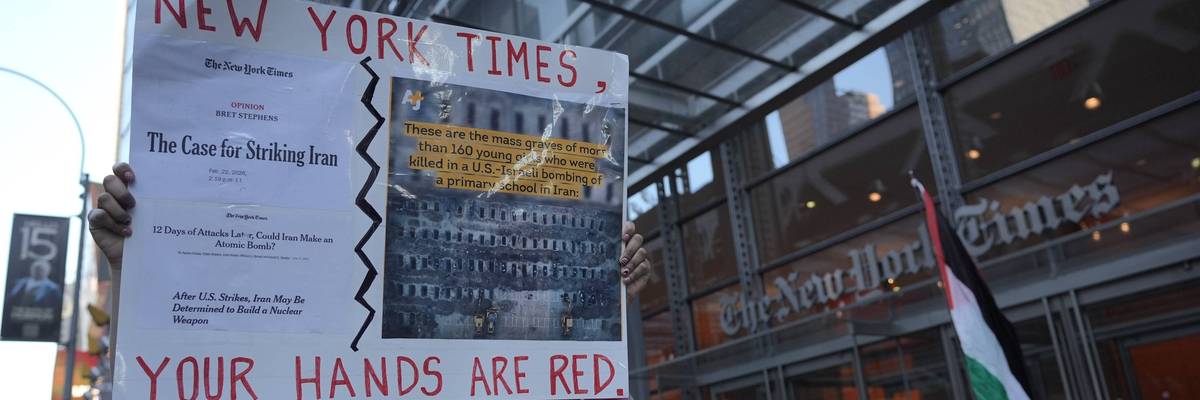
People rally outside The New York Times' headquarters in Manhattan on March 9, 2026 to protest the newspaper's role in advocating the illegal US-Israeli war on Iran.
"Spare us the Iraq War-style propaganda, especially with Israeli fingerprints all over it," said Iran's foreign minister. "Nobody is buying it."
Iranian officials on Tuesday condemned speculative reporting by CNN that Tehran is plotting a chemical or "dirty bomb" attack on Washington, DC, and by The New York Times that Iran may be building dams to supply underground missile sites with water, while critics noted the US corporate media's history of amplifying unsubstantiated claims to manufacture consent for war.
Iran's United Nations Mission in New York said on social media that "the recent preposterous allegations published by The New York Times concerning Iran’s dams, alongside CNN’s fabricated narrative about an alleged 'dirty bomb,' are part of a calculated disinformation campaign designed to manufacture pretexts for further aggression and war crimes."
The mission told CNN that "Iran considers the use of chemical weapons under any circumstances to be wholly illegitimate," remarks that came from the representative of a country that suffered frequent chemical attacks by US-backed Iraqi forces that killed and wounded hundreds of thousands of Iranian soldiers and civilians in the 1980s.
Iranian Foreign Minister Seyed Abbas Araghchi also took to social media, writing: "In the past 72 hours, pro-Israel media have 'reported' that Iran is supposedly plotting to use chemical weapons in DC while building missile bases under dams. RUBBISH."
"Spare us the Iraq War-style propaganda, especially with Israeli fingerprints all over it," Araghchi added. "Nobody is buying it."
Iranian Foreign Ministry spokesperson Esmaeil Baqaei accused "those who initiated the aggression against Iran" of "now seeking to lay the media groundwork for their sinister designs by manufacturing and disseminating baseless allegations, including the recent claims published by The New York Times and the fabricated media narrative surrounding an alleged 'dirty bomb' propagated by CNN."
"Step by step, they are attempting to manufacture a veneer of legitimacy for further aggression and atrocities," he added.
Iranian Parliamentary Speaker Mohammad Bagher Ghalibaf also responded to the Times article on social media.
"Cool," he wrote. "New rule: Any dam, port, or power plant near a US or Israeli base is dual-use. We’ll apply your logic consistently and even-handedly."
The Times article—written by Sanam Mahoozi, a London-based Iranian journalist, and Erika Solomon, the newspaper's bureau chief in Iran and Iraq—acknowledges in its third paragraph that "any connection" between Iran's missile program and its "ambitious, decades-old initiative to develop water infrastructure remains speculative."
"No conclusive evidence—but questions worth asking," Mohoozi wrote in a social media post promoting the piece.
CNN's "exclusive" article cites seven unnamed US officials who claim American intelligence agencies believe Iran is developing plans to potentially target senior Trump administration officials in Washington with a radioactive or chemical weapon.
The report describes the alleged planning as an effort by Tehran to give itself options, rather than evidence of an imminent attack.
As US corporate media outlets amplified the speculative reports, the White House itself appeared to undercut the alarmist framing, with spokesperson Lauren Bis tsaying Monday that "at this time, there are no credible threats to the homeland.”
Experts on the subjects covered in the CNN and Times articles joined critics and analysts of the corporate media in condemning the pieces.
Kaveh Madani, director of the United Nations University's Institute for Water, Environment, and Health in Canada, told Al Jazeera, “I’m one of the people quoted in the [Times] article, but my comments had nothing to do with dams or missiles!”
"Speculation is not evidence. Spatial proximity is not causality," Madani said on social media. "Even those who attacked Iran have not made such claims linking dams to missiles!"
"This reductionist, sensational narrative is irresponsible journalism with potentially dangerous consequences for civilian water infrastructure," he added. "The New York Times should know better."
"I’m one of the people quoted in the article, but my comments had nothing to do with dams or missiles!”
Addressing Mahoozi, Pakistani journalist Mahlia S. Lone said: "You are advocating for war crimes to be committed. This is not journalism."
Samira Moyheddin, founder of the independent digital journalism outlet On The Line Media, also replied to Mahoozi, saying, "This is shameful journalism and you know it."
Lebanese-American journalist and political analyst Rami Khouri called the Times article troubling, arguing that it reflected the complicity of US mainstream media in American and Israeli military aggression, as during the Iraq War and the ongoing Israeli genocide in Gaza.
"The telltale sign of noncredible wobbly journalism is when conditional words like 'speculative', 'suggestive', 'may have developed', 'may shed light', 'suspect', and 'long-term riddle' occur more often than any definitive, evidence-based facts," Khouri told Al Jazeera.
"Another sad day for US mainstream journalism," he added.
At the independent progressive news site Truthout, editor-in-chief Negin Owliaei said on Bluesky that the Times story "broke" her, with its "pure speculation about whether dams in Iran are powering missile cities with absolutely no evidence, proof, or logical explanation."
Owliaei added that she was "actually shocked it got published, even in the Judith Miller outlet."
Dubbed "woman of mass destruction" by Times colleague Maureen Dowd, an opponent of both the Iraq and Iran wars, Miller and other US journalists infamously regurgitated Bush administration lies about Iraq's nonexistent weapons of mass destruction in the run-up to the illegal war that killed hundreds of thousands of people and wrecked much of the country.
Miller subsequently resigned in disgrace, and Times editors later published an extraordinary mea culpa, but by that time, Iraqi casualties numbered tens of thousands killed or wounded, and those of US-led coalition troops in the thousands.
Laila Al-Arian, executive producer of Al Jazeera’s “Fault Lines,” said Monday that the CNN dirty bomb article is "giving Iraq WMDs reporting.”
New York Times spokesperson Nicole Taylor defended the newspaper's reporting on Iran's dam program, saying that the article "accurately cited research and analysis by seven international experts," and "provided readers with a deeper understanding of Iranian infrastructure investment and the effects of US and Israeli attacks on civilians."
"Framing the independent reporting as a pretext for violence is dangerous," Taylor added.
As for CNN—which had not yet publicly commented on the dirty bomb piece—its own employees have alleged a pro-Israel editorial bias in coverage of the Gaza genocide, which one staffer called "journalistic malpractice."
Trump has demonstrated that he does not need much pretext to wage his illegal war of choice on Iran and bomb civilian infrastructure, including oil facilities, power plants, water reservoirs, bridges, hospitals, and other sites—including an elementary school where 156 students and staff were massacred on the first day of the war.
However, the CNN and Times articles come amid fears of renewed US-Israeli attacks on civilian targets in Iran, and Trump responded directly to the reports during a Tuesday press conference in which he was asked whether there was any imminent threat from Tehran.
"Well, if there is, they will pay a price the likes of which no country has ever paid before," Trump said. "I hope it's not, but... we take it very seriously because they happen to be crazy."
This country and this world are at a monumental crossroads. US voters have an opportunity to beat back the forces of fascism and confront the billionaires who are rigging the economy, our media system, and our democracy, making it increasingly impossible for ordinary people to get by. We’re not just talking about the election. We’re talking about what must be done once these fascist elements are vanquished from power. We need a bolder set of solutions than what either major party has so far been willing to offer and a working-class movement ready to fight like hell for it. Trump didn't emerge from nowhere. The conditions that fueled MAGA authoritarianism were created by decades of radical neoliberal economic policies and a corrupt political system dominated by corporate interests. They slashed taxes on the super-rich, promising that the benefits would trickle down. They said giveaways to the corporate titans would make life more affordable for the rest of us. It was all bullshit. And when a bitter, betrayed populace searches for someone to blame, right-wing demagogues have little trouble finding scapegoats. People know when they're being lied to, but you won't hear any of this from the corporate media. Only independent journalism—powered and funded by people who believe in building a better world—can deliver truly trustworthy daily news. If you share our vision, please contribute whatever you can to sustain our work. |
Iranian officials on Tuesday condemned speculative reporting by CNN that Tehran is plotting a chemical or "dirty bomb" attack on Washington, DC, and by The New York Times that Iran may be building dams to supply underground missile sites with water, while critics noted the US corporate media's history of amplifying unsubstantiated claims to manufacture consent for war.
Iran's United Nations Mission in New York said on social media that "the recent preposterous allegations published by The New York Times concerning Iran’s dams, alongside CNN’s fabricated narrative about an alleged 'dirty bomb,' are part of a calculated disinformation campaign designed to manufacture pretexts for further aggression and war crimes."
The mission told CNN that "Iran considers the use of chemical weapons under any circumstances to be wholly illegitimate," remarks that came from the representative of a country that suffered frequent chemical attacks by US-backed Iraqi forces that killed and wounded hundreds of thousands of Iranian soldiers and civilians in the 1980s.
Iranian Foreign Minister Seyed Abbas Araghchi also took to social media, writing: "In the past 72 hours, pro-Israel media have 'reported' that Iran is supposedly plotting to use chemical weapons in DC while building missile bases under dams. RUBBISH."
"Spare us the Iraq War-style propaganda, especially with Israeli fingerprints all over it," Araghchi added. "Nobody is buying it."
Iranian Foreign Ministry spokesperson Esmaeil Baqaei accused "those who initiated the aggression against Iran" of "now seeking to lay the media groundwork for their sinister designs by manufacturing and disseminating baseless allegations, including the recent claims published by The New York Times and the fabricated media narrative surrounding an alleged 'dirty bomb' propagated by CNN."
"Step by step, they are attempting to manufacture a veneer of legitimacy for further aggression and atrocities," he added.
Iranian Parliamentary Speaker Mohammad Bagher Ghalibaf also responded to the Times article on social media.
"Cool," he wrote. "New rule: Any dam, port, or power plant near a US or Israeli base is dual-use. We’ll apply your logic consistently and even-handedly."
The Times article—written by Sanam Mahoozi, a London-based Iranian journalist, and Erika Solomon, the newspaper's bureau chief in Iran and Iraq—acknowledges in its third paragraph that "any connection" between Iran's missile program and its "ambitious, decades-old initiative to develop water infrastructure remains speculative."
"No conclusive evidence—but questions worth asking," Mohoozi wrote in a social media post promoting the piece.
CNN's "exclusive" article cites seven unnamed US officials who claim American intelligence agencies believe Iran is developing plans to potentially target senior Trump administration officials in Washington with a radioactive or chemical weapon.
The report describes the alleged planning as an effort by Tehran to give itself options, rather than evidence of an imminent attack.
As US corporate media outlets amplified the speculative reports, the White House itself appeared to undercut the alarmist framing, with spokesperson Lauren Bis tsaying Monday that "at this time, there are no credible threats to the homeland.”
Experts on the subjects covered in the CNN and Times articles joined critics and analysts of the corporate media in condemning the pieces.
Kaveh Madani, director of the United Nations University's Institute for Water, Environment, and Health in Canada, told Al Jazeera, “I’m one of the people quoted in the [Times] article, but my comments had nothing to do with dams or missiles!”
"Speculation is not evidence. Spatial proximity is not causality," Madani said on social media. "Even those who attacked Iran have not made such claims linking dams to missiles!"
"This reductionist, sensational narrative is irresponsible journalism with potentially dangerous consequences for civilian water infrastructure," he added. "The New York Times should know better."
"I’m one of the people quoted in the article, but my comments had nothing to do with dams or missiles!”
Addressing Mahoozi, Pakistani journalist Mahlia S. Lone said: "You are advocating for war crimes to be committed. This is not journalism."
Samira Moyheddin, founder of the independent digital journalism outlet On The Line Media, also replied to Mahoozi, saying, "This is shameful journalism and you know it."
Lebanese-American journalist and political analyst Rami Khouri called the Times article troubling, arguing that it reflected the complicity of US mainstream media in American and Israeli military aggression, as during the Iraq War and the ongoing Israeli genocide in Gaza.
"The telltale sign of noncredible wobbly journalism is when conditional words like 'speculative', 'suggestive', 'may have developed', 'may shed light', 'suspect', and 'long-term riddle' occur more often than any definitive, evidence-based facts," Khouri told Al Jazeera.
"Another sad day for US mainstream journalism," he added.
At the independent progressive news site Truthout, editor-in-chief Negin Owliaei said on Bluesky that the Times story "broke" her, with its "pure speculation about whether dams in Iran are powering missile cities with absolutely no evidence, proof, or logical explanation."
Owliaei added that she was "actually shocked it got published, even in the Judith Miller outlet."
Dubbed "woman of mass destruction" by Times colleague Maureen Dowd, an opponent of both the Iraq and Iran wars, Miller and other US journalists infamously regurgitated Bush administration lies about Iraq's nonexistent weapons of mass destruction in the run-up to the illegal war that killed hundreds of thousands of people and wrecked much of the country.
Miller subsequently resigned in disgrace, and Times editors later published an extraordinary mea culpa, but by that time, Iraqi casualties numbered tens of thousands killed or wounded, and those of US-led coalition troops in the thousands.
Laila Al-Arian, executive producer of Al Jazeera’s “Fault Lines,” said Monday that the CNN dirty bomb article is "giving Iraq WMDs reporting.”
New York Times spokesperson Nicole Taylor defended the newspaper's reporting on Iran's dam program, saying that the article "accurately cited research and analysis by seven international experts," and "provided readers with a deeper understanding of Iranian infrastructure investment and the effects of US and Israeli attacks on civilians."
"Framing the independent reporting as a pretext for violence is dangerous," Taylor added.
As for CNN—which had not yet publicly commented on the dirty bomb piece—its own employees have alleged a pro-Israel editorial bias in coverage of the Gaza genocide, which one staffer called "journalistic malpractice."
Trump has demonstrated that he does not need much pretext to wage his illegal war of choice on Iran and bomb civilian infrastructure, including oil facilities, power plants, water reservoirs, bridges, hospitals, and other sites—including an elementary school where 156 students and staff were massacred on the first day of the war.
However, the CNN and Times articles come amid fears of renewed US-Israeli attacks on civilian targets in Iran, and Trump responded directly to the reports during a Tuesday press conference in which he was asked whether there was any imminent threat from Tehran.
"Well, if there is, they will pay a price the likes of which no country has ever paid before," Trump said. "I hope it's not, but... we take it very seriously because they happen to be crazy."