SUBSCRIBE TO OUR FREE NEWSLETTER
Daily news & progressive opinion—funded by the people, not the corporations—delivered straight to your inbox.
5
#000000
#FFFFFF
To donate by check, phone, or other method, see our More Ways to Give page.
Daily news & progressive opinion—funded by the people, not the corporations—delivered straight to your inbox.
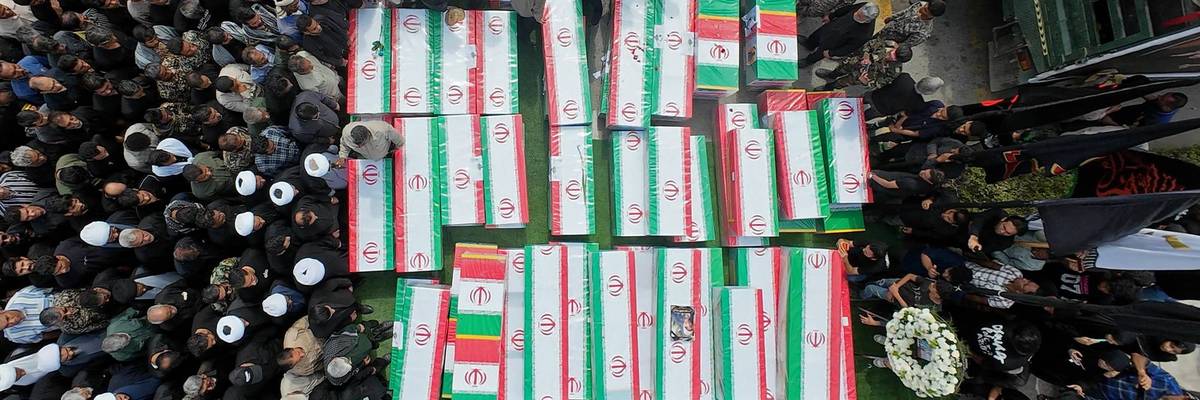
Coffins of victims of the February 28, 2026 US cruise missile strike on a girls' school in Minab, Iran are surrounded by mourners during funeral services on March 3, 2026 in Minab.
"War is nasty," the president said when asked about the February cruise missile strike that killed 156 students and staff in Minab, continuing the centuries-old presidential tradition of dismissing American atrocities.
President Donald Trump on Wednesday joined a long line of US leaders to brush off atrocities committed by American forces when he dodged questions about responsibility for the February cruise missile strike on an Iranian girls school that massacred students and staff.
On February 28—the first day of the illegal US-Israeli war of choice on Iran—a US strike on the Shajareh Tayyebeh girls’ elementary school in Minab killed 156 people, at least 120 of them children, and wounded 95 others.
Satellite imagery analyses confirmed eyewitness accounts that the attack was a “triple-tap” airstrike, in which an initial bombing was followed up with two additional strikes meant to kill survivors and rescue workers.
Asked by a journalist at the G7 meeting in France if anyone would be held accountable for the bombing, Trump replied, "It's such a strange question to be asked at this date, because you're talking about a long time ago."
"Nobody did that on purpose," Trump said of the school strike. "Mistakes are made. War is nasty. But I know it's under investigation."
"I would ask Pete Hegseth," the president added, referring to his defense secretary, who said at the war's start that US forces would not be bound by “stupid rules of engagement” and would instead prioritize “lethality.”
Fragments of a Tomahawk cruise missile found at the school and marked with the names of US weapons companies, a Pentagon contract number, and “Made in USA” added to the body of evidence pointing to the United States as the perpetrator of what numerous experts called a likely war crime.
Trump first claimed that Iran bombed the school, and when it was revealed that a Tomahawk missile was used in the strike, he risibly asserted that Tehran had such highly restricted US missiles in its arsenal. The US has not sold weaponry to the Iranian government since the 1970s, with the extraordinary exception of during the Iran-Contra Affair, in which the Reagan administration secretly sold arms to Iran in the 1980s to fund anti-communist Contra terrorists in Nicaragua.
A preliminary Pentagon probe indicated US responsibility for the Minab massacre—and that the building was struck intentionally, raising questions about the possible use of artificial intelligence for targeting purposes. The US military has confirmed use of AI in the Iran War, which is being carried out in partnership with Israeli forces that have used artificial intelligence extensively in their genocidal assault on the Gaza Strip. More than 250,000 Palestinians have been killed or wounded—most of them civilians—since the Hamas-led attack of October 7, 2023.
Numerous investigative journalism outlets and rights groups—including Bellingcat, The New York Times, Sky News, NPR, The Associated Press, the BBC, Reuters, Al Jazeera, CNN, and Amnesty International—also investigated the attack and concluded the US was responsible.
Trump administration officials and Republican US lawmakers dismissed or stonewalled efforts by journalists, activists, and Democratic legislators to seek accountability for one of the deadliest US civilian massacres in modern times.
The Minab strike ranks up with the bombing of a Baghdad bomb shelter during the 1991 Gulf War—which killed more than 400 people, mostly women, children, and elders—and the March 2017 slaughter of at least 105 people in an apartment building in Mosul, Iraq during Trump’s first-term “war of annihilation” against the so-called Islamic State.
The school massacre also drew comparisons with the 1968 wholesale slaughter of 504 unarmed villagers, mostly women and children—at least some of them raped before being killed—by US troops at My Lai in Vietnam.
Trump joins a long line of US leaders who have ducked accountability for—or worse, tried to justify—atrocities committed on their watch.
Faced with what was then commonly called the "Indian problem," a young Virginia governor named Thomas Jefferson justified what he called "their extermination, or their removal," because "the same world would scarcely do for them and us.”
During the Civil War, Gen. William Tecumseh Sherman, commander of an indiscriminate scorched-earth campaign during his March to the Sea, wrote that "war is cruelty, and you cannot refine it."
President Theodore Roosevelt attempted to defend US troops accused of mass murder and torture—including what's now known as waterboarding—during the Philippines War by shaming critics who condemned those crimes but turned blind eyes to the lynching of Black Americans in the South.
After ordering the only nuclear war in human history, against a defeated enemy making efforts to surrender, President Harry S. Truman said of his Japanese victims, "The only language they seem to understand is the one we have been using to bombard them."
After US forces killed hundreds of thousands of Vietnamese, Cambodian, and Laotian civilians in the 1960s and 1970s, US Army Chief of Staff Gen. William Westmoreland attempted to rationalize the slaughter by explaining: "The Oriental doesn't put the same high price on life as does the Westerner... Life is cheap in the Orient."
As US-driven United Nations sanctions reportedly killed hundreds of thousands of Iraqi children in the 1990s, Madeleine Albright, President Bill Clinton's secretary of state, opined that "we think the price is worth it."
During President George W. Bush's invasion of Iraq, US Central Command chief Gen. Tommy Franks said, "We don't do body counts" when asked about the staggering number of civilian casualties, while Vice President Dick Cheney dismissed waterboarding as a mere "dunk in the water" amid a worldwide torture scandal.
When President Barack Obama's drone war killed an American teenager in Yemen, administration spokesperson Robert Gibbs deflected blame by arguing that the child should have had "a far more responsible father.”
As Trump loosened rules of engagement meant to protect civilians during his first-term campaign to "bomb the shit out of" Islamic State militants in Iraq and Syria and "take out their families," his defense secretary, James "Mad Dog" Mattis, announced that the US was shifting from a policy of “attrition” to one of “annihilation."
“Civilian casualties are a fact of life in this sort of situation,” he said.
Dear Common Dreams reader, It’s been nearly 30 years since I co-founded Common Dreams with my late wife, Lina Newhouser. We had the radical notion that journalism should serve the public good, not corporate profits. It was clear to us from the outset what it would take to build such a project. No paid advertisements. No corporate sponsors. No millionaire publisher telling us what to think or do. Many people said we wouldn't last a year, but we proved those doubters wrong. Together with a tremendous team of journalists and dedicated staff, we built an independent media outlet free from the constraints of profits and corporate control. Our mission has always been simple: To inform. To inspire. To ignite change for the common good. Building Common Dreams was not easy. Our survival was never guaranteed. When you take on the most powerful forces—Wall Street greed, fossil fuel industry destruction, Big Tech lobbyists, and uber-rich oligarchs who have spent billions upon billions rigging the economy and democracy in their favor—the only bulwark you have is supporters who believe in your work. But here’s the urgent message from me today. It's never been this bad out there. And it's never been this hard to keep us going. At the very moment Common Dreams is most needed, the threats we face are intensifying. We need your support now more than ever. We don't accept corporate advertising and never will. We don't have a paywall because we don't think people should be blocked from critical news based on their ability to pay. Everything we do is funded by the donations of readers like you. When everyone does the little they can afford, we are strong. But if that support retreats or dries up, so do we. Will you donate now to make sure Common Dreams not only survives but thrives? —Craig Brown, Co-founder |
President Donald Trump on Wednesday joined a long line of US leaders to brush off atrocities committed by American forces when he dodged questions about responsibility for the February cruise missile strike on an Iranian girls school that massacred students and staff.
On February 28—the first day of the illegal US-Israeli war of choice on Iran—a US strike on the Shajareh Tayyebeh girls’ elementary school in Minab killed 156 people, at least 120 of them children, and wounded 95 others.
Satellite imagery analyses confirmed eyewitness accounts that the attack was a “triple-tap” airstrike, in which an initial bombing was followed up with two additional strikes meant to kill survivors and rescue workers.
Asked by a journalist at the G7 meeting in France if anyone would be held accountable for the bombing, Trump replied, "It's such a strange question to be asked at this date, because you're talking about a long time ago."
"Nobody did that on purpose," Trump said of the school strike. "Mistakes are made. War is nasty. But I know it's under investigation."
"I would ask Pete Hegseth," the president added, referring to his defense secretary, who said at the war's start that US forces would not be bound by “stupid rules of engagement” and would instead prioritize “lethality.”
Fragments of a Tomahawk cruise missile found at the school and marked with the names of US weapons companies, a Pentagon contract number, and “Made in USA” added to the body of evidence pointing to the United States as the perpetrator of what numerous experts called a likely war crime.
Trump first claimed that Iran bombed the school, and when it was revealed that a Tomahawk missile was used in the strike, he risibly asserted that Tehran had such highly restricted US missiles in its arsenal. The US has not sold weaponry to the Iranian government since the 1970s, with the extraordinary exception of during the Iran-Contra Affair, in which the Reagan administration secretly sold arms to Iran in the 1980s to fund anti-communist Contra terrorists in Nicaragua.
A preliminary Pentagon probe indicated US responsibility for the Minab massacre—and that the building was struck intentionally, raising questions about the possible use of artificial intelligence for targeting purposes. The US military has confirmed use of AI in the Iran War, which is being carried out in partnership with Israeli forces that have used artificial intelligence extensively in their genocidal assault on the Gaza Strip. More than 250,000 Palestinians have been killed or wounded—most of them civilians—since the Hamas-led attack of October 7, 2023.
Numerous investigative journalism outlets and rights groups—including Bellingcat, The New York Times, Sky News, NPR, The Associated Press, the BBC, Reuters, Al Jazeera, CNN, and Amnesty International—also investigated the attack and concluded the US was responsible.
Trump administration officials and Republican US lawmakers dismissed or stonewalled efforts by journalists, activists, and Democratic legislators to seek accountability for one of the deadliest US civilian massacres in modern times.
The Minab strike ranks up with the bombing of a Baghdad bomb shelter during the 1991 Gulf War—which killed more than 400 people, mostly women, children, and elders—and the March 2017 slaughter of at least 105 people in an apartment building in Mosul, Iraq during Trump’s first-term “war of annihilation” against the so-called Islamic State.
The school massacre also drew comparisons with the 1968 wholesale slaughter of 504 unarmed villagers, mostly women and children—at least some of them raped before being killed—by US troops at My Lai in Vietnam.
Trump joins a long line of US leaders who have ducked accountability for—or worse, tried to justify—atrocities committed on their watch.
Faced with what was then commonly called the "Indian problem," a young Virginia governor named Thomas Jefferson justified what he called "their extermination, or their removal," because "the same world would scarcely do for them and us.”
During the Civil War, Gen. William Tecumseh Sherman, commander of an indiscriminate scorched-earth campaign during his March to the Sea, wrote that "war is cruelty, and you cannot refine it."
President Theodore Roosevelt attempted to defend US troops accused of mass murder and torture—including what's now known as waterboarding—during the Philippines War by shaming critics who condemned those crimes but turned blind eyes to the lynching of Black Americans in the South.
After ordering the only nuclear war in human history, against a defeated enemy making efforts to surrender, President Harry S. Truman said of his Japanese victims, "The only language they seem to understand is the one we have been using to bombard them."
After US forces killed hundreds of thousands of Vietnamese, Cambodian, and Laotian civilians in the 1960s and 1970s, US Army Chief of Staff Gen. William Westmoreland attempted to rationalize the slaughter by explaining: "The Oriental doesn't put the same high price on life as does the Westerner... Life is cheap in the Orient."
As US-driven United Nations sanctions reportedly killed hundreds of thousands of Iraqi children in the 1990s, Madeleine Albright, President Bill Clinton's secretary of state, opined that "we think the price is worth it."
During President George W. Bush's invasion of Iraq, US Central Command chief Gen. Tommy Franks said, "We don't do body counts" when asked about the staggering number of civilian casualties, while Vice President Dick Cheney dismissed waterboarding as a mere "dunk in the water" amid a worldwide torture scandal.
When President Barack Obama's drone war killed an American teenager in Yemen, administration spokesperson Robert Gibbs deflected blame by arguing that the child should have had "a far more responsible father.”
As Trump loosened rules of engagement meant to protect civilians during his first-term campaign to "bomb the shit out of" Islamic State militants in Iraq and Syria and "take out their families," his defense secretary, James "Mad Dog" Mattis, announced that the US was shifting from a policy of “attrition” to one of “annihilation."
“Civilian casualties are a fact of life in this sort of situation,” he said.
President Donald Trump on Wednesday joined a long line of US leaders to brush off atrocities committed by American forces when he dodged questions about responsibility for the February cruise missile strike on an Iranian girls school that massacred students and staff.
On February 28—the first day of the illegal US-Israeli war of choice on Iran—a US strike on the Shajareh Tayyebeh girls’ elementary school in Minab killed 156 people, at least 120 of them children, and wounded 95 others.
Satellite imagery analyses confirmed eyewitness accounts that the attack was a “triple-tap” airstrike, in which an initial bombing was followed up with two additional strikes meant to kill survivors and rescue workers.
Asked by a journalist at the G7 meeting in France if anyone would be held accountable for the bombing, Trump replied, "It's such a strange question to be asked at this date, because you're talking about a long time ago."
"Nobody did that on purpose," Trump said of the school strike. "Mistakes are made. War is nasty. But I know it's under investigation."
"I would ask Pete Hegseth," the president added, referring to his defense secretary, who said at the war's start that US forces would not be bound by “stupid rules of engagement” and would instead prioritize “lethality.”
Fragments of a Tomahawk cruise missile found at the school and marked with the names of US weapons companies, a Pentagon contract number, and “Made in USA” added to the body of evidence pointing to the United States as the perpetrator of what numerous experts called a likely war crime.
Trump first claimed that Iran bombed the school, and when it was revealed that a Tomahawk missile was used in the strike, he risibly asserted that Tehran had such highly restricted US missiles in its arsenal. The US has not sold weaponry to the Iranian government since the 1970s, with the extraordinary exception of during the Iran-Contra Affair, in which the Reagan administration secretly sold arms to Iran in the 1980s to fund anti-communist Contra terrorists in Nicaragua.
A preliminary Pentagon probe indicated US responsibility for the Minab massacre—and that the building was struck intentionally, raising questions about the possible use of artificial intelligence for targeting purposes. The US military has confirmed use of AI in the Iran War, which is being carried out in partnership with Israeli forces that have used artificial intelligence extensively in their genocidal assault on the Gaza Strip. More than 250,000 Palestinians have been killed or wounded—most of them civilians—since the Hamas-led attack of October 7, 2023.
Numerous investigative journalism outlets and rights groups—including Bellingcat, The New York Times, Sky News, NPR, The Associated Press, the BBC, Reuters, Al Jazeera, CNN, and Amnesty International—also investigated the attack and concluded the US was responsible.
Trump administration officials and Republican US lawmakers dismissed or stonewalled efforts by journalists, activists, and Democratic legislators to seek accountability for one of the deadliest US civilian massacres in modern times.
The Minab strike ranks up with the bombing of a Baghdad bomb shelter during the 1991 Gulf War—which killed more than 400 people, mostly women, children, and elders—and the March 2017 slaughter of at least 105 people in an apartment building in Mosul, Iraq during Trump’s first-term “war of annihilation” against the so-called Islamic State.
The school massacre also drew comparisons with the 1968 wholesale slaughter of 504 unarmed villagers, mostly women and children—at least some of them raped before being killed—by US troops at My Lai in Vietnam.
Trump joins a long line of US leaders who have ducked accountability for—or worse, tried to justify—atrocities committed on their watch.
Faced with what was then commonly called the "Indian problem," a young Virginia governor named Thomas Jefferson justified what he called "their extermination, or their removal," because "the same world would scarcely do for them and us.”
During the Civil War, Gen. William Tecumseh Sherman, commander of an indiscriminate scorched-earth campaign during his March to the Sea, wrote that "war is cruelty, and you cannot refine it."
President Theodore Roosevelt attempted to defend US troops accused of mass murder and torture—including what's now known as waterboarding—during the Philippines War by shaming critics who condemned those crimes but turned blind eyes to the lynching of Black Americans in the South.
After ordering the only nuclear war in human history, against a defeated enemy making efforts to surrender, President Harry S. Truman said of his Japanese victims, "The only language they seem to understand is the one we have been using to bombard them."
After US forces killed hundreds of thousands of Vietnamese, Cambodian, and Laotian civilians in the 1960s and 1970s, US Army Chief of Staff Gen. William Westmoreland attempted to rationalize the slaughter by explaining: "The Oriental doesn't put the same high price on life as does the Westerner... Life is cheap in the Orient."
As US-driven United Nations sanctions reportedly killed hundreds of thousands of Iraqi children in the 1990s, Madeleine Albright, President Bill Clinton's secretary of state, opined that "we think the price is worth it."
During President George W. Bush's invasion of Iraq, US Central Command chief Gen. Tommy Franks said, "We don't do body counts" when asked about the staggering number of civilian casualties, while Vice President Dick Cheney dismissed waterboarding as a mere "dunk in the water" amid a worldwide torture scandal.
When President Barack Obama's drone war killed an American teenager in Yemen, administration spokesperson Robert Gibbs deflected blame by arguing that the child should have had "a far more responsible father.”
As Trump loosened rules of engagement meant to protect civilians during his first-term campaign to "bomb the shit out of" Islamic State militants in Iraq and Syria and "take out their families," his defense secretary, James "Mad Dog" Mattis, announced that the US was shifting from a policy of “attrition” to one of “annihilation."
“Civilian casualties are a fact of life in this sort of situation,” he said.