5
#000000
#FFFFFF
To donate by check, phone, or other method, see our More Ways to Give page.
Daily news & progressive opinion—funded by the people, not the corporations—delivered straight to your inbox.
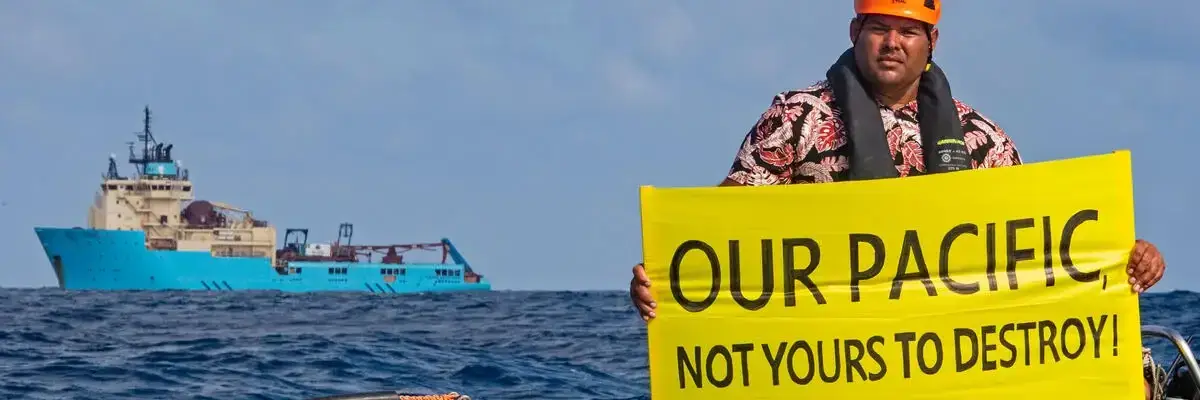
Victor Pickering, a Greenpeace International activist from Fiji, displays a banner reading “Our Pacific, Not Yours to Destroy” in front of the Maersk Launcher, a ship chartered by DeepGreen (now The Metals Comapany), one of the companies spearheading the drive to mine the deep sea, in May 2021.
"The US government should defend the deep, not fast-track its destruction," said one opponent.
Flouting a federal judge's recent finding that the Trump administration's approval of deep-sea mining lease sales violated the Endangered Species Act, the US government on Thursday opened more than 31 million acres of ocean floor near American Samoa to potential mineral exploration that opponents say will devastate marine habitats.
The deep-sea mining lease auction—held by the Department of the Interior's Marine Minerals Administration—marks a major step in President Donald Trump's push to accelerate seabed extraction of minerals including nickel, cobalt, copper, and manganese, which are used in batteries, electronics, and other critical products.
The Associated Press reported that the auction covered two areas of seabed, each spanning millions of acres northeast of American Samoa's Manua Islands. Startup Wetstone US Ventures, the only firm to submit bids, won both leases at the $3 million minimum threshold.
"This is the first time the United States has held an offshore critical minerals lease sale in the Pacific and a historic step for America's energy and mineral security," Interior Secretary Doug Burgum said in a statement. "Today's sale opens a path to learn more about the resources off the coast of American Samoa and assess whether they could contribute to a more reliable domestic supply."
The 20-year leases authorize surveys and other exploratory activities, not commercial extraction, which would require additional approval before mining could begin.
However, the auction and the administration's wider deep-sea mining policy have drawn opposition from environmental organizations, marine scientists, and Pacific Island communities concerned about potentially irreversible damage to fragile marine ecosystems and traditional ways of life.
“These lease sales will open the floodgates to the exploitation of our deep seas,” Oceana Defense Campaign manager Julia Singer said in a statement. “The message from American Samoa, and people across the United States, could not be clearer: Stop deep-sea mining before it starts."
"Thousands of scientists, local leaders, and community members have warned of the danger that deep-sea mining poses, yet the Trump administration is continuing to ignore widespread opposition to this proposal," Singer added. "The US government should defend the deep, not fast-track its destruction.”
The lease sale proceeded despite a Monday ruling by US District Judge Jill Otake in Hawaii that invalidated the government's environmental review of the proposed leases. Otake—a Trump appointee—found that the National Marine Fisheries Service (NMFS) violated the Endangered Species Act (ESA) by reviewing only the sale of the leases and not any potential subsequent mining activity.
"The court’s conclusion that NMFS’ acceptance of the limited definition of agency action was arbitrary and capricious also ensures that the purpose of the ESA—to prevent harm to vulnerable species—is served," Otake wrote in her 41-page ruling. "As extinction is permanent, caution and foresight before acting are necessary and 'caution can only be exercised if the agency takes a look at all the possible ramifications of the agency action.'"
“The message from American Samoa, and people across the United States, could not be clearer: Stop deep-sea mining before it starts."
Thursday's auction took place at the Ventura County Fire Department headquarters in Thousand Oaks, California, where dozens of demonstrators rallied outside.
“We had hoped it would never come to this,” said Sabrina Suluai-Mahuka, founder of the American Samoan youth environmental organization Finafinau. "Yet here we are, watching our ocean being auctioned to the highest bidder. As a mother, I cannot accept that my daughter's future, and the futures of generations yet to be born, are being treated as accseptable risks for an industry we never asked for."
Arlo Hemphill, Oceans Are Life campaign lead at Greenpeace USA, said: “The US just gave the deep-sea mining industry its first foothold in US waters after a court found it failed to consider the full scope of potential harm to endangered species. The industry will push to move from surveys to exploration to extraction, putting profits ahead of marine life and trampling the culture, livelihood, and objections of communities that have said no again and again."
"Once mining strips away habitat that took millions of years to form, no amount of money can bring it back," Hemphill added. "Congress should press the administration to suspend these leases before work begins.”
David Henkin, deputy managing attorney at Earthjustice, said Otake's ruling made Thursday's auction illegal because the government must comply with the ESA prior to any lease sale.
“We will use the full extent of the law to vigorously push for the leases to be voided,” he said.
Three separate lawsuits are challenging the Trump administration's deep-sea mining plans, including one brought by the Samoan council of chiefs Faleula o le Manu'atele, which questions the federal government's authority to lease waters surrounding the islands.
Meanwhile, a study published last week in the peer-reviewed journal Scientific Reports found that polymetallic nodules—the rock-like formations coveted by mining companies for their valuable mineral content—are important habitats for tiny organisms living inside their crevices.
“Our findings point out that commercial mining may result in an irreversible loss of undescribed and unique biodiversity associated with nodules,” said Sabine Gollner, a professor at the Royal Netherlands Institute for Sea Research and study co-author. “This needs to be considered in the environmental management of deep-sea mining.”
In an October opinion piece for Common Dreams, Suluai-Mahuka said the ocean is central to her people's identity and traditions.
"Our history and our culture are tied to this ocean," she wrote. "Yet, none of this was valued by the companies, and we, the people of American Samoa, were not meaningfully included in the decision-making process."
Suluai-Mahuka said her community and allies submitted more than 75,000 comments opposing the proposed auction.
"Almost all of us oppose deep-sea mining," she wrote.
This country and this world are at a monumental crossroads. US voters have an opportunity to beat back the forces of fascism and confront the billionaires who are rigging the economy, our media system, and our democracy, making it increasingly impossible for ordinary people to get by. We’re not just talking about the election. We’re talking about what must be done once these fascist elements are vanquished from power. We need a bolder set of solutions than what either major party has so far been willing to offer and a working-class movement ready to fight like hell for it. Trump didn't emerge from nowhere. The conditions that fueled MAGA authoritarianism were created by decades of radical neoliberal economic policies and a corrupt political system dominated by corporate interests. They slashed taxes on the super-rich, promising that the benefits would trickle down. They said giveaways to the corporate titans would make life more affordable for the rest of us. It was all bullshit. And when a bitter, betrayed populace searches for someone to blame, right-wing demagogues have little trouble finding scapegoats. People know when they're being lied to, but you won't hear any of this from the corporate media. Only independent journalism—powered and funded by people who believe in building a better world—can deliver truly trustworthy daily news. If you share our vision, please contribute whatever you can to sustain our work. |
Flouting a federal judge's recent finding that the Trump administration's approval of deep-sea mining lease sales violated the Endangered Species Act, the US government on Thursday opened more than 31 million acres of ocean floor near American Samoa to potential mineral exploration that opponents say will devastate marine habitats.
The deep-sea mining lease auction—held by the Department of the Interior's Marine Minerals Administration—marks a major step in President Donald Trump's push to accelerate seabed extraction of minerals including nickel, cobalt, copper, and manganese, which are used in batteries, electronics, and other critical products.
The Associated Press reported that the auction covered two areas of seabed, each spanning millions of acres northeast of American Samoa's Manua Islands. Startup Wetstone US Ventures, the only firm to submit bids, won both leases at the $3 million minimum threshold.
"This is the first time the United States has held an offshore critical minerals lease sale in the Pacific and a historic step for America's energy and mineral security," Interior Secretary Doug Burgum said in a statement. "Today's sale opens a path to learn more about the resources off the coast of American Samoa and assess whether they could contribute to a more reliable domestic supply."
The 20-year leases authorize surveys and other exploratory activities, not commercial extraction, which would require additional approval before mining could begin.
However, the auction and the administration's wider deep-sea mining policy have drawn opposition from environmental organizations, marine scientists, and Pacific Island communities concerned about potentially irreversible damage to fragile marine ecosystems and traditional ways of life.
“These lease sales will open the floodgates to the exploitation of our deep seas,” Oceana Defense Campaign manager Julia Singer said in a statement. “The message from American Samoa, and people across the United States, could not be clearer: Stop deep-sea mining before it starts."
"Thousands of scientists, local leaders, and community members have warned of the danger that deep-sea mining poses, yet the Trump administration is continuing to ignore widespread opposition to this proposal," Singer added. "The US government should defend the deep, not fast-track its destruction.”
The lease sale proceeded despite a Monday ruling by US District Judge Jill Otake in Hawaii that invalidated the government's environmental review of the proposed leases. Otake—a Trump appointee—found that the National Marine Fisheries Service (NMFS) violated the Endangered Species Act (ESA) by reviewing only the sale of the leases and not any potential subsequent mining activity.
"The court’s conclusion that NMFS’ acceptance of the limited definition of agency action was arbitrary and capricious also ensures that the purpose of the ESA—to prevent harm to vulnerable species—is served," Otake wrote in her 41-page ruling. "As extinction is permanent, caution and foresight before acting are necessary and 'caution can only be exercised if the agency takes a look at all the possible ramifications of the agency action.'"
“The message from American Samoa, and people across the United States, could not be clearer: Stop deep-sea mining before it starts."
Thursday's auction took place at the Ventura County Fire Department headquarters in Thousand Oaks, California, where dozens of demonstrators rallied outside.
“We had hoped it would never come to this,” said Sabrina Suluai-Mahuka, founder of the American Samoan youth environmental organization Finafinau. "Yet here we are, watching our ocean being auctioned to the highest bidder. As a mother, I cannot accept that my daughter's future, and the futures of generations yet to be born, are being treated as accseptable risks for an industry we never asked for."
Arlo Hemphill, Oceans Are Life campaign lead at Greenpeace USA, said: “The US just gave the deep-sea mining industry its first foothold in US waters after a court found it failed to consider the full scope of potential harm to endangered species. The industry will push to move from surveys to exploration to extraction, putting profits ahead of marine life and trampling the culture, livelihood, and objections of communities that have said no again and again."
"Once mining strips away habitat that took millions of years to form, no amount of money can bring it back," Hemphill added. "Congress should press the administration to suspend these leases before work begins.”
David Henkin, deputy managing attorney at Earthjustice, said Otake's ruling made Thursday's auction illegal because the government must comply with the ESA prior to any lease sale.
“We will use the full extent of the law to vigorously push for the leases to be voided,” he said.
Three separate lawsuits are challenging the Trump administration's deep-sea mining plans, including one brought by the Samoan council of chiefs Faleula o le Manu'atele, which questions the federal government's authority to lease waters surrounding the islands.
Meanwhile, a study published last week in the peer-reviewed journal Scientific Reports found that polymetallic nodules—the rock-like formations coveted by mining companies for their valuable mineral content—are important habitats for tiny organisms living inside their crevices.
“Our findings point out that commercial mining may result in an irreversible loss of undescribed and unique biodiversity associated with nodules,” said Sabine Gollner, a professor at the Royal Netherlands Institute for Sea Research and study co-author. “This needs to be considered in the environmental management of deep-sea mining.”
In an October opinion piece for Common Dreams, Suluai-Mahuka said the ocean is central to her people's identity and traditions.
"Our history and our culture are tied to this ocean," she wrote. "Yet, none of this was valued by the companies, and we, the people of American Samoa, were not meaningfully included in the decision-making process."
Suluai-Mahuka said her community and allies submitted more than 75,000 comments opposing the proposed auction.
"Almost all of us oppose deep-sea mining," she wrote.