SUBSCRIBE TO OUR FREE NEWSLETTER
Daily news & progressive opinion—funded by the people, not the corporations—delivered straight to your inbox.
5
#000000
#FFFFFF
To donate by check, phone, or other method, see our More Ways to Give page.
Daily news & progressive opinion—funded by the people, not the corporations—delivered straight to your inbox.
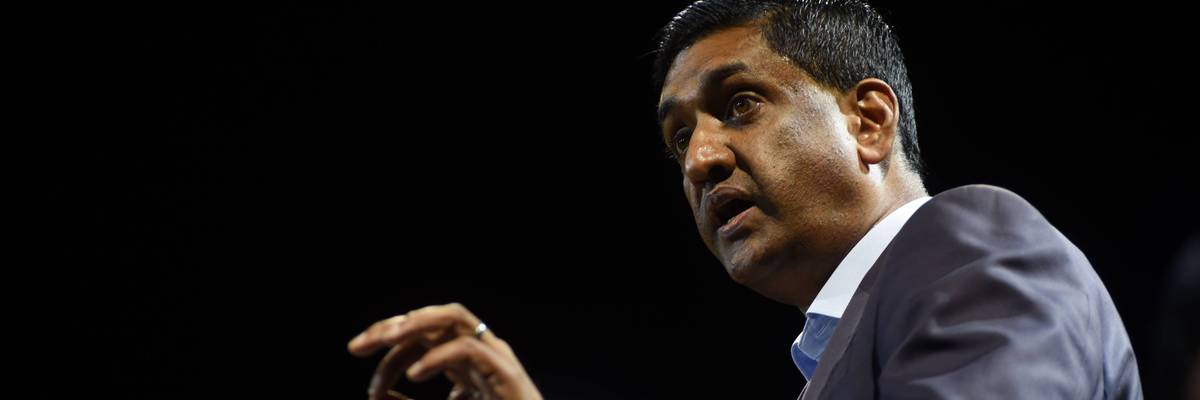
Rep. Ro Khanna (D-Calif.) speaks during the What's Next summit at Mission Ballroom on November 13, 2026 in Denver, Colorado.
Rep. Ro Khanna pointed fingers at President Donald Trump's administration for being caught flat-footed by the outages and not explaining their cause to voters.
With a number of outages hitting American aviation systems and banks over the last week, Rep. Ro Khanna took to social media to explain what's been going on.
In a video posted on Thursday, the California Democrat pointed to the recent release of a Chinese open-source artificial intelligence model called GLM 5.3, which he noted "does not have safeguards and can be used to have cyberattacks," which has led to many institutions rushing to upgrade their systems.
"The rate of patching... has increased dramatically since GLM 5.3 was released," he said. "When you have this increasing in patching, you have many more chances for outages. That's why we're seeing all of these outages across the country."
There is a cloud of confusion about the tech outages.Here is what’s really going on: https://t.co/vH8is7o3oT
— Ro Khanna (@RoKhanna) November 19, 2026
Khanna pointed fingers at President Donald Trump's administration for being caught flat-footed by the outages and not explaining their cause to voters.
"The president of the United States needs to direct... [the Cyber Infrastructure Agency] to take charge," Khanna said. "That agency has been totally cut. They need to restaff it, they need to have a director... and that director needs to coordinate with all of the companies and agencies to have a plan for how we increase our patching."
Khanna then said either the president or one of his deputies should give daily briefings updating the country about cybersecurity threats, while also gathering a broad coalition of government, business, and technology leaders to "upgrade our patching system against the increased AI threat."
"This is not a time for slogans," Khanna said. "This is not a time for politics. It's a time that we actually understand the issue and provide leadership."
Khanna's claims about GLM 5.3 being the primary driver of system upgrades mirrored an analysis published earlier in the week by investment firm Bridgewater Associates.
As reported by MarketWatch on Thursday, Bridgewater's analysis found that a surge in cyberattacks coincided with the release of GLM 5.3, which is far cheaper to use compared to AI models developed by OpenAI and Anthropic.
"We are in the middle of an arms race where malicious actors are using agents to find exploitable bugs and defenders are using agents to preemptively find and patch vulnerabilities," the firm explained. "While models have significantly accelerated work on both sides of the ledger, the defenders have the much heavier burden of patching all bugs before they can be exploited."
This country and this world are at a monumental crossroads. US voters have an opportunity to beat back the forces of fascism and confront the billionaires who are rigging the economy, our media system, and our democracy, making it increasingly impossible for ordinary people to get by. We’re not just talking about the election. We’re talking about what must be done once these fascist elements are vanquished from power. We need a bolder set of solutions than what either major party has so far been willing to offer and a working-class movement ready to fight like hell for it. Trump didn't emerge from nowhere. The conditions that fueled MAGA authoritarianism were created by decades of radical neoliberal economic policies and a corrupt political system dominated by corporate interests. They slashed taxes on the super-rich, promising that the benefits would trickle down. They said giveaways to the corporate titans would make life more affordable for the rest of us. It was all bullshit. And when a bitter, betrayed populace searches for someone to blame, right-wing demagogues have little trouble finding scapegoats. People know when they're being lied to, but you won't hear any of this from the corporate media. Only independent journalism—powered and funded by people who believe in building a better world—can deliver truly trustworthy daily news. If you share our vision, please contribute whatever you can to sustain our work. |
With a number of outages hitting American aviation systems and banks over the last week, Rep. Ro Khanna took to social media to explain what's been going on.
In a video posted on Thursday, the California Democrat pointed to the recent release of a Chinese open-source artificial intelligence model called GLM 5.3, which he noted "does not have safeguards and can be used to have cyberattacks," which has led to many institutions rushing to upgrade their systems.
"The rate of patching... has increased dramatically since GLM 5.3 was released," he said. "When you have this increasing in patching, you have many more chances for outages. That's why we're seeing all of these outages across the country."
There is a cloud of confusion about the tech outages.Here is what’s really going on: https://t.co/vH8is7o3oT
— Ro Khanna (@RoKhanna) November 19, 2026
Khanna pointed fingers at President Donald Trump's administration for being caught flat-footed by the outages and not explaining their cause to voters.
"The president of the United States needs to direct... [the Cyber Infrastructure Agency] to take charge," Khanna said. "That agency has been totally cut. They need to restaff it, they need to have a director... and that director needs to coordinate with all of the companies and agencies to have a plan for how we increase our patching."
Khanna then said either the president or one of his deputies should give daily briefings updating the country about cybersecurity threats, while also gathering a broad coalition of government, business, and technology leaders to "upgrade our patching system against the increased AI threat."
"This is not a time for slogans," Khanna said. "This is not a time for politics. It's a time that we actually understand the issue and provide leadership."
Khanna's claims about GLM 5.3 being the primary driver of system upgrades mirrored an analysis published earlier in the week by investment firm Bridgewater Associates.
As reported by MarketWatch on Thursday, Bridgewater's analysis found that a surge in cyberattacks coincided with the release of GLM 5.3, which is far cheaper to use compared to AI models developed by OpenAI and Anthropic.
"We are in the middle of an arms race where malicious actors are using agents to find exploitable bugs and defenders are using agents to preemptively find and patch vulnerabilities," the firm explained. "While models have significantly accelerated work on both sides of the ledger, the defenders have the much heavier burden of patching all bugs before they can be exploited."