SUBSCRIBE TO OUR FREE NEWSLETTER
Daily news & progressive opinion—funded by the people, not the corporations—delivered straight to your inbox.
5
#000000
#FFFFFF
To donate by check, phone, or other method, see our More Ways to Give page.
Daily news & progressive opinion—funded by the people, not the corporations—delivered straight to your inbox.
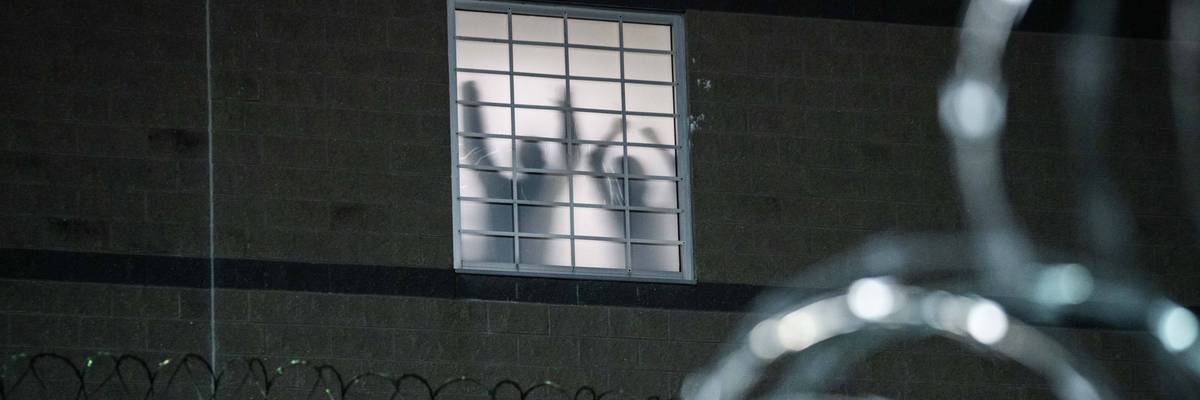
Detainees stand by a window inside the federal immigration center at Delaney Hall in Newark, New Jersey, where US Immigration and Customs Enforcement is housing detained immigrants on May 26, 2026.
"Hiding prisoners from the courts is unconstitutional," said one expert.
Critics reacted with horror to a Monday report from The Associated Press detailing how US Immigration and Customs Enforcement has abruptly ended its practice of disclosing the locations of thousands of detainees.
According to the AP, ICE "has stopped publicly revealing where it is holding... detainees who are subject to final deportation orders, an unannounced move that has made it far more difficult for lawyers and relatives to find them."
Immigration attorneys who spoke with the AP said that their clients had "vanished" from the system after ICE removed them from its online detainee locator system last week.
Greg Chen, senior director of government relations at the American Immigration Lawyers Association, told the AP that families of detainees "are freaking out because they think the person has been deported and they don’t know where the person might be."
Chen added that the new policy has "serious implications" for attorneys' ability to make contact with their clients.
Michelle Mendez, legal director at the National Immigration Project, told the AP that the new policy is "just another iteration of disappearing people."
"Why would we do that in the United States of America?" Mendez asked. "It's something we’d hear about in another country and be concerned about individual rights and due process."
Tom Jawetz, senior fellow at the Center for American Progress, echoed Mendez's analysis, writing in a social media post that the AP report reveals "an official government policy of disappearing people," as "systems for attorneys and loved ones to know where—even whether—a person with a final removal order is in ICE custody have been wiped clean."
Aaron Reichlin-Melnick, senior fellow at the American Immigration Council, described the new ICE policy as "unprecedented" for US immigration enforcement.
"People who have been detained for months are suddenly disappearing from the locator system—even if they haven't been moved anywhere," Reichlin-Melnick explained. "And people newly arrested are not showing up at all, their location now hidden from view."
Georgetown University political scientist Jonathan Ladd argued that the ICE policy was a fundamental violation of long-established rights in the US that date to before the country's official founding.
"The government moving or hiding jailed people to avoid review by courts isn't some loophole in our habeas corpus rights," Ladd explained. "This government behavior has been considered a violation of the people's habeas corpus rights since at least the Habeas Corpus Act of 1679."
Ladd further pointed out that "habeas corpus rights are guaranteed by Article I of our Constitution," which means "hiding prisoners from the courts is unconstitutional."
Journalist Gillian Brockell observed that the new ICE policy "will make it nearly impossible to file habeas petitions, because attorneys won’t even know what federal district their client has been moved to to stage for their removal."
Among those sharing the AP report on social media was Kate Lincoln-Goldfinch, an attorney for Wilbur Rafael Garces Perez, a 28-year-old Venezuelan shot by ICE in Austin, Texas on Sunday.
Initially, she and the immigrant's wife could not make contact with him, because ICE moved him from the hospital "to an undisclosed location," but Lincoln-Goldfinch said Monday afternoon that her client "is being held at Pearsall for interrogation."
"We got Wilber on the phone live from detention at the press conference," the attorney added. "He says he still has the bullet lodged in his shoulder. He says he is not doing well and has not received the medical care he needs."
This country and this world are at a monumental crossroads. US voters have an opportunity to beat back the forces of fascism and confront the billionaires who are rigging the economy, our media system, and our democracy, making it increasingly impossible for ordinary people to get by. We’re not just talking about the election. We’re talking about what must be done once these fascist elements are vanquished from power. We need a bolder set of solutions than what either major party has so far been willing to offer and a working-class movement ready to fight like hell for it. Trump didn't emerge from nowhere. The conditions that fueled MAGA authoritarianism were created by decades of radical neoliberal economic policies and a corrupt political system dominated by corporate interests. They slashed taxes on the super-rich, promising that the benefits would trickle down. They said giveaways to the corporate titans would make life more affordable for the rest of us. It was all bullshit. And when a bitter, betrayed populace searches for someone to blame, right-wing demagogues have little trouble finding scapegoats. People know when they're being lied to, but you won't hear any of this from the corporate media. Only independent journalism—powered and funded by people who believe in building a better world—can deliver truly trustworthy daily news. If you share our vision, please contribute whatever you can to sustain our work. |
Critics reacted with horror to a Monday report from The Associated Press detailing how US Immigration and Customs Enforcement has abruptly ended its practice of disclosing the locations of thousands of detainees.
According to the AP, ICE "has stopped publicly revealing where it is holding... detainees who are subject to final deportation orders, an unannounced move that has made it far more difficult for lawyers and relatives to find them."
Immigration attorneys who spoke with the AP said that their clients had "vanished" from the system after ICE removed them from its online detainee locator system last week.
Greg Chen, senior director of government relations at the American Immigration Lawyers Association, told the AP that families of detainees "are freaking out because they think the person has been deported and they don’t know where the person might be."
Chen added that the new policy has "serious implications" for attorneys' ability to make contact with their clients.
Michelle Mendez, legal director at the National Immigration Project, told the AP that the new policy is "just another iteration of disappearing people."
"Why would we do that in the United States of America?" Mendez asked. "It's something we’d hear about in another country and be concerned about individual rights and due process."
Tom Jawetz, senior fellow at the Center for American Progress, echoed Mendez's analysis, writing in a social media post that the AP report reveals "an official government policy of disappearing people," as "systems for attorneys and loved ones to know where—even whether—a person with a final removal order is in ICE custody have been wiped clean."
Aaron Reichlin-Melnick, senior fellow at the American Immigration Council, described the new ICE policy as "unprecedented" for US immigration enforcement.
"People who have been detained for months are suddenly disappearing from the locator system—even if they haven't been moved anywhere," Reichlin-Melnick explained. "And people newly arrested are not showing up at all, their location now hidden from view."
Georgetown University political scientist Jonathan Ladd argued that the ICE policy was a fundamental violation of long-established rights in the US that date to before the country's official founding.
"The government moving or hiding jailed people to avoid review by courts isn't some loophole in our habeas corpus rights," Ladd explained. "This government behavior has been considered a violation of the people's habeas corpus rights since at least the Habeas Corpus Act of 1679."
Ladd further pointed out that "habeas corpus rights are guaranteed by Article I of our Constitution," which means "hiding prisoners from the courts is unconstitutional."
Journalist Gillian Brockell observed that the new ICE policy "will make it nearly impossible to file habeas petitions, because attorneys won’t even know what federal district their client has been moved to to stage for their removal."
Among those sharing the AP report on social media was Kate Lincoln-Goldfinch, an attorney for Wilbur Rafael Garces Perez, a 28-year-old Venezuelan shot by ICE in Austin, Texas on Sunday.
Initially, she and the immigrant's wife could not make contact with him, because ICE moved him from the hospital "to an undisclosed location," but Lincoln-Goldfinch said Monday afternoon that her client "is being held at Pearsall for interrogation."
"We got Wilber on the phone live from detention at the press conference," the attorney added. "He says he still has the bullet lodged in his shoulder. He says he is not doing well and has not received the medical care he needs."