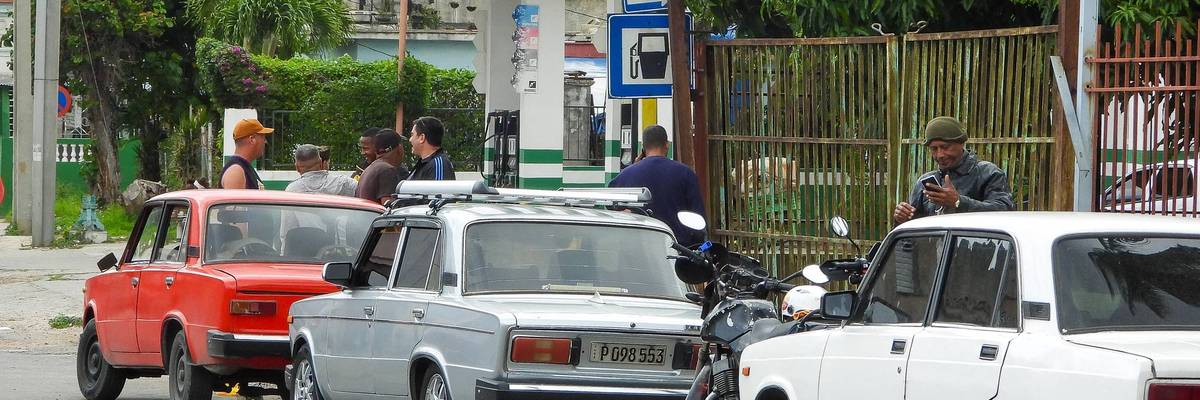
Vehicles wait in line to refuel at a gas station in Havana, Cuba on January 30, 2026.
Pushing for Regime Change, Trump Accused of 'Asphyxiating' Cuba With Fuel Embargo
"Bus stops are empty, and families are turning to wood and coal for cooking, living through near-constant power outages amid an economic crisis worsened by the Trump administration’s steps in recent weeks."
The Trump administration's decision to tighten the decadeslong US stranglehold on the Cuban economy by depriving the island nation of its largest source of oil has plunged the country into a rapidly worsening energy crisis, forcing its government to take far-reaching emergency steps to avert catastrophe—from curbing transportation services to shortening work and school hours.
"We are not going to collapse," Oscar Perez‑Oliva Fraga, Cuba's deputy prime minister, said in an address outlining the emergency measures late last week as White House officials—including Secretary of State Marco Rubio, a longtime Cuba hawk—pushed for the overthrow of the Cuban government by the end of the year.
The Wall Street Journal reported late last month that President Donald Trump's administration is "emboldened" by its kidnapping of Venezuelan President Nicolás Maduro and is now "searching for Cuban government insiders who can help cut a deal to push out" the government of Cuban President Miguel Díaz-Canel, who has expressed openness to talks with the US—but not under economic coercion.
"The Trump administration has assessed that Cuba’s economy is close to collapse and that the government has never been this fragile after losing a vital benefactor in Maduro," the Journal noted. "Officials don’t have a concrete plan to end the Communist government that has held power on the Caribbean island for almost seven decades, but they see Maduro’s capture and subsequent concessions from his allies left behind as a blueprint and a warning for Cuba."
Since its abduction of Maduro in early January, the Trump administration has vowed to bar any Venezuelan oil or money from reaching Cuba and threatened to slap tariffs on any country that sells oil to the Cuban government. Venezuela was previously Cuba's largest oil supplier, providing the island nation with roughly 70,000 barrels of crude oil and refined products last year.
In a January 29 executive order, Trump proclaimed—laughably—that Cuba "constitute[s] an unusual and extraordinary threat" to US national security.
The Trump administration's increasingly aggressive economic warfare has been disastrous for the Cuban people, who have always been the primary victims of the illegal and globally condemned US blockade.
"Bus stops are empty, and families are turning to wood and coal for cooking, living through near-constant power outages amid an economic crisis worsened by the Trump administration’s steps in recent weeks," Al Jazeera reported Sunday. "The government says it will prioritize available fuel for essential services—public health, food production, and defense—and push the installation of solar-based renewable energy sector and incentives therein. It will prioritise shifting energy to selected food production regions and accelerate the use of renewable energy sources, while cutting down on culture and sport activities and diverting resources towards the country’s early warning systems."
A spokesperson for United Nations Secretary-General António Guterres warned last week that the UN chief is "extremely concerned about the humanitarian situation in Cuba, which will worsen, if not collapse, if its oil needs go unmet."
David Adler, co-general coordinator of Progressive International, wrote Monday that "right now, Donald Trump is laying siege to the island of Cuba: asphyxiating its people, shuttering its hospitals, starving them of food."
"If you care about 'America', this is your fight," Adler added.
Over the weekend, the Mexican government announced that its Navy is sending more than 800 tons of humanitarian aid to Cuba, including "essential food items" and "personal hygiene products."
"Through these actions, the government of Mexico reaffirms the humanistic principles and spirit of solidarity that guide it, and its commitment to international cooperation among peoples, especially with those who require humanitarian assistance in situations of emergency and vulnerability," the government said in a statement. "Cuba and Mexico are sister nations, heirs to a long history of solidarity that we honor today."
In a social media post during the National Football League Super Bowl in the US, Drop Site journalist Ryan Grim wrote that "there are obviously a lot of shameful moments in American history, but Mexico being forced to send militarily protected humanitarian relief to a Cuban population we are starving for no reason, while we all stuff our faces with chicken wings, has to rank among our low moments."
We are at a crossroads
This country and this world are at a monumental crossroads. In a few short weeks, US voters will have an opportunity to beat back the forces of fascism and confront the billionaires who are rigging the economy, our media system, and our democracy, making it increasingly impossible for ordinary people to get by. We’re not just talking about the election. We’re talking about what must be done once these fascist elements are vanquished from power. We need a bolder set of solutions than what either major party has so far been willing to offer and a working-class movement ready to fight like hell for it. Trump didn't emerge from nowhere. The conditions that fueled MAGA authoritarianism were created by decades of radical neoliberal economic policies and a corrupt political system dominated by corporate interests. They slashed taxes on the super-rich, promising that the benefits would trickle down. They said giveaways to the corporate titans would make life more affordable for the rest of us. It was all bullshit. And when a bitter, betrayed populace searches for someone to blame, right-wing demagogues have little trouble finding scapegoats. People know when they're being lied to, but you won't hear any of this from the corporate media. Only independent journalism—powered and funded by people who believe in building a better world—can deliver truly trustworthy daily news. Our Fall Campaign is underway, and we need your help. To power our newsroom through the rest of the year, we need to raise $125,000 by midnight on October 31. So if you share our vision, please contribute whatever you can to sustain our work. |
The Trump administration's decision to tighten the decadeslong US stranglehold on the Cuban economy by depriving the island nation of its largest source of oil has plunged the country into a rapidly worsening energy crisis, forcing its government to take far-reaching emergency steps to avert catastrophe—from curbing transportation services to shortening work and school hours.
"We are not going to collapse," Oscar Perez‑Oliva Fraga, Cuba's deputy prime minister, said in an address outlining the emergency measures late last week as White House officials—including Secretary of State Marco Rubio, a longtime Cuba hawk—pushed for the overthrow of the Cuban government by the end of the year.
The Wall Street Journal reported late last month that President Donald Trump's administration is "emboldened" by its kidnapping of Venezuelan President Nicolás Maduro and is now "searching for Cuban government insiders who can help cut a deal to push out" the government of Cuban President Miguel Díaz-Canel, who has expressed openness to talks with the US—but not under economic coercion.
"The Trump administration has assessed that Cuba’s economy is close to collapse and that the government has never been this fragile after losing a vital benefactor in Maduro," the Journal noted. "Officials don’t have a concrete plan to end the Communist government that has held power on the Caribbean island for almost seven decades, but they see Maduro’s capture and subsequent concessions from his allies left behind as a blueprint and a warning for Cuba."
Since its abduction of Maduro in early January, the Trump administration has vowed to bar any Venezuelan oil or money from reaching Cuba and threatened to slap tariffs on any country that sells oil to the Cuban government. Venezuela was previously Cuba's largest oil supplier, providing the island nation with roughly 70,000 barrels of crude oil and refined products last year.
In a January 29 executive order, Trump proclaimed—laughably—that Cuba "constitute[s] an unusual and extraordinary threat" to US national security.
The Trump administration's increasingly aggressive economic warfare has been disastrous for the Cuban people, who have always been the primary victims of the illegal and globally condemned US blockade.
"Bus stops are empty, and families are turning to wood and coal for cooking, living through near-constant power outages amid an economic crisis worsened by the Trump administration’s steps in recent weeks," Al Jazeera reported Sunday. "The government says it will prioritize available fuel for essential services—public health, food production, and defense—and push the installation of solar-based renewable energy sector and incentives therein. It will prioritise shifting energy to selected food production regions and accelerate the use of renewable energy sources, while cutting down on culture and sport activities and diverting resources towards the country’s early warning systems."
A spokesperson for United Nations Secretary-General António Guterres warned last week that the UN chief is "extremely concerned about the humanitarian situation in Cuba, which will worsen, if not collapse, if its oil needs go unmet."
David Adler, co-general coordinator of Progressive International, wrote Monday that "right now, Donald Trump is laying siege to the island of Cuba: asphyxiating its people, shuttering its hospitals, starving them of food."
"If you care about 'America', this is your fight," Adler added.
Over the weekend, the Mexican government announced that its Navy is sending more than 800 tons of humanitarian aid to Cuba, including "essential food items" and "personal hygiene products."
"Through these actions, the government of Mexico reaffirms the humanistic principles and spirit of solidarity that guide it, and its commitment to international cooperation among peoples, especially with those who require humanitarian assistance in situations of emergency and vulnerability," the government said in a statement. "Cuba and Mexico are sister nations, heirs to a long history of solidarity that we honor today."
In a social media post during the National Football League Super Bowl in the US, Drop Site journalist Ryan Grim wrote that "there are obviously a lot of shameful moments in American history, but Mexico being forced to send militarily protected humanitarian relief to a Cuban population we are starving for no reason, while we all stuff our faces with chicken wings, has to rank among our low moments."
- Opinion | How the US Weaponizes Starvation and Aid in Gaza and Cuba | Common Dreams ›
- Israel's US-Backed Assault on Gaza Set Stage for Collective Punishment in Cuba, AOC Says | Common Dreams ›
- 'We Are Sailing to Cuba': Humanitarian Coalition Announces Flotilla to Break US Blockade | Common Dreams ›
- Opinion | Trump's Oil Embargo on Cuba Should Be Seen for What It Is: An Unprovoked Act of War | Common Dreams ›
- Trump Now 'Boasting of a War Crime' as Cuba Suffers Under Oil Blockade | Common Dreams ›
- 'The Siege Must Be Broken': Countries Called to Ship Fuel to Cuba After Trump Tariffs Struck Down | Common Dreams ›
- Four People on a Florida Speedboat Killed in Shootout With Cuban Troops | Common Dreams ›
- Opinion | We're Tired of Marco Rubio Speaking for Us: A New Cuban-American Movement | Common Dreams ›
- As Trump Tightens US Chokehold on Cuba's Economy, Rubio Says Fix Requires 'New People in Chargen' | Common Dreams ›
- Opinion | Why Regime Change in Cuba Is Imminent and We Should Be Worried | Common Dreams ›
The Trump administration's decision to tighten the decadeslong US stranglehold on the Cuban economy by depriving the island nation of its largest source of oil has plunged the country into a rapidly worsening energy crisis, forcing its government to take far-reaching emergency steps to avert catastrophe—from curbing transportation services to shortening work and school hours.
"We are not going to collapse," Oscar Perez‑Oliva Fraga, Cuba's deputy prime minister, said in an address outlining the emergency measures late last week as White House officials—including Secretary of State Marco Rubio, a longtime Cuba hawk—pushed for the overthrow of the Cuban government by the end of the year.
The Wall Street Journal reported late last month that President Donald Trump's administration is "emboldened" by its kidnapping of Venezuelan President Nicolás Maduro and is now "searching for Cuban government insiders who can help cut a deal to push out" the government of Cuban President Miguel Díaz-Canel, who has expressed openness to talks with the US—but not under economic coercion.
"The Trump administration has assessed that Cuba’s economy is close to collapse and that the government has never been this fragile after losing a vital benefactor in Maduro," the Journal noted. "Officials don’t have a concrete plan to end the Communist government that has held power on the Caribbean island for almost seven decades, but they see Maduro’s capture and subsequent concessions from his allies left behind as a blueprint and a warning for Cuba."
Since its abduction of Maduro in early January, the Trump administration has vowed to bar any Venezuelan oil or money from reaching Cuba and threatened to slap tariffs on any country that sells oil to the Cuban government. Venezuela was previously Cuba's largest oil supplier, providing the island nation with roughly 70,000 barrels of crude oil and refined products last year.
In a January 29 executive order, Trump proclaimed—laughably—that Cuba "constitute[s] an unusual and extraordinary threat" to US national security.
The Trump administration's increasingly aggressive economic warfare has been disastrous for the Cuban people, who have always been the primary victims of the illegal and globally condemned US blockade.
"Bus stops are empty, and families are turning to wood and coal for cooking, living through near-constant power outages amid an economic crisis worsened by the Trump administration’s steps in recent weeks," Al Jazeera reported Sunday. "The government says it will prioritize available fuel for essential services—public health, food production, and defense—and push the installation of solar-based renewable energy sector and incentives therein. It will prioritise shifting energy to selected food production regions and accelerate the use of renewable energy sources, while cutting down on culture and sport activities and diverting resources towards the country’s early warning systems."
A spokesperson for United Nations Secretary-General António Guterres warned last week that the UN chief is "extremely concerned about the humanitarian situation in Cuba, which will worsen, if not collapse, if its oil needs go unmet."
David Adler, co-general coordinator of Progressive International, wrote Monday that "right now, Donald Trump is laying siege to the island of Cuba: asphyxiating its people, shuttering its hospitals, starving them of food."
"If you care about 'America', this is your fight," Adler added.
Over the weekend, the Mexican government announced that its Navy is sending more than 800 tons of humanitarian aid to Cuba, including "essential food items" and "personal hygiene products."
"Through these actions, the government of Mexico reaffirms the humanistic principles and spirit of solidarity that guide it, and its commitment to international cooperation among peoples, especially with those who require humanitarian assistance in situations of emergency and vulnerability," the government said in a statement. "Cuba and Mexico are sister nations, heirs to a long history of solidarity that we honor today."
In a social media post during the National Football League Super Bowl in the US, Drop Site journalist Ryan Grim wrote that "there are obviously a lot of shameful moments in American history, but Mexico being forced to send militarily protected humanitarian relief to a Cuban population we are starving for no reason, while we all stuff our faces with chicken wings, has to rank among our low moments."
- Opinion | How the US Weaponizes Starvation and Aid in Gaza and Cuba | Common Dreams ›
- Israel's US-Backed Assault on Gaza Set Stage for Collective Punishment in Cuba, AOC Says | Common Dreams ›
- 'We Are Sailing to Cuba': Humanitarian Coalition Announces Flotilla to Break US Blockade | Common Dreams ›
- Opinion | Trump's Oil Embargo on Cuba Should Be Seen for What It Is: An Unprovoked Act of War | Common Dreams ›
- Trump Now 'Boasting of a War Crime' as Cuba Suffers Under Oil Blockade | Common Dreams ›
- 'The Siege Must Be Broken': Countries Called to Ship Fuel to Cuba After Trump Tariffs Struck Down | Common Dreams ›
- Four People on a Florida Speedboat Killed in Shootout With Cuban Troops | Common Dreams ›
- Opinion | We're Tired of Marco Rubio Speaking for Us: A New Cuban-American Movement | Common Dreams ›
- As Trump Tightens US Chokehold on Cuba's Economy, Rubio Says Fix Requires 'New People in Chargen' | Common Dreams ›
- Opinion | Why Regime Change in Cuba Is Imminent and We Should Be Worried | Common Dreams ›