

SUBSCRIBE TO OUR FREE NEWSLETTER
Daily news & progressive opinion—funded by the people, not the corporations—delivered straight to your inbox.
5
#000000
#FFFFFF
To donate by check, phone, or other method, see our More Ways to Give page.
Daily news & progressive opinion—funded by the people, not the corporations—delivered straight to your inbox.
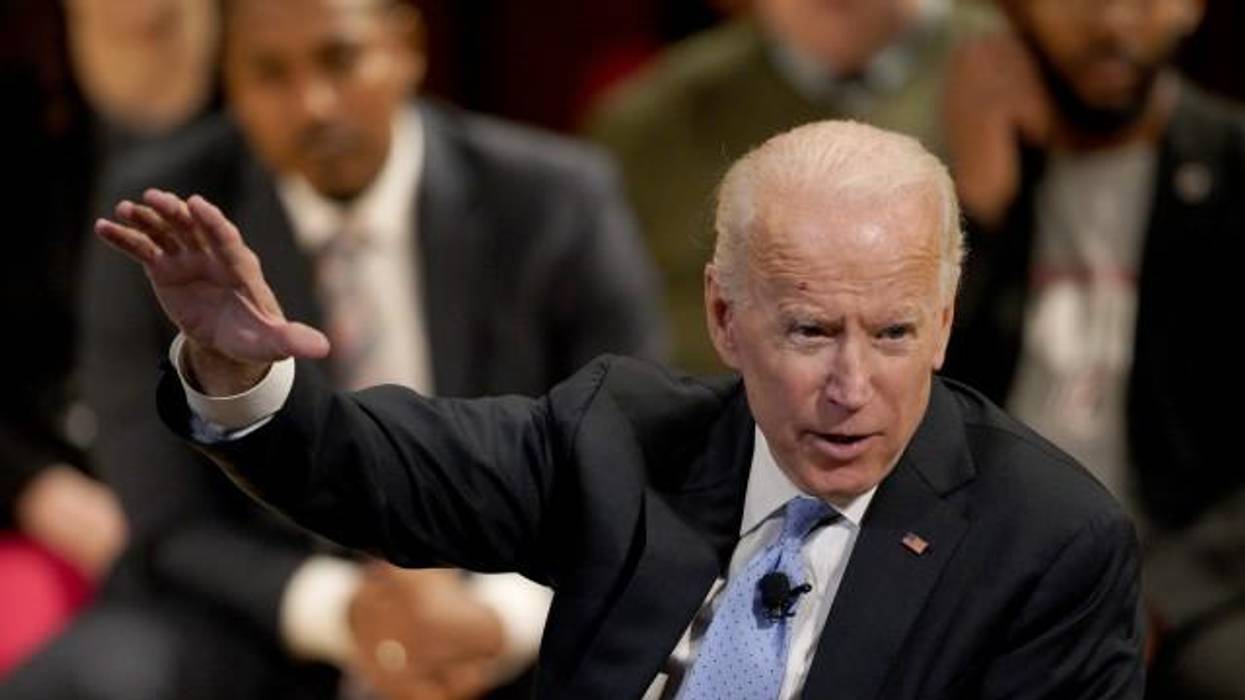
Joe Biden is, in so many ways, a man from a Democratic Party of another time. Yet as he inches closer to a campaign to lead the Democratic Party of 2020, he is suddenly finding himself being asked questions that had lay dormant while he served ably as Barack Obama's vice president for eight years, questions that get right to the heart of what his party stands for.
In most of the polls that have been taken of primary voters, Biden comes in first with around a quarter of the vote, in no small part because he is far more familiar than the other candidates (with the possible exception of Bernie Sanders). But like all the other candidates, his long record in office is being reexamined, particularly those parts that look much more problematic from the perspective of 2019 than they did even in 2008.
Like all the other candidates, his long record in office is being reexamined, particularly those parts that look much more problematic from the perspective of 2019 than they did even in 2008.
There's his role in writing the harsh 1994 crime bill, his advocacy for banks and credit card companies, his denunciations of busing in the 1970s. And there's the confirmation hearings for Clarence Thomas's nomination to the Supreme Court, which Biden oversaw as chair of the Senate Judiciary Committee, when Anita Hill was mocked and abused despite the fact that she was the one telling the truth. Biden now says "I wish I could have done something" to make it less awful for Hill, as though he were some sort of bystander. One thing he could have done was allow the other women who were prepared to corroborate Hill's account to testify. But he didn't.
Biden has expressed regret over all that; whether he has done enough is a matter people could disagree about. But now another issue has been raised, one that has been in plain sight for years: Biden's tendency, when standing next to women, to act as though he has the right to put his hands on their bodies without their permission.
As so often happens, it took one woman speaking out to force everyone else to take seriously what people already knew and joked about. Lucy Flores, who in 2014 was the Democratic nominee for lieutenant governor of Nevada, wrote an essay in New York Magazine about what happened to her when Biden came to do an event for her, and they stood backstage waiting to go on:
As I was taking deep breaths and preparing myself to make my case to the crowd, I felt two hands on my shoulders. I froze. "Why is the vice-president of the United States touching me?"
I felt him get closer to me from behind. He leaned further in and inhaled my hair. I was mortified. I thought to myself, "I didn't wash my hair today and the vice-president of the United States is smelling it. And also, what in the actual fuck? Why is the vice-president of the United States smelling my hair?" He proceeded to plant a big slow kiss on the back of my head.
"In my many years on the campaign trail and in public life, I have offered countless handshakes, hugs, expressions of affection, support and comfort," Biden said in a statement responding to Flores's account. "And not once--never--did I believe I acted inappropriately. If it is suggested I did so, I will listen respectfully. But it was never my intention." He also stressed the need to listen to what women have to say and promised to keep doing so.
Flores's response hit the right note: "Frankly, my point was never about his intentions, and they shouldn't be about his intentions. It should be about the women on the receiving end of that behavior."
I wouldn't be surprised at all if Biden has no memory of this incident, because what Flores describes is exactly what he does all the time. To call him "handsy" is an understatement. It's not necessarily sexual, but it's deeply disturbing.
What's distinctive about Biden's behavior is that unlike many politicians who have been accused of acting inappropriately, his acts were both private and public, not hidden as though it was something he might be afraid to be caught doing. Go to YouTube and you can find plenty of videos of Biden doing exactly what Lucy Flores described to any number of women and girls, particularly during Senate swearing-in ceremonies where newly elected members pose for pictures with their families. Biden will find himself next to a female--sometimes a grown woman, sometimes a teenager, sometimes a girl who looks no more than seven or eight--whereupon he'll grab her shoulders, thrust his face into her hair with a smile as though drinking in her scent, and maybe plant a kiss. Here's a photo of him burying his nose in the hair of actress and activist Eva Longoria at the same event he appeared at with Flores.
At these moments one notices that the women, like former Secretary of Defense Ashton Carter's wife Stephanie, stand stoically while he holds them, since this is no doubt not the first time they have experienced such a thing. The girls, on the other hand, like Senator Chris Coons' daughter, are more likely to squirm uncomfortably.
So what would we like to hear from Biden now that he's being forced to confront this issue? Perhaps something that demonstrates that he understands, or at least is trying to understand, how it can feel for a woman to have a powerful man walk up to her and put his hands all over her. How about something like this:
It has become clear to me that what I thought were moments of affection felt like anything but to the people on the other side. I can say I never intended to make anyone uncomfortable, but that's not good enough. I did make them uncomfortable. I treated them as though their bodies were available to me, at my whim, to stroke or smell or kiss, whether they wanted me to or not. I violated their autonomy, because I figured they'd enjoy it, and because I could. I understand, and I'm sorry. And I'm going to change.
Perhaps it would be naive to hope that any politician would actually say something like that, to present themselves as something less than a hero who was always in the right and never had anything but the purest of motives. In these kinds of situations, they tend to respond in ways that are respectful to the accuser but insist upon their own innocence. But there isn't a question of Biden's innocence, since he has done what Flores describes so many times on camera. The question is whether he understands why it's wrong.
Of course, you could argue that this doesn't have that much bearing on what sort of president he'd be, and Biden points to his work on things like the Violence Against Women Act to show that he is an advocate for women's rights. But as Rebecca Traister argues in a devastating indictment of the former vice president, it is the things that supposedly make Biden "electable" that are precisely the problem with the idea of him leading the Democratic Party at this point in its evolution.
Joe Biden, we are told over and over, is the one who can speak to the disaffected white men angry at the loss of their primacy. He's the one who doesn't like abortion, but is willing to let the ladies have them. He's the one who tells white people to be nice to immigrants, even as he mirrors their xenophobia ("You cannot go to a 7-Eleven or a Dunkin' Donuts unless you have a slight Indian accent," he said in 2006). He's the one who validates their racism and sexism while gently trying to assure them that they're still welcome in the Democratic Party. "In an attempt to win back That Guy," Traister writes, "Joe Biden has himself, so very often, been That Guy."
And Biden is the embodiment of the idea that winning the support of That Guy is the one true path to Democratic success. Not exciting African-American voters, or young voters, or Latino voters. Not engaging the millions of Americans who would vote for Democrats if someone convinced them to register. Not mobilizing the Democratic electorate as the party did so successfully in 2018, but winning over some of those endlessly glorified white working-class men.
It's not yet clear what policy agenda Biden will propose, though it's likely to be pretty standard Democratic fare that rejects some of the more ambitious goals other candidates have embraced. But Biden represents something more fundamental: a link to the politics and political style of the past. Even if that's not his intention.
Amo, amas,
I love a lass,
As a cedar tall and slender;
Sweet cowslip's grace,
Is her nominative case,
And she's of the feminine gender!
-- John O'Keefe, The Agreeable Surprise, (1783)
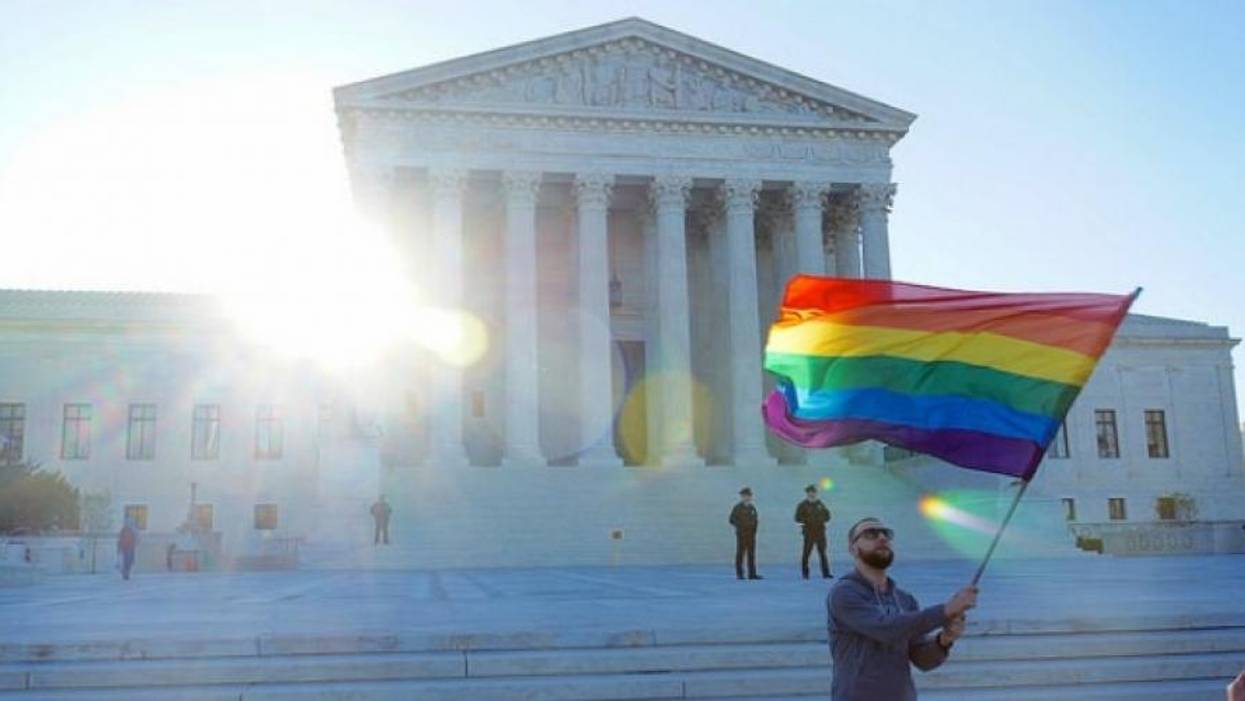
January was a bad month for the LGBTQ community. First it was Mississippi that made a brief appearance in the United States Supreme Court. Then it was Karen Pence, the vice-president's wife, who made an appearance in the media. And, finally, the armed services made a brief appearance in the United States Supreme Court.
It began with news on January 8, 2019, when a majority of the United States Supreme Court declined to get involved in a lawsuit challenging a law passed by the Mississippi legislature in 2016. In that year the legislature said, among other things, that it was alright for state employees and private businesses to refuse services to members of the LGBTQ community. The Mississippi legislature had received word from the God in whom they believe, that members of the LGBTQ community displeased Him notwithstanding the fact that He had participated in their creation. In order to know what their God thought, it was, of course, necessary for His thoughts to be filtered through the minds of His is self-appointed spokespersons in the Mississippi legislature who were responsible for passing the legislation in question. Those who objected to the law thought that for Mississippi legislators to be considered the vessels into which God would pour anti-LBGTQ venom, was highly suspicious, if not completely incredible. The Supreme Court was not so troubled. It declined to delve into the complex question presented, and permitted the law to stand.
A few days later it was Karen Spence, the wife of the vice-president, who was in the news. She, it turned out, was another vessel into which it seemed, God had poured anti-LBGTQ venom. She had taken a job at a school that does not simply refuse to hire members of the LBGTQ community in any capacity, but refuses to accept children if they participate in or condone homosexual activity. Among its many tenets, as described in the Parent Agreement that all parents sign, is a denial of the theory of evolution, a denial to which the actions of the school would lend credence. Employees are required to sign an employment agreement that, among other things, says the employee will not do anything that violates the "unique roles of male and female."
Karen's husband, Mike, was outraged that anyone was offended that his wife had gone to work at that well spring of intolerance. The vice-president said that attacking "Christian education, is deeply offensive to us." Some might respond that a school that espouses intolerance towards those who do not subscribe to what it thinks its God wants, is offensive to the rest of us.
The final episode occurred on January 22, 2019. The good news was that the bad news imparted to the country on that day, had nothing to do with anyone pretending to be the vessel through which God made His wishes known. It simply had to do with reversing what Trumpsters perceived to be an ill-conceived legacy from the Obama years pertaining to the LGBTQ community. It had to do with military service, something about which the Trump has no first-hand knowledge, due to the debilitating effects of a mischievous heel spur that prevented him from serving in the military.
In 2015, then Secretary of Defense, Ashton Carter, let it be known that he thought the only reason transgender people should be barred from the military should be an individual's lack of merit. On August 19, 2015, the Secretary said that regulations banning transgender individuals from the military were being dismantled, and on June 30, 2016, those regulations were repealed. Then came the Trump.
Thirteen months after the regulations were repealed, the Trump said transgender people would no longer be permitted to serve in the military. On August 25, 2017, the Trump ordered the Secretary of Defense and the Secretary of Homeland Security to submit an implementation plan by February 21, 2018, that would, among other things, reinstate the ban on transgender individuals serving in the military. Not unexpectedly, suits were brought attacking the Trump's actions. One trial court that heard a case that arose because of the decision to ban transgender individuals from the military, ruled, among other things, that the reasons the Trump gave for the ban "were not merely unsupported, but were actually contradicted by the studies, conclusions and judgment of the military itself."
Another case attacking the ban was brought in Washington state and, like its predecessor, the ban was struck down by the trial court. That court observed that the transgender individuals seeking entry into the military were a protected class and laws impairing their rights were subject to strict scrutiny. The government appealed that decision, and on January 22, 2019, the United States Supreme Court reversed the decision of the lower court that had prevented the administration from implementing its ban on permitting transgender individuals to serve in the military. It permitted the ban to go into effect while the matter was litigated in lower courts. Until the lower courts have ruled on the question, and the case once again arrives at the United States Supreme Court, transgender people will not be permitted to serve in the military. Only God knows how He will instruct the members of that Court to rule when the case once again appears before it. Those among my readers who are not in touch with God, however, probably know.
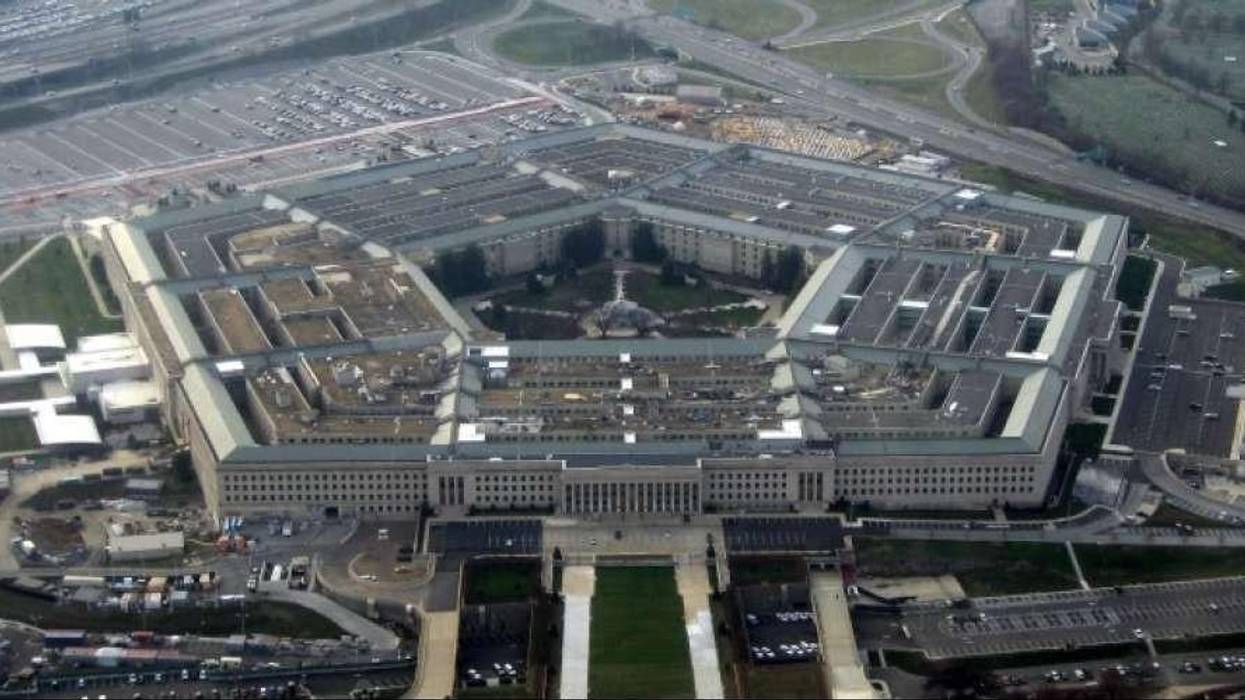
The way personnel spin through Washington's infamous revolving door between the Pentagon and the arms industry is nothing new. That door, however, is moving ever faster with the appointment of Patrick Shanahan, who spent 30 years at Boeing, the Pentagon's second largest contractor, as the Trump administration's acting secretary of defense.
Shanahan had previously been deputy secretary of defense, a typical position in recent years for someone with a significant arms industry background. William Lynn, President Obama's first deputy secretary of defense, had been a Raytheon lobbyist. Ashton Carter, his successor, was a consultant for the same company. One of President George W. Bush's deputies, Gordon England, had been president of the General Dynamics Fort Worth Aircraft Company (later sold to Lockheed Martin).
But Shanahan is unique. No secretary of defense in recent memory has had such a long career in the arms industry and so little experience in government or the military. For most of that career, in fact, his main focus was winning defense contracts for Boeing, not crafting effective defense policies. While the Pentagon should be focused on protecting the country, the arms industry operates in the pursuit of profit, even when that means selling weapons systems to countries working against American national security interests.
The closest analogues to Shanahan were Charlie Wilson, head of General Motors, whom President Dwight Eisenhower appointed to lead the Department of Defense (DoD) more than 60 years ago and John F. Kennedy's first defense secretary, Robert McNamara, who ran the Ford Motor Company before joining the administration. Eisenhower's choice of Wilson, whose firm manufactured military vehicles, raised concerns at the time about conflicts of interest -- but not in Wilson's mind. He famously claimed that, "for years I thought what was good for the country was good for General Motors and vice versa."
Shanahan's new role raises questions about whether what is in the best interest of Boeing -- bigger defense budgets and giant contracts for unaffordable and ineffective weaponry or aircraft -- is what's in the best interest of the public.
Rampant Conflicts of Interest
Unlike Wilson, Shanahan has at least implicitly acknowledged the potential for conflicts of interest in his new role by agreeing to recuse himself from decisions involving his former employer. But were he truly to adhere to such a position, he would have to avoid many of the Pentagon's most significant management and financial decisions. Last year, after all, Boeing received nearly $30 billion in DoD contracts for working on everything from combat, refueling, training, and radar planes to bombs, drones, missile-defense systems, ballistic missiles, and military satellites. If Shanahan were to step back from deliberations related to all of these, he would, at best, be a part-time steward of the Pentagon, unable even to oversee whether Boeing and related companies delivered what our military asked for.
There is already evidence, however, that he will do anything but refrain from overseeing, and so promoting, his old firm. Take Boeing's F-15X, for example. Against the wishes of the Air Force, the Pentagon decided to invest at least $1.2 billion in that fighter aircraft, an upgraded version of the Boeing F-15C/D, which had been supplanted by Lockheed Martin's questionable new F-35. There have been reports that Shanahan has already trashed Lockheed, Boeing's top competitor, in discussions inside the Pentagon. According to Bloomberg News, the decision to invest in the F-15X was due, in part at least, to "prodding" from him, when he was still deputy secretary of defense.
And that's just one of a slew of major contracts scooped up by Boeing in the past year. Others include a $9.2 billion program for a new training aircraft for the Air Force, an $805 million contract for an aerial refueling drone for the Navy, two new presidential Air Force One planes at a price tag of at least $3.9 billion, and significant new funding for the KC-46 refueling tanker, a troubled plane the Air Force has cleared for full production despite major defects still to be addressed. While there is as yet no evidence that Shanahan himself sought to tip the scales in Boeing's favor on any of these systems, it doesn't look good. As defense secretary, he's bound to be called on to referee major problems that will arise with one or more of these programs, at which point the question of bias towards Boeing will come directly into play.
Defenders of Shanahan's appointment to run what is by far the largest department in the federal government suggest that key Boeing decisions won't even reach his desk. That, however, is a deeply flawed argument for a number of reasons. To start, when making such decisions, lower-level managers will be aware of their boss's lifetime connection to Boeing -- especially since Shanahan has reportedly sung the praises of his former firm at the Pentagon. He has insisted, for example, that the massive F-35 program would have had none of the serious problems now plaguing it had it been run by Boeing.
In addition, Shanahan will be developing policies and programs sure to directly affect that company's bottom line. Among them, he'll be setting the DoD's priorities when it comes to addressing perceived threats. His initial message on his first day as acting secretary, for instance, was summarized as "China, China, China." Will he then prime the pump for expensive weapon systems like Boeing's P-8 Poseidon surveillance aircraft designed specifically to monitor Chinese military activities?
He has similarly been the Pentagon's staunchest advocate when it comes to the development of a new Space Force, something that likely thrills President Trump. He's advocated, for example, giving the Space Development Agency, the body that will be charged with developing military space assets, authority "on steroids" to shove ever more contracts out the door. As a producer of military satellites, Boeing is a major potential beneficiary of just such a development.
Then there's missile defense, another new presidential favorite. Shanahan presided over Boeing's missile defense division at a time when one of the systems being developed was the Airborne Laser, meant to zap launched nuclear missiles with lasers installed on Boeing 747 aircraft. The project, a dismal failure, was cancelled after more than $5 billion in taxpayer funds had been sunk into it. The Pentagon's latest "Star Wars"-style anti-missile technology, whose developmentwas just announced by President Trump, calls for a major investment in an equally impractical set of technologies at a price that Joseph Cirincione of the Ploughshares Fund suggests could reach $1 trillion in the decades to come.
Among Boeing's current missile-defense programs is the Ground-Based Midcourse Defense System, an array of land-based interceptor missiles that has already failed the majority of its tests. It's unlikely that it will ever function effectively in a situation in which incoming warheads would be accompanied by large numbers of decoys. The Congressional Budget Office has identified the cancellation of the program as one obvious decision that could save significant sums. But what chance is there that Shanahan would support such a decision, given all those years in which he advocated for that missile-defense system at Boeing?
Or take nuclear policy. His former company is one of two finalists to build a new intercontinental ballistic missile (ICBM). Critics of such weapons systems like Clinton administration Secretary of Defense William Perry point out that ICBMs are the most dangerous and unnecessary leg of the U.S. nuclear triad, since in a potential war they might need to be launched on only minutes' notice, lest they be lost to incoming enemy nukes. Even some of their supporters have questioned the need for a brand-new ICBM when older ones could be upgraded. Nuclear hawks might eventually be persuaded to adopt such a position, too, since the cost of the Pentagon's across-the-board $1.5 trillion "modernization" of the U.S. nuclear arsenal (including the production of new nuclear bombers, missiles, and warheads) will otherwise begin to impinge on department priorities elsewhere. But how likely is Shanahan to seriously entertain even such modest critiques when they threaten to eliminate a huge potential payday for Boeing?
Finally, there is the issue of U.S. support for the brutal war launched by Saudi Arabia and the United Arab Emirates (UAE) in Yemen nearly four years ago. Boeing's combat planes, bombs, and attack helicopters have played a central role in that conflict, which has killed tens of thousands of civilians, while a Saudi blockade of the country has put millions more at risk of famine. In addition, Boeing continues to benefit from a $480 million contract to service the F-15s it has supplied to the Royal Saudi Air Force.
Here, President Trump is firmly in that company's corner. "Boeing, Lockheed, Raytheon... I don't wanna hurt jobs," he told 60 Minutes. "I don't wanna lose an order like that [from the Saudi government]." Before his resignation, Secretary of Defense James Mattis was regularly called upon to comment on the Saudi war and help craft U.S. policy towards both that country and the UAE. Where will Shanahan stand on a war significantly fueled by the products of his former company?
There is, in fact, a grim precedent for Shanahan's present situation. The Intercept and the Wall Street Journal have both reported that State Department Acting Assistant Secretary for Legislative AffairsCharles Faulkner, a former lobbyist for Raytheon, advocated giving Saudi Arabia a clean bill of health on its efforts to avoid hitting civilians in its air strikes in Yemen, lest Raytheon lose a lucrative bomb deal. So much for draining the swamp.
The Revolving Door Spins Both Ways
Shanahan and Faulkner are far from the only former defense executives or lobbyists to populate the Trump administration. Secretary of the Air Force Heather Wilson is a former lobbyist for Lockheed Martin. Ellen Lord, who heads procurement at the Pentagon, worked at Textron, a producer of bombs and military helicopters. Secretary of the Army Mark Esper -- rumored as a possible replacement for Shanahan as secretary of defense -- was once a top lobbyist at Raytheon. Undersecretary of Defense for Policy John Rood was a senior vice president at Lockheed Martin. And the latest addition to the club is Charles Kupperman, who has been tapped as deputy national security advisor. His career includes stints at both Boeing and Lockheed Martin. (His claim to fame: asserting that the United States could win a nuclear war.)
All of the above, including Patrick Shanahan, spun through that famed revolving door into government posts, but so many former DoD officials and top-level military officers have long spun in the opposite direction. In 1969, for example, Wisconsin Democratic Senator William Proxmire, a legendary Pentagon watchdog, was already describing the problem this way:
"The easy movement of high-ranking military officers into jobs with major defense contractors and the reverse movement of top executives in major defense contractors into high Pentagon jobs is solid evidence of the military-industrial complex in operation. It is a real threat to the public interest because it increases the chances of abuse... How hard a bargain will officers involved in procurement planning or specifications drive when they are one or two years from retirement and have the example to look at of over 2,000 fellow officers doing well on the outside after retirement?"
Or, as a 1983 internal Air Force memo, put it, "If a colonel or a general stands up and makes a fuss about high cost and poor quality, no nice man will come to see him when he retires."
As a presidential candidate, Donald Trump appeared to recognize the obvious problem of the revolving door and proposed a five-point ethics reform plan to slow it down, if not shut it down entirely. Unfortunately, the ethics executive order he put in place once in office fell wildly short of his campaign ambitions, leaving that revolving door spinning madly. A new report from the Project On Government Oversight has documented 645 cases in 2018 alone in which former government officials held jobs at the top 20 Pentagon contractors. The leader among them? You probably won't be surprised to learn that it's Boeing, with 84 such hires.
Retired Vice Admiral Jeffrey Wieringa, who led the Pentagon's arms sales office, is a case in point. In that role, he helped promote sales of U.S. weaponry globally. Perhaps as a result, he "earned" himself a position as president for global services and support at Boeing less than a year after he retired. He's far from alone. Retired Rear Admiral Donald Gaddis, a program officer for Navy air systems, also joined the company, as did retired Air Force Major General Jack Catton, Jr., who served as the director of requirements for the Air Combat Command before moving to Boeing. Retired Vice Admiral Mark Harnitchek, the former head of the Defense Logistics Agency, charged with managing $35 billion in goods and services across the DoD annually, similarly became a vice president at Boeing.
Slowing the Revolving Door
Candidate Donald Trump saw the revolving door between government and industry as a problem. "I think anybody that gives out these big contracts should never ever, during their lifetime, be allowed to work for a defense company, for a company that makes that product," he said. As the continuing flow of officials through it suggests, however, as president, he's done anything but drain that swamp.
In order to do so, he would, as a start, have to focus his administration on closing the many loopholes in current federal ethics laws, which, however imperfectly, seek to limit conflicts of interest on the part of government officials who move to jobs in industry. Under current law, lobbying restrictions on such former officials can be circumvented if they label themselves "consultants" or "business development executives." Similarly, former Pentagon officials can go to work for an arms maker they once awarded a contract to as long as they're hired by a different division of that company. In addition, while Congress requires that the Pentagon track whoever's moving through that revolving door, the database that does so is both incomplete and not available for public viewing.
Candidate Trump was onto something. However, rather than curbing the blatant conflicts inherent in the revolving door -- the ultimate symbol of the military-industrial complex in action -- President Trump is actually accelerating them. America is indeed great again, if you happen to be one of those lucky enough to be moving back and forth between plum jobs in the Pentagon and the weapons industry.
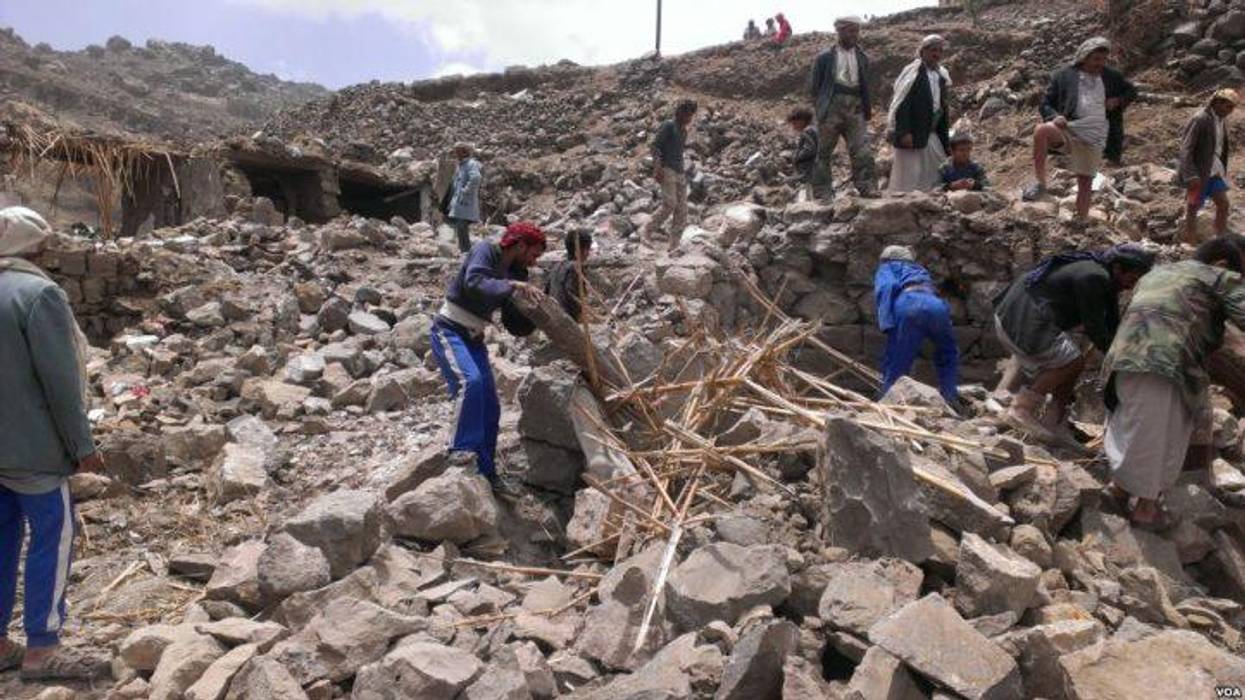
As Iraq finally pries the death grip of the Islamic State off of its bloodied form, you'd think US policy would reflect the lessons learned from killing innocent civilians and destroying the basic functions of a nation. Instead, more than a decade of using drones to "target" suspected terrorists, the Trump administration has now opened the door wide for the Saudis to ramp up the carnage in Yemen.
Just as the invasion of Iraq eventually produced the Islamic State (ISIS or IS), the killing of innocent Yemenis for no moral reason at all is providing a recruitment tool for terrorist organizations throughout the Middle East and Africa. And just as the Iraq invasion was predicated on a false claim of weapons of mass destruction, the war in Yemen rests on the bogus argument that Iranians are supporting terrorism in that country. In the first two years of the conflict in Yemen, the United States was not able to point to any evidence of Iranian weapons delivery to Yemen. Yet, the United States joined with Saudi Arabia and other Gulf States with weapon sales, intelligence, and a U.S.-enforced naval blockade. Trump's recent sale of arms to the Saudis was worth $125 billion.
The results of all this has been catastrophic. Take a look at the suffering of the Yemeni people in the past few years.
Yemen is one of the poorest countries in the Arab region. It has gone through conflicts for a variety of reasons: religion, ideology, and resources. In 1990, Yemen unified, but conflicts remained. The Zaidis (a branch of Shia Islam) are located in the mountains of northern Yemen where the Houthis are the major tribe/group. The remainder of the population of the country are Sunni. In 2014, the Houthis surged south and took control of the capital, Sanaa, and most of the surrounding area. The president of the country, Abdo Rabbu Mansour Hadi, escaped to Saudi Arabia in 2015. In six months, the Saudis and Hadi formed an army and took back part of the area but not Sanaa.
The Saudi-led war against the Houthis brings together troops from Saudi Arabia, President Hadi's supporters in the Yemeni military, Emirati countries, Islamist militants and some smaller tribes. Saudi allies are intervening to support the Hadi's Saudi-installed puppet regime, with the United States, Britain, France, Turkey, and Belgium joining in the effort. Regional countries - Kuwait, Bahrain, United Arab Republic (UAE), Egypt, Jordan, Morocco, and Sudan - are also providing support to the Saudis.
The Saudis are not just waging war against Houthi soldiers. They are bombing hospitals, schools, medical clinics and other civic places. The Houthis, outgunned, have resorted to fighting the war with child soldiers and, more recently, using smuggled weapons from Iran.
Yemen, a country of 25 million people, has 10,000 lives so far in this conflict. It has also experienced widespread human rights violations and disease, and nearly half the population is in a food crisis. "There is no food, no pure water, no electricity, nothing," a a Yemini woman says. "One day, a businessperson came to us and give us dishes and spoons but I told him sarcastically, 'what should we do with these? Eat the soil?'"
The dire situation in Yemen has become even more severe since the recent outbreak of cholera. The lack of sanitation, clean water, and medical care are fertile ground for the spread of the disease. This current outbreak reportedly infected 269,608 people and has caused the deaths of over 1,600. This number of fatalities in Yemen due to cholera is larger than all the cholera deaths in the world in 2015, as reported by the World Health Organization.
The current civilian slaughter, chaos, and daily indignities in Yemen create the perfect recruitment tool for the expansion of terrorist organizations. Al-Qaeda has been operating in Yemen for a long time. Known as al-Qaeda in the Arabian Peninsula (AQAP), they are augmenting their presence with technological savvy and are now considered one of the most dangerous al-Qaeda groups. In addition, IS has begun to make their presence felt in Yemen.
The Islamic State is on the verge of defeat. But U.S. analysts, most recently Ashton Carter in a Washington Post op-ed, continue to overlook how U.S. policies created the blowback of terrorism and entities like IS. In Yemen, the United States is repeating the same errors it made in Iraq. And the results, in terms of breeding terrorist backlash, will be the same. Until the United States learns to be more humane and severs ties with corrupt and ruthless dictators for the sake of oil or other commodity interests, this cycle will never end.
The immediate prospect for significant improvement in U.S.-Russia relations now depends on something tangible: Will the forces that sabotaged previous ceasefire agreements in Syria succeed in doing so again, all the better to keep alive the "regime change" dreams of the neoconservatives and liberal interventionists?
Or will President Trump succeed where President Obama failed by bringing the U.S. military and intelligence bureaucracies into line behind a cease-fire rather than allowing insubordination to win out?
The immediate prospect for significant improvement in U.S.-Russia relations now depends on something tangible: Will the forces that sabotaged previous ceasefire agreements in Syria succeed in doing so again, all the better to keep alive the "regime change" dreams of the neoconservatives and liberal interventionists?
Or will President Trump succeed where President Obama failed by bringing the U.S. military and intelligence bureaucracies into line behind a cease-fire rather than allowing insubordination to win out?
These are truly life-or-death questions for the Syrian people and could have profound repercussions across Europe, which has been destabilized by the flood of refugees fleeing the horrific violence in the six-year proxy war that has ripped Syria apart.
But you would have little inkling of this important priority from the large page-one headlines Saturday morning in the U.S. mainstream media, which continued its long obsession with the more ephemeral question of whether Russian President Vladimir Putin would confess to the sin of "interference" in the 2016 U.S. election and promise to repent.
Thus, the headlines: "Trump, Putin talk election interference" (Washington Post) and "Trump asks Putin About Meddling During Election" (New York Times). There was also the expected harrumphing from commentators on CNN and MSNBC when Putin dared to deny that Russia had interfered.
In both the big newspapers and on cable news shows, the potential for a ceasefire in southern Syria--set to go into effect on Sunday--got decidedly second billing.
Yet, the key to Putin's assessment of Donald Trump is whether the U.S. President is strong enough to make the mutually agreed-upon ceasefire stick. As Putin is well aware, to do so Trump will have to take on the same "deep-state" forces that cheerily scuttled similar agreements in the past. In other words, the actuarial tables for this cease-fire are not good; long life for the agreement will take something just short of a miracle.
Secretary of State Rex Tillerson will have to face down hardliners in both the Pentagon and CIA. Tillerson probably expects that Defense Secretary James "Mad-Dog" Mattis and CIA Director Mike Pompeo will cooperate by ordering their troops and operatives inside Syria to restrain the U.S.-backed "moderate rebels."
But it remains to be seen if Mattis and Pompeo can control the forces their agencies have unleashed in Syria. If recent history is any guide, it would be folly to rule out another "accidental" U.S. bombing of Syrian government troops or a well-publicized "chemical attack" or some other senseless "war crime" that social media and mainstream media will immediately blame on President Bashar al-Assad.
Bitter Experience
Last fall's limited ceasefire in Syria, painstakingly worked out over 11 months by Secretary of State John Kerry and Russian Foreign Minister Sergey Lavrov and approved personally by Presidents Obama and Putin, lasted only five days (from Sept. 12-17) before it was scuttled by "coalition" air strikes on well-known, fixed Syrian army positions, which killed between 64 and 84 Syrian troops and wounded about 100 others.
In public remarks bordering on the insubordinate, senior Pentagon officials a few days before the air attack on Sept. 17, showed unusually open skepticism regarding key aspects of the Kerry-Lavrov agreement - like sharing intelligence with the Russians (an important provision of the deal approved by both Obama and Putin).
The Pentagon's resistance and the "accidental" bombing of Syrian troops brought these uncharacteristically blunt words from Foreign Minister Lavrov on Russian TV on Sept. 26:
My good friend John Kerry ... is under fierce criticism from the U.S. military machine. Despite the fact that, as always, [they] made assurances that the U.S. Commander in Chief, President Barack Obama, supported him in his contacts with Russia ... apparently the military does not really listen to the Commander in Chief.
Lavrov's specifically criticized Joint Chiefs of Staff Chairman, Gen. Joseph Dunford for telling Congress that he opposed sharing intelligence with Russia despite the fact, as Lavrov put it, "the agreements concluded on direct orders of Russian President Vladimir Putin and U.S. President Barack Obama [who] stipulated that they would share intelligence." Noting this resistance inside the U.S. military bureaucracy, Lavrov added, "It is difficult to work with such partners."
Putin picked up on the theme of insubordination in an Oct. 27 speech at the Valdai International Discussion Club, in which he openly lamented:
My personal agreements with the President of the United States have not produced results. ... people in Washington are ready to do everything possible to prevent these agreements from being implemented in practice.
On Syria, Putin decried the lack of a "common front against terrorism after such lengthy negotiations, enormous effort, and difficult compromises."
Lavrov's Foreign Ministry spokeswoman, meanwhile, even expressed sympathy for Kerry's quixotic effort, giving him an "A" for effort.
After then-Defense Secretary Ashton Carter dispatched U.S. warplanes to provide an early death to the cease-fire so painstakingly worked out by Kerry and Lavrov for almost a year.
For his part, Kerry expressed regret - in words reflecting the hapless hubris befitting the chief envoy of the world's "only indispensible" country - conceding that he had been unable to "align" all the forces in play.
With the ceasefire in tatters, Kerry publicly complained on Sept. 29, 2016: "Syria is as complicated as anything I've ever seen in public life, in the sense that there are probably about six wars or so going on at the same time - Kurd against Kurd, Kurd against Turkey, Saudi Arabia, Iran, Sunni, Shia, everybody against ISIL, people against Assad, Nusra [Al Qaeda's Syrian affiliate]. This is as mixed-up sectarian and civil war and strategic and proxies, so it's very, very difficult to be able to align forces."
Admitting Deep-State Pre-eminence
Only in December 2016, in an interview with Matt Viser of the Boston Globe, did Kerry admit that his efforts to deal with the Russians had been thwarted by then-Defense Secretary Ashton Carter - as well as all those forces he found so difficult to align.
"Unfortunately we had divisions within our own ranks that made the implementation [of the ceasefire agreement] extremely hard to accomplish," Kerry said. "But it ... could have worked. ... The fact is we had an agreement with Russia ... a joint cooperative effort.
"Now we had people in our government who were bitterly opposed to doing that," he said. "I regret that. I think that was a mistake. I think you'd have a different situation there conceivably now if we'd been able to do that."
The Globe's Viser described Kerry as frustrated. Indeed, it was a tough way for Kerry to end nearly 34 years in public office.
After Friday's discussions with President Trump, Kremlin eyes will be focused on Secretary of State Tillerson, watching to see if he has better luck than Kerry did in getting Ashton Carter's successor, James "Mad Dog" Mattis and CIA's latest captive-director Pompeo into line behind what President Trump wants to do.
As the new U.S.-Russia agreed-upon ceasefire goes into effect on Sunday, Putin will be eager to see if this time Trump, unlike Obama, can make a ceasefire in Syria stick; or whether, like Obama, Trump will be unable to prevent it from being sabotaged by Washington's deep-state actors.
The proof will be in the pudding and, clearly, much depends on what happens in the next few weeks. At this point, it will take a leap of faith on Putin's part to have much confidence that the ceasefire will hold.
The closest I ever got to Mosul, Iraq's second largest city, was 1,720.7 miles away -- or so the Internet assures me. Although I've had a lifelong interest in history, I know next to nothing about Mosul's, nor do I have more than a glancing sense of what it looks like, or more accurately what it looked like when all its buildings, including those in its "Old City," were still standing. It has -- or at least in better times had -- a population of at least 1.8 million, not one of whom have I ever met and significant numbers of whom are now either dead, wounded, uprooted, or in desperate straits.
Consider what I never learned about Mosul my loss, a sign of my ignorance. Yet, in recent months, little as I know about the place, it's been on my mind -- in part because what's now happening to that city will be the world's loss as well as mine.
In mid-October 2016, the U.S.-backed Iraqi army first launched an offensive to retake Mosul from the militants of the Islamic State. Relatively small numbers of ISIS fighters had captured it in mid-2014 when the previous version of the Iraqi military (into which the U.S. had poured more than $25 billion) collapsed ignominiously and fled, abandoning weaponry and even uniforms along the way. It was in Mosul's Great Mosque that the existence of the Islamic State was first triumphantly proclaimed by its "caliph," Abu Bakr al-Bagdadi.
On the initial day of the offensive to recapture the city, the Pentagon was already congratulating the Iraqi military for being "ahead of schedule" in a campaign that was expected to "take weeks or even months." Little did its planners -- who had been announcing its prospective start for nearly a year -- know. A week later, everything was still "proceeding according to our plan," claimed then-U.S. Secretary of Defense Ashton Carter. By the end of January 2017, after 100 days of fierce fighting, the eastern part of that city, divided by the Tigris River, was more or less back in government hands and it had, according to New York Times reporters on the scene, been "spared the wholesale destruction inflicted on other Iraqi cities" like Ramadi and Fallujah, even though those residents who hadn't fled were reportedly "scratching out a primitive existence, deprived of electricity, running water and other essential city services."
And that was the good news. More than 100 days later, Iraqi troops continue to edge their way through embattled western Mosul, with parts of it, including the treacherous warren of streets in its Old City, still in the hands of ISIS militants amid continuing bitter building-to-building fighting. The Iraqi government and its generals still insist, however, that everything will be over in mere weeks. An estimated thousand or so ISIS defenders (of the original 4,000-8,000 reportedly entrenched in the city) are still holding out and will assumedly fight to the death. U.S. air power has repeatedly been called in big time, with civilian deaths soaring, and hundreds of thousands of its increasingly desperate and hungry inhabitants still living in battle-scarred Mosul as Islamic State fighters employ countless bomb-laden suicide vehicles and even small drones.
After seven months of unending battle in that single city, perhaps it shouldn't be surprising that Mosul has receded from the news here, even as civilian casualties grow, at least half a millionIraqis have been displaced, and the Iraqi military has suffered grievous losses.
Though there's been remarkably little writing about it, here's what now seems obvious: when the fighting is finally over and the Islamic State defeated, the losses will be so much more widespread than that. Despite initial claims that the Iraqi military (and the U.S. Air Force) were taking great care to avoid as much destruction as possible in an urban landscape filled with civilians, the rules of engagement have since changed and it's clear that, in the end, significant swathes of Iraq's second largest city will be left in ruins. In this, it will resemble so many other cities and towns in Iraq and Syria, from Fallujah to Ramadi, Homs to Aleppo.
The Disappearance of Mosul
At a moment when Donald Trump makes headlines daily with almost any random thing he says, the fate of Mosul doesn't even qualify as a major news story. What happens in that city, however, will be no minor thing. It will matter on this increasingly small planet of ours.
What's to come is also, unfortunately, reasonably predictable. Eight, nine, or more months after this offensive was launched, the grim Islamic State in Mosul will undoubtedly be destroyed, but so will much of the city in a region that continues to be -- to invent a word -- rubblized.
When Mosul is officially retaken, if not "ahead of schedule," then at least "according to plan," the proud announcements of "victory" in the war against ISIS will make headlines. Soon after, however, Mosul will once again disappear from our American world and worries. Yet that will undoubtedly only be the beginning of the story in a world in crisis. Fourteen years have passed since the U.S. invaded Iraq and punched a hole in the oil heartlands of the Middle East. In the wake of that invasion, states have been crumbling or simply imploding and terror movements growing and spreading, while wars, ethnic slaughter, and all manner of atrocities have engulfed an ever-widening region. Millions of Iraqis, Syrians, Afghans, Yemenis, Libyans, and others have been uprooted, sent into exile in their own countries, or fled across borders to become refugees. In Mosul alone, untold numbers of people whose fathers, mothers, grandparents, children, friends, and relatives were slaughtered in the Iraqi Army's offensive or simply murdered by ISIS will be left homeless, often without possessions, jobs, or communities in the midst of once familiar places that have been transformed into rubble.
Mosul now lacks an airport, a railroad station, and a university -- all destroyed in the recent fighting. Initial estimates suggest that its rebuilding will cost billions of dollars over many years. And it's just one of many cities in such a state. The question is: Where exactly will the money to rebuild come from? After all, the price of oil is at present below $50 a barrel, the Iraqi and Syrian governments lack resources of every sort, and who can imagine a new Marshall Plan for the region coming from Donald Trump's America or, for that matter, anywhere else?
In other words, the Iraqis, the Syrians, the Yemenis, the Libyans, the Afghans, and others are likely, in the end, to find themselves alone in the ruins of their worlds with remarkably little recourse. With that in mind and given the record of those last 14 years, how exactly do you imagine that things will turn out for the inhabitants of Mosul, or Ramadi, or Fallujah, or cities yet to be destroyed? What new movements, ethnic struggles, and terror outfits will emerge from such a nightmare?
To put it another way, if you think that such a disaster will remain the possession of the Iraqis (Syrians, Yemenis, Libyans, and Afghans), then you haven't been paying much attention to the history of the twenty-first century. You evidently haven't noticed that Donald J. Trump won the last presidential election in the United States, in part by playing on fears of a deluge of refugees from the Middle East and of Islamic terrorism; that the British voted to leave the European Union in part based on similar fears; and that across Europe pressures over refugees and terror attacks have helped to alter the political landscape.
Where Is Globalization Now That We Need It?
To frame things slightly differently, let me ask another question entirely: In these last years, haven't you wondered what ever happened to "globalization" and the endless media attention that was once paid to it? Not so very long ago we were being assured that this planet was binding itself into a remarkably tight knot of interconnectedness that was going to amaze us all. As Thomas Friedman of the New York Times put it in 1996, we were seeing "the integration of free markets, nation-states, and information technologies to a degree never before witnessed, in a way that is enabling individuals, corporations, and countries to reach around the world farther, faster, deeper, and cheaper than ever." All of this was to be fed and led by the United States, the last superpower standing, and as a result, the global "playing field" would miraculously "be leveled" on a planet becoming a mosaic of Pizza Huts, iMacs, and Lexuses.
Who of a certain age doesn't remember those years after the Soviet Union imploded when we all suddenly found ourselves in a single superpower world? It was a moment when, thanks to vaunted technological advances, it seemed blindingly clear to the cognoscenti that this was going to be a single-everything planet. We were all about to be absorbed into a "single market for goods, capital, and commercial services" from which, despite the worries of naysayers, "almost everyone" stood "to gain." In a world not of multiple superpowers but of multiple "supermarkets," we were likely to become both more democratic and more capitalistic by the year as an interlocking set of transnational corporate players, nations, and peoples, unified by a singularly interwoven set of communication systems (representing nothing short of an information revolution), triumphed, while poverty, that eternal plague of humanity, stood to lose out big time. Everything would be connected on what was, for the first time, to be a single, "flattened" planet.
It won't surprise you, I'm sure, to be told that that's not exactly the planet we're now on. Instead, whatever processes were at work, the result has been record numbers of billionaires, record levels of inequality, and refugees in numbers not seen since much of the world was in a state of collapse after World War II.
Still, don't you ever wonder where, conceptually speaking, globalization is now that we need it? I mean, did it really turn out that we weren't living together on a single shrinking planet? Were the globalists of that moment inhabiting another planet entirely in another solar system? Or could it be that globalization is still the ruling paradigm here, but that what's globalizing isn't (or isn't just) Pizza Huts, iMacs, and Lexuses, but pressure points for the fracturing of our world?
The globalization of misery doesn't have the cachet of the globalization of plenty. It doesn't make for the same uplifting reading, nor does skyrocketing global economic inequality seem quite as thrilling as a leveling playing field (unless, of course, you happen to be a billionaire). And thanks significantly to the military efforts of the last superpower standing, the disintegration of significant regions of the planet doesn't quite add up to what the globalists had in mind for the twenty-first century. Failed states, spreading terror movements, all too many Mosuls, and the conditions for so much more of the same weren't what globalization was supposed to be all about.
Perhaps, however, it's time to begin reminding ourselves that we're still on a globalizing planet, even if one experiencing pressures of an unexpected sort, including from the disastrous never-ending American war on terror. It's so much more convenient, of course, to throw the idea of globalization overboard and imagine that Mosul is thousands of miles away in a universe that bears next to no relation to our own.
What It Really Means to Be on a "Flattening" Planet
It's true that in France last week extremist presidential candidate Marine Le Pen was defeated by a young, little known former investment banker and government minister, Emmanuel Macron, and the European Union preserved. As with an earlier election in Holland in which a similar right-wing candidate lost, this is being presented as potentially the high-water mark of what's now commonly called "populism" in Europe (or the Brexit-style fragmentation of that continent). But I'd take such reassurances with a grain of salt, given the pressures likely to come. After all, in both Holland and France, two extreme nationalist parties garnered record votes based on anti-Islamic, anti-refugee sentiment and will, after the coming parliamentary elections in France, both be represented, again in record numbers, in their legislatures.
The rise of such "populism" -- think of it as the authoritarian fragmentation of the planet -- is already a global trend. So just imagine the situation four or potentially even eight years from now after Donald Trump's generals, already in the saddle, do their damnedest in the Greater Middle East and Africa. There's no reason to believe that, under their direction, the smashing of key regions of the planet won't continue. There's no reason to doubt that, in an expanding world of Mosuls -- the Syrian "capital" of the Islamic State, Raqqa, is undoubtedly the next city in line for such treatment -- "victories" won't produce a planet of greater ethnic savagery, religious extremism, military destruction, and chaos. This, in turn, ensures a further spread of terror groups and an even more staggering uprooting of peoples. (It's worth noting, for instance, that since the death of Osama bin Laden at the hands of U.S. Special Operations forces, al-Qaeda has grown, not shrunk, gaining yet more traction across the Greater Middle East.) So far, America's permanent "war on terror" has helped produce a planet of fear, refugees on an almost unimaginable scale, and ever more terror. What else would you imagine could arise from the rubble of so many Mosuls?
If you don't think that this is an ever-more connected planet still being "flattened" (even if in quite a different way than expected), and that sooner or later the destruction of Mosul will reverberate in our world, too, then you don't get our world. It's obvious, for instance, that future Mosuls will only produce more refugees, and you already know where that's led, from Brexit to Donald Trump. Destroy enough Mosuls and, even in the heartland of the planet's sole superpower, the fears of those who already feel they've been left in a ditch will only rise (and be fed further by demagogues ready to use that global flow of refugees for their own purposes).
Given the transformations of recent years, just think what it will mean to uproot ever vaster populations, to set the homeless, the desperate, the angry, the hurt, and the vengeful -- millions of adults and children whose lives have been devastated or destroyed -- in motion. Imagine, for instance, what those pressures will mean when it comes to Europe and its future politics.
Think about what's to come on this small planet of ours -- and that's without even mentioning the force that has yet to fully reveal itself in all its fragmenting and globalizing and leveling power. We now call it, mildly enough, "climate change" or "global warming." Just wait until, in the decades to come, rising sea levels and extreme weather events put human beings in motion in startling ways (particularly given that the planet's sole superpower is now run by men in violent denial of the very existence of such a force or the human sources of its power).
You want a shrinking planet? You want terror? You want globalization? Think about that. And do you wonder why, these days, I have Mosul on my mind?
Despite the attention being given to America's roiling wars and conflicts in the Greater Middle East, crucial decisions about the global role of U.S. military power may be made in a region where, as yet, there are no hot wars: Asia. Donald Trump will arrive in the Oval Office in January at a moment when Pentagon preparations for a future U.S.-Japan-South Korean triangular military alliance, long in the planning stages, may have reached a crucial make-or-break moment.
Despite the attention being given to America's roiling wars and conflicts in the Greater Middle East, crucial decisions about the global role of U.S. military power may be made in a region where, as yet, there are no hot wars: Asia. Donald Trump will arrive in the Oval Office in January at a moment when Pentagon preparations for a future U.S.-Japan-South Korean triangular military alliance, long in the planning stages, may have reached a crucial make-or-break moment. Whether those plans go forward and how the president-elect responds to them could help shape our world in crucial ways into the distant future.
On November 18th, Shinzo Abe, Japan's most conservative prime minister since the Cold War, became the first foreign head of state to meet with Donald Trump after his surprise election victory. The stakes for Abe were high. His rightist Liberal Democratic Party (LDP), which has run Japan for much of the last 70 years, has been one of America's most reliable, consistent, and subservient allies. Yet during the campaign, Trump humiliated him, as well as the leaders of nearby South Korea, with bombastic threats to withdraw U.S. forces from both countries if they didn't take further steps to defend themselves.
Even more shocking was Trump's proposal that Japan and South Korea develop their own atomic weapons to counter North Korea's rising power as a nuclear state. That left the governments of both countries bewildered -- particularly Japan, which lost tens of thousands of lives when the cities of Hiroshima and Nagasaki were incinerated by American atomic bombs in World War II. (Hundreds of Koreans in Japan died in those attacks as well.) Trump made these statements despite the LDP's ardent support over the decades for American wars in Korea, Vietnam, and Iraq, and the Japanese government's payment of around $2 billion annually to maintain a string of U.S. bases, primarily on the island of Okinawa, which host over 48,000 American soldiers.
Abe apparently got what he wanted. During an hour-long meeting at Trump Tower on New York's Fifth Avenue, he and the president-elect agreed that their military alliance was stable and capped their discussions with a friendly exchange of golf equipment. "I am convinced Mr. Trump is a leader in whom I can have great confidence," Abe declared to a gaggle of mostly Japanese reporters. The president-elect, he said, had established the trust "essential for the U.S.-Japanese relationship."
That same day, a high-level delegation representing Park Guen-Hye, South Korea's scandal-ridden president (who, three weeks later, would be impeached by the Korean parliament), was also in New York. She and her right-wing Saenuri Party had been no less disturbed than Abe by the tenor of Trump's campaign. According to a recent analysis by the Wall Street Journal, South Korea already pays about $900 million a year, or about 40% of the costs of the network of U.S. bases it hosts. It also has had a special relationship with the U.S. military that has no parallel elsewhere. Under the U.S.-Korean Combined Forces Command, established in 1978, should war ever break out on the peninsula, an American general will be in charge not just of the 28,000 U.S. personnel permanently stationed there, but of more than half a million South Korean troops as well.
Unlike Abe, however, Park's delegation was shunted off to discuss its concerns with Michael Flynn, the retired general who will soon be Trump's national security adviser. A few days earlier, Park had spoken to Trump for 10 minutes by phone. In that conversation, the president-elect reportedly stressed his admiration for Korea's economic prowess. "I've bought a lot of Korean products; they're great," he told Park, according to a Reuters correspondent in Seoul. Flynn would also reassure the Koreans that their alliance with Washington was "vital." So, on the surface at least, with less than six weeks to go until the Trump era officially begins, all is well and seemingly normal when it comes to U.S. relations with its allies in East Asia.
The Earth Shakes in Asia
Despite the apparent post-election softening of Trump's positions, however, his victory continues to cause consternation. In Tokyo, Japanese politicians of every stripe expressed doubts that the alliance with the U.S. could withstand the shock of the new American president. When Trump takes power, Shigeru Ishiba, a former defense minister and powerful figure in the LDP, told foreign reporters, "Japan can't just sit back and do what it's told to do by the United States." On the subject of the ties between the two countries, this rare sort of public dissent was one reason outgoing Secretary of Defense Ashton Carter flew to Tokyo on December 7th to reaffirm the alliance as "unlike any other."
The response in Seoul has been similar. "Koreans must think seriously about their ability to defend themselves when the U.S. they have long regarded as a friend and protector becomes a mere business acquaintance," the conservative newspaper Chosun Ilbo editorialized on November 10th. That was the day after the South Korean military held an unexpected emergency meeting to "assess the possible impact" of Trump's presidency and then established a task force to ensure that alliance agreements were kept in the years to come.
While fears of a more nationalistic America coursed through Asia, Trump's campaign rhetoric sent shudders through Washington as well. Decades of carefully laid plans by the Pentagon and the foreign policy establishment for tighter military ties with Japan and South Korea suddenly seemed threatened. In challenging the importance of such alliances, Trump could not help but implicitly question the essence of post-World War II U.S. military dominance in the Pacific, and of the primacy of Japan and South Korea as forward bases for the Pentagon in the "containment" of Asia's rising power, China.
Add one more thing to all of this: Trump's threats to withdraw American forces from the region have undermined President Obama's "Asian pivot" strategy, which has sparked the most significant U.S. military buildup in that region since the end of the Vietnam War. The steady, if slow, shift in military resources toward Asia remains highly dependent on the base structure that's been built up there since World War II and the Korean War and on the nearly 100,000 U.S. personnel now stationed in Japan and Korea. The establishment's fear that all of this might begin to unravel has been palpable in Washington since Trump's election.
"The president-elect has said rather curious things about our allies," lamented John Hamre, a former deputy secretary of defense who is now president and CEO of the Center for Strategic and International Studies (CSIS), which functions as an unofficial Pentagon think tank. Speaking at a November 21st conference on improving cooperation between the U.S. and Korean arms industries, Hamre obliquely criticized Trump for "implying we're not in Korea to help ourselves but just to help Korea." Not so, he insisted. The new president needs to understand that "we feel our strategic interests are at risk in Korea" and that those "require us to stay there. We should be grateful to have such a strong ally in South Korea."
As Hamre's audience well understood, the U.S. bases in the region have long been considered critical to the Pentagon's forward-based military strategy in Asia.
Nailing a Triple Alliance in Place Before Trump Takes Power
In the last few years, the Obama administration and the Pentagon have used China's expanding military might and the never-ending standoff with nuclearizing North Korea to incorporate Japan and South Korea ever more fully into a vision of an American-dominated Pacific. One stumbling block has been the deep animosity between the two countries, given that Japan colonized Korea from 1910 to 1945; later, during the Korean War, which devastated the peninsula, Japanprofited handsomely by supplying U.S. forces with vehicles and other military supplies. In addition, Korean anger over Japan's refusal to apologize for its use of Korean sexual slaves ("comfort women") during World War II remains a powerful force to overcome.
Until recently, the U.S. has had the help of a compliant leader, President Park Guen-Hye who, just as the Trumpian moment begins, finds herself scrambling for her political life as the first Korean president to be legally toppled since 1960. (An interim president, Park's conservative Prime Minister Hwang Kyo-ahn, will run the government until the Constitutional Court reviews the legality of her impeachment, a process that could take up to six months.) Despite all these problems, and while never quite publicly stating the obvious, American officials have been focused on putting in place a triangular alliance that would transform the Japanese and South Korean militaries into proxy forces capable of helping extend U.S. power and influence ever further into Asia (and also, potentially, elsewhere in the world).
On the eve of Donald Trump's election, such arrangements were quickly reaching fruition. As 2016 draws to an end, the Pentagon appears to be rushing to make Obama's Asian pivot and the militarization of the region that goes with it permanent before Trump can act or, for that matter, the United States can lose its Korean political allies(which could happen if Park's conservative ruling party is replaced in next year's elections).
Here are some recent steps taken to cement in place a U.S.-Japan-South Korean alliance:
* On November 23rd, Japan and South Korea signed their first military intelligence agreement that, according to the Korean government-owned Yonhap news agency, will allow the two countries to "better cope with evolving North Korean missile and nuclear threats despite historical animosities." This pact, the General Security of Military Information Agreement, has long been pushed by the Pentagon as a way to solidify the three-way alliance. When negotiations between Tokyo and Seoul broke down in 2012, American officials led the successful effort to get them back on track. (North Korea, according to its official news agency, views the arrangement as a serious threat "pursuant to the U.S. strategic interests to hold hegemony in Northeast Asia.")
* The construction of a maritime-based Aegis missile defense system aimed at China and North Korea that will link Washington, Tokyo, and Seoul. Not surprisingly, this has provoked deep concerns in Beijing, while sparking a broad, if localized, South Korean movement opposed to the building of a vast naval complex considered critical to Korean participation in the system on Jeju Island. "Missile defense is the core issue of the trilateral alliance," Choi Sung-Hee, a South Korean historian and one of the chief organizers of the protests at the Geongjang naval base, told me last spring when I visited the island.
* A historic 2015 change in Japan's national security law that allows the government to send its "Self-Defense Forces" (SDF) into military operations overseas for the first time since World War II. In Korea, this is seen as a legal mechanism that paves the way for Japanese forces to someday be deployed on their peninsula in case a war with the North looms. As Hankyoreh put it recently, "Landing troops from the Japanese Self-Defense Force in South Korea to rescue Japanese citizens is one of Japan's main goals, and it is a request that Japan has repeatedly made to South Korea." Like the intelligence-sharing pact, it's a change that has long been sought by the United States.
* An escalation of military and economic pressure on North Korea, including flights of U.S. nuclear-armed stealth B-2 bombers into Korean skies and intensified unilateral economic sanctions against dictator Kim Jong-Un and many of his top military aides. (The U.N. Security Council, with China's support, recently endorsed some sanctions as well.)In addition, stepped-up military exercises with South Korea have included practicing both preemptive strikes on the North's nuclear sites and the "decapitation" of that country's leaders. In other words, to use a phrase that previously hadn't made it out of the Greater Middle East and North Africa: regime change. Both Abe and Park have been solidly behind such developments, and Park's government has actually been encouraging the Pentagon to do more.
* A decision by the Pentagon to permanently station a Terminal High Altitude Area Defense (THAAD) missile system designed to counter incoming North Korean ballistic missiles in South Korea over the strong objections of many Korean citizens and politicians who dispute its value as a deterrent against the North. Despite its defensive nature, THAAD has also been denounced by China as a provocation. In November, Beijing made clear that it would regard the ultimate decision about installing THAAD as a "political weather vane" in its evaluation of the Trump administration. In recent days, Japanese defense officials said that they are studying the idea of deploying U.S. THAAD batteries in Japan as well. Such a move, the Japan Times pointed out, "would enable effective THAAD operations and information-sharing to be conducted among the three allies."
It goes without saying that such developments will greatly benefit the U.S. military industrial complex. Missile defense is a major boon for American military contractors and in particular a potential bonanza for Lockheed Martin in particular, which makes both the Aegis vessels and the THAAD system. These industrial projects would also deepen the developing trilateral alliance.
After signing a $490 million contract with South Korea and Japan to expand their Aegis missile defense fleets, Lockheed Martin noted, for instance, that the deal "comes on the heels of a successful joint-missile defense exercise... in which Aegis destroyers from the three nations shared data while detecting and tracking a simulated missile threat." As the military newspaper Stars & Stripes noted, that exercise, which took place last June, was "aimed as much at fostering cooperation between the two Asian neighbors as preparing for a possible North Korean attack."
Of course, none of this was discussed during the presidential campaign. But one reason Hillary Clinton received such solid support from Republican foreign policy establishment hawks like former Deputy Secretary of State Richard Armitage was her staunch support for the Asian pivot and the Pentagon's stepped-up presence in the region. Clinton was a sure bet to extend the buildup in Asia, deepen the trilateral alliance, and continue the current hostile policy toward China and North Korea. Now, the Pentagon and U.S. military planners can only hope that Donald Trump, already in a contretemps with China over receiving phone congratulations for his election from the president of Taiwan, does the same.
In the meantime, there are two other potential holes in this strategy that will undoubtedly also come into play next year: a years-old, intense, and still growing popular opposition to the U.S. Marines' base in Futenma, Okinawa, the Japanese island that is home to 70% of U.S. bases in that country, and the massive political protests in South Korea that have now toppled President Park and could bring an end to her pro-corporate, pro-U.S. government.
Global Cops and Robbers
When the Cold War ended in 1991, the rationale for all the American troops then based in Asia -- namely, the communist threat -- suddenly became less clear. U.S. officials, grimly determined not to see them go just because their raison d'etre may have disappeared, began promoting the idea that a permanent presence in Asia was inevitable for the purposes of "stability." As historian Chalmers Johnson chronicled in his 2000 masterpiece, Blowback: The Cost and Consequences of American Empire, the chief ideologists for this view were Harvard professor Joseph Nye, who had been an assistant secretary of defense during the Carter administration, and Armitage, who had held a similar position at the Pentagon in the Reagan administration. American forces in Asia, Nye wrote in 1995, ensured "the stability -- the oxygen -- that has helped provide for East Asian economic growth."
More than two decades later, that vague but all-encompassing code word for American domination of the Pacific region remains the primary justification for the Asian pivot. As Pentagon chiefCarter typically put it in a recent Foreign Affairs article: "Every port call, flight hour, exercise, and operation [in the pivot] has added a stitch to the fabric of the Asia-Pacific's stability." In other words, we're to remain the cops of the Pacific and the world.
But as global and Pacific cops, we need help. From the early post-Cold War years until today, American officials have pressured Japan to loosen its peace constitution (imposed during the post-World War II U.S. occupation) and allow its forces to be used abroad in conjunction with the U.S. military. That campaign finally bore fruit in 2015, when Abe managed to pass the new security law.
The precipitating event: the U.S. and Japanese response to the devastating earthquake and nuclear catastrophe at Fukushima in March 2011. American military forces in Japan played an instrumental role in the subsequent rescue operations, dubbed "Operation Tomodachi [friend]." Abe then drove home lessons from this collaboration to convince the Japanese Diet of the necessity of passing a new security law that allows Japan to exercise the right of "collective self-defense" and, for the first time since World War II, allows Japan's Self-Defense Forces to provide logistical and other support globally to U.S. and allied foreign forces. Previously, such support was limited only to areas near Japan.
As a result of this law, which went into effect in 2016, U.S. and Japanese military forces have commenced their first joint military drills and, in September, signed a new logistics agreement that allows Japan's SDF to supply the U.S. military with fuel and ammunition anywhere in the world. These steps will further enhance U.S.-Japanese military cooperation.
As usual, in the run-up to the new legislation, Abe received a political boost from Nye and Armitage. They got the collaboration ball rolling with a 2012 study for CSIS, "The US-Japan Alliance: Anchoring Stability in Asia." Citing the 2011 earthquake and "Operation Tomodachi," they suggested that Japan's "prohibition of collective self-defense" was "an impediment to the bilateral military alliance."
The 2011 earthquake, they argued, "demonstrated how our two forces can maximize our capabilities when necessary." As a result, a change in the law opening the way to collective self-defense "would allow our forces to respond in full cooperation throughout the security spectrum of peacetime, tension, crisis, and war." The first step, they added, would be for Japan to expand its legal system to encourage the protection of "other international peacekeepers, with force, if necessary" -- the exact point of Abe's 2015 law.
Lo and behold! On November 21st, three days after Abe's meeting with Trump, the first contingent of Japan's Self Defense Forces "authorized to use their weapons against enemy combatants while engaged in protection and rescue operations overseas" left Japan for South Sudan. There, they will take part in a U.N. peacekeeping mission. Despite the opposition of a majority of the Japanese public to the move, the dream of an American-led collective global defense, long held by Nye and Armitage, is now in place.
Abe's LDP has also been instrumental in protecting another pillar of Washington's strategy in the Pacific: retaining the island of Okinawa as a major forward base for the U.S. Marines. In the 1990s, following national protests against the rape and murder of an Okinawan schoolgirl by a Marine, Washington agreed to scale down its primary base in Futenma and shift the Marines there to Guam. But after protracted negotiations -- and intense pressure exerted by the Bush and then Obama administrations -- the drawdown agreement was linked to the right of the Marines to build a new base at Henoko Bay inthe northern part of Okinawa. Almost the entire island and its elected officials, from the governor on down, fiercely oppose this idea.
Over the past year, Abe's national police have been engaged in daily combat with citizens fighting such an expansion project, a situation that could well become critical in the early months of a Trump presidency. But so could the political situation in South Korea.
Tensions Rise
While Japan is home to 45,000 American airmen, soldiers, and sailors, South Korea is critical to Washington because it houses the only American ground forces on the Asian mainland. While the primary justification for them is the hostility of North Korea and its ominous nuclear weapons program, the U.S. military also considers its forces in Korea important for "global force projection" elsewhere in Asia.
A recent paper by the Center for a New American Security, a military think-tank founded in 2007, explained the view from the Pentagon's perspective:
"South Korea is the only place on the Asian continent with a U.S. military foothold. The military presence on the peninsula makes South Korea an essential geopolitical 'beachhead' for the United States in the Asia-Pacific region. Second, the U.S.-ROK [Republic of Korea] alliance provides physical territory from which to manage the North Korea problem... The main purpose of the alliance is to deter North Korea, but the U.S.-South Korea alliance is a vital tool for both Seoul and Washington to shape Asia's developing regional order and their respective roles within it."
The catalyst for all such planning has, of course, been North Korea, which is now seen by many military analysts as the toughest problem facing Washington in the foreign sphere. In these years, the Obama administration has refused to engage in any kind of negotiations with that country and its leader, Kim Jong-Un, unless the North Koreans agreed in advance to dismantle the nuclear program that they now see as essential to their national survival.
Since Obama took office in 2009, the North has, in fact, steadily improved its military capabilities. It has tested four nuclear weapons and worked to develop various kinds of missiles. In response, the Pentagon has steadily ratcheted up its military preparedness, in part by conducting massive annual joint exercises with the South Korean military, while from time to time flying nuclear-capable warplanes in Korean skies.
These steps have only heightened tensions with the North and neighboring China, while stirring powerful opposition movements in South Korea. If the intelligence pact with Japan, long sought by the Pentagon, was indeed the next logical step in the confrontation with the North, it has been bitterly opposed by some South Korean opposition lawmakersand much of the public, some of whom have also taken a strong stand against the THAAD anti-missile system. Now, with Park's government teetering, the Pentagon is suddenly concerned that its favored policies will be derailed -- or worse, that new presidents in both Seoul, where elections are scheduled for December 2017, and Washington this January could throw the evolving strategic triangular alliance into chaos.
Those were undoubtedly the fears that lurked behind John Hamre's remarks in late October at the Heritage Foundation, when he cautioned against moves that could spark further controversy in South Korea. "We have to do something [so] we don't become an issue in [Korea's] next election," he said. "There's a strong strain in the left parties [there] that America is the problem." (Ironically, Armitage may have added to that concern on December 6th, when he told a CSIS conference on the U.S.-South Korean alliance that he now favored a U.S. policy of regime change in North Korea -- something that's anathema not only to South Korean leftists but to many centrists as well.)
As December began, as if to underscore Hamre's point, USA Today reported that the growing protests against President Park could shift the country's priorities. "The pro-U.S. foreign policy of South Korean President Park Geun Hye is at risk now that she appears to be on her way out over a growing corruption scandal." CNBC similarly pointed out that the opposition parties pushing for Park's removal were firmly against the emplacement of THAAD and suggested that "South Korea's promise to host advanced American missile defense technology on its soil may fall apart" following Park's political demise.
Aware of the rising tide of criticism, the Pentagon has doubled down on its insistence on THAAD. When a reporter from Yonhap asked U.S. defense officials if Park's impeachment or resignation could affect the deployment of the THAAD system, he was told that the plans "remain ongoing, and the alliance continues to move forward with that plan."
So much for respecting Korean democracy.
Alternatives in Asia?
How Donald Trump will deal with these issues is, of course, an open question. During the campaign, he raised the possibility of talking directly to Kim Jong-Un as a way of defusing the nuclear standoff with North Korea -- an idea embraced by many Korea specialists and U.S. officials who have, in the past, dealt with that country. Since winning the election, however, he and his aides have been silent on the subject. Based on what the president-elect and his national security chief have reportedly said to the Japanese and South Korean governments, it's possible that his administration may not make any drastic moves soon to upset the three-way military alliance or undermine U.S. security policies in the region. In the unpredictable atmosphere of a Trump Tower presidency, however, there is simply no way yet to know.
Certainly, Trump's recent appointments of Flynn as national security adviser and retired Marine General James Mattis as secretary of defense suggest that his love for the Pentagon and for tough-guy generals may override any desire to upset the military apple cart in Asia and reverse policy developments of the last three decades hurriedly being nailed in place at this very moment. At the same time, he's being warned in no uncertain terms by the Obama administration and former Pentagon officials that North Korea could present his administration with an "explosive" situation that might, in fact, require a military response.
Donald Trump is certainly an unpredictable figure, but at the moment it looks like the only genuine opponents of the status quo may be the democratic opposition movement in South Korea, the anti-base movement in Okinawa, and what remains of the peace movement in the United States. Unfortunately, while the Pentagon has been focused on the military situation in Asia, the American antiwar movement has largely left Asia behind in the decades since the Vietnam War ended.
As we adjust to life under Trump, it might be wise to start looking again for alternatives to our militaristic policies in Asia, for more equitable ties with Japan and South Korea, and for a shift away from confrontation with North Korea and China. Perhaps the massive demonstrations and candlelight vigils that have brought millions of people into the streets of Seoul and other Korean cities, despite the volatile security situation in East Asia,could show us the way.
Amid all the uncertainty about what a Trump presidency means for the future role of the United States in the world, one possibility is that Trump will embrace some variant of the policies that have been pursued for the past few decades by the nation's foreign policy establishment.
Amid all the uncertainty about what a Trump presidency means for the future role of the United States in the world, one possibility is that Trump will embrace some variant of the policies that have been pursued for the past few decades by the nation's foreign policy establishment. Although Trump may break sharply with the establishment consensus that the United States must play the lead role in imposing order on the world, many signs indicate that Trump will continue to ensure that the United States plays the dominant role in policing the world.
Certainly, many Washington insiders feel differently about Trump. On election day, former State Department official Daniel Serwer presented the standard view of the foreign policy establishment that the "dramatic differences" between Donald Trump and Hillary Clinton made Trump a problematic candidate. Trump "prides himself on unpredictability" while Clinton "has a long track record well within the post-9/11 foreign policy consensus," Serwer explained, adding that Clinton "wants to maintain the stability of the international system and restore American authority." With his remarks, Serwer indicated that the foreign policy establishment could trust Clinton but not Trump to use American power to actively enforce a system of global order.
At times, additional observers issued more serious warnings. On the day after the election, for example, The New York Times warned that Trump would reverse decades of foreign policy practice by withdrawing the United States from its deep engagement with the world. "For the first time since before World War II, Americans chose a president who promised to reverse the internationalism practiced by predecessors of both parties and to build walls both physical and metaphorical," the newspaper reported. "Mr. Trump's win foreshadowed an America more focused on its own affairs while leaving the world to take care of itself." In short, The New York Times captured the basic establishment concern that Trump would no longer enforce the system of postwar order that his predecessors had maintained throughout the postwar period.
Enforcing the International Order
Still, not everyone agrees with the predictions. Although the foreign policy establishment remains concerned with Trump's unpredictability and perhaps even his neglect of decades of establishment thinking, several high-level officials in the Obama administration have recently begun to suggest that the United States will continue to play the lead role in enforcing a system of international order.
Notably, President Barack Obama has provided some reassurances. Speaking with the press a few days after the election, Obama made the case that Donald Trump would not be able to simply dictate a new strategy to the vast bureaucracy that manages the nation's foreign policy. The foreign policy decision-making process "is the result not just of the President, it is the result of countless interactions and arrangements and relationships between our military and other militaries, and our diplomats and other diplomats, and intelligence officers and development workers," Obama explained.
Moreover, Obama insisted that much of the media commentary about Trump missed the fact that most U.S. officials continue to share the same basic foreign policy goals. Certainly, "there's enormous continuity beneath the day-to-day news that makes us that indispensable nation when it comes to maintaining order and promoting prosperity around the world," Obama stated. "That will continue."
Finally, Obama disclosed one more important detail that pointed towards future continuity. Citing the meeting that he held with Trump at the White House after the election, Obama said that Trump "expressed a great interest in maintaining our core strategic relationships." Trump, in other words, appeared eager to continue working closely with U.S. allies to enforce a system of global order.
Shared Priorities
Trump and the Obama administration have always shared many of the same foreign policy objectives, even though Trump made every effort during his campaign to condemn Obama's policies as dangerous and destructive to both the United States and the world.
For starters, both Trump and the Obama administration have made it clear that they intend to ensure that the United States remains the most dominant military power in the world.
In March 2016, Secretary of Defense Ashton Carter presented the basic position of the Obama administration when he assured the Senate Committee on Armed Services that the Department of Defense "will keep ensuring our dominance in all domains." The following month, Trump declared his support for the same objective. "Our military dominance must be unquestioned," Trump stated.
Furthermore, Trump has displayed similar commitments on other fundamental issues. For instance, Trump has made it clear that he intends to prioritize the interests of the United States above everything else. "America First will be the major and overriding theme of my administration," Trump announced during his campaign. Indeed, Trump insisted that he would base his foreign policy on the premise that the United States should only take actions in the world that work to the advantage of the United States. "We're going to finally have a coherent foreign policy based upon American interests, and the shared interests of our allies," Trump stated.
Under Obama's leadership, administration officials have taken the same approach. Although the Obama administration has not used the same slogan, it has adopted an America First strategy. Vice President Joe Biden pointed to the administration's strategy when he toured Asia in July 2016 as part of the administration's "rebalance" to Asia. "We're not doing anyone any favors," Biden stated, referring to the administration's special focus on the region. "It's overwhelmingly in our interest. Overwhelmingly." Two months later, State Department official Antony J. Blinken provided more direct confirmation of the administration's strategy. "We don't work with other nations as a luxury, or as charity," Blinken explained. "Our national interest demands our global engagement."
Even President Obama has confirmed that his administration has adopted an America First strategy. When he recently commented on his decision to commit the United States to the Paris Agreement in order to address the threat of global climate change, Obama confirmed that he was primarily motivated by the U.S. interests at stake. Currently, "the biggest threat when it comes to climate change and pollution isn't going to come from us -- because we only have 300 million people," Obama explained. "It's going to come from China, with over a billion people, and India, with over a billion people." With his remarks, Obama indicated that the United States needed to join the Paris Agreement to prevent countries such as China and India from harming the United States with their pollution.
Shared Approach to the Islamic State
Both Trump and Obama have also made it clear that they intend to completely destroy the Islamic State (ISIS or IS). In November 2015, Trump outlined his position during a radio commercial in which he pledged to "quickly and decisively bomb the hell out of ISIS."
In recent months, officials in the Obama administration have articulated similar goals. This past June, for example, State Department official Brett McGurk stood before a map that showed various areas under the control of IS and announced that "we have to wipe them off this map." A few months later, Secretary of State John Kerry took a similar position. The United States has an interest in "terminating ISIL/Daesh, as fast as possible," Kerry stated.
In fact, the Obama administration has been busy working to fulfill its mission. In the time since the administration began its air campaign in August 2014, U.S. and coalition forces have conducted more than 15,000 airstrikes against IS and have killed more than 45,000 IS fighters. In other words, the administration has been bombing the hell out of ISIS. Clearly, IS fighters "should sleep with one eye open because we're not gonna give them a moment's peace," U.S. Colonel John Dorrian explained on November 16, 2016.
In the end, the outgoing Obama administration will soon hand over power to a Trump administration that shares some of the very same foreign policy commitments. Despite the fact that the foreign policy establishment remains uncertain about Trump's intentions, the president-elect has provided many signals that he intends for the United States to continue playing an active role in enforcing a system of global order.
As Trump has put it, using the standard language of the foreign policy establishment, his administration will mainly be "focusing on creating stability in the world."
How did the "growing trust" that Russian President Vladimir Putin once said marked his "working and personal relationship with President Obama" change into today's deep distrust and saber-rattling?
Their relationship reached its zenith after Mr. Putin persuaded Syria to give up its chemical weapons for verified destruction, enabling Mr. Obama at the last minute to call off, with some grace, plans to attack Syria in late summer 2013. But at an international conference in the Russian Black Sea resort of Sochi last week, Mr. Putin spoke of the "feverish" state of international relations and lamented: "My personal agreements with the President of the United States have not produced results." He complained about "people in Washington ready to do everything possible to prevent these agreements from being implemented in practice" and, referring to Syria, decried the lack of a "common front against terrorism after such lengthy negotiations, enormous effort, and difficult compromises."
A month earlier, Russian Foreign Minister Sergey Lavrov, who chooses his words carefully, told Russian TV viewers, "My good friend John Kerry ... is under fierce criticism from the U.S. military machine. Despite [Mr. Kerry's] assurances that the U.S. commander in chief, President Barack Obama, supported him in his contacts with Russia (he confirmed that during his meeting with President Vladimir Putin) apparently the military does not really listen to the commander in chief."
Do not chalk this up to paranoia. The U.S.-led coalition air strikes on known Syrian army positions killing scores of troops just five days into the September cease-fire -- not to mention statements at the time by the most senior U.S. generals -- were evidence enough to convince the Russians that the Pentagon was intent on scuttling meaningful cooperation with Russia.
Relations between the U.S. and Russian presidents have now reached a nadir, and Mr. Putin has ordered his own defense ministry to throw down the gauntlet. On Oct. 6, ministry spokesman Maj. Gen. Igor Konashenkov said Russia is prepared to shoot down unidentified aircraft -- including any stealth aircraft -- over Syria, and warned ominously that Russian air defense will not have time to identify the origin of the aircraft.
It seems possible that the U.S. air force will challenge that claim in due course -- perhaps even without seeking prior permission from the White House. Last week, National Intelligence Director and former Air Force General James Clapper commented offhandedly, "I wouldn't put it past them to shoot down an American aircraft ... if they felt it was threatening their forces on the ground."
Injecting additional volatility into the equation, major news outlets are playing down or ignoring Russia's warnings. Thus, Americans who depend on the corporate media can be expected to be suitably shocked by what that same media will no doubt cast as naked aggression out of the blue if Russian air defenses down a U.S. or coalition aircraft.
Meanwhile in Europe, as NATO defense ministers met in Brussels on Wednesday, Defense Secretary Ashton Carter told reporters the U.S. is contributing "a persistent rotational armored brigade combat team" as a "major sign of the U.S. commitment to strengthening deterrence here."
"This was a decision made by the alliance leaders in Warsaw," he explained, referring to NATO's July summit meeting in the Polish capital. "The United States will lead a battalion in Poland and deploy an entire battle-ready battalion task force of approximately 900 soldiers from the 2nd Cavalry Regiment, which is based in Germany."
On Thursday, at the Valdai Conference in the Russian Black Sea resort of Sochi, President Putin accused the West of promoting the "myth" of a "Russian military threat," calling this a "profitable business that can be used to pump new money into defense budgets ... expand NATO and bring its infrastructure, military units, and arms closer to our borders."
Myth or not, German Foreign Minister Frank-Walter Steinmeier was correct to point out last spring that military posturing on Russia's borders will bring less regional security. Mr. Steinmeier warned against "saber-rattling," adding that, "We are well advised not to create pretexts to renew an old confrontation."
Speaking of such pretexts, it is high time to acknowledge that the marked increase in East-West tensions over the past two and a half years originally stemmed from the Western-sponsored coup d'etat in Kiev on Feb. 22, 2014, and Russia's reaction in annexing Crimea. Americans malnourished on the diet served up by "mainstream" media are blissfully unaware that two weeks before the coup, YouTube published a recording of an intercepted conversation between U.S. Assistant Secretary of State Victoria Nuland and the U.S. ambassador in Kiev, during which "Yats" (for Arseniy Yatsenyuk) was identified as Washington's choice to become the new prime minister of the coup government in Kiev.
This unique set of circumstances prompted George Friedman, president of the think-tank STRATFOR, to label the putsch in Kiev on Feb. 22, 2014, "really the most blatant coup in history."
It's time for Western politicians and media to learn their lesson and pay attention to the statements coming out of Russia. Ask yourselves: Why all this hype now?
Over the past few months, the Obama administration has renewed its efforts to strengthen its position in Afghanistan. In spite of the worsening death toll from the ongoing war, the Obama administration has made a series of new wartime commitments to ensure that the United States maintains a powerful influence over the country well into the future.
In June 2016, President Obama made one of the most significant new commitments when he authorized U.S. military forces to more directly engage the Taliban in military operations. The new authorities allow "U.S. forces to be more proactive in supporting conventional Afghan forces as they take the fight to the Taliban," White House Press Secretary Josh Earnest explained. "And this means, in some cases, offering close air support, or it means, in some cases, accompanying Afghan forces on the ground or in the air."
In July 2016, President Obama then made another significant commitment. Reversing his earlier pledge to reduce the U.S. military presence to 5,500 troops by the end of 2016, Obama announced that "the United States will maintain approximately 8,400 troops in Afghanistan into next year, through the end of my administration." Obama decided to keep a larger troop presence in Afghanistan because, as he noted, "the Afghan people will need the partnership of the world -- led by the United States -- for many years to come."
With his latest moves, President Obama has ensured that the United States will continue to play a dominant role in Afghanistan. Although he will have to hand over responsibility for the war to his successor in the months ahead, Obama has provided the next administration with the tools to maintain a powerful hold over Afghanistan for the immediate future.
"The Taliban and their allies cannot wait us out," Secretary of State John Kerry insisted when he addressed the issue on October 5, 2016. No matter what happens in the upcoming U.S. presidential election, he added, "I have absolutely no doubt the United States is going to continue, there will be a renewed commitment."
Rising Doubts
Of course, some observers express doubts about the extent of that commitment. For example, former C.I.A. official Robert L. Grenier noted before the Senate Committee on Foreign Relations in early September 2016 that U.S. officials had settled on more modest objectives. "The U.S. no longer aims to defeat the Taliban; instead it hopes merely to keep the Kabul regime from being defeated," Grenier stated.
In late September 2016, the Chairman of the Joint Chiefs of Staff Joseph F. Dunford, Jr. provided another reason to be doubtful. Addressing the fact that the U.S.-backed Afghan military forces are struggling to defeat the Taliban, Dunford stated that the war had become "roughly a stalemate."
Moreover, the Afghan military forces continually struggle to withstand the latest Taliban offensives. In recent weeks, The New York Times has described in a number of articles how Afghan military forces have briefly lost control of major population centers to Taliban forces.
Regardless, most U.S. officials insist that both they and their Afghan allies will prevail in the war. If the war is a stalemate, then it is "a stalemate in which the government's controlling 70 percent of the population," the commander of U.S. and NATO forces in Afghanistan John W. Nicholson asserted on September 23, 2016. The Taliban and other enemy forces may retain control of some parts of the country, but the overall situation "is a positive in the sense of the majority of the population's under control of the government forces."
In fact, U.S. officials remain determined to help the Afghan government bring more of the country's population under the control of government forces.
"So, we clearly want to help the Afghans next year and beyond to gradually increase the amount of control they exercise over the population," Nicholson explained.
Cozying up to Warlords
At the same time, U.S. officials have taken additional steps to advance their objectives. Without relying solely on their military power, U.S. officials have applied their economic and political power to the country in significant ways. In the first place, U.S. officials have promised to provide the Afghan government with the funding it requires to keep functioning. "We will provide in excess of three billion dollars per year through 2020, and we expect the United States will remain the largest single funder of the Afghan National Defense and Security Forces," the Special Representative for Afghanistan and Pakistan Richard Olson announced on June 21, 2016.
In addition, U.S. officials are determined to keep working with the country's warlords, who are some of the country's most notorious killers. U.S. officials view the warlords as important forces for constraining the Taliban and controlling the Afghan people.
In early 2003, U.S. Congressman Dana Rohrabacher provided the basic logic when he instructed the new Afghan President Hamid Karzai "to integrate the warlords" into the new Afghan government. Comparing the country's warlords to "many of the Wild West's most famous sheriffs," Rohrabacher suggested that the warlords would provide "law and order" in Afghanistan. U.S. officials, who have refused to allow warlords such as Afghan Vice President Abdul Rashid Dostum into the United States, have continued to maintain friendly relations with a number of the country's warlords, viewing them as key power brokers.
Certainly, "we do treat the Vice President," meaning Abdul Rashid Dostum, "as the First Vice President of Afghanistan with all the respect that his office carries," Special Representative Olson acknowledged before members of Congress earlier this year. "And we are in touch with him at the appropriate level."
In fact, U.S. officials have recently grown more excited about the possibilities for integrating the warlords. When the Afghan government announced in late September 2016 its intentions to form a peace agreement with warlord Gulbuddin Hekmatyar, U.S. officials largely welcomed the news. The proposed peace deal "is encouraging in my mind" and "a very positive step," General Nicholson stated on September 23, 2016.
Days later, Secretary of State John Kerry expressed similar sentiments. According to the terms of the deal, "Hekmatyar's group will be able to emerge from the shadows to rejoin Afghan society," Kerry explained. Consequently, the deal "is a model for what might be possible" with the country's militants.
Holding It All Together
As they have supported the Afghan government's latest efforts to integrate the warlords, U.S. officials have also remained directly involved in the country's political process. Working closely with Afghan officials, they have worked to ensure that the Afghan government keeps functioning as the country's main domestic power center. Not even the fraudulent elections of 2014 deterred them from their mission. Clearly, "we've held Afghanistan together with a unity government after a failed election where it could have collapsed," John Kerry noted in late September 2016. Indeed, Kerry boasted that U.S. officials have been able to hold together a corrupt Afghan government that does not have any legitimacy. "We've been able to nurture that," he noted.
In short, U.S. officials are determined to continue guiding the country's fate.Although they remain well aware that many Afghans detest their government, they remain committed to increasing the power of the Afghan government over the country and preserving what has essentially become a client state. "I mean, look at a map of this region," Secretary of Defense Ashton Carter recently commented. "Not a bad place to have good friends. So we're -- we're in this for the long run."