

SUBSCRIBE TO OUR FREE NEWSLETTER
Daily news & progressive opinion—funded by the people, not the corporations—delivered straight to your inbox.
5
#000000
#FFFFFF
To donate by check, phone, or other method, see our More Ways to Give page.
Daily news & progressive opinion—funded by the people, not the corporations—delivered straight to your inbox.
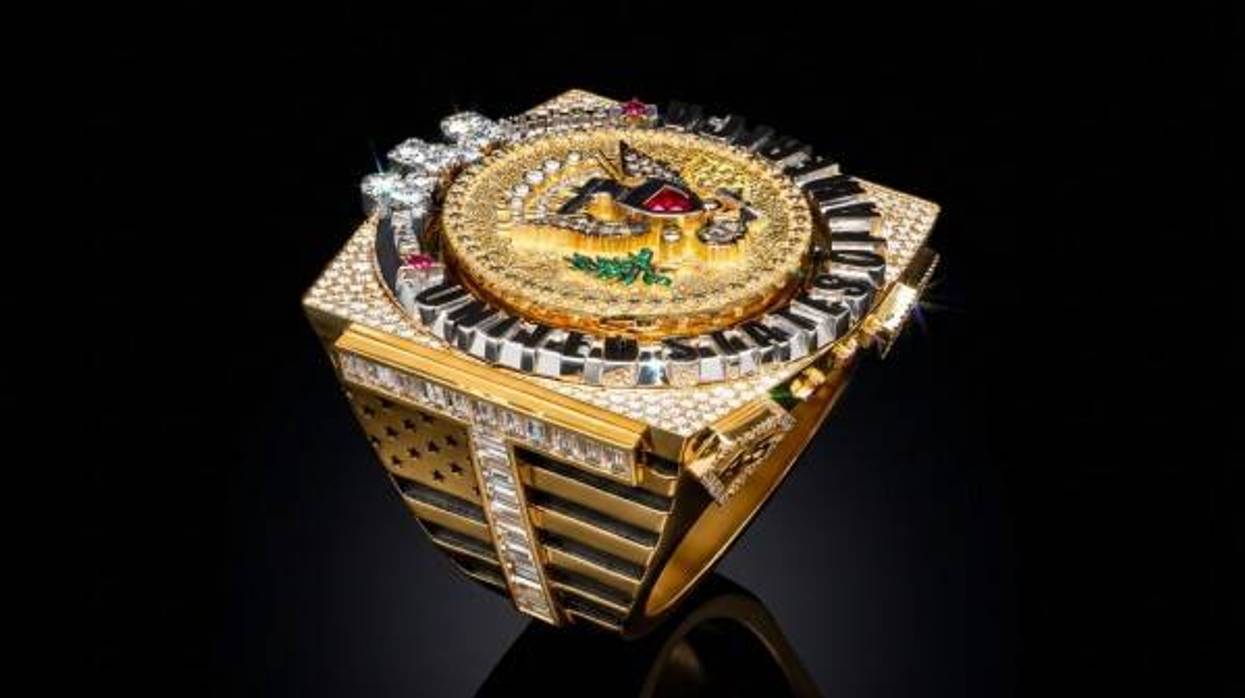
The gaudy gift came just weeks before Trump exempted Belgium’s diamond industry from his sweeping tariff regime, which the senators said “fit seamlessly” into a pattern of relief for those who give him gifts.
A pair of Democratic US senators has some questions for Belgium's diamond industry after it gave President Donald Trump what they said appears to be a "cartoonish bribe."
On Monday, Sens. Elizabeth Warren (D-Mass.) and Richard Blumenthal (D-Conn.) sent a letter inquiring about a "watch-sized, 18-karat gold ring encrusted with 321 diamonds and 75 gemstones" that the president had been gifted in late June by the Antwerp World Diamond Center (AWDC), a lobbying group for Belgian diamondmakers.
The custom ring, emblazoned with a gem-encrusted presidential seal, diamond emblems with the initial "T," and an interior engraving that reads "Crafted in Antwerp for Donald John Trump," is estimated to be worth $25,000-35,000.
“A very special thank you to my friends from Antwerp for the magnificent Freedom 250 ring,” Trump said in a video message during an event in Brussels upon receiving the gift at an event commemorating the 250th anniversary of the United States.
Just weeks later, the administration announced it was exempting European diamonds from Trump's sweeping tariff regime, which he was attempting to reinstate after the US Supreme Court had struck it down earlier this year.
After the diamond tariffs had been lifted, a press release from AWDC celebrated the decision, calling it a “significant boost” for Antwerp's diamond industry and “its international competitive position.”
According to the company, Antwerp exports about $2 billion worth of diamonds to the US each year. At 10%, that means importers would avoid paying about $200 million in tariffs annually under the exemption.
The senators noted that Isidore Mörsel, the president of the World Diamond Center, "explicitly linked the gift to trade issues" when presenting it to the US Ambassador to Belgium, Bill White, for delivery to Trump.
Mörsel said that AWDC commissioned the ring to "celebrate that enduring relationship" with the Antwerp diamond sector’s "most important trading partner for generations."
The senators said AWDC's public-private partnership with the Belgian government meant that Trump might be required to give up the ring under the Emoluments Clause of the US Constitution, which forbids federal officers from receiving gifts from foreign states without Congress' consent.
However, they said "presenting a gift of this magnitude could still play directly into President Trump’s well-established affinity for shiny gifts."
White House spokesperson Kush Desai has denied that the gift had any influence over Trump's decision, telling MS NOW that the administration "agreed to provide preferential tariff treatment for diamonds as part of our historic trade deal with the European Union that was signed last summer."
He added that “the only special interest guiding the Trump administration’s decision-making is the best interest of the American people.”
But the senators said the gift to Trump "fit seamlessly into [the] pattern" of executives appearing to use gifts and flattery to obtain lucrative tariff exemptions.
Apple CEO Tim Cook, who donated $1 million to the president’s inauguration committee, appeared to leverage his “very good relationship” with the President and a well-timed “24-karat” gold gift to secure exemptions from tariffs for various Apple products imported from China.
After Nvidia CEO Jensen Huang purchased a seat at President Trump’s Mar-a-Lago table for $1 million, the administration reversed course on implementing rules that would have prevented Nvidia from selling its most advanced chips to China.
And the administration slashed tariffs on Swiss imports from 39% to 15% just days after Swiss executives—including Rolex CEO Jean-Frédéric Dufour—presented President Trump with a personalized gold bar worth more than $130,000 and a luxury Rolex desk clock.
The senators said Antwerp's gift "raise[d] serious legal questions" under federal bribery law. They asked Mörsel and the jeweler who made the ring, David Gotlib, to provide details about the gift, including who funded it. They also requested information about any contact between the diamond lobbyists and White or other administration officials.

"I can think of only one thing more satiric than the only country on Earth that still routinely makes fun of soccer fixing the world’s biggest soccer tournament in their own favor. That would be fixing it and losing anyway," said one observer.
President Donald Trump's meddling in the 2026 FIFA World Cup came back to haunt him on Monday after Belgium demolished the US Men's National Team in a 4-1 rout.
On Sunday, multiple reports revealed that FIFA had overturned its one-game ban of top US player Folarin Balogun after Trump placed a phone call to FIFA President Gianni Infantino urging him to review referees’ decision to give Balogun a red card.
Trump's interference with the World Cup's disciplinary procedures and FIFA's decision to suspend Balogun's red card and allow him to play in the wake of Trump's call both drew sharp condemnation from longtime sports journalists and professional footballers, who said it called the integrity of the entire competition into question.
Concerns about the US winning a tainted victory due to Trump were ultimately banished, however, when Belgium dominated the US and eliminated them from the tournament.
After Belgium scored its fourth goal of the night, its players ridiculed Trump by doing an impersonation of the dance the president often performs at campaign rallies.
La selección de #Belgica se burla de Trump y en su casa. pic.twitter.com/sQEwyKqM3L
— ZuritaCarpio (@ZuritaCarpio) July 7, 2026
The Belgian team's social media accounts also took a shot at the president by posting images of victorious players alongside the caption, "Overturn this."
Overturn this. 🧏♂️ #USABEL pic.twitter.com/KcBAJp3Z7d
— Belgian Red Devils (@BelRedDevils) July 7, 2026
Media outlet MeidasTouch observed after the US loss that there have now been multiple occasions where the president has injected himself into a major sporting event, only to see his preferred competitor come up short.
"Sports fans are calling it the Trump curse," MeidasTouch wrote in a social media post. "He attended the Super Bowl and predicted a Chiefs win, but the Eagles blew them out... He sat in the owner’s suite when the Knicks snapped their huge playoff streak in NBA Finals Game 3. And he attended the Ryder Cup where Europe topped the US team."
A Tuesday report in USA Today similarly examined the possibility of a "Trump curse" in sporting events, of which the US Men's National Team's "error-plagued, idea-less, and lackluster performance" was only the latest example.
In a Tuesday column in The Financial Times, Edward Luce linked Trump's failed meddling in the World Cup with other disastrous initiatives such as his infamously botched renovation of the Lincoln Memorial Reflecting Pool.
"Call it the anti-Midas touch," Luce quipped. "Donald Trump loves gold. Yet so much of what he handles, from reflecting pools to US alliances, seems to turn into something else."
French newspaper Le Monde also took a dig at the president in its report on the US-Belgium match, writing sarcastically that "we are being told that Donald Trump wants to launch a legal action against Gianni Infantino, accusing the Belgian national team of having played football this Tuesday."
Writing in The Guardian on Tuesday, columnist Marina Hyde noted that Trump had turned global public opinion squarely against the US team in the tournament, and there was "joy" at seeing the president's machinations flop.
"It really brought the world together," Hyde remarked. "The last time this many people cheered on a Belgian resistance, it was 1914 and the Germans had just crossed the Meuse."
In a Monday column published by The Globe and Mail in Canada, Cathal Kelly declared that Trump's failed intervention had turned the US into a "laughingstock."
"I can think of only one thing more satiric than the only country on Earth that still routinely makes fun of soccer fixing the world’s biggest soccer tournament in their own favor," wrote Kelly. "That would be fixing it and losing anyway."
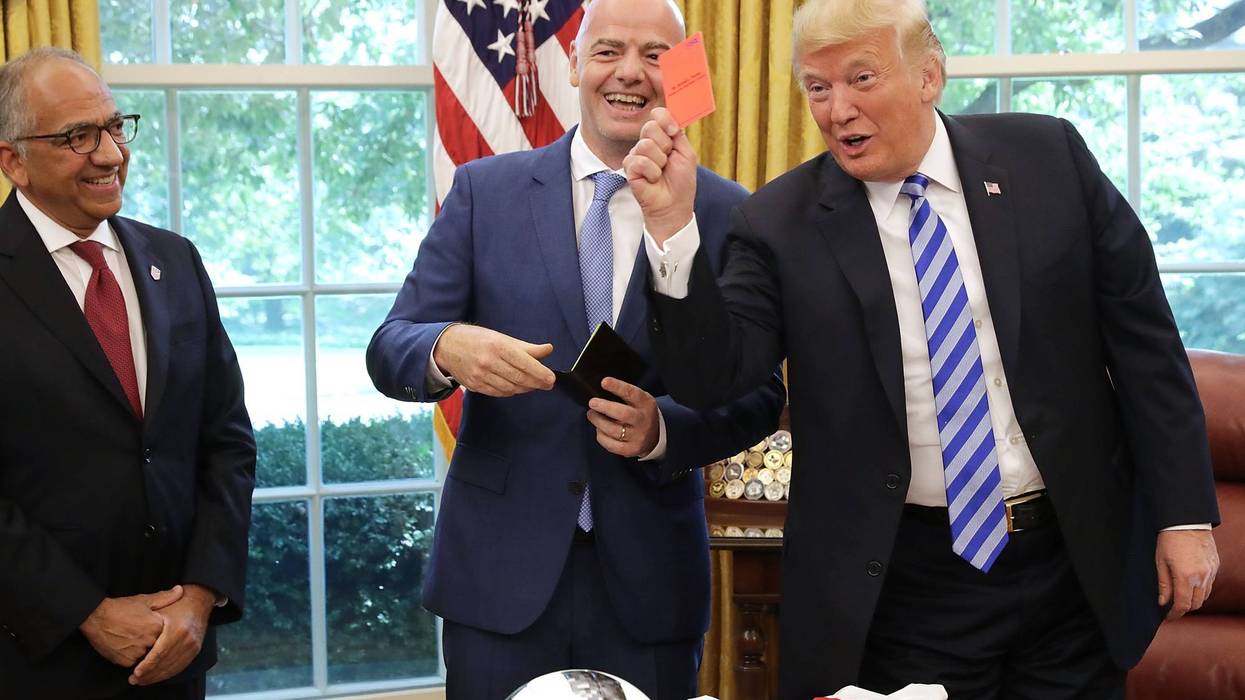
FIFA president Gianni Infantino, said one UK sports broadcaster, “needs to resign, he needs to resign today."
The world football governing body FIFA is facing international condemnation for its decision to suspend—at the reported urging of President Donald Trump—a one-game ban for Folarin Balogun, a top player on the US Men's National Team currently competing in the World Cup.
According to numerous reports, the Trump administration last week undertook a pressure campaign against FIFA to overturn Balogun's suspension, which included a personal phone call from Trump to FIFA president Gianni Infantino where the American president urged him to review the referees' decision.
On Sunday, FIFA shocked soccer fans by announcing that Balogun would be eligible to play in Monday’s World Cup match against Belgium. The decision—especially in light of the US being one of the host nation's for this year's Cup and the chummy relationship that Infantino has cultivated with Trump—drew widespread accusations of corruption and favoritism.
The Union of European Football Associations (UEFA) on Monday issued a statement accusing FIFA of "crossing a red line" by overturning Balogun's suspension, which it said damaged the World Cup's reputation.
"When the certainty of rules is no longer guaranteed by its guardians, the integrity of the game is at stake and the credibility of a competition is undermined," said UEFA. "Equally, such decision creates a precedent in the ongoing tournament, where similar situations will now require an equal treatment, to the detriment of the competition."
"We express our disbelief," the group added, "at such an unprecedented, incomprehensible, and unjustifiable decision."
UK sports broadcaster Jeff Sterling was among those in the world of football commentary who ripped into FIFA’s decision, which he labeled a "disgrace."
"To me, Gianni Infantino needs to resign, he needs to resign today," Sterling said during a Monday episode of talkSPORT's morning program. "He's the man who came up with the great idea of the FIFA Peace Prize and gave it to his mate, Donald Trump. And of course, his mate is the one who tries to influence this decision and have this suspension overturned."
Sterling said Infantino's position as FIFA president was rendered "untenable" by the decision.
"The smell of corruption allegations is particularly unpleasant," he added.
😡 "A disgrace!"
😡 "Infantino needs to resign!"
😡 "Shameless!"
Jeff Stelling is furious with Gianni Infantino after FIFA decided Folarin Balogun can play for the USA vs Belgium! 😤#FIFAWorldCup pic.twitter.com/z1p7PtViEN
— talkSPORT (@talkSPORT) July 6, 2026
Former UK football star Wayne Rooney delivered a similarly scathing assessment during a Sunday BBC broadcast.
"I think is an absolute disgrace and Infantino, he should be ashamed of this because I think for the sportsmanship of this game is in question here," said Rooney. "If I'm the USA's opponent I'd be absolutely fuming. I just think it's wrong in every way. I think it's an absolute disgrace."
"I think it's an absolute disgrace." 😡
Wayne Rooney questioned the call around Florian Balogun’s suspended red card for the USA. pic.twitter.com/beDcgnWNHO
— Match of the Day (@BBCMOTD) July 6, 2026
Other current and former football professionals also slammed FIFA's decision.
Norway coach Stale Solbakken described the overturned suspension as "a bad, bad, bad, bad, bad decision that will hurt the World Cup."
Former Manchester United players Gary Neville and Roy Keane joined with Arsenal great Ian Wright in decrying FIFA's handling of the matter.
- YouTube youtube.com
For his part, Keane said that the overturned suspension “seems unfair because it is unfair.”
Irish former professional footballer Roy Keane said that the overturned suspension "seems unfair because it is unfair."
The Royal Belgian Football Association (RBFA) declared itself "astonished by FIFA's decision," and demanded that the organization provide a justification for its actions.
RBFA also accused FIFA of trying to sabotage any efforts by Belgium to challenge the overturned suspension by only giving it "a few hours" to submit an appeal and by not responding to its request that FIFA provide justification for the original decision.
"For an appeal to be admissible, FIFA’s own regulations state that the reasoned decision must first have been communicated to the appellant," RBFA said. "While the RBFA was merely seeking legitimate explanations, FIFA itself created an appeal and immediately ensured that it would be declared inadmissible.
Infantino on Monday issued a statement where he denied directly interfering with the decision to reinstate Balogun for Monday's match.
"I read the decisions of the FIFA Disciplinary Committee when they are issued... sometimes I agree with them, and sometimes I disagree," said Infantino. "What I always do, however, is respect those decisions and the autonomy of the bodies that make them. Whether we personally like a decision or not is irrelevant. Respect for independent institutions and the rule of law is what protects the integrity of our competitions and the credibility of FIFA at all times."
Trump told reporters on Monday that he directly meddled to lobby FIFA to let Balogun play, calling the decision to suspend him "very unfair."
Trump on Balogun: "I saw the play, and I'm a person that loves sports ... that wasn't a foul. That wasn't even an infraction ... this referee, who is a little bit suspect if you check his past. He made a call that nobody could believe ... he's our best player, or one of our best… pic.twitter.com/YfIqb1JA4u
— Aaron Rupar (@atrupar) July 6, 2026
"How do you penalize him for a game that hasn't been played yet?" Trump said. "It's very unfair, you can't do that. So yes, I asked for a review by FIFA."
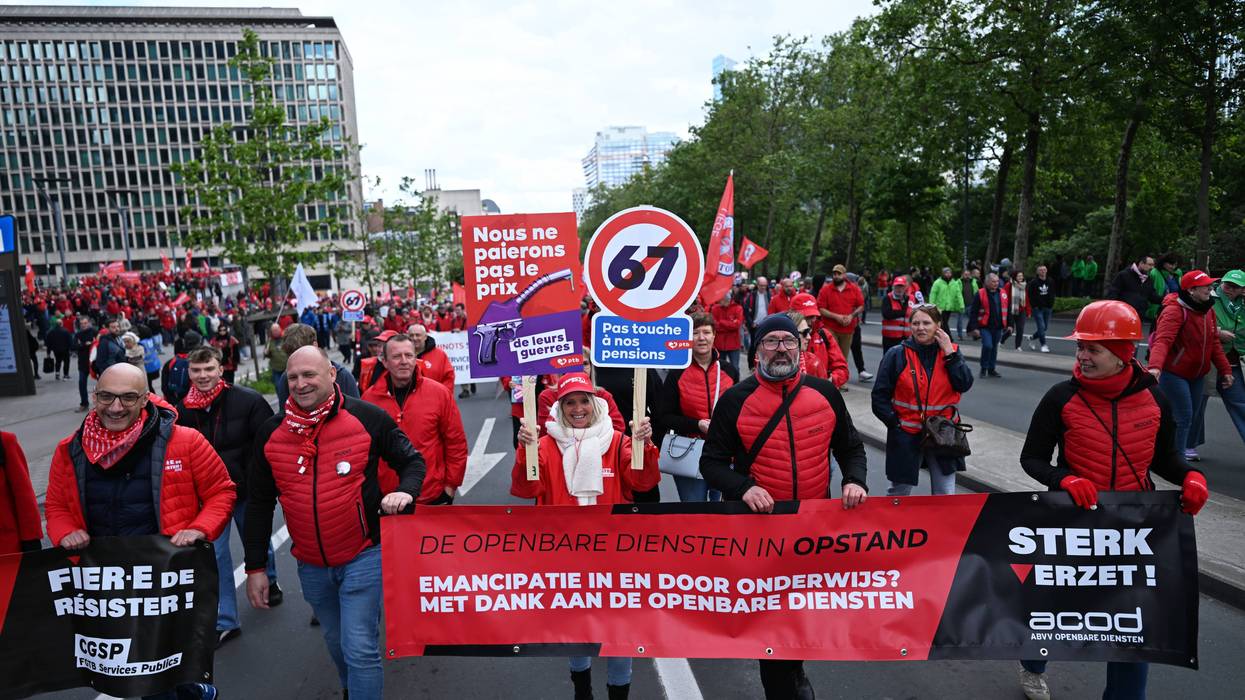
It's the latest of several national strikes over the past year and a half against policies that one union leader said will heighten "inequality" and "poverty."
Much of Belgium ground to a halt on Tuesday as tens of thousands of workers flooded the streets of Brussels as part of a general strike against government austerity measures.
Schools closed, public transit operated with reduced service, and flights out of major airports were grounded as workers walked off the job. Instead, they marched through the capital clad in red and green, the colors of Belgium's major labor unions, with some carrying signs that read, "Hands off our pensions" and "We will not pay the price of their wars."
According to Morning Star, as many as 100,000 people took part in the strike, which was called by the nation's three biggest trade unions in protest of measures by Prime Minister Bart De Wever's government that the unions say slash pensions, reduce wages, and attack collective bargaining.
The marchers called on the government to roll back plans to raise Belgium's retirement age to 67 and have called for an end to what the unions have dubbed a “pension penalty” that would cut benefits for those who retire early.
Amid rising costs caused by the US-Israeli war against Iran, the unions are also outraged by a proposed temporary cap on wage indexation, which requires wages to rise in tandem with inflation.
It's part of a broader trend of the government loosening labor rules for employers, which unions say has led to longer, more irregular hours and diminished employees' work-life balance.
"People will have less money left over and will still have to work more flexibly and longer," said Ann Vermorgen, the chair of the Confederation of Christian Trade Unions. "Even the Planning Bureau says that the reform will promote inequality and that poverty will emerge.”
Tuesday's general strike was just the latest over the past year and a half, as the unions have refused to let up on their push to reverse De Wever's agenda.
Gert Truyens, the chair of the General Confederation of Liberal Trade Unions of Belgium (ACLVB), said that with the pension penalty and the other labor proposals, the government was displaying “total disregard” for social dialogue by “unilaterally imposing things without discussing them with the trade unions and employers.”
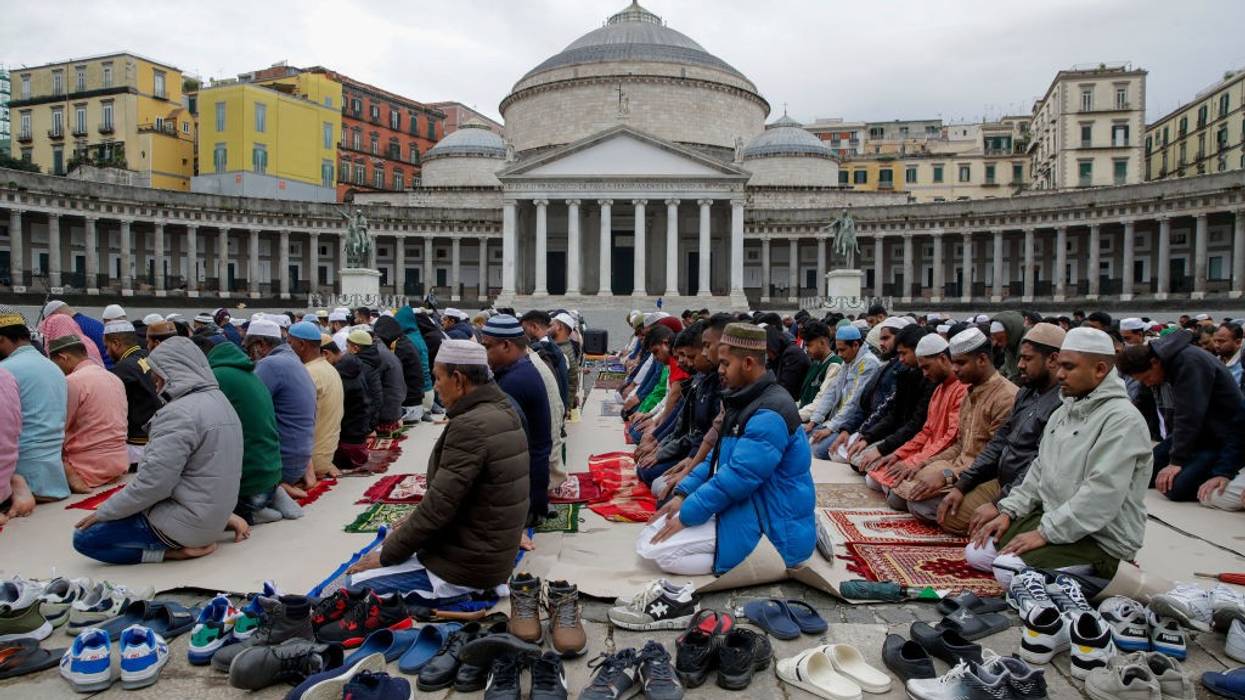
"What would the reaction would be if an Arab state wrote this about synagogues and Jews?" asked one critic.
Israel faced backlash this week after its Arabic-language account on the social media site X published a message warning Europeans to take action against the proliferation of mosques and "remove" Muslims from their countries.
"In the year 1980, there were only fewer than a hundred mosques in Europe. As for today, there are more than 20,000 mosques. This is the true face of colonization," posted Israel, a settler-colonial state whose nearly 2 million Muslim citizens face widespread discrimination, and where Palestinians in the illegally occupied territories live under an apartheid regime.
"This is what is happening while Europe is oblivious and does not care about the danger," the post continues. "And the danger does not lie in the existence of mosques in and of themselves, for freedom of worship is one of the basic human rights, and every person has the right to believe and worship his Lord."
"The problem lies in the contents that are taught in some of these mosques, and they are not limited to piety and good deeds, but rather focus on encouraging escalating violence in the streets of Europe, and spreading hatred for the other and even for those who host them in their countries, and inciting against them instead of teaching love, harmony, and peace," Israel added. "Europe must wake up and remove this fifth column."
Referring to the far-right Alternative for Germany party, Berlin-based journalist James Jackson replied on X that "even the AfD don't tweet, 'Europe must wake up and remove this fifth column' over a map of mosques."
Other social media users called Israel's post "racist" and "Islamophobic," while some highlighted the stark contrast between the way Palestinians and Israelis treat Christian people and institutions.
Others noted that some of the map's fearmongering figures misleadingly showing a large number of mosques indicate countries whose populations are predominantly or significantly Muslim.
"Russia has 8,000 mosques? Who would've known a country with millions of Muslim Central Asians and Caucasians would need so many!" said one X user.
Israel's post came amid growing international outrage over its 691-day assault and siege on Gaza, which has left more than 230,000 Palestinians dead, maimed, or missing and hundreds of thousands more starving and facing ethnic cleansing as Operation Gideon's Chariots 2—a campaign to conquer, occupy, and "cleanse" the strip—ramps up amid a growing engineered famine that has already killed hundreds of people.
Israel is facing an ongoing genocide case at the International Court of Justice, while Israeli Prime Minister Benjamin Netanyahu and Yoav Gallant, his former defense minister, are fugitives form the International Criminal Court, where they are wanted for alleged war crimes and crimes against humanity including murder and forced starvation.
European nations including Belgium, Ireland, and Spain are supporting the South Africa-led ICJ genocide case against Israel. Since October 2023, European countries including Belgium, France, Malta, Portugal, Slovenia, the United Kingdom, Ireland, Norway, and Spain have either formally recognized Palestinian statehood or announced their intention to do so.

"Discussions on the E.U.'s future relationship with Israel should above all be premised on an insistence that Netanyahu and Gallant face justice at the ICC for the crimes they are alleged to have committed."
Amnesty International is calling out the European Union for planning to welcome Israeli Foreign Minister Gideon Sa'ar to Belgium next Monday even as Prime Minister Benjamin Netanyahu and former Defense Minister Yoav Gallant face arrest warrants for Israel's genocidal assault on Palestinians in the Gaza Strip.
The human rights group joined historians, political leaders, and United Nations experts in condemning Israel's actions in Gaza as genocide in December—just two weeks after the International Criminal Court (ICC) formally issued arrest warrants for Netanyahu, Gallant, and Hamas leader Mohammed Diab Ibrahim Al-Masri.
"It is unconscionable that the E.U. is rolling out the red carpet for foreign minister Sa'ar whose boss, Prime Minister Netanyahu, is wanted by the ICC," Eve Geddie, director at the Amnesty International European Institutions Office, said in a Thursday statement about the foreign minister's trip to Brussels for an E.U.-Israel Association Council meeting.
"Discussions on the E.U.'s future relationship with Israel should above all be premised on an insistence that Netanyahu and Gallant face justice at the ICC for the crimes they are alleged to have committed, as well as on Israel's adherence to international law and an end to apartheid," Geddie argued. "E.U. leaders must put their commitments to international law, human rights, and the ICC above carefully choreographed diplomatic conferences with Israel."
"E.U. leaders should be deciding what measures to take to prevent the E.U. from aiding Israeli genocide, apartheid, and unlawful occupation instead of brushing these under the carpet for a diplomatic handshake in Brussels."
Geddie also highlighted threats against the ICC, including U.S. President Donald Trump's recent executive order sanctioning the court, which he announced shortly after welcoming Netanyahu to the White House earlier this month. Critics decried the sanctions, which followed the U.S. government—largely under former President Joe Biden—enabling Israel's destruction of Gaza with billions of dollars in military assistance.
Agnès Callamard, Amnesty's secretary general, said at the time that the "aggressive," "reckless," and "vindictive" order suggests "Trump endorses the Israeli government's crimes and is embracing impunity." She also urged governments and regional organizations to "do everything in their power to mitigate and block the effect" of the sanctions.
Geddie said Thursday that "the E.U.'s shameful silence on threats to the ICC and lack of urgent practical mitigating measures which it should have already taken following President Trump's egregious sanctions on the ICC, gives the firm impression that the E.U. has prioritized relations with a government implicated in the commission of genocide and war crimes, over support to an institution which is pursuing individual accountability for these crimes."
"E.U. leaders should be deciding what measures to take to prevent the E.U. from aiding Israeli genocide, apartheid, and unlawful occupation instead of brushing these under the carpet for a diplomatic handshake in Brussels," she concluded.
Amnesty's statement—which captured attention from the Israeli press—comes as the pro-Palestinian Hind Rajab Foundation (HRF) seeks an ICC warrant for Sa'ar over "war crimes and crimes against humanity committed during Israel's ongoing military assault on Gaza since October 7, 2023."
"As Belgium is a signatory to the Rome Statute, it has a legal obligation to cooperate with the ICC and take action against individuals accused of serious international crimes," HRF said Sunday, referring to the treaty that established the court. "The Hind Rajab Foundation calls on Belgian authorities to ensure that Sa'ar does not evade justice while on European soil."
"Allowing a suspected war criminal to visit Brussels unchallenged would be a betrayal of international legal commitments and the fundamental principles of justice," added the group, named for a 5-year-old girl killed by Israeli tank fire in Gaza.
A fragile cease-fire and hostage release deal took effect in Gaza last month, but Israel has repeatedly violated it, in addition to Israeli forces and settlers escalating attacks on Palestinians across the illegally occupied West Bank.
"The Israeli occupation has violated the cease-fire agreement more than 350 times since it was signed, clearly demonstrating its continued breach of commitments and its defiance of the international community," Ismail al-Thawabteh, head of the Government Media Office in Hamas-governed Gaza, said Friday, according to Anadolu Agency.
Amid threats of retaliation from Netanyahu, Hamas also said Friday that it was investigating claims that human remains the group gave to Israel on Thursday as part of the cease-fire deal did not include those of hostage Shiri Bibas.
Hamas has said that an Israeli airstrike killed Bibas and her sons Kfir and Ariel—whose remains were positively identified after being handed over to Israel—with al-Thawabteh saying that Netanyahu "bears full responsibility for killing her and her children." He said Friday that Bibas' body "was turned into pieces after apparently being mixed with other bodies under the rubble."
In preparation for Monday's meeting, EUobserver reported Friday that according to a draft joint communiqué, European foreign ministers intend to tell Sa'ar that "displaced Gazans should be ensured a safe and dignified return to their homes," and they are "rejecting any attempt at demographic or territorial changes in the Gaza Strip."
"The E.U. is gravely concerned that the occupation of the Palestinian territory that began in 1967 continues to this day, underlining... that the International Court of Justice has found that the continued presence of Israel in the occupied Palestinian territory is unlawful," the document reportedly says. It also warns that the bloc "is ready to take work forward on further restrictive measures against extremist settlers [in the West Bank] and against entities and organizations which support them."
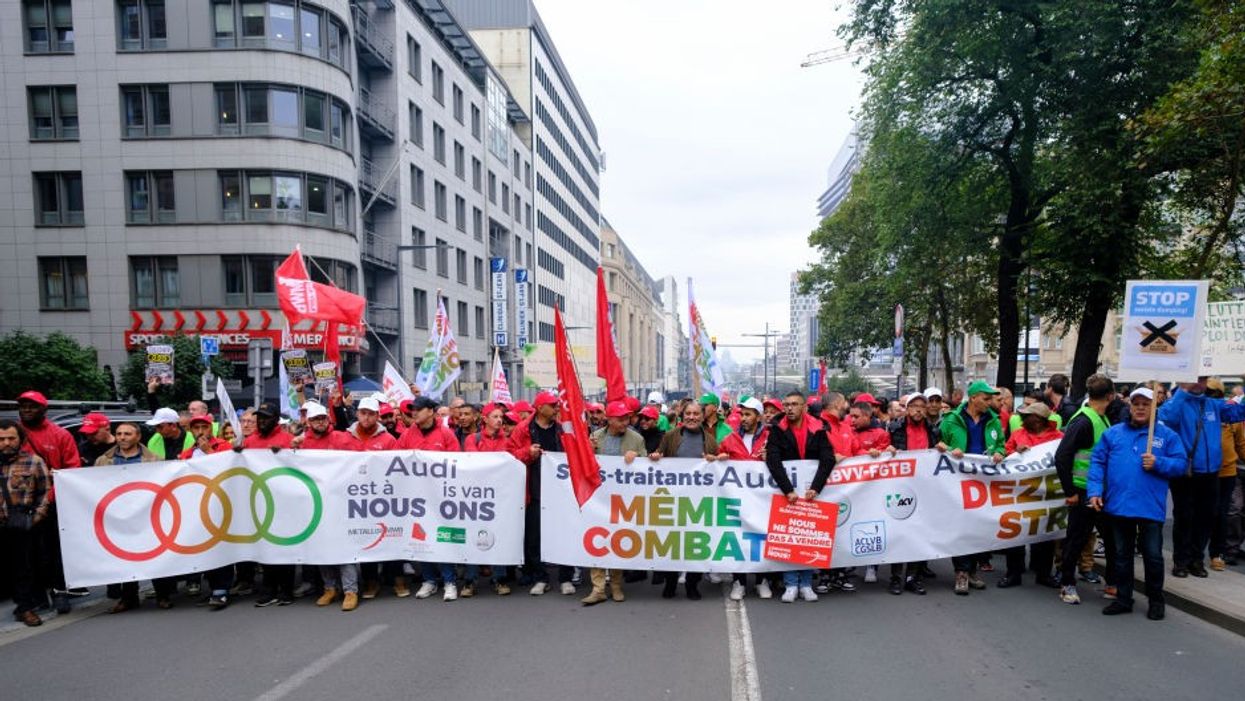
"Their anger is very legitimate, very understandable, especially since Audi is not very clear on its plans," a local employment minister said.
Thousands of autoworkers protested in Brussels on Monday following recent news that Audi, a subsidiary of the German automaker Volkswagen, would phase out production at its plant there, which is expected to mean layoffs for its roughly 3,000 employees by the end of 2025.
The phase-out announcement led to a labor dispute that's shuttered the plant for the last two weeks, with some employees forming an encampment protest outside. The plant is expected to resume operations on Tuesday even though the core issues underlying the labor dispute, which some unions have characterized as a lockout by management, haven't been resolved.
Between 5,500 and 11,000 demonstrators marched toward the European Parliament on Monday, bringing "chaos" to Brussels, where public transport was largely shut down. Unions not directly affected by the Audi plant's likely closure participated in solidarity.
"Their anger is very legitimate, very understandable, especially since Audi is not very clear on its plans," Bernard Clerfayt, a local employment minister, told AFP.
Charlie Le Paige of Belgium's worker's party, Parti du Travail de Belgique, wrote on social media that there were "lots and lots of people in the streets of Brussels in support of Audi workers and subcontractors."
Le Paige said that the company was treating employees as disposable while distributing huge amounts of money to shareholders, and declared that "workers are not adjustment variables!"
Beaucoup beaucoup de monde dans les rues de Bruxelles en soutien aux travailleurs et aux sous-traitants d'#Audi 🔥 Le groupe VW-Audi a distribué près de 12 milliards de dividendes l'année passée, les travailleurs ne sont pas des variables ajustement! pic.twitter.com/aUEgbCNZsl
— Charlie Le Paige (@charlielepaige) September 16, 2024
The state-of-the-art Audi plant in southern Brussels produces the Q8 e-Tron, an electric sport utility vehicle. Audi received about 27 million euros ($30 million) in public funding to retrain workers when it converted to electric vehicle production.
Audi announced in July that it was considering discontinuing production of the commercially unsuccessful Q8 e-Tron and closing the Brussels plant, and said earlier this month that it still hadn't found an alternative vehicle that it could produce there.
The following day, September 4, the plant's workers "downed tools" and set up protest camps on the premises, according to World Socialist Web Site.
On September 6, United Auto Workers President Shawn Fain, a leading U.S. unionist, visited the plant in solidarity with the workers there.
About 1,500 Audi workers at the plant face the prospect of layoffs as early as next month, another 1,100 by May, and the remainder by the end of 2025. There are also many hundreds of subcontractor workers that would be impacted by a closure, unions have said.
Last week, workers took about 200 car keys from vehicles at the plant as an act of protest, prompting warnings of legal action by the company. The workers later returned the keys to try to facilitate discussions with management.
The plant's likely closure is seen as part of E.V. failures at Volkswagen and European carmakers more generally, prompting calls for the European Union to invest in and protect the industry. Audi reportedly plans to make the successor to the Q8 e-Tron in Mexico.
Many of the demonstrators on Monday spoke harshly about E.U. policy.
"We also want to send a strong signal to European authorities, which are making things difficult for Belgian industry, but also for European industry," Patrick Van Belle, a leading union official at Audi Brussels, told Reuters, in explaining the reasons for Monday's demonstration. "The manufacturing industry is mainly migrating away from our countries."
Volkswagen's layoffs may in fact extend beyond Belgium. The company made the surprising announcement earlier this month that it may shutter factories in Germany, drawing fierce opposition from unions there. The closures would be the first in Germany in the company's 87-year history.
Former European Central Bank chief Mario Draghi last week issued a report, commissioned by the E.U., calling for stronger industrial policy and a degree of trade protectionism, including in the auto industry, which is struggling to compete with heavily subsidized Chinese vehicles. Draghi, hardly considered a radical political thinker, drew criticism from neoliberal institutions for the proposals.
Local police said about 5,500 people attended the demonstration on Monday while unions put the figure at 11,000.
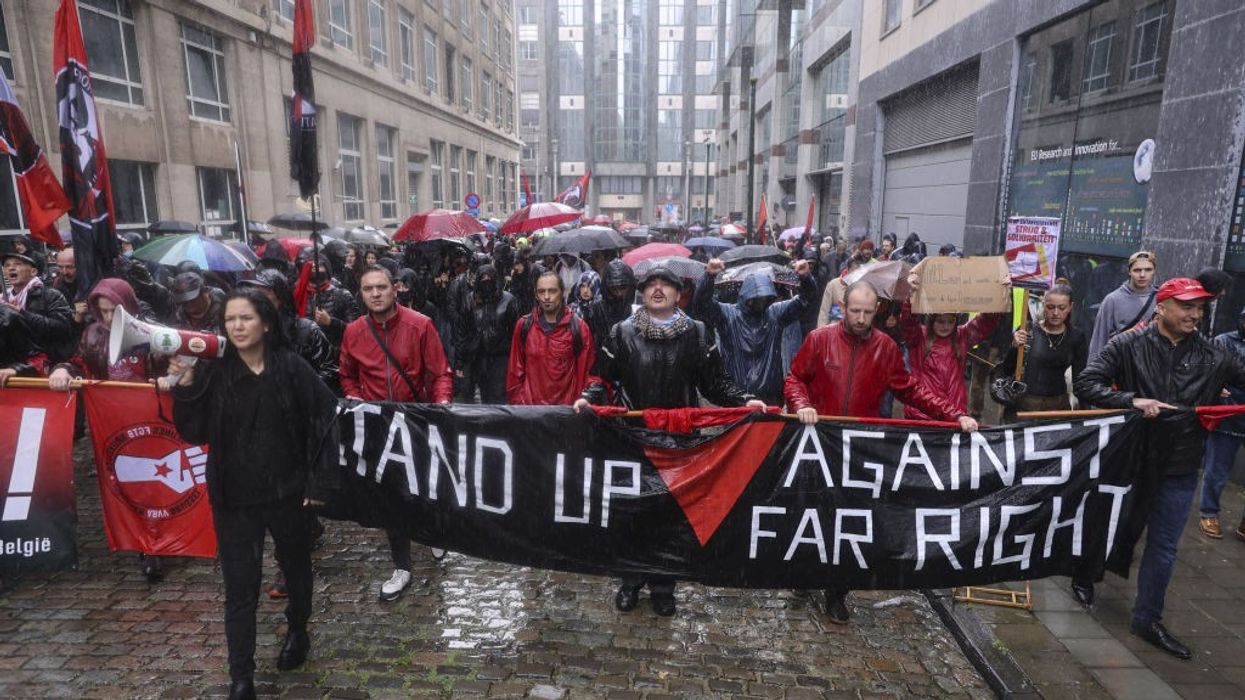
"It's important to show that we're in solidarity with everyone, whatever their nationality, whatever they earn, whatever they do," said a member of the Anti-Fascist Coordination of Belgium.
Thousands of people came together in Brussels on Sunday to march against the far-right parties' recent gains in the European Union elections—the second such protest in the Belgian capital since the results were announced earlier this month.
Sunday's march was organized by the Anti-Fascist Coordination of Belgium. The Brussels Times reported that "some 20 social movements and organizations are part of the CAB, including Young FGTB, Ades network, the Anti-Fascist Front of Liège, MOC Brussels, ASBL Garance, Ecolo J, and Mrax."
The organizers aimed to offer a "popular response and a contrasting social agenda" to the E.U.'s far-right movement, which they said "exacerbates social degradation" and promotes "absolutely disastrous policies" targeting democratic rights, the LGTBQ+ community, migrants, women, and workers.
"It will never be the far right that calls for taxing the richest, increasing the number of social housing, or implementing an ecological transition rooted in a logic of social justice, which is necessary for our common future."
"The far right will never demand higher wages for all," the organizers said. "It will never be the far right that calls for taxing the richest, increasing the number of social housing, or implementing an ecological transition rooted in a logic of social justice, which is necessary for our common future."
CAB member Sixtine Van Outryve told Euronews that "this march is important today to show a message of hope in the face of the messages of despair that the far right wants to bring us."
"It's important to show that we're in solidarity with everyone, whatever their nationality, whatever they earn, whatever they do," she said. "We stand together and we want a society that doesn't divide us. A society that doesn't exclude, a society that isn't racist or sexist."
"Many of us were shocked by the election results, showing far-right breakthroughs at the European level," Van Outryve added, expressing concern about the "alarming" normalization of far-right discourse.
The right-wing surge in the 27-member bloc's elections was widely anticipated, as key figures from across the continent and beyond collectively campaigned against migrants, feminism, socialism, LGBTQ+ rights, and the United Nations.
Parties that did well in the E.U. contests included Italian Prime Minister Giorgia Meloni's Brothers of Italy, Germany's Alternative für Deutschland, and Marine le Pen's National Rally in France, where President Emmanuel Macron responded to the results by calling snap national elections scheduled for June 30 and July 7.
As The Guardian reported earlier this month, "A surge in support for far-right parties in France, Germany, and Austria was tempered by strong support for centrist and left-wing groups in other countries."
The mixed results mean Ursula von der Leyen—who is tied to Germany's center-right Christian Democratic Union and the European People's Party—is expected to secure a second five-year term as president of the European Commission.
The Sunday march preceded a Monday evening meeting for heads of state and government to begin discussing who will fill that role and other top E.U. posts. In addition to the commission spot, The Guardian noted, "leaders will also decide on successors to Charles Michel, the president of the European Council, and Josep Borrell, the E.U.'s top diplomat."
"Consensus is also firming around Portugal's Socialist former Prime Minister António Costa to take over from Michel in chairing E.U. Council meetings," according to the British newspaper. "Estonia's prime minister, Kaja Kallas, is a favorite to take over from Borrell."
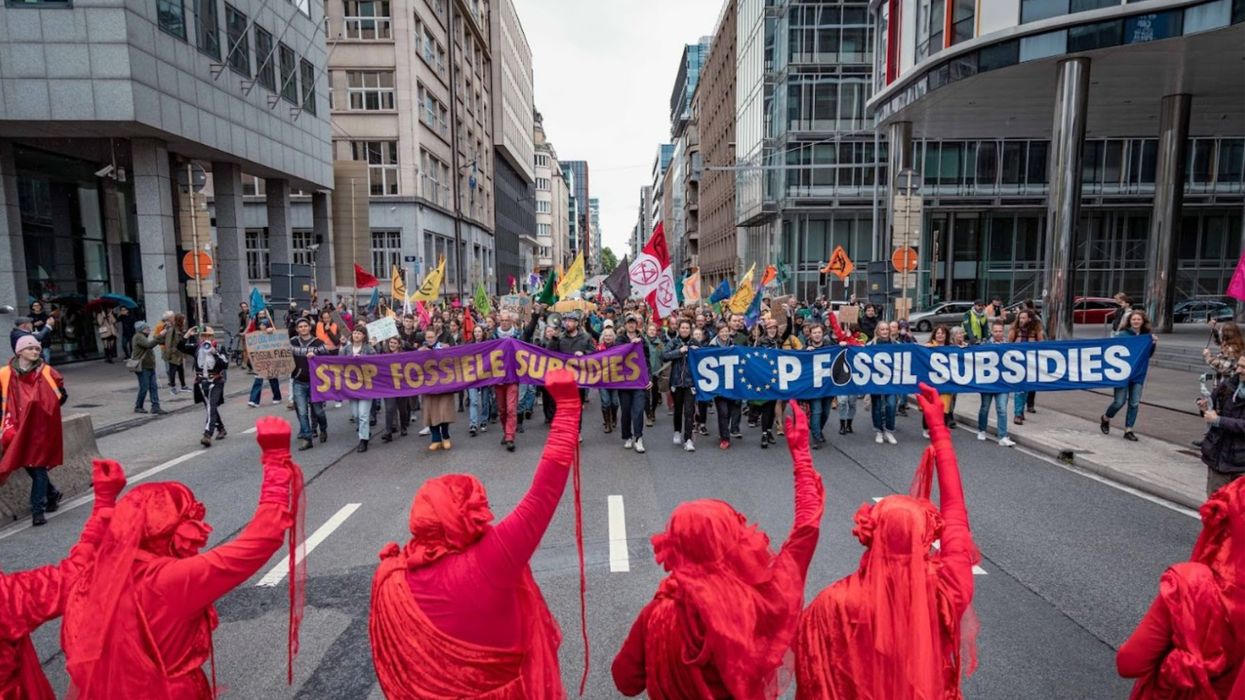
"The fact that national governments are subsidizing fossil fuels is akin to a crime against humanity," said one Extinction Rebellion organizer.
The climate action group Extinction Rebellion Belgium on Saturday decried what it called "disproportionate police violence" against nonviolent demonstrators who were arrested during a protest in Brussels demanding an end to fossil fuel subsidies.
Hundreds of Extinction Rebellion-led climate defenders blocked Rue Belliard in the European Quarter, the de facto European Union capital, during EU Open Day, when agencies of the 27-nation bloc open their doors to the public. In what Extinction Rebellion called an "unprecedented police response," officers allegedly struck protesters with batons and used chemical agents against demonstrators.
Brussels police said 132 activists—some of whom glued themselves to the ground—were arrested.
"This police behavior toward nonviolent protesters exercising their freedom of assembly is illegal and authoritarian," Extinction Rebellion Belgium said in a statement Saturday.
"We call on the police to exercise restraint and respect the right to demonstrate peacefully and without violence," the group added.
The activists are calling on European governments to stop subsidizing fossil fuels amid a worsening planetary crisis. They're also demanding the declaration of a climate emergency.
"National and European governments are spending at least €405 billion each year subsidizing major fossil fuel corporations," protest spokesperson Bertina Maes told The Brussels Times. "That's ten times more than what's spent on climate policy."
Maes said the Belgian government alone spent as much as €20 billion ($21.5 billion) on fossil fuel subsidies in 2020, more than 2% of the country's gross domestic product.
"The fact that national governments are subsidizing fossil fuels is akin to a crime against humanity," she asserted.
This weekend's demonstration and arrests come a month before E.U. parliamentary elections. According to an April Eurobarometer survey conducted by the European Parliament, climate action is the fifth-most important issue to voters, after poverty and social exclusion, health, jobs, and defense and security.
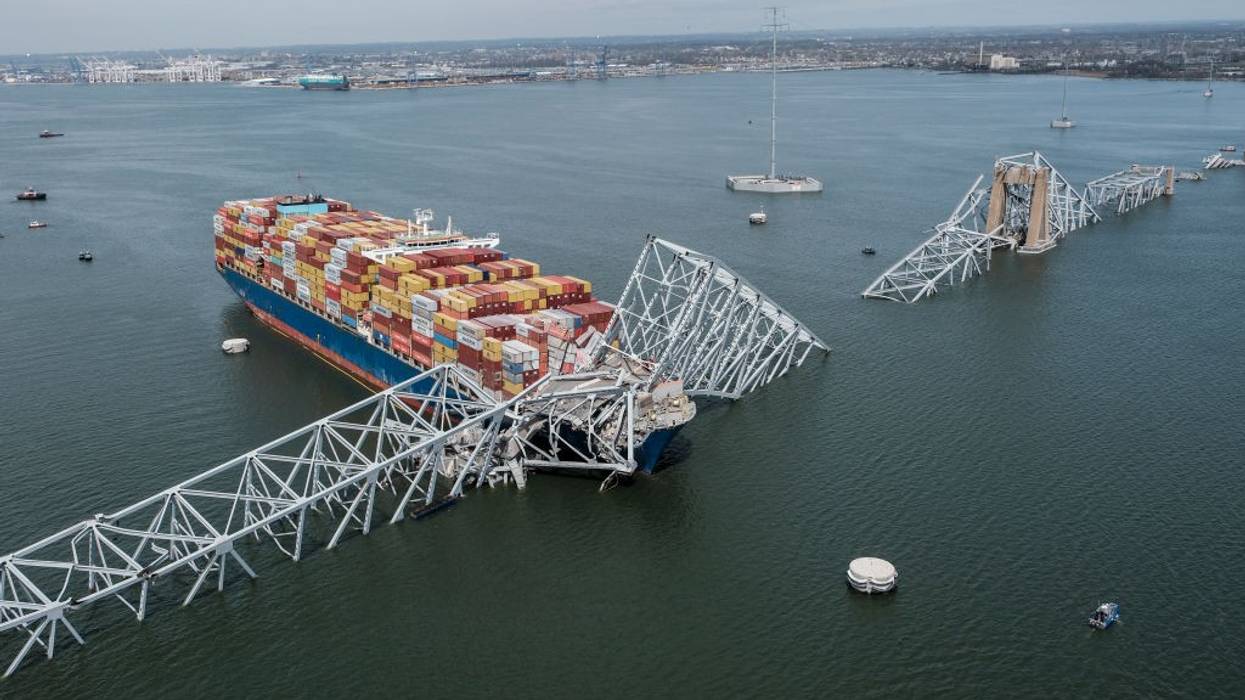
The Maersk-chartered MV Dali—which lost propulsion just before the collision—not only was involved in a previous crash, but was also briefly detained last year over problems with its propulsion system.
The mega-container ship that lost propulsion before toppling Baltimore's Francis Scott Key Bridge in a Tuesday morning collision was involved in a previous crash, and was cited last year for propulsion-related problems.
Newsweek reported that the Maersk Line Limited-chartered MV Dali—which crashed into the Interstate 695 Patapsco River crossing just before 1:30 am, causing the span to collapse and sending a construction crew into the water—collided with a wall in the harbor at Antwerp, Belgium in 2016. The accident, which was reported by Vessel Finder and other outlets at the time, was attributed to errors made by the ship's master and pilot.
The 9-year-old Dali was also detained by port officials in San Antonio, Chile last June after inspectors discovered a problem related to the vessel's "propulsion and auxiliary machinery," according to The Washington Post, which cited records from the intergovernmental shipping regulator Tokyo MOU.
The ship's owner, Grace Ocean Private Ltd., and operator, Synergy Marine, "have been sued at least four times in U.S. federal court on allegations of negligence and other claims tied to worker injuries on other ships owned and operated by the Singapore-based companies," according to The Associated Press.
Maersk was also sanctioned last year by the U.S. Labor Department for allegedly stopping employees from reporting safety concerns, documents published by The Lever revealed.
According to a July 14, 2023 Labor Department letter to Maersk regarding an Occupational Safety and Health Administration investigation, the Danish company "suspended and then terminated" a worker "in retaliation for reporting unsafe conditions and contacting the U.S. Coast Guard."
The fired employee "engaged in numerous protected activities" including reporting a leak and the need for repairs to a ship's cargo hold bilge system, alcohol use aboard the vessel by crew members, and inoperable equipment including an emergency fire pump and lifeboat block and releasing gear.
The search for six construction workers who were on the bridge when it collapsed into the river was suspended until Wednesday, according to The Associated Press. The workers are presumed dead by their employer, Brawner Builders. Local media reported that multiple vehicles plunged into the river and that two workers—one of whom was briefly hospitalized—were rescued from the water.