

SUBSCRIBE TO OUR FREE NEWSLETTER
Daily news & progressive opinion—funded by the people, not the corporations—delivered straight to your inbox.
5
#000000
#FFFFFF
To donate by check, phone, or other method, see our More Ways to Give page.
Daily news & progressive opinion—funded by the people, not the corporations—delivered straight to your inbox.
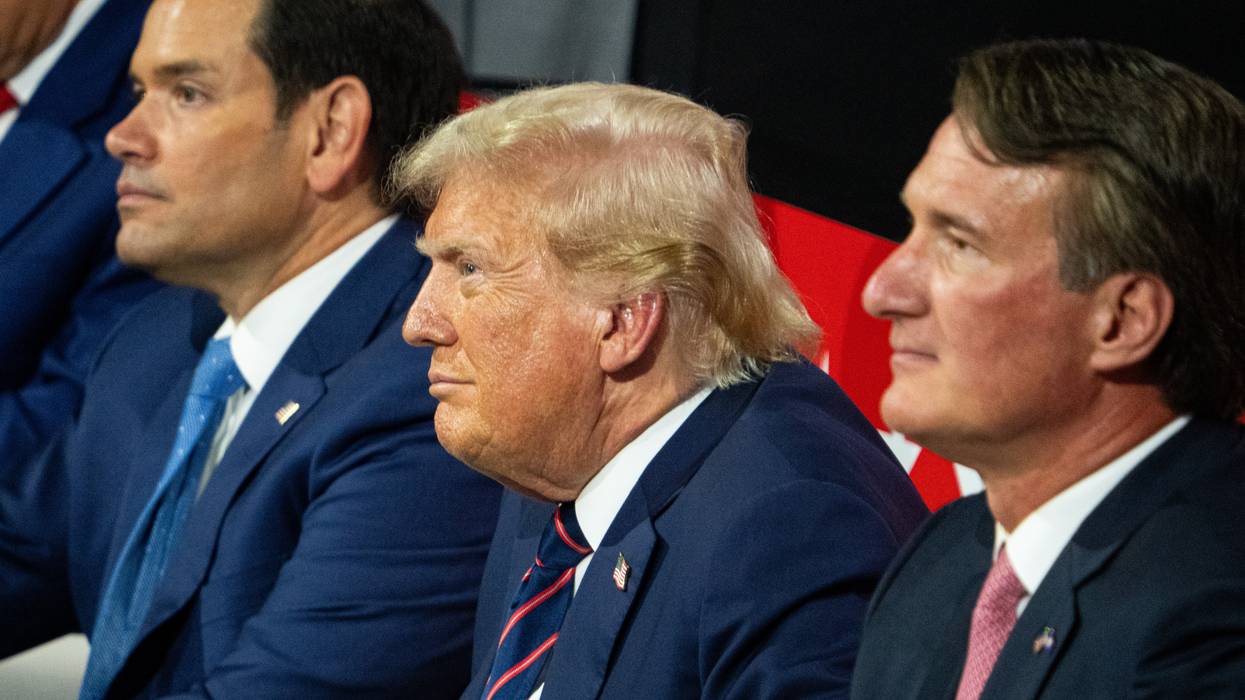
"This is the textbook definition of 'gaslighting' by Glenn Youngkin," said a progressive Virginia organization.
The Virginia Democratic Party said Tuesday that Republican Gov. Glenn Youngkin—long promoted in the political press as a "moderate" alternative to the far-right MAGA movement—had made clear he was a "disgrace to our commonwealth" in an interview regarding GOP presidential nominee Donald Trump's recent threat to deploy the U.S. military against his political opponents.
CNN anchor Jake Tapper on Monday evening confronted the governor with Trump's comments in an interview broadcast on Sunday in which the former president told Fox News' Maria Bartiromo that he was concerned about violence from "the enemy within" on Election Day.
"We have some very bad people, we have some sick people, radical left lunatics," Trump said in a clip played by Tapper on CNN. "And it should be very easily handled by, if necessary, by National Guard, or if really necessary, by the military."
He later pointed to U.S. Rep. Adam Schiff (D-Calif.), who helped lead the prosecution during Trump's first impeachment trial, as one of the "lunatics that we have inside."
"Is that something that you support?" Tapper asked Youngkin.
Youngkin repeatedly dodged Tapper's direct question, instead focusing on immigration and claiming the CNN anchor was "misinterpreting and misrepresenting" Trump's words, which he said were related to the former president's views on undocumented immigrants.
"I'm literally reading his quotes," said Tapper. "I'm literally reading his quotes to you and I played them earlier so you could hear that they were not made up by me."
The governor didn't budge from his message, repeatedly claiming that Tapper had taken "little snippets" from what Trump had said and created "a big narrative" out of the comments. He did not answer Tapper's question about whether he would support deploying the National Guard on Election Day.
"This is the textbook definition of 'gaslighting' by Glenn Youngkin... Insane. And EVIL," said progressive Virginia-based news outlet Blue Virginia. "Youngkin is an eternal disgrace to Virginia—worst governor ever, betrayer of our democracy, boot-licking Trump sycophant."
Independent journalist Eric Michael Garcia said the interview presented the latest evidence that Youngkin—who rose to his state's highest office after campaigning against the teaching of accurate U.S. history, including the history of racial injustice, in public schools—is not the "upbeat Post-Trump alternative" his supporters claim he is.
The interview aired around the time that Mark Esper, Trump's former defense secretary, urged CNN viewers to take seriously the GOP presidential nominee's threat to deploy the military on Election Day.
"I saw over the summer of 2020 where President Trump and those around him wanted to use the National Guard in various capacities in cities such as Chicago and Portland and Seattle," Esper told CNN's Kaitlan Collins, referring to Trump's response when the police killing of George Floyd sparked racial justice protests. "So that's what equally concerns me about his comment would be the use of the military in these types of things."
At a rally in Green Bay, Wisconsin on Monday, Democratic vice presidential nominee Gov. Tim Walz of Minnesota also addressed Trump's threat, telling the audience, "He's talking about you."
"We'll let the lawyers decide if what he said was treason, but what I know is it's a call for violence, plain and simple," said Walz. "If anyone wants to pretend that this is a normal conversation that Donald Trump is having, just dispel that."
After Youngkin refused to say that as a governor, he would oppose mobilizing the military against Trump opponents, progressive strategist Murshed Zaheed said that "every reporter should be asking every Republican governor whether they will call the National Guard to help Trump target his enemies."
"Would love to get answers to this question from governors of Georgia, Nevada, Ohio, etc.," he said, referring to several battleground states.
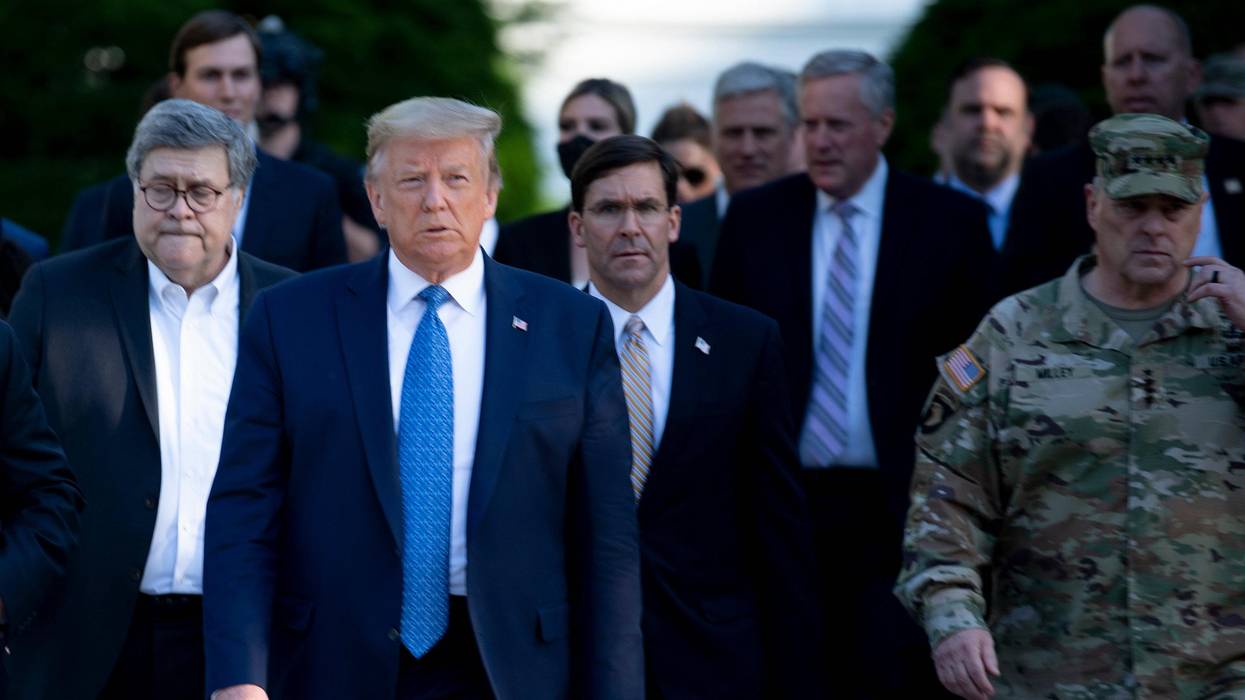
Former President Donald Trump suggested protesters in Washington, D.C. denouncing police brutality back in the spring of 2020 should be shot, according to former Defense Secretary Mark Esper.
The revelation scooped by Axios Monday comes in Esper's memoir--A Sacred Oath: Memoirs of a Secretary of Defense During Extraordinary Times--to be released May 10.
Referencing the protesters outside the White House the first week of June 2020, Trump asked: "Can't you just shoot them? Just shoot them in the legs or something?"
The moment inside the Oval Office was "surreal," writes Esper, who describes Trump as "red faced and complaining loudly about the protests under way in Washington, D.C."
Esper writes that he wanted to "figure out a way to walk Trump back without creating the mess I was trying to avoid."
The allegation in Esper's memoir mirrors one laid out last year in then-Wall Street Journal reporter Michael Bender's book Frankly, We Did Win This Election: The Inside Story of How Trump Lost.
"Crack their skulls!" Trump told his top law enforcement and military officials as to how to respond to the June 2020 protesters, according to Bender's book.
"Just shoot them," Trump reportedly said multiple times in the Oval Office, Bender's book charges. Then, after pushback from then-Joint Chiefs Chairman Gen. Mark Milley and then-Attorney General William Barr, Trump said, "Well, shoot them in the leg--or maybe the foot."
At the start of June 2020, Trump publicly threatened to use the Insurrection Act of 1807 to deploy the military to U.S. cities to suppress nationwide demonstrations over the police killing of George Floyd.
"If a city or state refuses to take the actions necessary to defend the life and property of their residents, then I will deploy the United States military and quickly solve the problem for them," said Trump.
Days later, Esper rebuffed the then-president's call, saying at a Pentagon press briefing that "the option to use active-duty forces in a law enforcement role should only be used as a matter of last resort, and only in the most urgent and dire of situations."
"We are not in one of those situations now," he said. "I do not support invoking the Insurrection Act."
Five months later, Trump fired Esper, announcing the news in a tweet.
Esper, NPR reported at the time, had "earned the derogatory nickname 'Yesper' for seemingly acquiescing or remaining silent over the president's kneejerk moves. Those ranged from reducing U.S. troops in Afghanistan and Syria with little or no deliberation to stopping Pentagon efforts to rename military bases named after Confederate generals."
The ex-defense chief, however, has rejected the characterization.
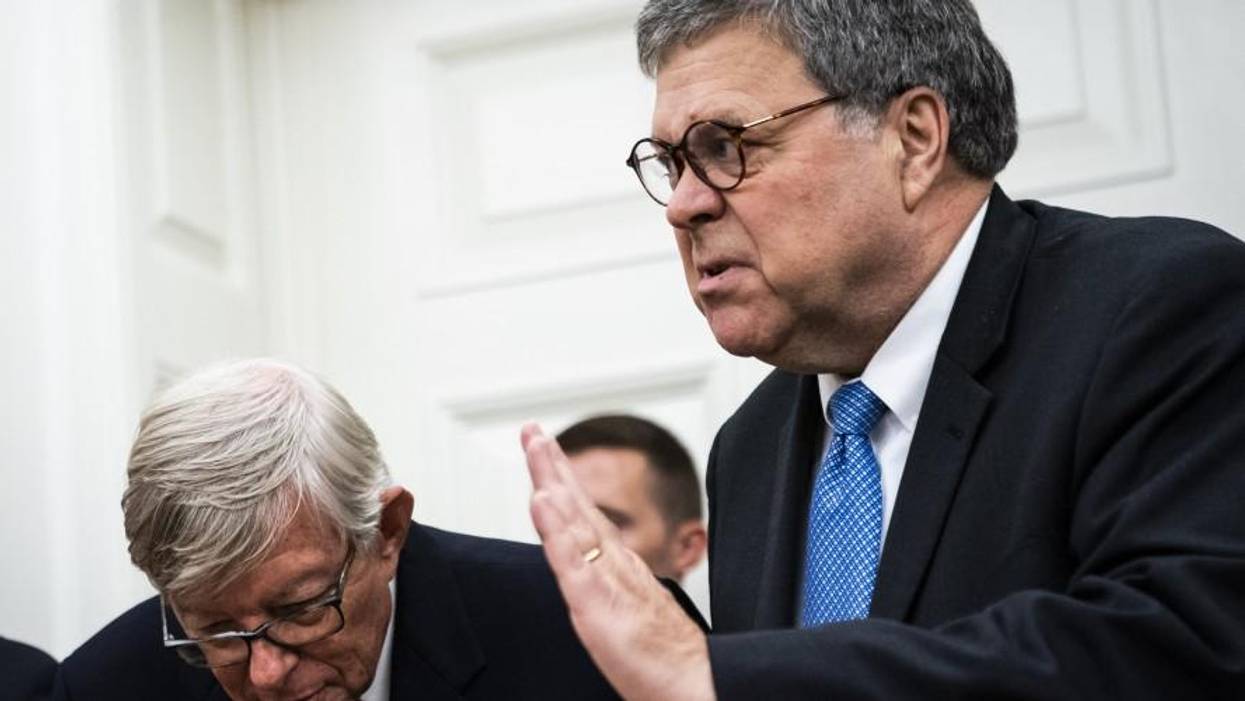
"We live in the age of narrative, not facts," former Attorney General William Barr told NBC News in an interview that aired on March 6, 2022.
He should know. For two years, Barr developed false narratives that protected then-President Donald Trump from incriminating facts, starting with a "distorted" and "misleading" summary of special counsel Robert Mueller's report. Barr diverted the public from Mueller's conclusions that Russia committed crimes to help Trump win the 2016 election, Trump's campaign had embraced the assistance, and Trump himself had obstructed justice during the ensuing investigation.
But now that Trump is at the center of a potential criminal conspiracy to remain in office after losing the election, Barr is promoting his new book and launching a new narrative.
And this time, he's trying to protect himself.
I have a few questions.
Why Did Barr Stop Pushing Trump's Big Lie?
Prior to the election, Barr repeatedly pushed Trump's lie that fraud could infect the outcome. He was still at it on November 9, 2020, when he reversed the Justice Department's longstanding hands-off policy surrounding elections and ordered an investigation into allegations of voting irregularities that, "if true, could potentially impact the outcome a federal election in an individual State."
According to former acting Attorney General Jeffrey Rosen's August 7, 2021 interview with the House committee investigating the January 6 attack, Barr "had been considering it earlier." But for some reason, he decided to announce the policy change two days after every news organization had confirmed Trump's defeat. The head of the Justice Department's Election Crimes Branch resigned from that position in protest.
On the same day and in a seemingly unrelated development, Trump fired Secretary of Defense Mark Esper and appointed Christopher C. Miller as acting secretary. Immediately, Miller replaced three top department officials and named three Trump loyalists to replace them:
Then in a recently revealed mid- to late-November meeting, Trump told Barr that his lawyers said the Justice Department could seize voting machines. Barr rejected the idea. But did he hear that Trump kept exploring the possibility with other federal agencies, including the Defense Department?
Shortly thereafter, Barr abruptly turned on Trump and renounced the Big Lie publicly. On December 1, he told the Associated Press that there was no evidence of voter fraud sufficient to change the election outcome.
Nine days later, Trump signed an executive order revising the Defense Department's line of succession. He moved up his newest departmental loyalists--Tata and Cohen-Watnick--and put them directly behind the deputy secretary and the secretaries of the Army, Navy, and Air Force. It meant that if Trump issued an order that the Pentagon's top four leaders refused to obey, the resulting departmental massacre would leave friendly faces in their stead.
What Did Barr Know about Trump's Phony Electors?
Trump tried to reverse his defeat in key states by litigating popular vote totals and contacting election officials. Many of those efforts were in plain sight at the time, and all of them failed. But recently we learned that Trump's allies were working secretly on another ploy.
On December 9, Boston attorney Kenneth Chesebro--whom the House's January committee subpoenaed on March 1, 2022--outlined a plan to press ahead with Trump's potential electors in six states that he had lost. Their combined electoral votes would swing the Electoral College outcome to Trump.
In accordance with the U.S. Constitution and federal law, the Electoral College voted on December 14 in state capitals throughout the country. Previously chosen electors for each state's winning candidate cast their ballots accordingly and transmitted them to federal officials, including the National Archives.
But in seven states that Biden won--the six states in Chesebro's memo plus New Mexico--Trump's potential electors pretended that Trump had won. They signed phony voting certificates that are now the subject of criminal investigations. Identically prepared as to font and format, the certificates falsely declared Trump the official winner in those states. One of Trump's illegitimate electors from Michigan later said that the request for the false certificates had come from the Trump campaign.
What Did Barr Know about the Defense Department's Involvement?
December 14 was an eventful day:
The following day, Rosen and others met in the Oval Office and told Trump that the Antrim County claims were false. Immediately afterward, Rosen briefed Barr on the session.
"Thanks for the update," Barr responded.
A recently revealed draft executive order dated December 16, 2020, ties together various election-subversion strands. Based on the lies about Antrim County, the order empowered the newly reworked Defense Department to seize voting machines, federalize the National Guard, and prepare an assessment of the situation within 60 days--nearly a month past the January 20 Inauguration Day set forth in the Constitution. The order also appointed a special counsel to investigate voter fraud.
On December 17, Secretary Miller ordered a cessation of transition team meetings between the Defense Department and President-elect Biden's team.
On December 18, an aide to Trump adviser Peter Navarro escorted Mike Flynn and attorney Sidney Powell into the Oval Office where they urged Trump to sign the draft executive order. Other advisers, including Rudy Giuliani, pushed back. So Trump told Giuliani to ask acting Deputy Secretary of Homeland Security Kenneth T. Cuccinelli II if his agency could seize voting machines. Cuccinelli said no.
Still, early on December 21, Navarro appeared on Fox News, proposing that the federal government "seize a lot of those voting machines" and appoint a special counsel before Inauguration Day to investigate. Shortly thereafter, Barr responded to a reporter's question, saying that he saw no basis for either step.
On December 23, Barr left office.
Less than three weeks later, a remarkable bipartisan op-ed appeared in the Washington Post. Evidently inspired by former Vice President Dick Cheney, who had served as secretary of defense for President George H.W. Bush when Barr was attorney general the first time, it issued a stark warning from all 10 living former secretaries of defense to leaders of the armed forces:
"Each of us swore an oath to support and defend the Constitution against all enemies, foreign and domestic. We did not swear it to an individual or a party...
"Efforts to involve the U.S. armed forces in resolving election disputes would take us into dangerous, unlawful and unconstitutional territory. Civilian and military officials who direct or carry out such measures would be accountable, including potentially facing criminal penalties, for the grave consequences of their actions on our republic."
The following day, Trump moved forcefully in a different direction. Along with Chapman University law professor John Eastman, he urged Pence to proceed with the final phase of the phony-electors plot. They wanted Pence to use the false certifications as a pretext to ignore the electoral votes that Biden had won in those seven states.
On the morning of January 6, Pence rejected the plan. The insurrection followed.
William Barr was the nation's top law enforcement officer--twice. He too had sworn an oath to support and defend the Constitution. We now know that after the election and before Barr left office, nefarious plots to undermine democracy swirled throughout the Trump administration. He quashed at least one himself.
What did Barr know and when did he know it?
Before he answers, put him under oath.
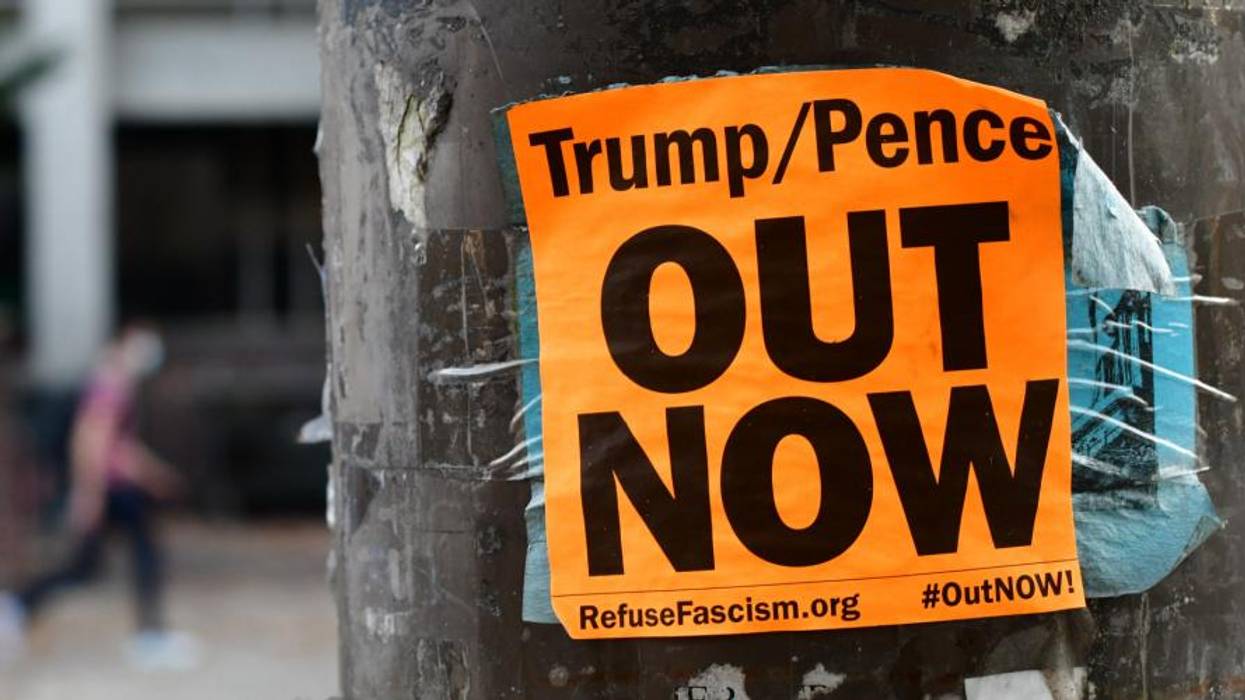
Fears that a possible slow-motion coup is in progress in the United States continued to grow on Wednesday, as observers sounded the alarm over President Donald Trump's decision to install "extreme Republican partisans" at the Pentagon after his firing of Defense Secretary Mark Esper resulted in resignations by numerous top officials at the department earlier this week.
The stacking of the Pentagon with Trump loyalists--combined with the president's ongoing refusal to accept his electoral defeat and Secretary of State Mike Pompeo's Tuesday comment that "there will be a smooth transition to a second Trump administration"--has heightened concerns about the Republican Party's authoritarianism and left experts and lawmakers warning that the country is in the midst of an extremely dangerous moment.
The Guardian reported that defense experts believe "there was little the new Trump appointees could do to use their positions to the president's advantage" given that high-ranking military leaders, including General Mark Milley, chairman of the Joint Chiefs of Staff, have vowed to keep the armed forces out of the political process.
Nevertheless, others view this week's personnel changes, which amount to the appointment of pro-Trump officials to key national security roles during the interregnum, as more evidence that Trump intends to use what one current defense official called "dictator moves" to cling to power despite receiving more than five million fewer votes than President-elect Joe Biden, who--based on current results reported by the Associated Press and other outlets--won the Electoral College by a margin of 290 to 217.
"If this is the beginning of a trend--the president either firing or forcing out national security professionals in order to replace them with people perceived as more loyal to him--then the next 70 days will be precarious at best and downright dangerous at worst."
--Rep. Adam Smith
Appearing on CNN Tuesday night, William Cohen, former Secretary of Defense and Republican senator, told network host Don Lemon the president's conduct is "more akin to a dictatorship than a democracy."
"It is hard to overstate just how dangerous high-level turnover at the Department of Defense is during a period of presidential transition," wrote Rep. Adam Smith (D-Wash.), the chairman of the House Armed Services Committee, on Tuesday.
The development, he said, "should alarm all Americans."
"If this is the beginning of a trend--the president either firing or forcing out national security professionals in order to replace them with people perceived as more loyal to him--then the next 70 days will be precarious at best and downright dangerous at worst," Smith added.
"Defense Secretary Mark Esper... was just the beginning," wrote Spencer Ackerman, senior national security correspondent at The Daily Beast, on Tuesday night. "Also out are Esper's chief of staff Jen Stewart and the Pentagon's top officials for policy and intelligence [James Anderson and Joseph Kernan]."
Ackerman explained that Trump is rushing to fill the recently "purged Pentagon" with "infamous MAGA figures" who are faithful to the president.
Esper was replaced by Chris Miller, previously the director of the National Counterterrorism Center, even though, as Ackerman reported, the "law unambiguously mandates" that David Norquist, the deputy secretary of defense, should have been named acting secretary.
Ackerman reported that Miller's chief of staff is Kash Patel, who--as a senior aide to Rep. Devin Nunes (R-Calif.)--"crafted a dubious memo, denounced by the FBI, to discredit the origins of the investigation into the Trump team's contacts with Russia."
"The new acting undersecretary for policy," Ackerman noted, "is Anthony Tata, who called Barack Obama a 'terrorist leader' in 2018 and claimed Obama is secretly Muslim."
In response to the appointment of Tata, Scott Simpson, public advocacy director at the civil rights organization Muslim Advocates, said in a statement that "every day that he serves as undersecretary of Defense is a day where all Americans are in danger."
Finally, "the top Pentagon official for intelligence is now Ezra Cohen-Watnick, a former National Security Council (NSC) aide to the convicted Mike Flynn."
Sen. Chris Murphy (D-Conn.) described Cohen-Watnick as a "34 year-old who... advocated for the CIA to orchestrate an overthrow [of] the Iranian regime...[and] was promptly fired from his job as soon as Gen. McMasters took over."
"That Ezra Cohen-Watnick is the acting undersecretary of defense for intelligence would be comical if it weren't so terrifying," a former NSC official in the Trump White House told Ackerman.
Murphy sounded the alarm on Tuesday night, tweeting that "the purge happening at the Department of Defense, in the middle of a messy transition, should worry us all."
"This is the making of a coup," warned author Keith Boykin, pointing not only to Trump's reshuffling of the Pentagon but also to the president's refusal to concede following his election loss as well as the dishonesty and complicity of Pompeo and Attorney General Barr.
The President denies he lost the election.
The Secretary of State lies to the world.
The Attorney General launches a sham investigation.
The Defense Secretary is fired.
Top Pentagon officials are replaced with loyalists.
This is the making of a coup.https://t.co/qpr0o2k1wU
-- Keith Boykin (@keithboykin) November 11, 2020
According to The Guardian, former defense officials and "military analysts argued that the post-election changes, while highly unusual, were not a reason to fear that the Pentagon would be weaponized in Trump's desperate efforts to hold on to power."
Regardless of whether or not a military coup is on the table, The Daily Poster's David Sirota argued on Tuesday night that Americans ought to be equally concerned by Trump's attempts to stage a judicial coup, which he said has not received sufficient attention from the Democratic Party.
According to Sirota, the president's strategy is to create enough "public perception of fraud" that Republican-dominated legislatures in key states can "try to invoke their constitutional power to ignore their states' popular votes, reject certified election results, and appoint slates of Trump electors."
"Even if the GOP fails to pull this off in 2020, the shit they're pulling right now is a test run of a plan they will use in the future to try to steal a presidential election and end whatever's left of American democracy," Sirota tweeted on Wednesday morning.
"And the next time," he added, "it may work."

Human rights advocates this week sounded the alarm on a meeting scheduled for Friday between American Defense Secretary Mark Esper and Indonesian Defense Minister Prabowo Subianto, a former U.S.-trained general in an elite army unit implicated in genocidal violence and other atrocities in East Timor, West Papua, Jakarta, and elsewhere in the archipelago nation in the late decades of the last century.
Since 2000, Prabowo has been banned from entering the United States by the Clinton, Bush, and Obama administrations. However, Esper last week invited the 68-year-old to Washington as the Trump administration seeks closer relations with the nation of 268 million people in a bid to counter China's growing clout.
"Allowing [Prabowo] to freely travel to the U.S. to meet with senior government officials further may violate the Leahy laws and will be catastrophic for human rights in Indonesia."
-- Amnesty International
Human rights groups say lifting the ban on Prabowo is a grave mistake.
Amnesty International on Tuesday sent a letter to Secretary of State Mike Pompeo, signed by numerous rights groups in the U.S. and Indonesia, urging the Trump administration to rescind Prabowo's invitation, arguing the decision to lift the 20-year ban "may violate the Leahy Law and will be catastrophic for human rights."
The Leahy Law--introduced in 1997 by Sen. Patrick Leahy (D-Vt.)--prohibits the State and Defense Departments from providing military assistance to armed forces that commit atrocities with impunity.
On Tuesday, Leahy issued a statement noting that "Prabowo has been credibly implicated in gross violations of human rights, including kidnapping, torture, and disappearances, and under our law he is ineligible to enter this country."
"By granting him a visa, the president and secretary of state have shown once again that for them 'law and order' is an empty slogan that ignores the imperative of justice," said Leahy. "The State Department should apply the law and deny him a visa, and the Pentagon should reaffirm its commitment to the rule of law."
Prabowo joined the elite Kopassus commando unit in 1976, just months after President Gerald Ford and Secretary of State Henry Kissinger green-lighted a genocidal Indonesian invasion of newly-independent East Timor that would ultimately claim as many as 200,000 lives--around a quarter of the nation's population.
Allegations against the former general--who was trained at Ft. Benning in Georgia--go back to the 1980s, during the long-running armed insurrection against the Indonesian occupation. He allegedly led the massacre of some 300 civilians, including many women and children, as well as the abduction and torture of 23 pro-democracy activists in 1997 and 1998 as the regime of ruling Gen. Suharto--who rose to power during U.S.-backed genocidal violence in the mid-1960s--collapsed.
Prabowo is also accused of orchestrating the worst atrocity of the period immediately preceding Suharto's fall. Kopassus troops under his command allegedly led the mass rape and murder of at least 160 Chinese-Indonesian women and girls, many of whom were reportedly burned to death after being sexually assaulted, and the murder of hundreds of other Indonesians of Chinese origin.
The Clinton administration cut ties with Kopassus in 1999. However, in 2010 the Obama administration, citing the unit's improved human rights record under a democratic Indonesian government, resumed cooperation. This, despite reports that Kopassus was still committing atrocities, this time against Christians in independence-minded West Papua.
Amnesty International's letter called on Pompeo to "clarify that the visa issued to... Prabowo does not extend any form of immunity to him, and to ensure that if he does travel to the U.S., he is properly and promptly investigated, and if there is sufficient evidence, brought to trial for his alleged responsibility for crimes under international law."
Experts, however, said it was highly unlikely that the U.S.--which has supported nearly every right-wing dictatorship since the end of World War II as well as genocidal regimes in Indonesia, Pakistan, Guatemala, Iraq, and Rwanda--would take legal action against Prabowo, as required under domestic and international law.
"It's likely that [Prabowo] has diplomatic immunity and therefore can't be charged with a crime or can't be arrested while he's in the U.S.," Ilya Somin, a professor at the Antonin Scalia Law School at George Mason University in Virginia, told Voice of America.
"I think this visit's really been choreographed at the highest levels and the minister is going to be greeted with great respect in Washington," added Brian Harding a former Pentagon official now with the U.S. Institute of Peace.
A 2010 proclamation by President Barack Obama also banned human rights violators from entering the United States, although the order has rarely been enforced and--like other U.S. human rights meausres including the Child Soldiers Prevention Act--allows for "national interest" exceptions.

Democratic lawmakers on Tuesday called on Defense Secretary Mark Esper to definitively declare that U.S. troops won't be used to influence the 2020 election after the Pentagon chief was evasive in written answers to questions about the role of the military in a peaceful transition of power.
Politico reports Reps. Elissa Slotkin (D-Mich.) and Mikie Sherrill (D-N.J.) raised alarm Tuesday after Esper would not explicitly rule out deploying troops to polling places on Election Day.
"It is incumbent upon the secretary of defense to fulfill his constitutional duties and ensure the apolitical role of the military."
--Rep. Mikie Sherrill
Esper would only say that "the U.S. military has acted, and will continue to act, in accordance with the Constitution and the law."
The representatives contrasted Esper's stance to that of Gen. Mark Milley, chairman of the Joint Chiefs of Staff, who on Sunday emphatically ruled out such action.
"We have established a very long 240-year tradition of an apolitical military that does not get involved in domestic politics," Milley told NPR. "We, the U.S. military, we are sworn to obey the lawful orders of our civilian leadership, and we want to ensure that there is always civilian leadership, civilian control of the military, and we will obey the lawful orders of civilian control of the military."
"This isn't the first time that someone has suggested that there might be a contested election," Milley continued. "And if there is, it'll be handled appropriately by the courts and by the U.S. Congress."
"There's no role for the U.S. military in determining the outcome of a U.S. election. Zero. There is no role there," Milley emphatically declared.
Slotkin, a former Pentagon official and CIA officer, said that Milley "answered in terms of what he would do as a cabinet-level official, but took a serious nod towards what he knows is the apolitical reputation of the military and demonstrated how important that was to him."
"We heard no such thing from Secretary Esper," she said.
Sherrill said that Esper "did not give us the sense that we could believe that he understood that this was such a critical time." The retired naval officer called Esper's answers "boilerplate." She added:
We have not received a direct commitment from Secretary Esper that he will refuse commands from an illegitimate president. Given the fact that the president has used our military for partisan purposes in the past and that the president has suggested he will not concede if he loses, it is incumbent upon the secretary of defense to fulfill his constitutional duties and ensure the apolitical role of the military.
The lawmakers' concern comes as the nation braces for a potential scenario in which the outcome of the presidential election is contested by President Donald Trump, who has incessantly attacked the legitimacy of the electoral process, especially mail-in voting.
The president has also alarmed many observers by refusing to commit to a peaceful transfer of power if he loses.
"We're going to have to see what happens," Trump told reporters in September when asked if he would step down after losing. "You know that I've been complaining very strongly about the ballots, and the ballots are a disaster."
Slotkin and Sherrill urged Esper to provide a more robust statement against potential politicization of the military, noting his opposition earlier this year to the possibility of the president invoking the Insurrection Act in response to racial justice protests across the nation.
Esper publicly declared that the 1807 law should be invoked "only in the most urgent and dire of situations."
"We are not in one of those situations now," he added.
Army leaders said on Tuesday that they have not received any requests for either active-duty or National Guard troops to be deployed to deal with possible civil unrest during or after the November 3 election, the Associated Press reports.
"We don't police American streets," insisted Gen. James McConville, commander of the Army.

Amid President Donald Trump's transparent efforts to sow doubt and discord around this year's election, his desire to confirm a right-wing Supreme Court justice ahead of November's contest, and his refusal to commit to a peaceful transfer of power regardless of the outcome, the specter of Trump ordering active-duty troops to quash protests during a possibly chaotic interregnum has reportedly provoked anxiety at the Pentagon.
According to Friday reporting by the New York Times, high-ranking military leaders have vowed to keep the armed forces out of the electoral process and its potentially chaotic aftermath, with Defense Department officials saying top generals could resign if the commander in chief tries to deploy them to U.S. streets.
As the Times reports:
Senior leaders at the Pentagon, speaking on the condition of anonymity, acknowledged that they were talking among themselves about what to do if Mr. Trump, who will still be president from Election Day to Inauguration Day, invokes the Insurrection Act and tries to send troops into the streets, as he repeatedly threatened to do during the protests against police brutality and systemic racism.
The Insurrection Act gives the president the power to deploy active-duty military personnel to neutralize civil unrest even if governors are opposed to it. General Mark Milley, chairman of the Joint Chiefs of Staff, and Defense Secretary Mark Esper both objected to taking that route this summer, and Trump yielded, though not before nearly firing Esper.
But the Times noted that Trump, "who refers to the armed forces as 'my military' and 'my generals,' has lumped them with other supporters like Bikers for Trump, who could offer backup in the face of opposition" this fall and winter.
"Which side will our military be on when this happens?" tweeted Charles Idelson of National Nurses United earlier this week after Trump refused to commit to a peaceful transfer of power if he is defeated at the polls. In other countries, a head of state's threat to "get rid of the ballots" to ensure a "continuation" rather than a "transfer" of power would be called a coup d'etat, Idelson remarked.
Many have been wondering for weeks what will happen if Trump, who has declined more than once to abide by the results of the election and has repeatedly and baselessly attacked mail-in ballots in an attempt to undermine the validity of the vote--which is already underway in some states--loses and refuses to voluntarily leave office.
On August 11, retired Army officers John Nagl and Paul Yingling argued in an open letter to Milley that "you may have to choose between defying a lawless president or betraying your constitutional oath... If Donald Trump refuses to leave office at the expiration of his constitutional term, the U.S. military must remove him by force, and you must give that order."
As CNN reported last month, Nagl and Yingling's "advocacy for having the armed forces get involved in settling a disputed election prompted backlash from both the Pentagon and other experts in the field of civilian-military relations."
When answering questions posed by Rep. Elissa Slotkin (D-Mich.) and Rep. Mikie Sherril (D-N.J.), both members of the House Armed Services Committee, Milley in late August was emphatic that the military would play no role in resolving a disputed election.
"I believe deeply in the principle of an apolitical U.S. military," Milley told lawmakers. "In the event of a dispute over some aspect of the elections, by law U.S. courts and the U.S. Congress are required to resolve any disputes, not the U.S. military. I foresee no role for the U.S armed forces in this process."
As the Associated Press reported last month, Milley "anchored many of his responses" in the U.S. Constitution. "Asked if the military would refuse an order from the president if he was attempting to use military action for political gain rather than national security, Milley said, 'I will not follow an unlawful order.'"
Milley was sharply criticized in June by current and former lawmakers and members of the armed forces for participating in Trump's militarized stunt in which protesters in Lafayette Square near the White House were violently dispersed by the National Guard so that Trump could be photographed holding a bible in front of St. John's Church.
Milley publicly apologized for escorting Trump through the park, much to the chagrin of the president.
According to the Times, in private discussions at the Defense Department about "the possibility of Mr. Trump trying to use any civil unrest around the elections to put his thumb on the scales... several Pentagon officials said that such a move could prompt resignations among many of Mr. Trump's senior generals, starting at the top with General Milley" and likely including General Charles Brown, the Air Force chief of staff.
Earlier this year, Rosa Brooks, a Georgetown University law professor and past Defense Department official under former President Barack Obama, was the head of a bipartisan team of more than 100 former national security officials and election experts who simulated the most significant risks to a peaceful transfer of power.
The Transition Integrity Project stressed that there is "a high degree of likelihood that November's elections will be marked by a chaotic legal and political landscape," and it is likely that Trump will "contest the result by both legal and extra-legal means, in an attempt to hold onto power."
But the analysis highlighted that "these risks can be mitigated," and the report (pdf) states:
The worst outcomes of the exercises are far from a certainty. The purpose of this report is not to frighten, but to spur all stakeholders to action. Our legal rules and political norms don't work unless people are prepared to defend them and to speak out when others violate them. It is incumbent upon elected officials, civil society leaders, and the press to challenge authoritarian actions in the courts, in the media, and in the streets through peaceful protest.
In a letter released Thursday, nearly 500 retired military leaders and national security officials from both major political parties said Trump is unfit for office and endorsed Democratic Party nominee Joe Biden.
The Times reported that Milley on Thursday during a virtual question-and-answer session with U.S. service members around the world urged them to "keep the Constitution close to your heart."

The U.S. is suffering from numerous biological and human plagues. Trump is an autocrat whose role models are Putin, Bolsonaro, and Duterte. He is now doing everything in his power to obstruct a free and fair election in November, and there is great danger that he will refuse to leave office through constitutionally prescribed means.
It is likely that the election will generate many court challenges and political contestation involving governors, state legislatures and Congress. We may also see civil violence fomented by Trump's far-right supporters, many of whom are armed and dangerous and have already shown their willingness to brandish their weapons in public.
It is thus also likely that citizens who care about democracy will be called upon to defend it through their own direct action.
Two commentaries published in recent days warrant special attention.
The central point of Frances Fox Piven and Deepak Bhargava's "What if Trump Won't Leave?" is encapsulated in this subtitle: "We must lay the groundwork now for the kind of mass action that defends democracy and evicts this despicable, racist, wannabe authoritarian from the White House." This piece neatly outlines the kinds of challenges such preparations will involve and the reasons why they are necessary.
"' . . . All Enemies Foreign and Domestic': An Open Letter to Gen. Milley," co-authored by John Nagl and Paul Yingling--two highly respected retired U.S. Army Officers closely associated with the "Petraeus Brain Trust" during the Iraq war--is a very important piece that deserves wide circulation. No doubt speaking for many retired and current U.S. military officers, Nagl and Yingling outline the dangers that Trump poses to democracy, and then call on Milley, chairman of the Joint Chiefs of Staff, to defend the Constitution in the event that Trump refuses to leave office as required by law, and instead seeks to encourage his supporters to defend him, even by force of arms:
"As the senior military officer of the United States, the choice between these two options lies with you. In the Constitutional crisis described above, your duty is to give unambiguous orders directing U.S. military forces to support the Constitutional transfer of power. Should you remain silent, you will be complicit in a coup d'etat. You were rightly criticized for your prior active complicity in the president's use of force against peaceful protesters in Lafayette Square. Your passive complicity in an extralegal seizure of political power would be far worse. "
It is striking and indeed horrifying that such an open letter would need to be published, now, just as it is striking that retired General James Mattis and retired Admiral Mike Mullen only recently published similar warnings. We are at a moment of great peril, and whether the coercive power of the state will be deployed in constitutionally democratic ways is genuinely in question.
Nagl and Yingling's letter is the perfect complement to Piven and Bhargava's powerful call, from the left, for preparations for mass street protest.
Piven and Bhargava present their strategy as a rebuke to establishment forces: "The professional communicators, technocrats, and lawyers in much of the mainstream Democratic Party and some in the media will be horrified by this call for a mass nonviolent uprising in response to the theft of an election." I think the extraordinary BLM protests of this summer have "normalized" protest for many. I also think they exaggerate the radicalism of their proposal, which is essentially a strategy of demonstrating through nonviolent protest that Trump must be "evicted." Their very nuanced piece does not call for the seizing of the White House. It envisions the use of protest and direct citizen action as a way of enforcing the law. This means convincing the state and its police and military forces to uphold the law and not to use violence against citizens in defense of a dictator.
No serious person imagines that we are on the cusp of a genuinely "revolutionary situation," which would be an utter disaster along every imaginable dimension--including the fact that the "masses" who are armed and organized are right-wing militias not likely to support radical democracy. The point of taking to the streets, if this becomes necessary, is to work in tandem--a complex and agonistic collaboration to be sure--with professional politicians, communicators, lawyers, bureaucrats, and police and military officers to defend the rule of law.
And "in the last instance," this means that the people at the top of the military command do exactly as Nagl and Yingling entreat them to do: say "no" to Trump, evict him and his miserable ilk from the White House, and tell his angry mobs of supporters to obey the law and go home.
We thus need to prepare to defend the November election by all legal means necessary.
But first, we must do everything in our power to win it.
Trump must go. And then the real work of democratic politics can continue.

Eleven Democratic senators said Monday that the Pentagon's refusal to provide details about its Covid-19 mitigation strategy at Guantanamo Bay, where 40 detainees are currently being held, only bolsters the case for shutting down the U.S. military prison in Cuba.
Lawmakers including Sens. Elizabeth Warren (D-Mass.), Bernie Sanders (I-Vt.), Ed Markey (D-Mass.), and Ron Wyden (D-Ore.) denounced the Department of Defense's response to their earlier letter, in which they demanded to know specifics regarding the government's plan to keep Covid-19 from spreading in the facility, where a number of medically vulnerable detainees are being held indefinitely.
"The Pentagon's response leaves doubts about the Guantanamo prison's capacity to protect military personnel and detainees from Covid-19 and is a reminder that the United States should work to responsibly close this facility."
--Democratic senators
In addition to the prison being "inconsistent with our values" and doing nothing to keep Americans safer, the senators said Monday, the Pentagon's lack of transparency regarding containment and mitigation methods makes it clear that Guantanamo Bay must no longer be used to detain people captured over the last two decades as part of the so-called "War on Terror," the majority of whom have not been charged with a crime.
In late May, the senators expressed concern to Defense Secretary Mark Esper about the facility's ability to provide medical care to detainees who contract Covid-19, given "the serious and deteriorating health conditions of detainees, the deficient infrastructure to care for complex medical needs at the prison facility, and the strict prohibition on detainee transfers to the United States."
The senators' letter came two months after the first case of Covid-19 was reported at the Naval station, when a sailor who was reportedly not involved with prison operations tested positive in late March. Another case was reported in April before the Pentagon ordered the base to stop reporting cases to maintain "operational security."
The Navy announced in March that it was implementing deep-cleaning measures, social distancing guidelines, and limits on group gatherings to prevent the spread of Covid-19. Since then, Matthew Donovan, an undersecretary of defense in charge of personnel and readiness, has also informed Congress that officials at Guantanamo Bay are requiring temperature checks for anyone who enters buildings there and that the prison clinic has six ventilators.
Still, the senators wrote in their letter to Esper, "it remains unclear whether the Department's coronavirus infection control efforts will be enough to protect the health of the 40 detainees at the Guantanamo prison facility, six some of whom are 'aging detainees [who] could require specialized treatment for issues such as heart attack, stroke, kidney failure, or even cancer.'"
The lawmakers requested specific information regarding procedures in place to address confirmed or possible Covid-19 cases, whether independent medical experts are available, and the status of the Pentagon's appointment of a chief medical officer at Guantanamo, as required by the National Defense Authorization Act.
Donovan replied to the senators' letter last month, offering just four paragraphs assuring them--without any details--that Joint Task Force Guantanamo "has been following a detailed Covid-19 contingency and mitigation plan," that some detainees have "medical expert consultants for the purposes of litigation, and that the Pentagon is working to fill the position of chief medical officer at the base.
"The Pentagon's response leaves doubts about the Guantanamo prison's capacity to protect military personnel and detainees from Covid-19 and is a reminder that the United States should work to responsibly close this facility," said the senators Monday.
The oldest detainee at Guantanamo Bay will turn 73 this month, and a number of people held there "retain the mental and physical wounds of torture and may be at greater risk of serious medical complications from Covid-19," the senators said in their statement.
The senators' statement came days after the International Committee of the Red Cross canceled its planned quarterly visit to Guantanamo Bay, citing concerns over the coronavirus pandemic. With the visit canceled, detainees at the facility will go the longest they have since 2002 without confidential discussions with an independent medical officer and the ability to relay messages to family.

Shortly after both chambers of Congress approved a $740 billion Defense Department budget for fiscal year 2021, Pentagon officials are reportedly pushing for more than $2 billion in cuts to military healthcare over the next five years, potentially threatening the coverage of millions of personnel and their families amid a global pandemic.
Politico reported Sunday that the proposed $2.2 billion cut to the military healthcare system is part of a "sweeping effort" by Defense Secretary Mark Esper to "eliminate inefficiencies within the Pentagon's coffers."
"Ever notice that it's never a cut to things used to send kids to war?" asked Josh Moon of the Alabama Political Reporter. "It's always--always--a cut to the promises we make to get them to volunteer for us. What a disgrace."
"Ever notice that it's never a cut to things used to send kids to war? It's always--always--a cut to the promises we make to get them to volunteer for us. What a disgrace."
--Josh Moon, Alabama Political Reporter
According to Politico, "Esper and his deputies have argued that America's private health system can pick up the slack" for any servicemembers who lose coverage.
"Roughly 9.5 million active-duty personnel, military retirees, and their dependents rely on the military health system, which is the military's sprawling government-run healthcare framework that operates hundreds of facilities around the world," Politico noted. "The military health system also provides care through TRICARE, which enables military personnel and their families to obtain civilian healthcare outside of military networks."
Rep. Mark Pocan (D-Wis.), co-chair of the Congressional Progressive Caucus, said the push for billions in healthcare cuts shows once again that the Pentagon "puts more effort in protecting defense contractor profits than the lives of our troops."
Alongside Rep. Barbara Lee (D-Calif.), Pocan co-sponsored an amendment to the National Defense Authorization Act that would have cut the proposed $740 billion budget by 10% without touching the military healthcare program. The amendment failed last month by a vote of 93-324, with 139 Democrats joining 185 Republicans in voting no.
A companion amendment in the Senate led by Sens. Bernie Sanders (I-Vt.) and Ed Markey (D-Mass.) also failed to pass.
Unnamed Defense Department officials told Politico that, if approved, the cuts "could effectively gut the Pentagon's healthcare system," adding to the rapidly swelling ranks of the uninsured. A study released last month by advocacy group Families USA found that at least 5.4 million Americans have lost their health insurance during the coronavirus pandemic.
Politico reported that the proposed $2.2 billion in cuts includes "eliminating all basic research dollars for combat casualty care, infectious disease and military medicine for [Uniformed Services University of the Health Sciences], as well as slicing operational funds."
"What's been proposed would be devastating," warned one anonymous senior official.