SUBSCRIBE TO OUR FREE NEWSLETTER
Daily news & progressive opinion—funded by the people, not the corporations—delivered straight to your inbox.
5
#000000
#FFFFFF
To donate by check, phone, or other method, see our More Ways to Give page.
Daily news & progressive opinion—funded by the people, not the corporations—delivered straight to your inbox.
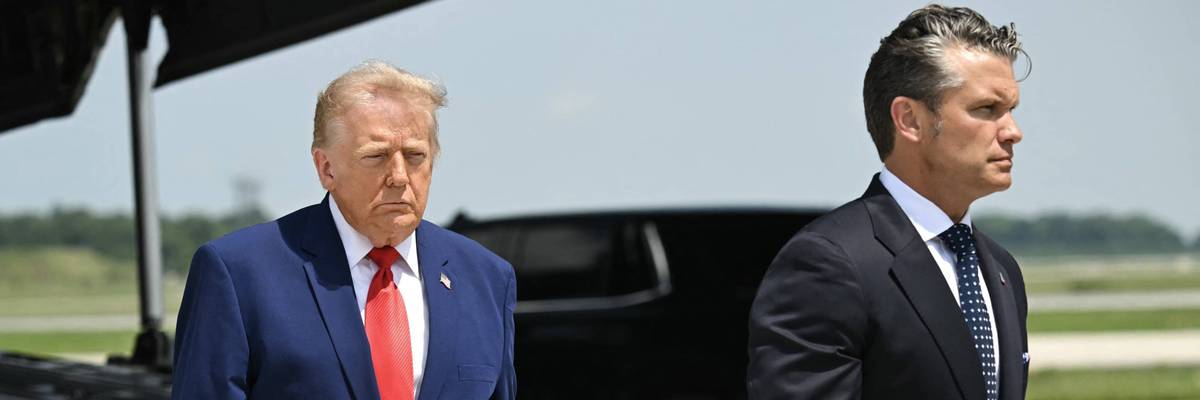
US President Donald Trump and Secretary of Defense Pete Hegseth attend a dignified transfer solemn event at Dover Air Force Base in Dover, Delaware, on July 22, 2026.
"This is a devastating defeat for the United States," said University of Chicago political scientist John Mearsheimer.
University of Chicago political scientist John Mearsheimer on Sunday delivered a harsh reality check to US President Donald Trump over the state of his illegal war with Iran.
In an interview with Australian journalist Tom Switzer, Mearsheimer was asked why Trump seemed willing to accept an arrangement in which Iran is able to demand fees from transport ships in exchange for reopening the Strait of Hormuz, which has been almost entirely shut down since the US and Israel began bombing Iran in late February.
"It's very simple... he has no choice," Mearsheimer replied. "He lost the war. This is a devastating defeat for the United States. Can you tell me what the United States should do to regain leverage over Iran? I actually think you can't tell me because we have no solution."
Host: But John, again, why would Trump accept an arrangement in the Strait of Hormuz where Iran receives fees & denies passage to anyone transiting without its permission?
John Mearsheimer: It’s very simple. He has no choice. He lost the war. This is a devastating defeat for the… pic.twitter.com/RQ9G5fKiDA
— Drop Site (@DropSiteNews) August 10, 2026
Mearsheimer then explained why Trump's threats to escalate his assault on Iran ring completely hollow.
"One, he's out of munitions," the political scientist said. "Number two, our Gulf allies have told him, in no uncertain terms, that is unacceptable because the Iranians have made it clear that if we escalate, they will escalate, and they will destroy oil facilities, desalination plants, and so forth."
In the same discussion, Vali Nasr, professor of international affairs at the Johns Hopkins School of Advanced International Studies, similarly argued that Iran appears to be in the driver's seat, noting that "the period where you can basically pressure Iran into submission... I think is gone."
Nasr added that Iran now appears to be "very comfortable demanding" concessions from the US in exchange for reopening the strait, and he said that many in the Washington foreign policy establishment had yet to understand this fact.
"In reality, Iran is not overplaying its hand," he said. "It's just playing its hand."
Johns Hopkins scholar Vali Nasr tells host Tom Switzer that Washington’s fixation on Tehran “overplaying its hand” reflects disbelief at how dramatically the balance of power has shifted.
“Iran is not overplaying. It’s just playing its hand,” he said.
Iran sees a narrow window… pic.twitter.com/7sL9ryc5Jw
— Drop Site (@DropSiteNews) August 10, 2026
The scholars' arguments were echoed by Daniel DePetris, fellow at Defense Priorities, who wrote in an analysis published Monday that the US has little choice but to accept Iran charging fees to ships in exchange for passage through the strait.
While acknowledging such a situation is far from ideal, DePetris said that it became inevitable when Trump launched his unprovoked war without authorization from the US Congress more than five months ago.
"Trump’s war handed Iran the perfect excuse to leverage its geography, and the Iranians didn’t hesitate to do so," wrote DePetris. "Over time, the Strait of Hormuz, in addition to Iran’s more aggressive posture toward its neighbors writ-large, has become something far more valuable: a strategic card Iran can play whenever Trump threatens to accelerate military operations."
Dear Common Dreams reader, It’s been nearly 30 years since I co-founded Common Dreams with my late wife, Lina Newhouser. We had the radical notion that journalism should serve the public good, not corporate profits. It was clear to us from the outset what it would take to build such a project. No paid advertisements. No corporate sponsors. No millionaire publisher telling us what to think or do. Many people said we wouldn't last a year, but we proved those doubters wrong. Together with a tremendous team of journalists and dedicated staff, we built an independent media outlet free from the constraints of profits and corporate control. Our mission has always been simple: To inform. To inspire. To ignite change for the common good. Building Common Dreams was not easy. Our survival was never guaranteed. When you take on the most powerful forces—Wall Street greed, fossil fuel industry destruction, Big Tech lobbyists, and uber-rich oligarchs who have spent billions upon billions rigging the economy and democracy in their favor—the only bulwark you have is supporters who believe in your work. But here’s the urgent message from me today. It's never been this bad out there. And it's never been this hard to keep us going. At the very moment Common Dreams is most needed, the threats we face are intensifying. We need your support now more than ever. We don't accept corporate advertising and never will. We don't have a paywall because we don't think people should be blocked from critical news based on their ability to pay. Everything we do is funded by the donations of readers like you. When everyone does the little they can afford, we are strong. But if that support retreats or dries up, so do we. Will you donate now to make sure Common Dreams not only survives but thrives? —Craig Brown, Co-founder |
University of Chicago political scientist John Mearsheimer on Sunday delivered a harsh reality check to US President Donald Trump over the state of his illegal war with Iran.
In an interview with Australian journalist Tom Switzer, Mearsheimer was asked why Trump seemed willing to accept an arrangement in which Iran is able to demand fees from transport ships in exchange for reopening the Strait of Hormuz, which has been almost entirely shut down since the US and Israel began bombing Iran in late February.
"It's very simple... he has no choice," Mearsheimer replied. "He lost the war. This is a devastating defeat for the United States. Can you tell me what the United States should do to regain leverage over Iran? I actually think you can't tell me because we have no solution."
Host: But John, again, why would Trump accept an arrangement in the Strait of Hormuz where Iran receives fees & denies passage to anyone transiting without its permission?
John Mearsheimer: It’s very simple. He has no choice. He lost the war. This is a devastating defeat for the… pic.twitter.com/RQ9G5fKiDA
— Drop Site (@DropSiteNews) August 10, 2026
Mearsheimer then explained why Trump's threats to escalate his assault on Iran ring completely hollow.
"One, he's out of munitions," the political scientist said. "Number two, our Gulf allies have told him, in no uncertain terms, that is unacceptable because the Iranians have made it clear that if we escalate, they will escalate, and they will destroy oil facilities, desalination plants, and so forth."
In the same discussion, Vali Nasr, professor of international affairs at the Johns Hopkins School of Advanced International Studies, similarly argued that Iran appears to be in the driver's seat, noting that "the period where you can basically pressure Iran into submission... I think is gone."
Nasr added that Iran now appears to be "very comfortable demanding" concessions from the US in exchange for reopening the strait, and he said that many in the Washington foreign policy establishment had yet to understand this fact.
"In reality, Iran is not overplaying its hand," he said. "It's just playing its hand."
Johns Hopkins scholar Vali Nasr tells host Tom Switzer that Washington’s fixation on Tehran “overplaying its hand” reflects disbelief at how dramatically the balance of power has shifted.
“Iran is not overplaying. It’s just playing its hand,” he said.
Iran sees a narrow window… pic.twitter.com/7sL9ryc5Jw
— Drop Site (@DropSiteNews) August 10, 2026
The scholars' arguments were echoed by Daniel DePetris, fellow at Defense Priorities, who wrote in an analysis published Monday that the US has little choice but to accept Iran charging fees to ships in exchange for passage through the strait.
While acknowledging such a situation is far from ideal, DePetris said that it became inevitable when Trump launched his unprovoked war without authorization from the US Congress more than five months ago.
"Trump’s war handed Iran the perfect excuse to leverage its geography, and the Iranians didn’t hesitate to do so," wrote DePetris. "Over time, the Strait of Hormuz, in addition to Iran’s more aggressive posture toward its neighbors writ-large, has become something far more valuable: a strategic card Iran can play whenever Trump threatens to accelerate military operations."
University of Chicago political scientist John Mearsheimer on Sunday delivered a harsh reality check to US President Donald Trump over the state of his illegal war with Iran.
In an interview with Australian journalist Tom Switzer, Mearsheimer was asked why Trump seemed willing to accept an arrangement in which Iran is able to demand fees from transport ships in exchange for reopening the Strait of Hormuz, which has been almost entirely shut down since the US and Israel began bombing Iran in late February.
"It's very simple... he has no choice," Mearsheimer replied. "He lost the war. This is a devastating defeat for the United States. Can you tell me what the United States should do to regain leverage over Iran? I actually think you can't tell me because we have no solution."
Host: But John, again, why would Trump accept an arrangement in the Strait of Hormuz where Iran receives fees & denies passage to anyone transiting without its permission?
John Mearsheimer: It’s very simple. He has no choice. He lost the war. This is a devastating defeat for the… pic.twitter.com/RQ9G5fKiDA
— Drop Site (@DropSiteNews) August 10, 2026
Mearsheimer then explained why Trump's threats to escalate his assault on Iran ring completely hollow.
"One, he's out of munitions," the political scientist said. "Number two, our Gulf allies have told him, in no uncertain terms, that is unacceptable because the Iranians have made it clear that if we escalate, they will escalate, and they will destroy oil facilities, desalination plants, and so forth."
In the same discussion, Vali Nasr, professor of international affairs at the Johns Hopkins School of Advanced International Studies, similarly argued that Iran appears to be in the driver's seat, noting that "the period where you can basically pressure Iran into submission... I think is gone."
Nasr added that Iran now appears to be "very comfortable demanding" concessions from the US in exchange for reopening the strait, and he said that many in the Washington foreign policy establishment had yet to understand this fact.
"In reality, Iran is not overplaying its hand," he said. "It's just playing its hand."
Johns Hopkins scholar Vali Nasr tells host Tom Switzer that Washington’s fixation on Tehran “overplaying its hand” reflects disbelief at how dramatically the balance of power has shifted.
“Iran is not overplaying. It’s just playing its hand,” he said.
Iran sees a narrow window… pic.twitter.com/7sL9ryc5Jw
— Drop Site (@DropSiteNews) August 10, 2026
The scholars' arguments were echoed by Daniel DePetris, fellow at Defense Priorities, who wrote in an analysis published Monday that the US has little choice but to accept Iran charging fees to ships in exchange for passage through the strait.
While acknowledging such a situation is far from ideal, DePetris said that it became inevitable when Trump launched his unprovoked war without authorization from the US Congress more than five months ago.
"Trump’s war handed Iran the perfect excuse to leverage its geography, and the Iranians didn’t hesitate to do so," wrote DePetris. "Over time, the Strait of Hormuz, in addition to Iran’s more aggressive posture toward its neighbors writ-large, has become something far more valuable: a strategic card Iran can play whenever Trump threatens to accelerate military operations."