

SUBSCRIBE TO OUR FREE NEWSLETTER
Daily news & progressive opinion—funded by the people, not the corporations—delivered straight to your inbox.
5
#000000
#FFFFFF
To donate by check, phone, or other method, see our More Ways to Give page.
Daily news & progressive opinion—funded by the people, not the corporations—delivered straight to your inbox.
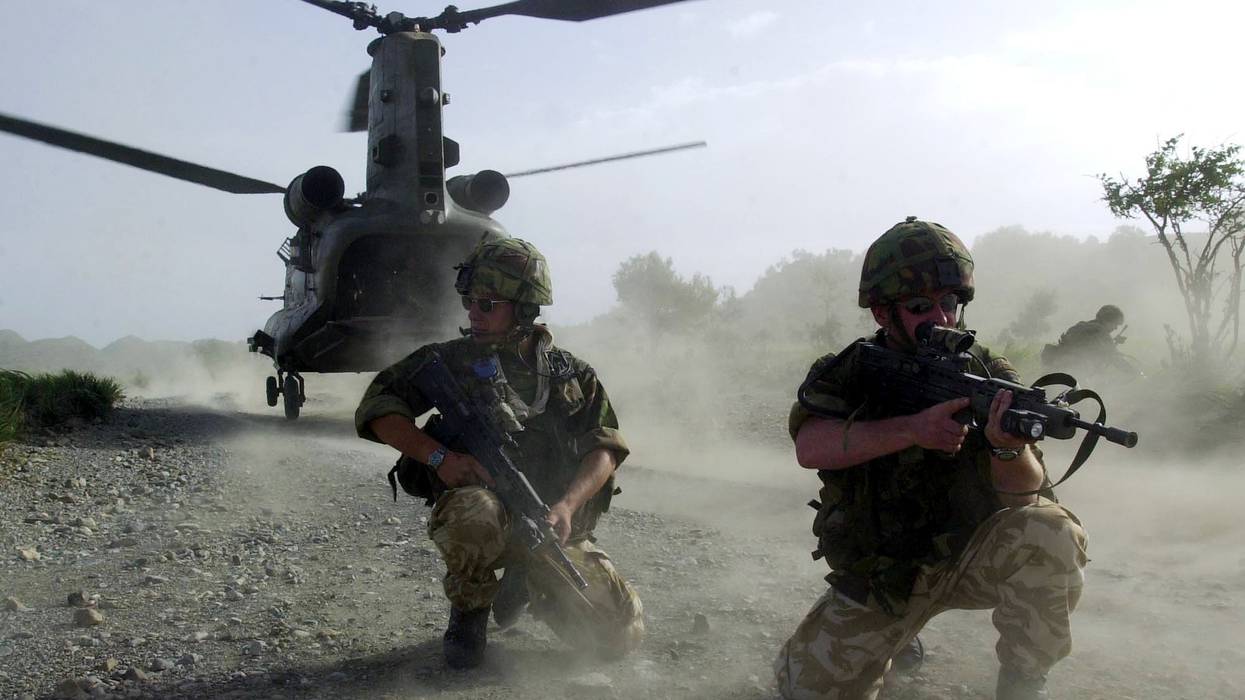
"They handcuffed a young boy and shot him," said one Special Air Service veteran.
Dozens of former United Kingdom Special Forces troops or those who served with them have broken their silence to describe alleged war crimes they witnessed—including the execution of children—during the U.S.-led wars on Afghanistan and Iraq.
BBC's "Panorama"—which has repeatedly aired episodes focused on war crimes committed by British soldiers during the so-called War on Terror—on Monday featured testimonies from 30 former U.K. Special Forces (UKSF) members, including Special Air Service (SAS), Special Boat Service (SBS), and supporting troops who served in Afghanistan and Iraq.
"They handcuffed a young boy and shot him," recalled one SAS veteran who fought in Afghanistan. "He was clearly a child, not even close to fighting age."
"It's not justified, killing people in their sleep."
Another veteran who served with the SAS said that killing was "intoxicating" for some soldiers and became "an addictive thing to do," adding that there were "lots of psychotic murderers" among the ranks.
"On some operations, the troop would go into guesthouse-type buildings and kill everyone there," he said. "They'd go in and shoot everyone sleeping there, on entry. It's not justified, killing people in their sleep."
One SBS veteran described executions of wounded people who posed no threat, including one man who was being treated by a medic when "one of our blokes came up to him."
"There was a bang. He'd been shot in the head at point-blank range," the veteran recalled, describing the killing and other like it as "completely unnecessary."
"These are not mercy killings," he said. "It's murder."
Another veteran recounted a fellow SAS commando who kept track of the dozens of Afghans he'd killed during his six-month deployment.
"It seemed like he was trying to get a kill on every operation, every night someone got killed," the former soldier said, adding that his colleague was "notorious in the squadron; he genuinely seemed like a psychopath."
The soldier allegedly slit the throat of an injured Afghan man after telling an officer not to shoot him again, "because he wanted to go and finish the wounded guy off with his knife."
Another veteran said "everyone knew" what was happening and that to avoid scrutiny for executions, British troops would plant "drop weapons" on victims' bodies to make it appear as if they were militants. U.S. troops—who widely engaged in this war crime—called it "dead-checking."
One veteran said that "there was implicit approval for what was happening" from commanders.
"We understood how to write up serious incident reviews so they wouldn't trigger a referral to the military police," he explained. "If it looked like a shooting could represent a breach of the rules of conflict, you'd get a phone call from the legal adviser or one of the staff officers in HQ. They'd pick you up on it and help you to clarify the language. 'Do you remember someone making a sudden move?' 'Oh yeah, I do now.' That sort of thing. It was built into the way we operated."
"Panorama" also confirmed for the first time that former Conservative U.K. Prime Minister David Cameron, who was in office from 2010-16, was repeatedly warned that British troops were committing war crimes.
Gen. Douglas Lute, a former U.S. ambassador to NATO, told "Panorama" that then-Afghan President Hamid Karzai—who repeatedly condemned American war crimes in his country—was "so consistent with his complaints about night raids, civilian casualties, and detentions that there was no senior Western diplomat or military leader who would have missed the fact that this was a major irritant for him."
In 2020, the International Criminal Courtdetermined that British troops committed war crimes in Iraq but declined to prosecute any alleged perpetrators.
Documented war crimes committed by U.S. troops, mercenaries, and other private contractors in nations including Afghanistan, Iraq, Pakistan, Yemen, Somalia, Libya, and Syria during the ongoing War on Terror include but are not limited to murder of civilians and detainees, extraordinary rendition, torture, rape, and jailing and sexual abuse of women and girls held as bargaining chips.
Whistleblowers who exposed these and other illegalities—including WikiLeaks founder Julian Assange, former NSA operative Edward Snowden, former Army analyst Chelsea Manning, former CIA intelligence officer John Kiriakou, and others—were almost always the only ones ever punished in connection with the crimes they exposed.
Other coalition troops—including Afghans, Iraqis, Australians, Germans, Poles, and Canadians—have allegedly committed atrocities during the War on Terror, as have Taliban, al-Qaeda, Islamic State, and other militants.
According to the Costs of War Project at Brown University's Watson Institute for International and Public Affairs, "at least 940,000 people have died due to direct war violence, including civilians, armed forces on all sides, contractors, journalists, and humanitarian workers" in U.S.-led wars since 9/11. This figure includes at least 408,000 civilians.

It's difficult to explain the nature of the Afghanistan peace talks. There is no single table with the combatants arrayed on either side. Talks are not even taking place in the same city, since there are at least two sets of discussions ongoing. One location for the peace talks is Doha, Qatar, where the Taliban is meeting with the U.S. government. The other location is Moscow, Russia, where the Taliban has been holding meetings with Afghan opposition leaders--including the former president Hamid Karzai. Absent from both meetings is the incumbent President Ashraf Ghani and his government. The Taliban sees them as illegitimate and irrelevant. Everyone--except President Ghani--says that the talks have made "progress." But seasoned diplomats say that this "progress" is far too slow for a war that has now lasted 18 years.
Qatar
Between February and March of this year, U.S. envoy Zalmay Khalilzad and Taliban co-founder Mullah Abdul Ghani Baradar met during the fifth round of peace talks. The Taliban says that there can be no peace unless all foreign forces withdraw from the country. On a practical level, the withdrawal of the 15,000 foreign--mostly U.S.--troops will deliver the country to the hands of the Taliban.
Last week, Taliban forces struck the Afghan government's troops across the country. Each spring, since 2002, the Taliban and its allies have left their mountain hideouts to conduct guerrilla and conventional attacks on U.S., NATO and Afghan government forces. The epicenter of these attacks has been in Afghanistan's southeast--Ghazni and Helmand provinces in particular--as well as in the western province of Ghor. Fierce fighting in these areas came alongside suicide attacks in Kabul.
Two changes in U.S. policy suggest that the U.S. government knows that the game is up in Afghanistan. In October 2017, the United States stopped counting casualties for Afghan security forces. This year, the U.S. government has stopped measuring how much territory and how much of the Afghan population is under government control. The last U.S. study showed that the Afghan government controlled territory in which about 63.5 percent of the population lived, while the rest was in Taliban hands or remained contested. All signs show that the balance is shifting, with the Taliban taking control of more territory. This is why the U.S. government has stopped its tally.
It is likely that whether the U.S. troops remain or go, the Taliban will soon have control of key districts--including access roads out of landlocked Afghanistan. If a deal is reached in Qatar to have the U.S. forces withdraw, the Taliban will eventually take Kabul.
Moscow
Having made his call for the withdrawal of foreign forces in Qatar, Baradar went to Moscow for the Russia-backed peace talks. Here the Taliban co-founder found a willing ear in Russian Foreign Minister Sergei Lavrov. Both affirmed the need for the departure of U.S. troops from the country as a precondition for further talks.
Karzai, who has emerged as the leader of a section of Afghanistan's opposition, agreed with this position. Karzai's former interior minister--Mohammad Hanif Atmar--has now said he would run against Ashraf Ghani in September's presidential election. Although Atmar fell out with Karzai about eight years ago, the two men are now said to be close. Atmar favors a full deal with the Taliban, whom he sees as a necessary ally in the Afghan government's fight against ISIS. Ghani, whose term ended on May 22, will face Atmar, who many believe was responsible for Ghani's victory in 2014.
Russia is eager to see an end to the 18-year war in Afghanistan. Threats of insurgency from Afghanistan have long troubled the Central Asian states, which continue to have close ties to Moscow. Chinese ambitions of the Belt and Road Initiative have suffered from the trouble in Afghanistan, which would be key territory not only for rail and road lines but also for the mining of minerals. Pressure from China on Pakistan--a key Chinese ally--will certainly mount. The Taliban is close to Pakistan, which would like to see the Taliban share power in Kabul in order to protect its interests and to sideline India. In June 2017, China and Russia brought both India and Pakistan into the Shanghai Cooperation Organization, and one of the group's main mandates is to settle the instability in Afghanistan. Both China and Russia are pushing for a peace deal--even if this means that the Taliban will emerge as a political force in Kabul.
War
The war on Afghanistan has been ugly. Untold numbers of Afghans have died in this conflict, whose aims are not easy to formulate. United Nations figures show that in 2018 the civilian death count was 3,804--with 900 of them being children. This is the deadliest year for civilians since the United States first began to bomb Afghanistan in 2001.
Death is one consequence of war. Starvation is another. The UN Office for the Coordination of Humanitarian Affairs (OCHA) in Afghanistan said that half of the population would need food assistance over the course of this year. These 3.3 million people will starve as a result of crop failures and dry irrigation channels. Drought in western Afghanistan sent an additional 275,000 people in search of food, walking across the country, bewildered. Hunger will intensify malnutrition and illness. There is little sign of any help for these people.
All signs point to the desire in the Trump administration to withdraw U.S. troops. The International Criminal Court had tried to open a war crimes investigation on the basis of a preliminary finding that U.S. troops had violated international law in Afghanistan. The Trump administration blocked the investigation. On June 7, however, the ICC's chief prosecutor Fatou Bensouda filed a request to continue her work. It appears that Bensouda is unwilling to allow the case to be politically closed down. On the table in Qatar is a side deal from the United States to accept some of the Taliban's demands if the Afghan government that will emerge asks the ICC to withdraw the case.
Many European states have begun to deport Afghan asylum seekers on the grounds that they are not "refugees" but are merely "economic migrants." A Norwegian Refugee Council report from 2018 shows, however, that those deported are forced to flee again. None of this matters to the European states. The rejuvenation of European racism and xenophobia drives the policy. Pressure from Europe to end this war is growing daily. It is likely that this pressure will mount at NATO headquarters, which will have an impact on the timetable for a U.S. withdrawal.
The peace talks in Qatar and Russia will not immediately result in any direct outcome. Afghanistan is damaged beyond belief, its own future less important to the external parties than their own petty gains.
This article was produced by Globetrotter, a project of the Independent Media Institute.

On April 12, 2019, the International Criminal Court said that it would not pursue a war crimes investigation against the U.S. military for its actions in Afghanistan. A very thick file was closed in The Hague.
Almost a decade ago, on February 12, 2010, U.S. Special Operations Forces arrived at the home of Haji Sharabuddin in Khataba (Paktia Province, Afghanistan). The family of Sharabuddin was celebrating the birth of a grandson. Inside the home were close family members (including a police investigator and a government prosecutor) as well as the vice-chancellor of Gardez University, Sayed Mohammed Mal. At 3 a.m., the U.S. forces attacked the home, killing five members of the family including Sharabuddin's son--Mohammed Dawood--who was the police investigator. After the killing, the soldiers carried the bodies into the house and removed the bullets with a knife. They did not want to leave evidence of their actions. They then ransacked the home--including stealing money--and left. The U.S. military said that those whom they killed were insurgents. Both the Afghan Independent Human Rights Commission and the Criminal Investigations Department of the Afghan Ministry of the Interior found this allegation to be false. A war crime had been committed here.
But, thanks to the withdrawal of the International Criminal Court, this crime--and hundreds of others--will neither be properly documented nor will there be justice for the victims and survivors. Thousands of family members, who know very well what happened in little villages like Khataba and Nangalam, will have no recourse either to an admission of guilt or punishment for the killers. The killing in Nangalam was by a U.S. helicopter on March 1, 2011. The pilots fired on nine boys, killing them all. "My son Wahidullah's head was missing," said Haji Bismillah. "I only recognized him from his clothes." The U.S. apologized for the killing but did nothing other than that.
One village and one town after another has families with stories of such violent and senseless deaths. This U.S. war on Afghanistan, which has been ongoing since 2001, has produced an unknown death count with unknown numbers of war crimes (by the U.S. troops, by the Afghan armed forces and by the Taliban). Afghanistan remains an open sore of crime and impunity.
The ICC
It was for good reason that the Afghan government of Hamid Karzai became a member of the International Criminal Court in 2003. There was pressure on Karzai from the U.S. government not to join the ICC, but he prevailed. It was hardly a victory. The ICC came out of the Rome Statute, which was drafted in 1998 and which came into force in 2002. The United States signed the original treaty, but then refused to ratify it. Worse, the U.S. Congress passed the American Service-Members' Protection Act of 2002 to discourage any cooperation with the ICC if the behavior of U.S. soldiers came under scrutiny. U.S. Senator Jesse Helms referred to the ICC as the International Kangaroo Court. Even if Afghanistan became a member of the ICC, no one in the U.S. establishment thought that this would have any consequences.
But prosecutors in the court had other ideas. In 2006, the ICC investigators opened a "preliminary investigation" into war crimes in Afghanistan. They were interested in war crimes committed by the U.S. forces, by Afghan forces and by the Taliban. An investigator, a few years later, told me that they had found "captivating evidence" of war crimes--mostly related to the torture centers run by the Central Intelligence Agency and by U.S. military intelligence. They sought more material evidence not only by interviewing former prisoners but also through access--which they did not get--to U.S. official documents.
In 2007, the Afghan parliament--a parliament of warlords--passed a law that gave immunity to all for war crimes committed in the country. This was a blanket--and shameful--immunity that was only in May 2017 amended to allow the country to be in compliance with the Rome Statute.
In 2010, WikiLeaks provided some of this evidence in the Afghan war logs, in whose 90,000 pages there was some--but not sufficient--documentation of various operations run by the U.S. forces. This did not shape the ICC investigation, which proceeded with deliberate intent with interviews and with scrutiny of whatever documentation was available.
On November 20, 2017, with almost a decade of careful investigation behind it, the ICC released a report with a bland title: "Situation in Afghanistan: Summary of the Prosecutor's Request for authorization of an investigation pursuant to article 15." The significant sentence of the brief report is the following: "Finally, the information available provides a reasonable basis to believe that members of the United States of America... armed forces and members of the Central Intelligence Agency... committed acts of torture, cruel treatment, outrages upon personal dignity, rape and sexual violence against conflict-related detainees in Afghanistan and other locations, principally in the 2003-2004 period." This did not mean that the crimes of 2010 and 2011 would not be investigated--only that the focus was on this early period and would later expand to include the entire span of the ongoing war.
The ICC's special prosecutor--Fatou Bensouda--asked the court to allow a full investigation of war crimes in Afghanistan. She received a green light.
Trump's Men
A year later, on September 10, 2018, U.S. National Security Adviser John Bolton said that if the ICC continues with its work on the U.S. war crimes docket, the U.S. government would place sanctions on the ICC and even criminally prosecute ICC officials in U.S. courts. This was not just for the ICC investigation of U.S. war crimes in Afghanistan, but also if the ICC persisted in its work on Israeli war crimes against the Palestinians.
Investigators at the ICC said, at that time, that gloom descended on their department. The sense was that the investigation would not be allowed to proceed. But, for the time being, there was no immediate attempt within the ICC to shut down the investigation. The process continued, with Bensouda's team building up the case against the United States--and others--for war crimes in Afghanistan.
It is important to bear in mind that the evidence was in the plain light of day. In 2005, the New York Times published a 2,000-page U.S. army investigation on the killing of Habibullah and Dilawar at Bagram in December 2002. None of the soldiers charged with the murder of these two men were convicted. All charges were dropped. But the evidence against them was clear in the army report (please see Alex Gibney's Oscar-winning documentary, Taxi to the Dark Side, 2007).
The ICC's special prosecutor, Fatou Bensouda, who was in charge of this file, visits the UN Security Council in New York City to deliver her report to the member states of the UN. For this, Bensouda--like other foreign nationals who work in the UN--must get a U.S. visa. On March 15 of this year, U.S. Secretary of State Mike Pompeo said that the United States would deny a visa to ICC personnel if they continue to investigate U.S. war crimes. A few weeks later, on April 5, the United States revoked Bensouda's visa. This was an act of immense hostility, little remarked in the press.
The pressure on the ICC from Trump's men rose. It would have taken international outcry to prevent them from getting their way. The revocation of Bensouda's visa was met with silence. The UN said nothing, nor did the member states. It was this silence that had a chilling effect on the ICC. On April 12, a three-judge panel rejected Bensouda's request for the investigation. This pre-trial chamber comprised of Antoine Kesia-Mbe Mindua of the Congo, Tomoko Akane of Japan and Rosario Salvatore Aitala of Italy. They decided that an investigation into U.S. war crimes in Afghanistan "would not serve the interests of justice."
So it goes.
This article was produced by Globetrotter, a project of the Independent Media Institute.

Seventeen years after the 2001 U.S. invasion of Afghanistan and just a day after former president and "war criminal" George W. Bush was granted the National Constitution Center's "Liberty Medal" at a ceremony in Philadelphia, the Associated Press reports Tuesday on the anger and sorrow of the Afghan people who say that the Americans--despite early and repeated promises to liberate and modernize the country--"have made a hell, not a paradise" of their war-torn nation.
"All the money that has come to this country has gone to the people in power. The poor people didn't get anything," Hajji Akram, a day laborer in Kabul's Old City who struggles to feed his family on around $4 a day, told AP. "The foreigners are not making things better. They should go."
Hamid Karzai, the former president of Afghanistan who was installed by the U.S. during the early part of the occupation and later re-elelected, said that early vows to bring harmony to the region were broken and that, ultimately, U.S. officials "simply neglected the views of the Afghan people and the conditions of the Afghans." As the reporting notes, Karzai now blames the lingering war on broken promises and endless U.S. failures.
The comments and despair out of Afghanistan come less than a week after the Cost of War project at Brown University published its latest estimate (pdf) of the number of people killed in America's so-called "Global War on Terror" since it began in the fall of 2001:
Hamidullah Nasrat, who sells imported fabrics in Kabul's main bazaar, said he was happy to see the Taliban defeated in 2001, but said now life is even more terrible than before.
"After the Taliban we were expecting something good, but instead, day by day, it is getting worse," Nasrat said. "How is it that a superpower like the United States cannot stop the Taliban? It is a question every Afghan is asking."

Welcome to the latest Washington crisis. The American people are supposed to be petrified at the threat posed by Russian spies who hack our emails, buy ads on Facebook and impersonate Americans in chat rooms. The evil Ruskies have the audacity to use phony websites to divide us over issues of racism and immigration -- as if we aren't perfectly capable of doing that ourselves.
And these no-goodnicks are getting ready to do it all over again for the 2018 elections!
Of course, the United States has been meddling in other countries' elections for decades, sometimes resulting in the overthrow of governments and civilian deaths. But more on that in a moment.
What are the major allegations against the Russians so far?
Trump officials, and Trump himself, may have committed all kinds of crimes, including lying to the FBI, money laundering, tax evasion and obstruction of justice. But there's no evidence that the Russians succeeded in electing Trump, or even had a major impact on the elections.
The Russians didn't hack voting machines. So there was no Russia-inspired vote fraud.
And even the Department of Justice, in its indictment of the 13 Russians, admitted, "There is no allegation in the indictment that the charged conduct altered the outcome of the 2016 election."
Hillary Clinton lost the election because Trump's campaign lies fooled people. She ran a bad campaign, which failed to mobilize the progressive Democratic Party base.
But even assuming the worst charges against the Russians are true, they pale by comparison to U.S. meddling in elections around the world.
Dov Levin, a post-doctoral fellow at the Institute for Politics and Strategy at Carnegie Mellon University, studied 117 cases of United States and Soviet/Russian interference in elections from 1948-2000. The United States accounted for a whopping 69% of the cases.
For example, the United States intervened in every Italian election for decades starting in 1948, according to Levin.
Italy had a strong Communist Party, which had spearheaded resistance to the Nazis during World War II. The United States feared that a democratically elected communist government would pull Italy out of NATO and either become neutral or even ally with the USSR. So the United States used any means necessary to keep pro-U.S. parties in power.
The CIA and other agencies shoveled money to the U.S.-allied Christian Democratic Party.
"The money often disappeared into the villas and Swiss bank accounts of politicians," Levin told me. "We worsened corruption in Italian politics."
By the early 1990s, Italy's Cold War parties dissolved in the face of corruption scandals. "The whole system collapsed into dust," said Levin.
Some United States intelligence officials justify such illegal interventions as necessary because we back the good guys. That view is echoed by some in the mainstream media.
New York Times reporter Scott Shane wrote, "American [electoral] interventions have generally been aimed at helping non-authoritarian candidates challenge dictators or otherwise promoting democracy."
Sorry guys, the record doesn't bear that out. The United States occasionally supports a centrist -- but only so long as he supports U.S. policy. The United States often backs right-wingers who use violence to stay in power.
In the 1980s, the United States created and financed a Nicaraguan rebel group called the Contras. They sought to overthrow the Sandinista government, which had come to power in a popular 1979 revolution.
The contras murdered more than a hundred teachers, doctors and other civilians working for the government in a U.S.-sponsored terror campaign. One faction of the contras shipped cocaine to United States to pay for their armaments. Those shipments helped create the crack cocaine epidemic in Los Angeles in the 1980s.
The Sandinistas won the presidency in free and fair elections in 1984. But in 1990 the United States made an all-out push against the Sandinistas. The CIA pumped money into the opposition party and planted derogatory news stories, using a classic CIA technique.
The CIA fed stories to German newspapers claiming Sandinista leaders had Swiss bank accounts filled with ill-gotten gains. The opposition used those reports to great effect, and it won the elections.
U.S. officials argued that fighting communism sometimes required backing nefarious characters. If fighting communism was the real U.S. motivation, then it would presumably would have stopped after the collapse of the USSR in 1991. But nooooooo.
The United States invaded Afghanistan in 2001 and it soon faced a political dilemma. It had to convince people at home and abroad that the United States was building a democratic nation. But the drug dealing warlords running the government weren't interested in free and fair elections. They just wanted power.
The United States installed Hamid Karzai as president in 2002, but by 2009 he was causing problems for the United States. I spoke with Matthew Hoh, who was a State Department official in Afghanistan at the time.
"Karzai was weary of the war," he said. "He opposed the U.S. airstrikes on civilians. He wanted talks with the Taliban, and we were against that."
The CIA tried to use the 2009 elections to oust Karzai. First the elections were delayed by three months, a violation of the country's constitution. Then the CIA promoted news articles, rallies and cash payments to politicians in an effort to create an anti-Karzai coalition.
Former Secretary of Defense Robert Gates in his memoirs called the effort a "clumsy and failed putsch."
But Karzai outsmarted the United States through massive vote fraud. Karzai won when the main opposition leader withdrew from a runoff election.
Of course, the Russians have also interfered in elections, most recently in Ukraine and other areas formerly controlled by the USSR. They also sought, unsuccessfully, to impact the 2016 U.S. elections.
But contrary to the U.S. government portrayal of a sophisticated ring of cyber spies, the Russian efforts were decidedly old school and not likely to have much impact.
In the old days, the Russians would romance secretaries and entice them to steal files from their politician bosses' file cabinets. These Russian "Romeos" would then plant the compromising documents in friendly media. Nowadays the spies can hack email servers and make embarrassing information public online.
The United States shouldn't interfere in other countries elections, including those in Russia. And Russia shouldn't interfere in our elections. But it's time to stop the hysteria in Washington that somehow Russia has succeeded in undermining U.S. democracy. It hasn't. Only we can do that.
[This essay is taken from chapter five of Anand Gopal's No Good Men Among the Living: America, the Taliban, and the War Through Afghan Eyes and appears at TomDispatch.com with the kind permission of Metropolitan Books.]
[This essay is taken from chapter five of Anand Gopal's No Good Men Among the Living: America, the Taliban, and the War Through Afghan Eyes and appears at TomDispatch.com with the kind permission of Metropolitan Books.]
The sky clotted gray and the winds gusted cold as the men crowded into an old roadside gas station. It was daybreak in Band-i-Timor, early December 2001, and hundreds of turbaned farmers sat pensively, weighing the choice before them. They had once been the backbone of the Taliban's support; the movement had arisen not far from here, and many had sent their sons to fight on the front lines. But in 2000, Mullah Omar had decreed opium cultivation to be un-Islamic, and whip-wielding police saw to it that production was halted almost overnight. Band-i-Timor had been poppy country for as long as anyone could remember, but now the fields lay fallow and children were going hungry. With the Taliban's days numbered after the U.S. invasion, the mood was ripe for a change. But could they trust the Americans? Or Hamid Karzai?
An enfeebled elder, Hajji Burget Khan, rose to speak. A legendary war hero and a chief of the millions-strong Ishaqzai tribe, Burget Khan commanded respect that few present could rival. "He was an inspiring leader," a tribal elder told me later, "as pure as the rain falling from the sky." He was also a consummate pragmatist, having forged alliances over the years across the political spectrum, including with the Taliban. Now he was extolling the virtues of the coming American order. There would be jobs, he said, and there would be development. And, most important, farmers would be left alone to do the work they'd always done.
A second elder then addressed the audience. A generation younger and a few waist sizes larger than Burget Khan, Hajji Bashar was a leader of the politically important Noorzai tribe, a frontier tycoon who had made his millions smuggling opium. Like Burget Khan, he had a knack for backing the right horse -- he was an early financier of the Taliban -- and now he insisted that with American wealth and power on their side, the future had never looked brighter.
For the first time in years, hope took hold of the poor farmers of Band-i-Timor. The local Taliban council of religious clerics was declared null and void, and in its place the attendees formed a council composed of representatives from all Maiwand tribes. Hajji Bashar was elected governor of the district, prompting the former governor and police chief to flee overnight. It was, in effect, a bloodless coup, with the Taliban authority replaced by an America-friendly administration. Although Maiwand would have many governments in the decade to follow, only this one, farmers would say for years afterward, truly belonged to them.
The parched Maiwand desert began to show signs of life. Schools and clinics, long ignored and abandoned by the Taliban, reopened their doors. Aid workers arrived to repair water channels and irrigation systems. Step by step, elders worked to help the fledgling government stand on its own. Hajji Burget Khan persuaded hundreds of former Taliban foot soldiers to declare their allegiance to the Karzai government.
It was a move as old as the wars themselves: just as these men had once flocked to the Taliban, they would now, for sheer survival, throw their weight behind the new power. Hajji Bashar delivered to the Kandahar governor 15 truckloads of weapons, including hundreds of rocket launchers and anti-aircraft missiles, that he had collected from former Talibs. Bashar, in fact, harbored ambitions to become a national player and was quick to find his way to the Americans. He had initiated contact as early as November 2001 -- when the Taliban was still in power -- via clandestine meetings with U.S. officials.
Then, in January 2002, he showed up at an American base and spent a few days telling officers everything he knew about the Taliban. His crowning achievement came the following month, when he helped convince erstwhile Taliban foreign minister and Maiwand native Mullah Mutawakkil to surrender to U.S. forces, making him one of the highest-ranking Talibs in American custody.
The Taliban Surrender
In fact, Mutawakkil's defection was only the latest in a rush of Taliban officials looking to switch allegiances. Within a month of its military collapse, the Taliban movement had ceased to exist. When religious clerics in Pakistan launched a fund-raising campaign to get the Taliban back on their feet and waging "jihad" against the Americans, it was roundly rejected by the Talib leadership. "We want to tell people the Taliban system is no more," Agha Jan Mutassim, finance minister of the fallen regime and Mullah Omar's confidant, told reporters. "They should not give any donations in the name of the Taliban." He added: "If a stable Islamic government is established in Afghanistan, we don't intend to launch any action against it."
Khalid Pashtoon, spokesman for the new Kandahar government, declared: "Ministers of the Taliban and senior Taliban are coming one by one and surrendering and joining with us." The list included the Taliban ministers of defense, justice, interior, vice and virtue, information, health, commerce, industry, and finance -- in effect, the entire Taliban cabinet; key military commanders and important governors; diplomats; and top officials who had worked with Mullah Omar.
The avalanche of surrenders knew no bounds of ideology: leaders of the notorious whip-wielding religious police were among the earliest to defect. A group of former Taliban officials even announced that they were forming a political party to participate in future democratic elections. "We are giving advice to Hamid Karzai," said their leader. "We support him."
By surrendering, the Taliban were following the pattern that had marked Afghan politics for much of the previous two decades. After the Soviet withdrawal, many Afghan Communists had rebranded themselves as Islamists and joined the mujahedeen. During the civil war, factions shifted loyalties based on nothing more than bald pragmatism. Upon the Taliban's entry onto the scene, warlords across the Pashtun belt had either retired, fled, or joined them. Now it was the Taliban's turn, and as one member of the movement after another submitted to the authority of the Karzai administration, there emerged the possibility of a truly inclusive political order.
It had long been Karzai's desire to convene a loya jirga, a grand assembly of elders, to elect a transitional government. The idea took hold around the country. At Kandahar's soccer stadium (last used under the Taliban as an execution ground), thousands of farmers and dignitaries packed the stands to rally for the jirga. Delegates were to be drawn from each of the nation's three hundred-plus districts. In Maiwand, unsurprisingly, the revered Hajji Burget Khan was elected despite his advanced age. "We felt as if we were born anew," recalled Kala Khan, a fellow tribal elder. "There was nothing we couldn't accomplish."
The Americans Attack
Spring washed over Band-i-Timor and the acacias bloomed and pomegranate groves grew thick, and for the first time in years the fields were lavender bright with poppies. Not far from the main river, overlooking those fields, stood a large quadrangle of mud buildings, with cars and jeeps parked out front and dozens of farmers milling about. This was the home of Hajji Burget Khan, who was busy day and night receiving Ishaqzai tribesmen from other districts, other provinces, even as far afield as Pakistan. They came to pay their respects to the octogenarian leader, and Abdullah, the family driver, would usually be dispatched to ferry them in from the bus stop.
One hot May night, Abdullah was sleeping in the courtyard when a thunderous blast shook him awake. Looking up, he saw a blinding white light in the space where the front gate had been. Silhouetted figures rushed toward him. He ran for the guesthouse, shouting that the house was under attack. Inside, Hajji Burget Khan was already awake; he had been sipping tea with visitors before the dawn prayer. His bodyguard Akhtar Muhammad raced into the courtyard, firing his weapon blindly. Before he knew it, he was thrown to the ground. Two or three men were on top of him. He was shackled and blindfolded, and he was kicked again and again. He heard shouting, in a language he couldn't understand.
Hajji Burget Khan and Hajji Tor Khan, Akhtar Muhammad's father, ran into the courtyard with other guests, heading for the main house. It was then, as the first morning light shaped the compound, that they saw armed men standing on the mud walls in camouflage uniforms and goggles and helmets. American soldiers. Gunfire erupted, and Hajji Tor Khan went down. Before Hajji Burget Khan could react, he, too, was shot.
Nearby, women huddled in their rooms, listening. Never before had strangers violated their home -- not during the Russian occupation, or the civil war, or under the Taliban. A woman picked up a gun and headed into the courtyard to defend her family, but the soldiers wrested it out of her hands. Then a soldier appeared with an Afghan translator and ordered the women outside. It was the first time they had ever left their home without a mahrem. They were flexicuffed and had their feet shackled, and some were gagged with torn pieces of turban. The group was then herded into a dry well behind the compound. As the day broke and village farmers stepped out into the dawn air, the women's cries rang out across the fields and mud houses, never to be forgotten.
The soldiers stayed for hours. House by house throughout the village, men were pulled out and marched to an open field. There, Hajji Burget Khan lay clinging to life. Then he and the rest -- 55 of them in all, nearly the entire adult male population of the village -- were loaded onto helicopters and trucks and taken away.
Creating an Afghan Blackwater
The central thesis of the American failure in Afghanistan -- the one you'll hear from politicians and pundits and even scholars -- was succinctly propounded by Deputy Secretary of State Richard Armitage: "The war in Iraq drained resources from Afghanistan before things were under control." In this view, the American invasion of Iraq became a crucial distraction from stabilization efforts in Afghanistan, and in the resulting security vacuum the Taliban reasserted themselves.
At its core, the argument rests upon a key premise: that jihadi terrorism could be defeated through the military occupation of a country. That formulation seemed natural enough to many of us in the wake of 9/11. But travel through the southern Afghan countryside, and you will hear quite a different interpretation of what happened. It comes in snippets and flashes, in the stories people tell and their memories of the time, and it points to a contradiction buried deep in the war's basic premise.
You can find this contradiction embodied in a sprawling jumble of dust-blown hangars, barracks, and Burger Kings, a facility of barbed wire, gunmen, and internment cages: Kandahar Airfield, or KAF, as it came to be called, the nerve center for American operations in southern Afghanistan, home to elite units like the Navy SEALs and the Green Berets. A military base in a country like Afghanistan is also a web of relationships, a hub for the local economy, and a key player in the political ecosystem. Unravel how this base came to be, and you'll begin to understand how war returned to the fields of Maiwand.
In December 2001, an American Special Operations Forces unit pulled into an old Soviet airbase on the outskirts of Kandahar city. They were accompanied by a team of Afghan militiamen and their commander, a gregarious, grizzly bear of a man named Gul Agha Sherzai. An anti-Taliban warlord, Sherzai had shot to notoriety in the 1990s following the death of his illustrious father, Hajji Latif, a onetime bandit turned mujahed known as "the Lion of Kandahar." (Upon assuming his father's mantle, Gul Agha had rechristened himself Sherzai, Son of the Lion. His first name, incidentally, roughly translates as "Respected Mr. Flower.") With American backing, Sherzai seized the airfield, then in ruins, and subsequently installed himself in the local governor's mansion -- a move that incensed many, Hamid Karzai among them. Nonetheless, Sherzai brought a certain flair to the office, quickly catching notice for his fist-pounding speeches, tearful soliloquies, and outbursts of uncontrollable laughter, sometimes all in a single conversation.
Sherzai may not have had much experience in government, except a brief tenure as Kandahar's "governor" during the anarchic mid-1990s, but he knew a good business opportunity when he saw one. The airbase where the Americans were encamped was derelict and weedy, strewn with smashed furniture and seeded with land mines from the Soviet era. Early on, one of Sherzai's lieutenants met Master Sergeant Perry Toomer, a U.S. officer in charge of logistics and contracting. "I started talking to him," Toomer said, "and found out that they had a knowledge of how to get this place started." After touring the facilities, the Americans placed their first order: $325 in cash for a pair of Honda water pumps.
It would mark the beginning of a long and fruitful partnership. With Sherzai's services, the cracked and cratered airstrip blossomed into a massive, sprawling military base, home to one of the world's busiest airports. Kandahar Airfield would grow into a key hub in Washington's global war on terror, housing top-secret black-ops command rooms and large wire-mesh cages for terror suspects en route to the American prison in Guantanamo Bay, Cuba.
For Sherzai, KAF would be only the beginning. In a few swift strokes, he made the desert bloom with American installations -- and turned an extravagant profit in the process. He swiped land and rented it to U.S. forces to the tune of millions of dollars. Amid the ensuing construction boom, he seized gravel quarries, charging as much as $100 a load for what would normally have been an $8-a-load job. He furnished American troops with fuel for their trucks and workers for their projects, raking in commissions while functioning as an informal temp agency for his tribesmen.
With this windfall, he diversified into gasoline and water distribution, real estate, taxi services, mining, and, most lucrative of all, opium. No longer a mere governor, he was now one of the most powerful men in Afghanistan. Every morning, lines of supplicants would curl out of the governor's mansion.
As his web of patronage grew, he began providing the Americans with hired guns, usually from his own Barakzai tribe -- making him, in essence, a private security contractor, an Afghan Blackwater. And like the employees of that notorious American firm, Sherzai's gunmen lived largely outside the jurisdiction of any government. Even as Washington pumped in funds to create a national Afghan army and police, the U.S. military subsidized Sherzai's mercenaries, who owed their loyalty to the governor and the special forces alone. Some of his units could even be seen garbed in U.S. uniforms, driving heavily armed flatbed trucks through the streets of Kandahar.
How to Fight the War on Terror Without an Adversary
Of course, even in the new Afghanistan there was no such thing as a free lunch. In return for privileged access to American dollars, Sherzai delivered the one thing U.S. forces felt they needed most: intelligence. His men became the Americans' eyes and ears in their drive to eradicate the Taliban and al-Qaeda from Kandahar.
Yet here lay the contradiction. Following the Taliban's collapse, al-Qaeda had fled the country, resettling in the tribal regions of Pakistan and in Iran. By April 2002, the group could no longer be found in Kandahar -- or anywhere else in Afghanistan. The Taliban, meanwhile, had ceased to exist, its members having retired to their homes and surrendered their weapons. Save for a few lone wolf attacks, U.S. forces in Kandahar in 2002 faced no resistance at all. The terrorists had all decamped or abandoned the cause, yet U.S. special forces were on Afghan soil with a clear political mandate: defeat terrorism.
How do you fight a war without an adversary? Enter Gul Agha Sherzai -- and men like him around the country. Eager to survive and prosper, he and his commanders followed the logic of the American presence to its obvious conclusion. They would create enemies where there were none, exploiting the perverse incentive mechanism that the Americans -- without even realizing it -- had put in place.
Sherzai's enemies became America's enemies, his battles its battles. His personal feuds and jealousies were repackaged as "counterterrorism," his business interests as Washington's. And where rivalries did not do the trick, the prospect of further profits did. (One American leaflet dropped by plane in the area read: "Get Wealth and Power Beyond Your Dreams. Help Anti-Taliban Forces Rid Afghanistan of Murderers and Terrorists.")
For several hours a day in a small Kandahar office, special forces and CIA officers pored over intelligence reports from the field, almost all of them originating from Sherzai's network. They worked closely with the head of the local spy agency, a Sherzai crony named Hajji Gulalai. An ex-mujahed, he had been tortured so badly by the Communists that he had acquired a skin condition for which an aide had to constantly scratch and massage his back.
With such a history, your list of enemies ran long, and the Americans knew it. According to former special forces soldiers, the two sides had an informal pact. "He'd give us intel," explained one, "and then we'd let him do whatever he wanted." A group of soldiers in a special forces detachment wrote in a collective memoir that on operations, Gulalai's men "could get into places and exact payback for something that had nothing to do with their mission." They added, "It happened a few times. The detachment had a deal with him."
Whatever they had been before, Sherzai and his men were now creatures of a world where, as the Bush administration had proclaimed, you were either with us or against us. Sherzai's network fed intelligence -- which in the absence of an actual enemy was almost all false -- to the Americans, and reaped the rewards: a business empire strung across the desert, garish villas abroad, and unfettered control of southern Afghan politics. The Americans, in turn, carried out raids against a phantom enemy, happily fulfilling their mandate from Washington.
Amid this bounty, Sherzai's operatives homed in on one place in particular: a district not far from Kandahar city that they nicknamed "Dubai," a reference to the port metropolis of shopping malls and palm trees that represented, for Kandaharis, an oasis of unbridled wealth and opportunity. For Sherzai's men, their new land of opportunity, their new Dubai, was none other than the impoverished desert district of Maiwand.
"Success" in Maiwand
Hajji Burget Khan and the other captives were brought to KAF and deposited in metal cages stacked side by side in the open air and flooded by bright white lights. They were forced to kneel there for hours, their hands bound behind them. Some passed out from the pain. Some lost sensation in their hands and feet. Then they were marched into a room and made to strip and stand in front of American soldiers for inspection, inspiring a humiliation that, in the Pashtun ethos, was difficult to even imagine.
"When they made us walk naked in front of all those Americans," captive Abdul Wahid later told a reporter, "I was praying to God to let me die. If someone could have sold me a poisoned tablet for $100,000, I would have bought it."
In a final act of emasculation, soldiers appeared with clippers. One by one the captives' beards were shorn off, and many of them broke down in tears. Some, for resisting, had their eyebrows removed as well.
Hajji Burget Khan, tribal leader and war hero, would not be seen alive again. The truth of what happened in his final hours may never be known. One account has it that he died en route to KAF from his gunshot wound. Another version, a confidential dispatch from the Canadian Joint Task Force 2, part of the special forces team that carried out the raid, states that "an elderly father died while in custody" at Kandahar Airfield, "reportedly from a butt stroke to the head, which has caused much grief/anguish in the village."
For days, the prisoners were questioned. "We don't know who we have, but we hope we got some senior Taliban or at least some Taliban folks in there," Lieutenant Colonel Jim Yonts, spokesman for the U.S. Central Command, told reporters. Yet it soon became apparent that the captives had all followed Burget Khan in embracing the new American order. After five days, they were brought to Kandahar's soccer stadium and released. A crowd of thousands, who had made the trip from Maiwand, was there to greet them. A few months earlier many of these farmers had packed the stadium seats waving the new Afghan flag and chanting in favor of the coming loya jirga. Now, for the first time, anti-American slogans filled the air.
"If we did any crime, they must punish us," shouted Amir Sayed Wali, a villager elder. "If we are innocent, we will take our revenge for this insult." Tribal elder Lala Khan asked, "Is there any law? Any accountability? Who are our leaders? The elders, or the Americans?"
The raid would leave lasting marks on a number of levels. "If they touch our women again, we must ask ourselves why we are alive," declared villager Sher Muhammad Ustad. "We will have no choice but to fight." Back in the village, one woman was heard shouting at her male relatives, "You people have big turbans on your heads" -- the quintessential accoutrement of Pashtun manhood -- "but what have you done? You are cowards! You can't even protect us. You call yourselves men?"
Hajji Burget Khan's son, wounded in the raid, was left wheelchair-bound. Burget Khan's close friend Tor Khan, who had been shot four times, died a slow, agonizing death. Villagers did not take him to the hospital for nearly 24 hours, fearing that the Americans would find him and finish the job. Six-year-old Zarghuna, fast asleep when the soldiers arrived, awoke in a panic and, searching for her parents, fell into a well shaft. It took hours for her parents to find the body. "She was the laughter of the house," her mother said.
American officials declared the mission "definitely a success." As Major A.C. Roper explained, "It's all a coalition effort to help rid this country of people that stand against peace and stability." Roper's confidence was grounded in intelligence indicating that Hajji Burget Khan had been meeting with senior Taliban leaders. That charge, it turned out, was true, but only in the most literal sense: he had been trying to convince the Talibs to support the Karzai government. The brief against him had been written almost entirely from the accusations of Sherzai and his allies. "Burget Khan was too independent," said Hajji Ehsan, a member of the Kandahar government. "He was independently popular and Sherzai saw him as a threat."
In the weeks following the killing, Ishaqzai tribespeople from around the country descended on Maiwand to pay their respects. The large Ishaqzai community in Pakistan staged angry protests. In the years to come thousands would be killed on all sides, but it would be the memory of Hajji Burget Khan's murder that villagers would never relinquish.
Resurrecting the Taliban
The men of Band-i-Timor were no strangers to tragedy, and as the summer came they returned to their fields, gathering at the mosque on Fridays to talk about the work and the rains and the future. Then, one morning in August, three months after the death of Burget Khan, they learned that U.S. forces had raided Maiwand again, this time arresting the entire police force -- 95 officers -- in one precinct. The government announced that the captives were "al Qaeda-Taliban."
Locals were mystified. "They were part of the government," said the police chief of a nearby station. "The government paid for their salaries and food. I don't understand how they could do this." The policemen had, in fact, been appointed by Hajji Bashar, the Noorzai elder who had worked so assiduously to win support for the new government. Within days of the arrests, a new police unit took over the precinct -- all of them Sherzai's men. Meanwhile, the captured policemen in U.S. custody were beaten, some of them suffering broken ribs, and stripped of their possessions, only to be released eventually, with the government spokesman admitting that officials "never had hard evidence" of a connection to militants. Instead, the spokesman acknowledged that "these people were all tribesmen of Hajji Bashar and very loyal to him."
The mood in Band-i-Timor continued to harden. If the government could do this "to their own people," said Amanullah, a storeowner, "then there is no guarantee they won't come after regular people. No one is safe from this." Some weeks later, U.S. forces stormed Band-i-Timor once again, this time detaining Hajji Nasro, a local leader and supporter of Hajji Bashar who had also allied with the new government.
The noose was tightening around Hajji Bashar himself. At first he had met regularly with U.S. military and intelligence officials. The goal, he later told a reporter, "was to make the situation in Afghanistan stable and also to help the Americans negotiate with moderate members of the Taliban to reconcile with the government." But now the writing was on the wall: the Americans were not fighting a war on terror at all, they were simply targeting those who were not part of the Sherzai and Karzai networks. Bashar fled with his family to Pakistan to wait for the dust to settle.
Bashar's story might have ended there, if not for his unquenchable ambition to land a position in the Afghan government. By 2005 he would rekindle contacts with the Americans, this time through a private company working with the Federal Bureau of Investigation. Over tea in a series of meetings in Dubai and Pakistan, he opened up about some of his business activities in hopes of winning Western backing for his political aspirations.
U.S. officials, however, had other plans. Bush administration officials had drawn up a list of the most wanted international drug barons who posed a threat to U.S. interests. When Assistant Secretary of State Bobby Charles saw it, he asked, "Why don't we have any Afghan drug lords on the list?" This was, in fact, a thorny problem, because some of the biggest Afghan narcotics kingpins -- Gul Agha Sherzai and Ahmed Wali Karzai, the president's brother, chief among them -- were allied with Washington, and in some cases even paid by the Americans. Finally, U.S. officials settled on a name: Hajji Bashar. He was a small-time player on a list of heavyweights, and potentially valuable to Washington as a peace broker, but political expediency sealed his fate.
Bashar was lured to an Embassy Suites hotel in New York City. For days he spoke with officials from the U.S. Drug Enforcement Agency on intelligence matters, sharing meals and tea. When they finished, he was -- to his astonishment -- handcuffed and read his rights. A trial on drug charges followed, and he is now serving a life sentence at Brooklyn Metropolitan Detention Center.
The Noorzais and Ishaqzais, the two largest tribal populations of Maiwand, had lost key leaders, both of them bridges to the Americans, and now the communities felt cut adrift. "We felt decapitated," said elder Kala Khan. "How could we convince our people that the Americans were our allies after this?"
As the seasons turned, the raids continued. Band-i-Timor was also the home of Akhtar Muhammad Mansur, former head of the Taliban air force, who had retired and offered his backing to the new government. Watching the violence unfold, he repeatedly approached government officials, pledging his support to anyone who would listen. Finally, learning that he was on the American target list, he, too, fled to Pakistan. Unlike Hajji Bashar, however, he abandoned reconciliation. Years later, he would become one of the leaders of the Taliban insurgency.
To the Americans, Sherzai's "intelligence" rang true because the tribes populating Maiwand had supported the Taliban when the movement first appeared. But the exigencies of the war on terror meant that U.S. forces were unable to recognize when those same tribes switched allegiances in 2001 -- which is precisely what made Maiwand so lucrative in Sherzai's eyes. There were weapons to be requisitioned, tribal elders to be shaken down, reward money to be collected -- boundless profits to be made. For Sherzai and his allies, it was indeed the New Dubai.
Once, when soldiers had come through Band-i-Timor, locals would smile and call out in greeting, but now they only watched in silence. People started carrying weapons again. The raids continued and villagers began fighting back, and that meant some people were caught in the middle. Soon, for many there was no choice but to leave.
Whole villages decamped to Pakistan, deserting their fields, returning to refugee camps. It was a development that officials in Kandahar city could not ignore, but they insisted that it was a necessary evil in the fight against terror. "Sometimes, the best way to catch a fish is to drain the pond," said Khan Muhammad, a high-ranking security official.
What if, however, there were no fish to begin with?
Call it an irony, if you will, but as the Obama administration struggles to slow down or halt its scheduled withdrawal from Afghanistan, newly elected Afghan President Ashraf Ghani is performing a withdrawal operation of his own. He seems to be in the process of trying to sideline the country's major patron of the last 13 years -- and as happened in Iraq after the American invasion and occupation there, Chinese resource companies are again picking up the pieces.
In the nineteenth century, Afghanistan was the focus of "the Great Game" between the imperial powers of that era, Britain and Czarist Russia, and so it is again. Washington, the planet's "sole superpower," having spent an estimated $1 trillion and sacrificed the lives of 2,150 soldiers fighting the Taliban in the longest overseas war in its history, finds itself increasingly and embarrassingly consigned to observer status in the region, even while its soldiers and contractors still occupy Afghan bases, train Afghan forces, and organize night raids against the Taliban.
In the new foreign policy that Ghani recently outlined, the United States finds itself consigned to the third of the five circles of importance. The first circle contains neighboring countries, including China with its common border with Afghanistan, and the second is restricted to the countries of the Islamic world.
In the new politics of Afghanistan under Ghani, as the chances for peace talks between his government and the unbeaten Taliban brighten, the Obama administration finds itself gradually but unmistakably being reduced to the status of bystander. Meanwhile, credit for those potential peace talks goes to the Chinese leadership, which has received a Taliban delegation in Beijing twice in recent months, and to Ghani, who has dulled the hostility of the rabidly anti-Indian Taliban by reversing the pro-India, anti-Pakistan policies of his predecessor, Hamid Karzai.
How to Influence Afghans
Within a month of taking office in late September, Ghani flew not to Washington -- he made his obligatory trip there only last week -- but to Beijing. There he declared China "a strategic partner in the short term, medium term, long term, and very long term." In response, Chinese President Xi Jinping called his Afghan counterpart "an old friend of the Chinese people," whom he hailed for being prepared to work toward "a new era of cooperation" and for planning to take economic development "to a new depth."
As an official of the World Bank for 11 years, Ghani had dealt with the Chinese government frequently. This time, he left Beijing with a pledge of 2 billion yuan ($327 million) in economic aid for Afghanistan through 2017.
The upbeat statements of the two presidents need to be seen against the backdrop of the twenty-first-century Great Game in the region in which, after 13 years of American war, Chinese corporations are the ones setting records in signing up large investment deals. In 2007, the Metallurgical Corporation of China and Jiangxi Copper Corporation, a consortium, won a $4.4 billion contract to mine copper at Aynak, 24 miles southeast of Kabul. Four years later, China National Petroleum Corporation in a joint venture with a local company, Watan Oil & Gas, secured the right to develop three oil blocks in northwestern Afghanistan with a plan to invest $400 million.
In stark contrast, 70 U.S. companies had invested a mere $75 million by 2012, according to the Afghanistan Investment Support Agency. What Washington policymakers find galling is that China has not contributed a single yuan to pacify insurgency-ridden Afghanistan or participated in the U.S.-led International Security Assistance Force in that country, and yet its corporations continue to benefit from the security provided by the presence of American soldiers.
In the other equally important realm of soft power, when it came to gaining popularity among Afghans through economic aid, New Delhi outperformed Washington in every way. Though at $2 billion, its assistance to Kabul was a fraction of what Washington poured into building the country's infrastructure of roads, schools, and health clinics, the impact of India's assistance was much greater. This was so partly because it involved little waste and corruption.
Continuing the practice dating back to the pre-Taliban era, the Indian government channeled its development aid for the building of wells, schools, and health clinics directly into the Afghan government's budget. This procedure was dramatically different from the one followed by the U.S. and its allies. They funneled their aid money directly to civilian contractors or to approved local and foreign nongovernmental organizations with little or no oversight. The result was massive fraud and corruption.
By funding the building of a new parliamentary complex on the outskirts of Kabul, the Afghan capital, at the cost of $140 million, India provided a highly visible example of its generosity. This gesture also served to set it off publicly from its regional rival, Pakistan. It has, after all, been a functioning multiparty democracy since independence (except for a 19-month hiatus under emergency rule in 1975-76). In contrast, the military in Pakistan has overthrown its civilian government three times, administering the country for 31 years since its founding in August 1947 following the partition of British India.
That partition took place in the midst of horrendous communal violence between Hindus and Sikhs on one side and Muslims on the other, resulting in an estimated 750,000 deaths and the migration of 12 million people across the freshly delineated borders between the two newly formed countries. Within two months of this unprecedented bloodletting, war had broken out between the new neighbors when the Hindu Maharaja of the Muslim-majority native state of Kashmir joined predominantly Hindu India.
A United Nations-brokered ceasefire came into effect in January 1950. By then, India controlled about two-fifths of Kashmir and repeated its earlier promise that, once normal conditions returned to the disturbed province, a plebiscite would be held in all of Kashmir in which its inhabitants could opt for either India or Pakistan. That plebiscite did not take place because of subsequent Indian foot-dragging. Pakistan's attempts in 1965 and 1999 to alter the status quo in Kashmir militarily failed. Little wonder that relations between the two neighbors, which openly declared themselves nuclear powers in 1998, have remained tense to hostile, punctuated by periodic exchanges of fire across the heavily militarized border in Kashmir.
A Great Game in the Neighborhood
After the U.S. drove the Taliban regime from Kabul in 2001, a contemporary version of the great game emerged in Afghanistan, as Pakistan and India became involved in a proxy war there. Most of the Taliban's leaders fled to Pakistan, then ruled by General Pervez Musharraf who was also the chief of army staff. In Pakistan, they were protected by the military's intelligence service, the powerful Inter-Services Intelligence directorate. Following the almost wholesale diversion of Washington's military and intelligence resources to invade and occupy Iraq in March 2003, the Taliban leadership, headed by Mullah Muhammad Omar, started rebuilding its movement.
The direct election of Hamid Karzai in 2004 as president of post-Taliban Afghanistan buoyed New Delhi. Karzai had spent seven years in India as a university student. During his stay, he became fluent in Urdu and Hindi, as well as an addict of Bollywood movies and North Indian cuisine. He also came to admire the country's democratic system. Within two months of assuming the Afghan presidency, he paid a state visit to India.
As the Afghan Taliban, led by its Pakistan-based leadership, regrouped and rearmed, and its insurgency against the Kabul government gathered momentum, relations between Karzai and Musharraf turned testy. To defuse the situation, they met in Islamabad in February 2006. Karzai handed the general a list of Taliban militants, including Mullah Omar, allegedly living in Pakistan. When no action followed -- with Musharraf later claiming that most of the information was old and useless -- his government leaked the list to the media.
On his part, Musharraf started complaining about an anti-Pakistani conspiracy being hatched by the Afghan defense and intelligence ministries, each run by pro-Delhi figures. In an interview with Newsweek International in September, Musharraf claimed that Mullah Omar was actually in the southern Afghan city of Kandahar, which meant that "the center of gravity of this [Taliban] movement is in Afghanistan." Karzai retorted, "Mullah Omar is for sure in Quetta in Pakistan... We have even given [Musharraf] the GPS numbers of his house... and the telephone numbers." And so it went.
Last month, in an interview with the Wall Street Journal, Musharraf, now confined to a villa in the Pakistani port city of Karachi, pointed out that India and Pakistan were then in a proxy war on Afghan soil that fed the conflict there. The role his government and the subsequent ones played in nurturing the Taliban and allied militant groups operating in Afghanistan, he argued, was a legitimate counterweight to the acts of rival India. "There are enemies of Pakistan that have to be countered," he said. "Certainly if there's an enemy of mine, I will use somebody [else] to counter him."
Given this zero-sum relationship between the two leading South Asian nations, the increasingly bitter quarrel between Karzai and Musharraf (and his successors) proved music to the ears of policymakers in New Delhi. They were also aware that their country was already far ahead in the Afghan popularity sweepstakes. According to a 2009 opinion poll done by the Afghan Centre for Socio-Economic and Opinion Research, for example, 91% of Afghans had a somewhat or very unfavorable view of Pakistan. The corresponding figure for India was 21%.
During his second term as president, Karzai capitalized on this popular sentiment. In October 2011, Indian Prime Minister Manmohan Singh and he signed an agreement for a "strategic partnership" in which India was, among other things, to "assist, as mutually determined, in the training, equipping, and capacity-building programs for Afghan National Security Forces."
Pakistani leaders, who regard Afghanistan as their country's backyard, were alarmed. Their apprehension increased when a news item in the Dubai-based newspaper, the National, cited a report in Jane's Defense Weekly that up to 30,000 recruits from the Afghan security forces were to be flown to India for training over a three-year period. There, they would be equipped with assault rifles and other small arms. Later, rocket launchers, light artillery, and even retrofitted Soviet T-55 tanks might be transferred to them.
There was great anxiety in Islamabad at the prospect of future Afghan commanders being indoctrinated by its mortal rival when Karzai had rejected repeated Pakistani offers to train Afghan army cadets at its military academy. This drove Pakistan's military strategists to firm up their plans for a worst-case scenario: a two-front assault on the country from India in the east and an Indian-Afghan military alliance in the west.
To their relief, the figure mentioned by Jane's Defense Weekly proved to be wildly inflated. During a Karzai visit to India in December 2013, the two governments announced that the 350 army and police personnel then being trained there annually would be raised to 1,000 in the future and that the focus of their training would be on counterinsurgency and counterterrorism operations. Islamabad was no less relieved to learn that, facing increased security risks in Afghanistan, a consortium of Indian companies had scaled back its investment to mine iron ore there from a projected $10.3 billion to $1.5 billion.
On the China front, invited by President Xi, Karzai attended the summit conference of the Shanghai Cooperation Organization in Beijing in June 2012. There the two leaders issued a joint statement on a "China-Afghanistan Strategic and Cooperative Partnership." Three months later, China's internal security chief, Zhou Yongka, visited Kabul and signed a range of Sino-Afghan economic and security agreements that included the training of a modest 300 Afghan police officers over the following four years.
A year later, during another Karzai visit to Beijing, Xi announced a grant of 200 million yuan ($32 million) to Afghanistan for 2013 and offered to host the annual 14-nation regional conference on Afghanistan, the first of which had been held in Istanbul in November 2011.
And so the stage was set for a major twist in both the Great Game in Asia and its limited version being played in Afghanistan.
The China Card
A telling irony is that Afghan President Ghani has been America's favorite, especially given the spats that Washington had with Karzai, who regularly denounced U.S. air strikes, banned night raids in his country, and refused to sign a bilateral security agreement that would keep U.S. forces there for up to a decade or more. On taking office, Ghani promptly signed the agreement, and then tried to neutralize its impact by actively courting China and Pakistan.
As a start, Ghani made sure to arrive in Beijing just before the Fourth Ministerial Conference of the Istanbul Process on Afghanistan began on October 31, 2014. In his talks with Xi, he reportedly expressed his readiness to confer with the Afghan Taliban and urged the Chinese leader to encourage the Pakistani government to pressure the Taliban's leaders into peace talks with his administration. He evidently got a receptive response.
Unlike Washington, which has had wildly fluctuating relations with Islamabad, Beijing has a lot more leverage there. Pakistan regards China, its main supplier of arms, as an all-weather ally of the first order. In May 2011, when Pakistan protested that Washington hadn't given the slightest hint that it would launch its clandestine operation to kill Osama bin Laden in Abbottabad, there was silence in capitals across the planet -- except in Beijing. It supported Pakistan's complaint. This led that country's ambassador to China, Masood Khan, to describe Sino-Pakistani relations in the most laudatory of terms. "We say it is higher than the mountains, deeper than the oceans, stronger than steel, dearer than eyesight, sweeter than honey, and so on."
China has its own security concerns. It is increasingly worried about Islamist radicalism among its Uighur population in the autonomous region of Xinjiang adjoining Pakistan. Menacingly, the Islamic State has vowed to "liberate" Xinjiang. Beijing is eager to see training camps run by Uighur Islamist terrorists along the Afghan-Pakistan border shut down, which can only be done with the active cooperation of the Afghan Taliban and its ally, the Pakistani Taliban.
In line with his foreign policy of giving first priority to neighbors, Ghani traveled to Islamabad in late November. There, after meeting with Pakistani Prime Minister Nawaz Sharif, he broke diplomatic protocol by calling on General Raheel Sharif, the powerful chief of army staff, who has the last word on matters of national security. His gesture alarmed the pro-India lobby in Afghanistan, but was applauded by Pakistan's officials and media.
Later Ghani suspended an order for heavy weapons Karzai had placed with India. In a further sign that he was disengaging himself from India's embrace, he has so far shown no interest in visiting New Delhi. "Ashraf Ghani is a balanced man," remarked Musharraf, adding, "I think he's a great hope" for Pakistan.
Nawaz Sharif has responded positively, altering a long-held Pakistani policy of encouraging the Taliban to stick to a hard line on peace talks. The December 16th killing of 132 Pakistani students, most of them the children of army officers, at the Army Public School in Peshawar helped this process. The leaders of the Tehrik-e-Taliban Pakistan, a homegrown organization close to the Afghan Taliban, masterminded the massacre. In its wake, Sharif declared that there were no longer "good terrorists" and "bad terrorists."
Ghani welcomed that statement. Reversing Karzai's policy, he ordered his security forces to begin working closely with their Pakistani counterparts to pacify the badlands along the Afghan-Pakistan border. General Sharif reciprocated by visiting Kabul and holding high-level talks with Afghan officials. Ghani then further changed his country's policies by sending a symbolic six Afghan army cadets to Pakistan's military academy for training.
In this way, Ghani seems to be creating an environment conducive to the holding of formal peace talks with the Taliban later this year. If so, a new chapter could unfold in war-torn Afghanistan in which the Chinese role would only grow, while the United States might end up as a footnote in the long history of that country.
Since the announcement by Afghanistan's chief executive, Abdullah Abdullah, in Moscow in February that the Taliban is willing to engage in direct negotiations with Kabul, there have been conflicting reports of the progress of the talks. These would be the first direct talks between Afghanistan's government and the Taliban since the 2001 invasion of Afghanistan. In February, the Chinese foreign minister, Wang Yi, also announced his country's offer to facilitate the talks.
Since the announcement by Afghanistan's chief executive, Abdullah Abdullah, in Moscow in February that the Taliban is willing to engage in direct negotiations with Kabul, there have been conflicting reports of the progress of the talks. These would be the first direct talks between Afghanistan's government and the Taliban since the 2001 invasion of Afghanistan. In February, the Chinese foreign minister, Wang Yi, also announced his country's offer to facilitate the talks.
Although public support in Afghanistan is increasing for negotiations with the Taliban, there are calls for transparency about the process and more clarity about the nature of the talks. There are also concerns that a rapid withdrawal of foreign troops from Afghanistan would create a security gap similar to that of Iraq.
But the key to success is the regional component. Afghan peace talks with the Taliban can only succeed if neighboring countries all contribute to a solution. A major test will be the attitude of Pakistan and the ability of Afghanistan's new president, Ashraf Ghani, to persuade Pakistan to use its influence with the Taliban in a constructive manner.
The Challenge of Pakistan's Involvement
So far, the talks do not face any apparent opposition from Afghanistan's neighbors. Afghan Vice President Abdul Rashid Dostum said in Mazar-e Sharif on March 21 that all the country's neighbors, including Iran, support the talks. Other important players, including Russia and the European Union, also back negotiations.
The wild card remains Pakistan. Particularly because of its long-time rival India, Pakistan's participation is a delicate issue. Abdullah Abdullah, chief executive officer of Afghanistan under a new unity government, recently praised India for helping Afghanistan and dismissed any cause for concern about "anything that is happening on the periphery." Abdullah added that Pakistan's active involvement in the talks with the Taliban would be tested. "We will be realistic when it comes to our dialogue or relationship with Pakistan," he said.
Former Afghan president Hamid Karzai has expressed concern about Pakistan's deep involvement in the peace talks. Karzai himself was an eager participant in previous negotiations and made numerous overtures to the Taliban, including releasing a suspected commander of the Haqqani network and other Taliban prisoners. Karzai has referred to Taliban as his "brothers" and called the bilateral security agreement signed by his successor and the Obama administration "shameful" and "without dignity." Karzai went so far as to say that he would rather sacrifice international aid than sign the agreement, noting, "If you ask me, I prefer to live in poverty than in uncertainty."
Karzai's policies toward Pakistan were confusing and conflicting. Conspiracy theories are not hard to come by in Afghanistan. Many Afghans see Pakistan's hand in almost everything bad that happens in their country. Nonetheless, one would expect a head of state to have a more sophisticated view.
Other prominent figures in the former government often shared the populist view and, consequently, devoted considerable efforts to convince the United States that Pakistan is not a good ally. The vague and conflicting Afghan positions on Pakistan sent contradictory messages, which has had a negative impact on the morale of Afghan security forces.
The new government, on the other hand, seems to be exploring different strategies toward achieving understanding with other countries that could destabilize Afghanistan or help to rebuild the country. President Ghani is seeking to attract foreign investment including from Arab countries. Securing these investments requires stability.
The China Factor
To his credit, Karzai initiated the effort to bring China into the peace negotiations. Karzai did this in part to persuade Pakistan to cooperate in the peace talks. This policy has been re-energized by the unity government. The Chinese, who have held several rounds of talks with the Taliban, have apparently encouraged the Taliban to have direct talks with the Afghan government.
China has sizable investments in Afghanistan's copper and oil sectors. The Aynak copper mine agreement alone is worth $3 billion. Given its broad and strategic stake in the country, China stands to benefit considerably from a lasting peace agreement. Afghanistan has sought to cement this interest by handing over Uyghur Muslim ethnic separatists to China.
Since the creation of Pakistan in 1947, two rivalries have pushed China and Pakistan closer together: the antagonism between India and Pakistan on the one side, and between India and China on the other.
Iran
By expanding its soft power in Afghanistan, Iran has secured its position as an indispensable partner. The Afghan relationship with Iran remains friendly despite disputes over water from the Hirmand river and Iran's execution of Afghan citizens convicted of crimes including drug trafficking.
Unlike with Pakistan, Afghanistan has no territorial disputes with Iran. Iran has heavily invested in Afghan infrastructure, and it needs Afghan government cooperation in combating the drug trade, which has hit Iran very hard. Iran may have some reservations over Pakistani involvement in Afghanistan, which Tehran fears could lead to more influence by Pakistan's patron, Saudi Arabia. However, Iran calculates that improving Afghan-Pakistani relations and relaxing international sanctions against Iran, assuming there is a nuclear deal, could revive plans for a so-called Peace pipeline bringing Iranian natural gas to Pakistan, a project that has been delayed many times. Iran hopes that India would ultimately participate in the project once sanctions no longer block foreign investment in Iran's oil and gas sector.
Iran is also promoting the port of Chabahar in its Sistan and Baluchestan Province on the Gulf of Oman as a reliable outlet for trade to and from Afghanistan, Central Asia, and India. In addition, Iran hopes to provide access for land-locked Afghanistan to the port of Bandar Abbas on the Persian Gulf. President Ghani has called improved trade access among Iran, Afghanistan, and India "of vital importance for Afghanistan."
By negotiating with the Taliban, however, the Afghan unity government is risking its credibility among core supporters and Afghans who fear that reintegration of the Taliban would threaten the advances Afghanistan has achieved since 2002. Alienating core supporters would be particularly dangerous if peace talks fail to produce a lasting agreement.
Ghani-Abdullah: an Ideal Combination
Despite the bitterness of the last election and residual antagonism between their camps, Ghani and Abdullah--who are visiting Washington together this week--have worked in relative harmony. Ghani's goal of improving the Pakistan-Afghan relationship complements Abdullah's better relationship with India and Iran.
It is too soon to evaluate the prospects for the peace process. In New Delhi recently, Abdullah used a Persian proverb--"Two kings cannot remain in a territory"-- in response to a question about his power sharing with Ghani. However, two kings who complement each other may have been the best outcome of last year's disputed presidential elections.
Afghanistan's problems with its neighbors are a relatively new phenomenon, dating back to creation of Pakistan in 1947. If in the past, the ethnic and tribal conflicts could be contained within the borders of one country, now they spread across them.
A good example is the civil strife in Iraq and Syria, which has contributed to the emergence of ISIS. Countries now understand that proxy conflicts can boomerang and contribute to domestic instability.
Even if a peace agreement with the Taliban is reached, the situation in Afghanistan is likely to remain volatile for some time. In this light, it is encouraging that the United States has decided to keep a relatively large military force in Afghanistan until the end of 2016.
On March 18, Matiullah Khan, the powerful police chief of Oruzgan who apparently was in Kabul on official business, was killed in a targeted suicide bombing. Meanwhile the spokesman for the Taliban, Zabihulla Mujadid, complained that the new Afghan government has increased torture of Taliban prisoners. Until and unless the peace talks lead to a meaningful solution, the cycle of violence will not stop.
Under the guise of a transfer of power, Afghan President Ashraf Ghani's and U.S. President Barack Obama announced on Tuesday new "flexibility" in the U.S. military's drawdown plan in Afghanistan, scrapping previous pledges made to reduce troop levels by the end of the year.
During the joint address, Obama said that none of the 9,800 U.S. troops in Afghanistan will be withdrawn in 2015--despite his initial pledge to reduce troop levels to 5,500 during that time.
"It means some folks are going to be rotating back into Afghanistan for a few extra months," Obama said during the press briefing.
While U.S. troops would no longer be serving a "combat" role, Obama said that they will continue to train, advise and assist Afghan Security Forces, as well as maintain targeted counterterrorism operations, or drone strikes, in that country.
During the remarks, the U.S. president maintained that the trajectory for complete troop withdrawal from Afghanistan is the end of 2016. However, the Bilateral Security Agreement, signed by Ghani in September, locked in another ten years of U.S. military presence.
"Based on President Ghani's request for flexibility in the U.S. drawdown timeline, the U.S. will maintain its current posture of 9,800 troops through the end of 2015," Obama said.
"This flexibility reflects our reinvigorated partnership with Afghanistan," Obama continued, highlighting Ghani's entreaty for U.S. troops to help maintain security and preventing Afghanistan from being used to launch terrorist attacks.
Ghani's predecessor, former President Hamid Karzai, was increasingly critical of U.S. military operations in that country, particularly its drone program, and had refused to sign the BSA.
After the September 2014 election, one of U.S.-backed Ghani's first actions was to sign the agreement, cementing his relationship with the U.S. government.
"It is quite convenient that the U.S.-backed candidate is asking the U.S. to remain on in Afghanistan--it transfers the blame for a continued occupation onto Afghanistan's shoulders."
--Sonali Kolhatkar, Afghan Women's Mission
Critics of the U.S. occupation expressed no surprise at the new drawdown timeline.
"It is quite convenient that the U.S.-backed candidate is asking the U.S. to remain on in Afghanistan--it transfers the blame for a continued occupation onto Afghanistan's shoulders," Sonali Kolhatkar, author and co-director of the Afghan Women's Mission, told Common Dreams.
Kolhatkar stressed that the situation on the ground in Afghanistan is "untenable." She continued: "Last year, 10,000 people died, among them thousands of civilians. This was the worst violence since 2009. This is happening under U.S. occupation. Having the U.S. stay on cannot make the situation any better as it is U.S. involvement that has taken Afghanistan to the brink of utter devastation. We have ruined Afghanistan so that we can claim to save it from ruin."
And 2015 Ridenhour Book Prize winner Anand Gopal added that the agreement "implies that there's a foreseeable time when Afghanistan has a functioning government and that's just not the case. The U.S. is funding a war of attrition."
On Monday, U.S. Defense Secretary Ashton Carter said that the U.S. would continue to fund the Afghan Security Forces at least into 2017.
"An Obama administration official declined to forecast the amount of U.S. funding that would be required in 2017 but noted that the cost in 2015 was around $4 billion and estimated to be nearly that much in 2016," Reuters reported.
During his remarks on Tuesday, Ghani specifically thanked U.S. taxpayers, as well as service member's children "for their sacrifice."
About $1 million of the U.S. Central Intelligence Agency's money, given to a secret Afghan government fund in 2010, ended up in al Qaeda's possession after it was used to pay part of a ransom for a diplomat kidnapped by the terror group, the New York Times reported on Saturday.
The CIA regularly bankrolled that coffer with monthly cash deliveries to the presidential palace in Kabul, as it has done for more than a decade. Along with another $4 million total provided by several other countries, the Afghan government paid off a $5 million ransom demanded by al Qaeda in exchange for freeing Afghan general consul Abdul Khaliq Farahi, kidnapped in Pakistan in 2008.
As a previous Times investigation revealed in 2013, the CIA provided monthly cash deliveries to support then-President Hamid Karzai's relatives and aides and to solicit influence over domestic politics--but just as often, it "fueled corruption and empowered warlords."
Letters regarding the payment were found in the 2011 Navy SEAL raid which killed al Qaeda leader Osama bin Laden. They were submitted as evidence during the trial of Abid Naseer, who was convicted this month of supporting terrorism and planning to bomb a shopping center in Manchester, England.
According to those communications, al Qaeda planned to use the money to buy weapons, support family members of the group's fighters being held in Afghanistan, and other operational needs.
The cash flow was "no well-laid trap," the Times writes. It was just another example of how the U.S. regularly "financed the very militants it is fighting."
The CIA's monthly deliveries to Karzai's palace, which ranged in amounts from hundreds of thousands of dollars to more than $1 million, were also used to finance "the loyalty of warlords, legislators and other prominent -- and potentially troublesome -- Afghans, helping the palace finance a vast patronage network that secured Mr. Karzai's power base," the Times continued.
While the cash flow has allegedly slowed since President Ashraf Ghani took office in September, it has not stopped. And Afghan officials did not elaborate on what restrictions, if any, the U.S. has put on how it may be spent.
The CIA declined to comment to the Times on their story.