

SUBSCRIBE TO OUR FREE NEWSLETTER
Daily news & progressive opinion—funded by the people, not the corporations—delivered straight to your inbox.
5
#000000
#FFFFFF
To donate by check, phone, or other method, see our More Ways to Give page.
Daily news & progressive opinion—funded by the people, not the corporations—delivered straight to your inbox.
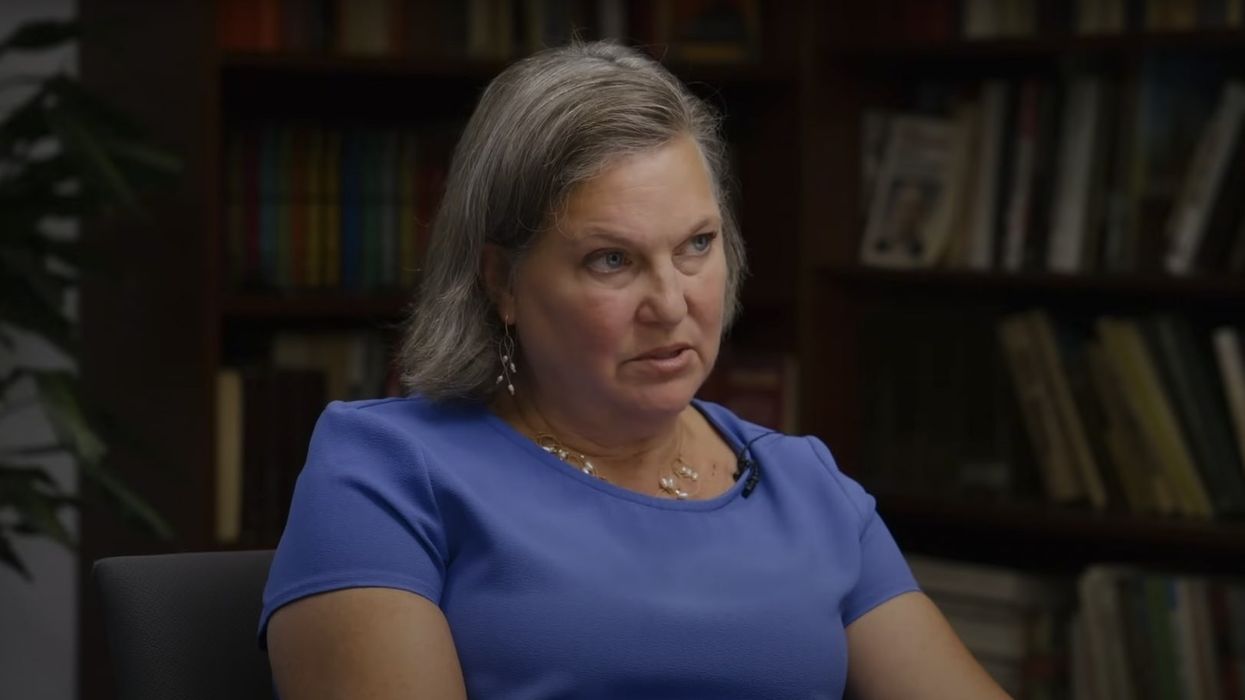
Relitigating these details two years later cannot be dismissed as an exercise in political archeology. More than two years later, the war drags on with no end in sight.
Victoria Nuland, former Under Secretary of State for Political Affairs and one of the principal architects of the Biden administration’s Russia policy, has now opined on what is perhaps the foggiest episode in a war distinguished by a nearly impenetrable kind of diplomatic opacity: the April 2022 Istanbul peace talks between Russia and Ukraine.
Furthermore she acknowledges that there was a deal on the table and that Western powers didn’t like conditions that would have limited Ukraine's military arsenal, lending credence to the theory that Ukraine’s supporters had a hand in ultimately scuttling it.
To be sure, neither the topic nor the content of Nuland’s comments is new. She is but the latest in a cavalcade of high-profile insiders, including former Israeli Prime Minister Nafatli Bennett and Ukrainian politician Davyd Arakhamia, whose testimony has shed light on the external pressures possibly informing the Zelenskyy government’s fateful decision to pull the plug on Turkish-brokered talks surrounding a draft treaty that would have ended the Ukraine war.
But, if we are to arrive at something approximating a full and unprejudiced post-mortem, it remains a necessary even if ungrateful task to carefully catalog all of these accounts — especially one from as influential a Russia policy figure as Nuland.
“Relatively late in the game the Ukrainians began asking for advice on where this thing was going and it became clear to us, clear to the Brits, clear to others that (Russian President Vladimir) Putin's main condition was buried in an annex to this document that they were working on,” she said, referencing Russia’s stipulation for hard caps and other limits on military personnel and types of weaponry that Ukraine can possess.
Such concessions, she argued, should be rejected by Kyiv because they would leave Ukraine “basically neutered as a military force.” She intimated, unsurprisingly without indulging specifics, that these anxieties were expressed by Western officials: “People inside Ukraine and people outside Ukraine started asking questions about whether this was a good deal and it was at that point that it fell apart,” Nuland said.
Just who “outside Ukraine” posed these questions and precisely what effect did these pointed queries exercise on Ukrainian officials? The full story of that short-lived diplomatic interlude is unlikely to be unraveled until after the war, in no small part due to the obvious political sensitivities at play. But there is now what appears to be, even in the most conservative estimation, a large body of circumstantial evidence that Western actors, quite possibly hailing from the UK and other countries which were designated as “guarantors” of Ukraine’s security under the Istanbul draft treaty, expressed reservations about the Istanbul format.
The extent to which these Western reservations were decisive insofar as they constituted a hard veto over the peace talks is a trickier question. One can reasonably surmise that Ukraine would have found it difficult to ink a deal that did not command at least tacit support from the Western countries on which it overwhelmingly relies, but it is no less true that the talks were fraught and, though there were positive signs of a slow convergence between the Moscow and Kyiv on key issues, the two sides were a considerable ways off from fully harmonizing their positions when the deal was terminated.
Victoria Nuland's comments lend further credence to the proposition that a settlement between Russia and Ukraine was on the table in Istanbul, that the West played a role in shaping Ukrainian thinking on the desirability of pursuing negotiations, and that Western leaders apparently conveyed the view that it was a bad deal.
Relitigating these details two years later cannot be dismissed as an exercise in political archeology; the facts of what transpired in Istanbul are as relevant as ever in informing our thinking about endgame scenarios as the war roils into its third year.
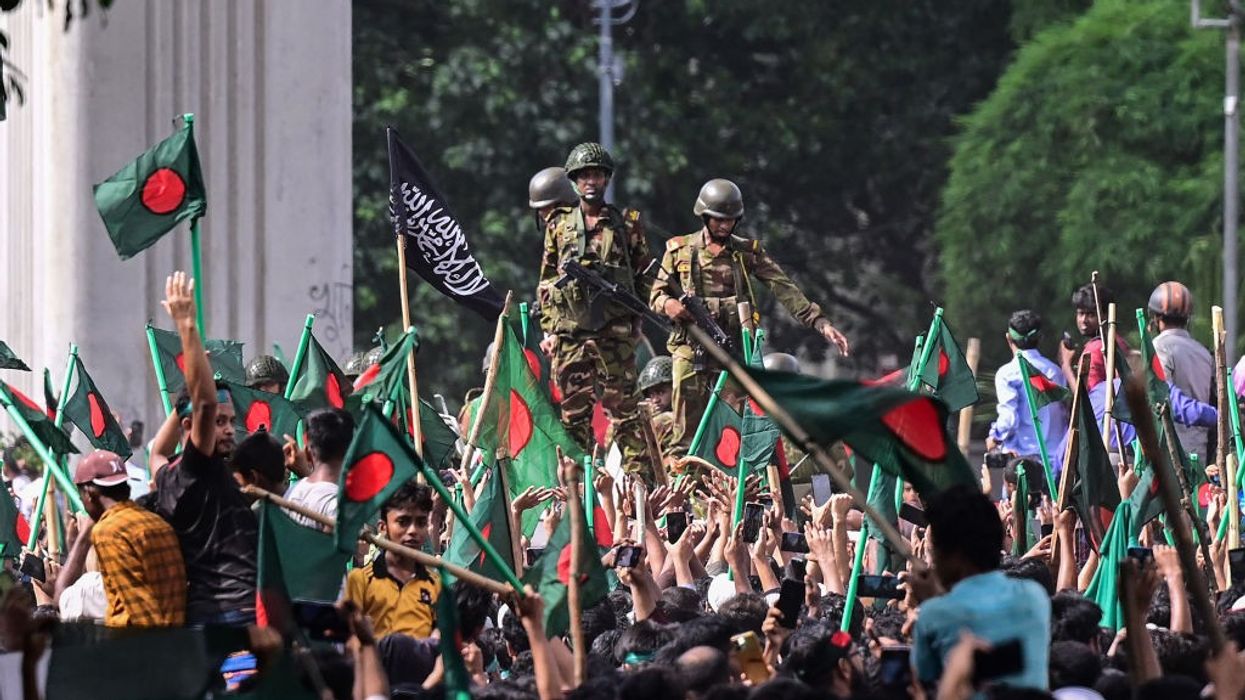
The very strong evidence of the U.S. role in toppling the government of Imran Khan in Pakistan raises the likelihood that something similar may have occurred in Bangladesh.
Two former leaders of major South Asian countries have reportedly accused the United States of covert regime change operations to topple their governments. One of the leaders, former Pakistan Prime Minister Imran Khan, languishes in prison, on a perverse conviction that proves Khan’s assertion. The other leader, former Bangladesh Prime Minister Sheik Hasina, fled to India following a violent coup in her country. Their grave accusations against the U.S., as reported in the world media, should be investigated by the UN, since if true, the U.S. actions would constitute a fundamental threat to world peace and to regional stability in South Asia.
The two cases seem to be very similar. The very strong evidence of the U.S. role in toppling the government of Imran Khan raises the likelihood that something similar may have occurred in Bangladesh.
In the case of Pakistan, Donald Lu, Assistant Secretary of State for South Asia and Central Asia, met with Asad Majeed Khan, Pakistan’s Ambassador to the U.S., on March 7, 2022. Ambassador Khan immediately wrote back to his capital, conveying Lu’s warning that PM Khan threatened U.S.-Pakistan relations because of Khan’s “aggressively neutral position” regarding Russia and Ukraine.
The Ambassador’s March 7 note (technically a diplomatic cypher) quoted Assistant Secretary Lu as follows: “I think if the no-confidence vote against the Prime Minister succeeds, all will be forgiven in Washington because the Russia visit is being looked at as a decision by the Prime Minister. Otherwise, I think it will be tough going ahead.” The very next day, members of the parliament took procedural steps to oust PM Khan.
On March 27, PM Khan brandished the cypher, and told his followers and the public that the U.S. was out to bring him down. On April 10, PM Khan was thrown out of office as the parliament acceded to the U.S. threat.
We know this in detail because of Ambassador Khan’s cypher, exposed by PM Khan and brilliantly documented by Ryan Grim of The Intercept, including the text of the cypher. Absurdly and tragically, PM Khan languishes in prison in part over espionage charges, linked to his revealing the cypher.
The U.S. appears to have played a similar role in the recent violent coup in Bangladesh. PM Hasina was ostensibly toppled by student unrest, and fled to India when the Bangladeshi military refused to prevent the protestors from storming the government offices. Yet there may well be much more to the story than meets the eye.
According to press reports in India, PM Hasina is claiming that the U.S. brought her down. Specifically, she says that the U.S. removed her from power because she refused to grant the U.S. military facilities in a region that is considered strategic for the U.S. in its “Indo-Pacific Strategy” to contain China. While these are second-hand accounts by the Indian media, they track closely several speeches and statements that Hasina has made over the past two years.
On May 17, 2024, the same Assistant Secretary Liu who played a lead role in toppling PM Khan, visited Dhaka to discuss the US Indo-Pacific Strategy among other topics. Days later, Sheikh Hasina reportedly summoned the leaders of the 14 parties of her alliance to make the startling claim that a “country of white-skinned people” was trying to bring her down, ostensibly telling the leaders that she refused to compromise her nation’s sovereignty. Like Imran Khan, PM Hasina had been pursuing a foreign policy of neutrality, including constructive relations not only with the U.S. but also with China and Russia, much to the deep consternation of the U.S. government.
To add credence to Hasina’s charges, Bangladesh had delayed signing two military agreements that the U.S. had pushed very hard since 2022, indeed by none other than the former Under-Secretary of State Victoria Nuland, the neocon hardliner with her own storied history of U.S. regime-change operations. One of the draft agreements, the General Security of Military Information Agreement (GSOMIA), would bind Bangladesh to closer military-to-military cooperation with Washington. The Government of PM Hasina was clearly not enthusiastic to sign it.
The U.S. is by far the world’s leading practitioner of regime-change operations, yet the U.S. flatly denies its role in covert regime change operations even when caught red-handed, as with Nuland’s infamous intercepted phone call in late January 2014 planning the U.S.-led regime change operation in Ukraine. It is useless to appeal to the U.S. Congress, and still less the executive branch, to investigate the claims by PM Khan and PM Hasina. Whatever the truth of the matter, they will deny and lie as necessary.
This is where the UN should step in. Covert regime change operations are blatantly illegal under international law (notably the Doctrine of Non-Intervention, as expressed for example in UN General Assembly Resolution 2625, 1970), and constitute perhaps the greatest threat to world peace, as they profoundly destabilize nations, and often lead to wars and other civil disorders. The UN should investigate and expose covert regime change operations, both in the interests of reversing them, and preventing them in the future.
The UN Security Council is of course specifically charged under Article 24 of the UN Charter with “primary responsibility for the maintenance of international peace and security.” When evidence arises that a government has been toppled through the intervention or complicity of a foreign government, the UN Security Council should investigate the claims.
In the cases of Pakistan and Bangladesh, the UN Security Council should seek the direct testimony of PM Khan and PM Hasina in order to evaluate the evidence that the U.S. played a role in the overthrow of the governments of these two leaders. Each, of course, should be protected by the UN for giving their testimony, so as to protect them from any retribution that could follow their honest presentation of the facts. Their testimony can be taken by video conference, if necessary, given the tragic ongoing incarceration of PM Khan.
The U.S. might well exercise its veto in the UN Security Council to prevent such a investigation. In that case, the UN General Assembly can take up the matter, under UN Resolution A/RES/76/, which allows the UN General Assembly to consider an issue blocked by veto in the UN Security Council. The issues at stake could then be assessed by the entire membership of the UN. The veracity of the U.S. involvement in the recent regime changes in Pakistan and Bangladesh could then be objectively analyzed and judged on the evidence, rather than on mere assertions and denials.
The U.S. engaged in at least 64 covert regime change operations during 1947-1989, according to documented research by Lindsey O’Rourke, political science professor at Boston Collage, and several more that were overt (e.g. by U.S.-led war). It continues to engage in regime-change operations with shocking frequency to this day, toppling governments in all parts of the world. It is wishful thinking that the U.S. will abide by international law on its own, but it is not wishful thinking for the world community, long suffering from U.S. regime change operations, to demand their end at the United Nations.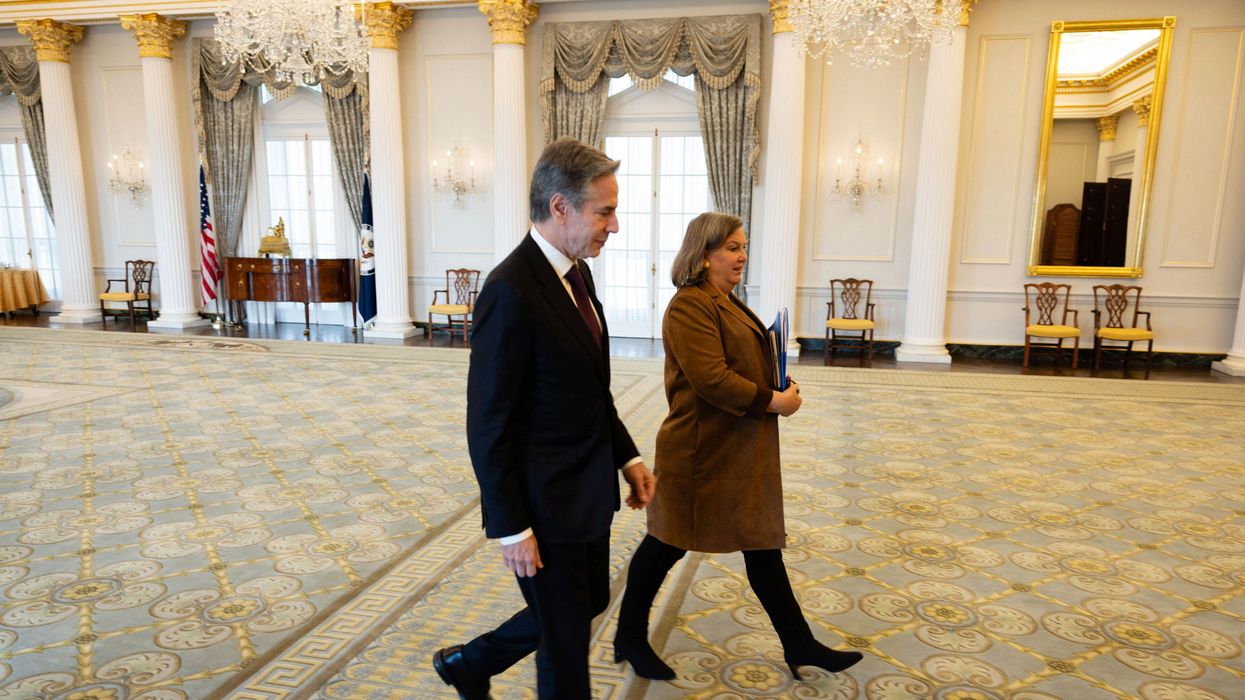
"Russia has issued a credible threat to counter-escalate" in the event of the policy shift, noted one former Pentagon official. "Are we prepared for such escalation?"
Anti-war voices this week sounded the alarm over U.S. Secretary of State Antony Blinken's newfound embrace of letting Ukraine use weapons supplied by the United States to attack targets inside Russia—a policy critics say risks a catastrophic escalation between the world's two top nuclear powers.
So far, the Biden administration has strictly forbidden Ukrainian forces—who are defending their country from the invasion ordered by Russian President Vladimir Putin in February 2022—from attacking targets inside Russia with U.S.-supplied weapons. This is in keeping with President Joe Biden's stated objective of "trying to avoid World War III."
However, The New York Times' David Sanger reported Wednesday that "the consensus around that policy is fraying" amid "a vigorous debate inside the administration over relaxing the ban to allow the Ukrainians to hit missile and artillery launch sites just over the border in Russia."
Elbridge Colby, a former deputy assistant defense secretary during the Trump administration,
warned Wednesday on social media that "there is exceptional and ill-advised danger in this course," as "Russia has issued a credible threat to counter-escalate" in the event of the policy shift.
"Are we prepared for such escalation?" he asked.
Michael Young, a senior editor at the Carnegie Middle East Center,
said Wednesday that Blinken's "move toward persuading Biden to allow Ukraine to widen the war to Russian territory is just a crazy idea, and makes any eventual negotiation all but impossible."
Ukrainian President Volodymyr Zelenskyy says forces and weapons amassed just across the Russian border have enabled Russia's recent territorial gains, including near Kharkiv, Ukraine's second-largest city, which has come under
heavy Russian bombardment in recent days.
After what Sanger called a "sobering" visit by Blinken to the Ukrainian capital Kyiv last week, the secretary of state has been pushing for a change in the Biden administration's stance. According to Sanger, "the consensus around that policy" of restraint is unraveling. It is not quite clear yet how many senior Biden administration officials support the move to greenlight Ukrainian attacks on Russia with U.S. arms, but one highly controversial undersecretary of state who recently resigned is a vocal proponent of the policy.
That would be Victoria Nuland, a neoconservative who is reviled by anti-imperialists around the world for her hawkish history that includes playing a key role in the plot to overthrow the pro-Moscow government of then-Ukrainian President Viktor Yanukovych during the Euromaidan uprising a decade ago.
"They need to be able to stop these Russian attacks that are coming from bases inside Russia," Nuland
told ABC News on Sunday. "Those bases ought to be fair game... I think it's time for that because Russia has obviously escalated this war."
NULAND CALLS FOR STRIKES ON RUSSIA pic.twitter.com/9WxCDZrM6b
— The_Real_Fly (@The_Real_Fly) May 19, 2024
The Biden administration is also weighing whether to train Ukrainian forces inside Ukraine, as opposed to in Germany under current policy—a move that could put U.S. and NATO troops in the line of fire.
Ukrainian officials welcomed Blinken's shift.
"Blinken's statement, which he repeated twice, that Ukraine is the one to choose its targets, created hope that the United States had changed its position: Ukraine should make its own decisions on the territories where it uses certain Western weapons, especially American ones," Nataliia Halibarenko, who heads Ukraine's mission to NATO, told Ukrinform on Thursday.
"The decision that we have the right to use American weapons beyond Ukraine must be made sooner or later," she added. "It is a pity that we are wasting time searching for a solution that should not cause doubts. But we will continue to promote it at all levels."
The U.S. would not be the first country to allow Ukraine to use weapons it supplies for attacks inside Russia. The United Kingdom has sent Ukraine Storm Shadow long-range air-launched cruise missiles, and British Foreign Secretary David Cameron says Ukraine "absolutely has the right to strike back at Russia."
The debate within the Biden administration over Ukraine's use of U.S.-supplied arms comes amid Russian military drills involving tactical nuclear weapons, which Russia's Defense Ministry earlier this month claimed were ordered in response to "provocative statements and threats of certain Western officials."

The imperative must be to chart a path back from this hopeless but ever-escalating war of attrition to the negotiating table that the U.S. and Britain upended nearly two years ago.
President Biden began his State of the Union speech with an impassioned warning that failing to pass his $61 billion dollar weapons package for Ukraine “will put Ukraine at risk, Europe at risk, the free world at risk.” But even if the president’s request were suddenly passed, it would only prolong, and dangerously escalate, the brutal war that is destroying Ukraine.
The assumption of the U.S. political elite that Biden had a viable plan to defeat Russia and restore Ukraine’s pre-2014 borders has proven to be one more triumphalist American dream that has turned into a nightmare. Ukraine has joined North Korea, Vietnam, Somalia, Kosovo, Afghanistan, Iraq, Haiti, Libya, Syria, Yemen, and now Gaza, as another shattered monument to America’s military madness.
This could have been one of the shortest wars in history, if President Biden had just supported a peace and neutrality agreement negotiated in Turkey in March and April 2022 that already had champagne corks popping in Kyiv, according to Ukrainian negotiator Oleksiy Arestovych. Instead, the U.S. and NATO chose to prolong and escalate the war as a means to try to defeat and weaken Russia.
Two days before Biden’s State of the Union speech, Secretary of State Blinken announced the early retirement of Acting Deputy Secretary of State Victoria Nuland, one of the officials most responsible for a decade of disastrous U.S. policy toward Ukraine.
On one hand, we believe President Biden when he says he does not want to start World War III. On the other hand, that is what his policy of incremental escalation is inexorably leading towards.
Two weeks before the announcement of Nuland’s retirement at the age of 62, she acknowledged in a talk at the Center for Strategic and International Studies (CSIS) that the war in Ukraine had degenerated into a war of attrition that she compared to the First World War, and she admitted that the Biden administration had no Plan B for Ukraine if Congress doesn’t cough up $61 billion for more weapons.
We don’t know whether Nuland was forced out, or perhaps quit in protest over a policy that she fought for and lost. Either way, her ride into the sunset opens the door for others to fashion a badly needed Plan B for Ukraine.
The imperative must be to chart a path back from this hopeless but ever-escalating war of attrition to the negotiating table that the U.S. and Britain upended in April 2022—or at least to new negotiations on the basis that President Zelenskyy defined on March 27, 2022, when he told his people, “Our goal is obvious: peace and the restoration of normal life in our native state as soon as possible.”
Instead, on February 26, in a very worrying sign of where NATO’s current policy is leading, French President Emmanuel Macron revealed that European leaders meeting in Paris discussed sending larger numbers of Western ground troops to Ukraine.
Macron pointed out that NATO members have steadily increased their support to levels unthinkable when the war began. He highlighted the example of Germany, which offered Ukraine only helmets and sleeping bags at the outset of the conflict and is now saying Ukraine needs more missiles and tanks. “The people that said 'never ever' today were the same ones who said 'never ever' planes, 'never ever' long-range missiles, 'never ever' trucks. They said all that two years ago,” Macron recalled. “We have to be humble and realize that we (have) always been six to eight months late.”
Macron implied that, as the war escalates, NATO countries may eventually have to deploy their own forces to Ukraine, and he argued that they should do so sooner rather than later if they want to recover the initiative in the war.
We are sure there are wiser heads within the U.S., French and other NATO governments who are saying this too, behind closed doors, and that may be precisely why Nuland is out...
The mere suggestion of Western troops fighting in Ukraine elicited an outcry both within France–from extreme right National Rally to leftist La France Insoumise–and from other NATO countries. German Chancellor Olaf Scholz insisted that participants in the meeting were “unanimous” in their opposition to deploying troops. Russian officials warned that such a step would mean war between Russia and NATO.
But as Poland’s president and prime minister headed to Washington for a White House meeting on February 12, Polish Foreign Minister Radek Sikorski told the Polish parliament that sending NATO troops into Ukraine “is not unthinkable.”
Macron’s intention may have been precisely to bring this debate out into the open and put an end to the secrecy surrounding the undeclared policy of gradual escalation toward full-scale war with Russia that the West has pursued for two years.
Macron failed to mention publicly that, under current policy, NATO forces are already deeply involved in the war. Among many lies that President Biden told in his State of the Union speech, he insisted that “there are no American soldiers at war in Ukraine.”
However, the trove of Pentagon documents leaked in March 2023 included an assessment that there were already at least 97 NATO special forces troops operating in Ukraine, including 50 British, 14 Americans and 15 French. Admiral John Kirby, the National Security Council spokesman, has also acknowledged a “small U.S. military presence” based in the U.S. Embassy in Kyiv to try to keep track of thousands of tons of U.S. weapons as they arrive in Ukraine.
But many more U.S. forces, whether inside or outside Ukraine, are involved in planning Ukrainian military operations; providing satellite intelligence; and play essential roles in the targeting of U.S. weapons. A Ukrainian official told the Washington Post that Ukrainian forces hardly ever fire HIMARS rockets without precise targeting data provided by U.S. forces in Europe.
All these U.S. and NATO forces are most definitely “at war in Ukraine.” To be at war in a country with only small numbers of “boots on the ground” has been a hallmark of 21st Century U.S. war-making, as any Navy pilot on an aircraft-carrier or drone operator in Nevada can attest. It is precisely this doctrine of “limited” and proxy war that is at risk of spinning out of control in Ukraine, unleashing the World War III that President Biden has vowed to avoid.
The United States and NATO have tried to keep the escalation of the war under control by deliberate, incremental escalation of the types of weapons they provide and cautious, covert expansion of their own involvement. This has been compared to “boiling a frog,” turning up the heat gradually to avoid any sudden move that might cross a Russian “red line” and trigger a full-scale war between NATO and Russia. But as NATO Secretary General Jens Stoltenberg warned in December 2022, “If things go wrong, they can go horribly wrong.”
We have long been puzzled by these glaring contradictions at the heart of U.S. and NATO policy. On one hand, we believe President Biden when he says he does not want to start World War III. On the other hand, that is what his policy of incremental escalation is inexorably leading towards.
U.S. preparations for war with Russia are already at odds with the existential imperative of containing the conflict. In November 2022, the Reed-Inhofe Amendment to the FY2023 National Defense Authorization Act (NDAA) invoked wartime emergency powers to authorize an extraordinary shopping-list of weapons like the ones sent to Ukraine, and approved billion-dollar, multi-year no-bid contracts with weapons manufacturers to buy 10 to 20 times the quantities of weapons that the United States had actually shipped to Ukraine.
Nuland’s early retirement could be the result of Biden and his foreign policy team finally starting to come to grips with the existential dangers of the aggressive policies she championed.
Retired Marine Colonel Mark Cancian, the former chief of the Force Structure and Investment Division in the Office of Management and Budget, explained, “This isn’t replacing what we’ve given [Ukraine]. It’s building stockpiles for a major ground war [with Russia] in the future.”
So the United States is preparing to fight a major ground war with Russia, but the weapons to fight that war will take years to produce, and, with or without them, that could quickly escalate into a nuclear war. Nuland’s early retirement could be the result of Biden and his foreign policy team finally starting to come to grips with the existential dangers of the aggressive policies she championed.
Meanwhile, Russia’s escalation from its original limited “Special Military Operation” to its current commitment of 7% of its GDP to the war and weapons production has outpaced the West’s escalations, not just in weapons production but in manpower and actual military capability.
One could say that Russia is winning the war, but that depends what its real war goals are. There is a yawning gulf between the rhetoric from Biden and other Western leaders about Russian ambitions to invade other countries in Europe and what Russia was ready to settle for at the talks in Turkey in 2022, when it agreed to withdraw to its pre-war positions in return for a simple commitment to Ukrainian neutrality.
The only way to find out what Russia really wants, or what it will settle for, is to return to the negotiating table.
Despite Ukraine’s extremely weak position after its failed 2023 offensive and its costly defense and loss of Avdiivka, Russian forces are not racing toward Kyiv, or even Kharkiv, Odesa or the natural boundary of the Dnipro River.
Reuters bureau in Moscow reported that Russia spent months trying to open new negotiations with the United States in late 2023, but that, in January 2024, National Security Adviser Jake Sullivan slammed that door shut with a flat refusal to negotiate over Ukraine.
The only way to find out what Russia really wants, or what it will settle for, is to return to the negotiating table. All sides have demonized each other and staked out maximalist positions, but that is what nations at war do in order to justify the sacrifices they demand of their people and their rejection of diplomatic alternatives.
Serious diplomatic negotiations are now essential to get down to the nitty-gritty of what it will take to bring peace to Ukraine. We are sure there are wiser heads within the U.S., French and other NATO governments who are saying this too, behind closed doors, and that may be precisely why Nuland is out and why Macron is talking so openly about where the current policy is heading.
We fervently hope that is the case, and that Biden’s Plan B will lead back to the negotiating table, and then forward to peace in Ukraine.
If feminists remain silent or support this Bush-era neocon simply because she is a woman, Victoria Nuland might just burn down the world in a nuclear fire.
When President Biden nominated Victoria Nuland as Undersecretary of State, CODEPINK feminists objected to her nomination out of concern she would bring pain and heartache to mothers and daughters as she fomented war in their midst. Instead of promoting diplomacy, Nuland lights matches wherever she meddles, agitating for war in Afghanistan, and now Ukraine.
If feminists remain silent or support this Bush-era neocon simply because she is a woman, Victoria Nuland might just burn down the world in a nuclear fire.
With drones already attacking the Crimean peninsula and long range US rockets on the way, Nuland’s push to cross another one of Putin’s red lines only ensures more death, destruction and ecocide in Ukraine.
The fact that Nuland was given a diplomatic job in the Biden administration in the first place never ceases to amaze because her record reads like a war criminal’s rap sheet.
For the women of Ukraine, the illegal Russian invasion-which Nuland provoked over the years with NATO expansion — has led to heightened sex trafficking and increased gender violence. According to the United Nations and relief organizations, this includes not only rape as a weapon of war, but “intimate partner violence and sexual harassment. “ With Ukraine under martial law and men aged 18–60 forced to the front lines, young women refugees-often unaccompanied-are vulnerable to abuse at border crossings.
The fact that Nuland was given a diplomatic job in the Biden administration in the first place never ceases to amaze because her record reads like a war criminal’s rap sheet.
Nuland served as Vice President Dick Cheney’s deputy national security adviser from 2003–2005, during the illegal US invasion and occupation of Iraq, a painful chapter in US history that left over a million Iraqis dead and thousands of US soldiers in body bags.
In 2005, Nuland became ambassador to NATO, where she lobbied Europe to participate in the disastrous U.S. occupation of Afghanistan. In persuading other governments the US could win that war, she sold a lie across Europe to prolong a near 20-year occupation that left Afghanistan broke, with six million children and adults at risk of starvation.
In May 2013, Nuland was nominated to act as assistant secretary of state for European and Eurasian affairs, where she was supposed to employ diplomacy in relations with Russia, Ukraine and other former Soviet states.
Instead, Nuland and the White House hurled $5 billion taxpayer dollars at Ukraine to overthrow its democratically elected President and engineer a transition government to privatize Ukraine and prepare for war with Russia. After Nuland passed out pastries during the Maidan coup, before President Viktor Yanukovych fled under a hail of bullets, Nuland was caught in a scandal involving a leaked phone call.
On the phone with US ambassador Geoffrey Pyatt, Nuland was secretly recorded saying “F .. the EU” if the European Union did not approve of her choices to run Ukraine’s transition government. The West gasped at her use of profanity. The more egregious profanity, however, was her insistence on manipulating the political affairs of another country to provoke Russia.
Nuland has repeatedly stated that she wants to destabilize other regions in Russia’s nuclear neighborhood: Belarus and Kazakhstan, because they are too friendly with Russia. What critics say she really wants is regime change in Russia, a country of 193 million people, 150 different ethnic minorities and 6,000 nuclear weapons.
On this International Women’s Day, President Biden would be well-advised to fire Victoria Nuland and hire a diplomat who embraces a feminist foreign policy centered around peace.
What could go wrong?
Nuland’s mission to sacrifice Ukrainian lives to take back Crimea-annexed by Russia after the 2014 coup-could drag other European nations onto the battlefield to start World War III.
On this International Women’s Day, President Biden would be well-advised to fire Victoria Nuland and hire a diplomat who embraces a feminist foreign policy centered around peace.

Why won't the U.S. provide a serious response to the Chinese peace plan, let alone engage with Beijing at a negotiating table?
There's something irrational about President Biden's knee-jerk dismissal of China's 12-point peace proposal titled "China's Position on the Political Settlement of the Ukraine Crisis."
"Not rational" is how Biden described the plan that calls for de-escalation toward a ceasefire, respect for national sovereignty, establishment of humanitarian corridors and resumption of peace talks.
"Dialogue and negotiation are the only viable solution to the Ukraine crisis," reads the plan. "All efforts conducive to the peaceful settlement of the crisis must be encouraged and supported."
Biden turned thumbs down
"I've seen nothing in the plan that would indicate that there is something that would be beneficial to anyone other than Russia if the Chinese plan were followed," Biden told the press.
In a brutal conflict that has left thousands of dead Ukrainian civilians, hundreds of thousands of dead soldiers, eight million Ukrainians displaced from their homes, contamination of land, air and water, increased greenhouse gasses and disruption of the global food supply, China's call for de-escalation would surely benefit someone in Ukraine.
Other points in China's plan, which is really more a set of principles rather than a detailed proposal, call for protection for prisoners of war, cessation of attacks on civilians, safeguards for nuclear power plants and facilitation of grain exports.
"The idea that China is going to be negotiating the outcome of a war that's a totally unjust war for Ukraine is just not rational," said Biden.
Instead of engaging China–a country of 1.5 billion people, the world's largest exporter, the owner of a trillion dollars in US debt and an industrial giant–in negotiating an end to the crisis in Ukraine, the Biden administration prefers to wag its finger and bark at China, warning it not to arm Russia in the conflict.
Psychologists might call this finger-wagging projection–the old pot calling the kettle black routine. It is the US, not China, that is fueling the conflict with at least $45 billion dollars in ammunition, drones, tanks and rockets in a proxy war that risks–with one miscalculation–turning the world to ash in a nuclear holocaust.
It is the US, not China, that has provoked this crisis by encouraging Ukraine to join NATO, a hostile military alliance that targets Russia in mock nuclear strikes, and by backing a 2014 coup of Ukraine's democratically elected Russia-friendly president Viktor Yanukovych, thus triggering a civil war between Ukrainian nationalists and ethnic Russians in eastern Ukraine, regions Russia has more recently annexed.
Biden's sour attitude toward the Chinese peace framework hardly comes as a surprise. After all, even former Israeli Prime Minister Naftali Bennett candidly acknowledged in a five-hour interview on YouTube that it was the West that last March blocked a near-peace deal he had mediated between Ukraine and Russia.
Why did the US block a peace deal? Why won't President Biden provide a serious response to the Chinese peace plan, let alone engage the Chinese at a negotiating table?
President Biden and his coterie of neo-conservatives, among them Undersecretary of State Victoria Nuland, have no interest in peace if it means the US concedes hegemonic power to a multi-polar world untethered from the all-mighty dollar.
What may have gotten Biden unnerved—besides the possibility that China might emerge the hero in this bloody saga—is China's call for the lifting of unilateral sanctions. The US imposes unilateral sanctions on officials and companies from Russia, China and Iran. It imposes sanctions on whole countries, too, like Cuba, where a cruel 60-year embargo, plus assignment to the State Sponsor of Terrorism list, made it difficult for Cuba to obtain syringes to administer its own vaccines during the COVID pandemic. Oh, and let's not forget Syria, where after an earthquake killed tens of thousands and left hundreds of thousands homeless, the country struggles to receive medicine and blankets due to US sanctions that discourage humanitarian aid workers from
operating inside Syria.
Despite China's insistence it is not considering weapons shipments to Russia, Reuters reports the Biden administration is taking the pulse of G-7 countries to see if they would approve new sanctions against China if that country provides Russia with military support.
The idea that China could play a positive role was also dismissed by NATO Secretary General Jens Stoltenberg, who said, "China doesn't have much credibility because they have not been able to condemn the illegal invasion of Ukraine."
Ditto from US Secretary of State Antony Blinken, who told ABC's Good Morning America, "China has been trying to have it both ways: It's on the one hand trying to present itself publicly as neutral and seeking peace, while at the same time it is talking up Russia's false narrative about the war."
False narrative or different perspective?
In August of 2022, China's ambassador to Moscow charged that the United States was the "main instigator"of the Ukraine war, provoking Russia with NATO expansion to Russia's borders.
This is not an uncommon perspective and is one shared by economist Jeffrey Sachs who, in a February 25, 2023 video directed at thousands of anti-war protesters in Berlin, said the war in Ukraine did not start a year ago, but nine years ago when the US backed the coup that overthrew Yanukovych after he preferred Russia's loan terms to the European Union's offer.
Shortly after China released its peace framework, the Kremlin responded cautiously, lauding the Chinese effort to help but adding that the details "need to be painstakingly analyzed taking into account the interests of all the different sides." As for Ukraine, President Zelinsky hopes to meet soon with Chinese President Xi Jinping to explore China's peace proposal and dissuade China from supplying weapons to Russia.
The peace proposal garnered more positive response from countries neighboring the warring states. Putin's ally in Belarus, leader Alexander Lukashenko, said his country "fully supports" the Beijing plan. Kazakhstan approved of China's peace framework in a statement describing it as "worthy of support." Prime Minister of Hungary Viktor Orbán–who wants his country to stay out of the war– also showed support for the proposal.
China's call for a peaceful solution stands in stark contrast to US warmongering this past year, when Secretary of Defense Lloyd Austin, a former Raytheon board member, said the US aims to weaken Russia, presumably for regime change–a strategy that failed miserably in Afghanistan where a near 20-year US occupation left the country broke and starving.
China's support for de-escalation is consistent with its long-standing opposition to US/NATO expansion, now extending into the Pacific with hundreds of US bases encircling China, including a new base in Guam to house 5,000 marines. From China's perspective, US militarism jeopardizes the peaceful reunification of the People's Republic of China with its break-away province of Taiwan. For China, Taiwan is unfinished business, left over from the civil war 70 years ago.
In provocations reminiscent of US meddling in Ukraine, a hawkish Congress last year approved $10 billion in weapons and military training for Taiwan, while House leader Nancy Pelosi flew to Taipei – over protests from her constituents–to whip up tension in a move that brought US-China climate cooperation to a halt.
A US willingness to work with China on a peace plan for Ukraine might not only help stop the daily loss of lives in Ukraine and prevent a nuclear confrontation, but also pave the way for cooperation with China on all kinds of other issues–from medicine to education to climate–that would benefit the entire globe.

Dear President Biden,
I am writing you as a proud member of Veterans For Peace and its former president. We have been following the war in Ukraine closely, since well before the Russian invasion on February 24 of this year. We were alarmed when you and President Obama supported the regime-change coup in Ukraine in 2014, which was openly cheered on by the State Department's Victoria Nuland, and spearheaded by self-described Nazis.
Mr. President, you might have stopped this war from happening merely by announcing that Ukraine would not become part of NATO and that you would end the militarization of Ukraine.
We watched in horror as those same self-described Nazis set fire to an Odessa union building full of Ukrainians who were protesting a new law outlawing the Russian language as an official language of Ukraine. 50 people were burned alive or shot and beaten to death. This in a country with a long history with Russia and millions of Russian speakers.
Appalled at the aforementioned atrocities, the Russian-speaking population of the Donbass in Eastern Ukraine declared their independence from Ukraine, and were soon attacked by Nazi militias. These self-described Nazi militias were then incorporated into the Ukrainian army, and the attacks continued. By the time that Russia invaded Ukraine on February 24 of this year, 14,000 Ukrainians had already been killed in that terrible civil war.
Russian president Putin repeatedly warned and almost begged the US and NATO: Do not push your hostile military forces any further onto Russia's borders. Taking Ukraine into NATO would cross a serious "red line." Russian troops then massed along the border with Ukraine, in a clear show of force.
Mr. President, you might have stopped this war from happening merely by announcing that Ukraine would not become part of NATO and that you would end the militarization of Ukraine. You could have accepted President Putin's offer to negotiate a new security arrangement in Europe. We looked on in disbelief as you rather cavalierly brushed aside Russia's legitimate concerns. It looked like you were saying, "Bring it on!"
Well, Russia brought it on. We were horrified by the Russian invasion as well as by your response. You armed Ukraine to the teeth and fanned the flames of war. Ukraine (and the Black market in Europe) is now awash with high-tech US weaponry. A full-on war has killed many thousands of civilians, made millions homeless, and destabilized much of the world. We are now facing economic disasters and fearing the all-too-real possibility of nuclear war. Why?
As veterans who have experienced the carnage of war, we are concerned about the young soldiers on both sides who are being killed and injured in the tens of thousands. We know all too well that the survivors will be traumatized and scarred for life. These are additional reasons why the Ukraine war must end now.
We ask you to listen to veterans who say "Enough is Enough--War is Not the Answer." We want urgent, good faith diplomacy to end the war in Ukraine, not more US weapons, advisors, and endless war. And certainly not a nuclear war.
It is not too late to do avoid further disaster, Mr. President. It is never too late to do the right thing. Show us a Profile of Courage and save the world from World War III, a war that could literally destroy human civilization as we know it. You must distance yourself from the neocons and weapons manufacturers who are giving you terrible advice. You must reverse course now. Drop the weapons and embrace diplomacy. For the sake of Ukraine. For the sake Russia, Europe and the United States. For the sake of the all the peoples of the world.
Negotiate, Don't Escalate!
Sincerely,
Gerry Condon, former president
VETERANS FOR PEACE
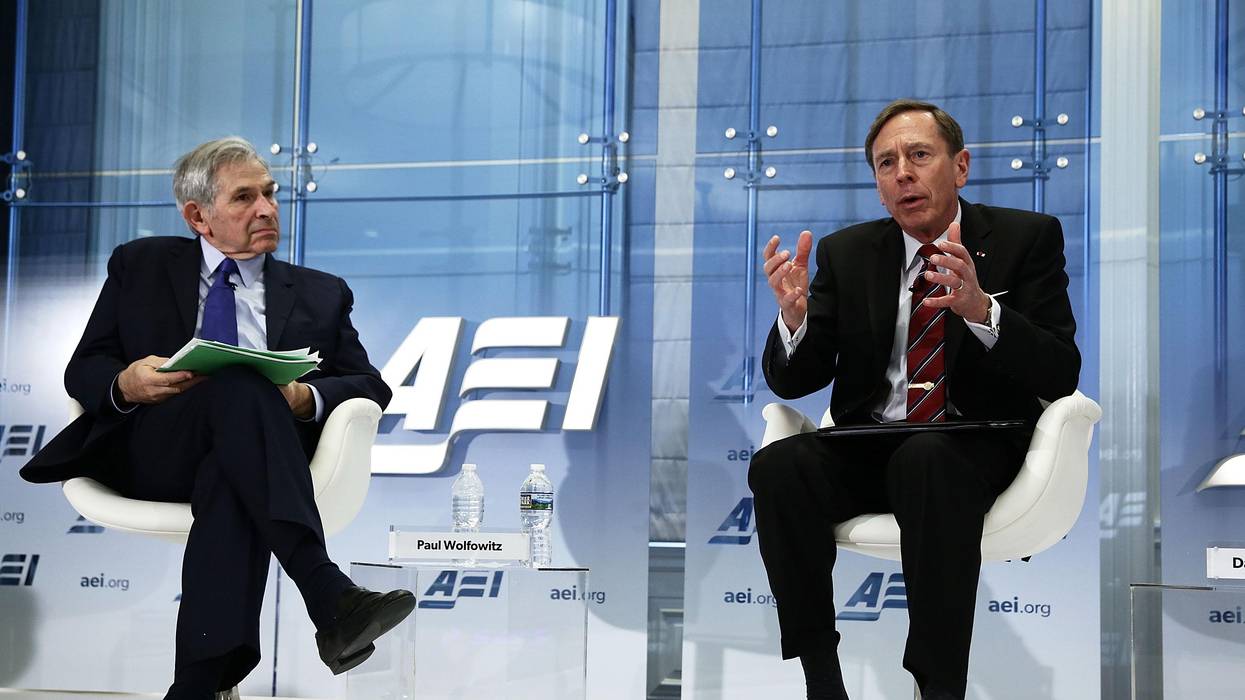
The war in Ukraine is the culmination of a 30-year project of the American neoconservative movement. The Biden Administration is packed with the same neocons who championed the US wars of choice in Serbia (1999), Afghanistan (2001), Iraq (2003), Syria (2011), Libya (2011), and who did so much to provoke Russia's invasion of Ukraine. The neocon track record is one of unmitigated disaster, yet Biden has staffed his team with neocons. As a result, Biden is steering Ukraine, the US, and the European Union towards yet another geopolitical debacle. If Europe has any insight, it will separate itself from these US foreign policy debacles.
The neocon outlook is based on an overriding false premise: that the US military, financial, technological, and economic superiority enables it to dictate terms in all regions of the world.
The neocon movement emerged in the 1970s around a group of public intellectuals, several of whom were influenced by University of Chicago political scientist Leo Strauss and Yale University classicist Donald Kagan. Neocon leaders included Norman Podhoretz, Irving Kristol, Paul Wolfowitz, Robert Kagan (son of Donald), Frederick Kagan (son of Donald), Victoria Nuland (wife of Robert), Elliott Cohen, Elliott Abrams, and Kimberley Allen Kagan (wife of Frederick).
The main message of the neocons is that the US must predominate in military power in every region of the world, and must confront rising regional powers that could someday challenge US global or regional dominance, most important Russia and China. For this purpose, US military force should be pre-positioned in hundreds of military bases around the world and the US should be prepared to lead wars of choice as necessary. The United Nations is to be used by the US only when useful for US purposes.
This approach was spelled out first by Paul Wolfowitz in his draft Defense Policy Guidance (DPG) written for the Department of Defense in 2002. The draft called for extending the US-led security network to the Central and Eastern Europe despite the explicit promise by German Foreign Minister Hans-Dietrich Genscher in 1990 that German unification would not be followed by NATO's eastward enlargement. Wolfowitz also made the case for American wars of choice, defending America's right to act independently, even alone, in response to crises of concern to the US. According to General Wesley Clark, Wolfowitz already made clear to Clark in May 1991 that the US would lead regime-change operations in Iraq, Syria, and other former Soviet allies.
The neocons championed NATO enlargement to Ukraine even before that became official US policy under George W. Bush, Jr. in 2008. They viewed Ukraine's NATO membership as key to US regional and global dominance. Robert Kagan spelled out the neocon case for NATO enlargement in April 2006:
[T]he Russians and Chinese see nothing natural in [the "color revolutions" of the former Soviet Union], only Western-backed coups designed to advance Western influence in strategically vital parts of the world. Are they so wrong? Might not the successful liberalization of Ukraine, urged and supported by the Western democracies, be but the prelude to the incorporation of that nation into NATO and the European Union--in short, the expansion of Western liberalhegemony?
Kagan acknowledged the dire implication of NATO enlargement. He quotes one expert as saying, "the Kremlin is getting ready for the 'battle for Ukraine' in all seriousness." The neocons sought this battle. After the fall of the Soviet Union, both the US and Russia should have sought a neutral Ukraine, as a prudent buffer and safety valve. Instead, the neocons wanted US "hegemony" while the Russians took up the battle partly in defense and partly out of their own imperial pretentions as well. Shades of the Crimean War (1853-6), when Britain and France sought to weaken Russia in the Black Sea following Russian pressures on the Ottoman empire.
Kagan penned the article as a private citizen while his wife Victoria Nuland was the US Ambassador to NATO under George W. Bush, Jr. Nuland has been the neocon operative par excellence. In addition to serving as Bush's Ambassador to NATO, Nuland was Barack Obama's Assistant Secretary of State for European and Eurasian Affairs during 2013-17, where she participated in the overthrow of Ukraine's pro-Russian president Viktor Yanukovych, and now serves as Biden's Undersecretary of State guiding US policy vis-a-vis the war in Ukraine.
In the "battle for Ukraine," the neocons were ready to provoke a military confrontation with Russia by expanding NATO over Russia's vehement objections because they fervently believe that Russia will be defeated by US financial sanctions and NATO weaponry.
The neocon outlook is based on an overriding false premise: that the US military, financial, technological, and economic superiority enables it to dictate terms in all regions of the world. It is a position of both remarkable hubris and remarkable disdain of evidence. Since the 1950s, the US has been stymied or defeated in nearly every regional conflict in which it has participated. Yet in the "battle for Ukraine," the neocons were ready to provoke a military confrontation with Russia by expanding NATO over Russia's vehement objections because they fervently believe that Russia will be defeated by US financial sanctions and NATO weaponry.
The Institute for the Study of War (ISW), a neocon think-tank led by Kimberley Allen Kagan (and backed by a who's who of defense contractors such as General Dynamics and Raytheon), continues to promise a Ukrainian victory. Regarding Russia's advances, the ISW offered a typical comment: "[R]egardless of which side holds the city [of Sievierodonetsk], the Russian offensive at the operational and strategic levels will probably have culminated, giving Ukraine the chance to restart its operational-level counteroffensives to push Russian forces back."
The facts on the ground, however, suggest otherwise. The West's economic sanctions have had little adverse impact on Russia, while their "boomerang" effect on the rest of the world has been large. Moreover, the US capacity to resupply Ukraine with ammunition and weaponry is seriously hamstrung by America's limited production capacity and broken supply chains. Russia's industrial capacity of course dwarfs that of Ukraine's. Russia's GDP was roughly 10X that of Ukraine before war, and Ukraine has now lost much of its industrial capacity in the war.
The most likely outcome of the current fighting is that Russia will conquer a large swath of Ukraine, perhaps leaving Ukraine landlocked or nearly so. Frustration will rise in Europe and the US with the military losses and the stagflationary consequences of war and sanctions. The knock-on effects could be devastating, if a right-wing demagogue in the US rises to power (or in the case of Trump, returns to power) promising to restore America's faded military glory through dangerous escalation.
Instead of risking this disaster, the real solution is to end the neocon fantasies of the past 30 years and for Ukraine and Russia to return to the negotiating table, with NATO committing to end its commitment to the eastward enlargement to Ukraine and Georgia in return for a viable peace that respects and protects Ukraine's sovereignty and territorial integrity.

Amid concerns that Russian President Vladimir Putin's deadly invasion of Ukraine could lead to a wider war, the Kremlin on Wednesday accused the United States government of waging economic warfare.
"We should remind ourselves that Putin is not synonymous with the Russian people."
"The U.S., undoubtedly, declared an economic war against Russia and they are waging this war. Yes, de facto this is exactly what it is," said Dmitry Peskov, a Kremlin spokesperson.
Peskov's remarks came in response to U.S. Undersecretary of State for Political Affairs Victoria Nuland's testimony at a Senate Foreign Relations Committee hearing Tuesday, according to the Russian state news agency TASS.
"I think his interior mind is now out there and for everybody to see," Nuland said of Putin. "So that's what makes me worried that not only do we have to ensure that this Ukraine gambit is a strategic failure for Putin for Ukraine's sake, but also for all of the other countries in the region, and his appetite has only grown with the eating. So you know, we can't allow this to stand."
Reuters reports that when asked about U.S. President Joe Biden's ban on Russian oil and energy imports, Peskov said that "the situation demands a rather deep analysis" but "if you are asking me what Russia is going to do--Russia is going to do what is necessary to defend its interests."
Peskov's comments came after Putin said over the weekend that Western sanctions imposed in response to the invasion "are akin to declaring war." The statement sparked alarm given his thinly veiled threat about nuclear weapons when he announced the invasion of Ukraine late last month.
Despite the Kremlin's crackdown on critical reporting about the Russian military's assault of Ukraine, anti-war protesters have taken to the streets across Russia, resulting in thousands of arrests over the past two weeks.
NPR reported last week that "everyday Russians are feeling the impact" of sanctions, including store closures, suspended container shipping, lack of support for airlines, the falling value of the ruble, rising interest rates, price hikes, and concerns about being paid by foreign employers.
Robert Reich, former U.S. labor secretary and a public policy professor at the University of California, Berkeley, argued Wednesday that "we should use whatever means are at our disposal to make Vladimir Putin end the brutal war he started. But it is proving difficult to use sanctions on specific oligarchs to get Putin to stop."
In his an opinion piece for The Guardian, Reich wrote:
Perhaps we should be more ambitious. My Berkeley colleague Gabriel Zucman recommends that the U.S. and the European Union freeze all offshore holdings of Russian nationals in excess of $10 million. This would affect about 10,000 to 20,000 Russians who have benefited the most from Putin's rule.
Meanwhile, blanket sanctions against the Russian economy are having an effect. Over the past week they have caused the ruble to collapse and decimated Russian markets.
But the burden has fallen mostly on ordinary Russians, many of whom have already suffered from Putin's brutal regime.
"As we've seen in North Korea and Iran, dictatorships don't depend on popular approval. In fact, widespread hardship can lead to even more repression and violence," Reich added. "We should remind ourselves that Putin is not synonymous with the Russian people."

No war is a one-sided affair. There is no sound to one hand clapping.
Russia's assault on Ukraine is an unambiguously bad thing. But it didn't happen in a vacuum. In order to solve the problem, we have to first understand the context in which it occurred, and the part that the U.S. played in its happening.
[The U.S.] can attain that end with two simple moves: declare that Ukraine will not be admitted intoNATO; and remove its offensive nuclear missiles from Russia's borders.
The Big Bang in U.S.-Russian relations was the breakup of the Soviet Union in 1991. Then-U.S. president George H.W. Bush and his Secretary of State, James Baker, promised Mikhail Gorbachev that if he agreed to the unification of Germany, NATO would not expand eastward, toward Russia, "not one inch."
That promise was broken almost immediately when, in 1999, Bill Clinton helped usher Poland, Hungary, and the Czech Republic into NATO. Russia considered this move not just a betrayal, but an act of aggression. First, Poland is an implacable enemy of Russia, and has been for centuries. And NATO had just finished bombing Russian ally Yugoslavia out of existence. The "slav" in Yugoslavia signifies the same ethnicity as the Slavs who are the Russian people.
It is lost on the average American that Russians are spooked by Western aggression. Napoleon invaded Russia in 1812 and burned Moscow to the ground. That's what Tchaikovsky's 1812 Overture, with its church bells ringing and cannons booming, is about.
The German invasion in the First World War caused the government of the Tsar to fall to the Bolsheviks. That gave birth to communism as a state-based system and the animus for the Cold War which dominated the second half of the Twentieth Century.
Before World War I was even settled, the Western victors invaded Russia to try to snuff out its new government before it was stable. That was the infamous White Counter-Revolution, led by the U.S., the U.K., Japan, and Italy.
The German invasion in World War II caused the death of 27,000,000 Russians, 90 times U.S. losses in the War. Over 70,000 villages, 1,500 towns, and 9,000 bridges were destroyed. The already primitive national transportation network was reduced to rubble and agricultural production was decimated. Russians remember these things, though they are barely known in the West.
The perception of aggressiveness in NATO moving eastward was hardly the Russians' alone. Bill Bradley, Paul Nitze, Sam Nunn, Robert McNamara, and more than 30 other foreign policy heavyweights wrote to Clinton that such expansion was both provocative and unnecessary, given the absence of a military threat.
George Kennan, the pre-eminent U.S. strategist of the post-World War II era, declared that, "NATO expansion will prove the greatest U.S. foreign policy blunder of the twentieth century." That is a pretty stern prediction, coming from the man who conceived of the Cold War policy of Containment and who, in 1980, wrote, "The Vietnam War was the most disastrous of all of America's undertakings over the whole two hundred years of its history." It didn't matter.
The U.S. had just won the Cold War. It was on a roll, convinced of its imperial inevitability, strategic infallibility, and military invulnerability. Vapid phrases masqueraded as deep ideas, phrases like "a new world order," "the end of history" and "the indispensable nation." They were tossed around as rationalizations for the use of force against any nation that stood in the way of U.S. pursuit of global hegemony. Think, Iraq, and Afghanistan.
The U.S. promise to not move NATO eastward was broken again, in 2004, when, during the George W. Bush administration, NATO admitted Estonia, Latvia, and Lithuania to membership. All three nations adjoin Russia, placing NATO forces on Russia's borders. NATO also admitted Romania and Bulgaria in the same induction batch.
Poland, Hungary, and Romania participate in NATO's "nuclear preparedness posture" which means hosting offensive nuclear missiles aimed at Russia. These can hit major Russian cities in as little as 10 minutes.
The best way to understand the provocativeness of this move to the Russians is the Cuban Missile Crisis. In 1962, the Soviet Union began placing offensive nuclear missiles in Cuba, 90 miles off the coast of Florida. It was in response to the U.S. having installed similar missiles in Turkey. The Cuban missiles would be able to hit Washington D.C. in 30 minutes.
The U.S. became apoplectic, in fact, hysterical. There was no defense against the missiles. U.S. military forces were put on "DEFCON 2" alert, the highest state of preparedness short of actual war. It was the only time during the entire 45 years of the Cold War they were placed at such an elevated state of readiness.
Robert McNamara, then Secretary of Defense, later wrote of going out onto the balcony of the White House, looking up at the stars, and crying. It occurred to him that this would be the last Saturday he would ever see. That's how perilous the Crisis was.
It was only John Kennedy's deft handling of the situation that defused the Crisis. Part of the resolution was that the U.S. agreed to remove its missiles from Turkey. It was an implicit acknowledgement on the part of the U.S. of just how provocative such forward-based offensive nuclear systems are. They are no less provocative today.
In 2014, the U.S. helped carry out a coup d'etat against the democratically-elected, Russian-leaning Ukrainian government of Viktor Yanukovych. It installed in its place a crypto-fascist, Western-leaning government headed by Arseniy Yatsenyuk. U.S. Assistant Secretary of State Victoria Nuland was recorded organizing the coup. The recordings were made public by Russian intelligence in February 2014. When told by her associate, Geoffrey Pyatt, that the EU would not support a coup, Nuland famously declared, "Fuck the EU."
Since the 2014 coup, the U.S. has shipped more than $2.5 billion in weapons to the new Ukrainian government. It has seen to it that Ukraine has not honored the Minsk I and II treaties that it signed in 2014 and 2015. Those treaties were designed to protect the autonomy of Russian-speaking dissidents in eastern Ukraine.
In early February, the government of Ukraine began shelling Donbass, that eastern region of the country with a majority Russian-ethnic population. This has been done with the implicit blessing of the U.S., Ukraine's strategic sponsor.
Between 2002 and 2020, the U.S. withdrew from the Anti-Ballistic Missile Treaty, the Intermediate Range Nuclear Forces Treaty, and the Open Skies Treaty. All were designed to reduce tensions with Russia by ensuring verifiable enforcement of strategic nuclear weapons systems. Without the Treaties, nuclear uncertainty, and, therefore, the risks of mis-step and war, are greatly heightened.
So, where does this leave us?
Harvard's Stephen Walt, hardly a lightweight or a leftist dove, wrote two weeks ago, "Whatever your views on NATO enlargement might be, there is overwhelming evidence that Russian leaders were alarmed by it from the start and expressed their concerns repeatedly. Moscow grew increasingly opposed ...as NATO crept ever eastward."
Nobody can pretend the West did not know what the stakes were or what was coming. No meaningful security guarantees were offered.
Indeed, in December, 2021, Vladimir Putin stated publicly that there was no further back that Russia could go. If the west would not provide meaningful security guarantees, Russia would solve the problem itself through "military-technical measures." The current invasion is what he was referring to. Nobody can pretend the West did not know what the stakes were or what was coming. No meaningful security guarantees were offered.
Again, Russia's invasion of Ukraine is unambiguously bad. But as we search for a solution to the crisis, the key consideration is that while Ukraine is existential for the Russians--a matter of life and death--it is not a vital national security interest to the U.S. This is revealed in President Biden's repeated assurances that no U.S. forces will be committed to Ukraine. That is the key to the solution.
If the U.S. is sincerely interested in a peaceful resolution of the crisis--and for argument's sake, let's assume that it is--it can attain that end with two simple moves: declare that Ukraine will not be admitted into NATO; and remove its offensive nuclear missiles from Russia's borders.
Since Ukraine is not a matter of strategic interest to the U.S., this would come at little cost to the U.S. but will yield vastly disproportional gains to the situation by facilitating immediate de-escalation. Both the U.S. and NATO have stated informally that Ukraine will not be admitted anyway, so nothing, save, perhaps a little face, is lost. It would allow Russia to withdraw with something to be said for its efforts.
As for the second plank of the solution--withdrawal of U.S. nuclear missiles from countries adjoining Russia--the U.S. understands better than any nation on earth the value of having offensive nuclear missiles removed from its borders. It knows, from first-hand experience, better than any nation in the world, how to defuse this crisis.
This is the concept of "strategic empathy:" understanding your adversary's interests and motivations, not to give in to them, but to better attain your own ends. As Walt, Kennan, and other analysts have said, Russia feels aggressed upon, threatened, and out of peaceful options. If the U.S.'s ends are peace, the means are at hand to achieve it, and with no loss of strategic position.
If the U.S.'s interests are not peace, that will be revealed equally as clearly, equally as quickly. Yes, there will be necessary negotiations about withdrawal, reparations, and other such wind-downs, but those pale next to the threat of unintended escalation to what could very easily end up as nuclear war.
The stakes are huge. Simple, workable solutions are at hand. The costs are small. The alternatives are unfathomable. If the U.S. wants peace, it can have it tomorrow.