

SUBSCRIBE TO OUR FREE NEWSLETTER
Daily news & progressive opinion—funded by the people, not the corporations—delivered straight to your inbox.
5
#000000
#FFFFFF
To donate by check, phone, or other method, see our More Ways to Give page.
Daily news & progressive opinion—funded by the people, not the corporations—delivered straight to your inbox.
You do not have to be a cynic to predict that Trump would relish such mayhem.
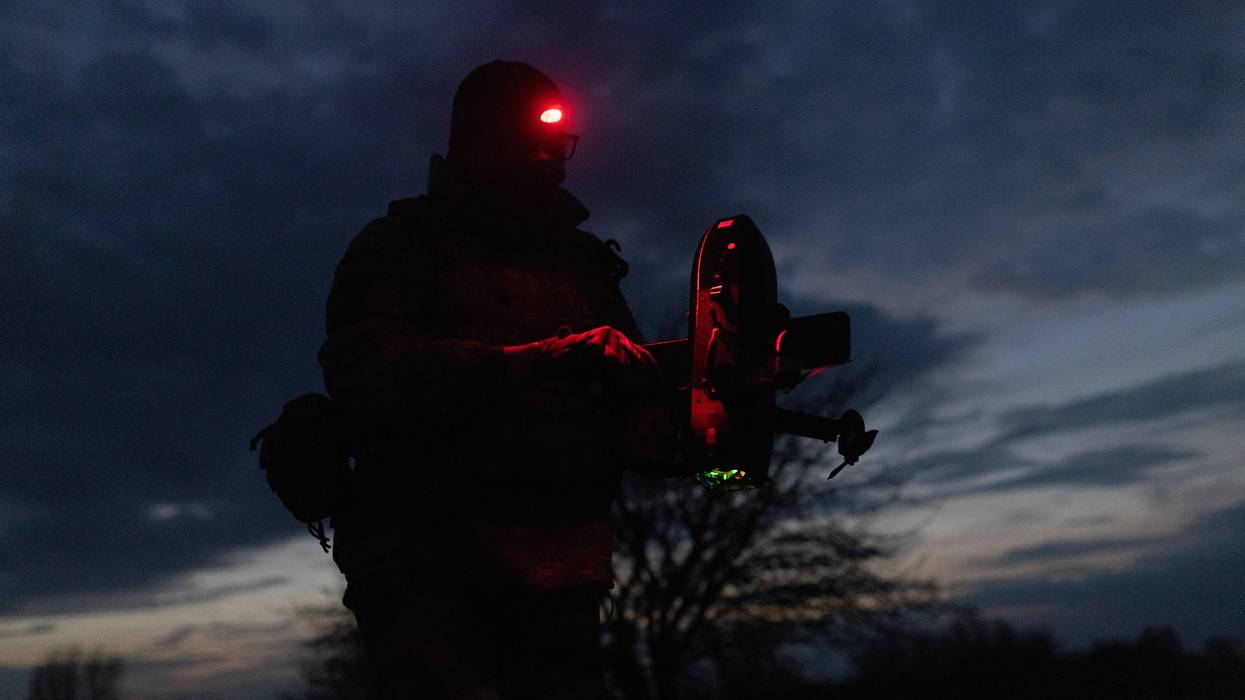
While our intelligence agencies and the Defense Department have long studied possible “domestic blowback scenarios” to our aggressive wars overseas, what happened last month was a troubling, unexplained reality. ABC News reported that the large Barksdale Air Force Base (BAFB) in Louisiana, where B-52 bombers are stationed, “detected multiple unauthorized drones operating in our airspace during the week of March 9th, quoting Capt. Hunter Rininger of the 2nd Bomb Wing. These drone flights continued for nearly a week.
More specifically, according to what ABC News described as a confidential Air Force briefing document dated March 15, 2026, “the drones came in waves and entered and exited the base in a way that may suggest attempts to ‘avoid the operator(s) being located.’ Lights on the drones suggested the operators ‘may be testing security response’ at the base.”
“Between March 9-15, 2026, BAFB Security Forces observed multiple waves of 12-15 drones operating over sensitive areas of the installation, including the flight line, with aircraft displaying non-commercial signal characteristics, long-range control links and resistance to jamming,” the document added.
These flights lasted around four hours each day. The confidential document obtained by ABC News considered these “incursions” to be criminal offenses under federal law, calling them “a significant threat to public safety and national security since they require the flight line to be shut down while also putting manned aircrafts already inflight in the area of risk.”
Well, Mr. Trump, even your MAGA loyalists may be wondering why your “Department of War” did not intercept these drones, bring them down, and learn whose sending them. One would also think, this would be a huge newsworthiness episode for the mainstream mass media. The American people were left with a vague assurance that the Air Force’s investigation was being assisted by the Louisiana State Police.
Since then, there has largely been silence, from the media, from Congress, and from the war-mongering Secretary of Defense, Pete Hegseth, who would be expected to overcome this unauthorized “unmanned aerial system.”
This is the kind of provocative event that generates conspiracy theories.
There is a larger puzzle here, given how much the Pentagon is given by Congress to spend on defense – over 50 percent of the entire federal government’s operating expenditures. Ellen Mitchell, writing in The Hill newspaper on March 7, 2026, gives us an expert’s assessment: “Brett Velicovich, a former Army intelligence special operations soldier who has worked with Ukraine’s drone forces in its defense against Russia, said he and other drone experts have been warning the US to prepare for drone warfare for years.” He added, “Our counter drone systems need work.”
Small Ukraine is ahead of the US in developing low-cost drones and drone interceptors, while the US builds $13 billion aircraft carriers, which in modern missile warfare would become sitting ducks.
The US military is presently experiencing Iran’s response to Trump’s February 28th treacherous attack, in the middle of negotiations no less, of their advanced, inexpensive Shahed drones, which can be assembled in a garage.
Those garages assembling drones could soon be in the US, which now are included in the blowback assessments noted earlier by US intelligence agencies. The more the US Empire blows up people abroad in countries that pose no threat to the US, the more the grieving survivors may be motivated to retaliate. Certainly, if the shoe were on the other foot and some giant military powers were obliterating US civilians and civilian infrastructure, does anyone doubt there would be vengeful retaliation?
Iran has the added grievances of having their elected prime minister overthrown by the CIA in 1953, followed by the US-installed dictator Shah for 25 years. Then, following the Iranian overthrow of the Shah in 1979, the US backed Iraq’s dictator, Saddam Hussein, to invade Iran, causing about 500,000 Iranian fatalities in this multi-year aggression. Since then, the US and Israel have been sabotaging Iran, annihilating its leaders, and imposing crushing economic sanctions on that country (twice the size of Texas) of 93 million people.
Is it a surprise that the militarily surrounded and massively infiltrated by Israeli spies Iranian theocratic regime imposes very harsh measures internally? By comparison, without any external threat, Tyrant Trump has imposed police state measures in our country, illegally seizing and imprisoning innocent people by the thousands, and causing casualties among United States citizens.
It is evident from warnings by specialists that the US is unprepared for ‘lone wolf’ drone attacks, much less more organized drone retaliations.
You do not have to be a cynic to predict that Trump would relish such mayhem, which he would immediately exploit to bolster his failing dictatorial regime and dropping poll numbers. Dictators know exactly how to brutally suppress dissent and consolidate their domination with exaggerated rhetoric to pursue massive violent revenge. Trump, in his lie-filled and violent televised diatribe to the nation on Wednesday, told the Iranian people that “We are going to hit them extremely hard over the next two to three weeks. We’re going to bring them back to the Stone Age, where they belong.” That is the grisly playbook that dictators have launched for generations to cover their own crimes of death and destruction.
The American people had better be alert to this predictable reaction by the dangerous Trump. His more extremist supporters, including some convicted violent criminals who he has pardoned, may not wait and are capable of trying to pull off a “false flag” operation to provoke worse impacts from Trumpian fascism.
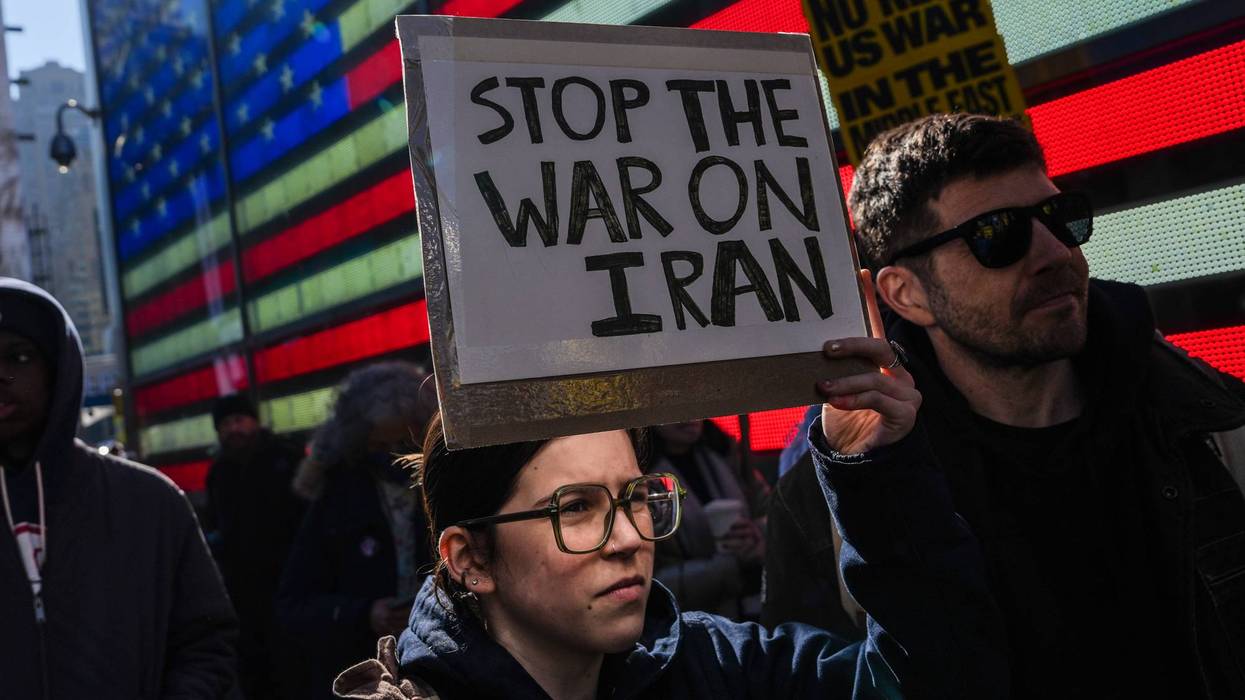
History tells us one thing: When we wage unjust wars that terrorize distant populations in far-off lands, the violence rarely remains confined there. Sooner or later, in one form or another, it returns.
What will the costs of the latest round of illegal, ill-fated US military adventurism in the Middle East amount to? Some of the toll is already clear. Washington has squandered billions of dollars on a reckless war of aggression against Iran. A merciless campaign of aerial bombardment has driven millions from their homes. American and Israeli airstrikes have rained destruction on 10,000 civilian sites and already killed more than 3,000 people in Iran and Lebanon. Among the dead are more than 200 children, many killed in a US strike on a girls’ school, a war crime that evokes the grim precedent of such past American atrocities as the 1968 My Lai massacre in Vietnam or the 1991 Amiriyah shelter bombing in Iraq.
The latest war has also dealt a potentially fatal blow to our already battered democratic institutions. It’s a war neither authorized by Congress nor supported by the public. Instead, it was launched by a president who refuses to submit to the law or heed the will of the people, claiming in true authoritarian fashion that he is the law, and that he alone embodies the popular will.
Such democratic backsliding has, however, been decades in the making, a predictable result of longstanding imperial impunity. Yet we may rapidly be approaching a point of no return. Even George W. Bush, in launching his catastrophic wars of choice in the region, sought to manufacture consent and present the case before the United Nations. Today, there is neither the pretense of legality nor of legitimacy.
The costs associated with this latest criminal war, measured in human lives; the misappropriation of national resources; and the erosion of the rule of law will only continue to mount. Yet there is also a less visible, less immediate price tag for such wars. If the history of American interventions in the region offers any guide, the full bill will likely not become apparent for months, years, or even decades. When it finally arrives, however, it will carry a familiar name: blowback.
In case after case, conflicts initiated or intensified by the United States appeared to subside, only to reemerge in new, more volatile forms.
For that reason, it’s important at this moment to recall the lessons Washington appears determined to forget. From Afghanistan to Iran, Iraq to Libya, the record is unmistakable. Yet as long as the historical amnesia that grips this country’s political establishment remains unchallenged, the same cycles of escalation and reprisal will undoubtedly persist in the years to come, threatening to once again draw the United States (and much of the world) ever deeper into the abyss of forever war.
While the post-9/11 “war on terror” is often invoked as the starting point of US militarism in the Middle East, the roots of conflict there stretch back nearly a century. The violence and instability unleashed after the attacks of September 11, 2001 represented less a rupture with the past than a continuation of long-established patterns of US policy. The seeds of the forever wars had, in fact, been planted decades earlier in the oil-rich soil of the region.
Direct American involvement began in the previous century in the years between the First and Second World Wars. By that point, petroleum had become not merely a valuable commodity but a strategic necessity for sustaining a modern industrial economy. The vast oil reserves discovered in the United States had propelled the American economy to global prominence and played a decisive role in fueling the Allied war effort during World War I. Yet policymakers in Washington understood that domestic reserves were finite. As petroleum became synonymous with power, economically, militarily, and politically, the United States increasingly turned abroad to secure new sources.
The Middle East emerged as a critical frontier in that search, drawing the region ever more tightly into the orbit of an expanding American empire. In 1933, Standard Oil of California secured an exploratory concession with the conservative monarchy of Saudi Arabia. The agreement created the Arabian American Oil Company (ARAMCO), laying the groundwork for the 1945 US-Saudi oil-for-security partnership that would become central to Washington’s future influence over the region’s geopolitical order.
Over the years, the insatiable thirst for oil only drew the United States ever deeper into the region. By 1953, American intervention assumed more overtly coercive forms. That year, in coordination with British intelligence, the CIA orchestrated the overthrow of Mohammad Mossadegh, Iran’s popular prime minister, who had committed a cardinal sin in the emerging Cold War years. In 1951, he presided over the nationalization of his country’s oil industry in an effort to return sovereign control of its resources to the Iranian people by wresting them from the exploitative grip of the Anglo-Iranian Oil Company, the precursor to British Petroleum.
Despite his staunchly nationalist rather than communist credentials, a fact understood in Tehran, London, and Washington, Mossadegh would then be cast as, at worst, a dangerous proxy of the Soviet Union and, at best, a threat to regional stability (as in, American hegemony). The coup that followed ended Iran’s fragile democratic experiment, secured continued access to Iranian oil for Western companies, and restored the Shah of Iran to power. His regime would then be sustained by a steady outward flow of oil and a nearly endless influx of US weaponry. With CIA backing, his secret police, SAVAK, would terrorize and torture a generation of Iranians.
Yet Washington celebrated this new arrangement, claiming that Iran had been transformed into an “island of stability,” and a cornerstone of the “twin pillar strategy,” in which Washington would outsource regional Cold War policing to compliant authoritarian allies in Iran and Saudi Arabia. Such subversion of nationalist movements and support for despotic monarchies, as well as the increasingly unequivocal backing of Israel, would generate intense backlash. Among the most visible early expressions of that was the 1973 OPEC oil crisis, demonstrating how US policy in the Middle East could reverberate domestically.
But the first unmistakable case of blowback arrived in 1979 with the Iranian Revolution. In that country, discontent had been simmering beneath the seemingly stable façade of the Shah’s rule for years. When the monarchy collapsed after months of protests and repression, the Islamic Republic would fill the political vacuum, drawing on the theological language of Shi’ism and the political rhetoric of opposition to the Shah, the United States, and Israel.
In the US, those developments were largely stripped of their historical context. Americans were instead cast as the innocent victims of irrational fanaticism. Why do they hate us? was the refrain that echoed across the Western media and the answers offered rarely confronted the long history of intervention and exploitation. Instead, they defaulted to a supposed civilizational conflict with Islam, which was portrayed as inherently antagonistic to “Western values.”
Such explanations obscured an uncomfortable reality—that the US had repeatedly undermined democracy across the region (as well as in other parts of the world) to advance its own interests. As a Pentagon commission report in 2004 acknowledged, the problem was not that people “hate our freedoms,” as President George W. Bush had reductively claimed, but that many “hate our policies.” In other words, the attacks on New York City and the Pentagon in Washington on September 11, 2001 were the ultimate, if deeply disturbing, expression of blowback.
Those widely resented policies from Washington were reinforced by its overreaction to the 1979 upheaval in Iran. That country’s new leader, Ayatollah Khomeini, sought not only to transform Iranian society internally but envisioned the Islamic Republic as the opening move in a broader anti-imperialist struggle across the Middle East. For Washington and its reactionary regional allies, the specter of such potential revolutionary contagion posed a profound threat.
In January 1980, in an attempt to contain the Iranian regime, President Jimmy Carter articulated a new foreign policy position that placed the US on a collision course in the region. The Carter Doctrine declared the Persian Gulf a “vital interest” of the United States, warning that any attempt by an outside power to gain control would be repelled by “any means necessary, including military force.” In that fashion, Washington asserted an explicit claim to a protectorate thousands of miles from its shores. The United States, Carter made clear, was prepared to send soldiers there to ensure uninterrupted access to oil.
The strategic reorientation that followed proved violent and far-reaching, while marking a shift away from East and Southeast Asia as the principal theaters of Cold War conflict. As Andrew Bacevich observed in his book America’s War for the Greater Middle East, if you were to measure US involvement by the number of troops killed in action, the transformation was striking. From the end of World War II to 1980 almost no American soldiers were killed in the region. Since 1990, however, virtually none have been killed anywhere except in what Bacevich termed the “Greater Middle East.”
Measured in American lives alone, the subsequent costs would number in the thousands. Measured in civilians killed across the region, the toll would be vastly greater. Over the past several decades US-led or -backed wars have contributed to the deaths of millions of people and the displacement of tens of millions more, producing one of the most devastating population catastrophes since the end of World War II.
The American shift toward the Middle East ensured that the United States would become deeply entwined in a cascade of conflicts. As regional actors moved either to defend a fragile status quo or exploit the upheavals that followed, Washington began instigating new conflicts in the region.
In Baghdad, Iraqi leader Saddam Hussein opposed the new government in Tehran on ideological and strategic grounds. The emergence of a revolutionary Shi’a state next door threatened his Sunni-dominated Ba’athist regime that ruled over a Shi’a majority in Iraq. At the same time, Saddam sought to exploit what he perceived to be Iranian weakness, pressing longstanding revanchist claims to the oil-rich borderlands of southwestern Iran.
Saudi Arabia viewed these developments with similar alarm. In the capital Riyadh, policymakers feared that revolutionary Shi’ism might threaten the legitimacy of the kingdom’s Sunni Wahhabi monarchy. The call for a Shi’a revolution also raised concerns about unrest in its oil-rich Eastern Province, where Shi’a workers faced economic exploitation and near colonial conditions. Similar anxieties reverberated across the other Gulf monarchies.
Violence begets violence, and imperial war has a way of boomeranging back upon those who initiate it.
The United States responded by doubling down on support for the remaining pillars of its regional order, Saudi Arabia and Israel, while seeking to contain and roll back the perceived threat posed by Iran. Still interpreting regional upheaval through the prism of the Cold War, US policymakers also expanded their involvement elsewhere. In Afghanistan, the CIA launched the largest covert operation in its history, channeling weapons and support to the Afghan mujahideen resisting the Soviet Union’s occupation of that country that began in December 1979.
The Soviet intervention itself was shaped by the shockwaves of the Iranian Revolution. Leaders in Moscow feared a militant Islam on their southern flank that might embolden similar currents within Muslim-majority regions of the Soviet Union.
In Iraq, the US publicly tilted toward Saddam Hussein while simultaneously engaging in illegal weapons sales to Iran, with the funds received being rerouted to bankroll another American-backed war in Nicaragua. Meanwhile, the Lebanese Civil War, worsened by Israel’s 1982 invasion of Lebanon, created the conditions for the rise of Hezbollah, which presented itself as a defender of marginalized Shi’a communities against Israeli military aggression and sectarian violence.
By 1986, after escalating regional violence and spillover, the administration of President Ronald Reagan took a step that paved the way for what would, in the next century, become Washington’s “War on Terror.” In April of that year, Reagan launched airstrikes in the dense heart of Tripoli on the home of Libyan leader Muammar Gaddafi, holding him responsible for acts of non-state terrorism abroad, including support for armed movements from the Palestine Liberation Organization to the Irish Republican Army.
That operation marked a significant escalation in the region and its justification would later be formalized as the Bush Doctrine: the claim that Washington could wage preemptive war anywhere against any state accused of supporting terrorism inside its country or outside its borders. That doctrine was no less illegitimate, illegal, or dangerous in the 1980s than it would become two decades later. As Daniel Ellsberg observed then (a point he would continue to press throughout his life, including after President Barack Obama ordered similar strikes on Libya in 2011), it seemed that the US had “adopted a public policy of responding to state-sponsored terrorism with US state-sponsored terrorism.”
In each instance, deeper involvement in the region produced deeper backlash. The US-backed Afghan jihad helped give rise to al-Qaeda in 1988 and paved the way for the Taliban’s seizure of power in 1996 and the failed 20-year American war in Afghanistan. The Iran-Iraq War of the 1980s set in motion a chain of events that culminated in the Gulf War of 1991, which laid the groundwork for the criminal 2003 US invasion of Iraq. The instability that followed not only expanded Iran’s regional influence but contributed to the emergence of the Islamic State. In Lebanon, the power vacuum that Hezbollah came to fill resulted in the 1983 barracks bombing in Beirut, the deadliest day for US Marines since Iwo Jima.
The pattern is difficult to ignore, despite our government’s persistent efforts to do so. Many of the actors Washington came to identify as its principal adversaries emerged either in direct response to US policies or had themselves once been cultivated by Washington in pursuit of short-sighted strategic aims. In case after case, conflicts initiated or intensified by the United States appeared to subside, only to reemerge in new, more volatile forms. Intervention produced instability; instability served to justify further interventions; and the cycle only repeated itself thereafter.
There is little reason to believe that Donald Trump’s war against Iran will prove any different. By now, the historical record should make that clear, which is why we must oppose the violence being carried out in our name, as it is wrong, criminal, and immoral. We must oppose it for the sake of our common humanity, but also for our own sake.
After all, history tells us one thing: When we wage unjust wars that terrorize distant populations in far-off lands, the violence rarely remains confined there. Sooner or later, in one form or another, it returns. Violence begets violence, and imperial war has a way of boomeranging back upon those who initiate it. We reap what we sow; the chickens, in time, invariably come home to roost.
"The problem with blowback is, it almost never hits the right people," said one observer.
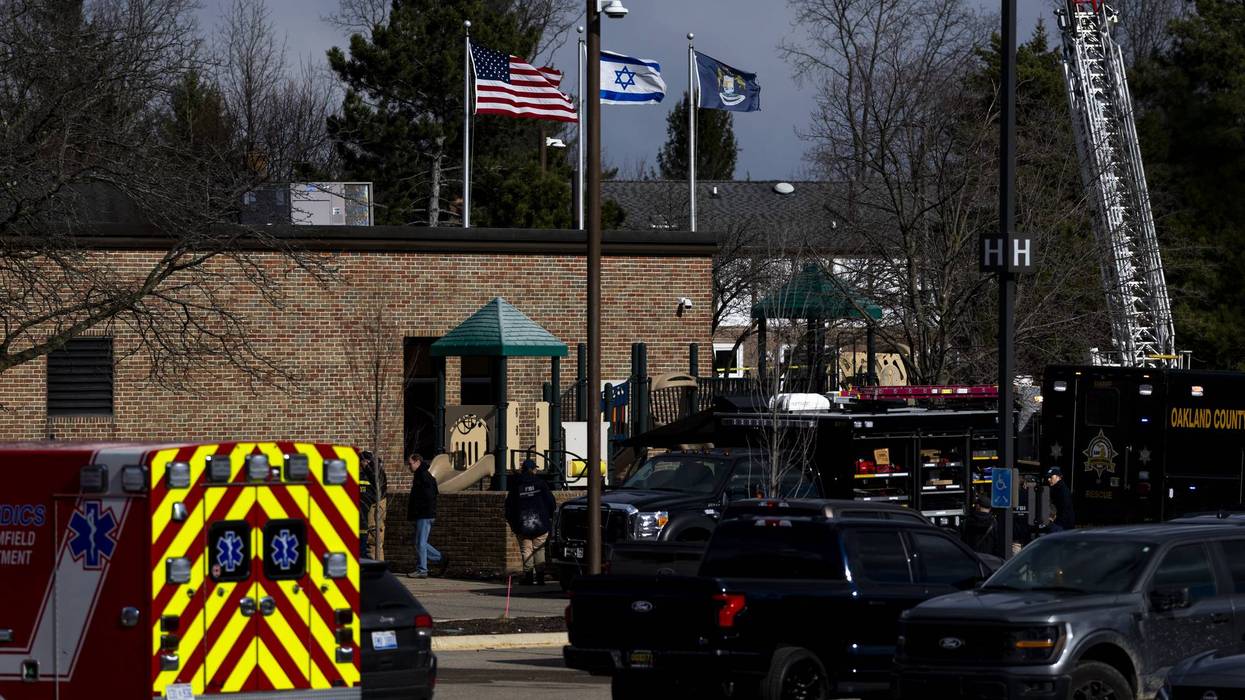
The Michigan man who rammed his vehicle into a suburban Detroit synagogue Thursday lost four relatives to an Israeli airstrike in Lebanon last week, according to an official in the Lebanese town where the massacre occurred.
Ayman Mohamad Ghazali—a 41-year-old naturalized US citizen born in Lebanon—was killed during a shootout with security guards at the Temple Israel synagogue in West Bloomfield Township after crashing his truck into the building. Authorities said the vehicle contained mortar-type explosives and ignited upon impact. One security guard was struck by the vehicle.
No one else inside the synagogue was injured. Cassi Cohen, Temple Israel's director of strategic development, told The Associated Press that “thankfully, we have had many active shooter drills and our staff is prepared for these situations."
Jennifer Runyan, the FBI special agent in charge of the bureau's Detroit field office, described the attack as a “targeted act of violence against the Jewish community."
However, a local official in Mashgharah, a town in the Beqaa Valley of Lebanon, told the AP on condition of anonymity that Ghazali's two brothers, niece, and nephew were among five people killed by a March 5 Israeli airstrike on their home while they were eating their fast-breaking dinner during the Muslim holy month of Ramadan.
US investigative journalist Ryan Grim published photos reportedly posted by Ghazali showing his four slain relatives.
Numerous observers called the attack on Temple Israel—which flies an Israeli flag outside the building—"blowback" from Israel's renewed war on Hezbollah in Lebanon, which was launched despite a November 2024 ceasefire agreement alongside the US-Israeli war on Iran.
"The guy's family was killed last week by Israel and he was taking revenge. That’s wrong. Murder is wrong," US political commentator and author Matt Stoller, who is Jewish American, said on X. "But this isn’t some uptick of antisemitism, it’s blowback. A lot of us have been saying that Israel is bad for the Jews. It is. We have to reject that country."
Others cautioned against conflating Israel with Judaism, with Grim asserting that "it is extremely important we separate the actions of a foreign government from an American synagogue, or any synagogue."
Rights groups have noted a dramatic rise in both Islamophobia and antisemitism following the Hamas-led attack of October 7, 2023 and Israel's genocidal retaliation.
Jewish Voice for Peace (JVP)—which has led numerous protests against Israel's war on Gaza—said Friday that "Jewish communities, like all people, deserve to be safe in our houses of worship and schools."
"The person who reportedly carried out this attack was a man whose siblings, niece, and nephew were just murdered in Lebanon by Israeli bombs," JVP continued. "This is grief upon grief. War always begets trauma and further violence."
"It is clear that the Israeli government’s atrocities make all of us—including Jews—less safe," JVP added. "Israel carries out brutal wars and genocide against families and children, then falsely claims these war crimes are done in the name of Jews. This leads to more antisemitism."
"War always begets trauma and further violence."
More than 4,700 people have been killed in Lebanon by Israeli forces since October 2023, including over 1,100 women and children, according to Lebanese officials.
Israeli forces have also killed or wounded over 250,000 Palestinians in Gaza and the illegally occupied West Bank since the October 2023 attack. US and Israeli attacks on Iran have slain or injured thousands more people.
Originally coined by the CIA in the wake of its 1953 coup in Iran to describe the unintended and often deadly consequences of covert or military action, the concept of blowback gained widespread popularity after the September 11, 2001 attack on the United States, which is often regarded as a classic example of the term in action.

Headlined "U.S. Seeks Other Ways to Stop Iran Shy of War," the article was tucked away on page A9 of a recent New York Times. Still, it caught my attention. Here's the first paragraph:
"American intelligence and military officers are working on additional clandestine plans to counter Iranian aggression in the Persian Gulf, pushed by the White House to develop new options that could help deter Tehran without escalating tensions into a full-out conventional war, according to current and former officials."
Note that "Iranian aggression." The rest of the piece, fairly typical of the tone of American media coverage of the ongoing Iran crisis, included sentences like this: "The C.I.A. has longstanding secret plans for responding to Iranian provocations." I'm sure I've read such things hundreds of times without ever really stopping to think much about them, but this time I did. And what struck me was this: rare is the moment in such mainstream news reports when Americans are the "provocative" ones (though the Iranians immediately accused the U.S. military of just that, a provocation, when it came to the U.S. drone its Revolutionary Guard recently shot down either over Iranian air space or the Strait of Hormuz). When it comes to Washington's never-ending war on terror, I think I can say with reasonable confidence that, in the past, the present, and the future, the one phrase you're not likely to find in such media coverage will be "American aggression."
I mean, forget the history of the second half of the last century and all of this one so far. Forget that back in the Neolithic age of the 1980s, before Iraqi autocrat Saddam Hussein turned out to be the new Adolf Hitler and needed to be taken down by us (no aggression there), the administration of President Ronald Reagan actively backed his unprovoked invasion of, and war against, Iran. (That included his use of chemical weapons against Iranian troop concentrations that American military intelligence helped him target.) Forget that, in 2003, the administration of George W. Bush launched an unprovoked war of aggression against Iraq, based on false intelligence about Saddam's supposed weapons of mass destruction and his supposed links to al-Qaeda. Forget that the Trump administration tore up a nuclear agreement with Iran to which that country was adhering and which would indeed have effectively prevented it from producing nuclear weapons for the foreseeable future. Forget that its supreme leader (in fatwas he issued) prohibited the creation or stockpiling of such weaponry in any case.
Forget that the Trump administration, in a completely unprovoked manner, imposed crippling sanctions on that country and its oil trade, causing genuine suffering, in hopes of toppling that regime economically as Saddam Hussein's had been toppled militarily in neighboring Iraq in 2003, all in the name of preventing the atomic weapons that the Obama-negotiated pact had taken care of. Forget the fact that an American president, who, at the last moment, halted air strikes against Iranian missile bases (after one of their missiles shot down that American drone) is now promising that an attack on "anything American will be met with great and overwhelming force... In some areas, overwhelming will mean obliteration."
Provocations? Aggression? Perish the thought!
And yet, just ask yourself what Washington and the Pentagon might do if an Iranian drone were spotted off the East Coast of the United States (no less in actual U.S. air space). No more need be said, right?
So here's the strange thing, on a planet on which, in 2017, U.S. Special Operations forces deployed to 149 countries, or approximately 75% of all nations; on which the U.S. has perhaps 800 military garrisons outside its own territory; on which the U.S. Navy patrols most of its oceans and seas; on which U.S. unmanned aerial drones conduct assassination strikes across a surprising range of countries; and on which the U.S. has been fighting wars, as well as more minor conflicts, for years on end from Afghanistan to Libya, Syria to Yemen, Iraq to Niger in a century in which it chose to launch full-scale invasions of two countries (Afghanistan and Iraq), is it truly reasonable never to identify the U.S. as an "aggressor" anywhere?
What you might say about the United States is that, as the self-proclaimed leading proponent of democracy and human rights (even if its president is now having a set of love affairs with autocrats and dictators), Americans consider ourselves at home just about anywhere we care to be on planet Earth. It matters little how we may be armed and what we might do. Consequently, wherever Americans are bothered, harassed, threatened, attacked, we are always the ones being provoked and aggressed upon, never provoking and aggressing. I mean, how can you be the aggressor in your own house, even if that house happens to be temporarily located in Afghanistan, Iraq, or perhaps soon enough in Iran?
A Planet of Aggressors and Provocateurs
To mine the same New York Times piece a little more, here's another paragraph:
"Some officials believe the United States needs [to] be willing to master the kind of deniable, shadowy techniques Tehran has perfected in order to halt Iran's aggressions. Others think that, while helpful, such clandestine attacks will not be enough to reassure American allies or deter Iran."
Of course, such clandestine American attacks would, by definition, not be "aggression," not given that they were directed against Iran. Forget the grim historical humor lurking in the above passage, since the present Iranian religious hard-liners probably wouldn't be there if, back in 1953, the CIA hadn't used just such techniques to overthrow a democratically elected Iranian government and install its own autocrat, the young Shah, in power.
As that Times piece also emphasizes, Iran now uses "proxy forces" throughout the region (indeed it does!) against U.S. (and Israeli) power, a tactic Americans evidently just hadn't thought about employing themselves in this century -- until now. Americans naturally have no proxy forces in the Greater Middle East. That's a well-known fact. Just out of curiosity, however, what would you call the local forces our special ops guys are training and advising in so many of those 149 countries around the planet, since obviously they could never be proxy forces? And how about the Afghan and Iraqi militaries that the U.S. trained, supplied with weaponry, and advised in these years? (You know, the Iraqi army that collapsed in the face of ISIS in 2014 or the Afghan security forces that have been unable to staunch either the growth of the Taliban or of the Afghan branch of ISIS.)
Now, don't get me wrong. Yes, the Iranians can (and sometimes do) provoke and aggress. It's an ugly planet filled with aggression and provocation. (Take Vladimir Putin's Russia in Crimea and Ukraine, for instance.) The Chinese are now aggressing in the South China Sea where the U.S. Navy regularly conducts "freedom of navigation" operations -- though no provocation there, as the Pacific's an American lake, isn't it?
In short, when it comes to provocation and aggression, the world is our oyster. There are so many bad guys out there and then, of course, there's us. We can make mistakes and missteps, we can kill staggering numbers of civilians, destroy cities, uproot populations, create hordes of refugees with our never-ending wars across the Greater Middle East and Africa, but aggression? What are you thinking?
One thing is obvious if you follow the mainstream media: in our world, no matter what we do, we're still the good guys on a planet filled with provocateurs and aggressors of every sort.
War to the Horizon
Now let's think for a moment about that remarkable American comfort level, that unprecedented sense of being at home practically anywhere on Earth we choose to send armed Americans -- and while we're at it, let's consider a related subject: America's wars.
If, in the early 1970s, you had told me or any other American that, in the nearly half-century to come, the U.S. would fight wars and other lesser conflicts of almost every imaginable sort in startling numbers of places thousands of miles from home, including Afghanistan, Iraq, Libya, Somalia, Syria, and Yemen, countries most Americans couldn't then (or now) find on a map, I guarantee you one thing: we would have thought you were nuts. (Of course, if you had described Donald Trump's White House to me then as our future reality, I would have considered you beyond delusional.)
And yet here we are. Think about Afghanistan for a moment. In those distant days of the last century, that country would undoubtedly have been known here only to small numbers of young adventurers eager to hike what was then called "the hippy trail." There, in a still remarkably peaceful place, a young American might have been greeted with remarkable friendliness and then spaced out on drugs.
That, of course, was before Washington's first (covert) Afghan War, the one the CIA oversaw, with the help of Saudi money (yes, even then!) and a major hand from the Pakistani intelligence services. Do you remember that conflict, which began in 1979 and ended a decade later with the Red Army limping out of Kabul in defeat, heading for a land, the Soviet Union, which would implode within two years? What a "victory" that proved to be for America, not to speak of the groups of extremist Islamic militants we helped to fund and support, including a young Saudi named Osama bin Laden.
And keep in mind as well that that was our "short" war in Afghanistan, a mere decade long. In October 2001, soon after the 9/11 attacks, instead of launching a police action against Osama bin Laden and crew, the administration of George W. Bush decided to invade that country. Almost 18 years later, the U.S. military is still fighting there (remarkably unsuccessfully) against a thoroughly rejuvenated Taliban and a new branch of ISIS. It now qualifies as the longest war in our history (without even adding in that first Afghan War of ours).
As we head into election season 2020, don't imagine that we're the good guys on Planet Earth.
And then, of course, there's Iraq. By my count, the U.S. has been involved in four conflicts involving that country, starting with Saddam Hussein's invasion of Iran in 1980 and the ensuing war, which the administration of President Ronald Reagan supported militarily (as the present one does the Saudi war in Yemen). Then there was President George H.W. Bush's war against Saddam Hussein after his military invaded Kuwait in 1990, which resulted in a resounding (but by no means conclusive) victory and the kind of victory parade in Washington that Donald Trump can only dream of. Next, of course, was President George W. Bush's 2003 invasion and occupation of Iraq (mission accomplished!), a grim and unsatisfying eight-year conflict from which President Barack Obama withdrew U.S. troops in 2011. The fourth war followed in 2014 when the U.S.-trained Iraqi military collapsed in the face of relatively small numbers of ISIS militants, a group that was an offshoot of al-Qaeda in Iraq, which didn't exist until the U.S. invaded that country. That September, President Obama loosed the U.S. air force on Iraq and Syria (so you can add a fifth war in a neighboring country to the mix) and sent U.S. troops back into Iraq and into Syria where they still remain.
Oh, yes, and don't forget Somalia. U.S. troubles there began with the famed Black Hawk Down incident amid the Battle of Mogadishu in 1993 and never, in a sense, really ended. Today, U.S. Special Operations forces are still on the ground there and U.S. air strikes against a Somali militant Islamic group, al-Shabaab, have actually been on the rise in the Trump era.
As for Yemen, from the first U.S. drone strike there in 2002, the U.S. had been in an on-again, off-again low-level conflict there that included commando raids, cruise missile attacks, air strikes, and drone strikes against al-Qaeda in the Arabian Peninsula, another offshoot of the original al-Qaeda. Since, in 2015, the Saudis and the United Arab Emirates launched their war against Houthi rebels (backed by Iran) who had come to control significant parts of the country, the U.S. has been supporting them with weaponry, intelligence, and targeting, as well as (until late last year) mid-air refueling and other aid. Meanwhile, that brutal war of destruction has led to staggering numbers of Yemeni civilian casualties (and widespread starvation), but as with so many of the other campaigns the U.S. has involved itself in across the Greater Middle East and Africa it shows no sign of ending.
And don't forget Libya, where the U.S. and NATO intervened in 2011 to help rebels take down Muammar Gaddafi, the local autocrat, and in the process managed to foster a failed state in a land now experiencing its own civil war. In the years since 2011, the U.S. has sometimes had commandos on the ground there, has launched hundreds of drone strikes (and air strikes), often against a branch of ISIS that grew up in that land. Once again, little is settled there, so we can all continue to sing the Marine Hymn ("...to the shores of Tripoli") with a sense of appropriateness.
And I haven't even mentioned Pakistan, Niger, and god knows where else. You should also note that the American forever war on terror has proven a remarkably effective war for terror, clearly helping to foster and spread such groups, aggressors and provocateurs all, around significant parts of the planet, from the Philippines to the Congo.
Addicted to war? Not us. Still, all in all, it's quite a record and let's not forget that looming on the horizon is another possible war, this time with Iran, a country that the men overseeing the invasion of Iraq in 2003 (including present National Security Advisor John Bolton) were eager to go after even then. "Everyone wants to go to Baghdad," so the saying reputedly went in Washington at the time. "Real men want to go to Tehran." And it's just possible that, in 2019, Bolton and crew will be able to act on that much delayed urge. Considering the history of American wars in these years, what could possibly go wrong?
To sum up, no one should ever claim that we Americans aren't "at home" in the world. We're everywhere, remarkably well funded and well armed and ready to face off against the aggressors and provocateurs of this planet. Just one small suggestion: thank the troops for their service if you want, and then, as most Americans do, go about your business as if nothing were happening in those distant lands. As we head into election season 2020, however, just don't imagine that we're the good guys on Planet Earth. As far as I can tell, there aren't many good guys left.

Joe Biden just put a spotlight on his mindset when he explicitly refused to apologize for fondly recalling how the Senate "got things done" with "civility" as he worked alongside some of the leading racist lawmakers of the 20th century. For Biden, the personal is the political; he knows that he's virtuous, and that should be more than good enough for African Americans, for women, for anyone.
"There's not a racist bone in my body," Biden exclaimed Wednesday night, moments after demanding: "Apologize for what?" His deep paternalism surfaced during the angry outburst as he declared: "I've been involved in civil rights my whole career, period, period, period."
"Joe Biden is the biggest threat to Joe Biden's political future."
Biden has been "involved" in civil rights his "whole career" alright. But at some crucial junctures, he was on the wrong side. He teamed up with segregationist senators to oppose busing for school desegregation in the 1970s. And he played a leading role--while pandering to racism with a shameful Senate floor speech--for passage of the infamous 1994 crime bill that fueled mass incarceration.
Such aspects of Biden's record provide context for his comments this week--praising an era of productive "civility" with the virulent segregationist Dixiecrat Senators Herman Talmadge of Georgia and James Eastland of Mississippi (known as the "Voice of the White South"), who often called black people "an inferior race."
Said Biden at a New York fundraiser Tuesday night: "Well guess what? At least there was some civility. We got things done. We didn't agree on much of anything. We got things done. We got it finished."
To Biden, any assessment of his past conduct that clashes with his high self-regard is unfair; after all, he really means well. On the campaign trail now, his cloying paternalism is as evident as his affinity for wealthy donors.
Biden shuttles between the billionaire class and the working class--funded by the rich while justifying the rich to everyone else. His aspirations are bound up in notions of himself as comforter-in-chief.
"I get it, I get it," Biden said during his brief and self-adulatory non-apology video in early April to quiet the uproar over his invasive touching of women and girls. He was actually saying: I get it that I need to seem to get it.
"I want to talk about gestures of support and encouragement that I've made to women and some men that have made them uncomfortable," Biden said in the video. "In my career I've always tried to make a human connection--that's my responsibility, I think. I shake hands, I hug people, I grab men and women by the shoulders and say, 'You can do this'. . . It's the way I've always been. It's the way I've tried to show I care about them and I'm listening."
Weeks later, appearing on ABC's "The View," he declared: "I have never in my life, never, done anything in approaching a woman that has been other than trying to bring solace." It was not a credible claim; consider Lucy Flores, or the countless other women and girls he has intrusively touched over the years.
For several decades, Biden has made his way through the political terrain as a reflexive glad-hander. But times have changed a lot more than he has. "What the American people do not know yet is whether Biden has actually internalized any of the blowback he's earned over the years for his treatment of women," journalist Joe Berkowitz wrote last week. "So far, it's not looking good."
"Biden sees his public roles of winking patriarch, civility toward racists and collaborator with oligarchs as a winning political combination. But if he becomes the Democratic presidential nominee, Biden will suppress turnout from the party's base while providing Republicans with plenty of effective (albeit hypocritical) fodder."
What's also looking grim is Biden's brazen adoration of wealthy elites who feed on corporate power. His approach is to split the rhetorical difference between the wealthy and the workers. And so, days ago, at a fundraiser filled with almost 180 donors giving his campaign the legal limit of $2,800 each--an event where he tried and failed to get funding from a pro-Trump billionaire--Biden declared: "You know, you guys are great but Wall Street didn't build America. You guys are incredibly important but you didn't build America. Ordinary, hard-working, middle-class people given half the chance is what built America."
The formula boils down to throwing the "hard-working middle class" some rhetorical bones while continuing to service "you guys" on Wall Street. Given his desire to merely revert the country to pre-Trump days, no wonder Biden keeps saying that a good future can stem from finding common ground with Republicans. But for people who understand the present-day GOP and really want a decent society, Biden's claims are delusional.
Biden sees his public roles of winking patriarch, civility toward racists and collaborator with oligarchs as a winning political combination. But if he becomes the Democratic presidential nominee, Biden will suppress turnout from the party's base while providing Republicans with plenty of effective (albeit hypocritical) fodder. Already the conservative press is salivating over the transparently fraudulent pretenses of Lunch Bucket Joe, as in this headline Tuesday in the right-wing Washington Examiner: "Biden Rubs Elbows With Billionaires in $34M Penthouse."
When Bernie Sanders (who I continue to actively support) denounces the political power of billionaires and repeats his 2020 campaign motto--"Not Me. Us."--it rings true, consistent with his decades-long record. But Biden can't outrun his own record, which is enmeshed in his ongoing mentality. And so, the former vice president is in a race between his pleasant image and unpleasant reality.
As the frontrunner for the Democratic presidential nomination, Joe Biden is the biggest threat to Joe Biden's political future. He continues to be who he has been, and that's the toxic problem.

Don't try to deny it! The political temperature of this country is rising fast. Call it Trump change or Trump warming, if you want, but grasp one thing: increasingly, you're in a different land and, whatever happens to Donald Trump, the results down the line are likely to be ever less pretty. Trump change isn't just an American phenomenon, it's distinctly global. After all, from Australia to India, the Philippines to Hungary, Donald Trumps and their supporters keep getting elected or reelected and, according to a recent CNN poll, a majority of Americans think Trump himself will win again in 2020 (though, at the moment, battleground-state polls look grim for him).
Still, whether or not he gets a second term in the White House, he only seems like the problem, partially because no president, no politician, no one in history has ever gotten such 24/7 media coverage of every twitch, tweet, bizarre statement, falsehood, or fantasy he expresses (or even the clothes he wears). Think of it this way: we're in a moment in which the only thing the media can't imagine saying about Donald Trump is: "You're fired!" And believe me, that's just one sign of a media -- and a country -- with a temperature that's anything but 98.6.
Since you-know-who is always there, always being discussed, always @(un)realdonaldtrump, it's easy enough to imagine that everything that's going wrong -- or, if you happen to be part of his famed base, right (even if that right isn't so damned hot for you) -- is due to him. When we're gripped by such thinking and the temperature's rising, it hardly matters that just about everything he's "done" actually preceded him. That includes favoring the 1%, deporting record numbers of illegal immigrants, and making war (unsuccessfully) or threatening to do so across significant parts of the planet.
Here, then, is the question of the day, the sort you'd ask about any patient with a rising temperature: If Donald Trump is only the symptom, what's the disease?
Blowback Central
Let me say that the late Chalmers Johnson would have understood President Trump perfectly. The Donald clearly arrived on the scene as blowback -- the CIA term of tradecraft Johnson first put into our everyday vocabulary -- from at least two things: an American imperium gone wrong with its never-ending wars, ever-rising military budgets, and ever-expanding national security state, and a new "gilded age" in which three men (Bill Gates, Jeff Bezos, and Warren Buffett) have more wealth than the bottom half of society and the .01% have one of their own, a billionaire, in the Oval Office. (If you want to add a third blowback factor, try a media turned upside down by new ways of communicating and increasingly desperate to glue eyes to screens as ad revenues, budgets, and staffs shrank and the talking heads of cable news multiplied.)
Now, I don't mean to sell Donald Trump short in any way. Give that former reality TV star credit. Unlike either Hillary Clinton or any of his Republican opponents in the 2016 election campaign, he sensed that there were voters in profusion in the American heartland who felt that things were not going well and were eager for a candidate just like the one he was ready to become. (There were, of course, other natural audiences for a disruptive, self-promoting billionaire as well, including various millionaires and billionaires ready to support him, the Russians, the Saudis... well, you know the list). His skill, however, never lay in what he could actually do (mainly, in these years, cut taxes for the wealthy, impose tariffs, and tweet his head off). It lay in his ability to catch the blowback mood of that moment in a single slogan -- Make America Great Again, or MAGA -- that he trademarked in November 2012, only days after Mitt Romney lost his bid for the presidency to Barack Obama.
Yes, four years later in the 2016 election, others began to notice the impact of that slogan. You couldn't miss the multiplying MAGA hats, after all. Hillary Clinton's advisers even briefly came up with the lamest response imaginable to it: Make America Whole Again, or MAWA. But what few at the time really noted was the crucial word in that phrase: "again." Politically speaking, that single blowback word might then have been the most daring in the English language. In 2016, Donald Trump functionally said what no other candidate or politician of any significance in America dared to say: that the United States was no longer the greatest, most indispensable, most exceptionable nation or superpower or hyper-power ever to exist on Planet Earth.
That represented a groundbreaking recognition of reality. At the time, it didn't matter whether you were Barack Obama, Hillary Clinton, or Marco Rubio, you had to acknowledge some version of that formula of exceptionalism. Trump didn't and, believe me, that rang a bell in the American heartland, where lots of people had felt, however indirectly, the blowback from all those years of taxpayer-funded fruitless war, while not benefitting from infrastructure building or much of anything else. They experienced blowback from a country in which new billionaires were constantly being created, while the financial distance between CEO salaries and those of workers grew exponentially vaster by the year, and the financing of the political system became a 1% affair.
With that slogan, The Donald caught the spirit of a moment in which both imperial and economic decline, however unacknowledged by the Washington political elite, had indeed begun. In the process, as I wrote at that time, he crossed a psychologically taboo line and became America's first declinist candidate for president. MAGA captured a feeling already at large that tomorrow would be worse than today, which was already worse than yesterday. As it turned out, it mattered not at all that the billionaire conman spouting that trademarked phrase had long been part of the problem, not the solution.
He caught the essence of the moment, in other words, but certainly didn't faintly cause it in the years when he financed Trump Tower, watched his five Atlantic City casinos go bankrupt, and hosted The Apprentice. In that election campaign, he captured a previously forbidden reality of the twenty-first century. For example, I was already writing this in June 2016, five months before he was elected president:
"In its halcyon days, Washington could overthrow governments, install Shahs or other rulers, do more or less what it wanted across significant parts of the globe and reap rewards, while (as in the case of Iran) not paying any price, blowback-style, for decades, if at all. That was imperial power in the blaze of the noonday sun. These days, in case you hadn't noticed, blowback for our imperial actions seems to arrive as if by high-speed rail (of which by the way, the greatest power on the planet has yet to build a single mile, if you want a quick measure of decline).
"Despite having a more massive, technologically advanced, and better funded military than any other power or even group of powers on the planet, in the last decade and a half of constant war across the Greater Middle East and parts of Africa, the U.S. has won nothing, nada, zilch. Its unending wars have, in fact, led nowhere in a world growing more chaotic by the second."
Mind you, three years later the United States remains a staggeringly powerful imperial force, with hundreds of military bases still scattered across the globe, while its economic clout -- its corporations control about half the planet's wealth -- similarly remains beyond compare. Yet, even in 2016, it shouldn't have been hard to see that the American Century was indeed ending well before its 100 years were up. It shouldn't have been hard to grasp, as Donald Trump intuitively did, that this country, however powerful, was already both a declining empire -- thank you, George W. Bush for invading Iraq! Mission Accomplished! -- and a declining economic system (both of which still looked great indeed, if you happened to be profiting from them). That intuition and that slogan gave Trump his moment in... well, dare I call it "the afternoon sun"? They made him president.
MTPGA
In a sense, all of this should have been expectable enough. Despite the oddity of Donald Trump himself, there was little new in it, even for the imperial power that its enthusiasts once thought stood at "the end of history." You don't need to look far, after all, for evidence of the decline of empires. You don't even have to think back to the implosion of the Soviet Union in 1991, almost three decades ago in what now seems like the Stone Age. (Admittedly, Russian President Vladimir Putin, a brilliant imagineer, has brought back a facsimile of the old Soviet Union, even if, in reality, Russia is now a rickety, fraying petro-state.)
Just take a glance across the Atlantic at Great Britain at this moment. And imagine that three-quarters of a century ago, that modest-sized island nation still controlled all of India, colonies across the planet, and an impressive military and colonial service. Go back even further and you'll find yourself in a time when it was the true superpower of planet Earth. What a force it was -- industrially, militarily, colonially -- until, of course, it wasn't.
If you happen to be looking for imperial lessons, you could perhaps say that some empires end not with a bang but with a Brexit. Despite all the pomp and circumstance (tweeting and insults) during the visit of the Trump royal family (Donald, Melania, Ivanka, Jared, Donald Jr., Eric, and Tiffany) to the British royals, led by a queen who, at 93, can remember better days, here's something hard to deny: with Brexit (no matter how it turns out), the Earth's former superpower has landed in the sub-basement of history. Great Britain? Obviously that adjective has to change.
In the meantime, across the planet, China, another once great imperial power, perhaps the greatest in the long history of this planet, is clearly on the rise again from another kind of sub-basement. That, in turn, is deeply worrying the leadership, civilian and military, of the planet's "lone superpower." Its president, in response, is wielding his weapon of choice -- tariffs -- while the U.S. military prepares for an almost unimaginable future war with that upstart nation, possibly starting in the South China Sea.
Meanwhile, the still-dominant power on the planet is, however incrementally, heading down. It's nowhere near that sub-basement, of course -- anything but. It's still a rich, immensely powerful land. Its unsuccessful wars, however, go on without surcease, the political temperature rises, and democratic institutions continue to fray -- all of which began well before Donald Trump entered the Oval Office and, in fact, helped ensure that he would make it there in the first place.
And yet none of this, not even imperial decline itself, quite captures the "disease" of which The Donald is now such an obvious symptom. After all, while the rise and fall of imperial powers has been an essential part of history, the planetary context for that process is now changing in an unprecedented way. And that's not just because, since the 1945 atomic bombings of Hiroshima and Nagasaki, growing numbers of countries have come to possess the power to take the planet down in a cataclysm of fire and ice (as in nuclear winter). It's also because history, as we've known it, including the rise and fall of empires, is now, in a sense, melting away.
Trump change, the rising political temperature stirred by the growing populist right, is taking place in the context of (and, worse yet, aiding and abetting) record global temperatures, the melting of ice across the planet, the rise of sea levels and the future drowning of coastlines (and cities), the creation of yet more refugees, the increasing fierceness of fires and droughts, and the intensification of storms. In the midst of it all, an almost unimaginable wave of extinctions is occurring, with a possible million plant and animal species, some crucial to human existence, already on the verge of departure.
Never before in history has the rise and decline of imperial powers taken place in the context of the decline of the planet itself. Try, for instance, to imagine what a "risen" China will look like in an age in which one of its most populous regions, the north China plain, may by century's end be next to uninhabitable, given the killing heat waves of the future.
In the context of both Trump change and climate change, we're obviously still awaiting our true transformative president, the one who is not a symptom of decline, but a factor in trying to right this country and the Earth before it's too late. You know, the one who will take as his or her slogan, MTPGA (Make The Planet Great Again).
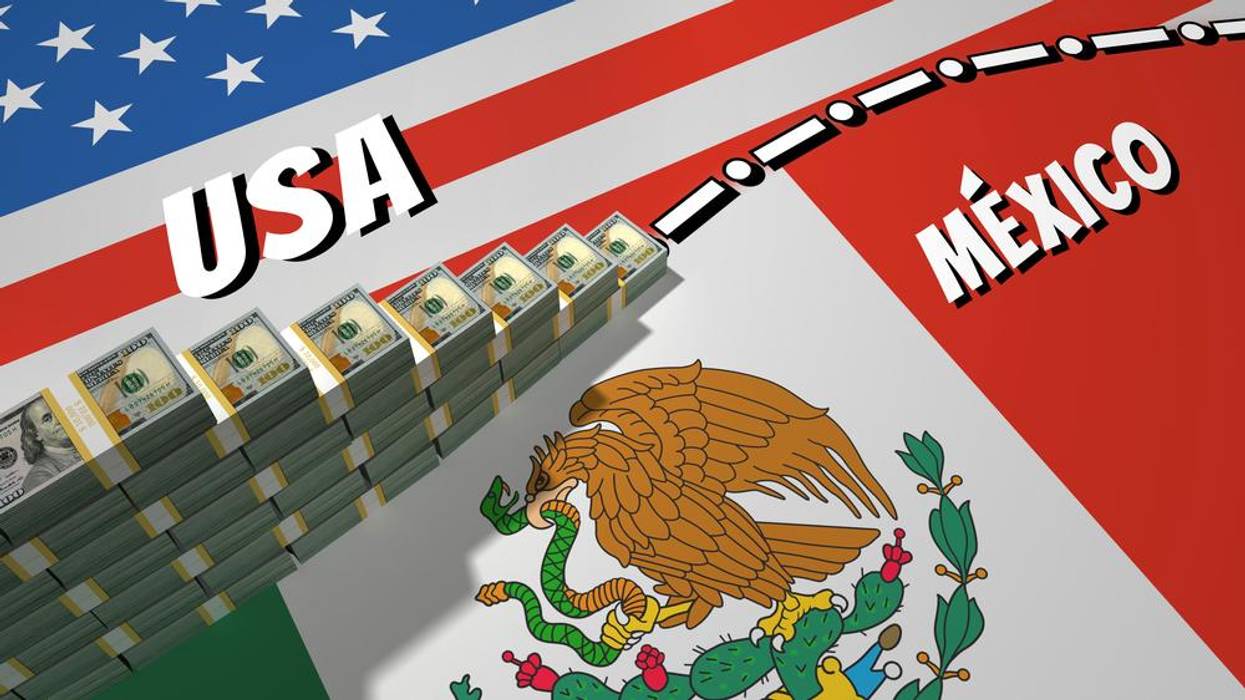
Donald Trump has once again torpedoed the U.S. relationship with Mexico--its third-largest trade partner, closest neighbor and, actually, an ally--by announcing his decision to impose a 5 percent tariff on all Mexican goods if Mexico doesn't stop Central American migrants and refugees from reaching the United States.
Trump, ever the alpha macho, has thrown down the gauntlet to Mexico. His rant written on White House stationary concludes with a direct threat to the Mexican president: "Mexico cannot allow hundreds of thousands of people to pour over its land and into our country--violating the sovereign territory of the United States. If Mexico does not take decisive measures, it will come at a significant price."
The move once again exploits the plight of thousands of families to galvanize a racist electoral base. The tariff measure against Mexico, like the wall, will fire up his supporters-- but he may have gone too far this time. Trump has gotten pushback from Republicans, business, and for the first time, from south of the border.
Mexico's president Andres Manuel Lopez Obrador fired off a letter retorting that "social problems are not solved with taxes or coercive measures." He reiterated his commitment to addressing the root causes of displacement and cited FDR's defense of the rights of freedom from want and freedom from fear. He ended politely but pointedly: "Please remember that I do not lack courage, that I am not a cowardly nor timid, but rather I act on principles."
After six months of enduring Trump's bluster, the tariff threat seems to have finally cracked the appeasement strategy of the new Mexican government. After months of capitulation--including flowery letters of praise that bewildered Mexicans who, if they agree on anything, agree on being vehemently against Trump--AMLO's sharp defense of Mexican sovereignty signals a shift in more than tone. The Mexican president said he does not want confrontation and much less to resort to retaliatory tariffs, but his letter makes it clear it's No More Mr. Nice Guy either.
An Absurd Ploy
Given this bold stance, the question is: What are the likely scenarios for the tariff threat, and the binational relationship in general?
The sheer absurdity of Trump's order renders it unworkable in political and even practical terms. According to the plan, the tariff, effective June 10 under the "International Emergency Economic Powers Act," would increase by 5 percent a month to 25 percent, and stay there if Mexico fails in the impossible--and probably illegal--task of running interference against migrant and refugee families for the U.S.
Unless AMLO takes a sudden sharp turn into Orwellian territory where no one is allowed to move about or speak freely, Mexico cannot stop immigration. There is no period or place in human history without human migrations. Migration always exists--U.S. immigration laws only determine whether it's documented or undocumented. The Republican administration has not even tried to adjust those laws to labor markets and other socioeconomic realities.
Other premises of the "emergency measure" are equally absurd. It should come as a relief to know that the number of migrants today is neither unprecedented nor unmanageable, that there is no basis for considering desperate families a security threat, and that this wave of migration is mostly not, in legal terms, illegal--it's asylum seekers immediately reporting to authorities for processing.
There's nothing "uncontrollable" about that--the U.S. government simply has to develop the mechanisms to attend to it in the terms established by national and international law that assure the right to safety for all human beings, and especially children, no matter where they happen to be born.
The countries people are fleeing--notably Honduras, Guatemala, and El Salvador--expel their own citizens in large part due to patterns of violence established by U.S. policies.
The countries people are fleeing--notably Honduras, Guatemala, and El Salvador--expel their own citizens in large part due to patterns of violence established by U.S. policies. These include supporting death squads and genocide, bolstering repressive dictatorships past and present, exporting the U.S. gang model, backing megaprojects that displace local communities and repress resistance, and spreading an economic model of inequality that leaves little or nothing to impoverished families with children to feed.
Ending policies that generate violence and repression, like the war on drugs and inequitable development practices, could fairly quickly give Central American families the option to stay home. This doesn't even require more U.S. aid.
These arguments are well known, and yet the "solutions" coming out of the White House place the onus on Mexico. Trump's statement reads: "If the illegal migration crisis is alleviated through effective actions taken by Mexico, to be determined in our sole discretion and judgment, the Tariffs will be removed."
Donald Trump's "sole discretion and judgment" is not a reasonable criterion in a critical binational relationship.
In the end, Mexico might not have anything to worry about. Trump faces some serious obstacles on the home front. His misuse of the Emergency Economic Powers Act, according to experts, will certainly spur lawsuits to block the tariff imposition.
Many Republican leaders are not on board either. Senate Finance Chair Chuck Grassley came out stating bluntly, "I support nearly every one of President Trump's immigration policies, but this is not one of them." CNN reports that Treasury Secretary Steven Mnuchin and advisor Jared Kushner warned Trump against the measure.
U.S. trade and manufacturing associations have predictably reacted in a panic, noting that the tariffs would punish U.S. consumers and put in jeopardy entire industries that rely on cross-border supply chains. The National Association of Manufacturers wrote: "These proposed tariffs would have devastating consequences on manufacturers in America and on American consumers." Industry and trade groups are rushing to Washington to lobby against the Mexican tariffs.
But so far, instead of backpedaling--as he did on his "I will close the southern border" threat--Trump is trying to assemble defenders. One of the few willing to enter the fray is trade adviser Peter Navarro. Navarro accused Mexico of "exporting illegal aliens," which he described as a business model (although the vast majority of immigrants are Central American and, under economic theory that he ostensibly has some familiarity with, when you export something you normally receive something for it).
Even the estranged Steve Bannon jumped in, gleefully anticipating a scenario where the tariffs against Mexico are applied in full: "The ratcheting up to 25 percent will get their attention," he gushed.
AMLO's Dilemma
South of the border, AMLO's Secretary of Foreign Relations Marcelo Ebrard praised AMLO's letter (in which he undoubtedly had a hand). The AMLO government has been criticized domestically for a crackdown on immigrants in response to Trump pressures. Now AMLO could gain backing from the Mexican population, and a large part of the U.S. population, if he follows through on promises to stand up to immigration policies that are becoming increasing unpopular even in the United States.
The problem is that the Mexican rhetorical defense of a different approach to immigration--one that respects human rights and addresses structural causes--is not what the government itself is doing on the ground. After initial signs of a change in policy, in recent months the Mexican government has upped deportation, detention rates, and raids. A May report from human rights groups on the Mexico-Guatemala border found a "focus on militarized security" and a "strategy of exhaustion and containment" similar to the United States.
Mexico has a lot to lose and a lot to gain. Both countries announced plans to begin the ratification process for the new trilateral accord that would replace NAFTA. Trump seems to be using the tariffs as leverage against the Mexican government and against Democrats, who have called for modifications to the agreement.
AMLO's government wants the new NAFTA, but says it's not willing to do anything more to get it. Agriculture and some manufacturing would be heavily hit, but what they're more concerned with is the markets. In the long term, Mexico wants to free itself from U.S. economic dependency, in part to avoid being a political hostage. But that's a long process, and the country can't afford major disruptions just as AMLO's signature social programs go into effect.
AMLO also wants to consolidate his image as a reformer--rarely has a president been so focused on legacy so early in the game. Straddling what appear to be contradictory policy goals is creating a crevasse he risks falling into unless makes a clear choice between caving to the abhorrent and coercive policies from the north or building a model that puts human security first and refuses to use Central American refugees as a bargaining chip.
For his part, Trump needs these tariffs to look tough. The latest threat is part of a campaign strategy that's just getting into swing and depends on hostility toward Mexico and immigrants. This means that the untenable and too-often deadly situation this creates for families will get worse, as manufactured blame for a manufactured crisis is used against forces that oppose the white supremacist agenda.
What he isn't factoring in, according to many on his own team, is the blowback. The U.S. stock market fell further than the Mexican market when the tariffs were announced. Higher consumer prices, broken supply chains, retaliatory tariffs on U.S. goods, armed white men in border communities, and rampant hate crime is not a pretty scenario for 2020.

From Syria to Yemen in the Middle East, Libya to Somalia in Africa, Afghanistan to Pakistan in South Asia, an American aerial curtain has descended across a huge swath of the planet. Its stated purpose: combatting terrorism. Its primary method: constant surveillance and bombing -- and yet more bombing. Its political benefit: minimizing the number of U.S. "boots on the ground" and so American casualties in the never-ending war on terror, as well as any public outcry about Washington's many conflicts. Its economic benefit: plenty of high-profit business for weapons makers for whom the president can now declare a national security emergency whenever he likes and so sell their warplanes and munitions to preferred dictatorships in the Middle East (no congressional approval required). Its reality for various foreign peoples: a steady diet of "Made in USA" bombs and missiles bursting here, there, and everywhere.
Think of all this as a cult of bombing on a global scale. America's wars are increasingly waged from the air, not on the ground, a reality that makes the prospect of ending them ever more daunting. The question is: What's driving this process?
For many of America's decision-makers, air power has clearly become something of an abstraction. After all, except for the 9/11 attacks by those four hijacked commercial airliners, Americans haven't been the target of such strikes since World War II. On Washington's battlefields across the Greater Middle East and northern Africa, air power is always almost literally a one-way affair. There are no enemy air forces or significant air defenses. The skies are the exclusive property of the U.S. Air Force (and allied air forces), which means that we're no longer talking about "war" in the normal sense. No wonder Washington policymakers and military officials see it as our strong suit, our asymmetrical advantage, our way of settling scores with evildoers, real and imagined.
Bombs away!
In a bizarre fashion, you might even say that, in the twenty-first century, the bomb and missile count replaced the Vietnam-era body count as a metric of (false) progress. Using data supplied by the U.S. military, the Council on Foreign Relations estimated that the U.S. dropped at least 26,172 bombs in seven countries in 2016, the bulk of them in Iraq and Syria. Against Raqqa alone, ISIS's "capital," the U.S. and its allies dropped more than 20,000 bombs in 2017, reducing that provincial Syrian city to literal rubble. Combined with artillery fire, the bombing of Raqqa killed more than 1,600 civilians, according to Amnesty International.
Meanwhile, since Donald Trump has become president, after claiming that he would get us out of our various never-ending wars, U.S. bombing has surged, not only against the Islamic State in Syria and Iraq but in Afghanistan as well. It has driven up the civilian death toll there even as "friendly" Afghan forces are sometimes mistaken for the enemy and killed, too. Air strikes from Somaliato Yemen have also been on the rise under Trump, while civilian casualties due to U.S. bombing continue to be underreported in the American media and downplayed by the Trump administration.
U.S. air campaigns today, deadly as they are, pale in comparison to past ones like the Tokyo firebombing of 1945, which killed more than 100,000 civilians; the atomic bombings of Hiroshima and Nagasaki later that year (roughly 250,000); the death toll against German civilians in World War II (at least 600,000); or civilians in the Vietnam War. (Estimates vary, but when napalm and the long-term effects of cluster munitions and defoliants like Agent Orange are added to conventional high-explosive bombs, the death toll in Southeast Asia may well have exceeded one million.) Today's air strikes are more limited than in those past campaigns and may be more accurate, but never confuse a 500-pound bomb with a surgeon's scalpel, even rhetorically. When "surgical" is applied to bombing in today's age of lasers, GPS, and other precision-guidance technologies, it only obscures the very real human carnage being produced by all these American-made bombs and missiles.
This country's propensity for believing that its ability to rain hellfire from the sky provides a winning methodology for its wars has proven to be a fantasy of our age. Whether in Korea in the early 1950s, Vietnam in the 1960s, or more recently in Afghanistan, Iraq, and Syria, the U.S. may control the air, but that dominance simply hasn't led to ultimate success. In the case of Afghanistan, weapons like the Mother of All Bombs, or MOAB (the most powerful non-nuclear bomb in the U.S. military's arsenal), have been celebrated as game changers even when they change nothing. (Indeed, the Taliban only continues to grow stronger, as does the branch of the Islamic State in Afghanistan.) As is often the case when it comes to U.S. air power, such destruction leads neither to victory, nor closure of any sort; only to yet more destruction.
Such results are contrary to the rationale for air power that I absorbed in a career spent in the U.S. Air Force. (I retired in 2005.) The fundamental tenets of air power that I learned, which are still taught today, speak of decisiveness. They promise that air power, defined as "flexible and versatile," will have "synergistic effects" with other military operations. When bombing is "concentrated," "persistent," and "executed" properly (meaning not micro-managed by know-nothing politicians), air power should be fundamental to ultimate victory. As we used to insist, putting bombs on target is really what it's all about. End of story -- and of thought.
Given the banality and vacuity of those official Air Force tenets, given the twenty-first-century history of air power gone to hell and back, and based on my own experience teaching such history and strategy in and outside the military, I'd like to offer some air power tenets of my own. These are the ones the Air Force didn't teach me, but that our leaders might consider before launching their next "decisive" air campaign.
Ten Cautionary Tenets About Air Power
1. Just because U.S. warplanes and drones can strike almost anywhere on the globe with relative impunity doesn't mean that they should. Given the history of air power since World War II, ease of access should never be mistaken for efficacious results.
2. Bombing alone will never be the key to victory. If that were true, the U.S. would have easily won in Korea and Vietnam, as well as in Afghanistan and Iraq. American air power pulverized both North Korea and Vietnam (not to speak of neighboring Laos and Cambodia), yet the Korean War ended in a stalemate and the Vietnam War in defeat. (It tells you the world about such thinking that air power enthusiasts, reconsidering the Vietnam debacle, tend to argue the U.S. should have bombed even more -- lots more.) Despite total air supremacy, the recent Iraq War was a disaster even as the Afghan War staggers on into its 18th catastrophic year.
3. No matter how much it's advertised as "precise," "discriminate," and "measured," bombing (or using missiles like the Tomahawk) rarely is. The deaths of innocents are guaranteed. Air power and those deaths are joined at the hip, while such killings only generate anger and blowback, thereby prolonging the wars they are meant to end.
Consider, for instance, the "decapitation" strikes launched against Iraqi autocrat Saddam Hussein and his top officials in the opening moments of the Bush administration's invasion of 2003. Despite the hype about that being the beginning of the most precise air campaign in all of history, 50 of those attacks, supposedly based on the best intelligence around, failed to take out Saddam or a single one of his targeted officials. They did, however, cause "dozens" of civilian deaths. Think of it as a monstrous repeat of the precision air attacks launched on Belgrade in 1999 against Slobodan Milosevic and his regime that hit the Chinese embassy instead, killing three journalists.
Here, then, is the question of the day: Why is it that, despite all the "precision" talk about it, air power so regularly proves at best a blunt instrument of destruction? As a start, intelligence is often faulty. Then bombs and missiles, even "smart" ones, do go astray. And even when U.S. forces actually kill high-value targets (HVTs), there are always more HVTs out there. A paradox emerges from almost 18 years of the war on terror: the imprecision of air power only leads to repetitious cycles of violence and, even when air strikes prove precise, there always turn out to be fresh targets, fresh terrorists, fresh insurgents to strike.
4. Using air power to send political messages about resolve or seriousness rarely works. If it did, the U.S. would have swept to victory in Vietnam. In Lyndon Johnson's presidency, for instance, Operation Rolling Thunder (1965-1968), a graduated campaign of bombing, was meant to, but didn't, convince the North Vietnamese to give up their goal of expelling the foreign invaders -- us -- from South Vietnam. Fast-forward to our era and consider recent signals sent to North Korea and Iran by the Trump administration via B-52 bomber deployments, among other military "messages." There's no evidence that either country modified its behavior significantly in the face of the menace of those baby-boomer-era airplanes.
5. Air power is enormously expensive. Spending on aircraft, helicopters, and their munitions accounted for roughly half the cost of the Vietnam War. Similarly, in the present moment, making operational and then maintaining Lockheed Martin's boondoggle of a jet fighter, the F-35, is expected to cost at least $1.45 trillion over its lifetime. The new B-21 stealth bomber will cost more than $100 billion simply to buy. Naval air wings on aircraft carriers cost billions each year to maintain and operate. These days, when the sky's the limit for the Pentagon budget, such costs may be (barely) tolerable. When the money finally begins to run out, however, the military will likely suffer a serious hangover from its wildly extravagant spending on air power.
6. Aerial surveillance (as with drones), while useful, can also be misleading. Command of the high ground is not synonymous with god-like "total situational awareness." It can instead prove to be a kind of delusion, while war practiced in its spirit often becomes little more than an exercise in destruction. You simply can't negotiate a truce or take prisoners or foster other options when you're high above a potential battlefield and your main recourse is blowing up people and things.
7. Air power is inherently offensive. That means it's more consistent with imperial power projection than with national defense. As such, it fuels imperial ventures, while fostering the kind of "global reach, global power" thinking that has in these years had Air Force generals in its grip.
8. Despite the fantasies of those sending out the planes, air power often lengthens wars rather than shortening them. Consider Vietnam again. In the early 1960s, the Air Force argued that it alone could resolve that conflict at the lowest cost (mainly in American bodies). With enough bombs, napalm, and defoliants, victory was a sure thing and U.S. ground troops a kind of afterthought. (Initially, they were sent in mainly to protect the airfields from which those planes took off.) But bombing solved nothing and then the Army and the Marines decided that, if the Air Force couldn't win, they sure as hell could. The result was escalation and disaster that left in the dust the original vision of a war won quickly and on the cheap due to American air supremacy.
9. Air power, even of the shock-and-awe variety, loses its impact over time. The enemy, lacking it, nonetheless learns to adapt by developing countermeasures -- both active (like missiles) and passive (like camouflage and dispersion), even as those being bombed become more resilient and resolute.
10. Pounding peasants from two miles up is not exactly an ideal way to occupy the moral high ground in war.
The Road to Perdition
If I had to reduce these tenets to a single maxim, it would be this: all the happy talk about the techno-wonders of modern air power obscures its darker facets, especially its ability to lock America into what are effectively one-way wars with dead-end results.
For this reason, precision warfare is truly an oxymoron. War isn't precise. It's nasty, bloody, and murderous. War's inherent nature -- its unpredictability, horrors, and tendency to outlast its original causes and goals -- isn't changed when the bombs and missiles are guided by GPS. Washington's enemies in its war on terror, moreover, have learned to adapt to air power in a grimly Darwinian fashion and have the advantage of fighting on their own turf.
Who doesn't know the old riddle: If a tree falls in the forest and no one is there to hear it, does it make a sound? Here's a twenty-first-century air power variant on it: If foreign children die from American bombs but no U.S. media outlets report their deaths, will anyone grieve? Far too often, the answer here in the U.S. is no and so our wars go on into an endless future of global destruction.
In reality, this country might do better to simply ground its many fighter planes, bombers, and drones. Paradoxically, instead of gaining the high ground, they are keeping us on a low road to perdition.

In this country, reactions to the Mueller report have been all-American beyond belief. Let's face it, when it comes to election meddling, it's been me, me, me, 24/7 here. Yes, in some fashion some set of Russians meddled in the last election campaign, whether it was, as Jared Kushner improbably claimed, "a couple of Facebook ads" or, as the Mueller report described it, "the Russian government interfer[ing]... in sweeping and systematic fashion."
Even though most Americans might find it hard to believe, we weren't exactly the first country to have an election meddled with by an intrusive foreign power with an agenda all its own.
But let me mention just a few of the things that we didn't learn from the Mueller report. We didn't learn that Russian agents appeared at Republican Party headquarters in 2016 with millions of dollars in donations to influence the coming election. (Oops, my mistake! That was CIA agents in the Italian election of 1948!) We didn't learn that a Russian intelligence agency in combination with Chinese intelligence, aided by a major Chinese oil company, overthrew an elected U.S. president and installed Donald Trump in the White House as their autocrat of choice. (Oops, my mistake again! That was the CIA, dispatched by an American president, and British intelligence, with the help of the Anglo-Persian Oil Company, later BP. In 1953, they overthrew Mohammad Mossadegh, the elected prime minister of Iran, and installed the young Shah as an autocratic ruler, the very first -- but hardly the last -- time the CIA successfully ousted a foreign government.) We didn't learn that key advisers to Russian President Vladimir Putin were in close touch with rogue elements of the U.S. military preparing to stage a coup d'etat in Washington, kill President Barack Obama in a direct assault on the White House, and put the head of the Joint Chiefs of Staff in office. (Sorry, again my slip-up and full apologies! That was President Richard Nixon's adviser Henry Kissinger in contact with Chilean military officers who, on September 11, 1973--the first 9/11--staged an armed uprising during which Salvador Allende, the democratically elected socialist president of that country, died and army commander-in-chief Augusto Pinochet took power.) We didn't learn that, at the behest of Vladimir Putin, Russian secret service agents engaged in a series of plots to poison or in some other fashion assassinate Barack Obama during his presidency and, in the end, had at least a modest hand in encouraging those who did kill him after he left office. (Oh, wait, I was confused on that one, too. I was actually thinking about the plots, as the 1960s began, to do in Congolese Prime Minister Patrice Lumumba.) Nor, for that matter, did we learn that the Russian military launched a regime-change-style invasion of this country to unseat an American president and get rid of our weapons of mass destruction and then occupied the country for years after installing Donald Trump in power. (Sorry one more time! What I actually had in mind before I got so muddled up was the decision of the top officials of President George W. Bush's administration, in the wake of the 9/11 attacks, to launch a "regime-change" invasion of Iraq in 2003, based on fraudulent claims that Iraqi despot Saddam Hussein was developing weapons of mass destruction, and install a government of their choice in Baghdad.)
No, none of that happened here. Still, even though most Americans might find it hard to believe, we weren't exactly the first country to have an election meddled with by an intrusive foreign power with an agenda all its own! And really, my examples above just begin an endless list of events the Mueller report didn't mention, ones that most Americans no longer know anything about or we wouldn't have acted as if the Russian election intervention of 2016 stood essentially alone in history.
I don't, however, want that to sound like blame. After all, if you lived in the United States in these years and didn't already know the secret history of American intervention and regime change across the globe from the end of World War II to the collapse of the Soviet Union, you could be forgiven for thinking that never had anyone done anything quite so dastardly as did the Putin regime in attempting to hack and alter the results of an American election. In the media, that Russian intervention has (with the rarest of exceptions) been covered as if it were an event unique in history. Admittedly, whatever the Russians did do in 2016 to lend a hand to Donald Trump, they didn't plan a coup d'etat; it wasn't an assassination attempt; and it wasn't, in the normal sense, what has come to be known as "regime change."
A World of Chaos Without End
Let's start with one thing that should have been (but wasn't) obvious since the first reports on Russian meddling in the election campaign of 2016 began to appear. Historically speaking, such a plan fits well with a classic Russian tradition. As scholar Dov Levin discovered in studying "partisan election interventions" from 1946 to 2000, the Russians -- the Soviet Union until 1991 -- engaged in a staggering 36 of them globally.
Whatever the Russians did do in 2016 to lend a hand to Donald Trump, they didn't plan a coup d'etat; it wasn't an assassination attempt; and it wasn't, in the normal sense, what has come to be known as "regime change."
If, however, you jumped to the conclusion that such an impressive cumulative figure gave the Russians the world's record for election meddling, think again. In fact, it left them languishing in a distant second place when it came to interfering in other countries' elections over more than four decades. The United States took the crown with, by Levin's count, a distinctly imperial 81 interventions! (USA! USA!)
Put another way, the two Cold War superpowers together meddled in approximately "one of every nine competitive elections" in that era in at least 60 countries covering every part of the planet but Oceania. Moreover, only seven of them were in the same election in the same country at the same time.
And elections are but one part of a story of meddling on a scale that has been historically remarkable. In her book Covert Regime Change, Lindsey O'Rourke notes that between 1947 and 1989, a span of nine Cold War-era American administrations, the least number of "U.S.-backed regime-change attempts" per president was three (Gerald Ford's administration), the most 30 (Dwight D. Eisenhower's). Harry Truman's administration came in second with 21, Lyndon Johnson's third with 19, Ronald Reagan's fourth with 16, John F. Kennedy's fifth with 15, and Richard Nixon's sixth with 10.
And keep in mind that, while such numbers remain unprecedented, despite a number of short-term successes from Iran to Guatemala, this was not generally a notable record of success in remaking the world in the image Washington desired. Many of those regime-change attempts, especially against countries in the Soviet bloc, failed dismally. Others created chaos or regimes that not only did their citizens little good but didn't end up doing much for Washington either. Still, that didn't stop one administration after another from trying, which is why the numbers remain mind-boggling.
And then the Soviet Union imploded and there was but a "sole" superpowerleft on Planet Earth. Its leaders had no doubt that its ultimate moment had come and it was to be no less than "the end of history"! The planet was obviously Washington's for the taking. No more need for subterfuge, subtle election meddling, secret support for dissidents, or even covert regime change, not when the only opposition to an American planet was a few weak "rogue states" (think: the "axis of evil," also known as Iran, Iraq, and North Korea), a desperately weakened and impoverished but still nuclear-armed Russia, and a modestly rising future power in Asia.
And then, of course, came 9/11, that staggering act of blowback--in part from one of the great "successes" of CIA covert action in the Cold War, the decisive defeat of the Red Army in Afghanistan thanks to the funding and arming of a set of extremist Islamist militants, a war in which a young Saudi named Osama bin Laden gained a certain modest reputation. On that day in 2001, the last superpower, the one exceptional nation, became the planet's greatest victim and all hell was let loose (just as bin Laden hoped it would be).
In response, in a world without other superpowers, the country with, as one president proudly put it, "the finest fighting force that the world has ever known" no longer needed to meddle secretly (or at least in a fashion that allowed for "plausible deniability"). With the invasion of Afghanistan that October, open regime change became the order of the day. Iraq would come in 2003, Libya in 2011. The U.S. Air Force and the CIA's drones would bomb and missile at least seven countries across the Greater Middle East and North Africa repeatedly in the years to come, helping reduce great cities to rubble, uprooting and displacing massive numbers of people, creating failed states galore, and setting in motion forces that, from Pakistan to Syria, Yemen to Niger, would in turn unsettle a significant part of the planet.
And, of course, it would all prove to be a militarized failure of the first order. And yet, with a potential new conflict ramping up in Iran and the U.S. still fighting in Afghanistan almost 18 years later, America's wars show little sign of winding down. Only recently, for instance, the chairman of the Joint Chiefs of Staff assured a group of senators that the American military would "need to maintain a counterterrorism presence as long as an insurgency continues in Afghanistan," which should be considered the very definition of a forever war. Think of it as a world of chaos without end and now consider again that Russian meddling in an American election.
Exceptional Meddling
So the issue isn't faintly whether Russian electoral meddling was despicable or not. The issue is that it's been covered here, like so much else has in this century, as yet another case of American exceptionalism (but never narcissism).
By the way, whatever the Russians did in 2016 (or may do in the future to American or other elections) is deplorable and should be denounced, no matter how slapdash it might have been. After all, as Dov Levin discovered, it doesn't necessarily take much to affect the result of an election in another country. Here's his conclusion for election meddling in the Cold War era:
"I find that an electoral intervention in favor of one of the sides contesting [an] election has a statistically significant effect, increasing its vote share by about 3%. Such an effect can have major 'real life' implications. For example, such a swing in the vote share from the winner to the loser in the 14 U.S. presidential elections occurring since 1960 would have been sufficient to change the identity of the winner in seven of these elections."
As we all know, a 3% shift in the 2016 election in several states would have made a staggering difference. After all, as the Washington Post reported, in Michigan, Pennsylvania, and Wisconsin, Donald Trump beat Hillary Clinton by "0.2, 0.7, and 0.8 percentage points, respectively--and by 10,704, 46,765, and 22,177 votes. Those three wins gave him 46 electoral votes; if Clinton had done one point better in each state, she'd have won the electoral vote, too."
So the issue isn't faintly whether Russian electoral meddling was despicable or not. The issue is that it's been covered here, like so much else has in this century, as yet another case of American exceptionalism (but never narcissism). As on 9/11--forget that first 9/11 in Chile--we eternally stand alone in our experiences because, by definition, we are the special ones, the ones who matter.
In the case of election meddling, however, this country just joined a moiling crowd of the interfered with--and largely by us. It was a classic case of getting a taste of one's own medicine and not liking it one bit. It should have taught us a lesson about our own global behavior since World War II. Instead, it's simply continued us on a path of exceptional meddling that will prove someday to have been one of the great follies in history.

Here's a statement it might be hard to disagree with: American war is off the charts.
Still, I'd like to explain -- but I'm nervous about doing so. I know perfectly well that the next word I plan to write will send most of you tumbling elsewhere in a universe in which "news" is the latest grotesque mass shooting; the craziest tweet from you-know-who; celebrities marching into court over college-admissions scandals; or even a boy, missing for years, who suddenly turns up only to morph into a 23-year-old impostor with a criminal record. How can America's wars in distant lands compete with that? Which is why I just can't bring myself to write the next word. So promise me that, after you read it, you'll hang in there for just a minute and give me a chance to explain.
Okay, here goes: Somalia.
A country in the horn of Africa, it once glued American eyeballs, but that was so last century, right? I mean, there was that bestselling book and that hit Hollywood movie directed by Ridley Scott (Blade Runner, Alien!) about the disaster early in Bill Clinton's presidency that came to be known as Black Hawk Down (aka the battle of Mogadishu).
In the age of Donald Trump, wasn't that a million presidencies ago? Honestly, can you even tell me anymore what in the world it was all about? I couldn't have, not without looking it up again. A warlord, starvation, U.S. intervention, 18 dead American soldiers (and hundreds of dead Somalis, but that hardly mattered) in a country that was shattering. President Clinton did, however, pull out those troops and end the disastrous mission -- and that was that, right? I mean, lessons learned. Somalia? Africa? What in the world did it all have to do with us? So Washington washed its hands of the whole thing.
And now, on a planet of outrageous tweets and murderously angry white men, you probably didn't even notice, but more than two years into the era of Donald Trump, a quarter-century after that incident, American air strikes in... yep, Somalia, are precipitously on the rise. Last year's 47 strikes, aimed at the leaders and fighters of al-Shabaab, an Islamist terror outfit, more than tripled the ones carried out by the Obama administration in 2016 (themselves a modest increase from previous years). And in 2019, they're already on pace to double again, while Somali civilians -- not that anyone (other than Somali civilians) notices or cares -- are dying in significantand rising numbers. And with 500 troops back on the ground there and Pentagon estimates that they will remain for at least another seven years, the U.S. military is increasingly Somalia-bound, Congress hasn't uttered a peep on the subject, and few in this country are paying the slightest attention.
So consider this a simple fact of the never-ending Global War on Terror (as it was once called): the U.S. military just can't get enough of Somalia. And if that isn't off the charts, what is? Maybe it's even worth a future book (with a very small print run) called not Black Hawk Down II but U.S. Down Forever and a Day.
And now that I've started on the subject (if you still happen to be reading), when it comes to the U.S. military, it's not faintly just Somalia. It's all of Africa. After all, this country's military uniquely has a continent-wide Africa Command (aka AFRICOM), founded in 2007. As Nick Turse has often written for TomDispatch, that command now has its troops, thousands of them, its planes, and other equipment spread across the continent, north to south, east to west -- air bases, drone bases, garrisons, outposts, staging areas, you name it. Meanwhile, AFRICOM's outgoing commanding general, Thomas Waldhauser, only recently told Congress why it's bound to be a forever outfit -- because, shades of the Cold War, the Ruskies are coming! ("Russia is also a growing challenge and has taken a more militaristic approach in Africa.")
And honestly, 600-odd words in, this wasn't meant to be a piece about either Somalia or Africa. It was meant to be about those U.S. wars being off the charts, about how the Pentagon now feeds eternally at the terror trough, al-Shabaab being only a tiny part of the slop it regularly digests. So, for the seven of you still reading, let me change the subject to something a little more appealingly -- to quote a well-known authority -- "ridiculous" when it comes to American war.
A "Ridiculous" War
Maybe you won't be surprised to learn that what I have in mind is the war in Afghanistan, another of Washington's off-the-charts affairs. It might even qualify as the original one (if you don't count Vietnam, which would take you back to the Neolithic Age of the U.S. military's infinite wars). Lest you think I only mean the war that began in Afghanistan after the terror attacks of 9/11, think again. I'm talking about the American war in that distant land that started in 1979, the decade-long conflict in which the U.S. supported extreme Islamists (including a young Saudi named Osama bin Laden) -- they were our guys, then -- to successfully force the Red Army out of Afghanistan.
That was in 1989, 30 years ago, and a triumphant Washington promptly took more than a decade-long holiday, while a brutal set of civil wars continued in already devastated Afghanistan and the Taliban rose to power in most of the country. Then, as in Somalia, having learned their lesson (the wrong one, of course), George W. Bush, Dick Cheney, and crew decided after 9/11 to emulate... well, the Red Army (even though the Soviet Union had imploded a decade earlier) and occupy the Afghan capital, Kabul. For the only great power left on the planet, facing a lightly armed extremist group, what could possibly go wrong?
Seventeen and a half years later, Congress has rarely focused on the war (not) to end all wars and there are still 14,000 American troops (and the usual set of private contractors) there, along with enough U.S. air power to... well, blow up a lot but not change anything decisively. Of course, the Taliban was long ago sent to hell in a hand basket...
...Whoops! The Taliban in 2019 is stronger and in control of more territory than at any moment since it was driven from power in November 2001. Staggering billions of American taxpayer dollars have gone into the "reconstruction" of that land to little effect (while the domestic infrastructure of the United States has begun to crumble without significant new federal investment). Meanwhile, the security forces of the American-backed Afghan government have been taking casualties at a reportedly unsustainable rate.
After not paying much attention to all of this for something like a decade and a half, the American people did, however inadvertently, vote into the White House a presidential candidate who had long had dissident thoughts about the Afghan War. Typical was this 2012 tweet of his: "Why are we continuing to train these Afghanis who then shoot our soldiers in the back? Afghanistan is a complete waste. Time to come home!"
And it's not a set of thoughts Donald Trump tossed overboard once he entered the Oval Office either. Only the other day, he ludicrously praised the "great strides in Afghanistan" that the U.S. military and NATO are(n't) making in an awkward meeting with that alliance's secretary general (in which he also managed to claim that his father -- distinctly from the Bronx, New York -- had been born and raised in Germany). He then doubled back and termed the Afghan War "ridiculous" and "unfortunate." And last December, soon after he announced that he was pulling all U.S. troops out of Syria (on which more in a moment), he essentially demanded that the U.S. military cut its forces in Afghanistan from 14,000 to 7,000 as part of its route (not rout!) out. That number was assumedly meant to include the 3,000 troops he had been persuaded to add to U.S. forces there in his first year in office.
As it happened, however, the Pentagon had its own forward-looking ideas on how to "withdraw" from Afghanistan. Having already turned that war into thelongest in American history, the high command was now evidently vying for another awe-inspiring record: the longest withdrawal of American forces from a war zone ever -- a three-to-five-year span of time with perhaps an initial cut of 7,000 somewhere in the months to come (though I wouldn't hold my breath on the subject). In that way, they were working to produce an American war of at least 21 years (USA! USA!), while perhaps also hoping to outlast this president and get one willing to commit to forever war forever.
Admittedly, the Trump administration has also launched peace talks with the Taliban and who knows where they might lead sooner or later. Still, when it comes to the "ridiculous" war the president continues to belittle, give credit where it's due. It remains robustly, even disastrously, ongoing and off the charts.
The Trump Surge
And none of that compares to Trump's Syrian debacle. In December, the president publicly overruled his advisers and ordered that the 2,000 U.S. troops stationed in that country be withdrawn within 30 days. "We have won against ISIS," he declared in a video posted on Twitter. "Our boys, our young women, our men -- they're all coming back, and they're coming back now."
I think of what followed as "the Trump surge," the third of the era. The first, of course, was General David Petraeus's 2007 surge into Iraq with more than 20,000 American troops. Its aim: to turn the disastrous occupation of that country that followed George W. Bush's May 2003 "mission accomplished" moment into a raging success. Petraeus, in fact, made his reputation on that turn-around of a surge... until, of course, it wasn't, and by then he had moved on.
The second surge was President Obama's decision to send more than 30,000 new U.S. troops into Afghanistan in 2009 -- and, of course, you know how that turned out. (See above.)
Now, appropriately enough, we've had an upside down, inside-out surge in Syria. Honestly, it could have been a Saturday Night Live routine, complete with Alec Baldwin.
In response to Trump's withdrawal decision, Secretary of Defense James Mattis promptly resigned and was almost instantly lauded as an all-American hero by a Congress and a media in an uproar over the decision. We're talking, of course, about "Mad Dog" Mattis, the former Marine general who so classically said of fighting the Taliban, "It's a hell of a hoot. It's fun to shoot some people. I'll be right up there with you. I like brawling."
And then, in February, as the pressure on the president ramped up, there was the first partial retreat. Think of it as the beginning of a withdrawal from the withdrawal. The news leaked out that, in a "concession" to Pentagon officials, 200 U.S. troops would be left in Syria "for a period of time." It only took another day for that number to rise to 400. Then, in mid-March, the Wall Street Journal reported that, in reality, 1,000 troops would be left in that country, a figure promptly and definitively denied ("factually incorrect") by no less a personage than the chairman of the Joint Chiefs of Staff, General Joseph Dunford. By month's end, however, that factually incorrect figure had been confirmed -- 1,000 U.S. personnel would indeed remain indefinitely, or at least until the fall of 2020.
Where the Trump surge will go from here we simply don't know as the subject has largely dropped from the news.
The President From Riyadh?
Meanwhile, don't forget the war that, unlike Afghanistan and Syria, Donald Trump may not be able to imagine ending, the only one on which, since 2001, Congress has taken a stand. I'm thinking, of course, about the grim U.S.-backed Saudi and Emirati war in Yemen. As April began, Congress passed a resolution calling on the president to "remove United States Armed Forces from hostilities in or affecting" Yemen within 30 days. (Of course, you already know how well such 30-day deadlines work when it comes to America's wars.) In the single most obvious situation in which a war (or at least American involvement in it) might possibly be ended, in which the president with the help of Congress might actually override the national security state's urge to fight on anywhere and everywhere, President Trump may sign the second veto of his term in office and successfully nix the congressional resolution.
And if so, who could be surprised. It's obviously the wrong off-the-charts war for the president from Riyadh to end -- or have I, like the president himself, gotten confused about which Trump was born where?
Oh yes, and talking about learning one's lessons, as well as truly going off the charts...
As the 2020 elections approach, watch out. There's one possible American war still to come in the Greater Middle East. You know, the one that won't be off the charts, that's bound to turn out well given the deep pool of experience and reflection on American war making that will have preceded it. I'm thinking, of course, about a potential war with Iran (the one the Bush administration's top officials wished for before they bogged down so disastrously in Iraq and Afghanistan). President Trump's foreign-policy team -- National Security Advisor John Bolton(a relicof the Bush years) and Secretary of State Mike Pompeo -- are visibly dying (if that's the right word) for just such a war and the president who ripped up the Obama administration's Iran nuclear deal, recently declared Iran's Revolutionary Guards a terror group, and has been threatening Iran ever since, seems all too open to it as well.
So, for the last few of us still here thinking about American wars, I would say that when it comes to off the charts, it's possible that you ain't seen nothin' yet.