Given the costs of both these wars—and the current possibility of our being drawn deeper into conflict in both Ukraine and Taiwan—it’s an important moment to discuss our history of wars, both illegal and unnecessary, and those that are arguably essential to the survival of democracy in the world.
To be clear, I support U.S. involvement—and even an expanded U.S. involvement—in the defense of the Ukrainian democracy against Vladimir Putin’s Adolf-Hitler-grabs-Poland-like attack and mass slaughter of Ukrainian civilians. Had the world mobilized to stop Hitler when he invaded the Sudetenland in Czechoslovakia in 1938 there almost certainly wouldn’t have been either the Holocaust or World War II, which is why Europe is so united in this effort.
Today’s reporting on the chaos in Afghanistan and the war to seize the Iraqi oil fields almost never mentions Bush’s and Cheney’s lies and ulterior motives in getting us into those wars in the first place.
If Putin succeeds in taking Ukraine, his administration has already suggested that both Poland and Moldova are next, with the Baltic states (Latvia, Lithuania, Estonia) also on the menu. That would almost certainly lead to war in Europe.
And China is watching: a Putin victory in Ukraine will encourage Xi Jinping to try to take Taiwan. Between the two—war in both Europe and the Pacific—we could find ourselves in the middle of World War III if Putin isn’t stopped now.
That said, essentially defensive military involvement like with Ukraine or in World War II has been the exception rather than the rule in American history. We’ve been far more likely to have presidents lie us into wars for their own personal and political gain than to defend ourselves or other democracies.
For example, after 9/11 in 2001 the Taliban that then ran Afghanistan offered to arrest Osama bin Laden, but Bush turned them down because he wanted to be a “wartime president” to have a “successful presidency.”
The Washington Post headline weeks after 9/11 put it succinctly: “Bush Rejects Taliban Offer On Bin Laden.” With that decision not to arrest and try bin Laden for his crime but instead to go to war, George W. Bush set the U.S. and Afghanistan on a direct path to disaster (but simultaneously set himself up for reelection in 2004 as a “wartime president”).
To further complicate things for Bush and Cheney, the 9/11 attacks were not planned, hatched, developed, practiced, expanded, worked out, or otherwise devised in Afghanistan or by even one single citizen of Afghanistan.
That country and its leadership in 2001, in fact, had nothing whatsoever to do with 9/11, as I detailed in depth here on August 15 of last year. The actual planning and management of the operation was done out of Pakistan and Germany, mostly by Khalid Sheik Mohammed.
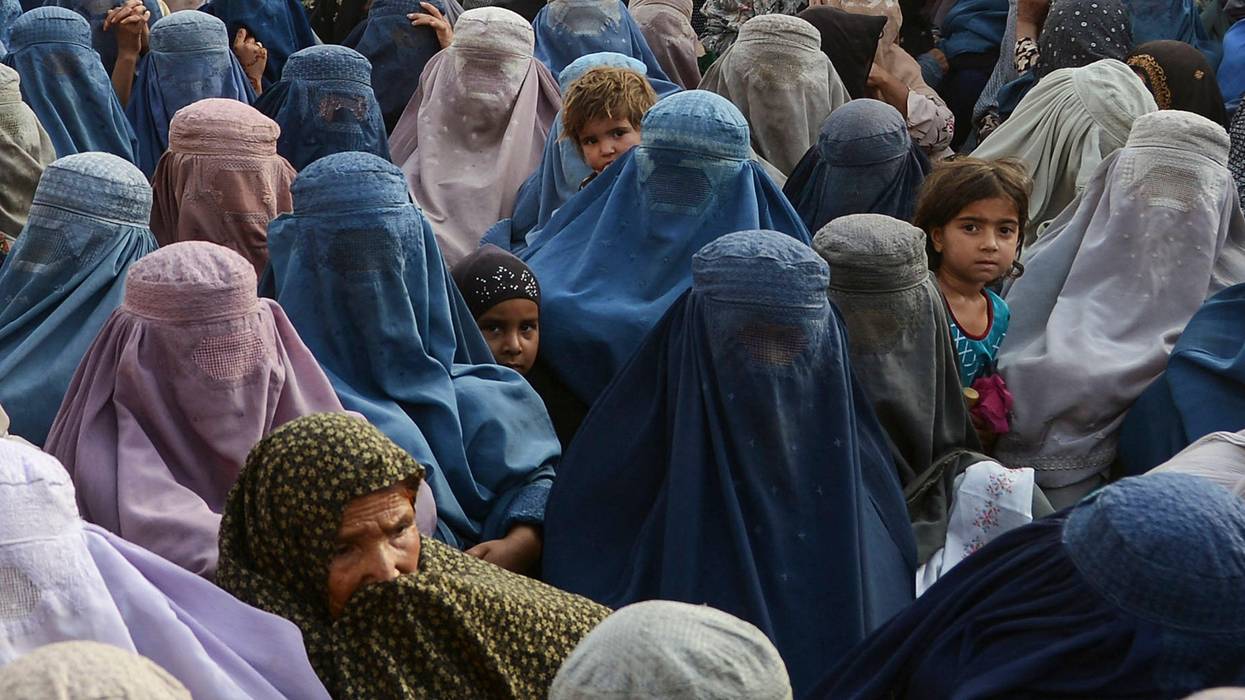
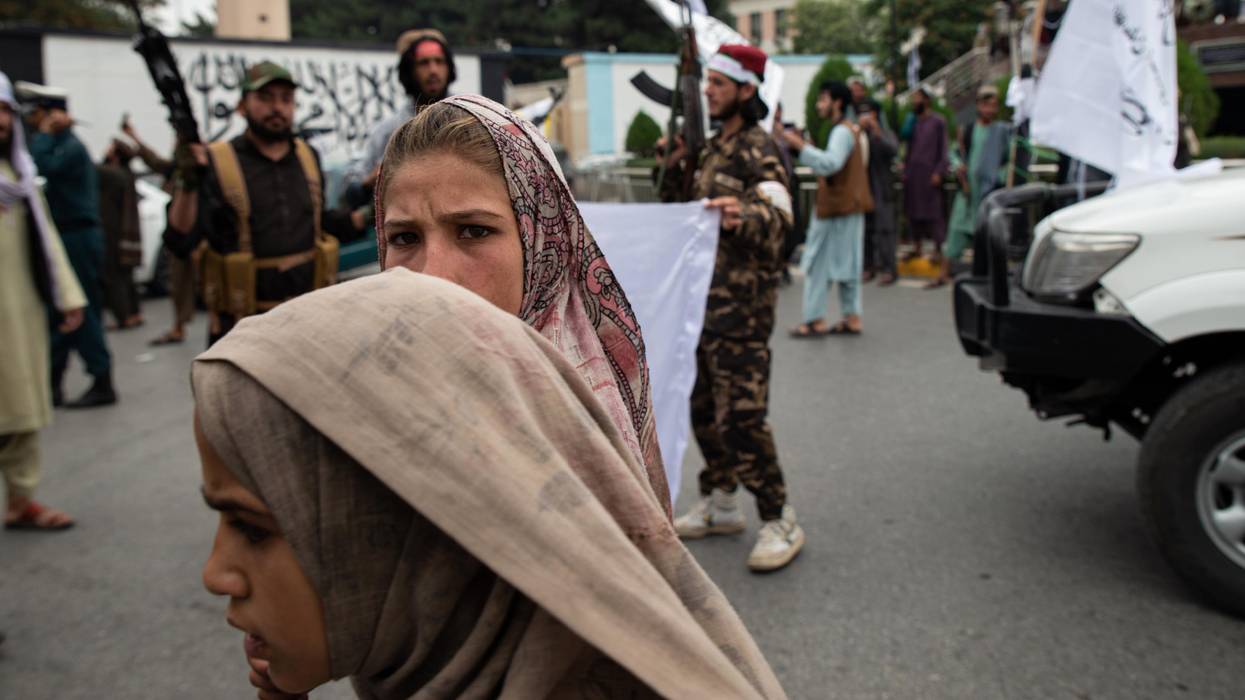
The Taliban were bad guys, trashing the rights of women and running a tinpot dictatorship, but they represented no threat whatsoever to America or our allies.
Almost two decades later, though, then-President Donald Trump and Mike Pompeo gave the Taliban everything they wanted—power, legitimacy, shutting down 9 of the 10 U.S. air bases in that country to screw incoming President Joe Biden, and the release of 5,000 of Afghanistan’s worst Taliban war criminals—all over the strong objections of the democratically elected Afghan government in 2019.
Trump did this so he could falsely claim, heading into the 2020 election, that he’d “negotiated peace” in Afghanistan, when in fact he’d set up the debacle that happened around President Biden’s withdrawal from that country.
”The relationship I have with the Mullah is very good,” Trump proclaimed—after ordering the mullah, who then named himself president of Afghanistan, freed from prison over the furious objection of Afghan’s government, which Trump had cut out of the negotiations.
Following that betrayal of both Afghanistan and America, Trump and the GOP scrubbed the record of their embrace of the Taliban from their websites, as noted here and here.
And the conservative Boris Johnson administration in the U.K. came right out and said that Trump’s “rushed” deal with the Taliban—without involvement of the Afghan government or the international community—set up the difficulties Biden faced.
“The die was cast,” Defense Minister Ben Wallace told the BBC, “when the deal was done by Donald Trump, if you want my observation.”
So, Republican George W. Bush lied us into both the Afghanistan and Iraq wars, and then Donald Trump tried to lie us out of at least one of them.
But this was far from the first time a president has lied us into a war.
— Vietnam wasn’t the first time an American president and his buddies in the media lied us into a war when Defense Secretary Robert McNamara falsely claimed that an American warship had come under attack in the Gulf of Tonkin and Lyndon B. Johnson went along with the lie.
— Neither was President William McKinley lying us into the Spanish-American war in 1898 by falsely claiming that the USS Maine had been blown up in Havana harbor (it caught fire all by itself).
— The first time we were lied into a major war by a president was probably the Mexican-American war of 1846 when President James Polk lied that we’d been invaded by Mexico. Even Abraham Lincoln, then a congressman from Illinois, called him out on that lie.
— You could also argue that when President Andrew Jackson signed the Indian Removal Act in 1830 leading to the Trail of Tears slaughter and forced relocation of the Cherokee under President James Buchanan (among other atrocities) it was all based on a series of lies.
Bush’s lies that took us into Afghanistan and, a bit over a year later into Iraq, are particularly egregious, however, given his and Cheney’s reasons for those lies.
In 1999, when George W. Bush decided he was going to run for president in the 2000 election, his family hired Mickey Herskowitz to write the first draft of Bush’s autobiography, A Charge To Keep.
Although Bush had gone AWOL for about a year during the Vietnam War and was thus apparently no fan of combat, he’d concluded (from watching his father’s “little three-day war” with Iraq) that being a “wartime president” was the most consistently surefire way to get reelected (if you did it right) and have a two-term presidency.
“I’ll tell you, he was thinking about invading Iraq in 1999,” Herskowitz told reporter Russ Baker in 2004.
“One of the things [Bush] said to me,” Herskowitz said, “is: ‘One of the keys to being seen as a great leader is to be seen as a commander-in-chief. My father had all this political capital built up when he drove the Iraqis out of (Kuwait) and he wasted it.’”
“[Bush] said, ‘If I have a chance to invade Iraq, if I had that much capital, I’m not going to waste it. I’m going to get everything passed I want to get passed and I'm going to have a successful presidency.’”
The attack on 9/11 gave Bush his first chance to “be seen as a commander-in-chief” when our guy Osama bin Laden, who the Reagan/Bush administration had spent $3 billion building up in Afghanistan, engineered an attack on New York and D.C.
The crime was planned in Germany and Florida and on 9/11 bin Laden was, according to CBS News, not even in Afghanistan:
“CBS Evening News has been told that the night before the September 11 terrorists attack, Osama bin Laden was in Pakistan. He was getting medical treatment with the support of the very military that days later pledged its backing for the U.S. war on terror in Afghanistan.”
When the Obama administration finally caught and killed bin Laden, he was back in Pakistan, the home base for the Taliban.
But attacking our ally Pakistan in 2001 would have been impossible for Bush, and, besides, nearby Afghanistan was an easier target, being at that time the second-poorest country in the world with an average annual per-capita income of $700 a year. Bin Laden had run terrorist training camps there—unrelated to 9/11—but they made a fine excuse for Bush’s first chance to “be seen as a commander-in-chief” and get some leadership cred.
Cheney, meanwhile, was in a world of trouble because of a huge bet he’d made as CEO of Halliburton in 1998. Dresser Industries was big into asbestos and about to fall into bankruptcy because of asbestos lawsuits that the company was fighting through the court system.
Cheney bet Dresser would ultimately win the suits and had Halliburton buy the company on the cheap, but a year later, in 1999, Dresser got turned down by the courts and Haliburton’s stock went into freefall, crashing 68% in a matter of months.
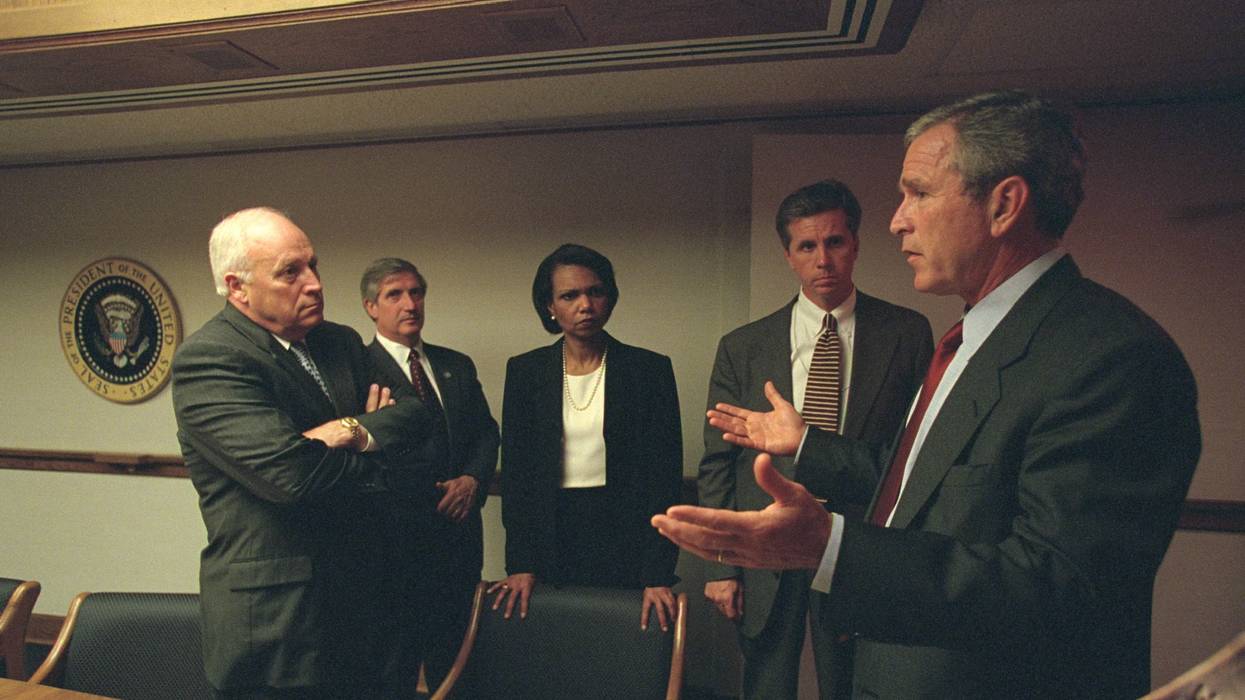
Bush had asked Cheney—who’d worked in his father’s White House as secretary of defense—to help him find a suitable candidate for VP.
Cheney, as his company was collapsing, recommended himself for the job. In July of 2000, Cheney walked away with $30 million from the troubled company, and the year after that, as VP, Halliburton subsidiary KBR received one of the first no-bid no-ceiling (no accountability and no limit on how much they could receive) multibillion-dollar military contracts.
Bush and Cheney both had good reason to want to invade Afghanistan in October 2001. Bush was seen as an illegitimate president at the time because his father’s corrupt appointee on the Supreme Court, Clarence Thomas, had cast the deciding vote in the Bush v. Gore lawsuit that made him president; a war that gave him legitimacy and the aura of leadership.
Cheney’s company was in a crisis, and Afghanistan War no-bid contracts helped turn around Halliburton from the edge of bankruptcy into one of the world’s largest defense contractors today.
Even Trump had to get into the “let’s lie about Afghanistan” game, in his case to have bragging rights that he’d “ended the war in Afghanistan.”
In 2019, Trump went around the Afghan government (to their outrage: he even invited the Taliban to Camp David in a move that disgusted the world) to cut a so-called “peace deal” that sent thousands of newly empowered Taliban fighters back into the field, and then drew down our troops to the point where today’s chaos in that country was absolutely predictable.
Trump’s deal was the signal to the 300,000+ Afghan army recruits we’d put together and paid that America no longer had their back and if the Taliban showed up they should just run away. Which, of course, is what happened on Trump’s watch. As Susannah George of The Washington Post noted:
“The Taliban capitalized on the uncertainty caused by the [Trump] February 2020 agreement reached in Doha, Qatar, between the militant group and the United States calling for a full American withdrawal from Afghanistan. Some Afghan forces realized they would soon no longer be able to count on American air power and other crucial battlefield support and grew receptive to the Taliban’s approaches.”
Jon Perr’s article at Daily Kos did a great summary, with the title: “Trump put 5,000 Taliban fighters back in battle and tied Biden’s hands in Afghanistan.”
Trump schemed and lied to help his own reelection efforts, and the people who worked with our military and the U.S.-backed Afghan government paid a terrible price for it.
As President Biden told America:
“When I came to office, I inherited a deal cut by my predecessor—which he invited the Taliban to discuss at Camp David on the eve of 9/11 of 2019—that left the Taliban in the strongest position militarily since 2001 and imposed a May 1, 2021 deadline on U.S. forces. Shortly before he left office, he also drew U.S. forces down to a bare minimum of 2,500.
“Therefore, when I became president, I faced a choice—follow through on the deal, with a brief extension to get our forces and our allies’ forces out safely, or ramp up our presence and send more American troops to fight once again in another country’s civil conflict. I was the fourth president to preside over an American troop presence in Afghanistan—two Republicans, two Democrats. I would not, and will not, pass this war onto a fifth.”
America has been lied into too many wars. It’s cost us too much in money, credibility, and blood. We must remember the lies, and tell our children about them so that memory isn’t lost.
When President Gerald Ford withdrew U.S. forces from Vietnam (I remember it well), there was barely a mention of McNamara’s and LBJ’s lies that got us into that war.
Similarly, today’s reporting on the chaos in Afghanistan and the war to seize the Iraqi oil fields almost never mentions Bush’s and Cheney’s lies and ulterior motives in getting us into those wars in the first place.
George Santayana famously noted, “Those who cannot remember the past are condemned to repeat it.”
We can’t afford to let these lies go down the memory hole, like we have the other wars we were lied into that I mentioned earlier. Sadly, it’s clear now that neither Bush nor Cheney will be held accountable for their lies or for the American, Afghan, and Iraqi blood and treasure they cost.
But both should be subject to a clear and public airing of the crimes they committed in office and required—at the very least—to apologize to the thousands of American families destroyed by the loss of their soldier children, parents, and spouses, as well as to the people of both Afghanistan and Iraq.
If the media refuses to mention the Bush/Cheney lies on this anniversary of 9/11, it’s all the more important that the rest of us use this opportunity to do so. Pass it on.