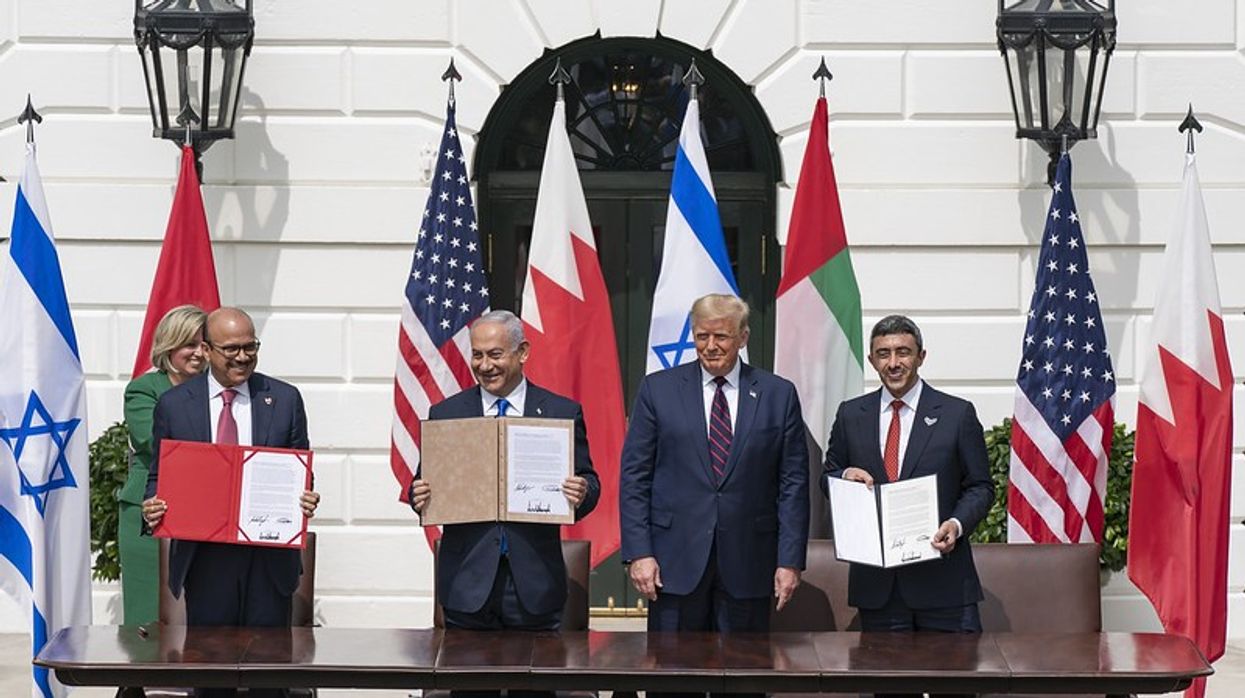
When President Carter brokered the peace plan between Israel and Egypt, that was a historic and significant achievement because every Arab-Israeli war up to that point was initially or primarily an Egyptian-Israeli war. For two countries to sign a peace plan, they have to have not already been in a state of peace. For two countries to sign a peace plan, they have to have been at war. But neither the UAE nor Bahrain have ever been at war with Israel. They have never been involved in a war with Israel. And, so, unlike Carter's achievement, Trump's achievement is not significant because it does not bring about a significant change in the Middle East. The relations that the agreements supposedly normalize have, covertly, been in the process of being normalized for a long time: a very long time.
"For two countries to sign a peace plan, they have to have been at war. But neither the UAE nor Bahrain have ever been at war with Israel."
Israel and the UAE have for a long time been engaged in commercial and security ties. In July, two Israeli defense companies signed agreements with an UAE tech firm that works in artificial intelligence. And, even before the new normalization of relations, senior Israeli officials had visited the UAE for a number of years. More importantly, according to Rashid Khalidi, professor of modern Arab studies at Columbia University, the UAE's air defense system and missile defense system are manufactured in Israel. They are made by Raytheon, which is an American company, though they are largely made in Israel. And the ties between Israel and the UAE are not new. Reporting by UPI in January of 2012 had already revealed that the UAE had "discreet ties with private security companies in Israel to protect its oil fields and borders." They report that ties between the UAE's Critical National Infrastructure Authority and several Israeli companies may go back to as early as 2007. Shockingly, and little discussed, clandestine ties go back even further than that. According to intelligence columnist for Haaretz, Yossi Melman, Israel and the UAE established intelligence community ties at least as early as the 1970s. And, he says, "Every head of Israel's Mossad intelligence agency since then has had a relationship with his counterpart in the UAE."
The same is true of Bahrain: Israel and Bahrain began forging ties decades ago. Stephen Zunes, professor of politics and international studies at the University of San Francisco, told me in a personal correspondence that there have been informal economic relations between Israel and Bahrain going back at least a couple of decades. Israel has reportedly sold spy software to Bahrain. According to reporting by the New York Times, Bahrain had already hosted an Israeli cabinet official as early as 1994. Three years ago, in 2017, Bahrain even sent a delegation to Israel. In the same year, at a security conference in Munich, Bahrain's foreign minister approached Israel's foreign minister to pass on a message from the king that he had already decided to "move towards normalization with Israel." Bahrain is ruled by a US backed dictator whose family has ruled the kingdom for over two hundred years. The U.S. fifth fleet is based in Bahrain, making Bahrain one of the most crucial allies in the web of US allies. The U.S. military actually controls about 20% of Bahrainian land.
Iran: They're More About War than Peace
The deals are less about peace between the Gulf States and Israel than they are about war between the Gulf States and Israel and Iran.
In February of 2017, at a press conference with Israeli Prime Minister Benjamin Netanyahu, Donald Trump declared that his "administration is committed to working with Israel and our common allies in the region towards greater security and stability." Netanyahu then identified those common allies as "our newfound Arab partners."
"Netanyahu was very clear that the road to the new peace plans was not about peace. It was about war: war with Iran."
Three years earlier in a September 2014 speech at the UN, Netanyahu had been clearer about what was meant by "security and stability": "After decades of seeing Israel as their enemy, leading states in the Arab world increasingly recognize that together we and they face many of the same dangers: principally this means a nuclear-armed Iran." In November, 2017, Netanyahu claimed that "Iran is devouring one nation after the other...The good news is that the other guys are getting together with Israel as never before. It is something that I would have never expected in my lifetime." He then added that Israel is "'working very hard' to establish an effective alliance with 'the modern Sunni states' to condemn and counter Iranian aggression."
Netanyahu was very clear that the road to the new peace plans was not about peace. It was about war: war with Iran. It is not at all surprising, then, that Trump used the promise of F-35 fighter jets and other advanced U.S. weaponry to pressure the UAE and Bahrain into publicly recognizing Israel. The U.S. administration also reassured a nervous Israel that the jets sold to the UAE "would not erode Israel's edge as they would be used to defend against the common enemy of Iran." The New York Times put this reassurance into context: "Trump administration officials say the detente between the Emirates and Israel--and possibly future deals between Israel and other Arab nations--are also part of a wider effort to counter Iran. Administration officials have tried to placate Israeli concerns about an Arab nation getting the F-35 by emphasizing that the Emirates, like Israel, is an avowed enemy of Iran and that strengthening the Emirati military will help Israel's security."
The peace plans were not about peace between countries already at peace, they were about war with Iran, a country they were already essentially at war with. The peace plans contribute more to war than to peace.
Perhaps the most telling sign that the Israel/UAE agreement was always more about war with Iran than peace in the Middle East is that Brian Hook, the U.S. envoy for Iran, accompanied Secretary of State Mike Pompeo to his meetings with Israel and the UAE. Hook promised that the Trump administration would help the UAE to defend itself against Iran while protecting Israel's qualitative military edge. Speaking at the White House, Hook said that "Peace between the Arabs and the Israelis is Iran's worst nightmare... And what we see today is a new Middle East. The trend lines are very different today. And we see the future is very much in the Gulf and with Israel. In the past, it was with the Iranian regime."
Bahrain is a 70% Shiite population ruled by a repressive, torturous U.S. backed dictatorship. Bahrain's geography is symbolic: it is attached to Saudi Arabia by a causeway and separated from Iran by a gulf. Located between Saudi Arabia and Iran, on the Strait of Hormuz, Bahrain is seen by the U.S. as a crucially located check on Iranian influence and power. So, it is not surprising that the normalization of relations agreement has at least one eye on Iran.
In 2011, peaceful protests in Bahrain was brutally put down by Saudi Arabia. US weapons featured largely in that brutal suppression.
Last year, Bahrain made its relationships with Israel and Iran clear. As Israel bombed Bahrain's fellow Arab states in Iraq, Syria and Lebanon--states seen as allied with Iran--Khalid bin Ahmed Al Khalifa, Bahrain's foreign minister, sided with Israel over Iran: "Iran is the one who declared war on us, with its Revolutionary Guards, its Lebanese party, its popular mobilization in Iraq, its Houthi arm in Yemen and others...Those who beat them and destroy their equipment are not to blame. It's self-defense."
A Separate Peace: the Abandonment of the Palestinians
The UAE was aware of the need to package their normalization agreement with Israel as an advancement of, or at least consistent with, the Saudi Peace initiative that promises never to normalize relations with Israel until Israel has returned to the pre-1967 borders and granted a state to the Palestinians. The deal with Israel does not do that, but it was made to look like it does that for consumption by the outside world and, especially, by the Arab world and the UAE's own domestic population.
So, the UAE's Crown Prince Mohammed bin Zayed packaged the plan and delivered it to his people and to the world as the attainment of the end of annexation of 30% of the West Bank.
But the agreement does not require Israel to "stop" annexation of the 30% of the West Bank promised to it in Trump's Middle East peace plan. The text of the agreement says "suspend," not stop. And "suspend," according to Jared Kushner, means that the annexation won't happen "for some time." But any amount of time is some time. Trump explained it as "right now it's off the table" and added that "I can't talk about some time into the future." American Ambassador to Israel, David Friedman was a lot clearer: "The word 'suspend' was chosen carefully by all the parties. 'Suspend,' by definition--look it up--means 'temporary halt.' It's off the table now, but it's not off the table permanently."
Trump never actually asked Netanyahu to stop the planned annexation. According to a senior Israeli political source, the Trump administration asked only "that we temporarily postpone declaring [sovereignty over parts of the West Bank] in order to achieve the beginning of this historic peace agreement with the Emirates."
"The Bahrainian agreement doesn't even pretend to keep one eye on Iran and one eye on the Palestinians. The agreement blatantly keeps both eyes on Iran and Bahrain's own interests."
The UAE/Israel agreement gave the Palestinians a suspended annexation that had already been suspended. Yisrael Katz, a member of Netanyahu's cabinet, confirmed on Israeli media on Sunday, August 16 "that the annexation of parts of the occupied West Bank was already suspended before the announcement of a deal to normalize relations with the United Arab Emirates (UAE)." He then explained that "presenting the agreement as related to [the annexation] is more suitable to all Arab countries".
The UAE agreement, for the first time, normalized relations with Israel while abandoning the promise to never to do so without addressing the Palestinian issue. But at least it was cognizant of the need to pretend.
The Bahrainian agreement doesn't even pretend to keep one eye on Iran and one eye on the Palestinians. The agreement blatantly keeps both eyes on Iran and Bahrain's own interests.
The text of the Joint Statement issued by Bahrain, Israel and the U.S. says only that Israel and Bahrain will "continue in their efforts in this regard to achieve a just, comprehensive, and enduring solution to the Israeli-Palestinian conflict and to enable the Palestinian people to realize their full potential." The only thing to continue, of course, is nothing.
Bahrain's Information Minister promised that "All historical precedents confirm that all the Kingdom's initiatives and decisions have always been in the interest of the Palestinian people and protecting them, and no one can outbid the Kingdom in this regard." But there is nothing in this agreement that addresses "the interest of the Palestinian people." There is only the betrayal of Bahrain's previous position that it would never establish diplomatic ties with Israel as long as Israel had not signed a peace deal with the Palestinians that included a Palestinian state in the pre-1967 borders. Bahrain defended its position by suggesting that the agreement sends a "positive and encouraging message to the people of Israel that a just and comprehensive peace with the Palestinians is the best path forward and truly serves their interests." But, in fact, it shows just the opposite: that Israel can negotiate a deal with the Gulf States that is in its interest without a comprehensive peace with the Palestinians.
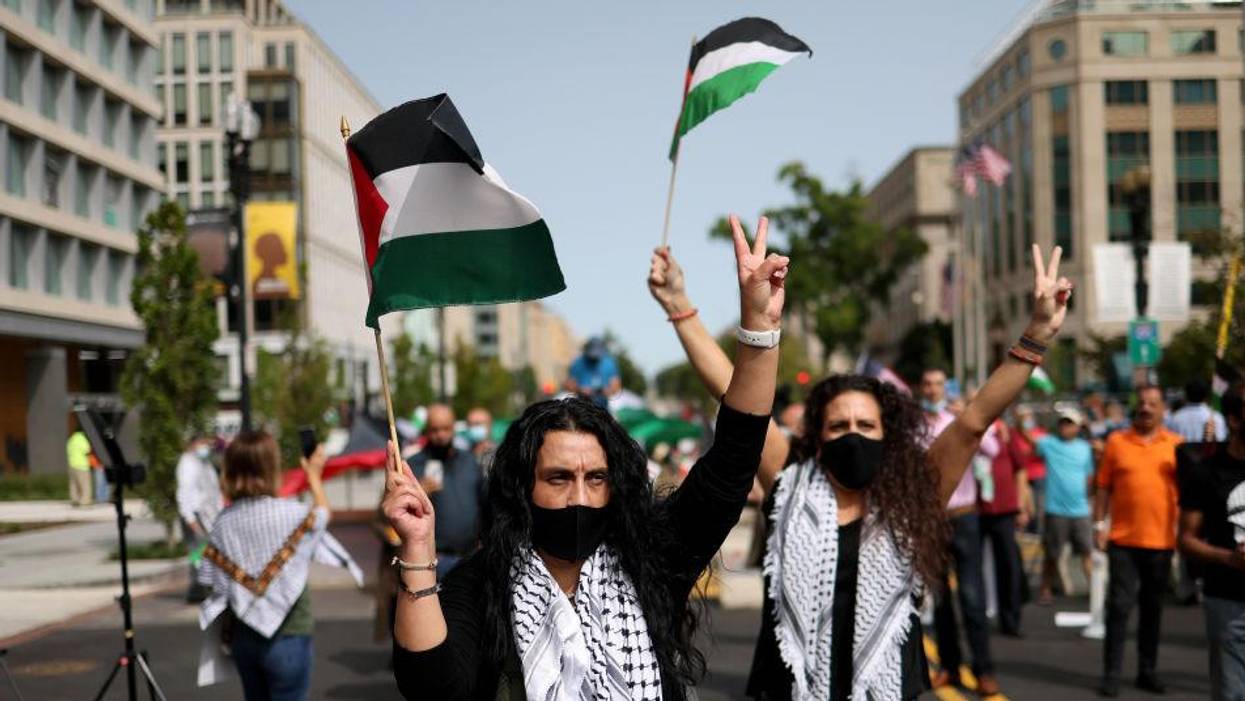
Trump naively said that the "Palestinians [are] in a very good position, they're going to want to come in because all of their friends are in." The Palestinians, however, recalled their ambassador to Bahrain and called the deal "a "dangerous violation of the Arab Peace Initiative" and a "threat to Palestinian rights."
Last year, Bahrain's foreign minister Khalid bin Ahmed Al Khalifa telegraphed his kingdom's abandonment of the Palestinians. No longer keeping one eye on Palestine and the other on Iran and its own interests, he explained that "We grew up talking about the Palestine-Israel dispute as the most important issue. But then at a later stage, we saw a bigger challenge. We saw a more toxic one, in fact the most toxic in our modern history, which came from the Islamic Republic, from Iran."
The two peace agreements between the Gulf States and Israel have nothing to do with peace. They are between nations that were already at peace and offer no peace to the Palestinians, while they proliferate U.S. arms in the region and have much more to do with the threat of war with Iran.
A version of this article initially appeared at Anti-War.com.


 This diamond-encrusted Rolex watch (left) is part of the white gold kit (right) that was allegedly sold by Bolsonaro associates in the United States. (Photo: Brazilian Federal Police)
 This photo shows some of the diamond jewelry cited in the Brazilian Federal Police indictment of former President Jair Bolsonaro and 11 others.(Photo: Brazilian Federal Police)