

SUBSCRIBE TO OUR FREE NEWSLETTER
Daily news & progressive opinion—funded by the people, not the corporations—delivered straight to your inbox.
5
#000000
#FFFFFF
To donate by check, phone, or other method, see our More Ways to Give page.
Daily news & progressive opinion—funded by the people, not the corporations—delivered straight to your inbox.

"Israel’s widespread and government-sanctioned use of torture against Palestinians contaminates every aspect of its legal system and means that Palestinians are convicted based on information extracted under torture."
Israeli security forces tortured Palestinian security detainees—and in at least one case, a Jewish Israeli—into confessions subsequently used to secure criminal convictions, according to a report published Wednesday that warns the practice poses a particularly grave threat now that Israel has legalized the death penalty for "terrorism"-related killings.
Israel's systematic torture of Palestinians, both during the Gaza genocide and in the illegally occupied West Bank, is well documented by both Israeli and international organizations. Less examined are allegations that members of Shin Bet, Israel's internal security agency, use torture to extract confessions from so-called "security detainees," who are subjected to a more severe detention regimen that often includes lengthy imprisonment without charge or trial.
A 25-page report, "Tainted by Torture: Palestinian Detainees in the Israeli Legal System," published by the Israeli advocacy group Public Committee Against Torture in Israel (PCATI), notes the general increase in Israeli torture, sometimes deadly, by Israel Prison Service and military personnel following the Hamas-led attack of October 7, 2023: "severe physical, psychological, and sexual violence, including beatings, kicking, attacks with dogs, electric shocks, threats, humiliation, touching and hitting genitals, and rape."
The report specifically examines 42 cases involving Palestinian security detainees who reported torture during interrogations by Shin Bet operatives over the past decade. PCATI also documented one exceptional case involving the alleged torture of a Jewish Israeli suspect.
According to the report, judges and other officials often ignore or dismiss clear and undisputed evidence of torture.
"Israel’s widespread and government-sanctioned use of torture against Palestinians contaminates every aspect of its legal system and means that Palestinians are convicted based on information extracted under torture," PCATI said. "That’s particularly egregious in light of initiatives to impose the death penalty on Palestinians—including based on confessions extracted under torture and irrespective of whether or not they are true."
PCATI documented how interrogation methods such as extreme sleep deprivation, beatings, and painful stress positions are used against security detainees, primarily Palestinians accused of resisting Israeli occupation. Of the 42 cases examined, 35 involved sleep deprivation, 24 involved physical violence, and 23 involved stress positions. In 33 cases, detainees confessed under torture or other illegal abuses.
Of the 29 cases for which PCATI had complete information about legal proceedings, 25 resulted in convictions. The report emphasizes that the cases it covers are not a representative sample of all Shin Bet interrogations, but rather are indicative of broader trends.
One of the most disturbing cases in the report involves a Palestinian lawyer identified as TB, who was arrested in February 2019 and interrogated by Shin Bet for nearly a month. According to official records, TB spent 552 hours under interrogation over more than 27 days—an average of 20 hours every day—with some sessions lasting dozens of consecutive hours. TB suffered severe physical pain, could not sleep, and had his hands and feet shackled in a painful stress position. The judge nevertheless extended his detention without addressing the allegations.
TB was convicted of involvement in shooting attacks targeting Israeli soldiers and buses. Despite his documented torture, the Justice Ministry's oversight division declined to recommend a criminal investigation, concluding that the interrogations had been authorized and conducted according to procedures.
Another Palestinian detainee, identified as R, was subjected to a month of violent interrogations involving physical abuse, humiliation, and threats to harm his family. R repeatedly confessed his alleged crime to his torturers, but then subsequently retracted his confession when brought before police investigators. He was then allegedly tortured anew until he signed a statement in which he said he confessed to make the torture stop.
Prosecutors attempted to use that confession against him, even though it had been extracted through coercion. After spending months behind bars, investigators found video footage proving R had not even been at the scene of the alleged crime. The charges against R and his brother, who had also been indicted, were ultimately dropped.
"This mechanism of torture creates a risk of false confessions, and R’s confession was the rare confession that Israeli authorities acknowledged to be false," the report states.
The report also examines the case of Amiram Ben-Uliel, a far-right Israeli settler-colonist convicted of murdering three members of the Dawabsheh family—including 18-month-old toddler Ali Dawabsheh—in a 2015 arson attack on the Palestinian family's home in the West Bank village of Duma. Shin Bet interrogators subjected the Jewish supremacist to so-called "necessity interrogations" involving methods his torturers acknowledged in court were "painful and perhaps even very painful."
While the court struck one confession made to police a day after the torture, it allowed another admission made 36 hours after the abuse.
"This case is exceptional in that the court accepted the interrogee’s version of events and even excluded some of his testimony because of the use of 'special methods,'" the report notes. "We are not aware of any parallel case involving a Palestinian interrogee."
The Israeli Justice Ministry said it "totally rejects" the report's claims.
"It should be recalled that in most cases the complainants are accused of terrorist offenses, and they therefore are likely to have a clear interest in complaining against the investigators and making claims that may allegedly help them in their criminal trial,” the ministry said. “Therefore, the examination of the complaints requires extra caution and usually additional supporting evidence will be needed."
The report's findings follow Israel's passage earlier this year of a law expanding the death penalty for "terrorism"-related offenses involving Palestinians tried in military courts in the occupied West Bank, with execution by hanging mandated within 90 days and sentences generally barred from commutation.
“When it comes to Palestinian detainees, the Israeli legal system officially sanctions torture as a tool for extracting confessions, regardless of whether the content of those confessions is true,” PCATI executive director Sari Bashi said. “The entire system is contaminated by unlawful violence that violates the rights of the accused and prevents the truth from coming to light."
"Torture as a tool of interrogation is particularly egregious," added Bashi, "given initiatives to impose the death penalty in Israel for the first time since 1962.”

“This approval to deploy a million data centers in space without any thought to the impacts on Earth is just a glimpse of what we’ll see during the next two years of Trump."
The Federal Communications Commission's approval on Wednesday of SpaceX's plan to deploy one million orbital data center satellites into space by 2040 was not "just irresponsible," said one environmental advocate.
"It’s reckless,” said Tim Whitehouse, executive director of Public Employees for Environmental Responsibility. “The potential for these projects to degrade the atmosphere with pollution and debris and harm wildlife needs to be carefully considered before licensing these projects.”
Whitehouse was among the critics who noted that the approval had been granted without an environmental review, which is required by the National Environmental Policy Act (NEPA).
FCC Chairman Brendan Carr said the deployment of one million "orbital space modules," which SpaceX has said would form a new data center constellation called "Starmind," would open "a bold new frontier" and allow the US to lead "the world into the era of super intelligence."
The satellites would process massive amounts of data to be used on Earth, according to SpaceX, the space exploration company led by Republican megadonor Elon Musk.
The environmental legal group Earthjustice said they also risk "changing our atmosphere, disrupting our daily activities that rely on satellites currently operating, disturbing wildlife, and fundamentally altering our night sky," and denounced the commission for releasing the decision as families across the US were preparing to celebrate Thanksgiving.
“Drastically expanding satellites in space has a direct impact on people’s everyday lives as well as the future of our planet,” said Jan Hasselman, senior attorney at Earthjustice. “Agencies that authorize companies looking to space as the next frontier still must operate within the law, and the law requires the FCC to consider all the risks and impacts of these proposals. It is dismaying that the FCC has ignored the law so blatantly and tried to mask the fact with a holiday filing.”
"Agencies that authorize companies looking to space as the next frontier still must operate within the law, and the law requires the FCC to consider all the risks and impacts of these proposals."
The number of satellites in space has already grown rapidly in the last several years, with 15,000 satellites in orbit in 2026—up from 1,400 just over a decade ago.Satellites cause emissions as they are placed in space through rocket launches, and other environmental impacts include debris from potential collisions—especially as the number of satellites grows—degradation of the ozone layer, and light pollution.
Astronomers spoke out against SpaceX's plan earlier this year, saying it would prevent scientists from studying the night sky with modern telescopes, as well as disrupting ecosystems and humans' biological clocks due to extreme light pollution.
On Wednesday, the American Astronomical Society (AAS) said it was "disheartened and dismayed" by the FCC's licensing of Musk's plan.
"The proposed constellation would significantly undermine decades of federal investment in astronomical facilities and the ability of astronomers and the public to enjoy and study the night sky," said the group. "The intended and unintended radio emissions from a constellation of such unprecedented size would imperil radio astronomy research, and the waste heat generated by the data centers would produce a thermal signature that would increase the infrared background of the sky and threaten the efficacy of sensitive instruments used in regular astronomy research. In addition, atmospheric pollution from the launches and reentries of so many satellites, as well as increased collision risks in orbit, remain significant concerns; both of these factors threaten research astronomy."
"The AAS is gravely concerned about the future of federally funded astronomical research under such a fundamentally altered night sky, and the resulting waste of taxpayer dollars invested in astronomical facilities throughout the country and the world," the AAS added.
Earthjustice emphasized that the approval came as Congress is considering the Bipartisan American Affordability and Jobs Act (BAAJA), the permitting reform bill that would prevent future administrations from revoking licenses for projects including data centers and would block courts from enforcing environmental review laws for such projects if they had been violated previously.
“This approval to deploy a million data centers in space without any thought to the impacts on Earth is just a glimpse of what we’ll see during the next two years of [President Donald] Trump,” said Sam Sankar, senior vice president of Earthjustice. “This is great example of why Congress should not pass a flawed bill like BAAJA that would lock in terrible projects like this one. Donald Trump is going to do a lot more dirty and lawless deals over the next years, and BAAJA prevents future presidents from reconsidering them.”

“This is not a close case,” a federal judge wrote. “Defendants may not retaliate against or punish plaintiffs and other broadcast license holders for disfavored speech.”
A federal judge's ruling against the Federal Communications Commission was applauded late Wednesday by one of the FCC's own commissioners, Democrat Anna Gomez, who has been critical of Chairman Brendan Carr's threats against media companies during the Trump administration and who said the decision in a case regarding ABC's broadcast licenses would bring "badly needed accountability to the commission."
US District Judge Loren AliKhan ordered the FCC to halt its review of ABC's licenses, which the commission ordered the network to file a renewal request for in April—even though its current licenses don't expire until 2028.
That demand from the FCC came after President Donald Trump accused ABC of giving him "negative coverage" and a day after the president attacked late-night host Jimmy Kimmel over jokes he made about First Lady Melania Trump.
AliKhan said Wednesday that all evidence showed “Chairman Carr has taken President Trump’s rhetoric as his marching orders."
“Against the backdrop of President Trump and Chairman Carr’s call-and-response, it is no coincidence that President Trump criticized Mr. Kimmel’s skit on social media and the very next day defendants initiated the early license renewal proceedings," wrote the judge.
AliKhan ruled in the case three months after ABC filed a First Amendment lawsuit against the FCC, arguing that the commission's early review of its broadcast licenses was part of a "deeply un-American" attack on media companies' speech.
The judge, who was appointed by former President Joe Biden, expressed strong agreement with ABC.
“This is not a close case,” she wrote. “No one doubts that the commission may enforce the law in the manner it sees fit. But in doing so, defendants may not retaliate against or punish plaintiffs and other broadcast license holders for disfavored speech.”
“Given the extreme, indeed existential, nature of the possible penalty plaintiffs face—loss of their broadcast licenses—the court concludes that early license renewal proceedings create a risk sufficient to chill a broadcaster of ordinary firmness,” she added.
The network argued in court that the threat to ABC's ability to continue broadcasting was already chilling speech, causing executives to question how they should cover the recent midterm elections and who could appear as a guest on the daytime talk show "The View" without angering the president.
“We sit with our head on the guillotine,” said Beth Wilkinson, a lawyer for ABC, at a hearing. “We are watching everything we do.”
AliKhan wrote that "these alterations to plaintiffs’ editorial decision-making showcase how the commission’s early license renewal proceedings have already curtailed plaintiffs’ protected activity. That an objectively reasonable broadcaster faced with the same existential threat would follow suit is beyond debate.”
Seth Stern, chief of advocacy for the Freedom of the Press Foundation, said AliKhan had seen the FCC's threats against ABC "for what they are: a campaign of intimidation and retaliation against speech that displeases Donald Trump."
"The First Amendment does not allow government officials to appoint themselves the journalism or comedy police. The Constitution recognizes that even good-faith government actors cannot adjudicate journalistic merits without letting political agendas cloud their judgment, and Brendan Carr is far from a good-faith actor," said Stern.
"The impact of the FCC’s censorship spree has not been limited to ABC or other outlets Carr has pursued directly—he has put broadcasters on notice that if their coverage provokes a Truth Social tantrum, the FCC may deem hurting the president’s feelings contrary to the 'public interest' and come after them with bogus investigations," he added. "Outlets that Carr has intimidated can breathe a little easier. The lesson to learn from this ruling is don’t cave to Carr or any other anti-speech bullies in this administration. Instead, take them to court—the judiciary is on to them, and they lose regularly."
The ruling follows Trump's attempt to ban reporters from CNN, MS NOW, and Politico from the White House. A federal judge struck down the ban in September.
In the case of the FCC and ABC, Gomez, the lone Democrat on the commission, said AliKhan's ruling had shown "that this FCC is a paper tiger whose threats crumble when challenged by those willing to defend their rights."
"Every broadcaster facing this pressure should take note," said Gomez, "and choose courage over capitulation because, as I've said from the beginning, the First Amendment is on their side."

"The FCC is attacking American democracy by allowing corporations and billionaires to cannibalize local TV stations," said one union leader.
Nonprofits and media unions this week filed a petition urging a US appellate court to stop the Republican-controlled Federal Communications Commission from repealing a policy put in place over two decades ago to limit corporate consolidation in broadcast television.
In 2004, Congress passed the Consolidated Appropriations Act, directing the FCC to ensure that no TV station owners reached more than 39% of the national broadcast audience. From that came the National Television Multiple Ownership Rule.
"Congress set the ownership cap so no one company could control too much of what Americans see on TV," explained John Bergmayer, legal director of Public Knowledge, which is part of the coalition behind the petition. "It's still needed. When one company buys stations in city after city, it can replace the local reporting that local TV still uniquely provides with programming beamed in from a distant city. Viewers are left with fewer reporters covering their schools, police departments, and city halls."
Led by President Donald Trump's FCC Chair, Brendan Carr, the commission voted in August to roll back the rule and replace it with one that allows for decisions made on a case-by-case basis.
The new rule "will decimate the broadcast news industry as we know it," warned Carrie Biggs-Adams, president of the National Association of Broadcast Employees and Technicians-Communications Workers of America (NABET-CWA) Local 51, another coalition member.
"We will see more and more mergers like Nexstar-TEGNA until the landscape is unrecognizable," she predicted. "NABET-CWA Local 51 members know that local news is the lifeblood of a functioning democracy. Independent journalism and local news will become things of the past unless we stop these media conglomerates."
Matt Wood, vice president of policy at Free Press, another group behind the legal challenge, said that "no FCC chairman, including President Trump's favorite attack dog, Brendan Carr, can ignore the will of Congress—no matter how much he wants to. With this brazen and unlawful move to erase a statute, Carr is continuing to hand out favors to media conglomerates in exchange for friendly coverage of President Trump."
"The agency cannot overturn this vital media-ownership limit," he argued. "It has no authority to eliminate laws like this. Carr's goal is to spur more media consolidation involving companies Trump views as ideological allies, but he cannot rewrite congressional mandates."
We, along with a coalition of unions and nonprofits, are urging an appeals court to block an illegal order from the FCC that will allow conglomerates to dominate the broadcast landscape.newsguild.org/the-newsguil...
[image or embed]
— The NewsGuild-CWA (@newsguild.org) November 25, 2026 at 2:34 PM
After notifying the FCC of the plans to launch a legal challenge last month, the coalition—which also includes the Future Film Coalition, the NewsGuild-CWA, Reporters Without Borders, the United Church of Christ Media Justice Ministry, Writers Guild of America East, and WGA West—filed the petition for review and a stay motion with the 9th Circuit Court of Appeals this week.
"Reporters Without Borders believes that the FCC's illegitimate dismantling of the national television ownership cap is a brazen concession to powerful media conglomerates and a direct assault on media pluralism," said the group's executive director in the United States, Clayton Weimers.
"When fewer corporations control more of the country's news outlets, local newsrooms, journalists, and ultimately the public pay the price," he stressed. "Congress established clear limits to prevent this concentration of power, and the FCC cannot simply disregard them. The court must intervene before irreversible damage is done to an already fragile media landscape."
Trump and his cronies have been accused of degrading US democracy during both of his nonconsecutive terms, and coalition members framed this rollback as a continuation of that. NewsGuild-CWA president Jon Schleuss declared that "the FCC is attacking American democracy by allowing corporations and billionaires to cannibalize local TV stations."
"The pillaging of local news must stop," said Schleuss, whose union is the largest for journalists in the United States. "We're urging a federal appeals court to protect our communities and journalists by blocking the FCC's illegal decision."
The coalition's lawyers include Simon Brewer from Democracy Forward, who emphasized that "democracy thrives when localism, viewpoint diversity, and competition in the media are protected, and people have access to the information they need to engage in civic life."
"We are hopeful that the court of appeals will see the harm that will come to our democracy if the FCC is allowed to abandon its long-standing rules preventing harmful corporate consolidations," he added, "and we are honored to work with this impressive and expansive coalition to fight for the current limits regarding media consolidation."
Despite the legal challenge from this coalition—and another recently launched by the Broadband Communications Association of Pennsylvania—Carr has shown no signs of slowing down, announcing Monday that the FCC "will be voting next month to modernize its local ownership rules for radio and TV broadcasters."

"Any serious commitment to a livable future for all must begin with confronting the US military’s role in destroying it," said CodePink.
The Army's detonation of nearly five tons of highly toxic explosives in Iowa on Wednesday has sparked condemnation from critics, including anti-war and environmental activists, who say the incident exemplifies a decades-long pattern of military pollution and the sacrifice of civilian communities in service of US militarism.
The Army blew up its stockpile of degraded lead azide stored at its Iowa Ammunition Plant near Middletown in what it called a "controlled" detonation, despite warnings from residents, environmental organizations, and lawmakers about the potential health and environmental consequences of the blast.
Smoke was seen rising over the area, and witnesses reported feeling two or three explosions in rapid succession. Residents closest to the 19,000-acre military installation had attempted to prepare for the blast by taping their windows, while some local families heeded evacuation advisories.
"It’s not a 'controlled explosion' of 9,000 pounds of toxic chemicals when residents have to evacuate," Tennessee state Rep. Justin Pearson (D-86) said Wednesday on social media. "We deserve access to clean air, water, and soil. I’m praying for everyone in Middletown. The impact of bad governance and lead pollution can last for generations."
In a statement released Wednesday, the anti-war group CodePink condemned what it called the Army's "reckless detonation," warning that the resulting toxic plume could expose communities across southeastern Iowa to lead contamination.
"This is not an isolated accident or a regrettable necessity; it is the latest instance of the military’s systematic poisoning of communities and ecosystems that has been going on for decades," the group said.
"The US military is the world’s largest institutional polluter, maintaining hundreds of bases with known cancer-causing PFAS contamination in the US and over 800 ecosystem-destroying bases globally and treating the land, water, and air it touches as sacrifice zones," CodePink continued, referring to the per- and polyfluoroalkyl substances that are popularly known as "forever chemicals" because they do not biodegrade and accumulate in soil, water, and the human body.
"The explosion in Iowa dispersed a neurotoxin with no safe level of exposure across homes, schools, farms, and rivers, endangering animals and people, specifically children and pregnant women," the group said.
"The environmental violence now being experienced by rural Iowans at the hands of the US military is the tip of the iceberg," CodePink noted. "The US military has been doing this around the world, either directly or indirectly, for years, including but not limited to Gaza, Iran, Puerto Rico, North Carolina, Guam, Hawaii, Korea, Vietnam, Palestine, and Iraq—where similar contaminants from the US invasion are still present in food and water and hair samples."
US use of depleted uranium munitions has been linked to birth defects, miscarriages, and cancers in Iraq and Yugoslavia. Chemical defoliant weapons like Agent Orange contained carcinogens and other toxins causing severe birth defects, diabetes, spina bifida, and cardiovascular, digestive, neurological, respiratory, skin, and other ailments that are still killing and harming people—including US troops and their descendants—more than half a century after their use in Vietnam, Cambodia, and Laos.
"It is a cycle of violence that begins with the production of weapons and the use of those weapons in wars and genocides," CodePink said. "For instance, the same plant that produced the iron azide stockpile manufactured the ammunition used to kill 5-year-old Hind Rajab during the height of the US/Israeli genocide in Gaza."
Meanwhile, the environmental advocacy group Earthjustice, which sued in an effort to stop the Iowa detonation, said Wednesday that the Army "knew since 2009 that the lead azide was deteriorating, and since March that the material was becoming unstable. Yet most Iowans, including public officials, learned of the plan to dispose of the chemicals through detonation only days before the planned... blast. The Army has not explained why it let the material degrade until every alternative was too dangerous."
Earthjustice won a temporary stay of Wednesday's detonation, originally scheduled for November 20. The legal group represented the state chapter of the Sierra Club and the Iowa Environmental Council, whose executive director, Sarah Green, said that "the Army’s neglect and lack of communication and preparedness caused an outcry among Iowans, so we took action to demand the transparency that Iowans deserve."
"This is proof that grassroots advocacy works and Iowans’ voices matter," Green added.
The stay was subsequently lifted after the Army agreed to additional protective measures.
“It took legal action to get from the Army the transparency and real help on the ground Iowa communities deserved,” said Wally Taylor, an attorney and legal chair of Sierra Club Iowa Chapter. “Now that the detonation happened, officials must stay involved until the cleanup is finished and the risk of lead harm is fully under control.”
The critics' condemnation of Wednesday's detonation follows decades of communities around the world fighting the environmental damage caused by US wars and military bases.
"The toxic legacy of US military action is now strewn the world over, from depleted uranium in Iraq, to dioxin poisoning in Southeast Asia, to massive jet fuel spills in Virginia Beach," Nikhil Pal Singh wrote for the Quincy Institute for Responsible Statecraft in 2019. Singh also noted that hundreds of cases of contaminated drinking water have been documented at US military installations across the country and around the world.
The American Cancer Society has highlighted how military burn pits have exposed US service members and people in nearby communities to harmful chemicals and particulate matter from the open-air burning of fuel, plastics, and other toxic waste.
Pollution generated from operating the world's largest military and most prolific war machine is also one of the biggest drivers of human-caused climate change.
"The fight against militarism and the fight for a livable planet are the same," CodePink said Wednesday. "The Pentagon’s proposed $1.5 trillion budget and its status as the number one institutional polluter are not separate from the climate crisis; it is the US military that is destroying the planet by fueling endless wars for resources that treat entire communities as environmental and public health sacrifice zones."
"We call on elected officials and environmental justice organizations to break their silence on the military’s role in the ever-growing climate crisis—starting with voting no on the upcoming $1.5 trillion [National Defense Authorization Act]," the group added. "Any serious commitment to a livable future for all must begin with confronting the US military’s role in destroying it."

"Anyone on the ground knows that Democratic voters in Pennsylvania loathe Fetterman and can't wait for the 2028 primaries," one Philadelphia organizer told Common Dreams.
Progressive organizers are up in arms after Sen. Kirsten Gillibrand, who chairs the Democratic Party’s Senate campaign arm, seemed to suggest on Tuesday that Sen. John Fetterman, the widely despised conservative Democrat from Pennsylvania, should run for reelection in 2028.
The Democratic Senatorial Campaign Committee (DSCC) generally backs incumbents seeking reelection. But Fetterman, who has spent the last four years morphing from a progressive in the style of Sen. Bernie Sanders (I-Vt.) into President Donald Trump's leading Democratic cheerleader, is an unusual case.
With a net approval rating of minus 9 percentage points among Pennsylvania Democrats, he is by far the least popular Democratic senator among his own party’s voters at home, according to polling from Morning Consult. In a PennLive/Bravo Group poll last week, 84% of Pennsylvania Democrats said they’d rather vote for “someone else” if Fetterman runs in 2028.
The resentment is no surprise. Fetterman has spent recent years loudly defending Trump’s aggressive warmaking and attacks on immigrants and has threatened to leave the Democratic Party over his colleagues’ growing criticism of Israel’s three-year genocidal war in Gaza.
For this reason, Gillibrand’s (D-NY) remarks in an interview with NBC News that aired Tuesday came as a shock to some.
NBC News’ Sahil Kapur noted that Pennsylvania was one of the swing states Democrats would need to hold to secure a 60-vote supermajority in 2028. He asked Gillibrand, “Should Sen. Fetterman run for reelection?”
Gillibrand replied: "Yeah. So far, we assume he is, and we are gonna win Pennsylvania. Yeah."
Asked whether the DSCC would support Fetterman in the general election, Gillibrand said: “We support our nominees. We support all our Democratic nominees.”
Kapur did not ask whether the DSCC would back Fetterman in a primary. He already has one challenger: Ahmed Moor, a Palestinian American writer and businessman from Gaza who is a member of the Democratic Socialists of America, announced his campaign earlier this month.
Gillibrand, Schumer and Fetterman are all AIPAC-powered characters. Jan. 3rd 2029 will be a new day. In the meantime, Van Hollen for Leader!
— Ahmed Moor (@AhmedMoor) November 25, 2026
Some progressive activists took Gillibrand’s answer as a show of support for another Fetterman term.
Joseph Geevarghese, the executive director of the grassroots left-wing advocacy group Our Revolution, told Common Dreams that her response “shows how out of touch Democratic leadership is with the people who got John Fetterman elected.”
“He ran as a populist who would fight for working people. He’s betrayed that trust,” Geevarghese said. “Fetterman campaigned on ending the filibuster and now defends it. He’s backed continued US military support for Israel and voted against advancing a measure to block a military sale… Too often, Fetterman would rather punch left than help build the kind of opposition that can take on Trump and deliver real reform.”
Kidus Girma, the campaigns and strategy director for the youth-led climate activist group Sunrise Movement, told Common Dreams that "senators like Gillibrand know better than to support Trump's favorite Democrat."
Fetterman described the climate crisis as an “existential threat” and called for a transition to clean energy in 2022 but has since embraced much of Trump’s energy agenda, championing fossil fuel exports and voting to confirm Trump’s pick to lead the US Environmental Protection Agency, Lee Zeldin, who has rolled back regulations with ruthless efficiency.
"Fetterman has spent the last couple of years turning his back on the people who elected him while data centers pollute our climate and communities, another oil war rages in the Middle East, and the cost of living continues to skyrocket," Girma said. "It's time for change in Pennsylvania."
The DSCC is under no legal obligation to support incumbents and has occasionally withheld its endorsement. In 2024, then DSCC chair Sen. Gary Peters (D-Mich.) declined to endorse Sen. Bob Menendez (D-NJ) after he was indicted on federal corruption charges. The DSCC also withheld an endorsement while Sen. Kyrsten Sinema (I-Ariz.) weighed running as an independent against then-Rep. Ruben Gallego (D-Ariz.), who was seeking the Democratic nomination that same year. Menendez and Sinema have since left the Senate, while Gallego has joined it.
Geevarghese added that "if [Fetterman] runs again in 2028, he should face a primary challenger, and the DSCC should stay neutral. Pennsylvania Democrats should decide who represents them."
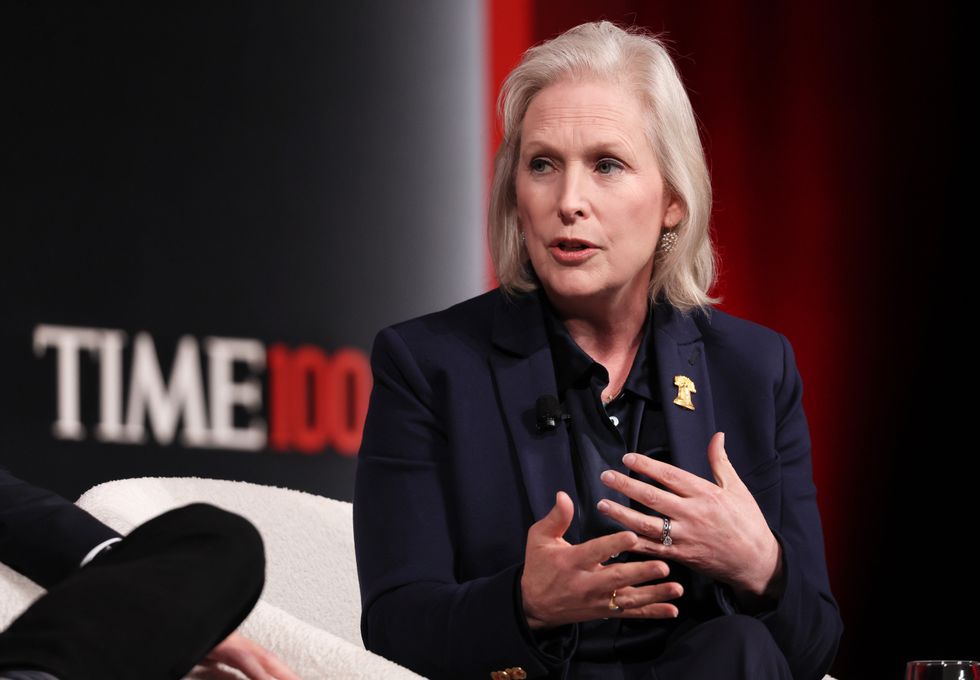 Sen. Kirsten Gillibrand (D-NY) speaks onstage during the 2025 TIME100 Summit at Jazz at Lincoln Center on April 23, 2025, in New York City. (Photo: Jemal Countess/Getty Images for TIME)
Gillibrand’s judgment as a party leader is drawing closer scrutiny as she seeks a second two-year term as DSCC chair. In an article for The Intercept Wednesday, journalist Eoin Higgins made the case that Gillibrand was “the wrong person to meet the moment.”
Noting her close alliance with her New York counterpart, Democratic Senate Minority Leader Chuck Schumer, Higgins described her as "a loyal member of the party’s pro-business wing" with a tendency toward "pushing ideological preferences" when selecting candidates:
While Gillibrand and the DSCC can point to real success stories like James Talarico in Texas and Mary Peltola in Alaska, they also backed Haley Stevens in Michigan, a charisma void who turned on the Democratic nominee, Abdul El-Sayed, in the last days of the race allegedly over his views on Israel.
In Maine, the DSCC and establishment Democrats recruited Gov. Janet Mills, a 78-year-old with little interest in running, whose campaign against progressive upstart Graham Platner failed to launch.
Gillibrand is also a top recipient of donations from the cryptocurrency industry, and Higgins wrote that she has moved "in lockstep" with its interests. A staunch supporter of Israel, she is among the biggest beneficiaries of contributions from AIPAC’s political spending arm.
In June 2025, she was widely criticized for falsely claiming that Zohran Mamdani, who'd just clinched the Democratic nomination for New York City mayor, had called for "global jihad," after he declined to condemn the pro-Palestinian slogan “globalize the intifada,” which he had never used himself. Gillibrand argued that such rhetoric was understood as a call to “slaughter the Jews and destroy Israel,” but later apologized for mischaracterizing Mamdani’s record.
Here's Gillibrand claiming that Zohran Mamdani supports "global jihad" and is among those who "glorify the slaughter of Jews". https://t.co/xVUmFoaUsO
— gato fumante (@KweenInYellow) November 25, 2026
Sergio Cea, the political director for the grassroots progressive advocacy group Reclaim Philadelphia, said that Gillibrand’s confidence that Fetterman could win Pennsylvania “shows that she’s out of touch and has learned nothing from the election" earlier this month.
"Working people are struggling at the pump and at the grocery store as a result of wars pushed by Trump and the state of Israel," Cea told Common Dreams. "Anyone on the ground knows that Democratic voters in Pennsylvania loathe Fetterman and can't wait for the 2028 primaries."
Pointing to US Rep. Summer Lee (D-Pa.), state Rep. Malcolm Kenyatta (D-181), and Moor, Cea said, "There is a huge bench of actual Democrats who can win in Pennsylvania."

"Her doctors know exactly how to help her. They just lack the resources. I cannot stop thinking about her, and about every child like her."
A toddler awaiting open-heart surgery is among thousands of Cuban children whose lives are imperiled by critical shortages caused or exacerbated by the Trump administration's tightened embargo, the head of the World Health Organization said Wednesday from the island as he called on the United States to immediately lift its illegal economic and fuel blockade.
WHO Director-General Tedros Adhanom Ghebreyesus—who did not mention US President Donald Trump by name in his remarks—described meeting the 1-year-old and her mother during a visit to Havana's William Soler Pediatric Hospital and Cardiocenter.
"Her mother was by her side, holding on to hope," Tedros said of the child. "Her doctors know exactly how to help her. They just lack the resources."
"I cannot stop thinking about her, and about every child like her," he continued. "Fuel restrictions and sanctions are straining Cuba's health system. Almost 100,000 surgeries are backlogged, including 12,000 for children. Some 34,000 pregnant women cannot access the care they need. Behind every number is a child, a mother, a family waiting."
"Health must never be a casualty of politics," Tedros added. "For these children and their mothers, I call for these sanctions to be lifted immediately. Their lives depend on it."
The WHO chief's appeal came amid mounting reports of Cuban children enduring potentially life-threatening delays for operations and other essential medical treatment.
Some children have not survived. In June, an Associated Press report on Cuban pediatric cancer patients featured an interview with one doctor who said that "we've had dead children."
The AP also interviewed Adriana Felipe, whose daughter's cancer treatment was at risk, and who said US officials "must soften their hearts."
While the Trump administration maintains that food and medicine are exempt from its sanctions and argues that the policy is intended to pressure Cuba's government into political and economic reform, the restrictions on financial transactions, energy supplies, and third-country businesses have made it increasingly difficult for the island to obtain critical goods.
Earlier this month, CBS News reported that foreign companies are increasingly fearful of US penalties and are reluctant to sell food and medical supplies to Cuba. The report also described hospitals struggling with shortages of cancer drugs, anesthetics, and laboratory equipment.
Cuba's once-vaunted public health system has deteriorated to the point where life expectancy has decreased for the first time since the country began keeping records in 1950, nearly a decade before the revolution that led to socialist rule.
On October 28, the United Nations General Assembly voted 130-17, with 25 abstentions, in favor of a nonbinding resolution calling for an end to the US embargo—the 34th consecutive time that the world body's member states have done so.
Former British Labour Party Leader Jeremy Corbyn condemned the blockade in a Wednesday interview with Novara Media.
"What is Cuba's crime? Developing public services, building universal healthcare, and raising life expectancy," said Corbyn, who now leads the socialist Your Party. "Somehow, this means the people of Cuba are deserving of being put under the most intense, severe, and cruel sanctions imaginable."
"Let's be clear what this blockade is: a crime against humanity," he added. "The US' criminal blockade is literally killing people—and our own government is standing idly by. Enough. Lift the blockade now. Viva Cuba."

The Centers for Medicare and Medicaid Services proposed letting insurance giants automatically enroll seniors in privatized Medicare Advantage plans.
The Trump administration on Wednesday proposed allowing corporate health insurance giants to automatically enroll seniors who are newly eligible for Medicare in for-profit Medicare Advantage plans, drawing immediate backlash from advocates who say the scheme is part of a broader effort to privatize Medicare.
The proposal from the Centers for Medicare and Medicaid Services (CMS) appears in an 868-page rule published in the Federal Register. CMS says it is considering allowing Medicare Advantage providers such as UnitedHealthcare and Aetna to "implement a seamless continuation of coverage enrollment process in which a newly Medicare-eligible individual enrolled in a commercial or marketplace plan it offers may be deemed to have elected an MA plan offered by the same organization."
The automatic enrollment system would apply to people who purchase a marketplace plan offered by an insurer that also provides MA plans, which are notorious for massively overbilling the federal government and denying necessary care.
Companies would have to get CMS approval before "engaging in use of the seamless enrollment mechanism," the proposal states. They would also have to give "advance notice to the individual of the organization's intent to seamlessly enroll them into an MA plan."
The Trump administration's proposal, which aligns with an idea pushed by the far-right Project 2025 initiative, is open for public comment until January 19, 2027.
"This administration is hell-bent on privatizing Medicare as fast as possible, especially after the shellacking they received in the midterms. We are going to fight them tooth and nail at every turn," Alex Lawson, executive director of the progressive advocacy group Social Security Works, told Common Dreams. "We are going to mobilize a flood of public comments opposing this rule, and make sure seniors are aware of the Trump administration's schemes to privatize Medicare."
Wendell Potter, a former health insurance executive who now champions Medicare for All, warned that "if the administration moves forward on this, it most certainly will lead to a much more rapid privatization of Medicare."
Potter noted in a blog post that Congress and CMS previously allowed insurers to automatically enroll seniors in MA plans if they did not opt out when notified. "Seniors and advocates said those notices were easy to miss in the pile of mail new retirees get from companies trying to sign them up," he observed.
Under the new proposal, Potter wrote, "CMS is considering requiring insurers to get agency approval and give people at least 60 days’ written notice with instructions for opting out."
"The winners would be the companies that sell both commercial or Obamacare coverage and Medicare Advantage," wrote Potter. "That includes UnitedHealthcare, Aetna, Elevance (which operates Anthem Blue Cross plans), and Centene. People who just turned 65 are among the cheapest Medicare enrollees to cover. Default enrollment would hand them over without the marketing costs or broker commissions insurers pay to win them now."
CMS is headed by Mehmet Oz, who previously voiced support for a proposal dubbed "Medicare Advantage for All."
The Trump administration outlined its plan as congressional Democrats increasingly coalesced around a push to expand traditional Medicare by lowering the eligibility age, insuring all children, and adding dental, hearing, and vision coverage. The lack of such coverage in traditional Medicare is one of the reasons that more than half of the Medicare-eligible population is currently enrolled in an MA plan.
"Instead of privatizing Medicare, we need to expand Medicare by adding vision, hearing, and dental coverage as well as an out-of-pocket cap," said Lawson. "We need to take on the massive overpayments that privatized Medicare companies receive and prevent their deadly delays and denials. And we must stop the Trump administration's schemes to introduce these same delays and denials into traditional Medicare. We will not stop until everyone in America has guaranteed, high-quality healthcare."

"States have a legal and moral duty to pressure Israel's government to stop the ongoing genocide against Palestinians in Gaza, protect the rights of women and girls, and address gendered crimes."
Nearly two years after Amnesty International concluded "unequivocally" that Israel was committing genocide in the Gaza Strip, the human rights group on Wednesday published an analysis exposing the "profound gendered dimensions" of the ongoing and systematic violence against Palestinians.
The report provides "new details about the brutal harms inflicted on women and girls that continue to devastate their lives and cause agonizing suffering despite the so-called ceasefire," said Amnesty secretary general Agnès Callamard.
Published on the International Day for the Elimination of Violence Against Women, "No Conditions for Life" lays out how "Israeli forces have killed thousands of women and girls, an average of roughly 30 a day before the so-called ceasefire, many through attacks that violated international humanitarian law, and also indirectly caused the death of an unknown number of additional women and girls through its unlawful blockade."
Since the Israel Defense Forces (IDF) began their retaliation for Hamas' October 2023 attack, various United Nations reports highlighted that a significant share of the fatalities in Gaza are women and children. The Amnesty report notes that as of October 1, the overall death toll had reached at least 74,237, including 13,299 women and 9,032 girls. That's 22,331 female fatalities, or 30.1% of the total.
Despite a "ceasefire" agreed to over a year ago, the death toll has continued to rise. As of Monday, at least 74,746 Palestinians were dead and 176,234 wounded, according to local authorities. Experts warn the true toll is likely far higher.
Wednesday's "harrowing" report features firsthand accounts of several survivors, including from "one of the deadliest strikes documented by Amnesty International," which was "on the Abu Nasr family home in Mashrou' Beit Lahia" on October 29, 2024. An estimated 240 relatives were staying in a five-story building until an Israeli airstrike killed 137 of them: 38 women, 44 men, 31 boys, and 24 girls.
"I woke up to a strike on my back," said 51-year-old Afaf, who lost her mother, husband, five children, and two grandchildren. "I found myself slipping into a hole. My daughter was next to me; her children were screaming, and my daughter-in-law was breathing her last. Only two of my children survived; the rest were all killed."
For those like Afaf who have lived through the years of bombings, raids, and limited humanitarian aid, "women and girls have been forced into a daily struggle for survival marred by grief, trauma, violence, repeated displacement, extreme deprivation, fear, and profound loss," says the Amnesty report. "They have been deprived of access to essential healthcare, including sexual and reproductive healthcare, and put at increased risk of gender-based violence."
"Israel's actions have also severely undermined Palestinians' ability to make decisions about if and when to have children, to conceive, carry pregnancies to term, and give birth safely," the report continues. "Women and girls in Gaza have experienced these harms cumulatively and repeatedly, resulting in devastating levels of physical, mental, and reproductive harm."
One survivor who used the name Sara for the report went into labor at a northern Gaza school where she'd sought shelter on December 6, 2023. She was forced to walk several hundred meters to Al-Awda Hospital—which, like other healthcare facilities across the exclave, has been repeatedly attacked by the IDF. Sara made the trek "with the assistance of her mother-in-law, along with an injured man and his father, carrying a white flag together," the report details.
"Suddenly, I heard gunfire, and my mother-in-law fell to the ground. I looked at her and saw that a bullet had entered the back of her head and exited through her forehead. She died instantly. I froze for a moment, then I started running, all while having strong contractions," Sara recalled. "The medical staff received me while I was still in shock."
"I did not feel the baby as he was delivered," she said. "I did not feel anything at all. I kept telling them that my mother-in-law was outside and asked if anyone could help her. I was still hoping she might be alive. They told me that no one could leave the hospital. The staff asked everyone to go inside, and they closed all the doors. They said the Israeli forces were getting closer and had taken positions in the houses surrounding the hospital."
Sara added that "right after I gave birth, they placed me in a room to rest. About an hour later, snipers fired directly at the room. I remember five bullets hitting the room. It was a miracle that neither my baby nor I was hit... I had to remain in the hospital under total siege for 18 days... No one felt safe inside the hospital. Snipers were positioned all around it, shooting at anyone who moved. I saw a cleaner shot and killed in front of me."
Another woman who shared her story with Amnesty is 37-year-old Ola, who gave birth in November 2023 in Gaza City. Shortly after that, some relatives, including her 14-year-old son, were killed in an airstrike, and the survivors were forcibly displaced.
"I was recovering from a cesarean section. I walked toward al-Falah School but left shortly before it was hit. We then went to another relative’s home near the school that was struck. We spent a night of terror and were then displaced to the south," she explained. I walked about 14 km [8.7 miles] on foot while recovering from the cesarean. I would walk two steps, then sit down to rest. I left with my husband’s brother’s children; they had lost both parents, and I had to take care of them. I, so in need of care myself, had to care for orphans and my own children and to walk with them."
The report stresses that "women's unmet reproductive health needs, gendered caregiving responsibilities, and pre-existing inequalities have intensified the harm they have endured. These violations have been an integral part of Israel's genocide against Palestinians in Gaza."
Amnesty estimated that "at least 85 Palestinian women and girls from Gaza have been held in Israeli detention facilities in Israel or the occupied West Bank and released back to Gaza" since October 2023. The group said that "the conduct described—particularly repeated, invasive strip searches involving forced nudity, and sometimes blindfolds, handcuffs, and exposure to male guards or cameras, as well as threats of rape—amounts to cruel, inhuman, or degrading treatment and sexual violence under international law. Several women Amnesty International interviewed also described being forced to kiss flags or sing humiliating songs."
While the Israeli agency COGAT told Agence France-Presse that Amnesty was "echoing Hamas' false narratives" and pointed to the medical equipment and medicine that have entered Gaza since the deal reached last year, Callamard said that "our report further demonstrates that even after the so-called ceasefire between Hamas and Israel in October 2025, Israel has continued to commit genocide, by deliberately inflicting on Palestinians in Gaza conditions of life calculated to bring about their physical destruction and causing serious bodily and mental harm to them."
Israel faces an ongoing genocide case led by South Africa at the International Court of Justice, and the International Criminal Court (ICC) has issued arrest warrants for Israeli Prime Minister Benjamin Netanyahu—who may soon be out of a job after last month's election—and his former defense minister, Yoav Gallant.
"Over the past three years, Israel has demonstrated an unending calculated intent to destroy Palestinians in Gaza," Callamard said. "States have a legal and moral duty to pressure Israel's government to stop the ongoing genocide against Palestinians in Gaza, protect the rights of women and girls, and address gendered crimes. They must use all means at their disposal to dismantle the structures enabling Israel's unlawful occupation and system of apartheid."
"This includes immediately halting all arms transfers to Israel, imposing targeted sanctions on Israeli officials implicated in genocide and other crimes under international law, and ensuring that businesses do not contribute to or profit from Israel’s unlawful conduct. They must do everything to ensure Israeli officials responsible for crimes are investigated and prosecuted," she added, calling on countries to support the ICC and ensure Netanyahu faces the court's judges.

“From one end of Maine to the other, I heard the same thing. People are working harder, falling further behind, and getting tired of being told to wait.”
Sen. Chris Van Hollen on Wednesday scored another endorsement in his bid to become the next Senate majority leader when Sen.-elect Troy Jackson announced his support for the Maryland Democrat.
In his endorsement of Van Hollen (D-Md.), who is challenging Sen. Chuck Schumer (D-NY) to be leader of the Democratic caucus in the US Senate, Jackson (D-Maine) said he was making the best choice for voters in his home state.
"I've talked with Mainers about what they need from the Senate, and I believe it’s time for a change in leadership," Jackson said. "I’ll be voting for Senator Van Hollen. When we spoke, I told him Maine needs a seat at the table when the caucus decides what gets funded and what we’re going to fight for."
"I was impressed by his vision for the caucus," Jackson added, "and I came away confident he’ll take Maine’s priorities seriously. From one end of Maine to the other, I heard the same thing. People are working harder, falling further behind, and getting tired of being told to wait."
Jackson also pointed to specific areas of agreement he shared with Van Hollen, such as ending the filibuster, passing Medicare for All, and raising the minimum wage.
"Mainers voted for change in November, and they ought to get it," Jackson said. "Whoever leads this caucus, I’ll fight like hell to make sure the Senate takes on the problems Mainers sent me to Washington to solve."
The International Association of Machinists and Aerospace Workers (IAM) praised Jackson for supporting Van Hollen, calling it a fulfillment of the incoming freshman senator's campaign pledge to be an establishment outsider.
"Working people across America chose economic justice and systemic change with unprecedented numbers in the midterm elections," the union said in a statement. "Every senator who respects direct democracy should heed the voices of their constituents and join Sen.-Elect Jackson in supporting Sen. Van Hollen for majority leader."
An unofficial Senate leadership whip count published by Drop Site suggests Van Hollen still has an uphill climb to securing the votes needed to become leader next year.
According to Drop Site’s tally, Schumer currently has 16 Democratic senators either committed to or leaning toward voting for him, versus just nine senators, including Jackson, who are committed to or leaning toward Van Hollen.
The election is set to take place on Tuesday, Dec. 1.

"With Chuck Schumer having a lower public approval rating at this moment than Trump does, there is a very good chance that we can vote for a new leader," said actor Mark Ruffalo.
If Democratic voters were in charge of picking the next Senate majority leader, it appears Sen. Chris Van Hollen would be in position to win a landslide victory.
An Economist/YouGov poll released Tuesday finds that 40% of Democratic voters prefer Van Hollen (D-Md.) to take over as leader of the Democratic Senate caucus next year, versus just 19% who support current Senate Minority Leader Chuck Schumer (D-NY).
People who voted for former Vice President Kamala Harris for president in 2024 are even more supportive of Van Hollen, with 48% saying they prefer the Maryland Democrat as the next Senate leader, versus just 18% who express support for Schumer.
Actor Mark Ruffalo on Wednesday pointed to polling on Schumer's favorability and urged progressives to push their senators to back Van Hollen.
"As of right now, the majority of Democratic senators are undecided, and they're listening to what their constituents are saying," Ruffalo said in a video posted on social media. "And with Chuck Schumer having a lower public approval rating at this moment than [President Donald] Trump does, there is a very good chance that we can vote for a new leader."
Chuck Schumer has a lower public approval rating than Trump. Read that again.We voted for a big blue wave for big blue CHANGE—and now we need Democrats in the US Senate to answer that call by electing Senator @vanhollen.senate.gov as Majority Leader.Call your Senators now at 877-219-6902!
— Mark Ruffalo (@MarkRuffalo) November 25, 2026
An unofficial Senate leadership whip count published by Drop Site suggests Van Hollen still has an uphill climb to securing the votes needed to become leader next year.
According to Drop Site's tally, Schumer currently has 16 Democratic senators either committed to or leaning toward voting for him, versus just nine senators committed to or leaning toward Van Hollen.
Van Hollen last week said that the race for Senate leader was still wide open, claiming to have secured the backing of around 15 Democratic senators.
Multiple progressive advocacy organizations, including Our Revolution, Indivisible, and MoveOn, have officially endorsed Van Hollen, as have major labor unions, including the International Association of Machinists and Aerospace Workers and National Nurses United.