SUBSCRIBE TO OUR FREE NEWSLETTER
Daily news & progressive opinion—funded by the people, not the corporations—delivered straight to your inbox.
5
#000000
#FFFFFF
To donate by check, phone, or other method, see our More Ways to Give page.
Daily news & progressive opinion—funded by the people, not the corporations—delivered straight to your inbox.
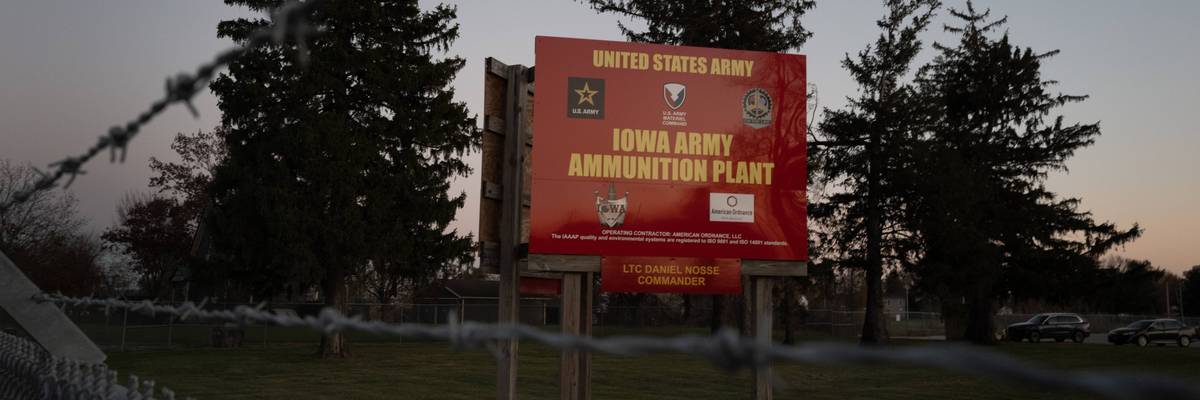
A sign identifying the facility sits inside a fence surrounding the Iowa Army Ammunition Plant on November 19, 2026 in Middletown, Iowa.
The Army allowed the materials to degrade "until it decided that the only safe option was to blow them up near populated areas," said one advocate. "That turned the Army’s storage management failure into a public health catastrophe."
A federal appeals court was considering a long-term halt on Friday to a plan by the US Army to detonate about five tons of aging, toxic lead-based explosives at a munitions plant near Middletown, Iowa, after issuing a temporary suspension of the US Environmental Protection Agency's permit, which had been for Monday.
In a one-sentence order, the US Court of Appeals issued a stay on the permit after the environmental legal group, Earthjustice, filed a lawsuit Thursday on behalf of the Iowa Environmental Council (IEC) and the Sierra Club Iowa chapter.
The IEC told Iowa Public Radio that the court could still allow Monday's detonation to go forward—an action that would send a toxic plume of lead dust into the air that could travel up to 100 miles north of the Iowa Army Ammunition Plant, as well as putting Middletown's population of about 360 people at risk.
The lawsuit filed Thursday said the EPA and the US Army had not conducted a full review of other potential disposal methods for the lead azide, which the Army has said has become unstable and is sensitive to shock and friction, increasing the risk of an uncontrolled explosion.
The detonation was originally set for Friday, but was postponed to Monday after outcry from the organizations and local political leaders, including Democratic Gov.-elect Rob Sand and senators in neighboring Illinois.
"The American people deserved better than this," said Sen. Tammy Duckworth (D-Ill.) after acting Army Secretary Adam Telle announced the postponement, which he said was now scheduled for the "latest possible moment" that the operation could take place before temperatures drop and make the lead azide more unstable.
"This whole operation was poorly planned and poorly communicated," said Duckworth. "Families were abruptly told to avoid the area, unsure if they would return to broken homes and whether their air and water could be at risk due to toxic lead exposure. This was unacceptable and a failure of leadership of epic proportions. Moving forward, I will continue to demand answers about how we even got to this point and accountability to make sure the Army never allows unsafe conditions to get this dire again."
Earthjustice noted that the lead dust may "linger on yards, gardens, and play areas for years" after the explosion. Even small amounts of lead exposure can permanently damage a child's developing brain, and 400,000 deaths are attributed to lead each year, including from cardiovascular disease. Exposure for pregnant people can also cause premature births.
The Army published a public notice of the detonation, which required an evacuation of the surrounding town, just five days before before it was set to go forward.
“The Army left 68 drums of a primary explosive to degrade for 20 years until it decided that the only safe option was to blow them up near populated areas. That turned the Army’s storage management failure into a public health catastrophe for people in at least two states,” said Earthjustice attorney Thien Chau. “Instead of keeping people safe, the Army is knowingly blanketing communities with lead and putting the burden on families to understand and mitigate the risks of the massive plume of lead dust.”
Wally Taylor, attorney and legal chair for the Sierra Club's Iowa chapter, said it was "obvious that the Army is proceeding recklessly with this action."
"Iowans," said Taylor, "deserve to see an environmental and health impact statement and investigation into better alternatives than this extreme planned explosion."
This country and this world are at a monumental crossroads. US voters have an opportunity to beat back the forces of fascism and confront the billionaires who are rigging the economy, our media system, and our democracy, making it increasingly impossible for ordinary people to get by. We’re not just talking about the election. We’re talking about what must be done once these fascist elements are vanquished from power. We need a bolder set of solutions than what either major party has so far been willing to offer and a working-class movement ready to fight like hell for it. Trump didn't emerge from nowhere. The conditions that fueled MAGA authoritarianism were created by decades of radical neoliberal economic policies and a corrupt political system dominated by corporate interests. They slashed taxes on the super-rich, promising that the benefits would trickle down. They said giveaways to the corporate titans would make life more affordable for the rest of us. It was all bullshit. And when a bitter, betrayed populace searches for someone to blame, right-wing demagogues have little trouble finding scapegoats. People know when they're being lied to, but you won't hear any of this from the corporate media. Only independent journalism—powered and funded by people who believe in building a better world—can deliver truly trustworthy daily news. If you share our vision, please contribute whatever you can to sustain our work. |
A federal appeals court was considering a long-term halt on Friday to a plan by the US Army to detonate about five tons of aging, toxic lead-based explosives at a munitions plant near Middletown, Iowa, after issuing a temporary suspension of the US Environmental Protection Agency's permit, which had been for Monday.
In a one-sentence order, the US Court of Appeals issued a stay on the permit after the environmental legal group, Earthjustice, filed a lawsuit Thursday on behalf of the Iowa Environmental Council (IEC) and the Sierra Club Iowa chapter.
The IEC told Iowa Public Radio that the court could still allow Monday's detonation to go forward—an action that would send a toxic plume of lead dust into the air that could travel up to 100 miles north of the Iowa Army Ammunition Plant, as well as putting Middletown's population of about 360 people at risk.
The lawsuit filed Thursday said the EPA and the US Army had not conducted a full review of other potential disposal methods for the lead azide, which the Army has said has become unstable and is sensitive to shock and friction, increasing the risk of an uncontrolled explosion.
The detonation was originally set for Friday, but was postponed to Monday after outcry from the organizations and local political leaders, including Democratic Gov.-elect Rob Sand and senators in neighboring Illinois.
"The American people deserved better than this," said Sen. Tammy Duckworth (D-Ill.) after acting Army Secretary Adam Telle announced the postponement, which he said was now scheduled for the "latest possible moment" that the operation could take place before temperatures drop and make the lead azide more unstable.
"This whole operation was poorly planned and poorly communicated," said Duckworth. "Families were abruptly told to avoid the area, unsure if they would return to broken homes and whether their air and water could be at risk due to toxic lead exposure. This was unacceptable and a failure of leadership of epic proportions. Moving forward, I will continue to demand answers about how we even got to this point and accountability to make sure the Army never allows unsafe conditions to get this dire again."
Earthjustice noted that the lead dust may "linger on yards, gardens, and play areas for years" after the explosion. Even small amounts of lead exposure can permanently damage a child's developing brain, and 400,000 deaths are attributed to lead each year, including from cardiovascular disease. Exposure for pregnant people can also cause premature births.
The Army published a public notice of the detonation, which required an evacuation of the surrounding town, just five days before before it was set to go forward.
“The Army left 68 drums of a primary explosive to degrade for 20 years until it decided that the only safe option was to blow them up near populated areas. That turned the Army’s storage management failure into a public health catastrophe for people in at least two states,” said Earthjustice attorney Thien Chau. “Instead of keeping people safe, the Army is knowingly blanketing communities with lead and putting the burden on families to understand and mitigate the risks of the massive plume of lead dust.”
Wally Taylor, attorney and legal chair for the Sierra Club's Iowa chapter, said it was "obvious that the Army is proceeding recklessly with this action."
"Iowans," said Taylor, "deserve to see an environmental and health impact statement and investigation into better alternatives than this extreme planned explosion."