SUBSCRIBE TO OUR FREE NEWSLETTER
Daily news & progressive opinion—funded by the people, not the corporations—delivered straight to your inbox.
5
#000000
#FFFFFF
To donate by check, phone, or other method, see our More Ways to Give page.
Daily news & progressive opinion—funded by the people, not the corporations—delivered straight to your inbox.
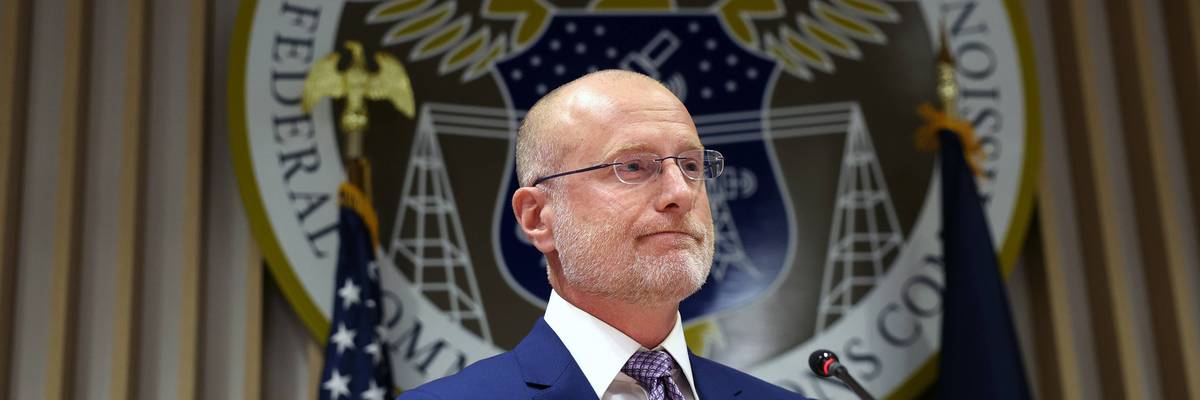
Federal Communications Commission Chairman Brendan Carr speaks at a news conference on February 18, 2026 in Washington, DC.
The lone Democrat on the FCC said Brendan Carr's plan would "destroy local newsrooms, silence community reporting, and drive-up costs for the American families."
Federal Communications Commission Chair Brendan Carr announced Wednesday that his agency will soon vote to repeal a decades-old rule aimed at limiting consolidation among television broadcasters, a move that press freedom organizations say would be disastrous for journalism and American democracy.
Carr, a loyalist of President Donald Trump, outlined his proposal in an op-ed for the far-right online publication Breitbart, claiming his plan would "restore balance to the broadcast airwaves." But Anna Gomez, the lone Democratic FCC commissioner, warned in a fiery statement that "this unlawful effort to hand control of the public airwaves to billionaire buddies of this administration will destroy local newsrooms, silence community reporting, and drive-up costs for the American families who depend on local stations for news and emergency alerts."
Carr said the FCC will vote on August 6 on his proposal to eliminate a rule barring any single TV broadcaster from reaching more than 39% of US households—a limit designed to constrain television conglomerates. The FCC, which has a two-to-one Republican majority, is likely to approve the plan.
But Gomez argued in her statement on Wednesday that Carr's proposal is illegal, noting that "Congress wrote that specific [39%] number into federal law in 2004, and it did so on purpose."
"This is not the first time the FCC has tried to move on this issue," said Gomez. "In 2003, the commission raised the cap to 45% under its own authority. Congress stepped in within months, rewrote the law to set the cap at 39%, and made clear the FCC did not have the authority to change it. An FCC vote to raise the cap now would be unlawful, as it would mean doing the exact thing Congress has already said the commission cannot do."
Politico noted that Carr's proposal "marks a likely victory for the National Association of Broadcasters and its members such as Nexstar and Sinclair, which would be freer to pursue mergers that would breach the cap."
Earlier this year, the FCC approved Nexstar's $6.2 billion acquisition of rival TV company Tegna. A federal judge blocked the merger deal in April pending resolution of a legal challenge. If the merger is finalized, the new media conglomerate would reach roughly 80% of US households, blowing past the statutory 39% limit that Carr is now working to remove.
"Just as the FCC had no power to waive a congressional statute to grease the skids for Nexstar’s merger with Tegna, it has no power now to completely obliterate the limit Congress set," Matt Wood, vice president of policy and general counsel at Free Press, said in a statement on Wednesday. "The national cap remains good policy. It promotes competition, localism, and diversity in broadcasting, incentivizing stations to preserve local newsrooms and local-journalism jobs instead of duplicating stories nationwide and passing that off as local news."
"But whatever the law’s merits may be," Wood added, "the key point is that Brendan Carr cannot undo the limit that Congress set just because he feels like it.”
Dear Common Dreams reader, It’s been nearly 30 years since I co-founded Common Dreams with my late wife, Lina Newhouser. We had the radical notion that journalism should serve the public good, not corporate profits. It was clear to us from the outset what it would take to build such a project. No paid advertisements. No corporate sponsors. No millionaire publisher telling us what to think or do. Many people said we wouldn't last a year, but we proved those doubters wrong. Together with a tremendous team of journalists and dedicated staff, we built an independent media outlet free from the constraints of profits and corporate control. Our mission has always been simple: To inform. To inspire. To ignite change for the common good. Building Common Dreams was not easy. Our survival was never guaranteed. When you take on the most powerful forces—Wall Street greed, fossil fuel industry destruction, Big Tech lobbyists, and uber-rich oligarchs who have spent billions upon billions rigging the economy and democracy in their favor—the only bulwark you have is supporters who believe in your work. But here’s the urgent message from me today. It's never been this bad out there. And it's never been this hard to keep us going. At the very moment Common Dreams is most needed, the threats we face are intensifying. We need your support now more than ever. We don't accept corporate advertising and never will. We don't have a paywall because we don't think people should be blocked from critical news based on their ability to pay. Everything we do is funded by the donations of readers like you. When everyone does the little they can afford, we are strong. But if that support retreats or dries up, so do we. Will you donate now to make sure Common Dreams not only survives but thrives? —Craig Brown, Co-founder |
Federal Communications Commission Chair Brendan Carr announced Wednesday that his agency will soon vote to repeal a decades-old rule aimed at limiting consolidation among television broadcasters, a move that press freedom organizations say would be disastrous for journalism and American democracy.
Carr, a loyalist of President Donald Trump, outlined his proposal in an op-ed for the far-right online publication Breitbart, claiming his plan would "restore balance to the broadcast airwaves." But Anna Gomez, the lone Democratic FCC commissioner, warned in a fiery statement that "this unlawful effort to hand control of the public airwaves to billionaire buddies of this administration will destroy local newsrooms, silence community reporting, and drive-up costs for the American families who depend on local stations for news and emergency alerts."
Carr said the FCC will vote on August 6 on his proposal to eliminate a rule barring any single TV broadcaster from reaching more than 39% of US households—a limit designed to constrain television conglomerates. The FCC, which has a two-to-one Republican majority, is likely to approve the plan.
But Gomez argued in her statement on Wednesday that Carr's proposal is illegal, noting that "Congress wrote that specific [39%] number into federal law in 2004, and it did so on purpose."
"This is not the first time the FCC has tried to move on this issue," said Gomez. "In 2003, the commission raised the cap to 45% under its own authority. Congress stepped in within months, rewrote the law to set the cap at 39%, and made clear the FCC did not have the authority to change it. An FCC vote to raise the cap now would be unlawful, as it would mean doing the exact thing Congress has already said the commission cannot do."
Politico noted that Carr's proposal "marks a likely victory for the National Association of Broadcasters and its members such as Nexstar and Sinclair, which would be freer to pursue mergers that would breach the cap."
Earlier this year, the FCC approved Nexstar's $6.2 billion acquisition of rival TV company Tegna. A federal judge blocked the merger deal in April pending resolution of a legal challenge. If the merger is finalized, the new media conglomerate would reach roughly 80% of US households, blowing past the statutory 39% limit that Carr is now working to remove.
"Just as the FCC had no power to waive a congressional statute to grease the skids for Nexstar’s merger with Tegna, it has no power now to completely obliterate the limit Congress set," Matt Wood, vice president of policy and general counsel at Free Press, said in a statement on Wednesday. "The national cap remains good policy. It promotes competition, localism, and diversity in broadcasting, incentivizing stations to preserve local newsrooms and local-journalism jobs instead of duplicating stories nationwide and passing that off as local news."
"But whatever the law’s merits may be," Wood added, "the key point is that Brendan Carr cannot undo the limit that Congress set just because he feels like it.”
Federal Communications Commission Chair Brendan Carr announced Wednesday that his agency will soon vote to repeal a decades-old rule aimed at limiting consolidation among television broadcasters, a move that press freedom organizations say would be disastrous for journalism and American democracy.
Carr, a loyalist of President Donald Trump, outlined his proposal in an op-ed for the far-right online publication Breitbart, claiming his plan would "restore balance to the broadcast airwaves." But Anna Gomez, the lone Democratic FCC commissioner, warned in a fiery statement that "this unlawful effort to hand control of the public airwaves to billionaire buddies of this administration will destroy local newsrooms, silence community reporting, and drive-up costs for the American families who depend on local stations for news and emergency alerts."
Carr said the FCC will vote on August 6 on his proposal to eliminate a rule barring any single TV broadcaster from reaching more than 39% of US households—a limit designed to constrain television conglomerates. The FCC, which has a two-to-one Republican majority, is likely to approve the plan.
But Gomez argued in her statement on Wednesday that Carr's proposal is illegal, noting that "Congress wrote that specific [39%] number into federal law in 2004, and it did so on purpose."
"This is not the first time the FCC has tried to move on this issue," said Gomez. "In 2003, the commission raised the cap to 45% under its own authority. Congress stepped in within months, rewrote the law to set the cap at 39%, and made clear the FCC did not have the authority to change it. An FCC vote to raise the cap now would be unlawful, as it would mean doing the exact thing Congress has already said the commission cannot do."
Politico noted that Carr's proposal "marks a likely victory for the National Association of Broadcasters and its members such as Nexstar and Sinclair, which would be freer to pursue mergers that would breach the cap."
Earlier this year, the FCC approved Nexstar's $6.2 billion acquisition of rival TV company Tegna. A federal judge blocked the merger deal in April pending resolution of a legal challenge. If the merger is finalized, the new media conglomerate would reach roughly 80% of US households, blowing past the statutory 39% limit that Carr is now working to remove.
"Just as the FCC had no power to waive a congressional statute to grease the skids for Nexstar’s merger with Tegna, it has no power now to completely obliterate the limit Congress set," Matt Wood, vice president of policy and general counsel at Free Press, said in a statement on Wednesday. "The national cap remains good policy. It promotes competition, localism, and diversity in broadcasting, incentivizing stations to preserve local newsrooms and local-journalism jobs instead of duplicating stories nationwide and passing that off as local news."
"But whatever the law’s merits may be," Wood added, "the key point is that Brendan Carr cannot undo the limit that Congress set just because he feels like it.”