

SUBSCRIBE TO OUR FREE NEWSLETTER
Daily news & progressive opinion—funded by the people, not the corporations—delivered straight to your inbox.
5
#000000
#FFFFFF
To donate by check, phone, or other method, see our More Ways to Give page.
Daily news & progressive opinion—funded by the people, not the corporations—delivered straight to your inbox.
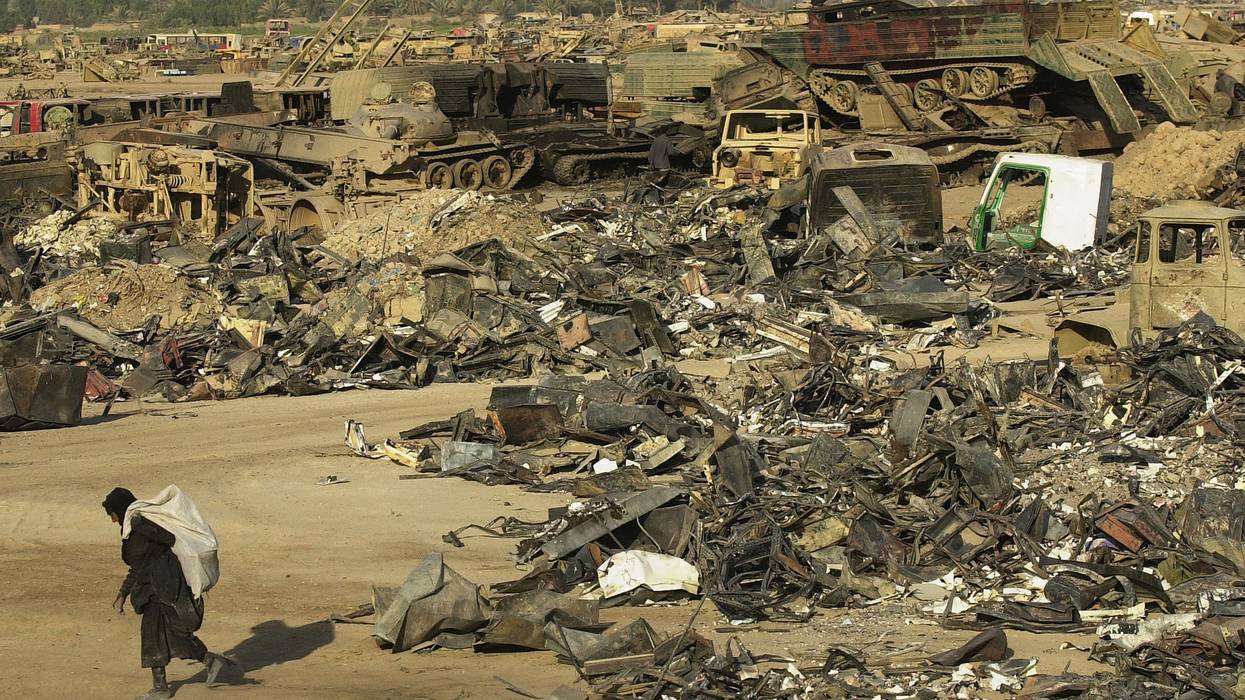
The horror of DU is what happens after the battles are over.
Freedom’s just another word for... blowing up your children? Giving them cancer?
Militarism is obsolete, for God’s sake. Its technology is out of control. The latest shred of news that has left me stunned and terror-stricken is this, as reported by Reuters: “The Biden administration will for the first time send controversial armor-piercing munitions containing depleted uranium to Ukraine... It follows an earlier decision by the Biden administration to provide cluster munitions to Ukraine, despite concerns over the dangers such weapons pose to civilians.”
Russia’s war on Ukraine is a disaster at every level. Some 70,000 Ukrainians have died, according to The New York Times, and possibly another 120,000 have been wounded, with Russia’s casualty level actually far higher. The war (like all wars) has to stop, but NATO and the U.S., just like Russia itself, are looking not for peace and conflict resolution but victory. Killing the enemy is what matters, the more the better. War is humanity’s most horrific addiction. When it takes hold of a people’s soul, all environmental and human concerns vanish. And today—indeed, throughout the course of my lifetime—with the development of nuclear weapons, we’ve been at the brink of self-generated extinction. And we’re still playing with it, rather than trying to move beyond it.
DU stays in the environment, and has been linked to huge rises in cancer and birth defects in the conflict zones.
Depleted uranium—DU—is one of the playthings of war: At 1.6 times the density of lead, DU shells are the last word in penetration power: locomotives compressed to the size of bullets. The shells ignite the instant they’re fired and explode on impact.
I first started writing about depleted uranium in 2003, when I heard Doug Rokke (who died two and a half years ago) speak in Chicago. Doug, a career soldier, was involved in the first Gulf War, leading a team of soldiers whose job was to clean up the war zones in the aftermath of our bombing raids.
As I wrote then: Depleted uranium
Isn’t really depleted of anything. It’s dirty: U-238, the low-level radioactive byproduct of the uranium enrichment process. And when the ammo explodes, poof, it vaporizes into particles so fine—a single micron in diameter, small enough to fit inside red blood cells—that, well, ‘conventional gas mask filters are like a barn door...’
What’s not to love, if you’re the Pentagon? We pounded Saddam’s army with DU ammo in Gulf War 1 and destroyed it on the ground. Maybe you’ve seen pictures of what we did to it; GIs cleaning up afterward coined the term ‘crispy critters’ to describe the fried corpses they found inside Iraqi tanks and trucks.
But the horror of DU is what happens after the battles are over. DU stays in the environment, and has been linked to huge rises in cancer and birth defects in the conflict zones. As Doug Rokke said: “You can’t clean it up.”
But so what? According to Sydney Young, writing for the Harvard International Review:
In the past, leaders did not pay the necessary amount of attention to the risks of depleted uranium. Documents suggest that the United States may have known about the potential consequences of depleted uranium during conflicts in which it was used. The International Atomic Energy Agency (IAEA) published a 1991 report indicating that deploying depleted uranium in the Gulf War could have caused 500,000 cancer deaths.
However, the United States still used depleted uranium in the Middle East despite the risks, deeming that its military benefits outweighed the potential civilian impact. This calculus reflects a common trend in which Western countries justify human rights abuses under the guise of ‘national interest’ or military necessity.
Another tactic of the political militarists is to deny there’s any negative consequences to their actions. Young also notes:
Research also faces political barriers. Governments that use depleted uranium have a vested interest in preventing research that suggests it has negative effects on human health. For instance, the United States, United Kingdom, Israel, and France all opposed a 2001 United Nations resolution to document depleted uranium in war.
There’s a collective human addiction not simply to militarism and war, but to winning: to domination. A focus on winning in the moment obliterates any sense of the larger future. The creation of peace is not a simplistic game. It has no weapons to parade before the public, whose use will obliterate the enemy of the moment and make the world a better place once and for all.
Noting the horrific extent to which the Ukraine war has stalemated, Jeet Heer writes at The Nation: “The time is surely ripe for a diplomatic push. Unfortunately, the passions ignited by war always make negotiations difficult...” and, alas “a strong ‘taboo’ against public discussion of diplomacy pervades the NATO countries.”
This is understandable, he notes, considering the criminality of the Russian invasion and the horror it has inflicted on Ukraine: “But an interminable bloodbath on Ukrainian soil is also horrific.”
Humanity has to figure out how to talk to itself, not kill itself.

Peace groups have long campaigned for a ban on DU munitions
The Biden administration will, for the first time, send controversial armor-piercing munitions containing depleted uranium to Ukraine, according to Reuters.
The munition can be fired from US Abrams tanks, which are expected to arrive in Ukraine in the coming weeks.
The shells, which will come from US excess inventory, would be funded by the Presidential Drawdown Authority, which lets the president make transfers from US stocks without Congress' approval in the case of an emergency.
This follows an earlier decision by the Biden administration to provide cluster munitions to Ukraine despite concerns over the dangers such weapons pose to civilians.
If the US deploys depleted uranium shells to Ukraine, Russian President Vladimir Putin has threatened to retaliate with DU rounds—which are linked to birth defects, miscarriages, and cancer.
Depleted uranium is a byproduct of the production of fuel used in nuclear power stations. Its extreme density gives rounds the ability to penetrate armor-plating easily.
The use of depleted uranium munitions has been fiercely debated, with opponents like the International Coalition to Ban Uranium Weapons saying there are dangerous health risks from ingesting or inhaling depleted uranium dust, including cancers and birth defects.
Common Dreams has reported:
The U.S.-led NATO coalition that waged the 1999 air war against Yugoslavia also used DU munitions, which experts believe are responsible for a surge in leukemia in the region, both among the local population and foreign troops deployed in the war zone.
Peace groups have long campaigned for a ban on DU munitions. Last September, the United Nations General Assembly approved an Indonesian draft resolution urging further research of the "health risks and environmental impact" of DU weapons and calling for a "cautionary approach" to their use.
The resolution was approved by 147 nations. The U.S., U.K., France, and Israel voted against the proposal.

The Biden administration has no diplomatic strategies, no demand for an immediate unconditional ceasefire followed by top-level peace negotiations.
Russia’s criminal war in Ukraine intensifies as it grinds on, World War I style with heavy casualties on both sides. While President Joe Biden keeps repeating that NATO, mostly meaning the U.S., will expand military support for Ukraine “as long as it takes.”
“As long as it takes,” is not a policy, it is deadly procrastination without any exit strategy.
Of course, Biden, who voted for former President George W. Bush’s criminal war in Iraq as a Senator in 2003, along with funding it with hundreds of billions of dollars over the years, is experienced in “as long as it takes.” That invasion and occupation took over 1 million Iraqi lives, caused even more injuries and sicknesses, and plunged Iraq into destructive chaos that persists to this day.
Our country should lead in peacemaking, in engaging the United Nations when its charter against offensive war is violated by any member country, and in observing our own constitutional mandates which reserve for Congress, not the presidency, the power to declare war.
“As long as it takes” for a million Ukrainian lives lost and the comparable destruction of their country? For the war to escalate beyond Ukraine, into Russia and bordering countries?
Biden spends more time thinking about when he will say, “Yes,” to Ukrainian President Volodymyr Zelensky’s demand for more powerful weapons—Advanced Armored Vehicles, longer-reaching artillery, Abrams Tanks with depleted-uranium rounds. The United Nations Environment Programme (UNEP) warns such ammunition is “chemically and radiologically toxic heavy metal.” The Harvard International Review reports, “Depleted uranium may pose a risk to both soldiers and local civilian populations. When ammunition made from depleted uranium strikes a target, the uranium turns into dust that is inhaled by soldiers near the explosion site. The wind then carries dust to surrounding areas, polluting local water and agriculture.”
Biden also supports providing Ukraine with F-16s, which take many months to learn to fly, and he has already sent Ukraine cluster bombs to match Russia’s cluster bombs so as to further endanger Ukrainians, including children, for years to come. The New York Times reports, “One-hundred and twenty-three nations—including many of America’s allies—have agreed never to use, transfer, produce, or stockpile cluster munitions.”
The Biden administration has no diplomatic strategies, no demand for an immediate unconditional ceasefire followed by top-level peace negotiations. This war is expanding and becoming more lethal each day. Provocations are also escalating as armed Ukrainian drones appear over Moscow and more Russian missiles target Ukrainian civilians.
Congress, ignorant of history’s lessons from wars in Vietnam, Iraq, Afghanistan, Libya, and other military boomerangs of the U.S. Empire, rubber-stamp Biden’s demands without any thorough Congressional hearings to examine where this war is heading. Congressional Democrats did, however, make sure to block a proposed Inspector General’s Office to oversee the spending of tens of billions of taxpayers’ dollars in U.S. military aid, watchdog corruption, and investigate diversions of military supplies.
A culpable Congress is also going along with the Biden and NATO decision to put 300,000 soldiers “at high readiness” stationed in the countries on Russia’s borders and in Europe. Already, thousands of U.S. soldiers, modern artillery, and warships are in that region.
Dictator Vladimir Putin doesn’t have to stretch the truth far in his propaganda to alarm the Russian people. They remember the invasions by Germany in World War I and World War II that took more than 50 million Russian lives and that caused massive devastation in Russia, their country. They see a military alliance of Western countries, (NATO) including Germany, Finland, Poland, Hungary, Czechia, Estonia, Romania, and Bulgaria. They also see moves to include Ukraine.
In 1990 several Western leaders assured Soviet President Mikhail Gorbachev that NATO would not expand. In 1991, when the Soviet Union started to formally dissolve and Soviet concerns about NATO increased. U.S. experts, including long-time expert George Kennan, warned of a redline disaster. The Guardian notes that “Putin claims that [James] Baker, [former Secretary of State] in a discussion on 9 February 1990 with the Soviet leader, Mikhail Gorbachev, made the promise that NATO would not expand to the east if Russia accepted Germany’s unification.”
President Bill Clinton infuriated Russian President Boris Yeltsin by breaking with past U.S. assurances on NATO expansion.
As pointed out in a long Harper’s June 2023 article on Ukraine, “…at NATO’s Bucharest summit in April 2008, the U.S. delegation, led by President Bush, urged the alliance to put Ukraine and Georgia on the immediate path to NATO membership. German Chancellor Angela Merkel understood the implications of Washington’s proposal: ‘I was very sure... that Putin was not going to just let that happen,’ she recalled in 2022. ‘From his perspective, that would be a declaration of war.’
“America’s ambassador to Moscow, William J. Burns, shared Merkel’s assessment. Burns had already warned Secretary of State Condoleezza Rice... ‘Ukrainian entry into NATO is the brightest of all redlines for the Russian elite (not just Putin),’” concluding that “‘Russia will respond.’”
Imagine the shoe being on the other foot, with Russia doing all this on our borders. Look how the U.S. reacted to 3,000 lives lost on 9/11.
The media also hasn’t learned its history lessons. Coverage of the Ukraine War towers over its coverage of our illegal military invasions in the Middle East. Except they avoid reporting about peace advocacy by domestic and international groups.
While The New York Times’ readers are told about how domestic pets and athletes are faring in the Ukraine conflict, this newspaper of record ignores the voyage of the Golden Rule Boat, sponsored by Veterans for Peace, docking this year at ports on the west Gulf and eastern coast. The mainstream media ignored the rally by many peace groups on July 22, 2023, at Biden’s hometown (Scranton, PA) in front of the Army Ammunition Plant run by General Dynamics.
Nor does the mass media probe the U.S. policy driving Germany into larger military budgets and weapons shipments to Ukraine, and ending the Nordic countries’ traditions of neutrality by bringing them into NATO. All these expansions provide huge business for the U.S. military-industrial complex, which Eisenhower warned us about.
The expansions also scare the Russian public and increase popular support for the aggressor Putin and Russian troops. Roger Cohen’s long report in The New York Times on his trip through Russia shed some light on these feelings.
Our country should lead in peacemaking, in engaging the United Nations when its charter against offensive war is violated by any member country, and in observing our own constitutional mandates which reserve for Congress, not the presidency, the power to declare war.
Instead, we expand a vast military budget (greater than the next 10 countries combined, including China and Russia), operate military bases in over 100 countries, bristle with military threats or incursions in the backyards of many of these nations—in violation of international law, the U.N. charter (which we most prominently drafted in 1946), and federal statutes. All done in a bipartisan fashion, with astounding hypocrisy and self-righteousness.
Whether or not you are a veteran, I urge you to virtually attend the annual Veterans for Peace Convention on August 25 through August 27, 2023, to hear the views of people who abhor all wars in favor of stopping the slaughter and deliberately waging peace.
Otherwise, prepare for a war of attrition on both sides, which could last for years. Unless, that is, it flares into a nuclear war.
That should sober all hawks, including the consistent one in the White House.
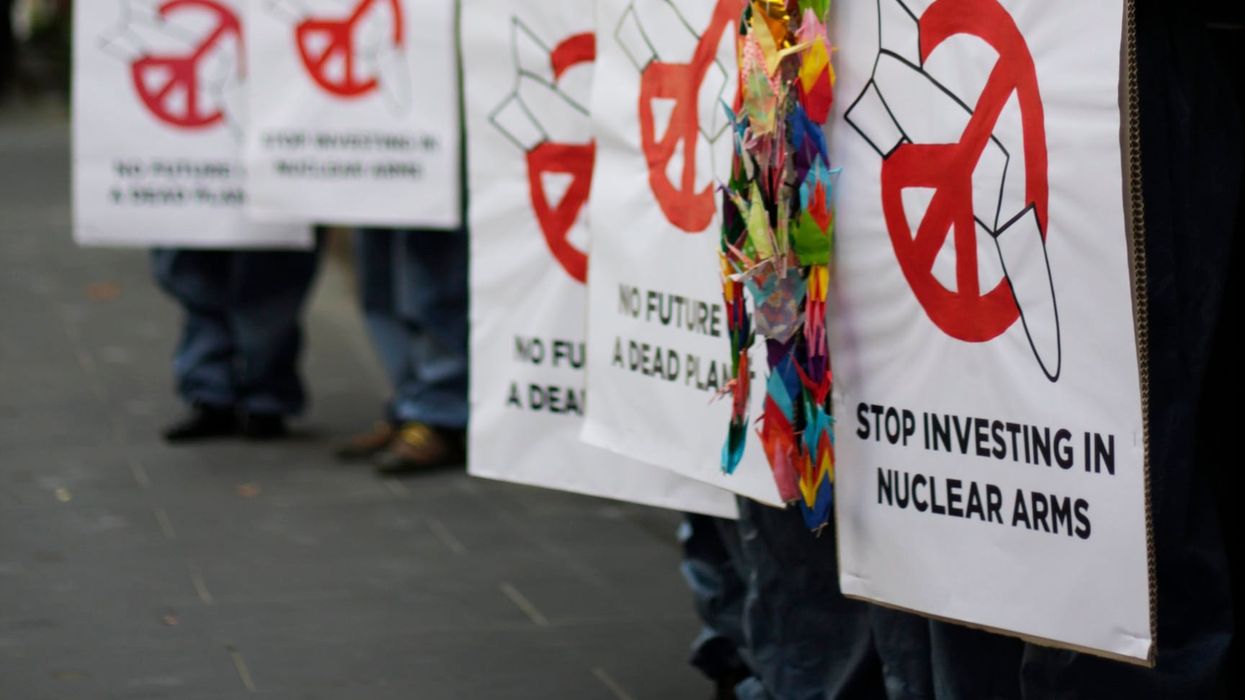
"Many investors, given a choice, would not want to profit from companies that manufacture weapons of mass destruction," said As You Sow's Andrew Behar.
Amidst what the Bulletin of Atomic Scientists calls "an exceedingly dangerous nuclear situation" facing humanity today, the largest U.S. mutual funds—which manage the retirement and other savings of tens of millions of Americans—are profiting from investments in nuclear weapons, cluster munitions, and other banned or controversial arms, an analysis by a leading shareholder advocacy group revealed Tuesday.
Measured by dollars invested, the top 25 U.S. asset managers "all earn a D grade or worse, with significant investments in arms manufacturers and major military contractors, including companies involved with nuclear weapons and controversial weapons like cluster munitions, anti-personnel landmines, incendiary weapons, and depleted uranium," Berkeley, California-based As You Sow said in its new report.
Some of the largest corporate 401(k)s like American Funds, John Hancock Funds, and Franklin Templeton Investments were among the most heavily invested in these armaments, while "fund managers that focus on sustainable investing have less exposure to military weapons, on average."
"Nearly every retirement plan has nuclear and other controversial weapons embedded in their plan."
Seven funds profiled in the analysis—Eventide Funds, Ecofin, New Alternatives, Vert Asset Management, Aspiration Funds ,Thrivent, and Kayne Anderson—held no investments in the controversial weapons.
"Many investors, given a choice, would not want to profit from companies that manufacture weapons of mass destruction," As You Sow CEO Andrew Behar said in a statement. "Yet nearly every retirement plan has nuclear and other controversial weapons embedded in their plan. Our new ratings empower investors with the tools to know what they own so they can invest their money in alignment with their values."
As You Sow's mutual fund ratings are part of the group's Weapons Free Funds investment tool, "built to help responsible investors prioritize peace and people over war and violence."
Nuclear weapons, landmines, and cluster munitions are all banned under international law. However, the United States is not a signatory to any of the bans, and none of the world's nine nuclear powers have signed the landmark Treaty on the Prohibition of Nuclear Weapons.
Common Dreams reported last month that nuclear-armed nations spent $82.9 billion on their arsenals last year, with the United States accounting for more than half of the global total, according to the Nobel Prize-winning International Campaign to Abolish Nuclear Weapons.
Meanwhile, U.S. House Republicans last week blocked a bipartisan amendment to the 2024 National Defense Authorization Act that would have banned the export of cluster munitions. This, as the Biden administration was giving final approval to transfer cluster bombs to Ukraine's military—which, like its Russian enemy, has used the weapons during the ongoing war with devastating effects.
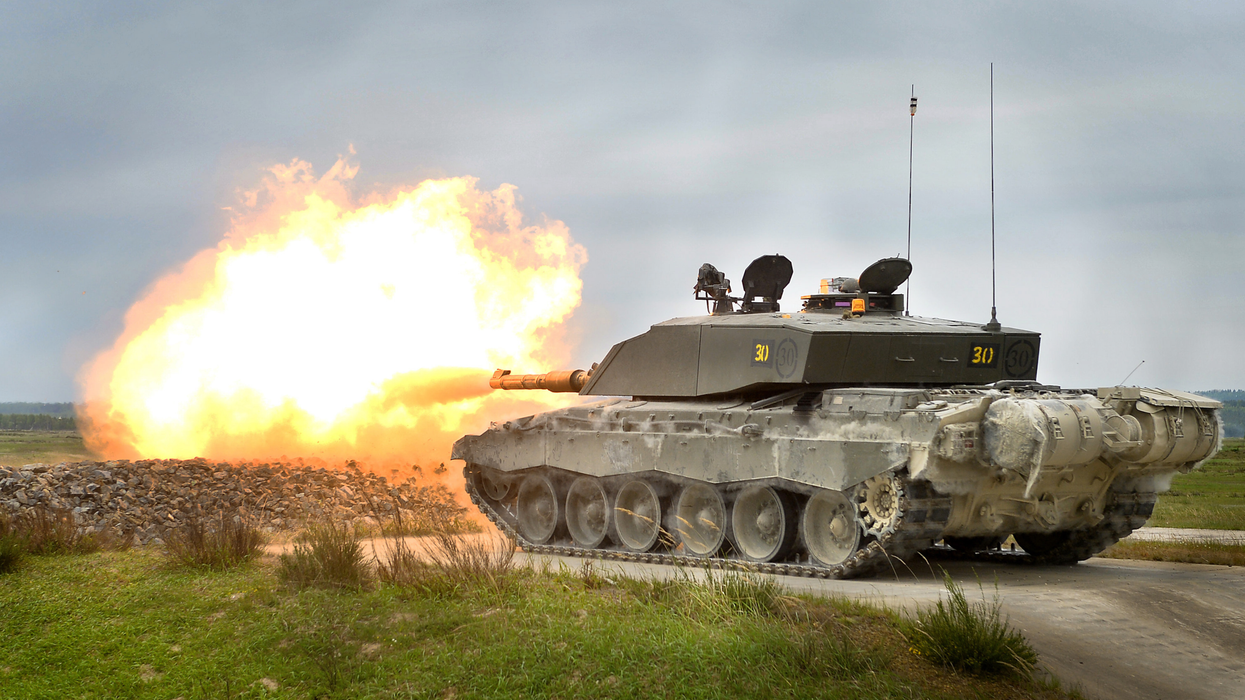
"Look at Fallujah. Look at Yugoslavia. Long after the end of the Ukraine war, the use of depleted uranium will give Ukrainians cancer and birth defects for decades," said one journalist.
The Biden administration is expected to equip Ukrainian homeland defenders with armor-piercing depleted uranium munitions for their U.S.-supplied Abrams main battle tanks, The Wall Street Journal reported Tuesday, prompting Russian President Vladimir Putin to threaten to retaliate with DU rounds—which are linked to birth defects, miscarriages, and cancer.
Citing an unnamed senior Biden administration official, the Journal reported that "there appear to be no major obstacles to approving" the shipment of the highly controversial ammunition to Ukrainian forces as they launch a counteroffensive against Russian troops entrenched along a vast front in the eastern and southern regions of the country.
The new reporting comes four months after The Redacted's Dan Cohen reported the U.S. would send DU rounds to Ukraine.
In February, a top British defense official announced that the United Kingdom would supply Ukrainian forces with DU rounds, dismissing warnings from Moscow that the Russian government would regard the deployment of such weapons as an act of nuclear war.
Reacting to news that the U.S. will likely supply Ukraine with DU munitions, Putin said Tuesday that "we have many such weapons, and if they use them, we will also reserve the right to use similar munitions," according to the state news agency TASS.
"There's nothing good about it, but, if need be, we can do it," he added. "We don't need to do it."
The Journal report prompted warnings from anti-war voices about the dangers of DU munitions.
"If you love Ukraine, if you care about Ukraine, depleted uranium is the last thing you would tell them to use," British journalist Richard Medhurst said on his video podcast Tuesday. "If you look at what the United States has done, everywhere they've used depleted uranium, it's like dropping a nuclear bomb."
Medhurst added that in Fallujah, Iraq—where U.S. forces used DU rounds during two attempts to capture the city in 2004—"you have higher rates of birth defects and congenital heart disease... than you did in Hiroshima and Nagasaki."
DU rounds are highly effective at penetrating the armor of most modern tanks and armored fighting vehicles. The U.S. Abrams, British Challenger 2, and German Leopard 2 main battle tanks, along with U.S. Bradley Fighting Vehicles that are being sent to Ukraine, can all fire DU munitions. The ammunition can also be fired from warplanes or field artillery.
However, exploding DU shells produce radioactive dust that contaminates soil, water, and air for many years after their use. U.S. Army training manuals caution that DU contamination "will make food and water unsafe for consumption" and require soldiers to wear protective clothing when in or near contaminated areas.
U.S. and allied forces used DU munitions during the 1991 and 2003-11 invasions of Iraq, and in Syria during the war against Islamic State militants. Miscarriages, birth defects, and cancers soared in Iraq after both wars.
According to one study, more than half of the babies born in Fallujah between 2007 and 2010 had birth defects. Among pregnant women in the study, over 45% experienced miscarriages in the two-year period following the battles for Fallujah. Geiger counter measurements of DU-contaminated sites in Iraqi cities have consistently shown radiation levels 1,000 to 1,900 times greater than normal.
The U.S.-led NATO coalition that waged the 1999 air war against Yugoslavia also used DU munitions, which experts believe are responsible for a surge in leukemia in the region, both among the local population and foreign troops deployed in the war zone.
Peace groups have long campaigned for a ban on DU munitions. Last September, the United Nations General Assembly approved an Indonesian draft resolution urging further research of the "health risks and environmental impact" of DU weapons and calling for a "cautionary approach" to their use.
The resolution was approved by 147 nations. The U.S., U.K., France, and Israel voted against the proposal.

Why isn’t depleted uranium banned? That’s a question antinuclear activists have been asking for years.
It’s sure to be a blood-soaked spring in Ukraine. Russia’s winter offensive fell far short of Vladimir Putin’s objectives, leaving little doubt that the West’s conveyor belt of weaponry has aided Ukraine’s defenses. Cease-fire negotiations have never truly begun, while NATO has only strengthened its forces thanks to Finland’s new membership (with Sweden soon likely to follow). Still, tens of thousands of people have perished; whole villages, even cities, have been reduced to rubble; millions of Ukrainians have poured into Poland and elsewhere; while Russia’s brutish invasion rages on with no end in sight.
The hope, according to Ukrainian President Volodymyr Zelensky, is that the Western allies will continue to furnish money, tanks, missiles, and everything else his battered country needs to fend off Putin’s forces. The war will be won, according to Zelensky, not through backroom compromises but on the battlefield with guns and ammo.
“I appeal to you and the world with these most simple and yet important words,” he said to a joint session of Great Britain’s parliament in February. “Combat aircraft for Ukraine, wings for freedom.”
The United Kingdom, which has committed well over $2 billion in assistance to Ukraine, has so far refused to ship fighter jets there but has promised to supply more weaponry, including tank shells made with depleted uranium (DU), also known as “radioactive bullets.” A by-product of uranium enrichment, DU is a very dense and radioactive metal that, when housed in small torpedo-like munitions, can pierce thickly armored tanks and other vehicles.
Reacting to the British announcement, Putin ominously said he would “respond accordingly” if the Ukrainians begin blasting off rounds of DU.
While the UK’s decision to send depleted-uranium shells to Ukraine is unlikely to prove a turning point in the war’s outcome, it will have a lasting, potentially devastating, impact on soldiers, civilians, and the environment. The controversial deployment of DU doesn’t pose faintly the same risks as the actual nuclear weapons Putin and his associates have hinted they might use someday in Ukraine or as would a potential meltdown at the embattled Zaporizhzhia nuclear facility in that country. Still, its use will certainly help create an even more lethal, all too literally radioactive theater of war — and Ukraine will end up paying a price for it.
The Radioactive Lions of Babylon
Stuart Dyson survived his deployment in the first Gulf War of 1991, where he served as a lance corporal with Britain’s Royal Pioneer Corps. His task in Kuwait was simple enough: he was to help clean up “dirty” tanks after they had seen battle. Many of the machines he spent hours scrubbing down had carried and fired depleted uranium shells used to penetrate and disable Iraq’s T-72 tanks, better known as the Lions of Babylon.
Dyson spent five months in that war zone, ensuring American and British tanks were cleaned, armed, and ready for battle. When the war ended, he returned home, hoping to put his time in the Gulf War behind him. He found a decent job, married, and had children. Yet his health deteriorated rapidly and he came to believe that his military service was to blame. Like so many others who had served in that conflict, Dyson suffered from a mysterious and debilitating illness that came to be known as Gulf War Syndrome.
After Dyson suffered years of peculiar ailments, ranging from headaches to dizziness and muscle tremors, doctors discovered that he had a severe case of colon cancer, which rapidly spread to his spleen and liver. The prognosis was bleak and, after a short battle, his body finally gave up. Stuart Dyson died in 2008 at the age of 39.
His saga is unique, not because he was the only veteran of the first Gulf War to die of such a cancer at a young age, but because his cancer was later recognized in a court of law as having been caused by exposure to depleted uranium. In a landmark 2009 ruling, jurors at the Smethwick Council House in the UK found that Dyson’s cancer had resulted from DU accumulating in his body, and in particular his internal organs.
“My feeling about Mr. Dyson’s colon cancer is that it was produced because he ingested some radioactive material and it became trapped in his intestine,” Professor Christopher Busby, an expert on the effects of uranium on health, said in his court testimony. “To my mind, there seems to be a causal arrow from his exposure to his final illness. It’s certainly much more probable than not that Mr. Dyson’s cancer was caused by exposure to depleted uranium.”
The U.S. Department of Defense estimated that American forces fired more than 860,000 rounds of DU shells during that 1991 war to push Iraqi autocrat Saddam Hussein’s military out of Kuwait. The result: a poisoned battlefield laced with radioactive debris, as well as toxic nerve agents and other chemical agents.
In neighboring southern Iraq, background radiation following that war rose to 30 times normal. Tanks tested after being shelled with DU rounds had readings 50 times higher than average.
“It’s hot forever,” explains Doug Rokke, a former major in the U.S. Army Reserve’s Medical Service Corps who helped decontaminate dozens of vehicles hit by DU shells during the first Gulf War. “It doesn’t go away. It only disperses and blows around in the wind,” he adds. And of course, it wasn’t just soldiers who suffered from DU exposure. In Iraq, evidence has been building that DU, an intense carcinogenic agent, has led to increases in cancer rates for civilians, too.
“When we were moving forward and got north of a minefield, there were a bunch of blown-out tanks that were near where we would set up a command post,” says Jason Peterson, a former American Marine who served in the first Gulf War. “Marines used to climb inside and ‘play’ in them … We barely knew where Kuwait was, let alone the kind of ammunition that was used to blow shit up on that level.”
While it’s difficult to discern exactly what caused the Gulf War Syndrome from which Dyson and so many other soldiers suffered (and continue to suffer), experts like Rokke are convinced that exposure to depleted uranium played a central role in the illness. That’s an assertion Western governments have consistently downplayed. In fact, the Pentagon has repeatedly denied any link between the two.
“I’m a warrior, and warriors want to fulfill their mission,” Rokke, who also suffers from Gulf War Syndrome, told Vanity Fair in 2007. “I went into this wanting to make it work, to work out how to use DU safely, and to show other soldiers how to do so and how to clean it up. This was not science out of a book, but science done by blowing the shit out of tanks and seeing what happens. And as we did this work, slowly it dawned on me that we were screwed. You can’t do this safely in combat conditions. You can’t decontaminate the environment or your own troops.”
Death to Uranium
Depleted uranium can’t produce a nuclear explosion, but it’s still directly linked to the development of atomic weaponry. It’s a by-product of the uranium enrichment process used in nuclear weapons and fuel. DU is alluring to weapons makers because it’s heavier than lead, which means that, if fired at a high velocity, it can rip through the thickest of metals.
That it’s radioactive isn’t what makes it so useful on the battlefield, at least according to its proponents. “It’s so dense and it’s got so much momentum that it just keeps going through the armor — and it heats it up so much that it catches on fire,” says RAND nuclear expert and policy researcher Edward Geist.
The manufacturing of DU dates back to the 1970s in the United States. Today, the American military employs DU rounds in its M1A2 Abrams tanks. Russia has also used DU in its tank-busting shells since at least 1982 and there are plenty of accusations, though as yet no hard evidence, that Russia has already deployed such shells in Ukraine. Over the years, for its part, the U.S. has fired such rounds not just in Kuwait, but also in Bosnia, Iraq, Kosovo, Syria, and Serbia as well.
Both Russia and the U.S. have reasons for using DU, since each has piles of the stuff sitting around with nowhere to put it. Decades of manufacturing nuclear weapons have created a mountain of radioactive waste. In the U.S., more than 500,000 tons of depleted-uranium waste has built up since the Manhattan Project first created atomic weaponry, much of it in Hanford, Washington, the country’s main plutonium production site. As I investigated in my book Atomic Days: The Untold Story of the Most Toxic Place in America, Hanford is now a cesspool of radioactive and chemical waste, representing the most expensive environmental clean-up project in history with an estimated price tag of $677 billion.
Uranium, of course, is what makes the whole enterprise viable: you can’t create atomic bombs or nuclear power without it. The trouble is that uranium itself is radioactive, as it emits alpha particles and gamma rays. That makes mining uranium one of the most dangerous operations on the planet.
Keep It in the Ground
In New Mexico, where uranium mines were primarily worked by Diné (Navajo People), the toll on their health proved gruesome indeed. According to a 2000 study in the Journal of Occupational and Environmental Medicine, rates of lung cancer in Navajo men who mined uranium were 28 times higher than in those who never mined uranium. The “Navajo experience with uranium mining,” it added, “is a unique example of exposure in a single occupation accounting for the majority of lung cancers in an entire population.”
Scores of studies have shown a direct correlation between exposure to uranium and kidney disease, birth defects in infants (when mothers were exposed), increased rates of thyroid disease, and several autoimmune diseases. The list is both extensive and horrifying.
“My family had a lot of cancer,” says anti-nuclear activist and Indigenous community organizer Leona Morgan. “My grandmother died of lung cancer and she never smoked. It had to be the uranium.”
One of the largest radioactive accidents, and certainly the least reported, occurred in 1979 on Diné land when a dam broke, flooding the Puerco River near Church Rock, New Mexico, with 94 million gallons of radioactive waste. The incident received virtually no attention at the time. “The water, filled with acids from the milling process, twisted a metal culvert in the Puerco and burned the feet of a little boy who went wading. Sheep keeled over and died, while crops curdled along the banks. The surge of radiation was detected as far away as Sanders, Arizona, fifty miles downstream,” writes Judy Pasternak in her book Yellow Dirt: A Poisoned Land and the Betrayal of the Navajo.
Of course, we’ve known about the dangers of uranium for decades, which makes it all the more mind-boggling to see a renewed push for increased mining of that radioactive ore to generate nuclear power. The only way to ensure that uranium doesn’t poison or kill anyone is to leave it right where it’s always been: in the ground. Sadly, even if you were to do so now, there would still be tons of depleted uranium with nowhere to go. A 2016 estimate put the world’s mountain of DU waste at more than one million tons (each equal to 2,000 pounds).
So why isn’t depleted uranium banned? That’s a question antinuclear activists have been asking for years. It’s often met with government claims that DU isn’t anywhere near as bad as its peacenik critics allege. In fact, the U.S. government has had a tough time even acknowledging that Gulf War Syndrome exists. A Government Accountability Office report released in 2017 found that the Veterans Affairs Department had denied more than 80% of all Gulf War illness claims by veterans. Downplaying DU’s role, in other words, comes with the terrain.
“The use of DU in weapons should be prohibited,” maintains Ray Acheson, an organizer for the International Campaign to Abolish Nuclear Weapons and author of Banning the Bomb, Smashing the Patriarchy. “While some governments argue there is no definitive proof its use in weapons causes harm, it is clear from numerous investigations that its use in munitions in Iraq and other places has caused impacts on the health of civilians as well as military personnel exposed to it, and that it has caused long-term environmental damage, including groundwater contamination. Its use in weapons is arguably in violation of international law, human rights, and environmental protection and should be banned in order to ensure it is not used again.”
If the grisly legacy of the American use of depleted uranium tells us anything, it’s that those DU shells the British are supplying to Ukraine (and the ones the Russians may also be using there) will have a radioactive impact that will linger in that country for years to come, with debilitating, potentially fatal, consequences. It will, in a sense, be part of a global atomic war that shows no sign of ending.
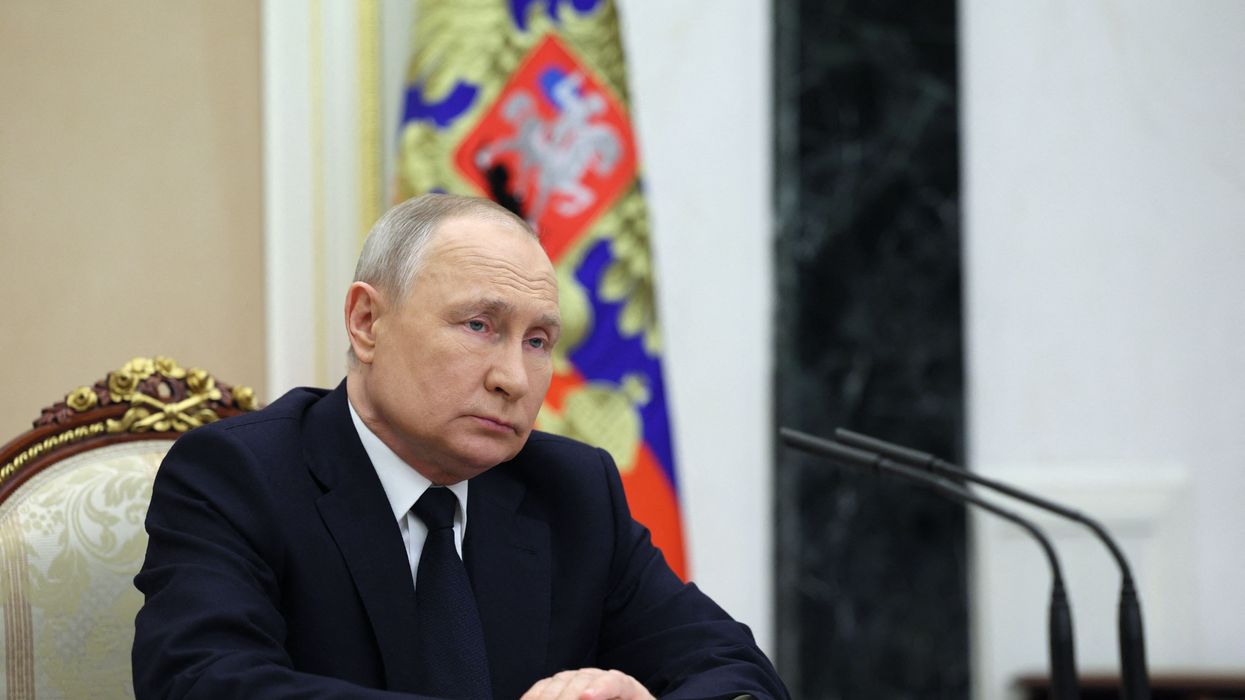
"Putin's nuclear provocations are dangerous and unacceptable. U.S. and NATO must resist calls to respond in kind and avoid injecting nuclear weapons deeper into this war," said Global Zero's Derek Johnson.
Russian President Vladimir Putin announced on state television Saturday plans to station tactical nuclear weapons in Belarus—an escalation anti-war campaigners had been warning about and that alarmed disarmament advocates and experts.
The International Campaign to Abolish Nuclear Weapons (ICAN) "condemns this extremely dangerous escalation which makes the use of nuclear weapons more likely," the group declared in a series of tweets.
"In the context of the war in Ukraine, the likelihood of miscalculation or misinterpretation is extremely high," ICAN added. "Sharing nuclear weapons makes the situation much worse and risks catastrophic humanitarian consequences."
"Sharing nuclear weapons makes the situation much worse and risks catastrophic humanitarian consequences."
The deployment decision comes 13 months into Russia's invasion of Ukraine and after the United Kingdom this week revealed plans to provide the invaded nation with armor-piercing rounds containing depleted uranium (DU).
Putin said the U.K.'s announcement "probably served as a reason" why Belarusian President Alexander Lukashenko agreed to the plan and argued that it won't violate Russia's international nonproliferation treaty obligations, according to a BBC translation.
As Reuters explained, "The Treaty on the Nonproliferation of Nuclear Weapons, signed by the Soviet Union, says that no nuclear power can transfer nuclear weapons or technology to a nonnuclear power, but it does allow for the weapons to be deployed outside its borders but under its control—as with U.S. nuclear weapons in Europe."
The United States, which has the world's second-largest nuclear arsenal after Russia, "long ago deployed their nuclear weapons on the territory of their allies, NATO countries, in Europe," the Russian leader noted. "We are doing the same thing that they have been doing for decades."
Russia "will not hand over" nuclear arms to Belarus, Putin insisted, explaining that his country has already given its ally an Iskander missile complex that can be equipped with weapons, plans to start training crews in early April, and aims to complete construction of a special storage facility for the nukes by the beginning of July.
The Soviet Union collapsed in 1991 and in the five years that followed, nuclear weapons based in Belarus, Kazakhstan, and Ukraine were transferred to Russia—where they have remained since.
"It's a very significant move," Nikolai Sokol, a senior fellow at the Vienna Center for Disarmament and Nonproliferation, told Reuters of the deployment decision. "Russia had always been very proud that it had no nuclear weapons outside its territory. So, now, yes, they are changing that and it's a big change."
Hans Kristensen, director of the Federation of American Scientists' Nuclear Information Project, told Reuters that "this is part of Putin's game to try to intimidate NATO... because there is no military utility from doing this in Belarus as Russia has so many of these weapons and forces inside Russia."
Global Zero managing partner Derek Johnson said that "Putin's nuclear provocations are dangerous and unacceptable. U.S. and NATO must resist calls to respond in kind and avoid injecting nuclear weapons deeper into this war."
In addition to his nuclear announcement, Putin pointed out during the Saturday interview that Russia also has depleted uranium shells. As he put it: "I must say that certainly, Russia has something to respond. Without exaggeration, we have hundreds of thousands, namely hundreds of thousands of such shells. We are not using them now."
A U.K. Ministry of Defense official had confirmed earlier this week that "alongside our granting of a squadron of Challenger 2 main battle tanks to Ukraine, we will be providing ammunition including armor-piercing rounds which contain depleted uranium," which swiftly generated concerns about not only Russian nuclear threats but also public health and environmental impacts.
"DU shells have already been implicated in thousands of unnecessary deaths from cancer and other serious illnesses," stressed Kate Hudson, general secretary of the U.K.-based Campaign for Nuclear Disarmament, which has advocated for a moratorium on such arms. "Sending them into yet another war zone will not help the people of Ukraine."
This post has been updated with new comments from Derek Johnson.
"Like in Iraq, the addition of depleted uranium ammunition into this conflict will only increase the long-term suffering of the civilians caught up in this conflict," said one peace campaigner.
Dismissing a warning from Russia that it would regard the deployment of Western depleted uranium munitions in Ukraine as an act of nuclear war, a top British defense official said Monday that the United Kingdom will send DU armor-piercing tank rounds to Ukrainian homeland defenders—a move condemned by peace campaigners in the U.K. and beyond.
Responding to a written question from Raymond Jolliffe, 5th Baron Hylton, a hereditary peer in the House of Lords, about "whether any of the ammunition currently being supplied to Ukraine contains depleted uranium," Minister of State at the Ministry of Defense Lord Annabel MacNicoll Goldie said that "alongside our granting of a squadron of Challenger 2 main battle tanks to Ukraine, we will be providing ammunition including armor-piercing rounds which contain depleted uranium. Such rounds are highly effective in defeating modern tanks and armored vehicles."
In addition to the British tanks, U.S. Bradley Fighting Vehicles, as well as German Leopard 2 tanks can fire DU rounds—although American officials have not said whether such munitions would be included as part of military aid to Ukrainian forces fighting a yearlong Russian invasion.
Fired from tanks, aircraft, and field artillery, DU rounds—which are extremely dense—are ideal for piercing hardened armor. However, the exploding shells produce radioactive dust that contaminates soil, water, and air for many years. U.S. Army training manuals warn that DU contamination "will make food and water unsafe for consumption" and requires soldiers to wear protective clothing when in or near contaminated areas.
U.S. and allied forces fired DU munitions during the 1991 and 2003-11 invasions of Iraq, and in Syria during the campaign against Islamic State. Miscarriages, birth defects, and cancers soared in Iraq after both wars. According to one study, more than half of the babies born in Fallujah between 2007 and 2010 had birth defects. Among pregnant women in the study, over 45% experienced miscarriages in the two-year period following the battles for Fallujah. Geiger counter measurements of DU-contaminated sites in Iraqi cities have consistently shown radiation levels 1,000 to 1,900 times greater than normal.
"Like in Iraq, the addition of depleted uranium ammunition into this conflict will only increase the long-term suffering of the civilians caught up in this conflict," Kate Hudson, general secretary of the U.K.-based Campaign for Nuclear Disarmament (CND), said in a statement. "DU shells have already been implicated in thousands of unnecessary deaths from cancer and other serious illnesses."
"CND has repeatedly called for the U.K. government to place an immediate moratorium on the use of depleted uranium weapons and to fund long-term studies into their health and environmental impacts," Hudson added. "Sending them into yet another war zone will not help the people of Ukraine."
In January, Konstantin Gavrilov, head of the Russian delegation to the Vienna Negotiations on Military Security and Arms Control, cautioned NATO countries against giving Ukrainian forces DU shells, warning that "if Kyiv were to be supplied with such munitions for the use in Western heavy military hardware, we would regard it as the use of 'dirty nuclear bombs' against Russia, with all the consequences that entails."
"Another step has been taken, and there are fewer and fewer left."
Asked if the U.K.'s move brought the world closer to nuclear war, Russian Defense Minister Sergei Shoigu told reporters Tuesday that "another step has been taken, and there are fewer and fewer left."
Responding to Goldie's announcement, Russian President Vladimir Putin—who last week was hit with an International Criminal Court war crimes arrest warrant—said Tuesday that "if all this happens, Russia will have to respond accordingly, given that the West collectively is already beginning to use weapons with a nuclear component."
On Telegram Tuesday, Maria Zakharova, a spokesperson for Russia's Ministry of Foreign Affairs, decried what she called a "Yugoslav scenario," a reference to NATO's use of DU rounds during the 1999 air war in Serbia and Kosovo, which many believe caused a surge in leukemia in the region—both among the local population and foreign troops deployed there.
Zakharova added that "it is naive to believe that only those against whom all this will be used will become victims. In Yugoslavia, NATO soldiers, in particular the Italians, were the first to suffer. Then they tried for a long time to get compensation from NATO for lost health. But their claims were denied."
Numerous researchers and veterans groups believe DU may be the cause of the mysterious Gulf War Syndrome afflicting hundreds of thousands of U.S. and coalition troops, although in 2021 the Pentagon concluded there is "no link" between the illness and DU.
"CND has repeatedly called for the U.K. government to place an immediate moratorium on the use of depleted uranium weapons and to fund long-term studies into their health and environmental impacts."
Peace groups have long campaigned for a ban on DU munitions. The United Nations General Assembly last year approved an Indonesian draft resolution expressing concerns about "the health risks and environmental impact" of DU weapons and calling for a "cautionary approach" to their use. The vote was 147-4, with the U.S., U.K., France, and Israel dissenting and 24 nations abstaining.
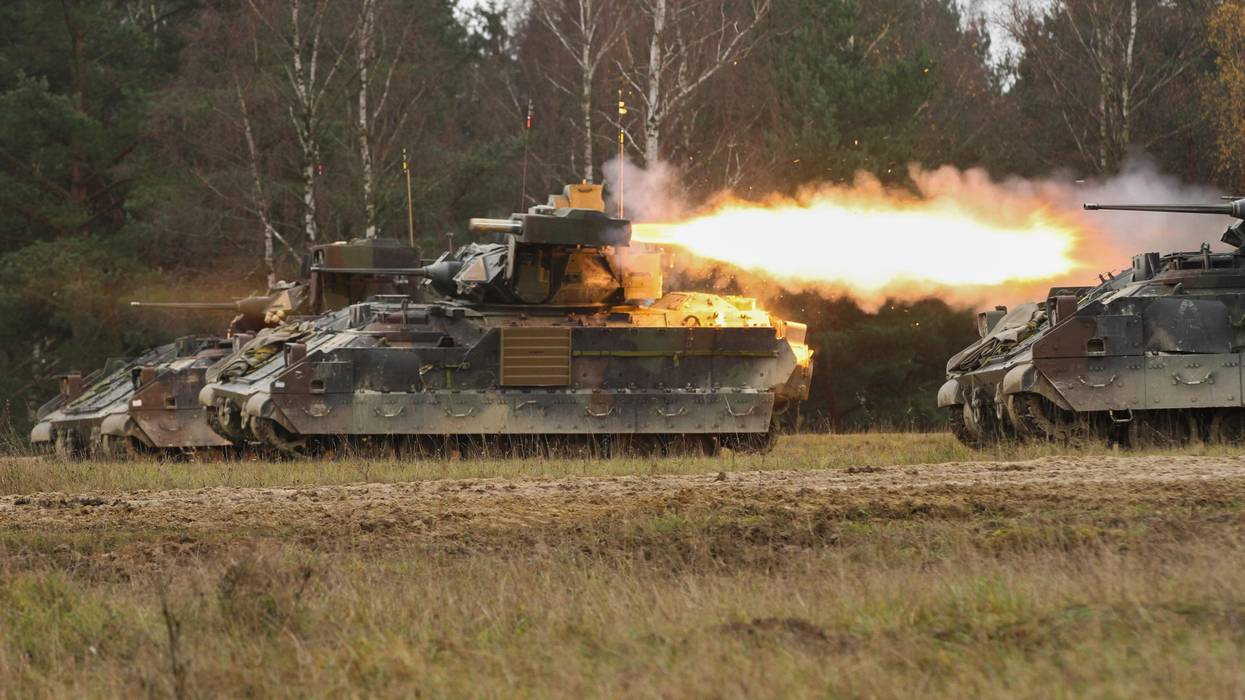
"We would regard it as the use of 'dirty nuclear bombs' against Russia, with all the consequences that entails," a Russian official said as the U.S. and Germany prepare to send tanks and armored vehicles capable of firing depleted uranium munitions to Ukraine.
A Russian official this week responded to the Biden administration's refusal to rule out sending depleted uranium anti-tank munitions to Ukraine by warning that deployment of such weapons—which have been linked to birth defects, miscarriages, and cancer—would be regarded by Moscow as use of "dirty nuclear bombs."
According to a White House transcript published after a Wednesday press call, an unnamed senior Biden administration official would not say when a reporter repeatedly asked whether the United States would provide armor-piercing depleted uranium (DU) ammunition for the Bradley Fighting Vehicles that are part of a recently announced $2.85 billion aid package to Ukraine. The Bradleys, as well as the U.S. Abrams and German Leopard tanks and Marder infantry fighting vehicles Ukraine is set to receive, can fire armor-piercing shells with uranium cores.
The official also declined to say whether the M1 Abrams main battle tanks the administration said it will send to Ukraine will be of the older M1A1 variety or the newer M1A2, which is equipped with DU armor. Citing "three people with knowledge of the deliberations," Politico reported Thursday that the U.S. will deliver 31 M1A2 Abrams tanks—but without DU armor.
"We know that Leopard 2 tanks, as well as Bradley and Marder armored fighting vehicles, can use depleted uranium shells, which can contaminate terrain, just like it happened in Yugoslavia and Iraq."
"We know that Leopard 2 tanks, as well as Bradley and Marder armored fighting vehicles, can use depleted uranium shells, which can contaminate terrain, just like it happened in Yugoslavia and Iraq," Konstantin Gavrilov, head of the Russian delegation to the Vienna Negotiations on Military Security and Arms Control, said at an Organization for Security and Cooperation in Europe meeting on Wednesday. "If Kyiv were to be supplied with such munitions for the use in Western heavy military hardware, we would regard it as the use of 'dirty nuclear bombs' against Russia, with all the consequences that entails."
Garilov also warned of grave consequences should Ukraine's backers supply it with more long-range weapons.
"If Washington and NATO countries provide Kyiv with weapons for striking against the cities deep inside the Russian territory and for attempting to seize our constitutionally affirmed territories, it would force Moscow to undertake harsh retaliatory actions," he said. "Do not say that we did not warn you."
Russian officials including President Vladimir Putin have repeatedly threatened Ukraine's Western allies with nuclear retaliation for perceived escalations.
Fired from tanks, planes, helicopters, and artillery, DU rounds are extremely dense and ideal for piercing hardened armor. However, exploding DU shells release radioactive dust particles that linger in the soil, water, food, and air for many years. While the Pentagon publicly states that DU is not known to cause any harm, an Army training manual warns that "contamination will make food and water unsafe for consumption" and requires soldiers coming within 80 feet of DU-contaminated material to wear protective clothing.
U.S. and allied forces relied heavily upon DU munitions during the 1991 and 2003-11 invasions of Iraq. In a situation reminiscent of the Agent Orange crisis in Vietnam, miscarriages, birth defects, and cancers soared in Iraq after both wars. One study found that more than half of the babies born in Fallujah between 2007 and 2010 had birth defects. Among the pregnant woman surveyed in the study, more than 45% experienced miscarriages in the two-year period following the U.S. assaults on Fallujah. Geiger counter readings of DU-contaminated sites in densely populated Iraqi urban areas have consistently shown radiation levels that are 1,000 to 1,900 times higher than normal.
DU rounds used by the U.S.-led NATO coalition during the 1999 air war against Yugoslavia are also believed to have caused a surge in leukemia in the region—both among the local population and foreign troops deployed there. Researchers and veterans groups also believe DU could be the cause of the mysterious Gulf War Syndrome afflicting hundreds of thousands of U.S. and coalition troops, although in 2021 the Pentagon concluded there is "no link" between the illness and DU.
In 2017, a U.S. military commander admitted that thousands of DU rounds were fired during attacks on Islamic State militants in Syria.
According to the International Campaign to Ban Uranium Weapons, the arsenals of at least 15 nations contain DU munitions.
Last year, the United Nations General Assembly approved a draft resolution submitted by Indonesia expressing concerns about "the health risks and environmental impact" of DU weapons and calling for a "cautionary approach" to their use. The vote was 147 to 4—the U.S., U.K., France, and Israel—with 24 abstentions.

This Saturday--March 20th, 2021--is the 18th anniversary of the United States invasion of Iraq. However, the American war against that country did not begin in 2003. The U.S. has been fighting a war against Iraq since 1991.
Thirty years of conflict has killed hundreds of thousands of Iraqis and injured many times more.
"Reparation funding must be allocated to provide individual Iraqis with monetary compensation for the extreme pain and suffering we have caused them and to (re)build their lives however they see fit."
Millions of people have been displaced directly by American bombing and invasion and indirectly by the rise of militia and paramilitary groups that flourished after the U.S. dismantled the Iraqi state. Extensive bombardment has destroyed thousands of homes, mosques, schools, and hospitals.
The use of weapons such as cluster bombs and depleted uranium has contaminated the landscape with dangerous and toxic unexploded munitions and heavy metals. Bombing, battles, and careless military occupation have damaged and destroyed an unknown number of priceless artifacts and world-historical monuments.
Americans must also remember--or learn for the first time--that their CIA helped the Iraqi Ba'ath Party come to power in the 1960s. This set in motion the events that led to Saddam Hussein's rise to the presidency in 1979.
Despite, or perhaps because of his brutality, the U.S. allied with Saddam in his war against Iran in the 1980s. It supported and enabled his use of internationally banned chemical weapons. American companies supplied the technologies to build those weapons.
It was only after Saddam's usefulness had been exhausted that George H.W. Bush turned on his former ally and launched the war that continues to this day. Six American presidents--George H.W. Bush, Bill Clinton, George W. Bush, Barack Obama, Donald Trump, and now Joe Biden--have continued this conflict.
Americans owe a debt to the people of Iraq that can never be repaid in full. However, it is incumbent and imperative that we try.
First and foremost, Biden must end the American war against Iraq without precondition or caveat. This means withdrawing all of the troops, stopping the bombing, and dismantling the structures of permanent occupation.
Second, we must bring the leaders and participants in this devastating war to account. Starting with the bombing of Iraq in 1991 that United Nations investigators called "near apocalyptic," the U.S. has continued to commit atrocities and war crimes for three decades. We must bring the planners and perpetrators of these crimes to some measure of justice.
"No amount of money can ever fully heal the physical and psychic wounds that the American war against Iraq has caused. But, on the inauspicious 30th anniversary of this conflict, Americans can demonstrate contrition, and work to ameliorate, if only partially, the suffering their government and military have caused."
Third, the United States must vastly expand its financial support for refugee resettlement. Those still leaving Iraq because of instability and violence should have the option to resettle in the United States or elsewhere as they so choose, and the U.S. should facilitate those processes.
Fourth, reparation funding must be allocated to provide individual Iraqis with monetary compensation for the extreme pain and suffering we have caused them and to (re)build their lives however they see fit. The U.S. must also dedicate resources for rebuilding infrastructure and environmental remediation. The toxic remains of weapons such as depleted uranium need to be safely cleaned up.
No amount of money can ever fully heal the physical and psychic wounds that the American war against Iraq has caused. But, on the inauspicious 30th anniversary of this conflict, Americans can demonstrate contrition, and work to ameliorate, if only partially, the suffering their government and military have caused by making that government make reparations to the people of Iraq.