SUBSCRIBE TO OUR FREE NEWSLETTER
Daily news & progressive opinion—funded by the people, not the corporations—delivered straight to your inbox.
5
#000000
#FFFFFF
To donate by check, phone, or other method, see our More Ways to Give page.
Daily news & progressive opinion—funded by the people, not the corporations—delivered straight to your inbox.

An aerial view shows single-family homes adjacent to a lot being cleared to build a new data center in Stone Ridge, Virginia on August 12, 2026.
The Bipartisan American Affordability and Jobs Act would create a regulatory regime that "runs counter to what science shows we need to do to resolve climate change," said the scientists.
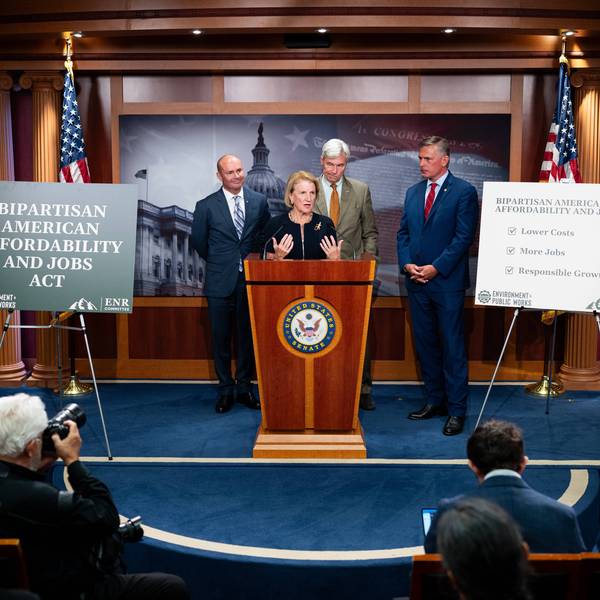
In copies of a letter that arrived at the offices of every member of the US House of Representatives late Monday, more than 160 climate scientists said they were aware of the need for "trade-offs and compromise when passing bipartisan legislation" like the permitting reform bill being pushed by Democrats including Sens. Sheldon Whitehouse and Martin Heinrich.
“But as scientists we feel strongly that the costs of this bill to the climate are too high," said the experts, urging lawmakers to vote against the Bipartisan American Affordability and Jobs Act of 2026 (BAAJA).
Whitehouse, Heinrich, and other supporters of the bill have argued the legislation, which passed in the Senate last week with 15 members of the Democratic caucus joining 47 Republicans in approving it, would speed the construction of renewable energy infrastructure.
The bill would limit federal courts' authority to block a variety of energy projects due to environmental protections, and could stop future administrations from rolling back approvals of projects that have previously been permitted. BAAJA could potentially speed up the modernization of electric grids and transmission lines for solar and wind energy projects.
But with international climate experts warning in recent months that continued fossil fuel emissions have all but eliminated the possibility of avoiding a global temperature rise surpassing 1.5°C over preindustrial levels—and more of the catastrophic, deadly extreme weather that such warming causes—the climate scientists emphasized on Monday that the benefits to renewable energy industries won't outweigh the dangers embedded in the bill, which would also speed up approvals for oil and gas projects and pollution-causing data centers.
The bill would "prevent the rapid and nearly total phaseout of coal, oil, and fossil gas from the US and global energy systems," reads the letter. "Without this phaseout, and the subsequent reduction of emissions to (net) zero, the world will be unable to halt global heating. BAAJA represents a step away from the transition to a (net) zero economy."
The scientists noted that under the "Disparate Treatment" standard in the bill, which creates a right for developers to challenge project delays and denials, "even if Congress passes climate legislation in the future, fossil-energy companies can sue federal agencies and win the full cost of their projects, plus attorney fees and economic damages," to be paid with public funds.
"This means that agencies may be required, by law, to continue permitting fossil fuel projects, lest they be sued and the government be subject to massive penalties," wrote the scientists, including Michal Mann of the University of Pennsylvania, Michal Oppenheimer of Princeton University, and J. Timmons Roberts of Brown University. "This Disparate Treatment standard will be, moreover, measured against the collective decisions of six years of the Trump administrations and four of the Biden administration, when clean energy met new demand but did not yet replace fossil energy."
The legislation, therefore, would create "a regulatory regime that makes the current balance of energy sources permanent" and "runs counter to what science shows we need to do to resolve climate change."
Along with climate scientists, energy experts have acknowledged in recent years that the world must transition away from fossil fuels to avoid the worst impacts of planetary heating, which has already been linked to deadly heatwaves, flooding, and wildfires.
The scientists questioned an analysis frequently cited by proponents of BAAJA, in which the Rhodium Group projected that the legislation could prevent up to 1.5 billion metric tons of US emissions through 2040.
"But that represents roughly 1/36th of current annual emissions, a tiny fraction of the reductions we need to achieve (net) zero emissions," they wrote. "In Rhodium’s high-emissions scenario US emissions rise between 2033-2040."
"Moreover, the Rhodium Group estimate is based primarily on the transmission provisions of BAAJA, and does not take into account what the bill does to the [National Environmental Policy Act] and other environmental laws," the scientists added, referring to the bill's exemptions for projects including pipeline expansions from environmental reviews.
The experts urged members of Congress to instead consider modeling from Purdue University engineering professor Kevin Kirchner, who found "that BAAJA likely increases domestic greenhouse gas emissions outright and also increases domestic mortality attributable to air pollution," and a report from Columbia University’s Center for Global Energy Policy, which warned that "the emissions effects of the bill are 'highly uncertain.'"
"It is our opinion as climate and Earth scientists that, even if BAAJA reduced emissions to the degree modeled above, those reductions would not offset the bill’s codifying of coal, oil, and natural gas in the US energy mix," the experts said. "Even reduced emissions continue to make global warming worse so long as they are ongoing."
In recent weeks, journalist and lawyer Aaron Regunberg said, the public has heard "lots of back-and-forth about whether BAAJA, backed by both the clean energy industry and Big Oil, is good or bad for climate."
"Climate scientists just weighed in with a very loud 'BAD,'" he said.
On Tuesday, US Rep. Pramila Jayapal (D-Wash.) explained on social media why she is "a strong NO on the Bipartisan American Affordability and Jobs Act when it comes to the House," noting that the bill disregards tribal sovereignty and creates "forever permits" for broadly unpopular artificial intelligence data centers.
"Democrats are ready to accelerate the clean energy transition—BAAJA is not how we reach that, though," said Jayapal. "I am proud to be one of 164 members who support the Energy Bills Relief Act, legislation that we should quickly pass next Congress. Waiting until the next Congress to pass permitting reform would provide a real opportunity to negotiate that never occurred with the current bill. I urge my colleagues to vote NO on this bill and listen to the resounding call of voters across the country to fight for our agenda, not fold."
This country and this world are at a monumental crossroads. US voters have an opportunity to beat back the forces of fascism and confront the billionaires who are rigging the economy, our media system, and our democracy, making it increasingly impossible for ordinary people to get by. We’re not just talking about the election. We’re talking about what must be done once these fascist elements are vanquished from power. We need a bolder set of solutions than what either major party has so far been willing to offer and a working-class movement ready to fight like hell for it. Trump didn't emerge from nowhere. The conditions that fueled MAGA authoritarianism were created by decades of radical neoliberal economic policies and a corrupt political system dominated by corporate interests. They slashed taxes on the super-rich, promising that the benefits would trickle down. They said giveaways to the corporate titans would make life more affordable for the rest of us. It was all bullshit. And when a bitter, betrayed populace searches for someone to blame, right-wing demagogues have little trouble finding scapegoats. People know when they're being lied to, but you won't hear any of this from the corporate media. Only independent journalism—powered and funded by people who believe in building a better world—can deliver truly trustworthy daily news. If you share our vision, please contribute whatever you can to sustain our work. |
In copies of a letter that arrived at the offices of every member of the US House of Representatives late Monday, more than 160 climate scientists said they were aware of the need for "trade-offs and compromise when passing bipartisan legislation" like the permitting reform bill being pushed by Democrats including Sens. Sheldon Whitehouse and Martin Heinrich.
“But as scientists we feel strongly that the costs of this bill to the climate are too high," said the experts, urging lawmakers to vote against the Bipartisan American Affordability and Jobs Act of 2026 (BAAJA).
Whitehouse, Heinrich, and other supporters of the bill have argued the legislation, which passed in the Senate last week with 15 members of the Democratic caucus joining 47 Republicans in approving it, would speed the construction of renewable energy infrastructure.
The bill would limit federal courts' authority to block a variety of energy projects due to environmental protections, and could stop future administrations from rolling back approvals of projects that have previously been permitted. BAAJA could potentially speed up the modernization of electric grids and transmission lines for solar and wind energy projects.
But with international climate experts warning in recent months that continued fossil fuel emissions have all but eliminated the possibility of avoiding a global temperature rise surpassing 1.5°C over preindustrial levels—and more of the catastrophic, deadly extreme weather that such warming causes—the climate scientists emphasized on Monday that the benefits to renewable energy industries won't outweigh the dangers embedded in the bill, which would also speed up approvals for oil and gas projects and pollution-causing data centers.
The bill would "prevent the rapid and nearly total phaseout of coal, oil, and fossil gas from the US and global energy systems," reads the letter. "Without this phaseout, and the subsequent reduction of emissions to (net) zero, the world will be unable to halt global heating. BAAJA represents a step away from the transition to a (net) zero economy."
The scientists noted that under the "Disparate Treatment" standard in the bill, which creates a right for developers to challenge project delays and denials, "even if Congress passes climate legislation in the future, fossil-energy companies can sue federal agencies and win the full cost of their projects, plus attorney fees and economic damages," to be paid with public funds.
"This means that agencies may be required, by law, to continue permitting fossil fuel projects, lest they be sued and the government be subject to massive penalties," wrote the scientists, including Michal Mann of the University of Pennsylvania, Michal Oppenheimer of Princeton University, and J. Timmons Roberts of Brown University. "This Disparate Treatment standard will be, moreover, measured against the collective decisions of six years of the Trump administrations and four of the Biden administration, when clean energy met new demand but did not yet replace fossil energy."
The legislation, therefore, would create "a regulatory regime that makes the current balance of energy sources permanent" and "runs counter to what science shows we need to do to resolve climate change."
Along with climate scientists, energy experts have acknowledged in recent years that the world must transition away from fossil fuels to avoid the worst impacts of planetary heating, which has already been linked to deadly heatwaves, flooding, and wildfires.
The scientists questioned an analysis frequently cited by proponents of BAAJA, in which the Rhodium Group projected that the legislation could prevent up to 1.5 billion metric tons of US emissions through 2040.
"But that represents roughly 1/36th of current annual emissions, a tiny fraction of the reductions we need to achieve (net) zero emissions," they wrote. "In Rhodium’s high-emissions scenario US emissions rise between 2033-2040."
"Moreover, the Rhodium Group estimate is based primarily on the transmission provisions of BAAJA, and does not take into account what the bill does to the [National Environmental Policy Act] and other environmental laws," the scientists added, referring to the bill's exemptions for projects including pipeline expansions from environmental reviews.
The experts urged members of Congress to instead consider modeling from Purdue University engineering professor Kevin Kirchner, who found "that BAAJA likely increases domestic greenhouse gas emissions outright and also increases domestic mortality attributable to air pollution," and a report from Columbia University’s Center for Global Energy Policy, which warned that "the emissions effects of the bill are 'highly uncertain.'"
"It is our opinion as climate and Earth scientists that, even if BAAJA reduced emissions to the degree modeled above, those reductions would not offset the bill’s codifying of coal, oil, and natural gas in the US energy mix," the experts said. "Even reduced emissions continue to make global warming worse so long as they are ongoing."
In recent weeks, journalist and lawyer Aaron Regunberg said, the public has heard "lots of back-and-forth about whether BAAJA, backed by both the clean energy industry and Big Oil, is good or bad for climate."
"Climate scientists just weighed in with a very loud 'BAD,'" he said.
On Tuesday, US Rep. Pramila Jayapal (D-Wash.) explained on social media why she is "a strong NO on the Bipartisan American Affordability and Jobs Act when it comes to the House," noting that the bill disregards tribal sovereignty and creates "forever permits" for broadly unpopular artificial intelligence data centers.
"Democrats are ready to accelerate the clean energy transition—BAAJA is not how we reach that, though," said Jayapal. "I am proud to be one of 164 members who support the Energy Bills Relief Act, legislation that we should quickly pass next Congress. Waiting until the next Congress to pass permitting reform would provide a real opportunity to negotiate that never occurred with the current bill. I urge my colleagues to vote NO on this bill and listen to the resounding call of voters across the country to fight for our agenda, not fold."