SUBSCRIBE TO OUR FREE NEWSLETTER
Daily news & progressive opinion—funded by the people, not the corporations—delivered straight to your inbox.
5
#000000
#FFFFFF
To donate by check, phone, or other method, see our More Ways to Give page.
Daily news & progressive opinion—funded by the people, not the corporations—delivered straight to your inbox.
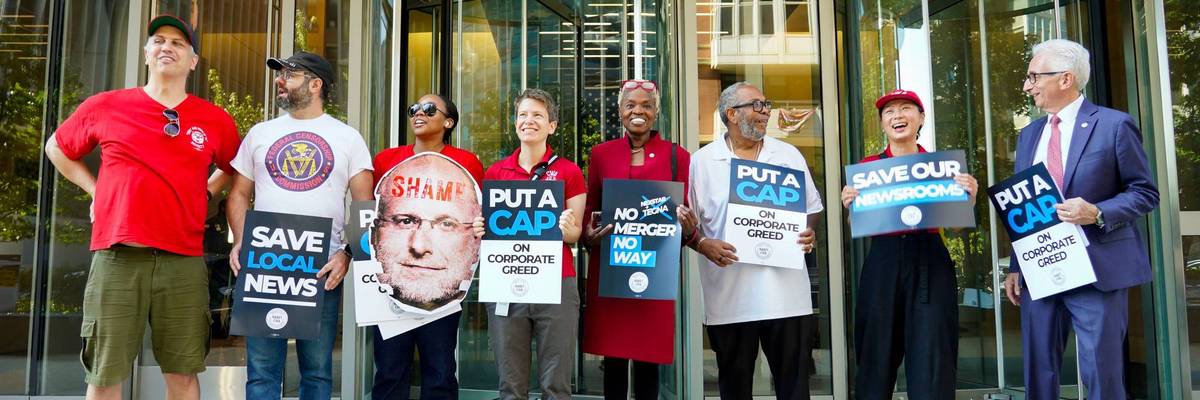
Free press advocates protest Federal Communications Commission Chair Brendan Carr on August 6, 2026 in Washington, DC.
"The FCC is attacking American democracy by allowing corporations and billionaires to cannibalize local TV stations," said one union leader.
Nonprofits and media unions this week filed a petition urging a US appellate court to stop the Republican-controlled Federal Communications Commission from repealing a policy put in place over two decades ago to limit corporate consolidation in broadcast television.
In 2004, Congress passed the Consolidated Appropriations Act, directing the FCC to ensure that no TV station owners reached more than 39% of the national broadcast audience. From that came the National Television Multiple Ownership Rule.
"Congress set the ownership cap so no one company could control too much of what Americans see on TV," explained John Bergmayer, legal director of Public Knowledge, which is part of the coalition behind the petition. "It's still needed. When one company buys stations in city after city, it can replace the local reporting that local TV still uniquely provides with programming beamed in from a distant city. Viewers are left with fewer reporters covering their schools, police departments, and city halls."
Led by President Donald Trump's FCC Chair, Brendan Carr, the commission voted in August to roll back the rule and replace it with one that allows for decisions made on a case-by-case basis.
The new rule "will decimate the broadcast news industry as we know it," warned Carrie Biggs-Adams, president of the National Association of Broadcast Employees and Technicians-Communications Workers of America (NABET-CWA) Local 51, another coalition member.
"We will see more and more mergers like Nexstar-TEGNA until the landscape is unrecognizable," she predicted. "NABET-CWA Local 51 members know that local news is the lifeblood of a functioning democracy. Independent journalism and local news will become things of the past unless we stop these media conglomerates."
Matt Wood, vice president of policy at Free Press, another group behind the legal challenge, said that "no FCC chairman, including President Trump's favorite attack dog, Brendan Carr, can ignore the will of Congress—no matter how much he wants to. With this brazen and unlawful move to erase a statute, Carr is continuing to hand out favors to media conglomerates in exchange for friendly coverage of President Trump."
"The agency cannot overturn this vital media-ownership limit," he argued. "It has no authority to eliminate laws like this. Carr's goal is to spur more media consolidation involving companies Trump views as ideological allies, but he cannot rewrite congressional mandates."
We, along with a coalition of unions and nonprofits, are urging an appeals court to block an illegal order from the FCC that will allow conglomerates to dominate the broadcast landscape.newsguild.org/the-newsguil...
[image or embed]
— The NewsGuild-CWA (@newsguild.org) November 25, 2026 at 2:34 PM
After notifying the FCC of the plans to launch a legal challenge last month, the coalition—which also includes the Future Film Coalition, the NewsGuild-CWA, Reporters Without Borders, the United Church of Christ Media Justice Ministry, Writers Guild of America East, and WGA West—filed the petition for review and a stay motion with the 9th Circuit Court of Appeals this week.
"Reporters Without Borders believes that the FCC's illegitimate dismantling of the national television ownership cap is a brazen concession to powerful media conglomerates and a direct assault on media pluralism," said the group's executive director in the United States, Clayton Weimers.
"When fewer corporations control more of the country's news outlets, local newsrooms, journalists, and ultimately the public pay the price," he stressed. "Congress established clear limits to prevent this concentration of power, and the FCC cannot simply disregard them. The court must intervene before irreversible damage is done to an already fragile media landscape."
Trump and his cronies have been accused of degrading US democracy during both of his nonconsecutive terms, and coalition members framed this rollback as a continuation of that. NewsGuild-CWA president Jon Schleuss declared that "the FCC is attacking American democracy by allowing corporations and billionaires to cannibalize local TV stations."
"The pillaging of local news must stop," said Schleuss, whose union is the largest for journalists in the United States. "We're urging a federal appeals court to protect our communities and journalists by blocking the FCC's illegal decision."
The coalition's lawyers include Simon Brewer from Democracy Forward, who emphasized that "democracy thrives when localism, viewpoint diversity, and competition in the media are protected, and people have access to the information they need to engage in civic life."
"We are hopeful that the court of appeals will see the harm that will come to our democracy if the FCC is allowed to abandon its long-standing rules preventing harmful corporate consolidations," he added, "and we are honored to work with this impressive and expansive coalition to fight for the current limits regarding media consolidation."
Despite the legal challenge from this coalition—and another recently launched by the Broadband Communications Association of Pennsylvania—Carr has shown no signs of slowing down, announcing Monday that the FCC "will be voting next month to modernize its local ownership rules for radio and TV broadcasters."
This country and this world are at a monumental crossroads. US voters have an opportunity to beat back the forces of fascism and confront the billionaires who are rigging the economy, our media system, and our democracy, making it increasingly impossible for ordinary people to get by. We’re not just talking about the election. We’re talking about what must be done once these fascist elements are vanquished from power. We need a bolder set of solutions than what either major party has so far been willing to offer and a working-class movement ready to fight like hell for it. Trump didn't emerge from nowhere. The conditions that fueled MAGA authoritarianism were created by decades of radical neoliberal economic policies and a corrupt political system dominated by corporate interests. They slashed taxes on the super-rich, promising that the benefits would trickle down. They said giveaways to the corporate titans would make life more affordable for the rest of us. It was all bullshit. And when a bitter, betrayed populace searches for someone to blame, right-wing demagogues have little trouble finding scapegoats. People know when they're being lied to, but you won't hear any of this from the corporate media. Only independent journalism—powered and funded by people who believe in building a better world—can deliver truly trustworthy daily news. If you share our vision, please contribute whatever you can to sustain our work. |
Nonprofits and media unions this week filed a petition urging a US appellate court to stop the Republican-controlled Federal Communications Commission from repealing a policy put in place over two decades ago to limit corporate consolidation in broadcast television.
In 2004, Congress passed the Consolidated Appropriations Act, directing the FCC to ensure that no TV station owners reached more than 39% of the national broadcast audience. From that came the National Television Multiple Ownership Rule.
"Congress set the ownership cap so no one company could control too much of what Americans see on TV," explained John Bergmayer, legal director of Public Knowledge, which is part of the coalition behind the petition. "It's still needed. When one company buys stations in city after city, it can replace the local reporting that local TV still uniquely provides with programming beamed in from a distant city. Viewers are left with fewer reporters covering their schools, police departments, and city halls."
Led by President Donald Trump's FCC Chair, Brendan Carr, the commission voted in August to roll back the rule and replace it with one that allows for decisions made on a case-by-case basis.
The new rule "will decimate the broadcast news industry as we know it," warned Carrie Biggs-Adams, president of the National Association of Broadcast Employees and Technicians-Communications Workers of America (NABET-CWA) Local 51, another coalition member.
"We will see more and more mergers like Nexstar-TEGNA until the landscape is unrecognizable," she predicted. "NABET-CWA Local 51 members know that local news is the lifeblood of a functioning democracy. Independent journalism and local news will become things of the past unless we stop these media conglomerates."
Matt Wood, vice president of policy at Free Press, another group behind the legal challenge, said that "no FCC chairman, including President Trump's favorite attack dog, Brendan Carr, can ignore the will of Congress—no matter how much he wants to. With this brazen and unlawful move to erase a statute, Carr is continuing to hand out favors to media conglomerates in exchange for friendly coverage of President Trump."
"The agency cannot overturn this vital media-ownership limit," he argued. "It has no authority to eliminate laws like this. Carr's goal is to spur more media consolidation involving companies Trump views as ideological allies, but he cannot rewrite congressional mandates."
We, along with a coalition of unions and nonprofits, are urging an appeals court to block an illegal order from the FCC that will allow conglomerates to dominate the broadcast landscape.newsguild.org/the-newsguil...
[image or embed]
— The NewsGuild-CWA (@newsguild.org) November 25, 2026 at 2:34 PM
After notifying the FCC of the plans to launch a legal challenge last month, the coalition—which also includes the Future Film Coalition, the NewsGuild-CWA, Reporters Without Borders, the United Church of Christ Media Justice Ministry, Writers Guild of America East, and WGA West—filed the petition for review and a stay motion with the 9th Circuit Court of Appeals this week.
"Reporters Without Borders believes that the FCC's illegitimate dismantling of the national television ownership cap is a brazen concession to powerful media conglomerates and a direct assault on media pluralism," said the group's executive director in the United States, Clayton Weimers.
"When fewer corporations control more of the country's news outlets, local newsrooms, journalists, and ultimately the public pay the price," he stressed. "Congress established clear limits to prevent this concentration of power, and the FCC cannot simply disregard them. The court must intervene before irreversible damage is done to an already fragile media landscape."
Trump and his cronies have been accused of degrading US democracy during both of his nonconsecutive terms, and coalition members framed this rollback as a continuation of that. NewsGuild-CWA president Jon Schleuss declared that "the FCC is attacking American democracy by allowing corporations and billionaires to cannibalize local TV stations."
"The pillaging of local news must stop," said Schleuss, whose union is the largest for journalists in the United States. "We're urging a federal appeals court to protect our communities and journalists by blocking the FCC's illegal decision."
The coalition's lawyers include Simon Brewer from Democracy Forward, who emphasized that "democracy thrives when localism, viewpoint diversity, and competition in the media are protected, and people have access to the information they need to engage in civic life."
"We are hopeful that the court of appeals will see the harm that will come to our democracy if the FCC is allowed to abandon its long-standing rules preventing harmful corporate consolidations," he added, "and we are honored to work with this impressive and expansive coalition to fight for the current limits regarding media consolidation."
Despite the legal challenge from this coalition—and another recently launched by the Broadband Communications Association of Pennsylvania—Carr has shown no signs of slowing down, announcing Monday that the FCC "will be voting next month to modernize its local ownership rules for radio and TV broadcasters."