SUBSCRIBE TO OUR FREE NEWSLETTER
Daily news & progressive opinion—funded by the people, not the corporations—delivered straight to your inbox.
5
#000000
#FFFFFF
To donate by check, phone, or other method, see our More Ways to Give page.
Daily news & progressive opinion—funded by the people, not the corporations—delivered straight to your inbox.
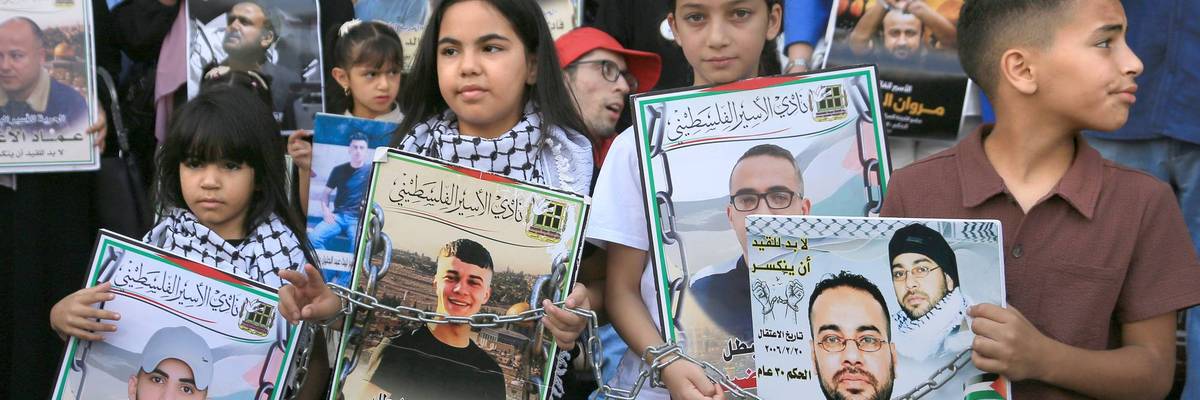
Palestinian children hold chains photos of their fathers imprisoned by Israel during an August 18, 2026 protest in Nablus, in the illegally occupied West Bank of Palestine.
"Israel’s widespread and government-sanctioned use of torture against Palestinians contaminates every aspect of its legal system and means that Palestinians are convicted based on information extracted under torture."
Israeli security forces tortured Palestinian security detainees—and in at least one case, a Jewish Israeli—into confessions subsequently used to secure criminal convictions, according to a report published Wednesday that warns the practice poses a particularly grave threat now that Israel has legalized the death penalty for "terrorism"-related killings.
Israel's systematic torture of Palestinians, both during the Gaza genocide and in the illegally occupied West Bank, is well documented by both Israeli and international organizations. Less examined are allegations that members of Shin Bet, Israel's internal security agency, use torture to extract confessions from so-called "security detainees," who are subjected to a more severe detention regimen that often includes lengthy imprisonment without charge or trial.
A 25-page report, "Tainted by Torture: Palestinian Detainees in the Israeli Legal System," published by the Israeli advocacy group Public Committee Against Torture in Israel (PCATI), notes the general increase in Israeli torture, sometimes deadly, by Israel Prison Service and military personnel following the Hamas-led attack of October 7, 2023: "severe physical, psychological, and sexual violence, including beatings, kicking, attacks with dogs, electric shocks, threats, humiliation, touching and hitting genitals, and rape."
The report specifically examines 42 cases involving Palestinian security detainees who reported torture during interrogations by Shin Bet operatives over the past decade. PCATI also documented one exceptional case involving the alleged torture of a Jewish Israeli suspect.
According to the report, judges and other officials often ignore or dismiss clear and undisputed evidence of torture.
"Israel’s widespread and government-sanctioned use of torture against Palestinians contaminates every aspect of its legal system and means that Palestinians are convicted based on information extracted under torture," PCATI said. "That’s particularly egregious in light of initiatives to impose the death penalty on Palestinians—including based on confessions extracted under torture and irrespective of whether or not they are true."
PCATI documented how interrogation methods such as extreme sleep deprivation, beatings, and painful stress positions are used against security detainees, primarily Palestinians accused of resisting Israeli occupation. Of the 42 cases examined, 35 involved sleep deprivation, 24 involved physical violence, and 23 involved stress positions. In 33 cases, detainees confessed under torture or other illegal abuses.
Of the 29 cases for which PCATI had complete information about legal proceedings, 25 resulted in convictions. The report emphasizes that the cases it covers are not a representative sample of all Shin Bet interrogations, but rather are indicative of broader trends.
One of the most disturbing cases in the report involves a Palestinian lawyer identified as TB, who was arrested in February 2019 and interrogated by Shin Bet for nearly a month. According to official records, TB spent 552 hours under interrogation over more than 27 days—an average of 20 hours every day—with some sessions lasting dozens of consecutive hours. TB suffered severe physical pain, could not sleep, and had his hands and feet shackled in a painful stress position. The judge nevertheless extended his detention without addressing the allegations.
TB was convicted of involvement in shooting attacks targeting Israeli soldiers and buses. Despite his documented torture, the Justice Ministry's oversight division declined to recommend a criminal investigation, concluding that the interrogations had been authorized and conducted according to procedures.
Another Palestinian detainee, identified as R, was subjected to a month of violent interrogations involving physical abuse, humiliation, and threats to harm his family. R repeatedly confessed his alleged crime to his torturers, but then subsequently retracted his confession when brought before police investigators. He was then allegedly tortured anew until he signed a statement in which he said he confessed to make the torture stop.
Prosecutors attempted to use that confession against him, even though it had been extracted through coercion. After spending months behind bars, investigators found video footage proving R had not even been at the scene of the alleged crime. The charges against R and his brother, who had also been indicted, were ultimately dropped.
"This mechanism of torture creates a risk of false confessions, and R’s confession was the rare confession that Israeli authorities acknowledged to be false," the report states.
The report also examines the case of Amiram Ben-Uliel, a far-right Israeli settler-colonist convicted of murdering three members of the Dawabsheh family—including 18-month-old toddler Ali Dawabsheh—in a 2015 arson attack on the Palestinian family's home in the West Bank village of Duma. Shin Bet interrogators subjected the Jewish supremacist to so-called "necessity interrogations" involving methods his torturers acknowledged in court were "painful and perhaps even very painful."
While the court struck one confession made to police a day after the torture, it allowed another admission made 36 hours after the abuse.
"This case is exceptional in that the court accepted the interrogee’s version of events and even excluded some of his testimony because of the use of 'special methods,'" the report notes. "We are not aware of any parallel case involving a Palestinian interrogee."
The Israeli Justice Ministry said it "totally rejects" the report's claims.
"It should be recalled that in most cases the complainants are accused of terrorist offenses, and they therefore are likely to have a clear interest in complaining against the investigators and making claims that may allegedly help them in their criminal trial,” the ministry said. “Therefore, the examination of the complaints requires extra caution and usually additional supporting evidence will be needed."
The report's findings follow Israel's passage earlier this year of a law expanding the death penalty for "terrorism"-related offenses involving Palestinians tried in military courts in the occupied West Bank, with execution by hanging mandated within 90 days and sentences generally barred from commutation.
“When it comes to Palestinian detainees, the Israeli legal system officially sanctions torture as a tool for extracting confessions, regardless of whether the content of those confessions is true,” PCATI executive director Sari Bashi said. “The entire system is contaminated by unlawful violence that violates the rights of the accused and prevents the truth from coming to light."
"Torture as a tool of interrogation is particularly egregious," added Bashi, "given initiatives to impose the death penalty in Israel for the first time since 1962.”
This country and this world are at a monumental crossroads. US voters have an opportunity to beat back the forces of fascism and confront the billionaires who are rigging the economy, our media system, and our democracy, making it increasingly impossible for ordinary people to get by. We’re not just talking about the election. We’re talking about what must be done once these fascist elements are vanquished from power. We need a bolder set of solutions than what either major party has so far been willing to offer and a working-class movement ready to fight like hell for it. Trump didn't emerge from nowhere. The conditions that fueled MAGA authoritarianism were created by decades of radical neoliberal economic policies and a corrupt political system dominated by corporate interests. They slashed taxes on the super-rich, promising that the benefits would trickle down. They said giveaways to the corporate titans would make life more affordable for the rest of us. It was all bullshit. And when a bitter, betrayed populace searches for someone to blame, right-wing demagogues have little trouble finding scapegoats. People know when they're being lied to, but you won't hear any of this from the corporate media. Only independent journalism—powered and funded by people who believe in building a better world—can deliver truly trustworthy daily news. If you share our vision, please contribute whatever you can to sustain our work. |
Israeli security forces tortured Palestinian security detainees—and in at least one case, a Jewish Israeli—into confessions subsequently used to secure criminal convictions, according to a report published Wednesday that warns the practice poses a particularly grave threat now that Israel has legalized the death penalty for "terrorism"-related killings.
Israel's systematic torture of Palestinians, both during the Gaza genocide and in the illegally occupied West Bank, is well documented by both Israeli and international organizations. Less examined are allegations that members of Shin Bet, Israel's internal security agency, use torture to extract confessions from so-called "security detainees," who are subjected to a more severe detention regimen that often includes lengthy imprisonment without charge or trial.
A 25-page report, "Tainted by Torture: Palestinian Detainees in the Israeli Legal System," published by the Israeli advocacy group Public Committee Against Torture in Israel (PCATI), notes the general increase in Israeli torture, sometimes deadly, by Israel Prison Service and military personnel following the Hamas-led attack of October 7, 2023: "severe physical, psychological, and sexual violence, including beatings, kicking, attacks with dogs, electric shocks, threats, humiliation, touching and hitting genitals, and rape."
The report specifically examines 42 cases involving Palestinian security detainees who reported torture during interrogations by Shin Bet operatives over the past decade. PCATI also documented one exceptional case involving the alleged torture of a Jewish Israeli suspect.
According to the report, judges and other officials often ignore or dismiss clear and undisputed evidence of torture.
"Israel’s widespread and government-sanctioned use of torture against Palestinians contaminates every aspect of its legal system and means that Palestinians are convicted based on information extracted under torture," PCATI said. "That’s particularly egregious in light of initiatives to impose the death penalty on Palestinians—including based on confessions extracted under torture and irrespective of whether or not they are true."
PCATI documented how interrogation methods such as extreme sleep deprivation, beatings, and painful stress positions are used against security detainees, primarily Palestinians accused of resisting Israeli occupation. Of the 42 cases examined, 35 involved sleep deprivation, 24 involved physical violence, and 23 involved stress positions. In 33 cases, detainees confessed under torture or other illegal abuses.
Of the 29 cases for which PCATI had complete information about legal proceedings, 25 resulted in convictions. The report emphasizes that the cases it covers are not a representative sample of all Shin Bet interrogations, but rather are indicative of broader trends.
One of the most disturbing cases in the report involves a Palestinian lawyer identified as TB, who was arrested in February 2019 and interrogated by Shin Bet for nearly a month. According to official records, TB spent 552 hours under interrogation over more than 27 days—an average of 20 hours every day—with some sessions lasting dozens of consecutive hours. TB suffered severe physical pain, could not sleep, and had his hands and feet shackled in a painful stress position. The judge nevertheless extended his detention without addressing the allegations.
TB was convicted of involvement in shooting attacks targeting Israeli soldiers and buses. Despite his documented torture, the Justice Ministry's oversight division declined to recommend a criminal investigation, concluding that the interrogations had been authorized and conducted according to procedures.
Another Palestinian detainee, identified as R, was subjected to a month of violent interrogations involving physical abuse, humiliation, and threats to harm his family. R repeatedly confessed his alleged crime to his torturers, but then subsequently retracted his confession when brought before police investigators. He was then allegedly tortured anew until he signed a statement in which he said he confessed to make the torture stop.
Prosecutors attempted to use that confession against him, even though it had been extracted through coercion. After spending months behind bars, investigators found video footage proving R had not even been at the scene of the alleged crime. The charges against R and his brother, who had also been indicted, were ultimately dropped.
"This mechanism of torture creates a risk of false confessions, and R’s confession was the rare confession that Israeli authorities acknowledged to be false," the report states.
The report also examines the case of Amiram Ben-Uliel, a far-right Israeli settler-colonist convicted of murdering three members of the Dawabsheh family—including 18-month-old toddler Ali Dawabsheh—in a 2015 arson attack on the Palestinian family's home in the West Bank village of Duma. Shin Bet interrogators subjected the Jewish supremacist to so-called "necessity interrogations" involving methods his torturers acknowledged in court were "painful and perhaps even very painful."
While the court struck one confession made to police a day after the torture, it allowed another admission made 36 hours after the abuse.
"This case is exceptional in that the court accepted the interrogee’s version of events and even excluded some of his testimony because of the use of 'special methods,'" the report notes. "We are not aware of any parallel case involving a Palestinian interrogee."
The Israeli Justice Ministry said it "totally rejects" the report's claims.
"It should be recalled that in most cases the complainants are accused of terrorist offenses, and they therefore are likely to have a clear interest in complaining against the investigators and making claims that may allegedly help them in their criminal trial,” the ministry said. “Therefore, the examination of the complaints requires extra caution and usually additional supporting evidence will be needed."
The report's findings follow Israel's passage earlier this year of a law expanding the death penalty for "terrorism"-related offenses involving Palestinians tried in military courts in the occupied West Bank, with execution by hanging mandated within 90 days and sentences generally barred from commutation.
“When it comes to Palestinian detainees, the Israeli legal system officially sanctions torture as a tool for extracting confessions, regardless of whether the content of those confessions is true,” PCATI executive director Sari Bashi said. “The entire system is contaminated by unlawful violence that violates the rights of the accused and prevents the truth from coming to light."
"Torture as a tool of interrogation is particularly egregious," added Bashi, "given initiatives to impose the death penalty in Israel for the first time since 1962.”