SUBSCRIBE TO OUR FREE NEWSLETTER
Daily news & progressive opinion—funded by the people, not the corporations—delivered straight to your inbox.
5
#000000
#FFFFFF
To donate by check, phone, or other method, see our More Ways to Give page.
Daily news & progressive opinion—funded by the people, not the corporations—delivered straight to your inbox.
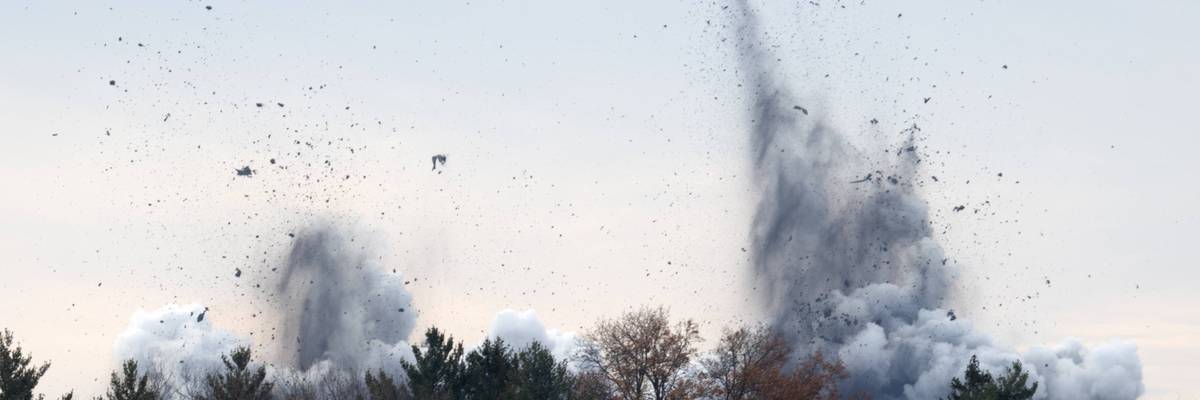
Debris flies into the air after the US Army detonated several tons of toxic degraded lead azide on the grounds of the Iowa Army Ammunition Plant in Middletown, Iowa, on November 25, 2026.
"Any serious commitment to a livable future for all must begin with confronting the US military’s role in destroying it," said CodePink.
The Army's detonation of nearly five tons of highly toxic explosives in Iowa on Wednesday has sparked condemnation from critics, including anti-awar and environmental activists, who say the incident exemplifies a decades-long pattern of military pollution and the sacrifice of civilian communities in service of US militarism.
The Army blew up its stockpile of degraded lead azide stored at its Iowa Ammunition Plant near Middletown in what it called a "controlled" detonation, despite warnings from residents, environmental organizations, and lawmakers about the potential health and environmental consequences of the blast.
Smoke was seen rising over the area, and witnesses reported feeling two or three explosions in rapid succession. Residents closest to the 19,000-acre military installation had attempted to prepare for the blast by taping their windows, while some local families heeded evacuation advisories.
"It’s not a 'controlled explosion' of 9,000 pounds of toxic chemicals when residents have to evacuate," Tennessee state Rep. Justin Pearson (D-86) said Wednesday on social media. "We deserve access to clean air, water, and soil. I’m praying for everyone in Middletown. The impact of bad governance and lead pollution can last for generations."
In a statement released Wednesday, the anti-war group CodePink condemned what it called the Army's "reckless detonation," warning that the resulting toxic plume could expose communities across southeastern Iowa to lead contamination.
"This is not an isolated accident or a regrettable necessity; it is the latest instance of the military’s systematic poisoning of communities and ecosystems that has been going on for decades," the group said.
"The US military is the world’s largest institutional polluter, maintaining hundreds of bases with known cancer-causing PFAS contamination in the US and over 800 ecosystem-destroying bases globally and treating the land, water, and air it touches as sacrifice zones," CodePink continued, referring to the per- and polyfluoroalkyl substances that are popularly known as "forever chemicals" because they do not biodegrade and accumulate in soil, water, and the human body.
"The explosion in Iowa dispersed a neurotoxin with no safe level of exposure across homes, schools, farms, and rivers, endangering animals and people, specifically children and pregnant women," the group said.
"The environmental violence now being experienced by rural Iowans at the hands of the US military is the tip of the iceberg," CodePink noted. "The US military has been doing this around the world, either directly or indirectly, for years, including but not limited to Gaza, Iran, Puerto Rico, North Carolina, Guam, Hawaii, Korea, Vietnam, Palestine, and Iraq—where similar contaminants from the US invasion are still present in food and water and hair samples."
US use of depleted uranium munitions has been linked to birth defects, miscarriages, and cancers in Iraq and Yugoslavia. Chemical defoliant weapons like Agent Orange contained carcinogens and other toxins causing severe birth defects, diabetes, spina bifida, and cardiovascular, digestive, neurological, respiratory, skin, and other ailments that are still killing and harming people—including US troops and their descendants—more than half a century after their use in Vietnam, Cambodia, and Laos.
"It is a cycle of violence that begins with the production of weapons and the use of those weapons in wars and genocides," CodePink said. "For instance, the same plant that produced the iron azide stockpile manufactured the ammunition used to kill 5-year-old Hind Rajab during the height of the US/Israeli genocide in Gaza."
Meanwhile, the environmental advocacy group Earthjustice, which sued in an effort to stop the Iowa detonation, said Wednesday that the Army "knew since 2009 that the lead azide was deteriorating, and since March that the material was becoming unstable. Yet most Iowans, including public officials, learned of the plan to dispose of the chemicals through detonation only days before the planned... blast. The Army has not explained why it let the material degrade until every alternative was too dangerous."
Earthjustice won a temporary stay of Wednesday's detonation, originally scheduled for November 20. The legal group represented the state chapter of the Sierra Club and the Iowa Environmental Council, whose executive director, Sarah Green, said that "the Army’s neglect and lack of communication and preparedness caused an outcry among Iowans, so we took action to demand the transparency that Iowans deserve."
"This is proof that grassroots advocacy works and Iowans’ voices matter," Green added.
The stay was subsequently lifted after the Army agreed to additional protective measures.
“It took legal action to get from the Army the transparency and real help on the ground Iowa communities deserved,” said Wally Taylor, an attorney and legal chair of Sierra Club Iowa Chapter. “Now that the detonation happened, officials must stay involved until the cleanup is finished and the risk of lead harm is fully under control.”
The critics' condemnation of Wednesday's detonation follows decades of communities around the world fighting the environmental damage caused by US wars and military bases.
"The toxic legacy of US military action is now strewn the world over, from depleted uranium in Iraq, to dioxin poisoning in Southeast Asia, to massive jet fuel spills in Virginia Beach," Nikhil Pal Singh wrote for the Quincy Institute for Responsible Statecraft in 2019. Singh also noted that hundreds of cases of contaminated drinking water have been documented at US military installations across the country and around the world.
The American Cancer Society has highlighted how military burn pits have exposed US service members and people in nearby communities to harmful chemicals and particulate matter from the open-air burning of fuel, plastics, and other toxic waste.
Pollution generated from operating the world's largest military and most prolific war machine is also one of the biggest drivers of human-caused climate change.
"The fight against militarism and the fight for a livable planet are the same," CodePink said Wednesday. "The Pentagon’s proposed $1.5 trillion budget and its status as the number one institutional polluter are not separate from the climate crisis; it is the US military that is destroying the planet by fueling endless wars for resources that treat entire communities as environmental and public health sacrifice zones."
"We call on elected officials and environmental justice organizations to break their silence on the military’s role in the ever-growing climate crisis—starting with voting no on the upcoming $1.5 trillion [National Defense Authorization Act]," the group added. "Any serious commitment to a livable future for all must begin with confronting the US military’s role in destroying it."
This country and this world are at a monumental crossroads. US voters have an opportunity to beat back the forces of fascism and confront the billionaires who are rigging the economy, our media system, and our democracy, making it increasingly impossible for ordinary people to get by. We’re not just talking about the election. We’re talking about what must be done once these fascist elements are vanquished from power. We need a bolder set of solutions than what either major party has so far been willing to offer and a working-class movement ready to fight like hell for it. Trump didn't emerge from nowhere. The conditions that fueled MAGA authoritarianism were created by decades of radical neoliberal economic policies and a corrupt political system dominated by corporate interests. They slashed taxes on the super-rich, promising that the benefits would trickle down. They said giveaways to the corporate titans would make life more affordable for the rest of us. It was all bullshit. And when a bitter, betrayed populace searches for someone to blame, right-wing demagogues have little trouble finding scapegoats. People know when they're being lied to, but you won't hear any of this from the corporate media. Only independent journalism—powered and funded by people who believe in building a better world—can deliver truly trustworthy daily news. If you share our vision, please contribute whatever you can to sustain our work. |
The Army's detonation of nearly five tons of highly toxic explosives in Iowa on Wednesday has sparked condemnation from critics, including anti-awar and environmental activists, who say the incident exemplifies a decades-long pattern of military pollution and the sacrifice of civilian communities in service of US militarism.
The Army blew up its stockpile of degraded lead azide stored at its Iowa Ammunition Plant near Middletown in what it called a "controlled" detonation, despite warnings from residents, environmental organizations, and lawmakers about the potential health and environmental consequences of the blast.
Smoke was seen rising over the area, and witnesses reported feeling two or three explosions in rapid succession. Residents closest to the 19,000-acre military installation had attempted to prepare for the blast by taping their windows, while some local families heeded evacuation advisories.
"It’s not a 'controlled explosion' of 9,000 pounds of toxic chemicals when residents have to evacuate," Tennessee state Rep. Justin Pearson (D-86) said Wednesday on social media. "We deserve access to clean air, water, and soil. I’m praying for everyone in Middletown. The impact of bad governance and lead pollution can last for generations."
In a statement released Wednesday, the anti-war group CodePink condemned what it called the Army's "reckless detonation," warning that the resulting toxic plume could expose communities across southeastern Iowa to lead contamination.
"This is not an isolated accident or a regrettable necessity; it is the latest instance of the military’s systematic poisoning of communities and ecosystems that has been going on for decades," the group said.
"The US military is the world’s largest institutional polluter, maintaining hundreds of bases with known cancer-causing PFAS contamination in the US and over 800 ecosystem-destroying bases globally and treating the land, water, and air it touches as sacrifice zones," CodePink continued, referring to the per- and polyfluoroalkyl substances that are popularly known as "forever chemicals" because they do not biodegrade and accumulate in soil, water, and the human body.
"The explosion in Iowa dispersed a neurotoxin with no safe level of exposure across homes, schools, farms, and rivers, endangering animals and people, specifically children and pregnant women," the group said.
"The environmental violence now being experienced by rural Iowans at the hands of the US military is the tip of the iceberg," CodePink noted. "The US military has been doing this around the world, either directly or indirectly, for years, including but not limited to Gaza, Iran, Puerto Rico, North Carolina, Guam, Hawaii, Korea, Vietnam, Palestine, and Iraq—where similar contaminants from the US invasion are still present in food and water and hair samples."
US use of depleted uranium munitions has been linked to birth defects, miscarriages, and cancers in Iraq and Yugoslavia. Chemical defoliant weapons like Agent Orange contained carcinogens and other toxins causing severe birth defects, diabetes, spina bifida, and cardiovascular, digestive, neurological, respiratory, skin, and other ailments that are still killing and harming people—including US troops and their descendants—more than half a century after their use in Vietnam, Cambodia, and Laos.
"It is a cycle of violence that begins with the production of weapons and the use of those weapons in wars and genocides," CodePink said. "For instance, the same plant that produced the iron azide stockpile manufactured the ammunition used to kill 5-year-old Hind Rajab during the height of the US/Israeli genocide in Gaza."
Meanwhile, the environmental advocacy group Earthjustice, which sued in an effort to stop the Iowa detonation, said Wednesday that the Army "knew since 2009 that the lead azide was deteriorating, and since March that the material was becoming unstable. Yet most Iowans, including public officials, learned of the plan to dispose of the chemicals through detonation only days before the planned... blast. The Army has not explained why it let the material degrade until every alternative was too dangerous."
Earthjustice won a temporary stay of Wednesday's detonation, originally scheduled for November 20. The legal group represented the state chapter of the Sierra Club and the Iowa Environmental Council, whose executive director, Sarah Green, said that "the Army’s neglect and lack of communication and preparedness caused an outcry among Iowans, so we took action to demand the transparency that Iowans deserve."
"This is proof that grassroots advocacy works and Iowans’ voices matter," Green added.
The stay was subsequently lifted after the Army agreed to additional protective measures.
“It took legal action to get from the Army the transparency and real help on the ground Iowa communities deserved,” said Wally Taylor, an attorney and legal chair of Sierra Club Iowa Chapter. “Now that the detonation happened, officials must stay involved until the cleanup is finished and the risk of lead harm is fully under control.”
The critics' condemnation of Wednesday's detonation follows decades of communities around the world fighting the environmental damage caused by US wars and military bases.
"The toxic legacy of US military action is now strewn the world over, from depleted uranium in Iraq, to dioxin poisoning in Southeast Asia, to massive jet fuel spills in Virginia Beach," Nikhil Pal Singh wrote for the Quincy Institute for Responsible Statecraft in 2019. Singh also noted that hundreds of cases of contaminated drinking water have been documented at US military installations across the country and around the world.
The American Cancer Society has highlighted how military burn pits have exposed US service members and people in nearby communities to harmful chemicals and particulate matter from the open-air burning of fuel, plastics, and other toxic waste.
Pollution generated from operating the world's largest military and most prolific war machine is also one of the biggest drivers of human-caused climate change.
"The fight against militarism and the fight for a livable planet are the same," CodePink said Wednesday. "The Pentagon’s proposed $1.5 trillion budget and its status as the number one institutional polluter are not separate from the climate crisis; it is the US military that is destroying the planet by fueling endless wars for resources that treat entire communities as environmental and public health sacrifice zones."
"We call on elected officials and environmental justice organizations to break their silence on the military’s role in the ever-growing climate crisis—starting with voting no on the upcoming $1.5 trillion [National Defense Authorization Act]," the group added. "Any serious commitment to a livable future for all must begin with confronting the US military’s role in destroying it."