

SUBSCRIBE TO OUR FREE NEWSLETTER
Daily news & progressive opinion—funded by the people, not the corporations—delivered straight to your inbox.
5
#000000
#FFFFFF
To donate by check, phone, or other method, see our More Ways to Give page.
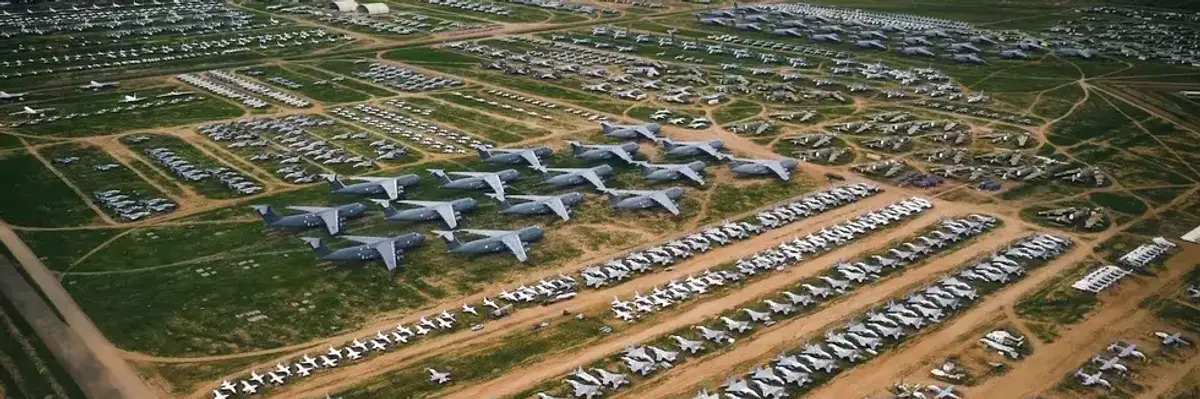
It’s a commonly repeated statistic that the US military is the world’s largest institutional polluter, but what exactly does that mean?
The quest to find a real answer to that question led journalist and documentary filmmaker Abby Martin and her husband and co-director Mike Prysner on a five-year journey from defense contractor conferences and international climate gatherings to the Rim of the Pacific military training exercises and the fight against the construction of a military base in Okinawa that would fill in its iconic Oura Bay.
The result is Earth’s Greatest Enemy, released this year independently through Martin and Prysner’s own Empire Files, with editing by Taylor Gill and an original score by Anahedron. The film uses personal narrative, research, investigative reporting, interviews, and live footage to detail all the ways in which the Pentagon poisons the planet, including greenhouse gas emissions, the ecocide of war, and the toxins left behind long after the fighting has stopped.
"When you combine all of this, it is completely undeniable that this force that is upheld by extreme violence is the greatest threat to all living things on Earth,” Martin told Common Dreams.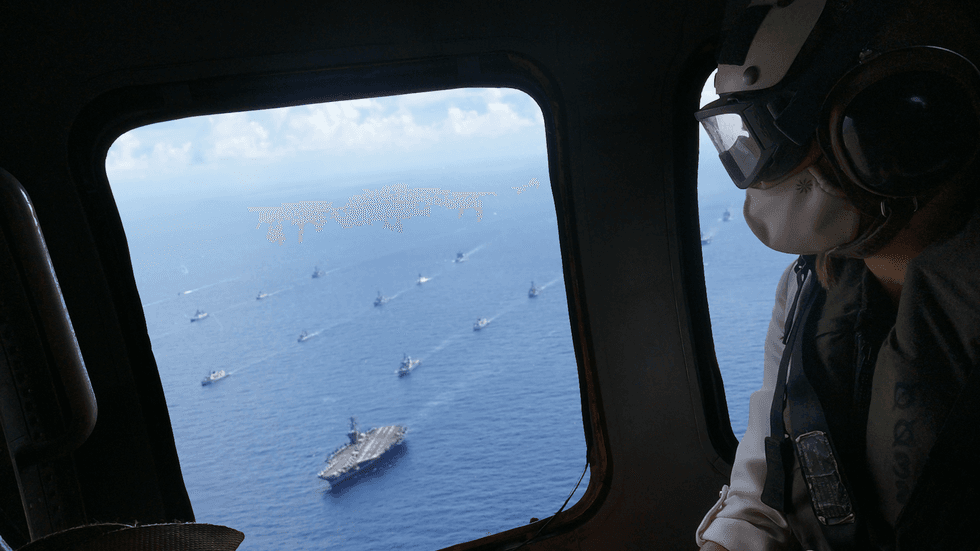
RIMPAC training exercises are shown in a still from Earth's Greatest Enemy. (Image via Empire Files)
Toward the beginning of the film, Martin sets out to explain how the Pentagon can count as the world’s largest institutional polluter, and why the numbers behind that fact actually undersell its impact.
It turns out, Martin told Common Dreams, that this statement is only based on the amount of oil the US military purchases on paper, which comes to 270,000 barrels per day. This puts its emissions at 55 million metric tons of carbon dioxide annually, more than 150 countries.
This itself is a staggering amount of carbon pollution.
As Martin explains in the film: “It would take the average American driver over 40 years to burn as much fuel as a single flight of a Boeing Pegasus. The US flies more than 600 of these tankers.”
"You have to look at the military as actually the institution that's actually keeping the fossil fuel infrastructure in place through brutality and violence.”
But it’s also only the tip of the melting iceberg. Through an interview with scientist Stuart Parkinson, Martin reveals how that 55 million keeps ballooning when considering life cycle emissions from military equipment and from the equipment purchased by NATO allies, projected to reach 295 million metric tons by 2028, or more than half of all countries. And that figure excludes the use of military equipment in war, or the emissions from reconstructing cities leveled by US-made bombs.
In one particularly candid interview, a major general tells Martin that it’s great to develop alternative energy sources, “but let’s not walk away from what fuels today’s national security, which is oil. You have to have it.”
And until something is developed that can completely replace oil, “I think you need to keep the alternatives in check," he says.
Statements like these give the lie to the idea that the US can have a “green military empire,” Martin said.
They also show how difficult it is to separate the US military’s carbon footprint from that of the fossil fuel industry itself.
“Everything has really been wrapped up into securing the fossil fuel, building the infrastructure for fossil fuel, and maintaining that infrastructure empire in order to maintain a fossil fuel economy,” she told Common Dreams. “So you have to look at the military as actually the institution that's actually keeping the fossil fuel infrastructure in place through brutality and violence.”

A helmet and dog tag are seen in Camp Lejeune, North Carolina in a still from the film Earth's Greatest Enemy. (Image via Empire Files)
The film also makes clear that carbon pollution isn’t the only kind of pollution the military generates.
“Once you get into the research, you realize every stone unturned is an entire other documentary because it's not just emissions, it's the totality of pollution that the military is emitting on a daily basis, the dumping of toxic waste, the legacy contamination, that alone is still killing people every day,” Martin said.
The film spends much of its run time digging into the landfill of military waste, from melted down pucks of plastic dumped off Navy boats and unused munitions exploded in the desert to decades of water contamination at Camp Lejeune, the 26 million marine mammals the US Navy is permitted to harm or kill over five years of training, and the more than 250,000 bullets left behind in Iraq and Afghanistan for every person killed.
Martin said that almost every fact or anecdote she unearthed surprised her.
"We're fighting for service members and every living person on Earth, because we are all victims of this.”
“No matter what you think you know, it's worse. It's actually worse because of how big it is and how every face is a story, every victim is a story,” she said.
One of the most devastating stories comes at the film’s beginning, as viewers spend time with Lavon Johnson, an Iraq War veteran who once starred in a US Army commercial and is now living on Veterans Row, a stretch of tents bearing American flags lined up outside the Veterans Affairs hospital in Brentwood, Los Angeles. “My life is so fucked!” he declares as he lifts his hands from the piano he furiously plays despite the nerve damage caused by exposure to hydraulic fluid while in the Army.
In the next scene, viewers see the camp being demolished by police, juxtaposed with images of war, pollution, and environmental destruction, such as soldiers breaking down doors or dumping trash off of boats, oil pump jacks working, and beachside homes collapsing into a rising tide.
Martin said she was inspired to open the film with Johnson because of a letter that late Iraq War veteran Tomas Young wrote to former President George W. Bush and Vice President Dick Cheney before he died, referring to himself and other victims of the invasion as “human detritus your war has left behind.”
“That always stuck with me, that line, ‘the human detritus,’” Martin told Common Dreams. “And that is exactly what they do to veterans. That is exactly what they do to veterans… they're churned up and spit out. They're the cannon fodder of the system. And for what?”
Prysner is an Iraq veteran who spoke out against the war, and Martin is very clear that veterans are not the target of the pairs’ critique.
“This isn't about service members,” she said. “This isn't about hating the military. This is about accountability and justice for them. We're fighting for service members and every living person on Earth, because we are all victims of this.”
The demolition of Johnson’s camp cut through with clips of war and weather disaster illustrates this point, and could serve as a sort of thesis for the film, showing that the US military ultimately turns everything it touches into detritus, including, if it’s not stopped, the planet itself.
“Everything on Earth is in Lavon’s tent,” Martin said.
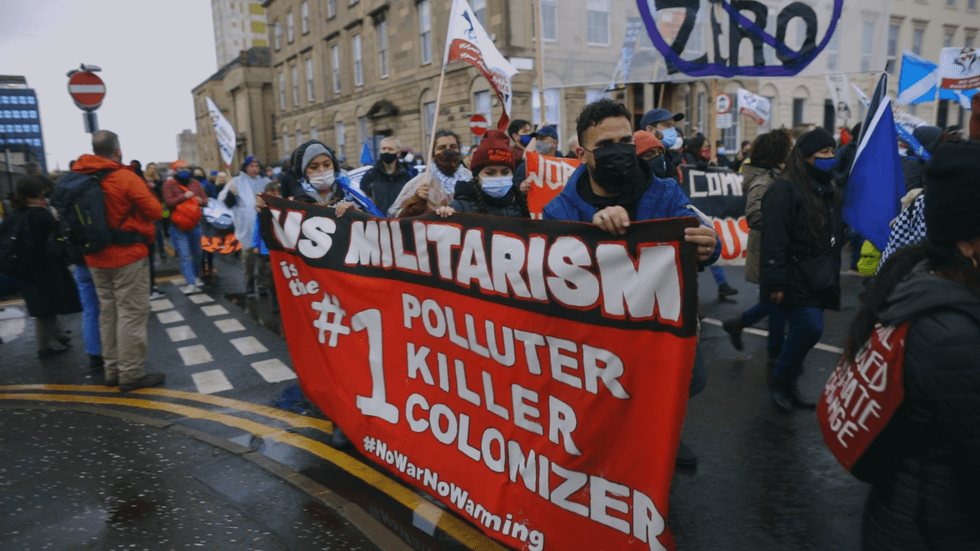
People march against US militarism at COP26 in Glasgow, in a still from Earth's Greatest Enemy. (Image via Empire Files)
This sense of connection is ultimately why Martin decided to keep Earth’s Greatest Enemy as a two-hour feature documentary rather than pivoting to a documentary series, despite the fact that, the more she dug, the more she realized “it could be 10 documentaries.”
She also ran into roadblocks when seeking Hollywood distribution. While environmentalist distributors would praise the film and compare it to Al Gore’s An Inconvenient Truth, they also said frankly, “You’re never going to be able to get anyone to buy this stuff.”
But, Martin said, “I was so committed to making a movie because movies were what radicalized me,” citing inspiration from films like The Revolution Will Not Be Televised, War Made Easy, and Michael Moore's filmography.
Ultimately, her stubbornness paid off.
“After we educate everyone, I hope to decommission the military empire."
“It shows that everything from ICE [Immigration and Customs Enforcement] to Gaza to the climate, that everything is connected,” she said. “Veterans, soldiers, the Indigenous people on the receiving end of this. If you care about cold water and good air, you can't walk away from this not being impacted. And that was the goal. The goal is to lock people in and explain the totality and to bring you down to the depths of hell.”
She added: “We have to understand those depths, and you can't get that with a 20-minute segment. You just can't. You have to go through the pain of all the victims in this community and come out the other side empowered with the truth and the resolve that we have to change this.”
Change is a large part of Martin’s motivation for making the film, by educating people about the scope of the military’s destructive force and connecting them into a broader coalition.
Martin speaks in the film about coming to political consciousness and beginning her career as a journalist during the Iraq War, meeting Prysner through their shared opposition to war and empire, and developing "profound climate anxiety" following the birth of the pairs' first child. She lamented that the climate and anti-imperialist movements have been largely siloed over the past two decades, though that is beginning to change.
Through local screenings, she said she wanted to “try to build the environmental movement with the anti-war movement together because… even though the consciousness is expanding, it's not happening fast enough. And we are simply out of the luxury of time.”
The sense of urgency has only increased with President Donald Trump’s second term. While the film does not cover this period, it points to many developments that have shaped the past 12 months, including Trump’s claim that he attacked Venezuela for oil, his imperialist push to control Greenland, and his deployment of ICE to terrorize US cities.
Toward the end of the movie, Martin includes a segment on the militarization of US policing and warns that “this is our system’s big plan for the climate crisis.” She also films a panel on “Domain Awareness and Air Superiority in the Arctic” in which the generals speaking tell US companies they have an “open invitation” to experiment in Alaska.
“We know what they want the Arctic for, and it's to pillage every last drop,” Martin said. “So if environmental organizations are not thinking this together, we have to do it for them. We have to do it for them quickly.”
So far, she has seen encouraging signs, with several Sierra Club chapters stepping up to host screenings and enthusiasm from the mainstream environmental groups, parks departments, and other city officials she has invited to attend.
But education is not her only goal.
“After we educate everyone, I hope to decommission the military empire,” Martin said.
For Martin, that doesn’t mean not having a military for self-defense, but rather decommissioning the 800 or so bases the US military maintains around the world and transforming the infrastructure into something that could help local communities in a climate-friendly way. It also means accountability for harm caused and redirecting military spending toward basic needs like housing and healthcare, and certainly not giving the Pentagon another $600 billion as Trump desires.
While that may seem like an impossible task given the current political climate, Martin maintains a sense of revolutionary optimism, encouraged by the global mobilization against the genocide in Gaza and the way that people are increasingly seeing the links between the multiple crises and struggles around the globe.
“There's so many of us,” Martin told Common Dreams. “We care about the planet. We have a vested stake in life. And that's our vision.”
“It's like they have a vision of death and destruction for profit,” she continued. “Our vision is life, and we have to fight for it with every fiber of our being. And let this movie assist you however you can do that.”
To attend a screening of Earth’s Greatest Enemy, see the schedule here. To host a screening of your own, email theempirefiles@gmail.com.
It’s a commonly repeated statistic that the US military is the world’s largest institutional polluter, but what exactly does that mean?
The quest to find a real answer to that question led journalist and documentary filmmaker Abby Martin and her husband and co-director Mike Prysner on a five-year journey from defense contractor conferences and international climate gatherings to the Rim of the Pacific military training exercises and the fight against the construction of a military base in Okinawa that would fill in its iconic Oura Bay.
The result is Earth’s Greatest Enemy, released this year independently through Martin and Prysner’s own Empire Files, with editing by Taylor Gill and an original score by Anahedron. The film uses personal narrative, research, investigative reporting, interviews, and live footage to detail all the ways in which the Pentagon poisons the planet, including greenhouse gas emissions, the ecocide of war, and the toxins left behind long after the fighting has stopped.
"When you combine all of this, it is completely undeniable that this force that is upheld by extreme violence is the greatest threat to all living things on Earth,” Martin told Common Dreams.RIMPAC training exercises are shown in a still from Earth's Greatest Enemy. (Image via Empire Files)
Toward the beginning of the film, Martin sets out to explain how the Pentagon can count as the world’s largest institutional polluter, and why the numbers behind that fact actually undersell its impact.
It turns out, Martin told Common Dreams, that this statement is only based on the amount of oil the US military purchases on paper, which comes to 270,000 barrels per day. This puts its emissions at 55 million metric tons of carbon dioxide annually, more than 150 countries.
This itself is a staggering amount of carbon pollution.
As Martin explains in the film: “It would take the average American driver over 40 years to burn as much fuel as a single flight of a Boeing Pegasus. The US flies more than 600 of these tankers.”
"You have to look at the military as actually the institution that's actually keeping the fossil fuel infrastructure in place through brutality and violence.”
But it’s also only the tip of the melting iceberg. Through an interview with scientist Stuart Parkinson, Martin reveals how that 55 million keeps ballooning when considering life cycle emissions from military equipment and from the equipment purchased by NATO allies, projected to reach 295 million metric tons by 2028, or more than half of all countries. And that figure excludes the use of military equipment in war, or the emissions from reconstructing cities leveled by US-made bombs.
In one particularly candid interview, a major general tells Martin that it’s great to develop alternative energy sources, “but let’s not walk away from what fuels today’s national security, which is oil. You have to have it.”
And until something is developed that can completely replace oil, “I think you need to keep the alternatives in check," he says.
Statements like these give the lie to the idea that the US can have a “green military empire,” Martin said.
They also show how difficult it is to separate the US military’s carbon footprint from that of the fossil fuel industry itself.
“Everything has really been wrapped up into securing the fossil fuel, building the infrastructure for fossil fuel, and maintaining that infrastructure empire in order to maintain a fossil fuel economy,” she told Common Dreams. “So you have to look at the military as actually the institution that's actually keeping the fossil fuel infrastructure in place through brutality and violence.”
A helmet and dog tag are seen in Camp Lejeune, North Carolina in a still from the film Earth's Greatest Enemy. (Image via Empire Files)
The film also makes clear that carbon pollution isn’t the only kind of pollution the military generates.
“Once you get into the research, you realize every stone unturned is an entire other documentary because it's not just emissions, it's the totality of pollution that the military is emitting on a daily basis, the dumping of toxic waste, the legacy contamination, that alone is still killing people every day,” Martin said.
The film spends much of its run time digging into the landfill of military waste, from melted down pucks of plastic dumped off Navy boats and unused munitions exploded in the desert to decades of water contamination at Camp Lejeune, the 26 million marine mammals the US Navy is permitted to harm or kill over five years of training, and the more than 250,000 bullets left behind in Iraq and Afghanistan for every person killed.
Martin said that almost every fact or anecdote she unearthed surprised her.
"We're fighting for service members and every living person on Earth, because we are all victims of this.”
“No matter what you think you know, it's worse. It's actually worse because of how big it is and how every face is a story, every victim is a story,” she said.
One of the most devastating stories comes at the film’s beginning, as viewers spend time with Lavon Johnson, an Iraq War veteran who once starred in a US Army commercial and is now living on Veterans Row, a stretch of tents bearing American flags lined up outside the Veterans Affairs hospital in Brentwood, Los Angeles. “My life is so fucked!” he declares as he lifts his hands from the piano he furiously plays despite the nerve damage caused by exposure to hydraulic fluid while in the Army.
In the next scene, viewers see the camp being demolished by police, juxtaposed with images of war, pollution, and environmental destruction, such as soldiers breaking down doors or dumping trash off of boats, oil pump jacks working, and beachside homes collapsing into a rising tide.
Martin said she was inspired to open the film with Johnson because of a letter that late Iraq War veteran Tomas Young wrote to former President George W. Bush and Vice President Dick Cheney before he died, referring to himself and other victims of the invasion as “human detritus your war has left behind.”
“That always stuck with me, that line, ‘the human detritus,’” Martin told Common Dreams. “And that is exactly what they do to veterans. That is exactly what they do to veterans… they're churned up and spit out. They're the cannon fodder of the system. And for what?”
Prysner is an Iraq veteran who spoke out against the war, and Martin is very clear that veterans are not the target of the pairs’ critique.
“This isn't about service members,” she said. “This isn't about hating the military. This is about accountability and justice for them. We're fighting for service members and every living person on Earth, because we are all victims of this.”
The demolition of Johnson’s camp cut through with clips of war and weather disaster illustrates this point, and could serve as a sort of thesis for the film, showing that the US military ultimately turns everything it touches into detritus, including, if it’s not stopped, the planet itself.
“Everything on Earth is in Lavon’s tent,” Martin said.
People march against US militarism at COP26 in Glasgow, in a still from Earth's Greatest Enemy. (Image via Empire Files)
This sense of connection is ultimately why Martin decided to keep Earth’s Greatest Enemy as a two-hour feature documentary rather than pivoting to a documentary series, despite the fact that, the more she dug, the more she realized “it could be 10 documentaries.”
She also ran into roadblocks when seeking Hollywood distribution. While environmentalist distributors would praise the film and compare it to Al Gore’s An Inconvenient Truth, they also said frankly, “You’re never going to be able to get anyone to buy this stuff.”
But, Martin said, “I was so committed to making a movie because movies were what radicalized me,” citing inspiration from films like The Revolution Will Not Be Televised, War Made Easy, and Michael Moore's filmography.
Ultimately, her stubbornness paid off.
“After we educate everyone, I hope to decommission the military empire."
“It shows that everything from ICE [Immigration and Customs Enforcement] to Gaza to the climate, that everything is connected,” she said. “Veterans, soldiers, the Indigenous people on the receiving end of this. If you care about cold water and good air, you can't walk away from this not being impacted. And that was the goal. The goal is to lock people in and explain the totality and to bring you down to the depths of hell.”
She added: “We have to understand those depths, and you can't get that with a 20-minute segment. You just can't. You have to go through the pain of all the victims in this community and come out the other side empowered with the truth and the resolve that we have to change this.”
Change is a large part of Martin’s motivation for making the film, by educating people about the scope of the military’s destructive force and connecting them into a broader coalition.
Martin speaks in the film about coming to political consciousness and beginning her career as a journalist during the Iraq War, meeting Prysner through their shared opposition to war and empire, and developing "profound climate anxiety" following the birth of the pairs' first child. She lamented that the climate and anti-imperialist movements have been largely siloed over the past two decades, though that is beginning to change.
Through local screenings, she said she wanted to “try to build the environmental movement with the anti-war movement together because… even though the consciousness is expanding, it's not happening fast enough. And we are simply out of the luxury of time.”
The sense of urgency has only increased with President Donald Trump’s second term. While the film does not cover this period, it points to many developments that have shaped the past 12 months, including Trump’s claim that he attacked Venezuela for oil, his imperialist push to control Greenland, and his deployment of ICE to terrorize US cities.
Toward the end of the movie, Martin includes a segment on the militarization of US policing and warns that “this is our system’s big plan for the climate crisis.” She also films a panel on “Domain Awareness and Air Superiority in the Arctic” in which the generals speaking tell US companies they have an “open invitation” to experiment in Alaska.
“We know what they want the Arctic for, and it's to pillage every last drop,” Martin said. “So if environmental organizations are not thinking this together, we have to do it for them. We have to do it for them quickly.”
So far, she has seen encouraging signs, with several Sierra Club chapters stepping up to host screenings and enthusiasm from the mainstream environmental groups, parks departments, and other city officials she has invited to attend.
But education is not her only goal.
“After we educate everyone, I hope to decommission the military empire,” Martin said.
For Martin, that doesn’t mean not having a military for self-defense, but rather decommissioning the 800 or so bases the US military maintains around the world and transforming the infrastructure into something that could help local communities in a climate-friendly way. It also means accountability for harm caused and redirecting military spending toward basic needs like housing and healthcare, and certainly not giving the Pentagon another $600 billion as Trump desires.
While that may seem like an impossible task given the current political climate, Martin maintains a sense of revolutionary optimism, encouraged by the global mobilization against the genocide in Gaza and the way that people are increasingly seeing the links between the multiple crises and struggles around the globe.
“There's so many of us,” Martin told Common Dreams. “We care about the planet. We have a vested stake in life. And that's our vision.”
“It's like they have a vision of death and destruction for profit,” she continued. “Our vision is life, and we have to fight for it with every fiber of our being. And let this movie assist you however you can do that.”
To attend a screening of Earth’s Greatest Enemy, see the schedule here. To host a screening of your own, email theempirefiles@gmail.com.
It’s a commonly repeated statistic that the US military is the world’s largest institutional polluter, but what exactly does that mean?
The quest to find a real answer to that question led journalist and documentary filmmaker Abby Martin and her husband and co-director Mike Prysner on a five-year journey from defense contractor conferences and international climate gatherings to the Rim of the Pacific military training exercises and the fight against the construction of a military base in Okinawa that would fill in its iconic Oura Bay.
The result is Earth’s Greatest Enemy, released this year independently through Martin and Prysner’s own Empire Files, with editing by Taylor Gill and an original score by Anahedron. The film uses personal narrative, research, investigative reporting, interviews, and live footage to detail all the ways in which the Pentagon poisons the planet, including greenhouse gas emissions, the ecocide of war, and the toxins left behind long after the fighting has stopped.
"When you combine all of this, it is completely undeniable that this force that is upheld by extreme violence is the greatest threat to all living things on Earth,” Martin told Common Dreams.RIMPAC training exercises are shown in a still from Earth's Greatest Enemy. (Image via Empire Files)
Toward the beginning of the film, Martin sets out to explain how the Pentagon can count as the world’s largest institutional polluter, and why the numbers behind that fact actually undersell its impact.
It turns out, Martin told Common Dreams, that this statement is only based on the amount of oil the US military purchases on paper, which comes to 270,000 barrels per day. This puts its emissions at 55 million metric tons of carbon dioxide annually, more than 150 countries.
This itself is a staggering amount of carbon pollution.
As Martin explains in the film: “It would take the average American driver over 40 years to burn as much fuel as a single flight of a Boeing Pegasus. The US flies more than 600 of these tankers.”
"You have to look at the military as actually the institution that's actually keeping the fossil fuel infrastructure in place through brutality and violence.”
But it’s also only the tip of the melting iceberg. Through an interview with scientist Stuart Parkinson, Martin reveals how that 55 million keeps ballooning when considering life cycle emissions from military equipment and from the equipment purchased by NATO allies, projected to reach 295 million metric tons by 2028, or more than half of all countries. And that figure excludes the use of military equipment in war, or the emissions from reconstructing cities leveled by US-made bombs.
In one particularly candid interview, a major general tells Martin that it’s great to develop alternative energy sources, “but let’s not walk away from what fuels today’s national security, which is oil. You have to have it.”
And until something is developed that can completely replace oil, “I think you need to keep the alternatives in check," he says.
Statements like these give the lie to the idea that the US can have a “green military empire,” Martin said.
They also show how difficult it is to separate the US military’s carbon footprint from that of the fossil fuel industry itself.
“Everything has really been wrapped up into securing the fossil fuel, building the infrastructure for fossil fuel, and maintaining that infrastructure empire in order to maintain a fossil fuel economy,” she told Common Dreams. “So you have to look at the military as actually the institution that's actually keeping the fossil fuel infrastructure in place through brutality and violence.”
A helmet and dog tag are seen in Camp Lejeune, North Carolina in a still from the film Earth's Greatest Enemy. (Image via Empire Files)
The film also makes clear that carbon pollution isn’t the only kind of pollution the military generates.
“Once you get into the research, you realize every stone unturned is an entire other documentary because it's not just emissions, it's the totality of pollution that the military is emitting on a daily basis, the dumping of toxic waste, the legacy contamination, that alone is still killing people every day,” Martin said.
The film spends much of its run time digging into the landfill of military waste, from melted down pucks of plastic dumped off Navy boats and unused munitions exploded in the desert to decades of water contamination at Camp Lejeune, the 26 million marine mammals the US Navy is permitted to harm or kill over five years of training, and the more than 250,000 bullets left behind in Iraq and Afghanistan for every person killed.
Martin said that almost every fact or anecdote she unearthed surprised her.
"We're fighting for service members and every living person on Earth, because we are all victims of this.”
“No matter what you think you know, it's worse. It's actually worse because of how big it is and how every face is a story, every victim is a story,” she said.
One of the most devastating stories comes at the film’s beginning, as viewers spend time with Lavon Johnson, an Iraq War veteran who once starred in a US Army commercial and is now living on Veterans Row, a stretch of tents bearing American flags lined up outside the Veterans Affairs hospital in Brentwood, Los Angeles. “My life is so fucked!” he declares as he lifts his hands from the piano he furiously plays despite the nerve damage caused by exposure to hydraulic fluid while in the Army.
In the next scene, viewers see the camp being demolished by police, juxtaposed with images of war, pollution, and environmental destruction, such as soldiers breaking down doors or dumping trash off of boats, oil pump jacks working, and beachside homes collapsing into a rising tide.
Martin said she was inspired to open the film with Johnson because of a letter that late Iraq War veteran Tomas Young wrote to former President George W. Bush and Vice President Dick Cheney before he died, referring to himself and other victims of the invasion as “human detritus your war has left behind.”
“That always stuck with me, that line, ‘the human detritus,’” Martin told Common Dreams. “And that is exactly what they do to veterans. That is exactly what they do to veterans… they're churned up and spit out. They're the cannon fodder of the system. And for what?”
Prysner is an Iraq veteran who spoke out against the war, and Martin is very clear that veterans are not the target of the pairs’ critique.
“This isn't about service members,” she said. “This isn't about hating the military. This is about accountability and justice for them. We're fighting for service members and every living person on Earth, because we are all victims of this.”
The demolition of Johnson’s camp cut through with clips of war and weather disaster illustrates this point, and could serve as a sort of thesis for the film, showing that the US military ultimately turns everything it touches into detritus, including, if it’s not stopped, the planet itself.
“Everything on Earth is in Lavon’s tent,” Martin said.
People march against US militarism at COP26 in Glasgow, in a still from Earth's Greatest Enemy. (Image via Empire Files)
This sense of connection is ultimately why Martin decided to keep Earth’s Greatest Enemy as a two-hour feature documentary rather than pivoting to a documentary series, despite the fact that, the more she dug, the more she realized “it could be 10 documentaries.”
She also ran into roadblocks when seeking Hollywood distribution. While environmentalist distributors would praise the film and compare it to Al Gore’s An Inconvenient Truth, they also said frankly, “You’re never going to be able to get anyone to buy this stuff.”
But, Martin said, “I was so committed to making a movie because movies were what radicalized me,” citing inspiration from films like The Revolution Will Not Be Televised, War Made Easy, and Michael Moore's filmography.
Ultimately, her stubbornness paid off.
“After we educate everyone, I hope to decommission the military empire."
“It shows that everything from ICE [Immigration and Customs Enforcement] to Gaza to the climate, that everything is connected,” she said. “Veterans, soldiers, the Indigenous people on the receiving end of this. If you care about cold water and good air, you can't walk away from this not being impacted. And that was the goal. The goal is to lock people in and explain the totality and to bring you down to the depths of hell.”
She added: “We have to understand those depths, and you can't get that with a 20-minute segment. You just can't. You have to go through the pain of all the victims in this community and come out the other side empowered with the truth and the resolve that we have to change this.”
Change is a large part of Martin’s motivation for making the film, by educating people about the scope of the military’s destructive force and connecting them into a broader coalition.
Martin speaks in the film about coming to political consciousness and beginning her career as a journalist during the Iraq War, meeting Prysner through their shared opposition to war and empire, and developing "profound climate anxiety" following the birth of the pairs' first child. She lamented that the climate and anti-imperialist movements have been largely siloed over the past two decades, though that is beginning to change.
Through local screenings, she said she wanted to “try to build the environmental movement with the anti-war movement together because… even though the consciousness is expanding, it's not happening fast enough. And we are simply out of the luxury of time.”
The sense of urgency has only increased with President Donald Trump’s second term. While the film does not cover this period, it points to many developments that have shaped the past 12 months, including Trump’s claim that he attacked Venezuela for oil, his imperialist push to control Greenland, and his deployment of ICE to terrorize US cities.
Toward the end of the movie, Martin includes a segment on the militarization of US policing and warns that “this is our system’s big plan for the climate crisis.” She also films a panel on “Domain Awareness and Air Superiority in the Arctic” in which the generals speaking tell US companies they have an “open invitation” to experiment in Alaska.
“We know what they want the Arctic for, and it's to pillage every last drop,” Martin said. “So if environmental organizations are not thinking this together, we have to do it for them. We have to do it for them quickly.”
So far, she has seen encouraging signs, with several Sierra Club chapters stepping up to host screenings and enthusiasm from the mainstream environmental groups, parks departments, and other city officials she has invited to attend.
But education is not her only goal.
“After we educate everyone, I hope to decommission the military empire,” Martin said.
For Martin, that doesn’t mean not having a military for self-defense, but rather decommissioning the 800 or so bases the US military maintains around the world and transforming the infrastructure into something that could help local communities in a climate-friendly way. It also means accountability for harm caused and redirecting military spending toward basic needs like housing and healthcare, and certainly not giving the Pentagon another $600 billion as Trump desires.
While that may seem like an impossible task given the current political climate, Martin maintains a sense of revolutionary optimism, encouraged by the global mobilization against the genocide in Gaza and the way that people are increasingly seeing the links between the multiple crises and struggles around the globe.
“There's so many of us,” Martin told Common Dreams. “We care about the planet. We have a vested stake in life. And that's our vision.”
“It's like they have a vision of death and destruction for profit,” she continued. “Our vision is life, and we have to fight for it with every fiber of our being. And let this movie assist you however you can do that.”
To attend a screening of Earth’s Greatest Enemy, see the schedule here. To host a screening of your own, email theempirefiles@gmail.com.

