SUBSCRIBE TO OUR FREE NEWSLETTER
Daily news & progressive opinion—funded by the people, not the corporations—delivered straight to your inbox.
5
#000000
#FFFFFF
To donate by check, phone, or other method, see our More Ways to Give page.



The couple's three daughters and son—Faryal, Salma, Amira, and Naeem—ranged in age from 6 to 13.
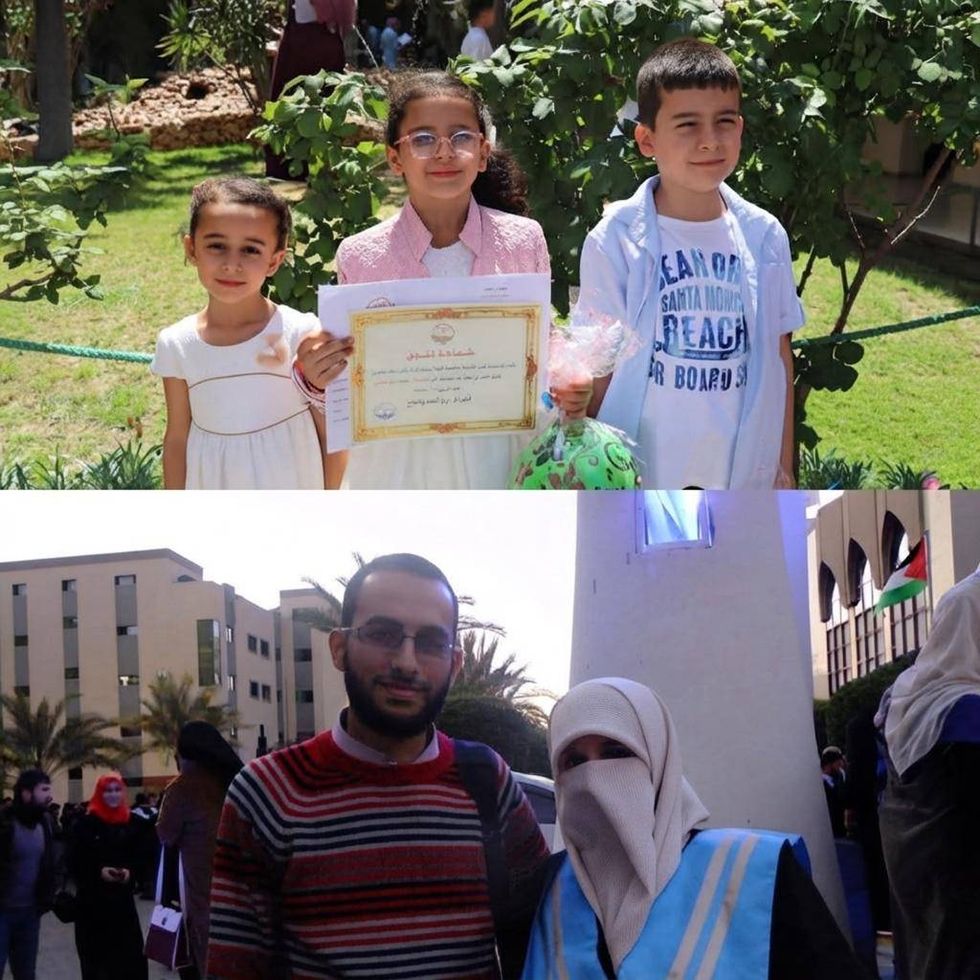 (Photo by el-Masri family/X)
At least some members of the family—who were sleeping when their home was bombed—were apparently not killed by the blast.
"They were all burned so much that our crews couldn't reach them," said Palestinian Civil Defense spokesperson Mahmoud Basal. "They were screaming and begging us to get them before they were martyred, but all attempts failed."
Video recordings of the airstrike's aftermath show first responders desperately trying to extinguish the blaze caused by the attack and retrieving the burnt victims' bodies.
Ahmed el-Masri told the Emirati newspaper The National that his brother's "entire family was wiped out from the civil registry."
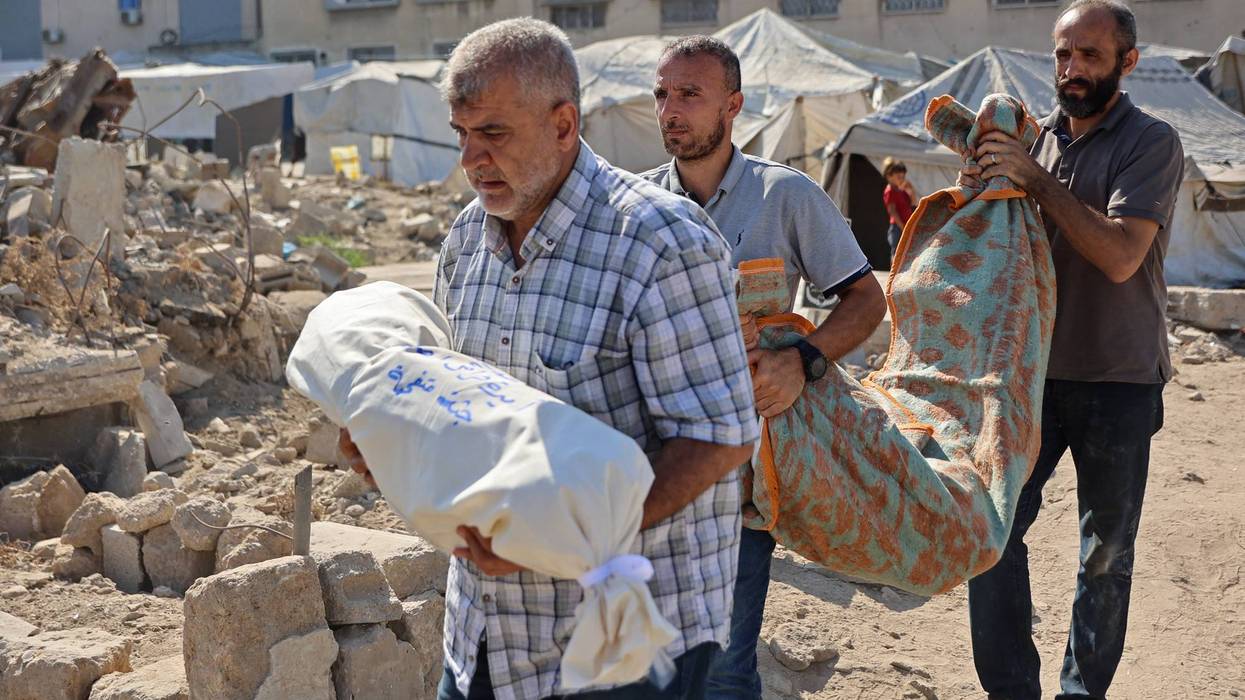
The el-Masri family is one of approximately 2,700 erased from the registry since Israel launched its war on Gaza in retaliation for the Hamas-led attack of October 7, 2023, according to an Al Jazeera analysis published in January.
The Israel Defense Forces confirmed the bombing, claiming the strike was targeting a Hamas member. The IDF dramatically loosened its rules of engagement following the October 7 attack, effectively allowing an unlimited number of civilians to be killed when targeting a single Hamas member, no matter how low-ranking.
Reuters reported at least six more Palestinians were killed by Israeli strikes later on Tuesday, including one targeting a vehicle in the central Gaza Strip.
On Monday, an IDF missile attack on the al-Yemen al-Saeed Hospital in northern Gaza's Jabalia refugee camp killed at least two people and wounded 16 others, including women and children.
“The children were having fun and playing football, and suddenly they started screaming,” eyewitness Youssef Akasha told Drop Site News contributor Mohamed Ahmed. “We found many children lying on the ground, women screaming, and young men running to rescue the wounded."
Graphic video footage shows children, including infants, being treated for shrapnel embedded in their bodies.
Israel's attack on the el-Masri family followed a Saturday IDF airstrike on the home of the Nasman family in the al-Nasser neighborhood of Gaza City that killed five people. The Israeli newspaper Haaretz reported that Adham Nasman, 42; his wife, Marwa, 40; and three of their children—Arwa, 8, Ibrahim, 16, and Yahya, 18—were killed, and that Adham was apparently the intended target.
The couple's 13-year-old son, also named Adham, was not home at the time of the strike. Video footage published by photojournalist Nahed Hajjaj shows the grieving boy beside the bodies of his slain family.
In another massacre on Saturday, an Israeli drone bombed a funeral in the Nuseirat refugee camp for a man who was allegedly a member of Palestinian Islamic Jihad, who had been killed earlier the same day in another IDF strike. Eight people were killed and 20 others wounded in the second attack, according to Palestinian, Israeli, and international media reports.
Israel's US-backed assault on Gaza has left more than 250,000 Palestinians dead, maimed, or missing since October 2023 and around 2 million people forcibly displaced, starved, or sickened. Over 21,500 children—1,022 of them babies—are among the more than 73,000 Palestinians killed by Israeli forces during the war that scholars, jurists, human rights groups, a panel of United Nations experts, and others say is a genocide.
Israel is facing a genocide case filed by South Africa at the International Court of Justice and supported by nearly 20 nations, while Israeli Prime Minister Benjamin Netanyahu and Yoav Gallant—his former defense minister who ordered the "complete siege" on Gaza that fueled famine and disease—are wanted by the International Criminal Court for alleged crimes against humanity and war crimes, including murder and forced starvation.
The IDF's continued attacks come despite a US-backed ceasefire that went into effect last October. Since then, more than 1,160 Palestinians—most of them civilians—have been killed and over 3,750 others wounded by Israeli forces, according to the Gaza Health Ministry.
“Nine months after the announcement of a ceasefire, still nowhere is safe for Palestinians in Gaza,” UN human rights spokesperson Thameen Al-Kheetan told reporters in Geneva on Tuesday. "The killing of civilians in these attacks raises concerns of continuing violations of international humanitarian law, war crimes and other possible atrocity crimes in Gaza. Under international law, deliberately attacking civilians is a war crime."
Akasha, who witnessed the Jabalia hospital bombing, told Drop Site News, “I don’t feel like there is a ceasefire at all."


The GMO said Thursday that at least 173,514 others—including more than 44,500 children—have been wounded, and 9,500 Palestinians are still missing and presumed dead and buried beneath the rubble of bombed-out buildings in the coastal strip, more than 90% of which has been destroyed and 80% of which is under Israeli control, according to officials.
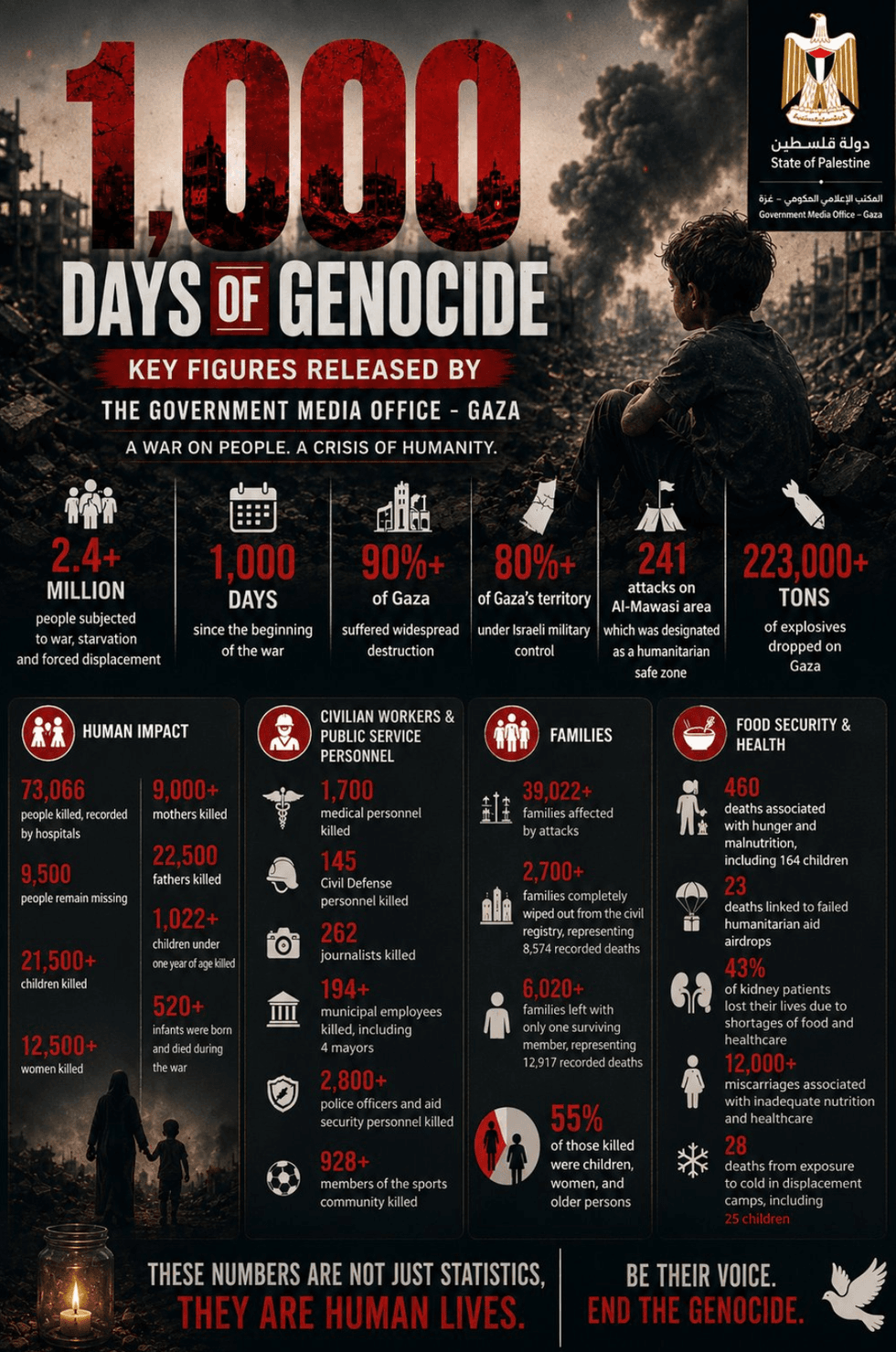 (Source: Gaza Government Media Office)
More than 11,000 Gazan children have suffered what the United Nations Children's Fund (UNICEF) called "life-changing injuries," including as many as 4,000 amputations, many of them performed without anesthesia.
“Every day for the past 1,000 days, the world has failed 1 million children in Gaza by not intervening to stop the killing and maiming of children," Ahmad Ahendawi, regional director at the charity Save the Children, said Thursday. "As their young, fragile bodies were blown to bits and pieces by bombs and missiles, the world sold those same weapons to the government of Israel [and]... continued trade agreements with the government of Israel."
Early in the war, UNICEF called Gaza “the world’s most dangerous place to be a child.”
Classified Israel Defense Forces (IDF) data leaked last August suggested that 5 in 6 Palestinians, or 83%, killed during the war's first 19 months were civilians. Experts attribute the high civilian death toll to Israel's use of artificial intelligence in target selection, its dropping of 1,000- and 2,000-pound bombs—many of them supplied by the US—in densely populated urban zones, and relaxed rules of engagement allowing for an unlimited number of noncombatant casualties in airstrikes targeting a single Hamas operative, no matter how low-ranking.
Last month, a United Nations commission of inquiry found that 30% of those killed by Israel in Gaza have been minors, and that “the deliberate targeting of children is one of the key elements establishing genocidal intent of the Israeli authorities and security forces to destroy the Palestinian group, in whole or in part, in Gaza."
The commission, which separately concluded that Israel is committing genocide in Gaza, used language consistent with Article II of the Genocide Convention, the international treaty against which Israel's actions are being weighed by the International Court of Justice in The Hague. In December 2023, South Africa filed a genocide case against Israel at the ICJ that is now formally backed by around 20 nations.
IDF troops have admitted to witnessing alleged war crimes, including indiscriminate murder of women and children. Doctors and other international volunteers who worked in Gaza's besieged hospitals during the genocide have reported the apparently deliberate targeting of Palestinian civilians, including children shot in the head and chest by Israeli snipers.
Palestinian survivors and witnesses have also accused IDF troops of summarily executing women and children.
“Every day for the past 1,000 days, the world has failed 1 million children in Gaza."
The new GMO figures note 460 deaths from malnutrition—164 of them children—and 28 Palestinians, mostly children, who perished from hypothermia in camps housing many of the approximately 2 million people forcibly displaced by the war.
According to figures published last month by UNICEF, more than 1,000 Palestinians, including at least 265 children, have been killed by Israeli bombs and bullets since the October 2025 ceasefire took effect. UNICEF called the purported truce a "cruel and deadly illusion."
All this in retaliation for the Hamas-led attack in which approximately 1,200 Israelis and foreign nationals were killed—some by so-called “friendly fire” and under the fratricidal Hannibal Directive—and 251 others abducted.
In the aftermath of the deadliest attack on Israel in its 75-year history, Israeli Prime Minister Benjamin Netanyahu—who is wanted by the International Criminal Court (ICC) in The Hague for alleged war crimes and crimes against humanity in Gaza, including murder and forced starvation—exhorted Israelis to "remember what Amalek has done to you."
According to the Hebrew Bible, the nation of Amalek was an ancient archenemy of the Israelites whose total extermination—"man and woman, infant and suckling"—was commanded by the Abrahamic deity figure God.
Numerous Israeli leaders made similarly genocidal statements, including Israeli President Isaac Herzog, who asserted that there are no innocent people in Gaza, former Defense Minister Yoav Gallant—who is also wanted by the ICC for ordering the "complete siege" of Gaza blamed for fueling deadly famine and disease—and the influential far-right politician Moshe Feiglin.
"Every child in Gaza is the enemy," Feiglin said last year. "We need to occupy Gaza and settle it, and not a single Gazan child will be left there."
According to the new GMO figures, 39,022 families in Gaza have suffered Israeli massacres, with more than 2,700 families entirely wiped out and another 6,020 left with only a single surviving member. More than 58,800 children have been orphaned, including 2,700 who lost both parents, while 26,370 women are now widows.
In 2024, Save the Children published a report detailing how Israel's onslaught has caused the "complete psychological destruction" of Gazan children. A subsequent study found that nearly all children in the embattled Palestinian enclave believed that their deaths were imminent—and nearly half of them said they wanted to die.
“We could die at any moment. I hope the war stops for us,” a 14-year-old girl identified as Amani told Save the Children in a report published Thursday.
“I hope the war stops so that I can continue my education in Gaza and live my rights as a human like any girl in other countries," she added. "I would like to live with love, peace, and an easy life."