
SUBSCRIBE TO OUR FREE NEWSLETTER
Daily news & progressive opinion—funded by the people, not the corporations—delivered straight to your inbox.
5
#000000
#FFFFFF
To donate by check, phone, or other method, see our More Ways to Give page.


Daily news & progressive opinion—funded by the people, not the corporations—delivered straight to your inbox.
"Canceling town halls to avoid voter backlash is the thing you do, right before you lose the majority," said one Democratic strategist.
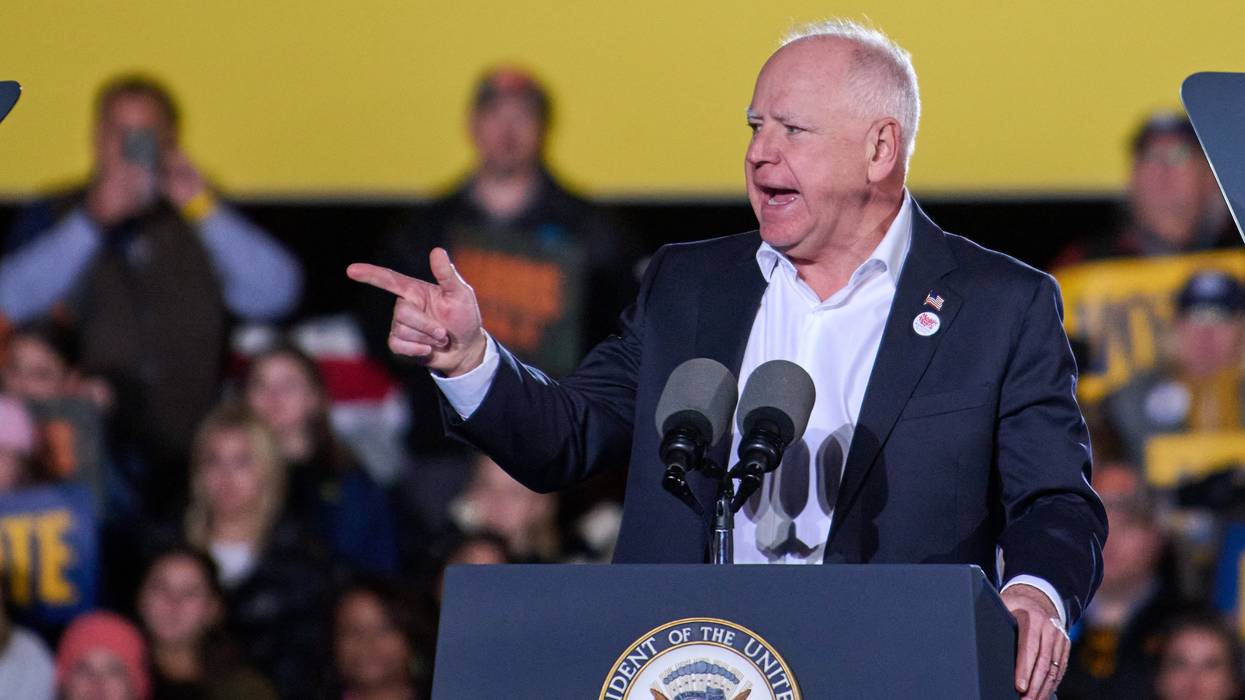
Voters in Republican districts may see considerably less of their members of Congress in the coming months following a directive from the chair of the U.S. House GOP's campaign arm on Tuesday, but Democratic leaders including Minnesota Gov. Tim Walz offered to fill in for lawmakers who don't want to face constituents who have questions about the Trump-Republican agenda.
"If your Republican representative won't meet with you because their agenda is so unpopular, maybe a Democrat will," said Walz, who was former Vice President Kamala Harris' running mate in the 2024 election. "Hell, maybe I will."
Walz's offer followed reports that Rep. Richard Hudson (R-N.C.), who chairs the National Republican Congressional Committee (NRCC), said in a private meeting that members of the right-wing caucus should no longer meet in person with constituents at town halls to avoid the outcry that has garnered media attention at many recent meetings.
As the party has pushed for $880 billion in cuts to Medicaid and federal food assistance in the budget proposal that the House passed last month—to help fund a tax cut for the richest Americans—and as President Donald Trump's billionaire ally, Elon Musk, has spearheaded massive cuts to federal agencies, Republicans at town halls have faced angry voters from across the political spectrum.
In Kansas on Saturday, Sen. Roger Marshall (R-Kan.) stood up and left his own town hall after a voter asked how the GOP can support mass firings that have impacted thousands of veterans.
Rep. Rich McCormick (R-Ga.) was booed last month at a town hall as voters denounced the Republican Party's support for cuts to federal health agencies, and lawmakers in Alaska, Wisconsin, and Oregon faced similar reactions.
Right-wing commentators quickly dismissed the outcry about cuts to crucial public services as the result of Democrats mobilizing their voters—in apparent disbelief that constituents, without being prompted, would express anger about cuts to a healthcare program that serves nearly 80 million people.
On Monday, Trump dismissed people who have spoken out at town halls as paid "troublemakers," and House Speaker Mike Johnson (R-La.) said Tuesday that those who have demanded answers from lawmakers about Musk's activities and the budget proposal are "Democrat activists who don't live in the district."
"They're professional protesters," he told reporters. "So why would we give them a forum to do that right now?"
Republicans have not presented any evidence that people speaking out about Musk's Department of Government Efficiency (DOGE) and the party's economic agenda are being paid to do so.
U.S. Rep. Derrick Van Orden (R-Wis.) went as far as to compare people who object to public spending cuts to Neo-Nazis and threatening to arrest people who are "disruptive" at town halls and charge them with a misdemeanor.
"I'm not going to put up with these agitators," said Van Orden. "We're not doing it. Republicans are too nice."
Dan Pfeiffer, co-host of the podcast "Pod Save America" and a former Obama administration official, said that "canceling town halls to avoid voter backlash is the thing you do, right before you lose the majority."
At the GOP meeting, Hudson reportedly told lawmakers that "the paid resistance people are out there like in 2017," leading Rep. Jim McGovern (D-Mass.) to ask whether the Republican Party also blames the "paid resistance" for their loss of more than 40 House seats in the 2018 elections, which followed the party's attempt to repeal the Affordable Care Act and its passage of the 2017 tax cuts that overwhelmingly benefited the wealthy.
Walz suggested Republicans' refusal to engage with their constituents could present an opportunity for Democrats to win more support in GOP districts.
"If your congressman refuses to meet, I'll come host an event in their district to help local Democrats beat 'em," said the governor.
Rep. Ro Khanna (D-Calif.) wrote in a column at The American Prospect Tuesday that he already has plans to meet with voters in Republican voters, just as GOP lawmakers retreat.
"Starting March 24th, I will be going to three red districts in California to speak out against DOGE's mass firings and the Republicans' Medicaid cuts. This is a moment for progressives to speak directly to people across the country, especially in places that have been hollowed out by the offshoring of jobs and failed policies that have put billionaires over the working class," wrote Khanna, noting that Sen. Bernie Sanders (I-Vt.) spoke in Nebraska and Iowa districts last month where GOP members face competitive elections in 2026.
Rep. Ilhan Omar (D-Minn.) added that she hosts "a town hall every single month because it gives me an opportunity to hear from my constituents and not hide from them."
"But I am not surprised Republicans are cowards," she said, "and will now be hiding from their constituents."
"This bill is a five-alarm fire for anyone who seeks to protect free speech, civil society, and democracy," said one rights advocate.
After widespread condemnation of 52 U.S. House Democrats who joined the GOP last week in backing a bill that would threaten nonprofit groups, there was significantly less support among Democratic members for the legislation on Thursday—but civil society groups denounced those who persisted in supporting what one critic called a "MAGA assault" on fundamental rights.
The so-called "Terror-Financing and Tax Penalties on American Hostages Act" (H.R. 9495) passed in the House by a vote of 219-184, with 15 Democrats joining all but one Republican in supporting the bill.
The 15 Democrats who supported the legislation in Thursday's vote include Reps. Jared Golden (Maine), Colin Allred (Texas), Marie Gluesenkamp Perez (Wash.), and Henry Cuellar (Texas).
If ultimately signed into law, the bill would allow the U.S. Treasury Department to revoke tax-exempt status from nonprofits that it deems "terrorist supporting organizations."
Former Labor Secretary Robert Reich urged the Senate, which is led by the Democrats until January, not to allow the "attack on free speech [to] come up for a vote during the lame-duck."
"If it does, they must vote NO," he said.
But with Republicans set to take control of both chambers of Congress as well as the White House after the New Year, advocates are warning that it will ultimately give the Trump administration "unprecedented and unchecked power" to take action against groups whose mission and work President-elect Donald Trump opposes, particularly those fighting for Palestinian rights.
"This bill is a five-alarm fire for anyone who seeks to protect free speech, civil society, and democracy. This bill is part of a broader MAGA assault on the fundamental right to public protest that begins with attacks on Palestinian rights groups and is aimed at outlawing all social justice movements fighting for progressive change," said Beth Miller, political director for Jewish Voice for Peace. "It is shameful that the House of Representatives passed a bill that is straight out of the well-worn authoritarian playbook. The Senate must ensure that this bill to dismantle fundamental freedoms does not move forward or become law."
JVP noted that H.R. 9495 has its roots in the right-wing policy agenda Project 2025 and the Heritage Foundation's Christian nationalist initiative Project Esther, which claims to combat antisemitism but is aimed at denying resources to groups that support the human rights of Palestinian people.
Advocacy groups including JVP credited civil society groups that mobilized in recent days to demand that Democrats oppose H.R. 9495, as Republicans prepared to bring the bill up again for a simple-majority floor vote. The legislation was blocked in the previous vote, despite the support of 52 Democrats, because it required a two-thirds majority to pass under a procedural rule.
JVP Action said it "drove over 35,000 letters to Congressional offices in one week opposing this legislation," while groups including Fight for the Future, Muslims for Progressive Values, and the Council on American-Islamic Relations also joined the effort.
Chip Gibbons, policy director for Defending Rights & Dissent, a group dedicated to protecting the freedoms enshrined in the Bill of Rights, condemned the lawmakers who were unmoved by "overwhelming civil society opposition."
"Two hundred and four Republicans and 15 Democrats in the House voted in favor of a bill that will be used to strip organizations of their nonprofit status in a politically motivated fashion and without proper due process," said Gibbons. "The bill is driven by the current McCarthyite attacks on Palestine solidarity activism, but it empowers the executive branch to crackdown on charities broadly. It is intolerable for any administration to have these powers, but it is reckless for anyone who claims Trump poses a threat to democracy to hand his administration yet another weapon to use against their opponents."
Under the legislation, the federal government would not be required to disclose evidence of its allegations that nonprofits are "terrorist supporting organizations."
"In the absence of meaningful due process, any nonprofit—from humanitarian organizations to independent newsrooms—could risk losing tax-exempt status," said Defending Rights & Dissent. "The bill has further implications for civil society. The mere threat of being tied up in litigation, facing the reputational harm that such a designation would bring, and loss of donors, would chill speech and stifle dissent."
Online news outlet Mondoweiss said that if signed by Trump after he takes office, the measure "could become a powerful tool to crack down on groups that advocate for justice in Palestine."
"If H.R. 9495 becomes law, we'll be entering a dangerous era where nonprofits can be shut down with little evidence and no accountability," said Mondoweiss. "Today it's pro-Palestinian groups—tomorrow it could be any organization critical of government policy."
“If Speaker Johnson drives House Republicans down this highly partisan path," said Democratic leaders, "the odds of a shutdown go way up."
Leading U.S. Senate Democrats on Friday accused House Republicans of "wasting precious time catering to the hard MAGA right" as House Speaker Mike Johnson unveiled a stopgap funding bill tied to a proposal that would require proof of citizenship in order to vote in federal elections.
The proposal—the Safeguard American Voter Eligibility (SAVE) Act—has been pushed by Republican presidential nominee and former President Donald Trump and was passed by the House in July, with five Democrats joining the GOP in supporting the bill.
Non-citizens are already barred from voting in federal elections. With about 21.3 million eligible voters reporting in a recent survey that they would not be able to quickly access their birth certificate, passport, naturalization certificate, or certificate of citizenship in order to prove their status, critics say the proposal is a clear attempt to stop people of color and young Americans from taking part in elections.
Johnson proposed including the legislation in a stopgap bill, or a continuing resolution, that would keep the government running roughly at current spending levels through March 28—a move that would postpone major spending negotiations until after the next president takes office.
U.S. Senate Majority Leader Chuck Schumer (D-N.Y.) and Senate Appropriations Committee Chair Patty Murray (D-Wash.) said that "avoiding a government shutdown requires bipartisanship, not a bill drawn up by one party," and alluded to former House Speaker Kevin McCarthy's (R-Calif.) attempt last September to ram a spending bill through with immigration and border policy changes in order to avert a government shutdown.
"Speaker Johnson is making the same mistake as former Speaker McCarthy did a year ago," said Schumer and Murray in a statement. "The House Republican funding proposal is an ominous case of déjà vu."
“If Speaker Johnson drives House Republicans down this highly partisan path," they added, "the odds of a shutdown go way up, and Americans will know that the responsibility of a shutdown will be on the House Republicans' hands."
Johnson is expected to bring the bill to the House floor on Wednesday after lawmakers return from summer recess. Congress has a September 30 deadline to make changes to the spending bill in order to avoid a partial government shutdown on October 1.
The House speaker called the proposal "a critically important step" toward funding the government and ensuring "that only American citizens can decide American elections"—prompting one critic to accuse Johnson of pushing a "manufactured" issue.
"Anyone who reads the SAVE Act understands it is a bad bill," said attorney Heath Hixson, "a poorly worded unfunded mandate that'll lead to voter suppression and racist outcomes."
"President Biden saved our democracy by delivering us from Trump in 2021," said Rep. Lloyd Doggett. "He must not deliver us to Trump in 2024."
Crediting U.S. President Joe Biden with spearheading "transformational" changes since taking office three-and-a-half years ago, Rep. Lloyd Doggett on Tuesday became the first Democratic member of Congress to call on the president to withdraw from the 2024 electoral race, warning that a potential victory by former President Donald Trump would "usher America into a long, dark, authoritarian era."
With just four months until Election Day, and weeks until the Democratic Party formally nominates its presidential candidate, Doggett (D-Texas) said in a statement that the party's "overriding consideration must be who has the best hope of saving our democracy from an authoritarian takeover by a criminal and his gang."
Doggett spoke out five days after Biden faced Trump in the first debate of the presidential campaign and alarmed viewers, Democratic strategists, and aides with his performance. The president, speaking in a raspy voice and appearing to lose his train of thought several times, struggled to make the case for his achievements and to call out Trump's repeated lies.
The debate reportedly sent a wave of panic through the Democratic Caucus, with one party insider telling Politico that names of potential replacements for Biden were being floated.
In his statement, Doggett noted that Biden's poll numbers compared to Trump's were cause for concern for several months before the debate.
"Too much is at stake to risk a Trump victory—too great a risk to assume that what could not be turned around in a year, what could not be turned around in the debate, can be turned around now," said Doggett. "President Biden saved our democracy by delivering us from Trump in 2021. He must not deliver us to Trump in 2024."
Doggett's comments came as CNN released a poll showing that Trump is leading Biden by 49% v. 43%, while his lead over Vice President Kamala Harris in a potential matchup is smaller. Trump leads the vice president by two points.
Among Independent voters, Harris has a three-point edge over the former president, while Trump leads Biden by 10 points.
A separate poll released Tuesday by the progressive grassroots group Our Revolution showed that 67% of respondents supported Biden suspending his reelection campaign.
Doggett noted that the days following the debate have made increasingly clear the danger of a potential second Trump term, as the U.S. Supreme Court on Monday ruled that Trump has "absolute immunity" regarding "official acts" he committed while he was in office—casting doubt on whether he can be held accountable for trying to overturn the 2020 presidential election results and rendering any U.S. president, as Justice Sonia Sotomayor said, "a king above the law."
"Newly empowered with immunity," said Doggett, Trump would be "unchecked by either the courts or a submissive Republican Congress."
The congressman noted that while Biden has spearheaded some far-reaching legislative reforms, the president signaled earlier in his term that he planned to serve only one term.
"He has the opportunity to encourage a new generation of leaders from whom a nominee can be chosen to unite our country through an open, democratic process," said Doggett. "Recognizing that, unlike Trump, his first commitment has always been to our country, not himself, I am hopeful that he will make the painful and difficult decision to withdraw. I respectfully call on him to do so."
Doggett told Matthew Choi of The Texas Tribune that he had notified the White House of his decision to speak out in favor of Biden stepping aside last Friday, the day after the debate.
"After the debate, the risk of a Trump presidency has grown so much that I felt forced to take this action," Doggett said.
Another survey released Tuesday by Puck News showed alternative candidates including Harris, Transportation Secretary Pete Buttigieg, California Gov. Gavin Newsom, and Michigan Gov. Gretchen Whitmer polling ahead of Biden in a potential matchup with Trump.
In light of the the new polling numbers, said former Rhode Island lawmaker and lawyer Aaron Regunberg, Democratic leaders who are "trying to shut down this debate are actively helping Trump."
Regunberg called Doggett's statement "courageous."
"Biden cannot beat Trump," he said. "But another Democrat absolutely can! Whether it's a handoff to VP Harris or an open convention, we don't have to resign ourselves to fascism. It's time for Biden to do the honorable thing and pass the torch."
Also on Tuesday, longtime Democratic National Committee (DNC) member James Zogby wrote to Chairman Jamie Harrison outlining a process through which the party could select its presidential nominee over the next month, ahead of the Democratic National Convention.
Potential candidates could work to secure the endorsements of at least 40 current DNC members and the party could then host two televised events in which the candidates would "make their cases before Democratic voters across the country" before the formal nomination process at the convention starting August 19.
"The excitement generated by this process and the attention it will be given will be a plus for our eventual nominee," said Zogby.
In an interview with The Nation national affairs correspondent John Nichols, Zogby concurred with Doggett's suggestion that Biden's ability to continue serving as president is not what has caused growing concern.
"The focus of this election shouldn't be on the president's age, on his capacity to campaign, on his capacity to govern," said Zogby, founder of the Arab American Institute. "It should be on the danger that Donald Trump presents to the country, on the threat that Donald Trump poses."
"We have to face reality here," he said. "Do I think that Joe Biden is capable of governing? I would say 'yes.' Is he capable of forming a team that can govern? Yes. But can he win an election under these circumstances, when these questions about his abilities will be the constant focus? When the Republicans and the media are looking for the next gaffe, waiting for the next time he forgets something, watching his every step to see if he will stumble? This is not what the election should focus on. And, yet, that's where it's headed."
"I would trust Joe Biden on his worst day more than Donald Trump on his best day. But I don't want his last campaign to be one where all people talk about are his weaknesses," Zogby added. "To go out as the gracious warrior, who fought the great battle to defeat Donald Trump in 2020, served four years and then decided to pass the torch, would absolutely solidify his place in history as somebody who thought more about the good of the country than himself."
“The far-right extremists in Congress and their enablers have made their values clear: bigotry over inclusivity, security, and our climate."
Previewing what one anti-war group called "a terrifying, hate-driven vision of a U.S. government under undivided conservative control," the Republican-controlled U.S. House on Friday not only passed its latest military spending package of nearly $1 trillion, but included a number of amendments attacking the bodily autonomy and other rights of service members.
The National Defense Authorization Act (NDAA) was passed in the House largely along party lines, with 217 voting for the $884 billion package and 199 voting against it.
Six Democrats—Reps. Henry Cuellar (Texas), Donald Davis (N.C.), Jared Golden (Maine), Vicente Gonzalez (Texas), Mary Peltola (Alaska), and Marie Gluesenkamp Perez (Wa.)—joined with the Republican majority to help pass the measure.
Rep. Pramila Jayapal (D-Wash.), chair of the Congressional Progressive Caucus, once again noted her disapproval of a bill that places military spending over "investments in domestic priorities, from education to housing, healthcare to childcare," as she has in previous years—but the annual Pentagon funding package drew additional ire for its inclusion of amendments related to abortion rights, transgender healthcare, and other culture war battles.
"For the second year in a row, MAGA House Republicans pursued a path of extremism for the annual Pentagon authorization bill to continue waging their attacks on climate action, reproductive rights, LBGTQ+ rights, and communities of color," said Jayapal. "This bloated $833 billion Pentagon authorization bill approves $8.6 billion in additional tax dollars for an out-of-control military budget, expanding costly and unnecessary weapons systems while banning gender-affirming care, abortion travel, and diversity efforts for servicemembers."
The amendments pushed through by Republicans include one proposed by Rep. Beth Van Duyne (R-Texas), which would block a Biden administration policy that reimburses members of the military for travel costs they incur when seeking an abortion, and one put forward by Rep. Matt Rosendale (R-Mont.), which would block funding for gender-affirming medical procedures for service members.
Rep. Chip Roy (R-Texas) proposed a ban on any funds in the legislation being used to implement President Joe Biden's climate change executive orders.
Reps. Jim Banks (R-Ind.) and Glenn Grothman (R-Wis.) proposed placing Pentagon jobs related to diversity, equity, and inclusion (DEI) initiatives on a permanent hiring freeze, and Rep. Andrew Clyde (R-Ga.) added an amendment requiring the Reconciliation Monument, a Confederate memorial, to be relocated to Arlington National Cemetery.
On Thursday, Rep. Don Beyer (D-Va.) called the latter amendment "disheartening."
"Mr. Clyde is proposing that we return a monument to treason to our national cemetery without any accompanying context or education," said Beyer. "The monument in question is a basic ode to the Confederacy, to romanticize a lost cause."
The Republicans' amendments, said Stephen Miles, president of Win Without War, aimed to "turn the NDAA into a vehicle for numerous far-right, hate-fueled amendments that attack the core rights of our friends, neighbors, and communities."
While doing so, said Miles, the GOP "left positive amendments on the cutting room floor, like needed efforts to repeal the 2002 [Authorization for Use of Military Force], cut the ballooning Pentagon budget, and renew and expand the Radiation Exposure Compensation Act (RECA) to do justice to victims of radiation exposure from nuclear weapons testing and uranium mining."
"The far-right extremists in Congress and their enablers have made their values clear: bigotry over inclusivity, security, and our climate," Miles added. "We thank our progressive allies for pushing for amendments that would have helped everyday people. Now that Republicans have made their decision, we need a unified chorus from Democrats that our basic rights aren't up for debate, and to have these hateful measures stripped from the final bill."
Jayapal added that progressive members of the House were barred from proposing amendments to "protect human rights abroad, reaffirm congressional war powers, strengthen labor and civil rights for service members, and reduce waste, fraud, and abuse in military spending.
The NDAA in its current form is unlikely to pass in the Democratic-led Senate, where the Armed Services Committee held a markup this week on its own version of the legislation.
Jayapal expressed hope that after the November elections, the NDAA process will be "led by a Democratic House that allows an open and robust debate on the issues Americans care about—national security and peace, upholding human rights, protecting our servicemembers and their families, and taking on the climate crisis and corporate corruption—not cynical attacks on vulnerable Americans."
While the Senate and House had no trouble spitting up some $95 billion for war, they couldn’t spare $1 billion to fully fund the Women’s, Infants, and Children food program.
For its own sake, it’s good to celebrate a spring rising to its glorious peak, but the passing of wintry bleakness this year reveals our nation’s twisted priorities and deep distress. Hence the title of this piece.
In response to pleas from the Biden administration, the U.S. Senate approved a $95 billion aid package for Ukraine, Gaza, and Israel on February 13, and late this April, the House followed suit. Of that $95 billion, only $10 billion was set aside for humanitarian aid to Ukraine, Gaza, and Israel combined, at a time when at least one quarter of Gazans were starving and almost all the rest are without shelter, adequate food, clean water, medical care, or sanitation. If you’re reading this column, you are doubtless familiar with the appalling numbers of dead and wounded, especially among women and children, along with some of their personal grief, but it’s essential to add that $60 billion went for weapons to Ukraine, $8 billion for military aid to Taiwan, and another $14 billion went to more than triple the size of the standard weapons gift to Israel. As we mark this start of the growing season, we also note that Ukraine’s black earth is seeded with a half million land mines, courtesy of Russia and the U.S. You can draw your own conclusions about what that means for the eventual harvest and hunger worldwide.
In late March, while the U.S. reluctantly got out of the way of a United Nations Security Council resolution calling for a temporary cease-fire in Gaza, President Joe Biden quietly authorized another package of 2,000-pound bombs for Bibi and accelerated work on a new generation of nuclear weapons. He couldn’t even be honest enough to do it out in the open. Piling further injury upon injury, he later authorized another $18 billion in weapons to Israel, above and beyond the $14 billion he had previously approved—just as Israeli air strikes hit the Iranian embassy in Damascus, which is sovereign Iranian territory, and killed seven aid workers from World Central Kitchen who had been providing humanitarian aid in Gaza. Netanyahu claimed that the strike was unintentional, but a report from the ground by Haaretz, an Israeli newspaper, told of a deliberate, serial attack on three clearly marked World Central Kitchen cars in a convoy.
The profiteering, heedlessness, mendacity, hypocrisy, and casual cruelty involved are astonishing to behold.
Over and over again, Netanyahu has made it plain that he will do whatever he feels like about Gaza in particular and the Palestinians in general, and lash out wherever he likes, but that obvious point fails to penetrate in the White House or State Department. Instead, all we get from the Biden administration for Gaza and world peace are rationalizations and crocodile tears. Bombs away!
Do any of you donate to UNICEF, Oxfam, Human Rights Watch, Doctors Without Borders, or Amnesty International? All five organizations have described the Israeli military campaign in Gaza as genocidal in nature, and in February, Amnesty reported that Israeli soldiers were killing civilians “with impunity.” Thus any U.S. weapons aid to the Netanyahu government makes the U.S. directly complicit in violations of international law and covenants to which the U.S. is a party. It also costs us here at home, both morally and materially.
This column originates in Maine, whose gift to the Senate’s $14 billion weapons package for Israel is $43,000,000. Here’s what that $43 million could have bought instead:
Maine’s gift to Biden’s additional $18 billion is $55 million, which means we can now more than double the cost to Maine in unmet human needs as listed above.
In case the implications for state and local government and local small businesses aren’t plain enough, remember that war and preparation for war are the strongest engines worsening climate change. The last 10 months have seen record-breaking global temperatures, which means the prospects for the rest of this year are grim. Our state and local governments are already paying dearly for the resulting damage. Meanwhile, the majority of Maine’s delegation to Congress eagerly promotes militarism as a boost to the state’s prosperity and well-being. Respect for the environment and anything remotely resembling international law and equity—much less common sense and common decency—are barely an afterthought, except in official propaganda.
While the Senate and House had no trouble spitting up some $95 billion for war, they couldn’t spare $1 billion to fully fund the Women’s, Infants, and Children food program. That adds 2 million to the number of people in our country without enough to eat.
As if all that weren’t reckless enough, the Biden administration has proposed a $700 million boost in the appropriation for the National Nuclear Security Administration, that branch of the Energy Department which develops, modernizes, and produces nuclear weapons. The proposal assumes continued operation of the missile triad, with production facilities working until at least 2080. What lies ahead is an indefinitely continued nuclear arms race, complete with ongoing violations of our obligations under Article 6 of the Non-Proliferation Treaty.
The profiteering, heedlessness, mendacity, hypocrisy, and casual cruelty involved are astonishing to behold.
By way of underscoring the point, here’s a poem from Thomas Merton which came out in 1968:
Love of the Sultan
A slave
cuts off his own head
after a long speech
declaring how much
he loves the sultan
A quaint old Asian custom
Love of the sultan!
It looks like the ship of state is sinking.
Mayday! Mayday!
"We can't bomb our way to peace, equality, and freedom," said Rep. Cori Bush. "With thousands of lives lost and millions more at stake, we need a cease-fire now."
A group of progressives in the U.S. House introduced a resolution Monday calling on the Biden administration to push for an immediate deescalation and cease-fire in Israel and the occupied Gaza Strip amid a worsening humanitarian disaster.
The "Cease-Fire Now Resolution" urges Biden administration officials to use the "immense diplomatic power" of the United States to "save Israeli and Palestinian lives."
The brief resolution also demands that the administration "promptly send and facilitate the entry of humanitarian assistance into Gaza" as the World Health Organization warns that the territory has roughly 24 hours of water, electricity, and fuel left.
"I am grieving for every Palestinian, Israeli, and American life lost to this violence, and my heart breaks for all those who will be forever traumatized because of it," Rep. Cori Bush (D-Mo.), one of the leaders of the new resolution, said in a statement. "The United States bears a unique responsibility to exhaust every diplomatic tool at our disposal to prevent mass atrocities and save lives. We can't bomb our way to peace, equality, and freedom. With thousands of lives lost and millions more at stake, we need a cease-fire now."
A dozen House Democrats joined Bush in backing the cease-fire resolution: Reps. Rashida Tlaib (Mich.), André Carson (Ind.), Summer Lee (Pa.), Delia Ramirez (Ill.), Jamaal Bowman (N.Y.), Bonnie Watson Coleman (N.J.), Jesús García (Ill.), Jonathan Jackson (Ill.), Alexandria Ocasio-Cortez (N.Y.), Ilhan Omar (Minn.), Ayanna Pressley (Mass.), and Nydia Velázquez (N.Y.).
The resolution was also endorsed by dozens of advocacy groups, including Jewish Voice for Peace Action, 350.org, American Muslims for Palestine, and the Working Families Party.
"With over 2,600 Palestinians, more than 1,400 Israelis, and 30 Americans killed, scores of others wounded, hostages' lives at risk, and millions in Gaza lacking food, electricity, and clean drinking water, we must pursue an immediate cease-fire to protect civilians and save lives," Pressley said in a statement. "The United States has a moral obligation to get Americans in Gaza and Israel safely home, save Israeli and Palestinian civilian lives, and ensure humanitarian assistance is provided to Gaza. Our shared humanity is at stake and we must move with urgency."
The resolution came as hundreds of Jewish Americans and allies rallied outside the White House on Monday imploring the Biden administration to support a cease-fire. Last week, HuffPost viewed internal emails showing that U.S. State Department officials have urged diplomats not to use the terms "deescalation" or "cease-fire" in press materials.
More and more of us are streaming towards the White House now. pic.twitter.com/Zqlml4eUyl
— IfNotNow🔥 (@IfNotNowOrg) October 16, 2023
Meanwhile, the White House and congressional leaders are working on a major weapons package for Israel as it continues its relentless bombing campaign in Gaza, obliterating the enclave's infrastructure, displacing more than a million people, and wiping out entire families.
Relatively few U.S. lawmakers thus far have been willing to demand a cease-fire even as the grisly death toll in Gaza and Israel mounts and the humanitarian crisis in the occupied territory deepens, fueled by Israel's airstrikes and total blockade. Those who were first to publicly call for a cease-fire—including Bush and Tlaib—were attacked by their fellow lawmakers, including members of their own party.
Tlaib, the first Palestinian-American woman ever elected to the U.S. Congress, is currently facing a Republican-authored censure resolution. The Michigan Democrat has condemned the measure as an attempt to "silence" her voice.
Other members of the House, led by Reps. Michael McCaul (R-Texas) and Gregory Meeks (D-N.Y.), are pushing a resolution that says the U.S. "stands ready to assist Israel with emergency resupply and other security, diplomatic, and intelligence support."
That resolution doesn't mention the thousands of Palestinians that Israel has killed in Gaza since October 7 or the humanitarian crisis.
In a statement on Monday, Tlaib said that "we need legislation that saves as many lives as possible, no matter one's faith or ethnicity."
"I am proud to join my colleagues and a coalition of human rights advocates in calling for deescalation, cease-fire, and a strong humanitarian response that prevents more devastating civilian casualties across the region," said Tlaib.
"It's important that the Independent Redistricting Commission get to work expeditiously and present a map that fairly reflects the racial, ethnic, cultural, religious, and socioeconomic diversity of our great state," said U.S. House Minority Leader Hakeem Jeffries.
Progressives on Thursday expressed hope that a ruling by a state appeals court in New York will give the Democratic Party an opportunity to regain control of several U.S. House seats that were won by Republicans in last year's midterm elections following what critics called an "undemocratic process" of drawing the state congressional map.
The appellate division of the state Supreme Court sided on Thursday with the Democratic Party, which had argued in a lawsuit that the district map that was drawn for the 2022 midterms was only meant to be temporary.
The current map was drawn last year by a special master who had been appointed by the state Supreme Court after it ruled that Democrats had unfairly gerrymandered the previous map. That ruling took the responsibility for redistricting out of the hands of the state's Independent Redistricting Commission (IRC).
The five-judge panel on Thursday voted 3-2 in favor of ordering the IRC to "commence its duties forthwith" and redraw the state map.
If it stands, the ruling is set to give the New York Legislature, which is dominated by Democrats, final say over the state's 26 U.S. House districts in the coming years. The party could retake as many as six seats currently held by Republicans who won their elections last year, including U.S. Rep. Mike Lawler in the 17th District and Rep. George Santos in the 3rd District.
Marc Elias of the voting rights group Democracy Docket called the ruling a "huge victory" for fair districting.
U.S. House Minority Leader Hakeem Jeffries (D-N.Y.) said the ruling presents the party with an opportunity to retake seats it lost after "the current congressional map was drawn by an unelected, out-of-town special master appointed by an extreme right-wing judge, who himself was handpicked by partisan political operatives," referring to Judge Patrick McAllister of the state Supreme Court.
"It's important that the Independent Redistricting Commission get to work expeditiously and present a map that fairly reflects the racial, ethnic, cultural, religious, and socioeconomic diversity of our great state," said Jeffries.
The special master-drawn map forced progressive former Rep. Mondaire Jones out of the 17th District and changed the district where grassroots organizer Rana Abdelhamid had been campaigning, pitting her against other progressives and forcing her to end her U.S. House bid. Jones announced earlier this month that he is running again in the 17th District.
The ruling handed down on Thursday "is huge and could have massive national implications," said Abdelhamid.
Democrats could now win back enough seats in New York to offset losses that are expected in North Carolina, where the right-wing state Supreme Court earlier this year cleared the way for Republicans to redraw the state map.
Republican lawmakers said they will appeal Thursday's ruling, which would give the state Court of Appeals the final word. The Court of Appeals has moved to the left in the last year, with liberal Judge Rowan Wilson—who dissented last year when the court rejected Democrats' appeal of the appointment of the special master—having replaced former Chief Judge Janet DiFiore.
Organizer Victor Shi called the appellate division's ruling a "victory for anyone who cares about democracy and voting rights."
"The right to participate in the democratic process is the most essential right in our system of governance," said the court. "The procedures governing the redistricting process, all too easily abused by those who would seek to minimize the voters' voice and entrench themselves in the seats of power, must be guarded as jealously as the right to vote itself; in granting this petition, we return the matter to its constitutional design."
"Once again," said Congressional Progressive Caucus Chair Pramila Jayapal, Republicans are "putting politics over poor and working people."
Progressive U.S. lawmakers on Monday took House Republicans to task after the Congressional Budget Office said the erstwhile deficit hawks' first bill before the 118th Congress—a measure critics say is meant to "protect wealthy and corporate tax cheats"—will swell the federal deficit by more than $100 billion.
"They all run on reducing the deficit and now the House GOP's first... bill will increase the deficit by $114 billion," tweeted Rep. Ilhan Omar (D-Minn.). "Make it make sense."
Increasing the federal deficit can help people and the economy. Republicans have been criticized for hypocritically pushing cuts to social safety net programs in the name of fiscal responsibility while being willing to raise the deficit to help corporations and the rich.
The nonpartisan Congressional Budget Office (CBO) estimated that the euphemistically named Family and Small Business Taxpayer Protection Act—which faces a vote as soon as Monday evening—would "decrease outlays by $71 billion and decrease receipts by $186 billion over the 2023-2032 period."
That's because the legislation would rescind $72 billion of $80 billion worth of new Internal Revenue Service (IRS) funding authorized under the Inflation Reduction Act (IRA) passed by the Demorcat-controlled 117th Congress and signed into law last year by President Joe Biden.
In a December 30 letter to colleagues, House Majority Leader Steve Scalise (R-LA) said the proposed bill "rescinds tens of billions of dollars allocated to the IRS for 87,000 new IRS agents" under the IRA, a GOP talking point that has been widely debunked.
"Today, Republicans in Congress demonstrated their commitment to 'fiscal responsibility,'" Sen. Elizabeth Warren (D-Mass.) sardonically tweeted. "The first bill advanced by the GOP adds $114 billion to the deficit—by allowing the super-wealthy to cheat their taxes while everyone else pays. Corporate lobbyists are popping champagne."
Congressional Progressive Caucus Chair Pramila Jayapal (D-Wash.) lamented that the "first order of business in the GOP House of Representatives" will be to "vote to increase the deficit $114 BILLION by letting tax cheats dodge paying what they owe."
"Once again," she added, "they're putting politics over poor and working people."
Advocacy groups also questioned GOP lawmakers' motives for introducing the bill, with Americans for Tax Fairness tweeting that "House Republicans are using their new majority to try and repeal IRS funding that will make rich and corporate tax cheats pay what they owe."
"The GOP wants to let their rich friends keep cheating the rest of us," the group added.
"In their first legislative vote, Republicans will vote to repeal $9 out of every $10 in new IRS funding," said Americans for Tax Fairness. "All to protect their rich tax cheat friends from paying taxes they owe."
Republicans began their control of the 118th Congress Tuesday with a narrow majority that failed six times to elect a speaker but had in hand "hit-the-ground-running" plans to pass legislation that critics say will "protect wealthy and corporate tax cheats" by rescinding tens of billions of dollars in new Internal Revenue Service funding in the Inflation Reduction Act.
On Monday, Steve Scalise (R-La.), a party leader, said that the lower chamber's first order of business after electing a speaker will be taking up the Family and Small Business Taxpayer Protection Act.
"This Republican bill is ill-named because what it actually does is protect tax cheaters by repealing most of the new IRS funding set forth in last year's Inflation Reduction Act," Mother Jones senior editor Michael Mechanic wrote.
In a December 30 letter to House Republicans, Scalise said the legislation—along with 10 other bills and resolutions he proposed—would let GOP lawmakers "hit the ground running in our first weeks in the majority."
Scalise said in the letter that the Family and Small Business Taxpayer Act "rescinds tens of billions of dollars allocated to the IRS for 87,000 new IRS agents in the Inflation Reduction Act."
Although the "87,000 new IRS agents" claim has been widely debunked, it has nevertheless become a GOP talking point.
Writing for The American Independent, Josh Israel noted: "It has appeared in ads run by the campaigns of Sen. Ron Johnson (R-Wis.) and North Carolina Republican Senate nominee Rep. Ted Budd; it has been used in Senate Leadership Fund attack ads in Georgia, Nevada, New Hampshire, North Carolina, and Ohio; and the right-wing Club for Growth Action and Congressional Leadership Fund have run spots lying about the number of new IRS agents. The Senate Republican conference's official Twitter account and those of dozens of other House and Senate Republicans have also tweeted the bogus 87,000 number."
As Mechanic pointed out, "From 2010 to 2018, even as the IRS received 9% more tax returns, its annual budget was slashed by $2.9 billion—a 20% reduction that cost the agency more than one-fifth of its workforce."
"Virtually no partnerships were audited in 2018," he continued. "By then, with [former President] Donald Trump in the Oval Office, the kneecapped IRS was scrutinizing the individual returns of just 0.03% of those $10 million—plus taxpayers, down from a peak of 23% in 2010. Audits of the $5 million—to—$10 million filers fell from just under 15% to a scant 0.04%."
Mechanic added:
A fair subset of superwealthy Americans doesn't even bother filing. The Treasury Department's Inspector General for Tax Administration reported in 2020 that nearly 880,000 "high income" non-filers from 2014 through 2016 still owed $46 billion, and the IRS was in no condition, resource-wise, to collect. The 300 biggest delinquents owed about $33 million per head, on average. Fifteen percent of their cases had been closed without examination by IRS staffers, and another one-third weren't even in line to be "worked."
"The recently enacted IRS funding—$80 billion over 10 years—was meant to remedy this shameful state of affairs," he wrote.
Despite the disunity evident in the speaker struggle, House Republicans appear united when it comes to
slashing Social Security, gutting ethics safeguards, and pursuing policies like the IRS defunding measure that exacerbate inequality in one of the most unequal societies in the developed world.