SUBSCRIBE TO OUR FREE NEWSLETTER
Daily news & progressive opinion—funded by the people, not the corporations—delivered straight to your inbox.
5
#000000
#FFFFFF
To donate by check, phone, or other method, see our More Ways to Give page.


Daily news & progressive opinion—funded by the people, not the corporations—delivered straight to your inbox.
Data center development depends on imported critical conflict minerals and massive amounts of electricity generated by fossil fuels, which contribute directly to US-backed conflicts and war.
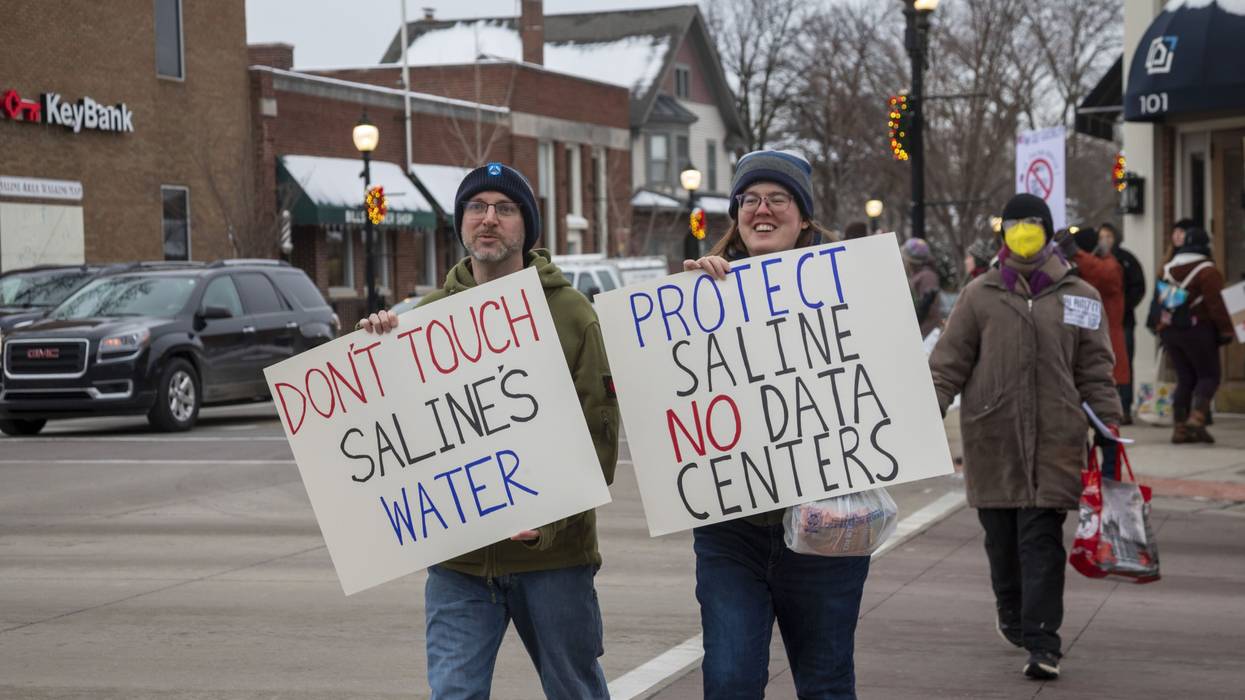
“We’re used to people saying ‘fuck no’ and doing it anyway.” These words were seemingly spoken by our very own Gov. Gretchen Whitmer earlier this month, caught on a hot mic chatting with Oracle executive Clay Magouryk. The two were celebrating breaking ground on the controversial new AI data center in rural Saline, Michigan—currently the largest data center project in the country. Gov. Whitmer is apparently happy to sell Michigan out to military tech giants OpenAI and Oracle.
This is the latest in a series of data center projects being forced into communities that have made their opposition crystal clear. Michiganders are "fighting like hell" because they understand exactly what is at stake; Southwest Michigan residents have already filed a class-action lawsuit for the 24/7 noise nuisance that disrupts daily life and reduces property values.
The development of AI data centers creates harm and destruction. The companies that drive this development, such as OpenAI and Palantir, have contracts with the US military and government agencies like Immigration and Customs Enforcement. Locally, the influx of these data centers provides infrastructure for mass surveillance and diverts municipal resources. Globally, the push for data center expansion demands massive amounts of minerals and fossil fuels from resource-rich countries in the Global South, which are obtained through US military intervention and US-backed militia groups. As such, we as Michiganders must continue to oppose these data center projects.
The harm these data centers inflict ripples across the world. Data center development depends on imported critical conflict minerals and massive amounts of electricity generated by fossil fuels, which contribute directly to US-backed conflicts and war on Venezuela, Iran, and in Congo. Tantalum, tin, tungsten, and gold, referred to as 3TG, are essential, and their extraction is linked to financing armed groups and militias. The struggle for control over mineral-rich areas has led to prolonged violence in Congo, contributing to millions of deaths and leaving entire regions destabilized.
Gov. Whitmer’s hot mic comment confirmed what we already suspected: Our voices and opposition are flat out ignored in favor of destructive corporations.
Detroit is becoming a hub for technology, manufacturing, and the military-industrial complex, where events like the annual Reindustrialize conference bring together defense contractors, surveillance firms, and policymakers to strategize a future built on automated warfare and mass data extraction. Palantir, Lockheed Martin, and Boeing attended, representing key pillars of the US defense and surveillance industry. Palantir’s Project Maven and Where’s Daddy track individuals and automate kill chain recommendations with little human oversight. Lockheed Martin and Boeing produce the missiles, bombs, warcraft, and strike systems that turn algorithmic targeting into genocide.
It’s understandable that some Michiganders might think the development of AI data centers is a good thing, or at least an inevitability. Gov. Whitmer, for one, claims that if Michigan does not lead the charge on these data centers, “they’ll be done elsewhere… with lower wages in a way that abuses the natural resources and jacks up energy prices.” Thus far, this seems to mean that companies that develop these data centers can receive tax breaks and circumvent public input, which sets a disadvantageous precedent.
These data centers, furthermore, are not an inevitability, and they can drastically impact resource usage in their regions. At the Saline data center, even with the closed-loop cooling system to reduce on-site water consumption, water will be consumed indirectly: Increased electricity needs increase the need for water and oil consumption for local power plants. There is also no guarantee that any jobs created will be given to local residents. None of the reported advantages are worth the imperialism needed to supply resources to these data centers, nor the mass surveillance apparatus that comes with them.
Gov. Whitmer’s hot mic comment confirmed what we already suspected: Our voices and opposition are flat out ignored in favor of destructive corporations. Michiganders across the state have stood up and said, "Fuck no" to data centers and more war, yet projects keep moving forward. Residents deserve better than politicians who prioritize tech billionaires and war profiteers over their own people.
"Once again, Democrats have thrown working people under the bus, this time in Michigan," said one critic.
Economic justice advocates excoriated Michigan Gov. Gretchen Whitmer on Friday after the Democrat signed legislation that, while speeding up the state's increase to a $15 hour minimum wage, could leave tipped workers earning less than they would under a system imposed last year by the state Supreme Court, according to critics.
Whitmer signed a pair of bills changing the state's minimum wage, tip credit, and paid sick leave law following an eleventh-hour legislative compromise, explaining in a statement that "Michigan workers deserve fair wages and benefits so they can pay the bills and take care of their family, and small businesses need our support to keep creating good jobs."
Abigail Disney, a member of the group Patriotic Millionaires, said in a statement, "Once again, Democrats have thrown working people under the bus, this time in Michigan under the stewardship of Gov. Gretchen Whitmer."
"In its quest to rebrand itself and win back the working-class vote, Democrats needed to present a unified front in this pivotal moment in Michigan—and anything less than that, which this is, should be taken as an abysmal failure," Disney continued.
"This is the unfortunate but predictable outcome of a party that has proven itself over the years to be for sale to the highest bidder. Voters will definitely notice, and Democrats shouldn't expect them to forgive and forget at the polls in 2026 and beyond," she added.
In 2018, advocates drafted ballot initiatives aimed at expanding paid sick leave and raising the state minimum wage, which was then $9.25 an hour. But Republican state lawmakers moved to block the measures by maliciously adopting and then favorably amending them. Last July, Michigan's Supreme Court ruled this "adopt and amend" tactic unconstitutional and ordered the initial sick leave and minimum wage proposals to take affect at midnight on Friday.
By signing one of the bills, S.B. 8, Whitmer leaves in place a system in which tipped workers' minimum wage will be $4.74 instead of $6 under the court-ordered plan. Customer tips are counted upon to close the gap between the tipped and regular minimum wage of $12.48 per hour. Employers must pay the difference if workers don't reach that amount with tips.
While the Michigan Restaurant and Lodging Association welcomed Whitmer's move, John Driscoll, author of Pay the People! Why Fair Pay Is Good for Business and Great for America, said in a statement that "restaurant lobbyists in Michigan may say that they 'won' this battle in preserving the subminimum wage for tipped workers, but in the end, their efforts will only hurt themselves and their state's economy."
"I know from my own experience as the CEO and chair of businesses that pay people stable and fair wages that doing so is best for workers, businesses, and the broader economy," he continued. "When workers have economic security, they are more loyal and productive, which will help businesses and stimulate growth."
"Contrary to what restaurant associations may claim, everybody lost today when Gov. Whitmer signed S.B. 8 into law," Driscoll added. "Tipped workers lost. Businesses lost. And the Democrats lost too when they sacrificed the most vulnerable workers in Michigan to lobbyists."
The advocacy group One Fair Wage accused the governor of "stripping millions of dollars" from Michigan workers' paychecks.
"Michigan's highest court ruled that these wage increases should take effect," One Fair Wage president Saru Jayaraman said in a statement. "Michigan workers have already earned this raise, and taking it away is not a compromise—it is wage theft. We are mobilizing to ensure voters—not politicians—have the final say on whether these protections remain in place."
One Fair Wage said: "If enough valid signatures are collected, S.B. 8 will be blocked from implementation, and the 2024 Michigan Supreme Court decision requiring that all workers receive a raise to $15 an hour with tips on top will go into effect. The referendum will thus ensure that Michigan voters—not politicians—decide whether these wage increases stand."
One Fair Wage must gather 223,099 valid signatures to suspend S.B. 8 and leave the matter up to Michigan voters.
Meanwhile, the federal tipped minimum wage remains stuck at $2.13 an hour, where it's been since 1991. The federal minimum wage has been $7.25 since 2009.
"The Republican Speaker of the House just told the tens of thousands of construction workers building New York and America's future they want to send them pink slips ASAP," said Senate Majority Leader Chuck Schumer.
On MSNBC Friday night, U.S. Rep. Alexandria Ocasio-Cortez issued an unexpected "thank you" to House Speaker Mike Johnson—expressing appreciation for his admission that the GOP will try to repeal the CHIPS and Science Act, which has created more than 115,000 manufacturing jobs, if the party wins control of Congress and the White House.
"What I would like to thank Speaker Johnson for is his honesty and his forthrightness about what they plan to do with a Republican majority in the House of Representatives," said Ocasio-Cortez (D-N.Y.). "You heard it straight from the horse's mouth and we'll see exactly what happens if we allow a Republican majority in the House and a Donald Trump presidency."
The congresswoman was referring to an interview by Luke Radel, a student journalist at Syracuse University, who asked Johnson (R-La.) about Trump's recent comments that the CHIPS and Science Act is "so bad."
"You voted against it," said Radel. "If you have a Republican majority in Congress and Trump in the White House, will you guys try to repeal that law?"
"I expect that we probably will, but we haven't developed that part of the agenda yet," said Johnson before attempting to pivot to talking about Rep. Brandon Williams, a Republican who represents New York's 22nd District, where a $100 billion Micron Technology chipmaking facility has benefited from the CHIPS and Science Act.
"The Republican Speaker of the House just told the tens of thousands of construction workers building New York and America's future they want to send them pink slips ASAP," said Senate Majority Leader Chuck Schumer (D-N.Y.).
The exchange grew increasingly awkward as Radel asked Williams whether he would vote to repeal the legislation, signed by President Joe Biden in 2022, that Micron has said will create 50,000 semiconductor manufacturing jobs in the Syracuse area.
"No, obviously, the CHIPS Act is hugely impactful here, and my job is to keep lobbying on my side," said Williams. "I will remind [Johnson] night and day how important the CHIPS Act is and that we… break ground on Micron."
Speaking with anchor Chris Hayes on MSNBC, Ocasio-Cortez said the CHIPS Act "is not a remote and faraway thing for workers" in Upstate New York, Michigan, Arizona, and other states where jobs have been created by the legislation.
For thousands of workers, the law represents "the jobs and especially the union jobs that result and are created, that people can actually take and will help them put food on the table without having to work triple or double overtime in order to accomplish that," said Ocasio-Cortez. "People in Buffalo, people in Upstate New York, people in Michigan, they hear about the plant that they work at."
The International Brotherhood of Electrical Workers (IBEW) echoed the congresswoman's sentiment, saying Johnson's plan to repeal the CHIPS Act would impact "tens of thousands of IBEW jobs created by this administration."
"We are NOT going back," said the union.
Johnson's remark got the attention of other politicians whose states have benefited from the law, including Sen. Mark Kelly (D-Ariz.), Rep. Jasmine Crockett (D-Texas), and Michigan Gov. Gretchen Whitmer.
Less than two weeks ago, Whitmer announced that through the CHIPS Act, the Biden administration had provided $325 million in direct funding to Michigan manufacturer Hemlock Semiconductor, allowing it to create over 1,000 good-paying construction jobs to build a new facility as well as 180 permanent manufacturing jobs.
"Mike Johnson's asinine admission that he would repeal the CHIPS Act if Republicans and Trump win the election is a complete disaster for thousands of Michigan workers relying on the jobs that this legislation provides," said the Democratic governor. "Make no mistake, a repeal of the CHIPS Act would kill thousands of good-paying manufacturing jobs right here in Michigan."
Johnson attempted to do damage control, saying he had "misheard the question," but Radel noted that he was standing close to the House speaker when he asked about the CHIPS Act and others commented that the word "repeal" was said clearly. Williams and Johnson also tried to backtrack during their exchange with the student journalist, saying they aimed only to reform the law—but as Radel noted, the former president has made clear he opposes the CHIPS Act.
Vice President Kamala Harris' Democratic presidential campaign said Johnson's threat to repeal the CHIPS Act is the latest of several recent questionable "promises" made by Trump and his surrogates in the last days before the election.
" Mike Johnson wants to lose Arizona, Georgia, Michigan, and North Carolina jobs," said James Singer, a rapid response adviser to Harris, posting an image showing where the CHIPS Act has created semiconductor manufacturing jobs.
Johnson's comments came as Ocasio-Cortez, United Auto Workers president Shawn Fain, Rep. Rashida Tlaib (D-Mich.), and others were rallying Michigan UAW members at a labor-focused get-out-the-vote event in Detroit.
"I do not see elections as an endpoint," Ocasio-Cortez told UAW members at the rally. "They are a waypoint... Because the larger task that we have today is organizing a mass movement of labor in the United States of America. We have a generational task ahead of us, and electing Kamala Harris is an opening silo to the movement that we are about to embark upon."
America’s most dangerous crude oil pipeline threatens the future of the Great Lakes. That’s why young voters want it shut down.
Picture this: shimmery sunlight dancing on water. Deep blue crests over seafoam green before dissipating as waves meet the shore. The Chicago skyline gazes from a distance.
Running along Lake Michigan is one of my favorite pastimes at Northwestern University. We pride ourselves on having not one, but two beaches on campus that showcase the lake. The body of water is so wide it feels more like an ocean. The sound of the waves crashing onto the sand reminds me of the beaches back home in the San Francisco Bay Area.
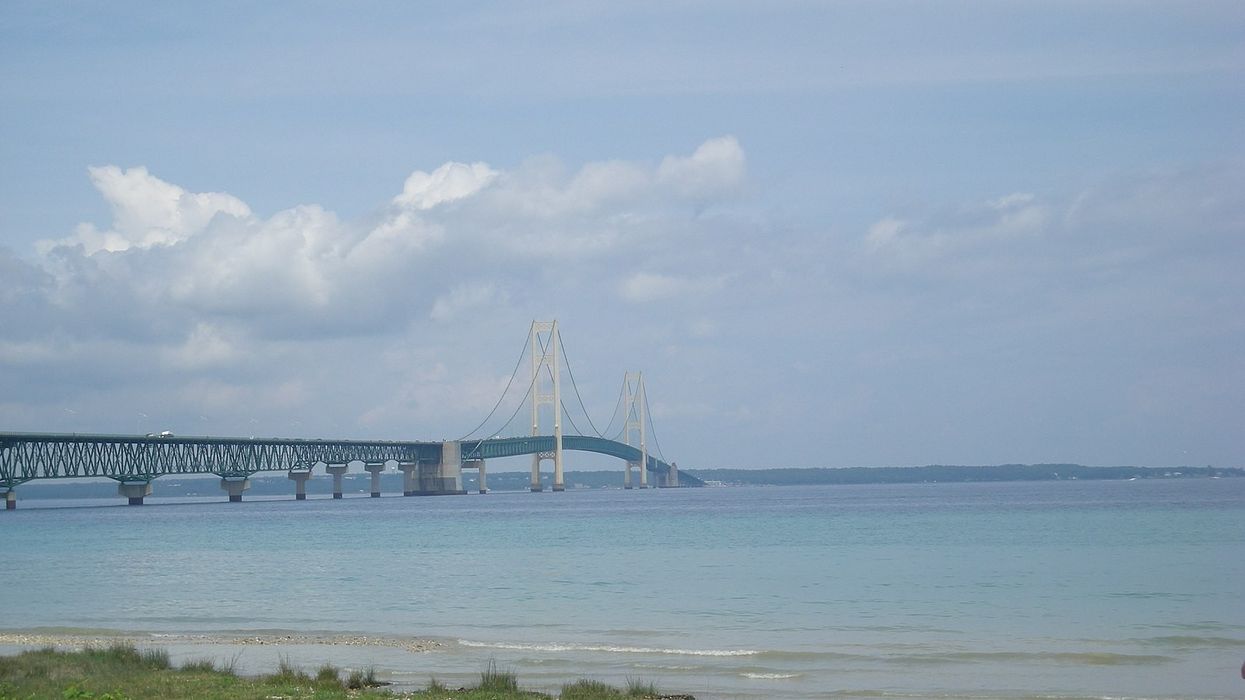
But in the heart of the Great Lakes—where Lake Michigan meets Lake Huron—America’s most dangerous crude oil pipeline threatens 700 miles of coastline and our climate future.
By incorporating pipeline shutdowns in her climate platform, Harris can send a clear message that our future doesn’t rely on fossil fuels and that people can raise their families and thrive in the Great Lakes region.
Growing up in the Bay Area showed me that addressing the climate crisis is my generation’s mission. When I was a junior in high school in 2020, California experienced the worst wildfire in state history. Orange haze blanketed everything. With the air quality index skyrocketing, I did not dare go outside. Friends had to evacuate their homes, and a teacher of mine saw their house burn down. I knew I wanted a career focused on the environment when I realized our wildfires would grow worse every year without action.
Coming here for college, I was excited to explore a new part of the country and catch a break from the wildfire season. People tout the Midwest as a haven from the climate crisis, but environmental issues are aplenty here as well.
As the presidential election date gets closer with states in the Midwest crucial for the Harris-Walz ticket to pick up, looming threats to our Great Lakes should gain wider attention, all because of North America’s most dangerous fossil fuel pipeline. The Great Lakes hold one-fifth of the world’s available fresh water supply, but under it lurks an oil pipeline called Line 5, operated by Canadian oil corporation Enbridge, which could ruin millions of people’s drinking water, mar Lake Michigan’s beauty, and devastate our communities.
Right in the heart of the Great Lakes, the Line 5 oil pipeline is accelerating our climate crisis as we speak. Seventy-one years ago, Enbridge built Line 5 right through Michigan and Wisconsin and in some of the most sensitive areas in the Great Lakes as a shortcut to reach Ontario, Canada. A spill from Line 5 could reach the Lake Michigan shoreline where myself and hundreds of thousands of people live and walk by everyday.
Enbridge has a sordid history when it comes to pipeline infrastructure. They are responsible for one of the largest inland oil spills in United States history from another pipeline they operate in Michigan. They didn’t shut the valve for 17 hours, and remediation efforts took five years. A similar spill from Line 5 would significantly threaten the Great Lakes and the people who call this region home. When burned, the oil in Line 5 contributes more greenhouse gas emissions than the three most polluting coal-fired power plants in the country combined
With a major election this year, young voters across Michigan, Wisconsin, Illinois, and Minnesota will be a crucial voting bloc. For many of us—myself included—it’s going to be our first time voting in a presidential election. Taking action for the environment is at the forefront of my generation’s concerns, which means that delivering a tangible victory to protect our climate and Great Lakes is absolutely necessary. Enbridge’s Line 5 must be shut down and decommissioned. While a Harris-Walz administration can deliver by making this action happen, U.S. President Joe Biden can do so now by revoking this outdated pipeline’s permit.
The Great Lakes aren’t just the source of drinking water for over 40 million people. They’re our identity, creating a major reason why many of us live in the Midwest to begin with. When governments are putting more energy toward keeping fossil fuel pipelines in the Great Lakes than preserving the water we drink from, swim in, and fish from, it gives the impression that our natural resources aren’t worth saving. We cannot afford to be complacent in a time of crisis, and we must do better.
Indigenous Tribes, environmental groups, small businesses, and local residents across the Great Lakes have been fighting Enbridge’s Line 5 for over a decade because of the severe risks it poses to our air, land, water, and health. Enbridge has been operating illegally in Michigan since Gov. Gretchen Whitmer took action to stop the pipeline in 2020. And since 2012, Enbridge has been trespassing on the Bad River Band’s reservation in Wisconsin.
People are taking action against Line 5 by signing petitions, attending rallies in the U.S. and Canada, writing to their legislators, and emailing administration officials like U.S. Secretary of Transportation Pete Buttigieg for a shutdown. Volunteers have organized local businesses, faith communities, and Native Nations to attend teach-ins and community events and share information on Line 5’s dangers.
With Vice President Kamala Harris at the top of the ticket now, shutting down Line 5 should be a key issue in her policy platform. Gov. Whitmer won reelection handily after calling for a shutdown order, which shows that moving away from fossil fuels and decommissioning unsafe pipelines can be a winning electoral issue. Prioritizing a Line 5 shutdown could show that Harris can be one of the most pro-environment presidents in American history—her track record from California and her time in the Senate suggests that she prioritizes environmental policies like this. Shutting down the pipeline can set the stage for a new climate champion government.
A Line 5 shutdown is an achievable, easy win with real advantages. If climate is on the agenda for young voters in key Midwest states, Line 5 should be on the list of the vice president’s campaign priorities. By incorporating pipeline shutdowns in her climate platform, Harris can send a clear message that our future doesn’t rely on fossil fuels and that people can raise their families and thrive in the Great Lakes region. Young voters from the Midwest, like me, are firmly uniting behind one key message: Shut down Line 5.
Michigan Gov. Gretchen Whitmer said the city is "defined by winners willing to get their hands dirty to build up their city and create their communities—something Donald Trump could never understand."
Federal, state, and local leaders in Michigan took issue with former President Donald Trump's latest apparent voter mobilization strategy in the crucial battleground state: insulting its largest city while delivering a campaign speech there on Thursday.
At the Detroit Economic Club, the Republican presidential nominee told business owners that if Democratic Vice President Kamala Harris wins the election, the entire country will "end up being like Detroit."
"The whole country will be like, you want to know the truth? It'll be like Detroit if she's your president. You're gonna have a mess on your hands," he said. "We're not going to let her do that to this country. We're not gonna let it happen."
Trump didn't specify why Detroit residents should recoil at the thought of a country that resembles their city, long recognized as an industrial and cultural center in the Rust Belt. He has previously attacked other large cities, calling Milwaukee "horrible" weeks before the Republican National Convention and saying at Temple University in Philadelphia that the city is "one of the most egregious places anywhere in the world."
The former president has also frequently lambasted Chicago, comparing violence in the nation's third-largest city to that of a war zone.
Critics have accused Trump of singling out cities with large Black and brown communities for his vitriol. More than 77% of Detroit residents are Black.
U.S. Rep. Shri Thanedar (D-Mich.), who represents the city in Congress, implored Trump to "keep Detroit and our people out of your mouth."
"Detroit is a city with a booming economy, diverse culture, and some of the best people in America," he said, adding that the heavily Democratic city "will elect Kamala Harris."
Detroit Mayor Mike Duggan, a Democrat, also responded to Trump's comment, pointing to the success of the city's major sports teams, growing population, and sinking crime rate.
Michigan Gov. Gretchen Whitmer, also a Democrat, suggested the "grit" of Detroit, which has made a significant rebound since becoming the largest city in U.S. history to declare bankruptcy in 2013, is likely unfamiliar to Trump.
Detroit, she said, is "defined by winners willing to get their hands dirty to build up their city and create their communities—something Donald Trump could never understand."
An Emerson College poll out Thursday showed Trump and Harris tied at 49% in Michigan.
"At this point, there is virtually zero chance that CNN, Jake Tapper, and Dana Bash don't know that Rashida Tlaib never said what they are claiming," said one observer.
Calls grew on Monday for CNN and two of its top on-air personalities to apologize for claiming that U.S. Congresswoman Rashida Tlaib made an antisemitic remark during a recent interview after the journalist who interviewed the Michigan Democrat confirmed that the reporters were lying.
During the September 13 interview with Detroit Metro Times reporter Steve Neavling, Tlaib—the only Palestinian American member of Congress—condemned Democratic Michigan Attorney General Dana Nessel for setting a "dangerous precedent" by prosecuting University of Michigan students who peacefully protested against Israel's war on Gaza, for which the key U.S. ally is on trial for genocide at the International Court of Justice. Charges against the Michigan protesters include trespassing on their own campus and obstructing police.
"I'm the reporter who interviewed Rashida Tlaib. She never said Nessel did this because she's Jewish. Never. You're spreading lies."
"We've had the right to dissent, the right to protest," Tlaib said during the interview. "We've done it for climate, the immigrant rights movement, for Black lives, and even around issues of injustice among water shutoffs. But it seems that the attorney general decided if the issue was Palestine, she was going to treat it differently, and that alone speaks volumes about possible biases within the agency she runs."
Nessel, who is Jewish, accused Tlaib of antisemitism in a Friday social media post comparing the congresswoman's comments to a cartoon drawn by Detroit News automotive reporter Henry Payne and published in the right-wing National Review implying Tlaib is a member of Hezbollah, the Lebanese political and paramilitary group.
Enter Jake Tapper, CNN's lead Washington anchor, who critics have long accused of pro-Israel bias. On Monday, Tapper interviewed Michigan Gov. Gretchen Whitmer, asking the Democrat to respond to Tlaib's purported assertion that Nessel is only prosecuting Palestine protesters "because she's Jewish."
"I'm not going to get in the middle of this argument that they're having," Whitmer said. "I can just say this. We do want to make sure that students are safe on our campuses, and we recognize that every person has the right to make their statement about how they feel about an issue, a right to speak out, and I'm going to use every lever of mine to ensure that both are true."
During a live broadcast on Monday, CNN anchor Dana Bash lamented what she called the "sad reality" that "antisemitism is everywhere and it comes from both ends of the political spectrum."
"But politicians sometimes sidestep calling it out when it comes from a member of their own party," she added, referring to "a Democratic congresswoman's accusation that the state's Jewish attorney general was letting her religion influence her job."
There was no such "accusation."
Jonathan Greenblatt, CEO and national director of the Anti-Defamation League—which has come under fire for conflating legitimate criticism of Israel with hatred of Jews—slammed Whitmer,
posting Monday that "saying you want to 'make sure that students are safe on our campuses' is just words if you are not willing to use your bully pulpit to speak out unequivocally on antisemitism and support holding people accountable for violating the law when it affects Jews."
Whitmer then issued a new statement
saying: "The suggestion that Attorney General Nessel would make charging decisions based on her religion as opposed to the rule of law is antisemitic. We must all use our platforms and voices to call out hateful rhetoric and racist tropes."
Neavling accused Whitmer of "adding to the lie."
"I'm the reporter who interviewed Rashida Tlaib," he
said in response to a social media post by Tapper. "She never said Nessel did this because she's Jewish. Never. You're spreading lies."
On Monday,
Detroit Metro Times also published a fact-check by Neavling underscoring that Tlaib never said what Nessel, Tapper, and Bash claim.
"Tlaib never once mentioned Nessel's religion or Judaism. But Metro Times pointed out in the story that Nessel is Jewish, and that appears to be the spark that led to the false claims," Neavling wrote. "It should also be noted that the ACLU of Michigan criticized Nessel for charging peaceful protesters at the University of Michigan."
Margaret Zaknoen DeReus, executive director at the California-based Institute for Middle East Understanding, said Monday that "at this point, there is virtually zero chance that CNN, Jake Tapper, and Dana Bash don't know that Rashida Tlaib never said what they are claiming."
"Why are they doubling down instead of correcting themselves and apologizing?" she asked.
Isaac Bailey, a McClatchy columnist and professor of communications practices at Davidson College in North Carolina, asserted Tuesday that Bash and Tapper "owe Tlaib an apology."
Later on Monday, Tapper said during an interview with Nessel that he "misspoke yesterday" about Tlaib's comments.
Bash followed Tuesday by acknowledging that Tlaib "did not reference Nessel's Jewish identity," but added that Nessel believes the congresswoman's remarks were antisemitic.
Dawud Walid, executive director of the Michigan branch of the Council on American-Islamic Relations, said in a statement Tuesday that "CNN made a misstatement of fact that needs to be retracted if the network is to maintain its journalistic credibility."
"Congresswoman Tlaib should also be offered a public apology for falsely claiming she is antisemitic," Walid added.
As the Jewish Telegraphic Agency noted earlier this year, Bash and Tapper have "both infused their Jewish identity into their reporting."
Tlaib has faced repeated unfounded allegations of antisemitism from both Democrats and Republicans in Congress, especially for calling Israel's war on Gaza a "genocide"—an assessment with which many experts concur—and for using the phrase, "From the river to the sea."
The congresswoman has explained that, to her and to many Palestinians, the phrase—which is also a core component of the original platform of Israeli Prime Minister Benjamin Netanyahu's right-wing Likud party—"is an aspirational call for freedom, human rights, and peaceful coexistence, not death, destruction, or hate."
Last November, Tlaib's House colleagues voted 234-188, with 22 Democrats joining almost all Republicans present, in approving a resolution to censure the congresswoman over her defense of Palestine and criticism of Israel's annihilation of Gaza, which has now left more than 147,000 Palestinians dead, maimed, or missing.
On Tuesday, 21 House Democrats led by Reps. Debbie Wasserman Schultz (D-Fla.) and Haley Stevens (D-Mich.) published a statement contending that "casting doubt on Attorney General Nessel's impartiality or implying these cases are being handled unfairly due to her religious background is antisemitic, deeply disturbing, and unacceptable."
The dead in Gaza include at least 100 journalists, the vast majority of whom are Palestinian.
In May, the Paris-based press freedom group Reporters Without Borders (RSF) filed a third complaint at the International Criminal Court alleging "war crimes against journalists in Gaza."
RSF said it had "reasonable grounds for thinking that some of these journalists were deliberately killed and that the others were the victims of deliberate IDF attacks against civilians" and accused Israel of "an eradication of the Palestinian media."
There has been little reporting on the subject by the U.S. corporate media, even as American journalists are killed or wounded in what journalistic investigations have concluded are deliberate targetings by Israeli forces.
The reminder that there’s no automatic connection between a D next to your name and some courage on climate comes from many spots around the country, including in the deep blue Northeast.
Much of my past month has been spent Kamaling—I don’t know if I hold the record, but along with helping organize and MC the Elders for Kamala call, I’ve made cameos on Climate Leaders for, Oudoor and Conservation Leaders for, Christians for, and Vermonters for. I’m for. U.S. Vice President Kamala Harris and Minnesota Gov. Tim Walz have run a sparkling campaign so far, and this week’s convention in Chicago is a reminder that Democrats look and sound like America at its best. As opposed to the monochrome and bitter gathering that nominated former President Donald Trump (“Mass Deportations Now”), it’s been one long Party party. (When Patti LaBelle kicked off Tuesday night’s proceedings, the musician gap with the GOP grew unbridgeably wide).
Which is not to say that Harris will be a sterling climate president—we’ll have to wait and see, because we had no primary to press her on it. I don’t like long campaigns any more than anyone else, but in our system they are the only place activists can actually make a forceful case—that’s how climate became a real presidential issue for the first time in the 2020 race, which led quite directly to the Inflation Reduction Act. (And now, instead of a second-term Democrat freed to act with relative abandon, we’ll have a first-termer constrained by thoughts of her re-elect). So we’ll doubtless have to push her, once we’ve helped push her into the White House.
The reminder that there’s no automatic connection between a D next to your name and some courage on climate comes from many spots around the country, including even some where lots of good work has been done. Michigan Gov. Gretchen Whitmer and Coach Walz have gotten high high marks—converting narrow legislative margins into big action packages.
But places where it should be easier—in the deep blue, not the purple— haven’t gone as well. Gov. Gavin Newsom’s California has accomplished a lot with the move to solar power, as I’ve been writing about all spring—but he also has gutted both rooftop solar and community solar this spring. According to the Solar Rights Alliance, 22% of all solar jobs in the state have disappeared. That’s just stupid policy: Rooftop solar, among other things, has dramatically decreased the amount of electricity the grid needs to provide, which may be why the utilities hate it. (Texas Republicans, meanwhile, have made one attempt after another to gut renewables, but they may have waited too long—there’s enough money behind wind and sun now to defeat such efforts, and the state’s renewables, and just as importantly its battery fleet, are now growing like topsy.)
The closer we move to actual implementation of the big climate promises that politicians made during the Greta years, the more of this kind of backsliding we’re going to see.
And on the other side of the country, in the deep blue Northeast?
New York could and should be a renewable powerhouse. It lacks a Mojave Desert, but Long Island Sound could be the Qatar of offshore wind—the DOE estimates it could power 11 million homes, which is 4 million more homes than New York contains. With NYSERDA, the New York State Energy Research and Development Authority, it has some of the finest energy conservation minds in the country. And it has an environmentally minded populace—everyone thinks about New York City as a liberal bastion, but it was upstaters who banded together to force a ban on fracking.
And yet the state is lagging badly, in no small part thanks to Gov. Kathy Hochul. The Buffalo-area pol, who ascended more or less accidentally to her job when Andrew Cuomo couldn’t stop grabbing the women who worked for him, got perhaps her biggest moment of infamy earlier this year when, out of nowhere, she shifted 180° her position on congestion pricing in lower Manhattan and nixed the program—weeks after she’d given a long speech extolling it, and past the point where the city and state had spent hundreds of millions of dollars buying the cameras to make it work.
But that’s not her only anti-climate act. She’s also sat on her hands for months now after the state legislature passed the Climate Superfund act, which would send the bill for climate disasters to the oil companies that caused them. (You can sign a petition for the Superfund here). And now she’s “pondering” a “relaxation” of the state’s basic climate law, which promises to use renewables for 70% of the state’s power by 2030. According to Inside Climate News, she told reporters recently that “the goals are still worthy. But we have to think about the collateral damage of these decisions. Either mitigate them or rethink them.”
Why? Well, because she’s hearing from groups like
the Business Council of New York State ... They want to go beyond pushing back CLCPA deadlines. They hope to rewrite the law itself, targeting mandates to electrify buildings, passenger vehicles, and school buses.
“We are now at a point where implementation challenges call for a reassessment of the underlying statutory mandates,” the Business Council said July 30 while releasing a letter to Hochul signed by 60 business, fossil fuel, labor, farming, and small business groups.
This is the kind of utterly predictable pushback that confident legislators simply manage with a few well-chosen words, even as they push forward. (See, Joe Biden). But Hochul shows no sign of that kind of confidence. NYRenews, the group that has helped push much of the New York legislation, released a report yesterday showing that under Hochul’s leadership, the state’s four key implementation agencies are sitting on their hands.
Only a handful of agencies have issued specific guidance or regulations to support compliance efforts. Notably, it appears that the state’s largest and most powerful agencies have entirely failed to comply with the Climate Act and have not yet issued policies or guidance on implementation of the law.
For example:
• The New York State Department of Transportation (“NYSDOT”) has pushed forward at least 40 highway expansion projects without properly assessing their impacts on DACs and the climate;
• Empire State Development (“ESD”) has awarded at least $780 million in clean energy funding without ensuring that 40% of the benefits go to DACs;
• The New York Education Department (“NYSED”) has approved at least 25,971 construction projects at public schools across the state without properly assessing their climate and DAC impacts; and
• The New York State Department of Health (“NYSDOH”) has approved at least 223 construction projects for new and renovated healthcare facilities without assessing or mitigating their climate impacts.
This is where leadership makes a difference, one way or the other. You need some nerve—(something like, though in reverse, the chutzpah of the New York Republican legislator who last week penned an op-ed explaining that this summer’s violent storms were a reason to postpone climate action). Hochul, casting New York’s votes at the convention Tuesday night, cited the Empire State as the birthplace of the women’s rights and gay rights movement. If she were smart she’d listen to impassioned voices from the climate movement, who also know something about reality: Listen to Bob Howarth, the world-leading methane scientist who also sits on the board charged with implementing the new law.
“I am appalled at this pushback against the CLCPA by business interests pushing their short-sighted agenda,” Howarth told WaterFront. “Climate change is very real. The consequences of climate disruption (floods, droughts, fires, crop failures) are becoming increasing obvious to all.”
“The political leaders of NY understood these dangers when they drafted the CLCPA and its predecessor beginning in 2015…. Due to political delay, we may miss CLCPA targets by a few years. But the needed trajectory remains clear.”
Howarth sits on the state’s Climate Action Council, which passed a plan to implement CLCPA in December 2022 (by a vote of 19-3). The council had determined that “it was entirely possible and reasonable to meet the CLCPA goals and targets… that would benefit individual homeowners,” Howarth said.
Furthermore, the successful implementation of CLCPA would set an example to the world by showing “that a globally important economy could thrive while addressing the climate crisis and moving away from fossil fuels,” he added.
But the council hasn’t met for many months. “The state simply has not seen adequate political leadership to move ahead with the CLCPA goals and the council’s plan,” he said.
Something similar is happening in New York City where Mayor Eric Adams, in between dealing with corruption investigations, has done his best to weaken the city’s landmark Law 97. As Pete Sikora of New York Communities for Change explained to me, he’s pushed back the implementation date for the statute, which mandates efficiency improvements in big buildings. (Not surprisingly, he’s taken lots of campaign money from real estate interests).
The two year delay he's created will cost thousands of jobs and raise pollution yearly by a few hundred thousand tons per year as landlords put off energy efficiency projects (more worrying: it's a signal he'll further weaken the law if reelected and the major pollution limit starts in 2030).
But Adams—well, he’s also attempting to turn one of the city’s neighborhood landmarks, the Elizabeth Street Garden, into a housing complex. The city needs housing, which is why the garden’s friends have come up with all kinds of alternate sites in the same neighborhood, but so far he hasn’t yielded, even thought even Murdoch’s New York Post has made it clear what a bad idea the development is. Now, the Times reports, there’s been a huge letter-writing campaign from local public school students.
For the 575 or so students who attend P.S. 130, Elizabeth Street Garden serves as an extension of the classroom. The elementary school lacks green space, but it is only a 10-minute walk from the garden, allowing for frequent visits and class trips. So the garden has become a de facto playground and nature center where the children can plant seeds, learn about nature, and have Easter egg hunts.
“Tree’s also provide homes for animals like birds, squirrels, and raccoons. This is why we should save the garden!” wrote one student.
Another explained, “The garden adds color and brightness to the city.”
Many were concerned about their favorite play space disappearing: “One reason why we should keep the garden is because with all the trees, we can play hide and seek and eat lunch.”
One reason that pols like Hochul and Adams can get away with moves like this is that there’s very little coverage—the Elizabeth Street garden is the exception that proves the rule. Indeed, the Times announced last week that it would no longer endorse candidates for local office, which is odd since those were probably the only endorsements the paper made that actually moved voters. Albany, meanwhile, exists in a news vacuum—the number of voters who know that Hochul is emerging as a northern DeSantis on climate issues is minuscule.
The closer we move to actual implementation of the big climate promises that politicians made during the Greta years, the more of this kind of backsliding we’re going to see. Consider, just as a random example, Connecticut, where utility regulators have introduced an excellent system of performance-based regulation for power providers, moving away from the old system which basically just takes a utility’s costs and adds a chunk of profit on top. The Nutmeg State’s two big utilities have fought it from the start, and now they’re moving to have the regulator who introduced it, Marissa Gillett, fired. The state’s governor, Ned Lamont, said when the law was introduced that “you just don’t get paid an automatic 9% whether you do good work or bad work. You get paid for doing good work.” Now we’ll see if he has the courage to keep her at her job. Or Massachusetts, where the legislature adjourned without taking up the crucial enabling legislation for the state’s climate law—there’s some talk that governor (and climate hawk) Maura Healey might call them back for a special session, but more likely it will drag on for another year. Delay is the new denial.
Or take Delaware—the state needs to develop its offshore wind resources to meet climate goals. Indeed, given its relatively small population, it could become a linchpin for the entire Atlantic seaboard. But though polling shows strong support across the region, well-financed opponents have successfully made it appear that grassroots opposition is growing, particularly in coastal communities. I’ve watched it happen in Cape Cod, where activists are trying to block the cable necessary to bring power onshore from turbines, and in Maine where other activists want to block the construction of the terminal to support the offshore farms. There are always arguments—perfect enemy of the good—but none of them make much sense in a world where August looks like it will be even hotter than last year’s all-time record. It’s why, when real champions emerge—say, former National Wildlife Federation CEO Collin O’Mara, running in the Democratic primary for Delaware governor—change gets so much easier.
The default is always to the status quo. For Republicans that means fossil fuel uber alles. For Democrats, too often, it means “don’t ruffle more feathers than you have to.” That’s why we always have to make sure that there are plenty of climate hawks with plenty of feathers.
Correction: An earlier version of this op-ed mistakenly identified Gretchen Whitmer as the governor of Wisconsin. She is the governor of Michigan.
"If Kamala Harris wants the nomination, and wants it to be worth anything, she has to at least show that she fought for it and won it cleanly," argued one commentator.
Vice President Kamala Harris quickly racked up endorsements from major Democratic figures—including President Joe Biden—and received the backing of deep-pocketed party donors on Sunday after the incumbent exited the 2024 contest in the face of insurmountable pressure.
But while much of the party coalesced around the vice president and argued she's the obvious choice to take on Republican nominee Donald Trump in November, some Democrats and commentators made the case for a competitive nominating process, contending that it would strengthen the eventual candidate and avoid the appearance of an undemocratic "coronation."
Former President Barack Obama was the most prominent Democrat to hint at support for something resembling an open convention, saying in a statement that he has "extraordinary confidence that the leaders of our party will be able to create a process from which an outstanding nominee emerges."
Prior to Biden's exit, dozens of former Democratic lawmakers endorsed an open convention, writing in an open letter that the process would "energize the party and capture the imagination and interest of voters—especially younger and marginalized voters—who have been uninspired by the choices so far."
"I am for an open convention—huge media coverage leading up and during—knock the Trump campaign off kilter and off the air!" former Rep. Peter DeFazio (D-Ore.), one of the letter's signatories, wrote in a social media post on Sunday.
Opponents of an open convention, meanwhile, argued such a process would be chaotic, divisive, and inherently damaging to the party's prospects.
"Democrats have a choice to make: unite and win, or fight each other and lose," said Birmingham, Alabama Mayor Randall Woodfin.
Rep. Alexandria Ocasio-Cortez (D-N.Y.) and other progressives in Congress also made the case for rallying behind Harris rather than leaving the door open to potential Democratic challengers and requiring Harris to win the nomination at the party's convention in Chicago next month.
" Kamala Harris will be the next president of the United States. I pledge my full support to ensure her victory in November," Ocasio-Cortez wrote on social media. "Now more than ever, it is crucial that our party and country swiftly unite to defeat Donald Trump and the threat to American democracy. Let's get to work."
It's unclear whether any viable challenger would emerge should Democrats opt for an open convention, but Harris herself said after Biden dropped his reelection bid that her "intention is to earn and win this nomination."
Sen. Joe Manchin of West Virginia is reportedly considering re-registering as a Democrat to compete for the nomination—a bid that would be doomed to fail given that he's reviled by the Democratic Party's progressive wing and much of the establishment for obstructing significant elements of Biden's legislative agenda.
(Update: Manchin told CBS News Monday morning that he is "not going to be a candidate for president.")
NOTUS reported Sunday that "a small group of Democratic leaders are seen as having the credibility and resources to challenge for the nomination," including Pennsylvania Gov. Josh Shapiro, Michigan Gov. Gretchen Whitmer, and California Gov. Gavin Newsom. Shapiro and Newsom both endorsed Harris on Sunday, and Whitmer backed the vice president on Monday.
According to The New York Times, some Democrats privately "argued that a more competitive process would benefit Ms. Harris because it could dispel doubts about her political skills." Notably, Senate Majority Leader Chuck Schumer (D-N.Y.), House Minority Leader Hakeem Jeffries (D-N.Y.), and former House Speaker Nancy Pelosi (D-Calif.) were not among the Democratic lawmakers who endorsed Harris on Sunday.
Drop Site's Ryan Grim observed Sunday that "the conventional wisdom is that an open convention is simply never going to happen, and if it does it will be a disaster for Democrats—weeks of infighting and chaos that'll drag the party down."
"But that argument is merely a mix of assumption and assertion," Grim wrote. "With a little imagination, that chaos could be turned toward the party's advantage at a time when it's desperately needed. The argument for coronating Kamala Harris doesn't consider how it would look for a party that is in the grip of a legitimacy crisis—Democratic elites were the last in the country to acknowledge Biden's frailty—to foist a new nominee on the public."
"If Kamala Harris wants the nomination, and wants it to be worth anything, she has to at least show that she fought for it and won it cleanly," he added. "And the only way to do that is at an open convention."
The Democratic National Committee's (DNC) rules panel is set to meet this week to "implement a framework to select a new nominee," as The Wall Street Journal reported. The panel's co-chairs, according to the Journal, vowed the process would be "comprehensive, fair, and expeditious."
Before Biden's exit, the DNC was planning to hold a virtual roll call vote early next month to cement the incumbent president as the Democratic nominee weeks before the party's convention in Chicago.
It's unclear whether the DNC plans to move ahead with a virtual vote.
"While an open convention would undoubtedly be entertaining to watch, I doubt we'll see that," said Dan Tokaji, an election law expert at the University of Wisconsin Law School. "It's possible that delegates will vote to nominate Harris before the convention even begins."
Biden stepping down and being replaced by a dynamic, younger candidate might be risky at this point. But it’s not as risky as a visibly enfeebled Biden staying in the race.
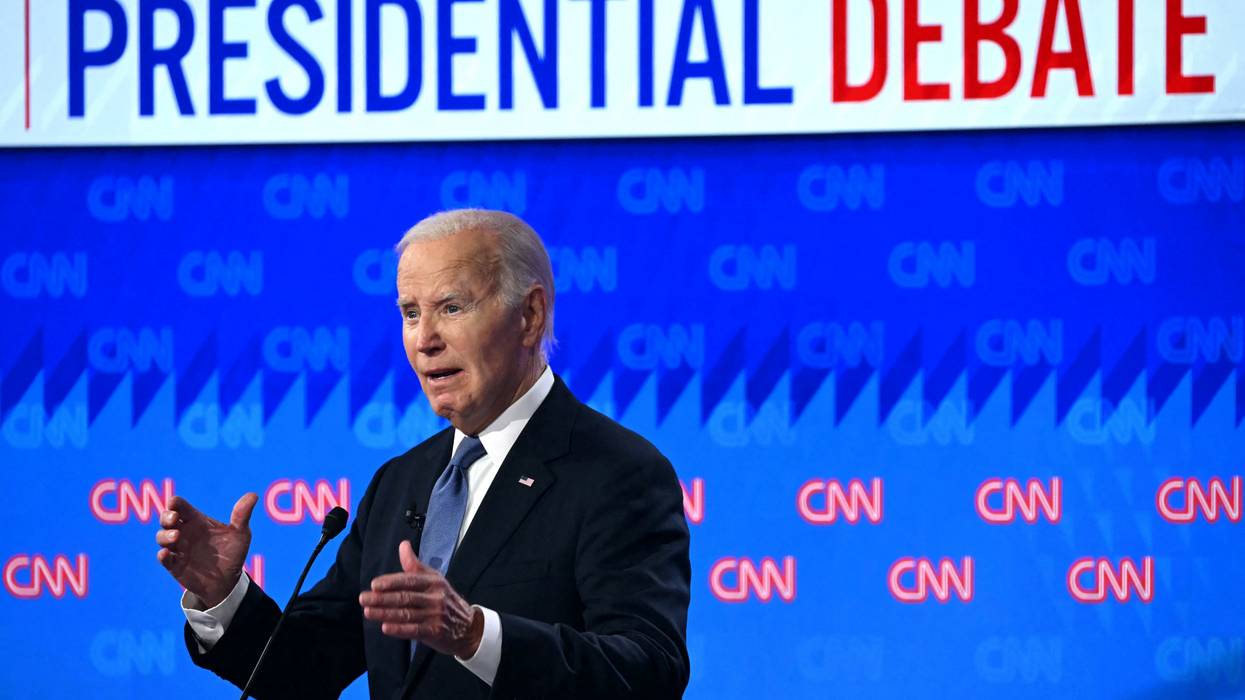
Since last week’s debate, plenty of smart people have argued that U.S. President Joe Biden must be replaced if former President Donald Trump is to be defeated and democracy protected. Among them are The New York Times editorial board, James Carville, David Remnick, former Obama speechwriter Jon Favreau, Biden friend Tom Friedman, pollster Nate Silver, and too many more to name. Meanwhile, a post-debate CBS News/YouGov poll shows that 72% of registered voters think Biden does not have the “mental & cognitive health to serve as president,” while only 27% think he does; 63% think Biden should not be running for president while only 37% think he should be.
Despite that, Biden’s inner circle and leading Democratic officials have been pushing back with their own version of a “big lie” that we shouldn’t believe what we saw with our own eyes, Biden just had one bad night, and he’ll be just fine. But as Times columnist Bret Stephens wrote: “The transparent problem with the president’s performance wasn’t that he debated poorly. It’s that he is suffering from serious cognitive decline, something from which there is no coming back… To those who love the president, starting with his wife, it’s time to tell him: for God’s sake, and the country’s, and his own—don’t run.”
So, if Biden is to be replaced as the Democratic nominee, how would it work legally?
If President Biden withdrew, and one or more prominent younger Democrats threw their hat in the ring, the party would undoubtedly hold a series of debates and town halls to introduce them to national voters and see who performs best under the national spotlight.
There are approximately 3,933 regular convention delegates elected in primaries and caucuses, almost all of whom are Biden delegates. In addition there are 739 “automatic” or “superdelegates” who are mostly party functionaries and elected officials for a total of approximately 4,672 delegates. The regular delegates may vote on the first ballot, and to win nomination on the first ballot a candidate must garner a majority of these or about 1,968 delegates. According to rule changes adopted after the 2016 Hillary Clinton/Bernie Sanders contest, superdelegates may not vote on the first ballot. They can only vote in the second and subsequent ballots, if no candidate wins on the first ballot. It would then take a majority of all delegates, including regular and superdelegates, or approximately 2,258 votes to win the nomination.
While regular delegates normally vote for the candidate they are “pledged” to, according to rules adopted after the 1980 primary contest between Jimmy Carter and Ted Kennedy, regular delegates are not technically required to vote for the candidate whom they are pledged to.
According to the convention rules, regular delegates being required to vote for the candidate they are pledged to is aspirational, not binding. The rules state that “all delegates to the National Convention pledged to a presidential candidate shall in good conscience reflect the sentiments of those who elected them.” Thus, if in “good conscience” one or more regular delegate no longer believes her candidate reflects the sentiments of those who elected her, she has the right under the rules to vote for another candidate whom she believes in good conscience does—it’s apparently up to each delegate to make that call. Thus, at least in theory, even if Biden stays in the race, if there’s a big enough groundswell to replace him, he could fail to win the nomination on the first ballot.
In reality, if Biden stays in the race, that result is highly unlikely. The regular delegates are picked in the first place because they are generally loyalists of the candidate they’re nominated to support. And prominent Democrats who might be viable alternatives to Biden are probably too scared of threats to their careers from the Democratic establishment to directly challenge Biden at this point.
If, however, Biden withdraws his candidacy before the convention, it becomes an open convention. As Elaine Kamarck of the Brookings Institution, who helped write the party rules, states: “About 4,000 people have already been elected to the convention. If Biden stepped aside tomorrow, several people would get into the race, no doubt, and the race would consist of calling these people and trying to convince them. It would be an old-fashioned convention. All 4,000 delegates pledged to Biden would suddenly be uncommitted, and you’d have a miniature campaign.”
Among the possible alternatives to Biden are Michigan Gov. Gretchen Whitmer, California Gov. Gavin Newsom, Kentucky Gov. Andy Beshear, Illinois Gov. J.B. Pritzker, Maryland Gov. Wes Moore, Pennsylvania Gov. Josh Shapiro, and Vice President Kamala Harris. If President Biden withdrew, and one or more prominent younger Democrats threw their hat in the ring, the party would undoubtedly hold a series of debates and town halls to introduce them to national voters and see who performs best under the national spotlight. None of these potential candidates significantly differ from each other or President Biden on the main issues, so the campaign for a successor would likely turn on personality and which one seems the most electable.
If an alternative to Biden is nominated, there’s then the question of what happens to the campaign funds raised to date by Biden. According to an email from Trevor Potter of the Campaign Legal Center, if a candidate withdraws, then the candidate’s campaign committee may transfer the funds to the national party that may spend them on the new nominee. If Vice President Harris were the new nominee, since Biden and Harris currently share a campaign committee, she would have access to all the funds in the committee. However, Biden’s campaign committee would not transfer more than a de minimis part of the funds to another candidate’s campaign committee. Another candidate would need to rely on the funds transferred to the National Committee, raise new funds, or refund the money to the original donors who could then contribute to the new candidate.
Biden stepping down and being replaced by a dynamic, younger candidate might be risky at this point. But it’s not as risky as a visibly enfeebled Biden staying in the race when over 70% of registered voters say they don’t think he has the mental and cognitive ability to serve. If an ageing relative no longer has the capacity to drive safely and might crash his car into a school bus killing dozens of children, you take away his keys.
Indeed, with so many voters dreading a Biden-Trump rematch, an exciting new candidate might well inspire a wave of enthusiasm.
"Use our democratic process to speak up about your core values, where you want to see our country go," said Rep. Rashida Tlaib, the only Palestinian American in Congress.
The Listen to Michigan campaign made its final appeals as the swing state's Democrats headed to polling stations for the primary on Tuesday, urging them to vote "uncommitted" to pressure President Joe Biden into supporting an immediate and permanent cease-fire in Israel's U.S.-backed war on the Gaza Strip.
Since launching just three weeks ago, Listen to Michigan has picked up support from key figures across the state and beyond, from Our Revolution and Dearborn Mayor Abdullah Hammoud to former U.S. Rep. Andy Levin (D-Mich.) and current Rep. Rashida Tlaib (D-Mich.), the only Palestinian American in Congress.
Tlaib—whose sister, Dearborn community organizer Layla Elabed, is leading Listen to Michigan—shared a video circulated by the campaign on social media after she cast her vote.
"We must protect our democracy. We must make sure that our government is about us, about the people, when 74% of Democrats in Michigan support a cease-fire, yet President Biden is not hearing us," Tlaib said. "This is the way we can use our democracy to say, listen. Listen to Michigan, listen to the families right now that have been directly impacted, but also listen to the majority of Americans who are saying enough. No more wars, no more using our dollars to fund a genocide, no more."
"So please, take your family members," she urged Michigan residents, noting that she was joined at the polls by her 18-year-old son. "Use our democratic process to speak up about your core values, where you want to see our country go."
Elabed said in a statement that "with an ambitious yet critical goal of garnering 10,000 'uncommitted' votes, we aim to demonstrate that a significant voting bloc within Michigan is uncommitted to President Biden's reelection efforts."
The campaign leader pointed out that 10,000 votes is about the same margin that former President Donald Trump—the likely Republican nominee for this cycle—had over Hillary Clinton, the Democratic candidate, in the state in 2016.
"Voting uncommitted isn't just symbolic; it represents the electoral margins that could determine President Biden's electoral fate in November 2024," Elabed stressed. "The path to the White House runs through Michigan and Michigan runs through Dearborn and Detroit. Michigan Democrats and our diverse, multifaith coalition have already made our demands for cease-fire and ending funding for war and occupation clear."
Asked about the effort during a televised NBC News interview on Monday, Democratic Michigan Gov. Gretchen Whitmer, who is serving as a co-chair for Biden's reelection campaign, said, "I think there will be a sizable number of votes for uncommitted," and 10,000 is "possible."
While acknowledging the right of voters to make their voices heard and that "there's a lot of pain" in Michigan's Arab, Palestinian, Muslim, and Jewish communities, she also urged voters to support Biden at the polls, warning that "anything other than that makes it more likely we see a second Trump term."
That tracks with messaging guidance that the Biden campaign issued ahead of the primary, according to Politico. One unnamed elected official said: "The Biden campaign wants me to tell you that any vote not for Biden is a vote for Donald Trump... I'm not gonna go that hard... I mean, they're like, 'Donald Trump never killed us, Joe Biden killed our families.'"
Since the Hamas-led October 7 attack on Israel, Israeli forces have killed around 30,000 Palestinians in Gaza, displaced most of the enclave's 2.3 million residents, and devastated civilian infrastructure—provoking widespread allegations of genocide that are currently before the International Court of Justice.
While negotiating for a temporary pause in fighting and exchange of prisoners and hostages, the Biden administration has also blocked and opposed United Nations cease-fire resolutions, bypassed Congress to arm Israeli forces, and sought more than $14 billion on top of the nearly $4 billion that Israel gets in annual military aid from the U.S.
As The New York Times reported Tuesday:
The White House did dispatch a high-ranking team to meet in private this month with Arab American officials in Dearborn, at which a senior foreign policy aide acknowledged "missteps" on the administration's foreign policy and public messaging about the conflict in Gaza.
Other would-be Biden surrogates were asked to travel to Michigan and declined because they did not want to engage with Gaza protesters, according to people familiar with the negotiations. The Biden campaign declined to comment for this article.
The newspaper also noted that "for some context, there were about 20,000 votes for 'uncommitted' in each of the last two Democratic presidential primaries in Michigan that featured robust and competitive fields."
Elabed pointed out that "uncommitted voters in Dearborn have already reported being given independent ballots instead of Democratic Party ballots from poll workers when saying: 'We want to vote uncommitted.'"
"This confusion could likely dampen turnout," the Listen to Michigan leader warned. "We're watching closely."