

SUBSCRIBE TO OUR FREE NEWSLETTER
Daily news & progressive opinion—funded by the people, not the corporations—delivered straight to your inbox.
5
#000000
#FFFFFF
To donate by check, phone, or other method, see our More Ways to Give page.
Daily news & progressive opinion—funded by the people, not the corporations—delivered straight to your inbox.
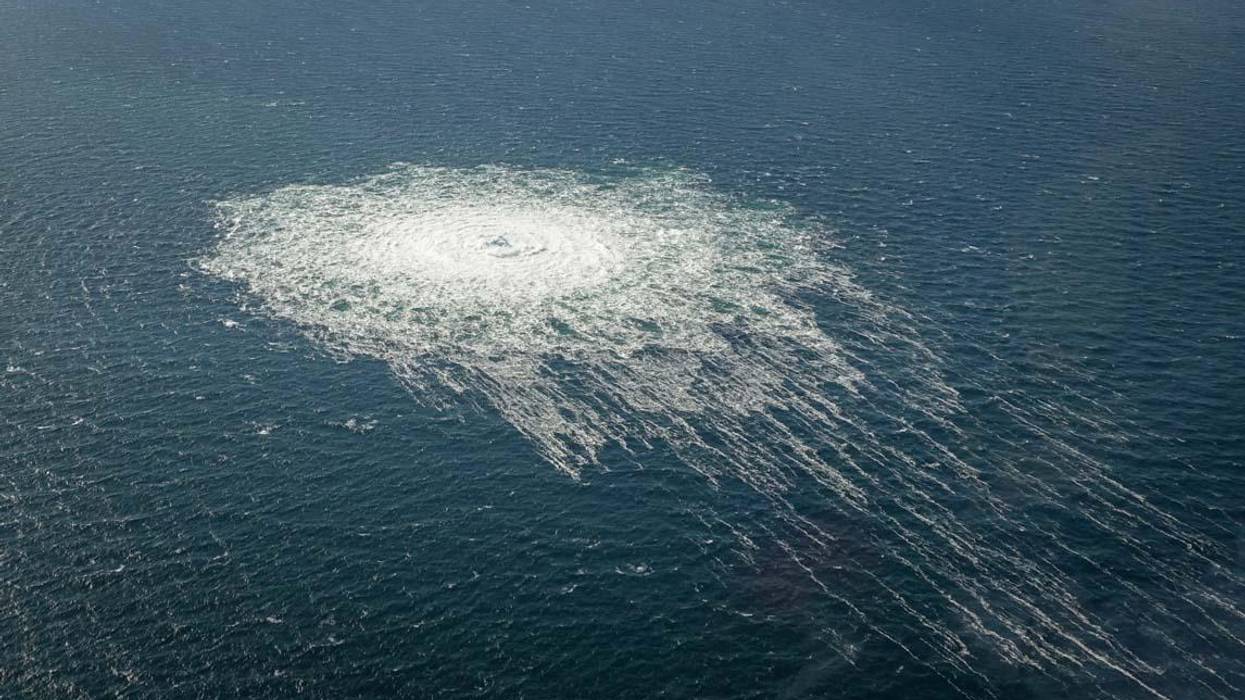
The country is the second U.S. ally in the past month to end an investigation into the pipeline explosions.
Denmark became the latest country to close its investigation into the underwater explosions that caused leaks in two pipelines that were built to carry gas from Russia to Germany, with authorities saying they had found that "there was deliberate sabotage" of the infrastructure but would not go further in their probe to confirm who was behind the blasts.
"The assessment is that there are not sufficient grounds to pursue a criminal case," said the Danish police, prompting criticism from Russian officials and other critics.
Since the gas leaks were discovered in September 2022, seven months after Russia invaded Ukraine, various observers have accused the two countries as well as the United States of being at fault.
The leaks—which experts said led to the single largest release of methane gas due to human activity—were discovered beneath the Baltic Sea, off the coast of the Danish island of Bornholm. Seismic institutes found that two explosions had occurred underwater just before the leaks were recorded.
Russian energy giant Gazprom owns a majority stake in the pipelines, with German, Dutch, and French companies also owning interests. Weeks before the leaks were discovered, Russia had intensified tensions in Europe by cutting gas supplies in suspected retaliation for sanctions against Moscow.
The U.S. was a longtime critic of the Nord Stream pipelines, arguing they would increase European dependence on Russia for energy.
Just before Russia invaded Ukraine in February 2022, U.S. President Joe Biden said in a joint news conference with German Chancellor Olaf Scholz that a Russia offensive would push the U.S. to "bring an end to" the Nord Stream 2 pipeline.
But the U.S. has denied involvement in the explosions, saying in February 2023 that one report alleging U.S. sabotage published by veteran journalist Seymour Hersh was "false and complete fiction."
Hersh reported, based on a single anonymous source who had "direct knowledge of the operational planning," that Biden had authorized U.S. Navy divers to plant remotely triggered explosives that destroyed the Nord Stream pipelines, enlisting the help of the Norwegian Navy and secret service.
In March 2023, weeks after Hersh's report was released, the U.S. and several Western allies opposed a United Nations Security Council resolution that aimed to launch an international probe into the Nord Stream explosions.
Earlier this month, Sweden concluded its own investigation, saying the case did not fall under its jurisdiction and noting that they had given "material that can be used as evidence" to German authorities for their probe. Swedish prosecutor Mats Ljungqvist said that the "primary assumption is that a state is behind it."
The German federal prosecutor's investigation is ongoing.
Journalist Thomas Fazi suggested U.S. allies have dropped their probes because they are "terrified of actually finding the culprit."
The question of who caused the Nord Stream gas leaks, said author Tony Norfield, "has troubled Swedish and Danish investigators so much, they have closed their inquiries. Just in case they uncover something embarrassing."

If only the CIA’s rogue operations had been consigned to history as a result of the crimes exposed by the Church Committee, or at the least had brought the CIA under the rule of law and public accountability. But that was not to be.
There are three basic problems with the CIA: its objectives, methods, and unaccountability. Its operational objectives are whatever the CIA or the President of the United States defines to be in the U.S. interest at a given time, irrespective of international law or U.S. law. Its methods are secretive and duplicitous. Its unaccountability means that the CIA and president run foreign policy without any public scrutiny. Congress is a doormat, a sideshow.
As a recent CIA Director, Mike Pompeo, said of his time at the CIA: "I was the CIA director. We lied, we cheated, we stole. We had entire training courses. It reminds you of the glory of the American experiment."
The CIA was established in 1947 as the successor to the Office of Strategic Services (OSS). The OSS had performed two distinct roles in World War II, intelligence and subversion. The CIA took over both roles. On the one hand, the CIA was to provide intelligence to the US Government. On the other, the CIA was to subvert the “enemy,” that is, whomever the president or CIA defined as the enemy, using a wide range of measures: assassinations, coups, staged unrest, arming of insurgents, and other means.
It is the latter role that has proved devastating to global stability and the U.S. rule of law. It is a role that the CIA continues to pursue today. In effect, the CIA is a secret army of the U.S., capable of creating mayhem across the world with no accountability whatsoever.
When President Dwight Eisenhower decided that Africa’s rising political star, democratically elected Patrice Lumumba of Zaire (now the Democratic Republic of Congo), was the “enemy,” the CIA conspired in his 1961 assassination, thus undermining the democratic hopes for Africa. He would hardly be the last African president brought down by the CIA.
The extent of the continuing mayhem resulting from CIA operations gone awry is astounding.
In its 77-year history, the CIA has been held to serious public account just once, in 1975. In that year, Idaho Senator Frank Church led a Senate investigation that exposed the CIA’s shocking rampage of assassinations, coups, destabilization, surveillance, and Mengele-style torture and medical “experiments.”
The expose by the Church Committee of the CIA’s shocking malfeasance has recently been chronicled in a superb book by the investigative reporter James Risen, The Last Honest Man: The CIA, the FBI, the Mafia, and the Kennedys―and One Senator's Fight to Save Democracy.
That single episode of oversight occurred because of a rare confluence of events.
In the year before the Church Committee, the Watergate scandal had toppled Richard Nixon and weakened the White House. As successor to Nixon, Gerald Ford was unelected, a former Congressman, and reluctant to oppose the oversight prerogatives of the Congress. The Watergate scandal, investigated by the Senate Ervin Committee, had also empowered the Senate and demonstrated the value of Senate oversight of Executive Branch abuses of power. Crucially, the CIA was newly led by Director William Colby, who wanted to clean up the CIA operations. Also, FBI Director J. Edgar Hoover, author of pervasive illegalities also exposed by the Church committee, had died in 1972.
In December 1974, investigative reporter Seymour Hersh, then as now a great reporter with sources inside the CIA, published an account of illegal CIA intelligence operations against the U.S. antiwar movement. The Senate Majority Leader at the time, Mike Mansfield, a leader of character, then appointed Church to investigate the CIA. Church himself was a brave, honest, intelligent, independent-minded, and intrepid Senator, characteristics chronically in short supply in U.S. politics.
If only the CIA’s rogue operations had been consigned to history as a result of the crimes exposed by the Church Committee, or at the least had brought the CIA under the rule of law and public accountability. But that was not to be. The CIA has had the last laugh —or better said, has brought the world to tears—by maintaining its preeminent role in U.S. foreign policy, including overseas subversion.
Since 1975, the CIA has run secretive operations backing Islamic jihadists in Afghanistan that utterly wrecked Afghanistan while giving rise to al-Qaeda. The CIA has likely run secretive operations in the Balkans against Serbia, in the Caucuses against Russia, and in Central Asia targeting China, all deploying CIA-backed jihadists. In the 2010s, the CIA ran deadly operations to topple Syria’s Bashir al-Assad, again with Islamic jihadists. For at least 20 years, the CIA has been deeply involved in fomenting the growing catastrophe in Ukraine, including the violent overthrow of Ukraine’s President Viktor Yanukovych in February 2014 that triggered the devastating war now engulfing Ukraine.
What do we know of these operations? Only the parts that whistleblowers, a few intrepid investigative reporters, a handful of brave scholars, and some foreign governments have been willing or able to tell us, with all of these potential witnesses knowing that they might face severe retribution from the U.S. government. There has been little to no accountability by the U.S. government itself, or meaningful oversight or restraint imposed by Congress. On the contrary, the government has become ever-more obsessively secretive, pursuing aggressive legal actions against disclosures of classified information, even when, or especially when, that information describes the illegal actions by the government itself.
Once in a while, a former U.S. official spills the beans, such as when Zbigniew Brzezinski revealed that he had induced Jimmy Carter to assign the CIA to train Islamic jihadists to destabilize the government of Afghanistan, with the aim of inducing the Soviet Union to invade that country.
In the case of Syria, we learned from a few stories in the New York Times in 2016 and 2017 of the CIA’s subversive operations to destabilize Syria and overthrow Assad, as ordered by President Barack Obama. Here is the case of a dreadfully misguided CIA operation, blatantly in violation of international law, that has led to a decade of mayhem, an escalating regional war, hundreds of thousands of deaths, and millions of displaced people, and yet there has not been a single honest acknowledgment of this CIA-led disaster by the White House or Congress.
In the case of Ukraine, we know that the U.S. played a major covert role in the violent coup that brought down Yanukovych and that swept Ukraine into a decade of bloodshed but to this day, we don’t know the details. Russia offered the world a window into the coup by intercepting and then posting a call between Victoria Nuland, then U.S. Assistant Secretary of State (now Under-Secretary of State) and U.S. Ambassador to Ukraine Geoffrey Pyatt (now Assistant Secretary of State), in which they plot the post-coup government. Following the coup, the CIA covertly trained special operations forces of the post-coup regime the U.S. had helped bring to power. The U.S. government has been mum about the CIA’s covert operations in Ukraine.
We have good reason to believe that CIA operatives carried out the destruction of the Nord Stream pipeline, as per Seymour Hersh, who is now an independent reporter. Unlike in 1975, when Hersh was with the New York Times at a time when the paper still tried to hold the government to account, the Times does not even deign to look into Hersh’s account.
Holding the CIA to public account is of course a steep uphill struggle. Presidents and the Congress don’t even try. The mainstream media don’t investigate the CIA, preferring instead to quote “senior unnamed officials” and the official cover-up. Are the mainstream media outlets lazy, suborned, afraid of advertising revenues from the military-industrial complex, threatened,
ignorant, or all of the above? Who knows.
There is a tiny glimmer of hope. Back in 1975, the CIA was led by a reformer. Today, the CIA is led by William Burns, one of America’s long-standing leading diplomats. Burns knows the truth about Ukraine, since he served as Ambassador to Russia in 2008 and cabled Washington about the grave error of pushing NATO enlargement to Ukraine. Given Burns’ stature and diplomatic accomplishments, perhaps he would support the urgently needed accountability.
The extent of the continuing mayhem resulting from CIA operations gone awry is astounding. In Afghanistan, Haiti, Syria, Venezuela, Kosovo, Ukraine, and far beyond, the needless deaths, instability, and destruction unleashed by CIA subversion continues to this day. The mainstream media, academic institutions, and Congress should be investigating these operations to the best of their ability and demanding the release of documents to enable democratic accountability.
Next year is the 50th anniversary of the Church Committee hearings. Fifty years on, with the precedent, inspiration, and guidance of the Church Committee itself, it’s urgently time to open the blinds, expose the truth about the U.S.-led mayhem, and begin a new era in which U.S. foreign policy becomes transparent, accountable, subject to the rule of law both domestic and international, and directed towards global peace rather than subversion of supposed enemies.

Brazil and China supported Russia's request while the U.S. and other members of the United Nations Security Council abstained.
The United Nations Security Council on Monday rejected a Russia-led effort to launch a fresh international probe into last year's sabotage of the Nord Stream pipelines in the wake of investigative journalist Seymour Hersh's reports accusing the U.S. of carrying out the attack.
Brazil and China supported Russia's resolution while the U.S., France, the United Kingdom, and other Security Council members abstained, leaving the proposal short of the nine votes needed for passage.
The Security Council said in a press release that, if adopted, the resolution would have requested that the secretary-general establish "an international, independent investigation commission to conduct a comprehensive, transparent, and impartial international investigation of all aspects of the act of sabotage on the Nord Stream 1 and 2 gas pipelines—including identification of its perpetrators, sponsors, organizers, and accomplices."
Ahead of Monday's vote, Russia's U.N. Ambassador Vassily Nebenzia said that "without an objective and transparent international investigation, the truth will not be uncovered as to what happened."
Robert Wood, the deputy U.S. ambassador to the U.N., countered that the Biden administration "was not involved in any way" in the Nord Stream explosions and accused Russia of attempting to "discredit the work of ongoing national investigations and prejudice any conclusions they reach that do not comport to Russia's predetermined and political narrative."
Denmark, Sweden, and Germany told the U.N. Security Council last month that their investigations into the Nord Stream blasts—which nations agree was an act of deliberate sabotage rather than an accident—are still ongoing.
A spokesperson for the U.S. State Department told reporters that the Biden administration is "not a party" to those investigations "because there are countries on whose sovereign territory this attack occurred, and we're deferring it to them."
The Intercept's Jeremy Scahill reported over the weekend that Russian officials have complained in letters to the U.S. and European governments that "they have been barred from examining evidence gathered from the sites where the blasts occurred."
Scahill noted that "despite Russia's majority ownership of the pipelines, Russian officials said, Germany, Denmark, and Sweden have rejected Russia's repeated requests for a joint investigation—confirming their 'suspicions that these countries are trying to conceal evidence, or to cover up the sponsors and perpetrators of these acts of sabotage.'"
"Denmark and Sweden have cited procedural matters and national regulations as to why they aren't collaborating with Russia," Scahill added. "But it's pretty obvious that they have also adopted the position that Russia should be viewed as a suspect in the sabotage and wouldn't want to invite it into the probe, particularly given Russia's invasion of Ukraine."
Citing an anonymous source, Hersh reported last month that U.S. President Joe Biden ordered the sabotage of the Nord Stream pipeline system, believing it posed a threat to "western dominance." According to Hersh, the Biden White House was particularly concerned about Nord Stream 2, which would have carried gas from Russia to Germany.
Germany put the pipeline on hold a day before Russia invaded Ukraine in February 2022.
Weeks after Hersh published his initial report, The New York Times ran a story alleging that "intelligence reviewed by U.S. officials" implicates a shadowy "pro-Ukrainian group" in the Nord Stream attack.
Last week, Hersh alleged that U.S. intelligence agencies have been "feeding" the Times and other outlets false information in an attempt to cover up the Biden administration's involvement in the Nord Stream operation. Hersh also blasted the U.S. press corps for failing to ask why the Biden administration has thus far been unwilling to launch its own investigation.
At a congressional hearing a day after Hersh published his follow-up story, Rep. Brad Sherman (D-Calif.) asked U.S. Secretary of State Antony Blinken whether he can "assure the world that no agency of the U.S. government blew up those pipelines or facilitated that action."
"Yes," Blinken responded, "yes I can."
Scahill noted Saturday that he asked the Biden White House Hersh's question about why American intelligence agencies have not formally announced a probe of the Nord Stream attack.
"In a statement, National Security Council spokesperson Adrienne Watson did not directly address any of my questions," Scahill wrote.
Instead, she repeated the White House's dismissal of Hersh's reporting as "totally false concoctions."

The veteran investigative journalist alleged that Biden administration officials have been "feeding" the press false stories to "protect a president who made an unwise decision and is now lying about it."
In a follow-up to his explosive story accusing U.S. President Joe Biden of ordering the sabotage of the Nord Stream pipelines, veteran U.S. journalist Seymour Hersh charged Wednesday that the White House—in collaboration with German Chancellor Olaf Scholz—is attempting a "cover-up of its operation" by "feeding" false alternative narratives to the press, most prominently The New York Times.
Hersh's initial reporting, which was based on anonymous sourcing, was quickly dismissed by the Biden administration, with State Department Spokesperson Ned Price calling the detailed February account "false" and suggesting that those who believe its version of events are "naive" and "gullible."
Hersh, who famously exposed U.S. forces' massacre of Vietnamese civilians in My Lai and the torture of detainees at Abu Ghraib prison in Iraq, forcefully hit back at the Biden administration on Wednesday and criticized the American press for failing to push the White House on the September attack, which has major geopolitical implications.
"Press aides for the White House and Central Intelligence Agency have consistently denied that America was responsible for exploding the pipelines, and those pro forma denials were more than enough for the White House press corps," Hersh wrote on his Substack.
"There is no evidence that any reporter assigned there has yet to ask the White House press secretary whether Biden had done what any serious leader would do: formally 'task' the American intelligence community to conduct a deep investigation, with all of its assets, and find out just who had done the deed in the Baltic Sea," the journalist continued. "According to a source within the intelligence community, the president has not done so, nor will he. Why not? Because he knows the answer."
Officials from Norway, Germany, and Swedentold the United Nations last month that they are still investigating the explosions that severely damaged the Nord Stream pipelines, setting off an environmental nightmare and immediate speculation as to who was responsible. Such speculation is ongoing, with both official and unofficial probes attempting to determine the perpetrator.
The Nord Stream 2 pipeline—which Biden vocally opposed—never became operational, as the German government put it on hold just ahead of Russia's invasion of Ukraine in February 2022.
During a press briefing late last month, Price said the U.S. "is not a party to this investigation because there are countries on whose sovereign territory this attack occurred, and we're deferring it to them to conduct this investigation."
On March 7, nearly a month after Hersh published his report, The New York Times ran a story—also based on anonymous sourcing—alleging that "new intelligence reviewed by U.S. officials" indicates "a pro-Ukrainian group carried out the attack on the Nord Stream pipelines last year."
The Ukrainian government has
denied any involvement in the attack.
"U.S. officials said there was much they did not know about the perpetrators and their affiliations," notes the Times report, which makes brief mention of Hersh's story and quotes unnamed U.S. officials denying any Biden administration involvement.
"The disinformation professionals inside the CIA understand that a propaganda gambit can only work if those on receiving are desperate for a story that can diminish or displace an unwanted truth."
The same day as the Times published its story, the German weekly newspaper Die Zeit ran a report alleging that German investigators "succeeded in identifying the boat that was allegedly used for the secret operation" to sabotage the Nord Stream pipelines.
"It is said to be a yacht rented from a company based in Poland, apparently owned by two Ukrainians," Die Zeit reported. "According to the investigation, the secret operation at sea was carried out by a team of six people. It is said to have been five men and one woman."
In his Wednesday piece, Hersh contended that the message of the Times and Die Zeit stories—both of which emphasized that much of the sabotage operation remains shrouded in mystery—"was that the press and the public should stop asking questions and let the investigators unravel the truth."
"Holger Stark, the author of the report in Die Zeit, went a step further and noted that there were some 'in international security services' who had not excluded the possibility that the yacht story 'was a false flag operation.' Indeed, it was," Hersh alleged, citing an anonymous source inside the U.S. intelligence community.
That source told Hersh that the yacht narrative reported by Die Zeit "was a total fabrication by American intelligence that was passed along to the Germans, and aimed at discrediting your story."
Hersh went on to add that "the disinformation professionals inside the CIA understand that a propaganda gambit can only work if those on receiving are desperate for a story that can diminish or displace an unwanted truth."
"And the truth in question is that President Joe Biden authorized the destruction of the pipelines and will have a difficult time explaining away his action as Germany and its Western European neighbors suffer as businesses are shuttered amid high day-to-day energy costs," wrote Hersh, citing an energy expert who argued that the damage to the Nord Stream pipelines "led to a further surge of natural gas prices."
According to Hersh, the "most telling evidence" of the "weakness" of the Times reporting can be found in a podcast interview featuring Julian Barnes, one of three reporters whose bylines appeared on the March 7 story.
Barnes told podcast host Michael Barbaro that "we know really very little" about the pro-Ukrainian group that the Times reporting alleges may have been behind the Nord Stream attack.
"This group remains mysterious," Barnes said. "And it remains mysterious not just to us, but also to the U.S. government officials that we have spoken to. They know that the people involved were either Ukrainian, or Russian, or a mix. They know that they are not affiliated with the Ukrainian government. But they know they’re also anti-Putin and pro-Ukraine."
In response, Hersh wrote that "the Times reporters in Washington were at the mercy of White House officials 'who had access to intelligence.'"
"But the information they received," he added, "originated with a group of CIA experts in deception and propaganda whose mission was to feed the newspaper a cover story—and to protect a president who made an unwise decision and is now lying about it."
Hersh also alleged that while it remains an "open question" whether Scholz was aware of the planned pipeline sabotage in advance, the German leader has "clearly been complicit since last fall in support of the Biden Administration’s cover-up of its operation in the Baltic Sea."
Hersh wrote:
In early March, President Biden hosted German Chancellor Olaf Scholz in Washington. The trip included only two public events—a brief pro forma exchange of compliments between Biden and Scholz before the White House press corps, with no questions allowed; and a CNN interview with Scholz by Fareed Zakaria, who did not touch on the pipeline allegations. The chancellor had flown to Washington with no members of the German press on board, no formal dinner scheduled, and the two world leaders were not slated to conduct a press conference, as routinely happens at such high-profile meetings. Instead, it was later reported that Biden and Scholz had an 80-minute meeting, with no aides present for much of the time.
Citing an anonymous official with "access to diplomatic intelligence," Hersh wrote that "certain elements in the Central Intelligence Agency were asked to prepare a cover story in collaboration with German intelligence that would provide the American and German press with an alternative version for the destruction of Nord Stream 2."
"In the words of the intelligence community," Hersh continued, "the agency was 'to pulse the system' in an effort to discount the claim that Biden had ordered the pipelines' destruction."

After a year of slaughter and destruction in Ukraine, we can declare that the economic winners of this war are: Saudi Arabia, ExxonMobil and its fellow oil giants, Lockheed Martin, and Northrop Grumman.
With the Ukraine war now reaching its one-year mark on February 24, the Russians have not achieved a military victory but neither has the West achieved its goals on the economic front. When Russia invaded Ukraine, the United States and its European allies vowed to impose crippling sanctions that would bring Russia to its knees and force it to withdraw.
Western sanctions would erect a new Iron Curtain, hundreds of miles to the east of the old one, separating an isolated, defeated, bankrupt Russia from a reunited, triumphant and prosperous West. Not only has Russia withstood the economic assault, but the sanctions have boomeranged–hitting the very countries that imposed them.
Western sanctions on Russia reduced the global supply of oil and natural gas, but also pushed up prices. So Russia profited from the higher prices, even as its export volume decreased. The International Monetary Fund (IMF) reports that Russia’s economy only contracted by 2.2% in 2022, compared with the 8.5% contraction it had forecast, and it predicts that the Russian economy will actually grow by 0.3% in 2023.
On the other hand, Ukraine’s economy has shrunk by 35% or more, despite $46 billion in economic aid from generous U.S. taxpayers, on top of $67 billion in military aid.
European economies are also taking a hit. After growing by 3.5% in 2022, the Euro area economy is expected to stagnate and grow only 0.7% in 2023, while the British economy is projected to actually contract by 0.6%. Germany was more dependent on imported Russian energy than other large European countries so, after growing a meager 1.9% in 2022, it is predicted to have negligible 0.1% growth in 2023. German industry is set to pay about 40% more for energy in 2023 than it did in 2021.
The United States is less directly impacted than Europe, but its growth shrank from 5.9% in 2021 to 2% in 2022, and is projected to keep shrinking, to 1.4% in 2023 and 1% in 2024. Meanwhile India, which has remained neutral while buying oil from Russia at a discounted price, is projected to maintain its 2022 growth rate of over 6% per year all through 2023 and 2024. China has also benefited from buying discounted Russian oil and from an overall trade increase with Russia of 30% in 2022. China’s economy is expected to grow at 5% this year.
Other oil and gas producers reaped windfall profits from the effects of the sanctions. Saudi Arabia’s GDP grew by 8.7%, the fastest of all large economies, while Western oil companies laughed all the way to the bank to deposit $200 billion in profits: ExxonMobil made $56 billion, an all-time record for an oil company, while Shell made $40 billion and Chevron and Total gained $36 billion each. BP made “only” $28 billion, as it closed down its operations in Russia, but it still doubled its 2021 profits.
As for natural gas, U.S. LNG (liquefied natural gas) suppliers like Cheniere and companies like Total that distribute the gas in Europe are replacing Europe’s supply of Russian natural gas with fracked gas from the United States, at about four times the prices U.S. customers pay, and with the dreadful climate impacts of fracking. A mild winter in Europe and a whopping $850 billion in European government subsidies to households and companies brought retail energy prices back down to 2021 levels, but only after they spiked five times higher over the summer of 2022.
While the war restored Europe’s subservience to U.S. hegemony in the short term, these real-world impacts of the war could have quite different results in the long term. French President Emmanuel Macron remarked, “In today’s geopolitical context, among countries that support Ukraine, there are two categories being created in the gas market: those who are paying dearly and those who are selling at very high prices… The United States is a producer of cheap gas that they are selling at a high price… I don’t think that’s friendly.”
An even more unfriendly act was the sabotage of the Nord Stream undersea gas pipelines that brought Russian gas to Germany. Seymour Hersh reported that the pipelines were blown up by the United States, with the help of Norway—the two countries that have displaced Russia as Europe’s two largest natural gas suppliers. Coupled with the high price of U.S. fracked gas, this has fueled anger among the European public. In the long term, European leaders may well conclude that the region’s future lies in political and economic independence from countries that launch military attacks on it, and that would include the United States as well as Russia.
"The losers are, first and foremost, the sacrificed people of Ukraine, on both sides of the front lines, all the soldiers who have lost their lives and families who have lost their loved ones."
The other big winners of the war in Ukraine will of course be the weapons makers, dominated globally by the U.S. “big five”: Lockheed Martin, Boeing, Northrop Grumman, Raytheon and General Dynamics. Most of the weapons so far sent to Ukraine have come from existing stockpiles in the United States and NATO countries. Authorization to build even bigger new stockpiles flew through Congress in December, but the resulting contracts have not yet shown up in the arms firms’ sales figures or profit statements.
The Reed-Inhofe substitute amendment to the FY2023 National Defense Authorization Act authorized “wartime” multi-year, no-bid contracts to “replenish” stocks of weapons sent to Ukraine, but the quantities of weapons to be procured outstrip the amounts shipped to Ukraine by up to 500 to one. Former senior OMB official Marc Cancian commented, “This isn't replacing what we've given [Ukraine]. It's building stockpiles for a major ground war [with Russia] in the future.”
Since weapons have only just started rolling off production lines to build these stockpiles, the scale of war profits anticipated by the arms industry is best reflected, for now, in the 2022 increases in their stock prices: Lockheed Martin, up 37%; Northrop Grumman, up 41%; Raytheon, up 17%; and General Dynamics, up 19%.
While a few countries and companies have profited from the war, countries far from the scene of the conflict have been reeling from the economic fallout. Russia and Ukraine have been critical suppliers of wheat, corn, cooking oil and fertilizers to much of the world. The war and sanctions have caused shortages in all these commodities, as well as fuel to transport them, pushing global food prices to all-time highs.
So the other big losers in this war are people in the Global South who depend on imports of food and fertilizers from Russia and Ukraine simply to feed their families. Egypt and Turkey are the largest importers of Russian and Ukrainian wheat, while a dozen other highly vulnerable countries depend almost entirely on Russia and Ukraine for their wheat supply, from Bangladesh, Pakistan and Laos to Benin, Rwanda and Somalia. Fifteen African countries imported more than half their supply of wheat from Russia and Ukraine in 2020.
The Black Sea Grain Initiative brokered by the UN and Turkey has eased the food crisis for some countries, but the agreement remains precarious. It must be renewed by the UN Security Council before it expires on March 18, 2023, but Western sanctions are still blocking Russian fertilizer exports, which are supposed to be exempt from sanctions under the grain initiative. UN humanitarian chief Martin Griffiths told Agence France-Presse on February 15 that freeing up Russian fertilizer exports is “of the highest priority.”
After a year of slaughter and destruction in Ukraine, we can declare that the economic winners of this war are: Saudi Arabia, ExxonMobil and its fellow oil giants, Lockheed Martin, and Northrop Grumman.
The losers are, first and foremost, the sacrificed people of Ukraine, on both sides of the front lines, all the soldiers who have lost their lives and families who have lost their loved ones. But also in the losing column are working and poor people everywhere, especially in the countries in the Global South that are most dependent on imported food and energy. Last but not least is the Earth, its atmosphere and its climate—all sacrificed to the God of War.
That is why, as the war enters its second year, there is a mounting global outcry for the parties to the conflict to find solutions. The words of Brazil’s President Lula reflect that growing sentiment. When pressured by President Biden to send weapons to Ukraine, he said, “I don’t want to join this war, I want to end it.”

"Ukraine needs to learn from the horrible experience of Afghanistan to avoid becoming a long-term disaster."
The greatest enemy of economic development is war. If the world slips further into global conflict, our economic hopes and our very survival could go up in flames. The Bulletin of the Atomic Scientists has moved the hands of the Doomsday Clock to a mere 90 seconds to midnight.
The world’s biggest economic loser in 2022 was Ukraine, where the economy collapsed by 35% according to the International Monetary Fund. The war in Ukraine could end soon, and economic recovery could begin, but this depends on Ukraine understanding its predicament as victim of a U.S.-Russia proxy war that broke out in 2014.
The U.S. has been heavily arming and funding Ukraine since 2014 with the goal of expanding NATO and weakening Russia. America’s proxy wars typically rage for years and even decades, leaving battleground countries like Ukraine in rubble.
Unless the proxy war ends soon, Ukraine faces a dire future. Ukraine needs to learn from the horrible experience of Afghanistan to avoid becoming a long-term disaster. It could also look to the U.S. proxy wars in Vietnam, Cambodia, Lao PDR, Iraq, Syria, and Libya.
Afghanistan lies in ruins. While the U.S. wasted more than $2-trillion of U.S. military outlays, Afghanistan is impoverished, with a 2021 GDP below $400 per person!
Starting in 1979, the U.S. armed the mujahideen (Islamist fighters) to harass the Soviet-backed government in Afghanistan. As president Jimmy Carter’s national security advisor Zbigniew Brzezinski later explained, the U.S. objective was to provoke the Soviet Union to intervene, in order to trap the Soviet Union in a costly war. The fact that Afghanistan would be collateral damage was of no concern to U.S. leaders.
The Soviet military entered Afghanistan in 1979 as the U.S. hoped, and fought through the 1980s. Meanwhile, the US-backed fighters established al-Qaeda in the 1980s, and the Taliban in the early 1990s. The U.S. “trick” on the Soviet Union had boomeranged.
In 2001, the U.S. invaded Afghanistan to fight al-Qaeda and the Taliban. The U.S. war continued for another 20 years until the U.S. finally left in 2021. Sporadic U.S. military operations in Afghanistan continue.
Afghanistan lies in ruins. While the U.S. wasted more than $2-trillion of U.S. military outlays, Afghanistan is impoverished, with a 2021 GDP below $400 per person! As a parting “gift” to Afghanistan in 2021, the U.S. government seized Afghanistan’s tiny foreign exchange holdings, paralyzing the banking system.
The proxy war in Ukraine began nine years ago when the U.S. government backed the overthrow of Ukraine’s president Viktor Yanukovych. Yanukovych’s sin from the US viewpoint was his attempt to maintain Ukraine’s neutrality despite the U.S. desire to expand NATO to include Ukraine (and Georgia). America’s objective was for NATO countries to encircle Russia in the Black Sea region. To achieve this goal, the U.S. has been massively arming and funding Ukraine since 2014.
The American protagonists then and now are the same. The U.S. government’s point person on Ukraine in 2014 was Assistant Secretary of State Victoria Nuland, who today is Undersecretary of State. Back in 2014, Nuland worked closely with Jake Sullivan, president Joe Biden’s national security adviser, who played the same role for Vice President Biden in 2014.
The U.S. overlooked two harsh political realities in Ukraine. The first is that Ukraine is deeply divided ethnically and politically between Russia-hating nationalists in western Ukraine and ethnic Russians in eastern Ukraine and Crimea.
The second is that NATO enlargement to Ukraine crosses a Russian redline. Russia will fight to the end, and escalate as necessary, to prevent the U.S. from incorporating Ukraine into NATO.
The U.S. repeatedly asserts that NATO is a defensive alliance. Yet NATO bombed Russia’s ally Serbia for 78 days in 1999 in order to break Kosovo away from Serbia, after which the U.S. established a giant military base in Kosovo. NATO forces similarly toppled Russian ally Moammar Qaddafi in 2011, setting off a decade of chaos in Libya. Russia certainly will never accept NATO in Ukraine.
At the end of 2021, Russian president Vladimir Putin put forward three demands to the U.S.: Ukraine should remain neutral and out of NATO; Crimea should remain part of Russia; and the Donbas should become autonomous in accord with the Minsk II Agreement.
The Biden-Sullivan-Nuland team rejected negotiations over NATO enlargement, eight years after the same group backed Yanukovych’s overthrow. With Putin’s negotiating demands flatly rejected by the U.S., Russia invaded Ukraine in February 2022.
In March 2022, Ukraine’s president Volodymyr Zelensky seemed to understand Ukraine’s dire predicament as victim of a U.S.-Russia proxy war. He declared publicly that Ukraine would become a neutral country, and asked for security guarantees. He also publicly recognised that Crimea and Donbas would need some kind of special treatment.
Israel’s prime minister at that time, Naftali Bennett, became involved as a mediator, along with Turkey. Russia and Ukraine came close to reaching an agreement. Yet, as Bennett has recently explained, the U.S. “blocked” the peace process.
Since then, the war has escalated. According to U.S. investigative reporter Seymour Hersh, U.S. agents blew up the Nord Stream pipelines in September, a claim denied by the White House. More recently, the U.S. and its allies have committed to sending tanks, longer-range missiles, and possibly fighter jets to Ukraine.
The basis for peace is clear. Ukraine would be a neutral non-NATO country. Crimea would remain home to Russia’s Black Sea naval fleet, as it has been since 1783. A practical solution would be found for the Donbas, such as a territorial division, autonomy, or an armistice line.
Most importantly, the fighting would stop, Russian troops would leave Ukraine, and Ukraine’s sovereignty would be guaranteed by the U.N. Security Council and other nations. Such an agreement could have been reached in December 2021 or in March 2022.
Above all, the government and people of Ukraine would tell Russia and the U.S. that Ukraine refuses any longer to be the battleground of a proxy war. In the face of deep internal divisions, Ukrainians on both sides of the ethnic divide would strive for peace, rather than believing that an outside power will spare them the need to compromise.

The American people must demand that U.S. political and military leaders tell the truth about this horrific war and our country's role in it. And we must also demand that the media transmit the truth to the public.
In a recent column, military analyst William Astore wrote, "[Congressman] George Santos is a symptom of a much larger disease: a lack of honor, a lack of shame, in America. Honor, truth, integrity, simply don't seem to matter, or matter much, in America today… But how do you have a democracy where there is no truth?"
Astore went on to compare America's political and military leaders to the disgraced Congressman Santos. "U.S. military leaders appeared before Congress to testify the Iraq War was being won," Astore wrote. "They appeared before Congress to testify the Afghan War was being won. They talked of "progress," of corners being turned, of Iraqi and Afghan forces being successfully trained and ready to assume their duties as U.S. forces withdrew. As events showed, it was all spin. All lies."
Now America is at war again, in Ukraine, and the spin continues. This war involves Russia, Ukraine, the United States and its NATO allies. No party to this conflict has leveled with its own people to honestly explain what it is fighting for, what it really hopes to achieve and how it plans to achieve it. All sides claim to be fighting for noble causes and insist that it is the other side that refuses to negotiate a peacefual resolution. They are all manipulating and lying, and compliant media (on all sides) trumpet their lies.
It is a truism that the first casualty of war is the truth. But spinning and lying has real-world impacts in a war in which hundreds of thousands of real people are fighting and dying, while their homes, on both sides of the front lines, are reduced to rubble by hundreds of thousands of howitzer shells.
Yves Smith, the editor of Naked Capitalism, explored this insidious linkage between the information war and the real one in an article titled, "What if Russia won the Ukraine War, but the Western press didn't notice?" He observed that Ukraine's total dependence on the supply of weapons and money from its Western allies has given a life of its own to a triumphalist narrative that Ukraine is defeating Russia, and will keep scoring victories as long as the West keeps sending it more money and increasingly powerful and deadly weapons.
But the need to keep recreating the illusion that Ukraine is winning by hyping limited gains on the battlefield has forced Ukraine to keep sacrificing its forces in extremely bloody battles, like its counter-offensive around Kherson and the Russian sieges of Bakhmut and Soledar. Lt. Col. Alexander Vershinin, a retired U.S. tank commander, wrote on Harvard's Russia Matters website, "In some ways, Ukraine has no choice but to launch attacks no matter the human and material cost."
No party to this conflict has leveled with its own people to honestly explain what it is fighting for, what it really hopes to achieve and how it plans to achieve it.
Objective analyses of the war in Ukraine are hard to come by through the thick fog of war propaganda. But we should pay attention when a series of senior Western military leaders, active and retired, make urgent calls for diplomacy to reopen peace negotiations, and warn that prolonging and escalating the war is risking a full-scale war between Russia and the United States that could escalate into nuclear war.
General Erich Vad, who was German Chancellor Angela Merkel's senior military adviser for seven years, recently spoke to Emma, a German news website. He called the war in Ukraine a "war of attrition," and compared it to the First World War, and to the Battle of Verdun in particular, in which hundreds of thousands of French and German soldiers were killed with no major gain for either side.
Vad asked the same persistent unanswered question that the New York Times editorial board asked of President Biden last May. What are the U.S. and NATO's real war aims?
"Do you want to achieve a willingness to negotiate with the deliveries of the tanks? Do you want to reconquer Donbas or Crimea? Or do you want to defeat Russia completely?" asked General Vad. He concluded, "There is no realistic end state definition. And without an overall political and strategic concept, arms deliveries are pure militarism. We have a militarily operational stalemate, which we cannot solve militarily. Incidentally, this is also the opinion of the American Chief of Staff Mark Milley. He said that Ukraine's military victory is not to be expected and that negotiations are the only possible way. Anything else is a senseless waste of human life."
Whenever Western officials are put on the spot by these unanswered questions, they are forced to reply, as Biden did to the Times eight months ago, that they are sending weapons to help Ukraine defend itself and to put it in a stronger position at the negotiating table. But what would this "stronger position" look like? When Ukrainian forces were advancing toward Kherson in November, NATO officials agreed that the fall of Kherson would give Ukraine an opportunity to reopen negotiations from a position of strength. But when Russia withdrew from Kherson, no negotiations ensued, and both sides are now planning new offensives.
The U.S. media keep repeating the narrative that Russia will never negotiate in good faith, and it has hidden from the public the fruitful negotiations that began soon after the Russian invasion but were quashed by the United States and United Kingdom. Few outlets reported the recent revelations by former Israeli Prime Minister Naftali Bennett about the ceasefire negotiations between Russia and Ukraine in Turkey that he helped to mediate in March 2022. Bennett said explicitly that the West "blocked" or "stopped" (depending on the translation) the negotiations.
Bennett confirmed what has been reported by other sources since April 21, 2022, when Turkish Foreign Minister Mevlut Cavusoglu, one of the other mediators, told CNN Turk after a NATO foreign ministers' meeting, "There are countries within NATO who want the war to continue… They want Russia to become weaker."
Objective analyses of the war in Ukraine are hard to come by through the thick fog of war propaganda.
Advisers to Prime Minister Zelenskyy provided the details of Boris Johnson's April 9 visit to Kyiv that were published in Ukrayinska Pravda on May 5th. They said Johnson delivered two messages. The first was that Putin and Russia "should be pressured, not negotiated with." The second was that, even if Ukraine completed an agreement with Russia, the "collective West," who Johnson claimed to represent, would take no part in it.
The Western corporate media has generally only weighed in on these early negotiations to cast doubt on this story or smear any who repeat it as Putin apologists, despite multiple-source confirmation by Ukrainian officials, Turkish diplomats and now the former Israeli prime minister.
The propaganda frame that Western establishment politicians and media use to explain the war in Ukraine to their own publics is a classic "white hats vs black hats" narrative, in which Russia's guilt for the invasion doubles as proof of the West's innocence and righteousness. The growing mountain of evidence that the U.S. and its allies share responsibility for many aspects of this crisis is swept under the proverbial carpet, which looks more and more like The Little Prince's drawing of a boa constrictor that swallowed an elephant.
Western media and officials were even more ridiculous when they tried to blame Russia for blowing up its own pipelines, the Nord Stream underwater natural gas pipelines that channeled Russian gas to Germany. According to NATO, the explosions that released half a million tons of methane into the atmosphere were "deliberate, reckless, and irresponsible acts of sabotage." The Washington Post, in what could be considered journalistic malpractice, quoted an anonymous "senior European environmental official" saying, "No one on the European side of the ocean is thinking this is anything other than Russian sabotage."
It took former New York Times investigative reporter Seymour Hersh to break the silence. He published, in a blog post on his own Substack, a spectacular whistleblower's account of how U.S. Navy divers teamed up with the Norwegian navy to plant the explosives under cover of a NATO naval exercise, and how they were detonated by a sophisticated signal from a buoy dropped by a Norwegian surveillance plane. According to Hersh, President Biden took an active role in the plan, and amended it to include the use of the signaling buoy so that he could personally dictate the precise timing of the operation, three months after the explosives were planted.
The White House predictably dismissed Hersh's report as "utterly false and complete fiction", but has never offered any reasonable explanation for this historic act of environmental terrorism.
President Eisenhower famously said that only an "alert and knowledgeable citizenry" can "guard against the acquisition of unwarranted influence, whether sought or unsought, by the military-industrial complex. The potential for the disastrous rise of misplaced power exists and will persist."
So what should an alert and knowledgeable American citizenry know about the role our government has played in fomenting the crisis in Ukraine, a role that the corporate media has swept under the rug? That is one of the main questions we have tried to answer in our book War in Ukraine: Making Sense of a Senseless Conflict. The answers include:
What would an alert and knowledgeable citizenry make of all this? We would clearly condemn Russia for invading Ukraine. But then what? Surely we would also demand that U.S. political and military leaders tell us the truth about this horrific war and our country's role in it, and demand that the media transmit the truth to the public. An "alert and knowledgeable citizenry" would surely then demand that our government stop fueling this war and instead support immediate peace negotiations.

The Biden White House adamantly denied the veteran investigative journalist's reporting, calling it "complete fiction."
Pulitzer Prize-winning investigative journalist Seymour Hersh published a story Wednesday alleging that the United States was behind the sabotage of the Nord Stream pipeline system last year, citing a single unnamed source "with direct knowledge of the operational planning."
According to Hersh, who published the story on his new Substack, the September attack on the Russia-to-Germany gas pipelines was carried out by the U.S. Navy "under the cover of a widely publicized mid-summer NATO exercise known as BALTOPS 22" and with the help of the Norwegian navy and secret service.
Last June, with the authorization of President Joe Biden, U.S. Navy divers planted "remotely triggered explosives that, three months later, destroyed three of the four Nord Stream pipelines," Hersh reported.
Adrienne Watson, a White House National Security Council spokesperson, told the Russian state-owned outlet TASS that Hersh's reporting is "false and complete fiction." The White House gave the same statement to Reuters and to Hersh himself, who over the course of his decades-long career has famously exposed U.S. forces' massacre of hundreds of Vietnamese civilians and shined light on the torture of detainees at the U.S-run Abu Ghraib prison in Iraq.
In recent years, Hersh has drawn growing backlash from mainstream media outlets and the federal government for casting doubts on the official U.S. narrative surrounding the killing of Osama bin Laden and questioning whether bin Laden really masterminded the September 11 attacks. Hersh has also drawn criticism for relying too heavily on anonymous sources.
In his Wednesday piece, Hersh reported that "Biden's decision to sabotage the pipelines came after more than nine months of highly secret back and forth debate inside Washington's national security community about how to best achieve that goal."
“This is not kiddie stuff," the anonymous source told Hersh, calling the pipeline attack "an act of war" that would be seen as such if it was traced back to the U.S.
According to Hersh, who provided a detailed account of the closed-door deliberations that preceded the pipeline attack, "there was a vital bureaucratic reason" for the Biden administration's decision to rely on graduates of the U.S. Navy’s Diving and Salvage Center to carry out the operation.
"The divers were Navy only, and not members of America's Special Operations Command, whose covert operations must be reported to Congress and briefed in advance to the Senate and House leadership," he continued. "The Biden administration was doing everything possible to avoid leaks as the planning took place late in 2021 and into the first months of 2022."
As for why the U.S. would be compelled to sabotage the Nord Stream system, Hersh wrote:
From its earliest days, Nord Stream 1 was seen by Washington and its anti-Russian NATO partners as a threat to western dominance. The holding company behind it, Nord Stream AG, was incorporated in Switzerland in 2005 in partnership with Gazprom, a publicly traded Russian company producing enormous profits for shareholders which is dominated by oligarchs known to be in the thrall of Putin. Gazprom controlled 51% of the company, with four European energy firms—one in France, one in the Netherlands and two in Germany—sharing the remaining 49% of stock, and having the right to control downstream sales of the inexpensive natural gas to local distributors in Germany and Western Europe. Gazprom’s profits were shared with the Russian government, and state gas and oil revenues were estimated in some years to amount to as much as 45% of Russia's annual budget.
America's political fears were real: Putin would now have an additional and much-needed major source of income, and Germany and the rest of Western Europe would become addicted to low-cost natural gas supplied by Russia—while diminishing European reliance on America. In fact, that's exactly what happened...
Nord Stream 1 was dangerous enough, in the view of NATO and Washington, but Nord Stream 2, whose construction was completed in September of 2021, would, if approved by German regulators, double the amount of cheap gas that would be available to Germany and Western Europe.
The Biden administration wasn't quiet about its opposition to Nord Stream 2, which never became operational after Germany put the process on hold just days before Russian forces invaded Ukraine in late February of last year.
"If Russia invades—that means tanks or troops crossing the border of Ukraine—then there will be no longer a Nord Stream 2," Biden said during a press conference on February 7. "We will bring an end to it."
"I promise you, we will be able to do it," the U.S. president added.
Citing his unnamed source, Hersh reported that "several of those involved in planning the pipeline mission were dismayed by what they viewed as indirect references to the attack" by Biden and other U.S. officials.
“The plan was for the options to be executed post-invasion and not advertised publicly," Hersh wrote. "Biden simply didn't get it or ignored it."
Hersh reported that a number of options were considered to sabotage the pipelines.
"The Navy proposed using a newly commissioned submarine to assault the pipeline directly," the journalist wrote. "The Air Force discussed dropping bombs with delayed fuses that could be set off remotely. The CIA argued that whatever was done, it would have to be covert. Everyone involved understood the stakes."
The CIA denied Hersh's reporting, calling it "completely and utterly false."
Ultimately, according to Hersh, Norwegian officials proposed that the June NATO exercise in the Baltic Sea—sponsored annually by the United States Sixth Fleet naval unit—"would be the ideal cover to plant the mines" on the pipelines.
According to the reporting:
The Americans provided one vital element: they convinced the Sixth Fleet planners to add a research and development exercise to the program. The exercise, as made public by the Navy, involved the Sixth Fleet in collaboration with the Navy's "research and warfare centers." The at-sea event would be held off the coast of Bornholm Island and involve NATO teams of divers planting mines, with competing teams using the latest underwater technology to find and destroy them.
"It was both a useful exercise and ingenious cover," Hersh wrote. "The C4 explosives would be in place by the end of BALTOPS22, with a 48-hour timer attached. All of the Americans and Norwegians would be long gone by the first explosion."
The White House later had second thoughts about the proposed two-day detonation window, according to Hersh, and opted for a plan by which "the C4 attached to the pipelines would be triggered by a sonar buoy dropped by a plane on short notice."
"On September 26, 2022, a Norwegian Navy P8 surveillance plane made a seemingly routine flight and dropped a sonar buoy," Hersh wrote. "The signal spread underwater, initially to Nord Stream 2 and then on to Nord Stream 1. A few hours later, the high-powered C4 explosives were triggered and three of the four pipelines were put out of commission."
After conducting separate investigations into the pipeline explosions, which unleashed a large sum of planet-warming methane into the atmosphere, both Sweden and Denmark concluded that the blasts were a result of deliberate sabotage, pointing to traces of explosives found at the scene.
Neither country has publicly assigned blame.
In the days following the attack, speculation and baseless allegations circulated rapidly, with some European officials pointing to Russia while Moscow suggested that the U.S. or the U.K. may have been responsible.
While it remains impossible to verify Hersh's account without access to his source or other corroborating evidence, Wednesday's story put the international whodunit back up for serious consideration and generated a fresh round of questions about the possible U.S. role.
Ishaan Tharoor, a foreign affairs columnist for The Washington Post, wrote on Twitter that while he is "not going to wade into debates over the sourcing and reporting" in Hersh's story, "it is without a doubt a bit odd how this whole story quietly went away once it became clear it didn't make any sense as an act of Russian sabotage."
"And of course, when the explosion actually happened, some folks in the transatlantic, anti-Kremlin space cheered it happily as a successful act of anti-Russian sabotage," Tharoor added, an apparent reference to a European member of Parliament's since-deleted tweet thanking the U.S. for the Nord Stream explosions.

Despite facing zero resistance and finding only a few weapons, Calley ordered his men to execute the entire population. In all, some 500 Vietnamese civilians were executed, including more than 350 women, children and babies. Other senior leaders in the chain of command had advised the soldiers of Charlie Company that all people in the village should be considered either Viet Cong or VC supporters. Medina and Calley were ordered to destroy the village. They did so with brutal precision and savagery.
The Army covered up the massacre for more than a year, until journalist Seymour Hersh broke the story in November 1969. Now obliged to conduct a public investigation into what was no doubt a major war crime, the Army's investigating officer recommended that no fewer than 28 officers be charged in the killings and subsequent cover-up. Medina, Calley and most other participants in the slaughter chose to plead--just as Nazi soldiers had--that they were only following orders.
That may well have been true. Still, military regulations--then and now--oblige a soldier or officer not to follow illegal or immoral orders. Nonetheless, in subsequent trials, all but one of the defendants were acquitted by sympathetic juries. Only Calley, the ringleader, received a life sentence. On appeal, that sentence was reduced to 20 years; later, President Richard Nixon ordered Calley transferred to house arrest at his quarters in Fort Benning, Ga., until finally, the lieutenant was paroled in 1974.
More than 500 innocent Vietnamese lives were apparently worth naught but three years and a stint of cushy house arrest for a single Army lieutenant. No colonels or generals were held seriously accountable. This is typical; the burden of responsibility generally flows downhill, and junior leaders are left holding the proverbial bag. A staggering 77% of Americans polled felt that Calley was scapegoated; a popular song supportive of the defendant, titled "The Battle Hymn of Lt. Calley," was even released. It included such absurd lyrics as:
My name is William Calley, I'm a soldier of this land
I've tried to do my duty and to gain the upper hand
But they've made me out a villain, they have stamped me with a brand.
I got to thinking about this, the worst (reported) American massacre in the criminal Vietnam War, when California Rep. Duncan Hunter recently defended a Navy SEAL, Special Operations Chief Edward Gallagher, who was accused of committing murder and other horrific crimes during a 2004 tour in Afghanistan. According to reports, President Donald Trump is considering a pardon for Gallagher and other convicted war criminals from the so-called war on terror. This would be, to say the least, a morally reprehensible act, one likely to encourage more American servicemen to abuse their power and break internationally recognized rules of war. That the story has garnered so little attention is a tragedy of the first order.
Still, Hunter's comments and Trump's consideration should come as little surprise. The U.S. military and the government in Washington have rarely held accused American war criminals accountable. And with a sympathetic populace here at home--one that trusts primarily the military among public institutions--expect current and future U.S. war criminals to get a pass (or what Hunter called "a break"). This is not only ethically repugnant, it further sullies what's left of America's reputation abroad and will only increase terrorist recruitment and endanger the U.S. homeland.
In the case of Gallagher, the Navy chief stands accused of shooting civilians and murdering a teenage Islamic State captive with his knife. Afterward, Gallagher allegedly posed for photos with the corpse, texted the images to friends and even held a re-enlistment ceremony over the body. Rep. Hunter, himself facing federal corruption charges, brushed off Gallagher's actions, admitting that as an artillery officer in Fallujah, Iraq, he'd "killed probably hundreds of civilians" and had "[p]robably killed women and children." Hunter wondered aloud, "So do I get judged too?" He should--but he undoubtedly won't.
Hunter went even further, stating that "I frankly don't care if [the captive] was killed, I just don't care," and adding, "Even if everything that the prosecutors say is true in this case, then, you know, Eddie Gallagher should still be given a break, I think." Such a despicable statement, and Hunter's admission of his own criminal acts in Iraq, should stagger us all. But again, it won't have that effect. Here's the kicker: Gallagher wasn't railroaded by a dovish press or "liberal" legal system--his fellow SEALs turned him in. Apparently, many American soldiers don't agree with Gallagher, Hunter or Trump; they actually possess an independent moral compass.
War crimes of this magnitude, while rare, do occur in the "war on terror." In some cases, the perpetrators have been held accountable, but they've just as often been let off. Few were punished for rampant prisoner abuse at Abu Ghraib in Iraq, and essentially no high-ranking military or government officials were held accountable. Nor was any senior official charged with torture for the post-9/11 CIA practice of waterboarding--a crime for which Japanese military leaders were executed after World War II. Generals hardly ever go to jail here in the "land of the free."
Neither--or not for long--do war criminal mercenary contractors, apparently. Trump is also reportedly considering a pardon for Blackwater employee Nick Slatten, who was twice convicted of shooting to death dozens of Baghdad civilians in 2007. I was in that chaotic city when Slatten opened fire on a crowded square, and my unit had to deal with the consequences. Understandably, Iraqis didn't distinguish between us soldiers and the similarly clad contractors, over whom we had no control. To the Iraqi populace, Americans were Americans, and it is highly likely that support for the insurgency and the killing of U.S. troops increased after the Blackwater shooting and Abu Ghraib scandal. I was told as much by many Iraqis in the ensuing months.
In terms of Hunter, Trump and Gallagher, let us be clear: The logical extension of a pardon would be that there becomes essentially no such thing as an American war crime. That would overturn everything I learned regarding the laws of war in my 18-year military career. Hunter may claim that photographing corpses was commonplace and that "a lot of us have done the exact same thing," but that's patently false. Most of my fellow officers did follow the rules of war, didn't parade enemy or civilian corpses, and did everything they could to avoid noncombatant casualties. We were ethically and legally obliged to do so.
Admittedly, the ill-advised, illegal and immoral American invasion of Iraq resulted in hundreds of thousands of civilians' deaths--killed by all sides, including our own. I'm not excusing that loathsome and unnecessary war; not by a long shot. I remain haunted by my own participation in the conflict and the likelihood that my unit accidentally killed civilians during various and confusing firefights. Still, there must be some standard of conduct for America's "warriors," my own included. What sort of society would America be if its soldiers were free to rape, pillage and plunder in current and future wars? A venal empire, that's what--which this country resembles more and more.
That Trump would consider pardons for Gallagher, Slatten and other accused or convicted murders also reflects the nepotism that informs his administration. Gallagher's defense attorney also represents the Trump organization, and Slatten's former boss at Blackwater, Erik Prince, is the brother of Trump's education secretary, Betsy DeVos. A Trump pardon, moreover, would relieve the enormous U.S. war machine of any responsibility to wage war morally or legally. It would set a dangerous precedent, encourage other potential murderers in uniform and champion the notion that the U.S. military has the right to do as it pleases the world over.
Hunter's reprehensible verbal nonsense and Trump's potential pardons reflect a military chauvinism that infuses the American vernacular in the 21st century. The dangerous doctrine of American exceptionalism applies, apparently, to this country's so-called exceptional right to commit war crimes with impunity. Thinking back to My Lai, though, it seems that whitewashing, excusing and apologizing for criminal military behavior is as American as apple pie. Hunter and Trump just say as much out loud.

Ever since 1969, when he rose to national prominence with the story of the My Lai massacre, Seymour Hersh has been one of the best-known investigative journalists in the world. His career has not been without controversy. His most recent piece, about the recently deceased George H.W. Bush's role in the Iran-Contra affair ("The Vice President's Men"), is a clear example of why he remains controversial.
Hersh's principal thesis, that the office of Vice President George H.W. Bush controlled much of President Reagan's foreign policy, including the Iran-Contra debacle, is certainly plausible. Lawrence Walsh, the independent counsel directing the Iran-Contra investigation, found substantial evidence leading to the vice president's office, and Bush, by then president in his own right, pardoned virtually every conspirator while misleadingly denouncing Walsh's indictment of felonious activity as merely "the criminalization of policy differences."
"The true history of U.S. national security policy is baffling enough. It does not require embellishment by sensational but unverifiable claims made by sources who apparently insist on anonymity 35 years later, long after applicable statutes of limitations have passed and many of the participants have died."
But Hersh makes at least three sensational claims that beg for airtight evidence. First, that the Washington bureaucracy was riddled with Soviet sleeper agents who, when detected, were not prosecuted, but allowed to "wither on the vine." Second, that what the author calls "Star Wars" (otherwise referred to as SDI or ballistic missile defense) was known to be unachievable or impractical: "[n]obody on the Joint Chiefs of Staff ever believed we were going to build Star Wars." Third, that the Iran-Contra affair was made public by an article appearing in a Lebanese magazine - an article based, in Hersh's telling, on a leak provided by the very U.S. government cell that was conducting the operation. The purpose of the leak was to shut down an out-of-control caper.
As to Star Wars, over $200 billion has been spent since Reagan initiated the program, and it continues today under a different name. It was, according to Hersh, intended as a ruse to tempt the Soviet sleeper agents to expose themselves in efforts to find out technical details about the program. But if SDI were merely a false flag, why was it not terminated upon the collapse of the Soviet Union? He may be right, but as the eminent science writer Carl Sagan said, "Extraordinary claims require extraordinary evidence." Independently confirmable evidence is as yet nowhere in sight.
Second, what about those sleeper agents? Exposing and prosecuting them would supposedly also expose SDI's role as a ruse, a contention which is credible only if we believe the entire program was designed with deliberate errors intended to mislead the Soviets in the Cold War (a program that continues in 2019).
The contention of one of Hersh's anonymous sources that "we" (meaning the Reagan administration) "could not take the chance of another McCarthy period" is risible on its face. As a former congressional staff member, my entire career's association with Republican politicians suggests to me that they would have bounded like spring lambs at the chance to publicly tar their political opponents, or opponents of SDI, as communist sympathizers.
Who were all those sleeper agents? How far up in the bureaucracy did they go? Any names? When I asked Hersh these questions at a public event this February in Washington, Hersh said he did not know anything about them, impatiently dismissing the questions as harping on "just one sentence in the story." Like Carl Sagan's hypothesized invisible pet fire-breathing dragon that lived in his garage (a thought experiment intended to emphasize the crucial importance of testable evidence), the sleeper agents exist on Hersh's insistence.
Finally, the leaked information about the arms-for-hostages deal that appeared on November 3, 1986, in Ash-Shiraa magazine in Beirut. Mr. Hersh's contention that a cell within the U.S. government blew its own secret operation out of the water, a news leak that would have unforeseeable and uncontrollable criminal consequences leading to potential presidential impeachment, is surely a blockbuster.
The leak was allegedly orchestrated by former members of a "secret team" assembled by one of the vice president's key men: Vice Admiral Arthur Moreau, a covert operative apparently more formidable in his capacity for mischief than James Bond's nemesis Ernst Stavro Blofeld. But a competing explanation exists for the exposure of Iran-Contra. On October 5, 1986, a month before the Lebanon leak, the C-123 cargo aircraft piloted by the CIA-connected Eugene Hasenfus crashed in Nicaragua, blowing open the Central American end of the Iran-Contra affair. The story was already unraveling, and the Ash-Shiraa story was merely one more dangling thread, whatever its source.
The true history of U.S. national security policy is baffling enough. It does not require embellishment by sensational but unverifiable claims made by sources who apparently insist on anonymity 35 years later, long after applicable statutes of limitations have passed and many of the participants have died.
There is a larger lesson. Many of us have long been skeptical of the claims of the conventional wisdom emanating from within the Beltway: government agencies, establishment pundits, think tanks and foundations that subsist off the status quo. But we must apply the same skepticism and insistence upon verifiable evidence to the self-described truth-tellers, whistle-blowers, and gadflies possessing their own agendas. The problem of establishing the boundaries between complex truth, pernicious half-truth, and outright falsehood, has never been more necessary than in the present era.