SUBSCRIBE TO OUR FREE NEWSLETTER
Daily news & progressive opinion—funded by the people, not the corporations—delivered straight to your inbox.
5
#000000
#FFFFFF
To donate by check, phone, or other method, see our More Ways to Give page.
Daily news & progressive opinion—funded by the people, not the corporations—delivered straight to your inbox.
A lawyer for the plaintiffs argues that the Department of Energy "is using an untested loophole to avoid considering the impacts of this project on Americans’ health and on the environment."
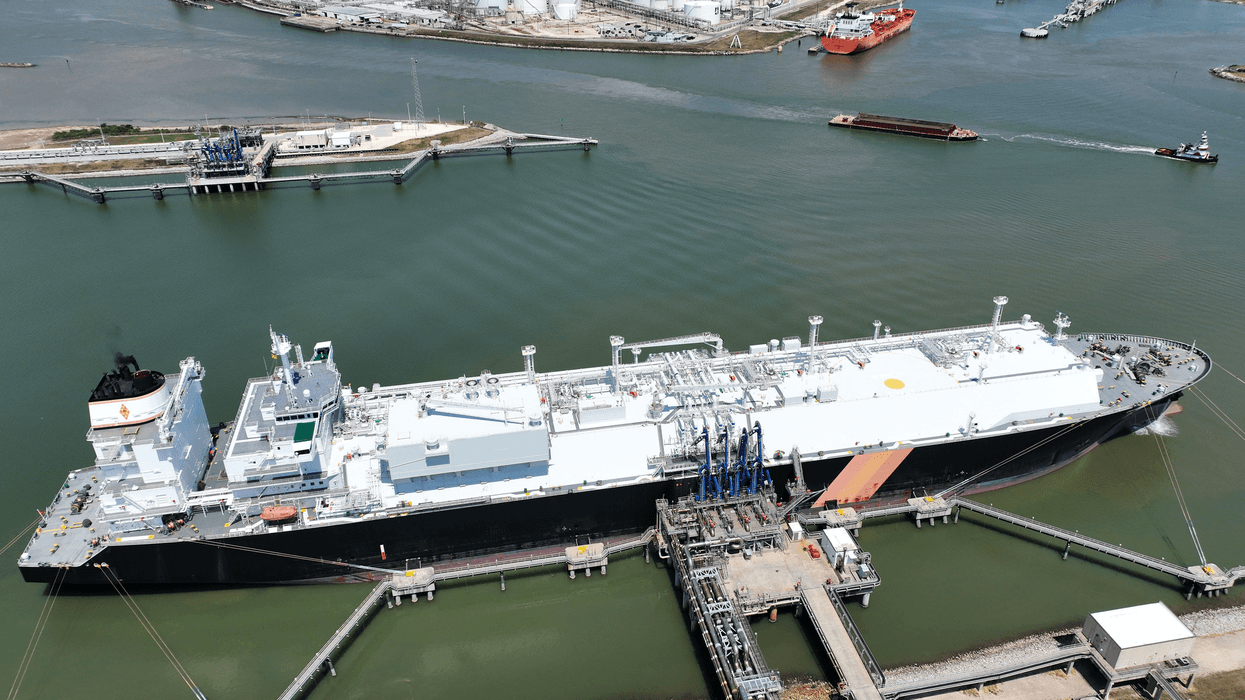
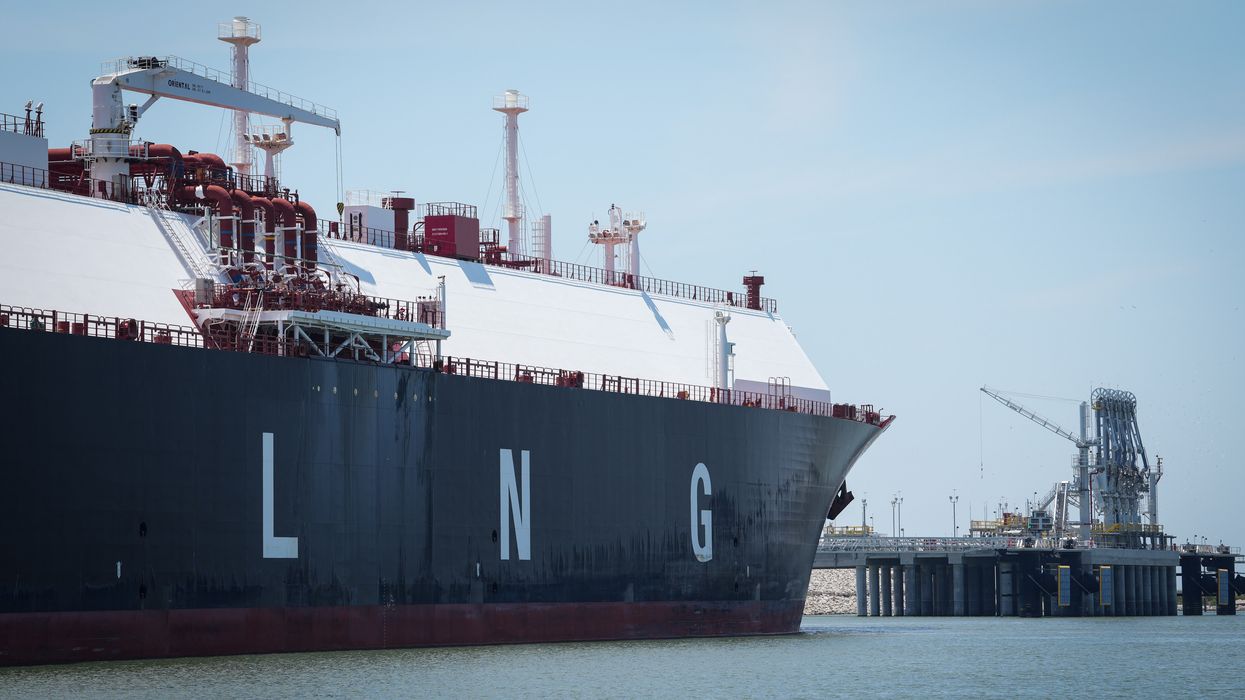
A coalition of green groups filed a lawsuit Tuesday contesting the Trump administration's approval of what would be one of the world's largest liquefied natural gas facilities—permission granted despite the project's threats to frontline communities, the environment, and climate.
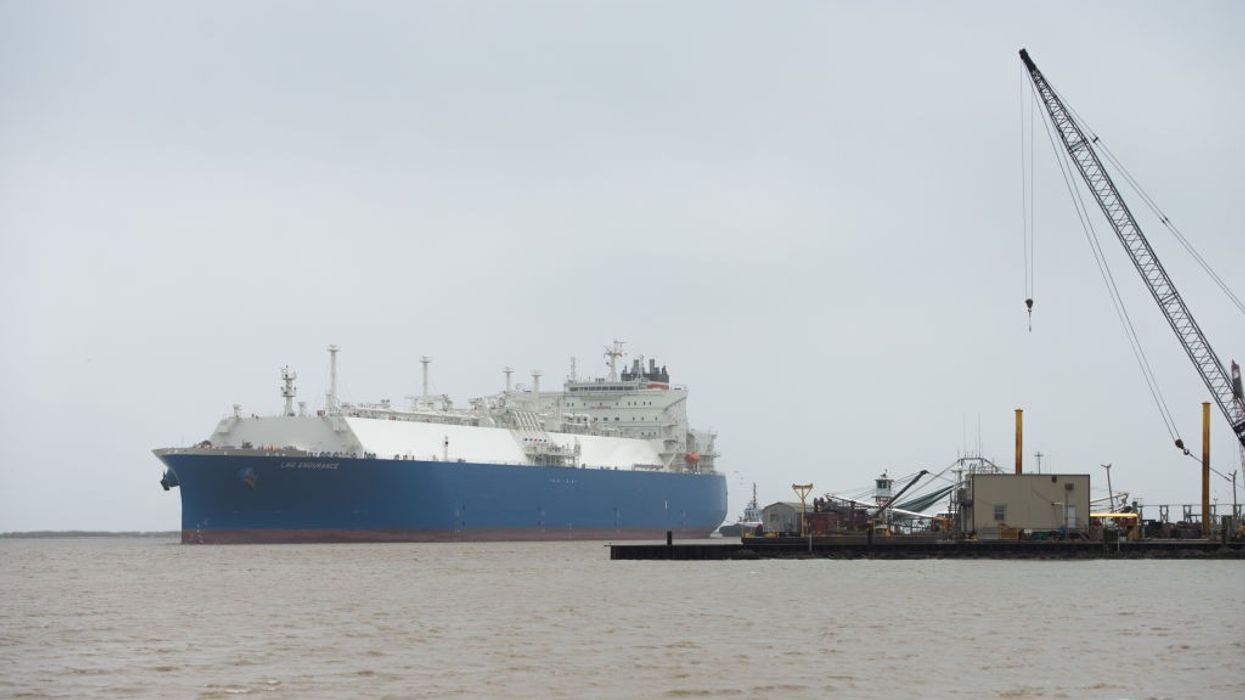
The National Resources Defense Council (NRDC) and Earthjustice are representing the Sierra Club, which is suing the US Department of Energy (DOE) for approving Venture Global’s application to export liquefied natural gas (LNG) from the Calcasieu Pass 2, or CP2, terminal, which is now under construction in Cameron Parish, Louisiana.
“We’re suing over DOE’s unlawful approval of this facility that will increase climate-warming pollution and do nothing to lower energy costs for Americans,” NRDC senior attorney Caroline Reiser said. “DOE is using an untested loophole to avoid considering the impacts of this project on Americans’ health and on the environment. The agency also failed to consider how LNG exports could increase US energy prices.”
As Earthjustice explained:
CP2’s pollution, traffic, sprawl, and visual impact would add to the harms the nine overburdened local Gulf Coast communities located near the facility already experience from nearby existing LNG terminals. These communities already bear the burden of other heavy industry and are on the frontlines of the bigger hurricanes and storms fueled by the worsening climate crisis. Approving CP2’s exports will add to environmental injustice, fuel additional climate change, and increase prices for domestic consumers.
CP2 is one of the key projects in what climate campaigners called a "staggering" LNG expansion under former President Joe Biden. In January 2024, his administration announced a temporary pause on DOE approvals of pending and future LNG export applications to nations with which the US did not have free trade agreements. A federal judge appointed by President Donald Trump later ruled the pause illegal.
The United States is the world’s leading natural gas producer and LNG exporter. While the fossil fuel industry often calls LNG a “bridge fuel”—a cleaner alternative to coal that will ease the transition to sustainable energy sources—critics have warned that the fossil gas actually hampers the transition to a green economy. LNG is mostly composed of methane, which has more than 80 times the planetary heating power of carbon dioxide during its first two decades in the atmosphere.
Trump's DOE—headed by former fracking CEO Chris Wright—granted preliminary approval to CP2 last March, with the final green light coming in October. If built as planned, it would export around 20 million metric tons per year of LNG.
"The estimated lifecycle greenhouse gas from this methane gas would be more than the annual emissions of 47 million gas-powered cars, or 54 coal-fired power plants," said NRDC.
CP2 construction has already harmed local communities in Cameron Parish—especially local fishers. Last summer, dredging despoiled hundreds of acres of marshland, burying crab traps and oyster beds, and killing wildlife including the crabs, fish, and shrimp upon which fishers depend for their livelihood.
“We’re routinely seeing less and less catch. LNG has polluted our waters and disrupted the wildlife," one local fisher and dock manager said last year. "The shrimp just do not want to come in because of the LNG projects.”
"While the Loss and Damage Fund sits almost empty, oil and gas companies are investing more than $60 billion each year into new exploration," said one campaigner.
The fossil fuel industry is "racing toward climate breakdown with its foot on the accelerator," said one official at the German environmental rights group Urgewald on Tuesday as the group released its Global Oil and Gas Exit List.
The report shows that as world leaders prepare to meet in Brazil for the annual United Nations climate summit, any discussion they have there regarding a green transition is being undercut by massive expansion in oil and gas extraction and production, including in the fracking and liquefied natural gas (LNG) industries.
Four years after the International Energy Agency (IEA) stated that no new oil and gas fields have a place on a pathway to limiting planetary heating to 1.5°C—marking global energy experts' public endorsement of warnings that had come from climate scientists for years prior—96% of fossil fuel firms are exploring and developing new oil and gas resources, said Urgewald.
Short-term expansion is up 33% since 2021, when the IEA issued its warning, with fossil fuel giants planning to bring 256 billion barrels of oil and gas equivalent (bboe) into production in the coming years.
Five companies account for about one-third of global short-term expansion: QatarEnergy (26.2 bboe), Saudi Aramco (18.0 bboe), ADNOC in the United Arab Emirates (13.8 bboe), Russian state-owned entity Gazprom (13.4 bboe) and US firm ExxonMobil (9.7 bboe).
Nils Bartsch, head of oil and gas research at Urgewald, said the largest fossil fuel companies in the world "are treating the Paris Agreement like a polite suggestion, not a survival plan."
The analysis comes a decade after 195 countries signed the legally binding Paris Agreement, committing to develop and implement national climate action plans to draw down fossil fuel emissions.
"With 256 billion barrels of new projects on the table, this is not a transition—it is defiance," said Bartsch.
The Paris Agreement also included a demand for wealthy countries to contribute funds to help the Global South mitigate and adapt to the climate emergency, and annual UN conferences have addressed climate finance, but the industry is still spending about 75 times more on oil and gas exploration than governments have pledged to the UN Loss and Damage Fund, according to the report.
On average, companies listed in the Global Oil and Gas Exit List (GOGEL) spent an average of $60.3 billion over the last three years on oil and gas expansion.
“Brazil is showing an alarming level of climate hypocrisy—presenting itself as a climate leader at COP30 while allowing oil and gas expansion right at the summit’s doorstep, threatening one of our most fragile ecosystems."
The US has pledged just 17.5 million to the Loss and Damage Fund, while two of its biggest fossil fuel companies, Chevron and ExxonMobil, have spent $1.3 billion and $1.1 billion on oil and gas exploration, respectively, in the last three years.
"While the Loss and Damage Fund sits almost empty, oil and gas companies are investing more than $60 billion each year into new exploration, exacerbating the problem the fund is meant to alleviate. This is financial and moral negligence. Regulators and supervisory authorities need to start treating this as a risk, not a footnote," said Fiona Hauke, oil and gas researcher and financial regulation expert at Urgewald.
The report was released a week before world leaders are scheduled to meet in Belém, Brazil for the 2025 United Nations Climate Change Conference (COP30), even as state-owned fossil fuel company Petrobras begins drilling in Foz do Amazonas Basin in the fragile, biodiverse Amazon rainforest.
Petrobras was named in GOGEL as the 15th largest fossil fuel exporter worldwide, currently spending $1.1 billion annually searching for new reserves, as Brazil prepares to host a meeting that is meant to focus on implementing emissions reduction plans.
“Brazil is showing an alarming level of climate hypocrisy—presenting itself as a climate leader at COP30 while allowing oil and gas expansion right at the summit’s doorstep, threatening one of our most fragile ecosystems,” said Nicole Oliveira, executive director of the Arayara International Institute in Brazil.
GOGEL also pointed to oil and gas expansion in the US under the Trump administration, with the US overtaking China as the number-one developer of gas-fired power even as a recent UN and World Bank report found that nine out of 10 renewable energy projects are cheaper than even the lowest-cost fossil fuel alternatives.
The US is home to the largest LNG export developer worldwide, Venture Global, as companies are planning an export capacity of around 847 million tons per year—a 171% increase from current operational capacity.
Urgewald noted that even TotalEnergies CEO Patrick Pouyanné recently acknowledged that the LNG sector is "building too much."
"Analysts warn that if current plans proceed, the world could face an oversupplied gas market within five years, with far more capacity than global demand can absorb," reads GOGEL. "Yet despite industry leaders acknowledging the risk, investment continues."
"US fracking companies are producing far more gas than they can sell domestically," adds the report, noting that the country is turning to Mexico as an export platform. "Now faced with a flood of excess gas, companies are racing to build new LNG facilities to liquefy their surplus and push it onto countries around the globe."
Pablo Montaño, director of Conexiones Climáticas, Mexico, said new LNG projects "are not for the benefit of Mexicans."
"They will import fracked gas from the US, liquefy it in Mexico and send it straight to Asia. Gas liquefaction is an incredibly dirty business," he said.
Despite clear warnings from energy and climate experts, said Cathy Collentine, Beyond Dirty Fuels campaign director at the Sierra Club in the US, "fossil fuel expansion continues to put communities and the climate at risk."
"Under the Trump administration," she said, "we are seeing a disregard for both to do the bidding of Big Oil and Gas."
Donald Trump is using his bully pulpit to foist fossil fuels on the U.S. and on the world, but his efforts may backfire.
When I was a cub reporter at the New Yorker in the early 1980s, New York City was actually a somewhat seedy and dangerous (if fascinating) place (sort of fitting the image currently assigned it by MAGA ideologues who have ignored its almost complete makeover into a remarkably safe enclave). In those days, anyone wandering the Times Square neighborhood where I worked could count on seeing a three-card monte game on every block, with fast-talking card sharps hustling the tourists. It wasn’t very sophisticated, but it must have worked because they were out there every day.
The grift playing out this week in the federal government around climate is no more complicated, but it too relies on speed and distraction. On the first day of his term, U.S. President Donald Trump set up the con by asking the Environmental Protection Agency (EPA) to evaluate its 2009 finding that greenhouse gas emissions were dangerous. Yesterday, EPA czar and former failed gubernatorial candidate Lee Zeldin dutifully made his long-awaited announcement: Nothing to fear from carbon dioxide, methane, and the other warming gases.
“Today is the greatest day of deregulation our nation has seen,” EPA Administrator Lee Zeldin said when he first announced the idea. “We are driving a dagger straight into the heart of the climate change religion to drive down cost of living for American families, unleash American energy, bring auto jobs back to the U.S., and more.”
Trump didn’t really need to do this in order to stop working on the climate crisis—he’s done that already. The point here is to try and make that decision permanent, so that some future administration can’t work on climate either, without going through the long and bureaucratic process of once again finding that the most dangerous thing on the Earth is in fact dangerous.
The problem with this simple one-two punch from Trump and Zeldin is that someone will challenge it in court as soon as it becomes official. “If EPA finalizes this illegal and cynical approach, we will see them in court,” said Christy Goldufss of the Natural Resources Defense Council. And they’ll have an argument, since—well, floods, fires, smoke, storms. I mean, if carbon dioxide was dangerous in 2009, that’s a hell of a lot more obvious 16 years later. The Supreme Court upheld the idea that CO2 was dangerous in 2007—here’s how Justice John Paul Stevens began that opinion:
A well-documented rise in global temperatures has coincided with a significant increase in the concentration of carbon dioxide in the atmosphere. Respected scientists believe the two trends are related. For when carbon dioxide is released into the atmosphere, it acts like the ceiling of a greenhouse, trapping solar energy and retarding the escape of reflected heat. It is therefore a species—the most important species—of a “greenhouse gas.”
But that was a different, and non-corrupted, Supreme Court. John Roberts wrote the dissent, and he’s doubtless eager to do with climate change what he’s already done with abortion. But that would be easier if they had some “well-respected experts” to say that there’s not any trouble—stage three of this grift. It’s true that there aren’t any well-respected experts that believe that, but the White House has hired several aged contrarians who have maintained for decades that global warming is not a problem, even as the temperature (and the damage) soared. And yesterday they released a new report that reads more or less like a Wall Street Journal op-ed. In it they cherry pick data, turn to old and long-debunked studies, and in general set up a group of strawmen so absurd that one almost has to grin in admiration. Actual climate scientists were lining up to say their papers had been misquoted, but all you needed was a modicum of knowledge to see how stupid the whole enterprise was. Just as an example, our contrarians hit the old talking point that CO2 is plant food—indeed, “below 180 ppm [parts per million], the growth rates of many C3 species are reduced 40-60% relative to 350 ppm (Gerhart and Ward 2010) and growth has stopped altogether under experimental conditions of 60-140 ppm CO2.” Great point except that there is no one calling for, and no way, to get CO2 levels anywhere near that low. I led a large-scale effort to remind people that anything above 350 ppm is too high, and that was so successful that we’re now at 420 ppm and climbing. Too little carbon dioxide is a problem for the planet in the way that too little arrogance is a problem for the president
And yet, when it finally reaches the court, they will doubtless cite this entirely cynical and bad-faith document to buttress the case that the EPA should be allowed to stop paying attention to carbon dioxide. As I said, it’s a pretty easy to follow swindle, but they count on the fact that most people won’t. Butter won’t melt in their mouths—as Energy Secretary (and former fracking executive) Chris Wright said in his foreword to the new report:
I chose the [authors] for their rigor, honesty, and willingness to elevate the debate. I exerted no control over their conclusions. What you’ll read are their words, drawn from the best available data and scientific assessments. I’ve reviewed the report carefully, and I believe it faithfully represents the state of climate science today.
Every word of that is nonsense, but it doesn’t matter—because it’s an official document on the right letterhead it will do the trick. This is precisely what science looks like when it’s perverted away from the search for truth. It’s disgusting.
Still, there’s another grift also underway this week, and this one that may work the other way and do the world some good. The president announced his new trade deal with the European Union, which calls for 15% tariffs—but it’s sweetened by the European promise to buy $750 billion worth of American natural gas in the next three years. Trump has essentially been using the tariff process as a shakedown, a way to repay his Big Oil cronies for their hundreds of millions in support: it’s pretty much exactly like a mob protection racket, where you buy from the guy you’re told to or you get a rock through the window. The White House quickly put out a list of thank yous, including one from the American Petroleum Institute: “We welcome POTUS’ announcement of a U.S.-E.U. trade framework that will help solidify America’s role as Europe’s leading source of affordable, reliable and secure energy.”
And yet, as Reuters first noted and then many others also calculated, the numbers are clearly nonsense. First, the E.U. actually doesn’t buy any energy itself, and it can’t tell its member states what to purchase; in fact, even those member states usually rely on private companies to buy stuff. Second, it’s physically impossible to imagine the U.S. selling Europe $250 billion worth of natural gas a year. As Tim McDonnell wrote at Semafor:
Total U.S. energy exports to the world were worth $318 billion last year, of which about $74.4 billion went to the E.U., according to Rystad Energy. So to meet the target, the E.U. would need to more than triple its purchases of U.S. fossil fuels—and the U.S. would need to stop selling them to almost anyone else.
“These numbers make no sense,” said Anne-Sophie Corbeau, a researcher specializing in European gas markets at Columbia University’s Center on Global Energy Policy.
The biggest reason it won’t happen, though, is that Europe is quickly switching to renewable energy. As Bill Farren-Price, head of gas research at the Oxford Institute for Energy Studies, explained to the Financial Times:
“European gas demand is soft, and energy prices are falling. In any case, it is private companies not states that contract for energy imports,” he said. “Like it or not, in Europe the windmills are winning.”
Trump will doubtless coerce some countries into buying more liquefied natural gas (LNG) in the short run, and that will do damage. Global Venture announced Tuesday that they’d found the financing for the massive Calcasieu Pass 2 (CP2) export terminal, which has been opposed by both climate scientists and environmental justice activists. As Louisiana’s Roishetta Ozane said Tuesday:
The CP2 LNG facility is an assault on everything I hold dear. It’s a direct threat to the health and safety of my community and an assault on the livelihoods of our fishermen and shrimpers.
I’ve seen my kids struggle with asthma, eczema, headaches, and other illnesses that result from the pollution petrochemical and LNG plants dump into my community. I won’t stop opposing this project in every way I can, because my children—and everyone’s children—deserve to breathe clean air, drink clean water, and live in a healthy environment. I refuse to let Venture Global turn my community into a sacrifice zone for the sake of its profits.
But my guess is that such facilities won’t be pumping for as many decades as their investors imagine. Europe pivoted hard to renewables because Russian President Vladimir Putin proved an unstable supplier of natural gas; Trump’s America is hardly more reliable, since the president has made it clear he’ll tear up any agreement on a whim. Any rational nation will be making the obvious calculation: “I may not have gas of my own, but I’ve got wind and sun and they’re cheap. I’d rather rely on the wind than the windbag.”
Trump’s a conman, but he’s also a mark.