SUBSCRIBE TO OUR FREE NEWSLETTER
Daily news & progressive opinion—funded by the people, not the corporations—delivered straight to your inbox.
5
#000000
#FFFFFF
To donate by check, phone, or other method, see our More Ways to Give page.
Daily news & progressive opinion—funded by the people, not the corporations—delivered straight to your inbox.
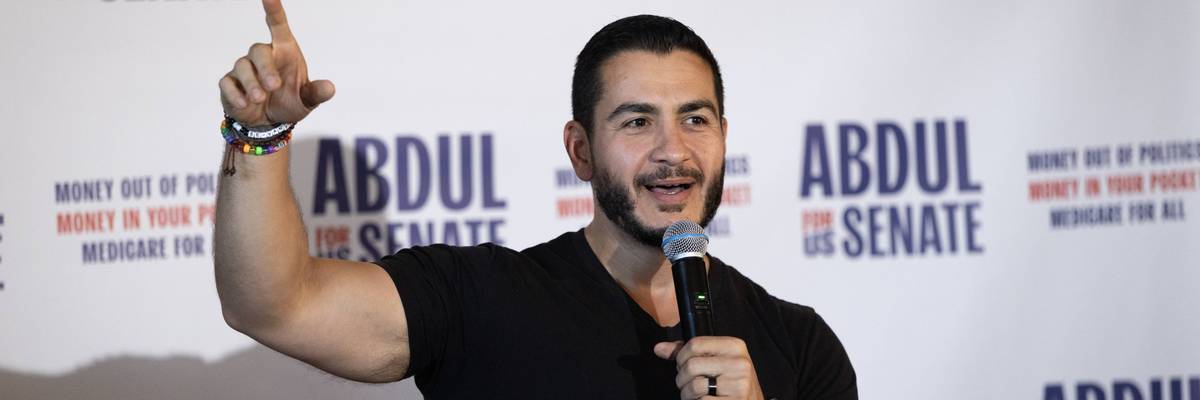
Democratic candidate for US Senate in Michigan Abdul El-Sayed speaks during a rally at The Congregation on August 3, 2026 in Detroit, Michigan.
In the Michigan Democratic Senate primary, Abdul El-Sayed put guaranteed healthcare at the center of a statewide campaign and let voters decide. They decided.
You won’t find “Medicare for All” printed on any Michigan ballot from Tuesday’s primary. What you’ll find is a name: Abdul El-Sayed, the Ann Arbor physician who literally wrote the book on single-payer healthcare and then built his Senate campaign around it.
El-Sayed co-authored Medicare for All: A Citizen’s Guide, with a foreword from Sen. Bernie Sanders (I-Vt.), laying out how the country could guarantee healthcare as a right instead of rationing it by income. He wasn’t a candidate who discovered Medicare for All in a focus group. He ran because of it, and Tuesday night he routed the Democratic establishment’s chosen candidate, Haley Stevens. That’s as close to a referendum on single-payer healthcare as American politics gets, and voters delivered a verdict.
El-Sayed didn’t soften his message for the donor class. He paired “Medicare for All” with a blunt indictment of a country rich enough to end medical bankruptcy but too captured by insurance money to bother. Voters in Washtenaw and Kent counties answered.
What makes this remarkable is who El-Sayed beat and how. Stevens had every advantage institutional Democratic politics can hand a candidate: Sen. Chuck Schumer’s (D-NY) early backing, a late endorsement from Michigan Gov. Gretchen Whitmer, and roughly $30 million from the American Israel Public Affairs Committee (AIPAC) and its affiliates, the largest single-race investment in that organization’s history. This was one of the most expensive Democratic primaries ever run, a fire hose of establishment cash aimed at burying a single-payer candidate. It wasn’t enough. Voters weren’t buying what millions in outside spending were selling.
As a practicing physician assistant who has spent years advocating for Medicare for All and working in electoral politics, I've heard the same warning over and over: Don't run on single-payer. Michigan suggests that conventional wisdom deserves another look.
That should terrify the consultant class that has spent a decade telling Democrats Medicare for All is political poison in a state like Michigan, that it scares away suburban moderates. El-Sayed’s night says otherwise: an unapologetic healthcare message is exactly what turns out voters a low-turnout August primary usually leaves behind. Reporting pointed to a young, energized base and a ground game that outperformed expectations where turnout can’t be bought with television ads.
The country is catching up to what El-Sayed put in writing years ago. Over 85 million working-age Americans are uninsured or underinsured, per Commonwealth Fund research, shut out of the system or paying premiums that still leave them exposed the moment they get sick. Millions are one diagnosis away from medical debt they’ll spend a decade paying off. Public patience with an industry that profits by denying claims has curdled into open contempt, visible in viral outrage over coverage denials and a for-profit sector that ranks among the least trusted in America. Strip away the euphemisms, and the arithmetic is obscene. Insurers post billions in profit by finding reasons to say no to sick people, skimming a cut off human suffering as a business model. The United States is the only wealthy industrialized democracy that treats healthcare as a product to be underwritten, means tested, and denied rather than a right owed to its citizens. El-Sayed didn’t invent that anger, and he didn’t just write a book about it. He built a winning campaign on the promise that Democrats don’t have to keep managing that anger on behalf of the industry that causes it.
There’s symbolic weight here too. El-Sayed lost a bruising primary for governor in 2018, written off as unelectable in a state supposedly too uneasy about a candidate named Abdul. Eight years later, running on the same conviction that no one should go bankrupt getting cancer treatment, he built a coalition big enough to beat back one of the most heavily financed efforts to defeat a progressive candidate in recent Democratic primary history. That’s proof of where the Democratic base stands on healthcare, no matter what the party’s risk-averse, industry-funded strategists have told candidates for two decades.
As a practicing physician assistant who has spent years advocating for Medicare for All and working in electoral politics, I've heard the same warning over and over: Don't run on single-payer. Michigan suggests that conventional wisdom deserves another look.
Michigan shows the old fear, that Medicare for All is too risky to run on out loud, was always a story told by people who never tried telling voters the truth about their premiums. Michigan is a battleground state, not a safely progressive one, and El-Sayed won by refusing to hide the ball. He put guaranteed healthcare at the center of a statewide campaign and let voters decide. They decided. That’s not a fluke. It’s a preview of what happens when a candidate treats single-payer healthcare like the popular, morally obvious policy it has always been. AIPAC and the insurance lobby’s allies spent a fortune trying to prove otherwise and lost.
Party insiders will insist this was about mechanics, not Medicare for All. They said the same after every progressive upset this cycle, right up until they had to explain the next one. For one night, the closest thing Michigan had to a ballot question on national healthcare got its answer, and it wasn’t close.
Dear Common Dreams reader, It’s been nearly 30 years since I co-founded Common Dreams with my late wife, Lina Newhouser. We had the radical notion that journalism should serve the public good, not corporate profits. It was clear to us from the outset what it would take to build such a project. No paid advertisements. No corporate sponsors. No millionaire publisher telling us what to think or do. Many people said we wouldn't last a year, but we proved those doubters wrong. Together with a tremendous team of journalists and dedicated staff, we built an independent media outlet free from the constraints of profits and corporate control. Our mission has always been simple: To inform. To inspire. To ignite change for the common good. Building Common Dreams was not easy. Our survival was never guaranteed. When you take on the most powerful forces—Wall Street greed, fossil fuel industry destruction, Big Tech lobbyists, and uber-rich oligarchs who have spent billions upon billions rigging the economy and democracy in their favor—the only bulwark you have is supporters who believe in your work. But here’s the urgent message from me today. It's never been this bad out there. And it's never been this hard to keep us going. At the very moment Common Dreams is most needed, the threats we face are intensifying. We need your support now more than ever. We don't accept corporate advertising and never will. We don't have a paywall because we don't think people should be blocked from critical news based on their ability to pay. Everything we do is funded by the donations of readers like you. When everyone does the little they can afford, we are strong. But if that support retreats or dries up, so do we. Will you donate now to make sure Common Dreams not only survives but thrives? —Craig Brown, Co-founder |
You won’t find “Medicare for All” printed on any Michigan ballot from Tuesday’s primary. What you’ll find is a name: Abdul El-Sayed, the Ann Arbor physician who literally wrote the book on single-payer healthcare and then built his Senate campaign around it.
El-Sayed co-authored Medicare for All: A Citizen’s Guide, with a foreword from Sen. Bernie Sanders (I-Vt.), laying out how the country could guarantee healthcare as a right instead of rationing it by income. He wasn’t a candidate who discovered Medicare for All in a focus group. He ran because of it, and Tuesday night he routed the Democratic establishment’s chosen candidate, Haley Stevens. That’s as close to a referendum on single-payer healthcare as American politics gets, and voters delivered a verdict.
El-Sayed didn’t soften his message for the donor class. He paired “Medicare for All” with a blunt indictment of a country rich enough to end medical bankruptcy but too captured by insurance money to bother. Voters in Washtenaw and Kent counties answered.
What makes this remarkable is who El-Sayed beat and how. Stevens had every advantage institutional Democratic politics can hand a candidate: Sen. Chuck Schumer’s (D-NY) early backing, a late endorsement from Michigan Gov. Gretchen Whitmer, and roughly $30 million from the American Israel Public Affairs Committee (AIPAC) and its affiliates, the largest single-race investment in that organization’s history. This was one of the most expensive Democratic primaries ever run, a fire hose of establishment cash aimed at burying a single-payer candidate. It wasn’t enough. Voters weren’t buying what millions in outside spending were selling.
As a practicing physician assistant who has spent years advocating for Medicare for All and working in electoral politics, I've heard the same warning over and over: Don't run on single-payer. Michigan suggests that conventional wisdom deserves another look.
That should terrify the consultant class that has spent a decade telling Democrats Medicare for All is political poison in a state like Michigan, that it scares away suburban moderates. El-Sayed’s night says otherwise: an unapologetic healthcare message is exactly what turns out voters a low-turnout August primary usually leaves behind. Reporting pointed to a young, energized base and a ground game that outperformed expectations where turnout can’t be bought with television ads.
The country is catching up to what El-Sayed put in writing years ago. Over 85 million working-age Americans are uninsured or underinsured, per Commonwealth Fund research, shut out of the system or paying premiums that still leave them exposed the moment they get sick. Millions are one diagnosis away from medical debt they’ll spend a decade paying off. Public patience with an industry that profits by denying claims has curdled into open contempt, visible in viral outrage over coverage denials and a for-profit sector that ranks among the least trusted in America. Strip away the euphemisms, and the arithmetic is obscene. Insurers post billions in profit by finding reasons to say no to sick people, skimming a cut off human suffering as a business model. The United States is the only wealthy industrialized democracy that treats healthcare as a product to be underwritten, means tested, and denied rather than a right owed to its citizens. El-Sayed didn’t invent that anger, and he didn’t just write a book about it. He built a winning campaign on the promise that Democrats don’t have to keep managing that anger on behalf of the industry that causes it.
There’s symbolic weight here too. El-Sayed lost a bruising primary for governor in 2018, written off as unelectable in a state supposedly too uneasy about a candidate named Abdul. Eight years later, running on the same conviction that no one should go bankrupt getting cancer treatment, he built a coalition big enough to beat back one of the most heavily financed efforts to defeat a progressive candidate in recent Democratic primary history. That’s proof of where the Democratic base stands on healthcare, no matter what the party’s risk-averse, industry-funded strategists have told candidates for two decades.
As a practicing physician assistant who has spent years advocating for Medicare for All and working in electoral politics, I've heard the same warning over and over: Don't run on single-payer. Michigan suggests that conventional wisdom deserves another look.
Michigan shows the old fear, that Medicare for All is too risky to run on out loud, was always a story told by people who never tried telling voters the truth about their premiums. Michigan is a battleground state, not a safely progressive one, and El-Sayed won by refusing to hide the ball. He put guaranteed healthcare at the center of a statewide campaign and let voters decide. They decided. That’s not a fluke. It’s a preview of what happens when a candidate treats single-payer healthcare like the popular, morally obvious policy it has always been. AIPAC and the insurance lobby’s allies spent a fortune trying to prove otherwise and lost.
Party insiders will insist this was about mechanics, not Medicare for All. They said the same after every progressive upset this cycle, right up until they had to explain the next one. For one night, the closest thing Michigan had to a ballot question on national healthcare got its answer, and it wasn’t close.
You won’t find “Medicare for All” printed on any Michigan ballot from Tuesday’s primary. What you’ll find is a name: Abdul El-Sayed, the Ann Arbor physician who literally wrote the book on single-payer healthcare and then built his Senate campaign around it.
El-Sayed co-authored Medicare for All: A Citizen’s Guide, with a foreword from Sen. Bernie Sanders (I-Vt.), laying out how the country could guarantee healthcare as a right instead of rationing it by income. He wasn’t a candidate who discovered Medicare for All in a focus group. He ran because of it, and Tuesday night he routed the Democratic establishment’s chosen candidate, Haley Stevens. That’s as close to a referendum on single-payer healthcare as American politics gets, and voters delivered a verdict.
El-Sayed didn’t soften his message for the donor class. He paired “Medicare for All” with a blunt indictment of a country rich enough to end medical bankruptcy but too captured by insurance money to bother. Voters in Washtenaw and Kent counties answered.
What makes this remarkable is who El-Sayed beat and how. Stevens had every advantage institutional Democratic politics can hand a candidate: Sen. Chuck Schumer’s (D-NY) early backing, a late endorsement from Michigan Gov. Gretchen Whitmer, and roughly $30 million from the American Israel Public Affairs Committee (AIPAC) and its affiliates, the largest single-race investment in that organization’s history. This was one of the most expensive Democratic primaries ever run, a fire hose of establishment cash aimed at burying a single-payer candidate. It wasn’t enough. Voters weren’t buying what millions in outside spending were selling.
As a practicing physician assistant who has spent years advocating for Medicare for All and working in electoral politics, I've heard the same warning over and over: Don't run on single-payer. Michigan suggests that conventional wisdom deserves another look.
That should terrify the consultant class that has spent a decade telling Democrats Medicare for All is political poison in a state like Michigan, that it scares away suburban moderates. El-Sayed’s night says otherwise: an unapologetic healthcare message is exactly what turns out voters a low-turnout August primary usually leaves behind. Reporting pointed to a young, energized base and a ground game that outperformed expectations where turnout can’t be bought with television ads.
The country is catching up to what El-Sayed put in writing years ago. Over 85 million working-age Americans are uninsured or underinsured, per Commonwealth Fund research, shut out of the system or paying premiums that still leave them exposed the moment they get sick. Millions are one diagnosis away from medical debt they’ll spend a decade paying off. Public patience with an industry that profits by denying claims has curdled into open contempt, visible in viral outrage over coverage denials and a for-profit sector that ranks among the least trusted in America. Strip away the euphemisms, and the arithmetic is obscene. Insurers post billions in profit by finding reasons to say no to sick people, skimming a cut off human suffering as a business model. The United States is the only wealthy industrialized democracy that treats healthcare as a product to be underwritten, means tested, and denied rather than a right owed to its citizens. El-Sayed didn’t invent that anger, and he didn’t just write a book about it. He built a winning campaign on the promise that Democrats don’t have to keep managing that anger on behalf of the industry that causes it.
There’s symbolic weight here too. El-Sayed lost a bruising primary for governor in 2018, written off as unelectable in a state supposedly too uneasy about a candidate named Abdul. Eight years later, running on the same conviction that no one should go bankrupt getting cancer treatment, he built a coalition big enough to beat back one of the most heavily financed efforts to defeat a progressive candidate in recent Democratic primary history. That’s proof of where the Democratic base stands on healthcare, no matter what the party’s risk-averse, industry-funded strategists have told candidates for two decades.
As a practicing physician assistant who has spent years advocating for Medicare for All and working in electoral politics, I've heard the same warning over and over: Don't run on single-payer. Michigan suggests that conventional wisdom deserves another look.
Michigan shows the old fear, that Medicare for All is too risky to run on out loud, was always a story told by people who never tried telling voters the truth about their premiums. Michigan is a battleground state, not a safely progressive one, and El-Sayed won by refusing to hide the ball. He put guaranteed healthcare at the center of a statewide campaign and let voters decide. They decided. That’s not a fluke. It’s a preview of what happens when a candidate treats single-payer healthcare like the popular, morally obvious policy it has always been. AIPAC and the insurance lobby’s allies spent a fortune trying to prove otherwise and lost.
Party insiders will insist this was about mechanics, not Medicare for All. They said the same after every progressive upset this cycle, right up until they had to explain the next one. For one night, the closest thing Michigan had to a ballot question on national healthcare got its answer, and it wasn’t close.