SUBSCRIBE TO OUR FREE NEWSLETTER
Daily news & progressive opinion—funded by the people, not the corporations—delivered straight to your inbox.
5
#000000
#FFFFFF
To donate by check, phone, or other method, see our More Ways to Give page.


Daily news & progressive opinion—funded by the people, not the corporations—delivered straight to your inbox.
The traces of the attack were visible everywhere. There was a large hole in the solid concrete roof. The rebars had been torn apart. On the walls there were pictures in long lines. Pictures of children, who should have had their lives ahead of them. Pictures of burnt bodies. Their lives ended abruptly in the very place where they thought they would be safe.
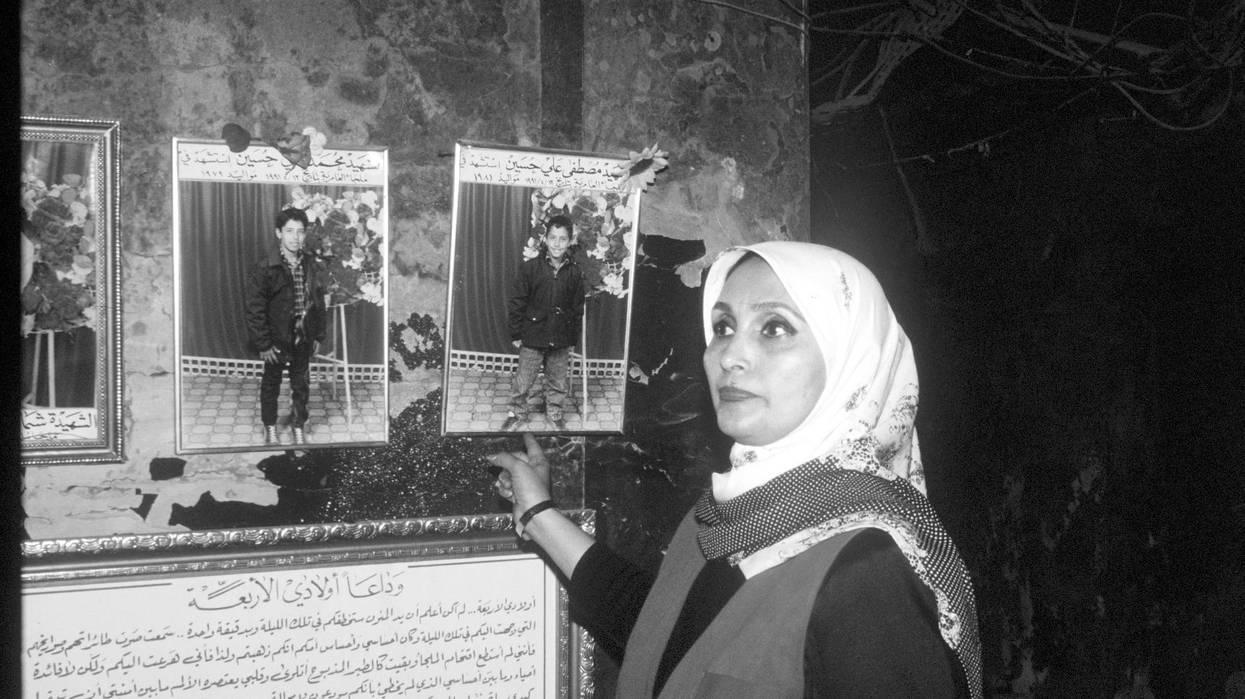
Intesar Ahmed showed me around in the shelter in al-Amiriya on the western outskirts of Baghdad. She told me what happened at four o'clock in the morning on February 13, 1991.
"Every night during the war, people sought refuge here. They were civilians, innocent people. US bombs killed our neighbors and friends. 52 of the dead were children under the age of five, twelve were infants. This was where their life ended..."
When I visited al-Amiriya, more eleven years had passed since that dramatic night. But during the visit in October 2012, it felt so close.
Hundreds of people had huddled in the shelter. Some of them were probably asleep when the first missile blew up the hole in the roof. Four minutes later, the next missile penetrated into the shelter. What did they think during those minutes?
I try to imagine the fear, the panic, the anxiety of death. But I think it is impossible to understand. 408 people lost their lives that night.
When the attack on the shelter was carried out, the Gulf War had been going on for almost a month. The coalition led by U.S. had begun its airstrikes against Iraq on January 17, 1991. The official aim was said to be to save Kuwait and enforce the Iraqi army to leave Iraq's small neighbour to the south.
A quarter of a million Iraqis lost their lives during the six weeks of the war. That can be compared to the fact that 148 Americans were killed.
In the tv news, the Gulf War was portrayed as some kind of video game. The viewers got to see video clips with cool light effects when the missiles hit their targets. "Smart bombs" became a concept.
The reality on the ground was different.
Ramsey Clark, former U.S. Secretary of Justice, traveled to Iraq shortly after the war. What he saw -- the result of 42 days of bombings - shocked him. He drew the conclusion that this was not a war. It was rather "a planned, systematic genocide of a defenseless population, almost without setting a foot on Iraqi soil".
A quarter of a million Iraqis lost their lives during the six weeks of the war. That can be compared to the fact that 148 Americans were killed.
Something that also brings you to mind genocide was the systematic destruction of infrastructure. Denis Halliday, U.N. Vice Secretary-General 1997-1998, told the world that the coalition attacked water treatment plants, sewage systems, schools, railways and oil refineries.
One who experienced the horrors himself was Murtada Hassan, chief physician at the al-Mansour Children's Hospital in the Iraqi capital. I met him in October 2002.
"During the Gulf War, the United States shut down the electricity supply. Without electricity, neither the water supply nor the air conditioning will work. A hospital gets hot and dirty," he said during the tour of hos work place.
"We had to perform surgeries with only candle light. Vaccine and blood were destroyed in the heat. They bombed hospitals, health clinics and shelters."
In October 2002, the memories from 1991 had been brought to life again. The Iraqis were well aware that they would soon be hit by a new hellish war led by George W Bush and Tony Blair. The Iraqis feared that it would be even worse than the Gulf War.
The anxiety and abandonment was also felt during the visit in al-Amariya.
"Why is the United States planning to start a new war? I can assure you that we are not terrorists. I think it's about the United States wanting our oil. The entire Iraqi people are victims," Intesar Ahmed said.
At the end of the tour, I remember her raising her eyes, pointing to the pictures of two smiling children who were killed during the attack:
"This is exactly what will happen if the US attacks us again..."
She was right. The Gulf War 30 years ago was only the beginning of a long period of death, suffering and looting in Iraq. A period which has not yet ended.
This article (in Swedish) was first published in Swedish weekly Proletaren (proletaren.se).
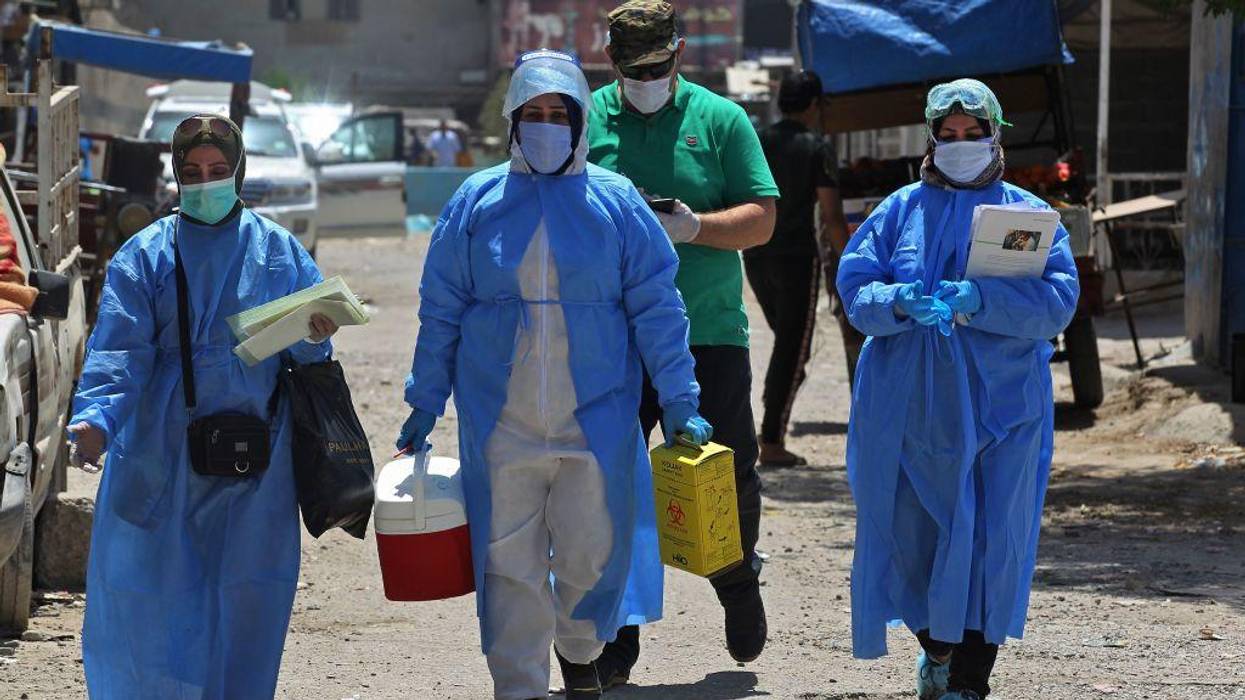
Iraq experienced a dramatic upsurge in COVID cases beginning in early in June just as a group of mask-makers in Western Massachusetts was sending 500 masks--including 100 highly effective, medical-quality HEPA vac masks-- to the Pediatric Oncology Unit at Children's Welfare Teaching Hospital in Medical City Baghdad (CWTH). They were sent on June 5; I tracked them as they traveled to Kentucky, then to Dubai--taking some days at each stop. Then, they were in transit in Baghdad, scheduled for delivery on Wednesday, June 17. But they didn't move. I checked the UPS tracking site; I phoned my local store and the international UPS help line. At one point the message said the package was being help-up by a government regulatory agency hold; at another point they said it had been shipped to Kurdistan and informed the doctor who'd phoned from Baghdad they would need a request from the Ministry of Health in that province to get the package released. And then the next day--June 22nd--they told me the package was classified as "lost."
And all this while, the virus is spreading and taking a toll in Baghdad and throughout Iraq. One hundred fifty new cases of the virus were recorded on May 18; 1463 recorded on June 18 and 1870 on June 20. While aware of the emerging pandemic, masks weren't necessarily on the doctor's radar when I first asked about them. They're in an existential crisis, as they have been for more than three decades now, exhausted by their efforts to meet the needs of an increasing number of increasingly serious cancer cases without the facilities, drugs or sufficient number of properly trained personnel necessary for such a challenging specialty.
Nonetheless when I suggested my local group might make masks, they welcomed the idea even if they were not yet fully aware of what was coming, if or when it was coming, or how the masks would be of help. Infection control is a huge issue in Iraqi hospitals where--to name just a few irregularities: two or more patients and their mothers share a room; the lowest-cost, non-medical-standard cleaning service is employed; people come-and-go in street clothes rather than changing to sanitized clothing. But, everything is an issue in Iraqi hospitals for that matter. The hospitals and the entire medical system of a country that once boasted the best training, care and facilities in the Middle East--and all at no cost--fell into a state of chaos beginning with UN Economic Sanctions and the First Gulf war in 1990. The chaos and dysfunction continue to this day.
Healthcare, along with education and other vital public services, is a government function. The role of government in managing, or not-managing-- this public health crisis has been highlighted throughout these last months; we know which governments are doing a good job, and which are failing. But, Iraq hasn't had a functioning government for many months; the cabinet was only confirmed in early June. And, most recently before that, the government they did have was notoriously corrupt and preoccupied with ongoing international conflict and street protests demanding reforms.
These doctors have not stood by helplessly as all of this has unfolded in Iraq; they have been outspoken; they spoke to the press--to anyone who would listen. They publish papers, they petition global health and international cancer care organizations.
Doctors have been left on their own, managing their patients and their wards with whatever resources they can muster. Those who have chosen to stay in Iraq--the doctors on the unit at CWTH--have been witness to misery beyond their control: a soaring Under Five Mortality rate, half a million children dead , many from preventable illness such as diarrhea or from malnutrition; They have witnessed the collapse of their once stellar medical education and hospital system; had to regroup, and redouble their efforts as colleagues were kidnapped, killed or chose to leave the country for security reasons. Doctors have had endure as the world of cancer care passed them by as a result of the crippling sanctions--even books and medical journals, medicines and medical equipment were forbidden. They have had to work harder as the number of patients increased and their overall capacity decreased. They and their families, friends and neighbors have had to live with the stress of insecurity and ongoing violence in "post-war" Baghdad. And now comes COVID 19.
These doctors have not stood by helplessly as all of this has unfolded in Iraq; they have been outspoken; they spoke to the press--to anyone who would listen. They publish papers, they petition global health and international cancer care organizations. But, help has not arrived. The suggestion by WHO and the UN--that we end ongoing conflicts and concentrate our collective efforts in understanding, containing and developing drugs and treatments for COVID--seems to have fallen on deaf ears. Iraq and Iraqis struggle on--on their own.
Where governments fail to meet human needs, or make peace, or work cooperatively--people mount campaigns. Not just internationally, you see it in crisis everywhere--institutions fail and ordinary people step into the void. This was the case with the COVID masks. A group of women created a system to produce the best quality as quickly as possible; some are washing and cutting fabric and elastic or tie bands, some are assembling kits and delivering them to pick-up locations around our Valley; some are sewing, some are responding to requests and delivering masks. The materials are/have become scarce. At some points, you couldn't find elastic for instance or the HEPA vac fabric. It all became precious and costly.
The loss of the masks--505 masks that weighed in at almost 20 lbs.--and of the $800 dollars donated for shipping costs is devastating. They are desperately needed in Baghdad. And then, so disturbing on our end, is the profound disappointment experienced by the sewing collective. Our human-to-human good-will gesture--the washing, cutting, sewing, assembling and shipping costs along with the sweet anticipation of their arrival in Baghdad--has been denied, stolen from us.
I'm sure this disappearance would be world-making news If what was lost was a feral cat or beloved stray dog some army regimen had adopted off the streets of Baghdad. And, all stops would be pulled and costs disregarded to find the animal and reunite it with their humans. I'm hoping the masks will elicit the same response. Fingers crossed.
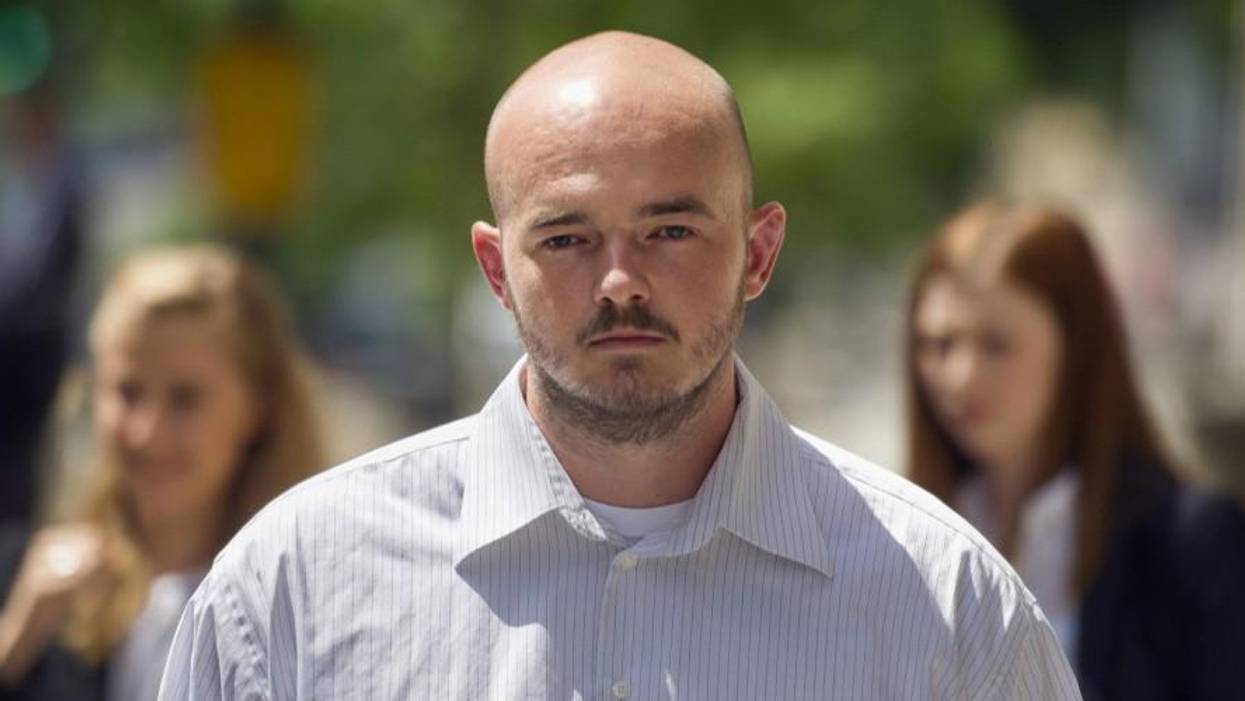
Rejecting claims from defense attorneys and family members that U.S. prosecutors scapegoated former Blackwater security guard Nicholas Slatten to improve U.S.-Iraqi relations, a federal judge sentenced former Blackwater security guard Nicholas Slatten to life in prison Wednesday for his role in the notorious 2007 Nisour Square massacre.
"The jury got it exactly right," Judge Royce Lamberth of the U.S. District Court for D.C. reportedly said while issuing the sentence. "This was murder."
Paul Dickinson, an attorney who represented families of six massacre victims--including 9-year-old Ali Kinani--welcomed the sentence in a series of tweets Wednseday evening, declaring that "justice prevails" for his clients.
U.S. prosecutors charged that on Sept. 16, 2007, Slatten fired the first shots into a crowded Baghdad traffic circle, killing 19-year-old Ahmed Haithem Ahmed Al Rubia'y and setting off a flurry of machine gun and grenade fire that left 14 Iraqi civilians dead and over a dozen more injured.
"Several of Slatten's supporters openly accused prosecutors of scapegoating an innocent man in order to placate Iraqi public opinion," The Associated Press reported. "The shootings strained U.S.-Iraqi relations and focused intense international scrutiny on the extensive use of private military contractors in Iraq."
As journalist Jeremy Scahill detailed in his book Blackwater: The Rise of the World's Most Powerful Mercenary Army, the company, "founded by secretive right-wing Christian supremacist Erik Prince...had deep ties to the Bush administration and served as a sort of neoconservative Praetorian Guard for a borderless war launched in the immediate aftermath of 9/11."
Prince has since move on from Blackwater, which relaunched as Academi, but the billionaire war profiteer--and brother of Education Secretary Betsy DeVos--has advised the Trump administration on intelligence and defense issues.
According to The Washington Post, Judge Lamberth said Wednesday
he agreed with jurors that evidence showed that the convoy was not under insurgent fire and that Slatten shot into Al Rubia'y's vehicle with premeditation, striking the medical student between the eyes.
Lamberth, a U.S. Army captain and lawyer who served in Vietnam, disputed Slatten's defenders' claims that his conduct was justified, saying he had seen combat, "but I was in a situation where we depended on each other to carry out orders to ensure that innocent people were not needlessly killed, and we followed those orders."
A jury found Slatten, now 35, guilty of first-degree murder in December. That verdict came as part of his third trial, after an appeals court ordered a retrial for Slatten--and resentencing for Blackwater contractors Dustin Heard, Evan Liberty, and Paul Slough--in August of 2017, and Slatten's second trial ended in a mistrial in September of 2018.
Slatten's new sentence may still not stick. The New York Times reported Wednesday that his attorneys "made clear that they would keep fighting, including by asking the Court of Appeals for the District of Columbia to overturn the sentence and the verdict."
The Times also pointed to the newspaper's report from May that President Donald Trump might be considering a pardon for Slatten, given that "the White House had requested paperwork about his and a handful of other cases, according to two United States officials."
Last week, Elham Pourtaher, an Iranian graduate student at the State University of New York in Albany, wrote about how U.S. policies cause suffering and trauma far beyond U.S. borders. Her diabetic father, for example, is in danger of losing access to medicines because sanctions against Iranian banks make it nearly impossible to pay for imported goods, including medicine and food. Shortages could lead to thousands of deaths. Pourtaher described "the collective sense of fear caused by the increased sanctions."
President Trump expressed concern that 150 people could be killed if U.S. airstrikes against Iran had been carried out last week. We must ask how many people could die because of economic warfare against Iran.
By 1996, U.N. officials reported that the economic sanctions directly contributed to the deaths of hundreds of thousands of children.The economic war cripples Iran's economy and afflicts the most vulnerable Iranian people--the sick, the poor, the elderly and the children.
In more than seventy visits to Iraq from 1991 to 2003, Voices in the Wilderness, a team of peace activists I was part of, reported on deteriorating conditions as people struggled to find desperately needed goods, including medicines and medical relief supplies. By 1996, U.N. officials reported that the economic sanctions directly contributed to the deaths of hundreds of thousands of children.
Wasting away from curable diseases, thousands of children who entered pediatrics wards never left. In Baghdad, Mosul, Babylon, Amara, Nasiriyah, and Basra, we visited wards that became death row for infants. Those children were by no means criminal. They couldn't possibly have been held accountable for the actions of Saddam Hussein and the ruthless dictatorship ruling Iraq. Their plight seldom appeared in U.S. news reports about Iraq. But they were brutally and lethally punished, ostensibly because Iraq might possess weapons of mass destruction.

By the end of 2002, most Iraqis I knew dreaded a new round of military attacks and invasion. People I'd regarded as having nerves of steel said, "Believe me, Kathy, I am so scared," or asked, "How can I possibly protect my children?"
On February 5, 2003, colleagues and I huddled over a shortwave radio on the balcony of Baghdad's Al-Fanar hotel, straining to hear Colin Powell as he presented evidence that he said proved beyond a doubt that Iraq harbored weapons of mass destruction. After the 2003 bombing and invasion, evidence of Colin Powell's allegations simply couldn't be found. Now, Iraq is a broken, battered, and traumatized country.
Why should the United States now be punishing Iran?
In its last quarterly report, issued May 31, the International Atomic Energy Agency again verified Iran's compliance with the Joint Comprehensive Plan of Action, the so-called nuke deal, even though the United States has reneged on it. Noted analyst Professor Juan Cole emphasizes that Iran's theocratic government adheres to Islamic teachings, which forbid stockpiling or use of weapons that afflict mass casualties on civilian populations. This surely includes nuclear weapons.
The greatest outlier in terms of possessing nuclear weapons is the United States, which in an alarming new development has granted seven permits for the transfer of sensitive nuclear information by U.S. businesses to the Saudi government. So far, the Saudi government has not shown readiness to abide by safeguards which would prevent it from diverting or misusing nuclear materials to assemble nuclear weapons. Saudi Arabia already has sophisticated ballistic missile delivery systems. Crown Prince Mohammed bin Salman stated on national TV that if Iran acquires a nuclear weapon, so will Saudi Arabia.
In 2016, the United States signed a Memorandum of Understanding to provide Israel with $38 billion in military assistance over a ten-year period. Even though the official Israeli position is neither to confirm nor deny the existence of its nuclear weapons program, it is now estimated that Israel has a nuclear arsenal of at least eighty warheads. However, Israel still is not a state party to the Nuclear Non-Proliferation Treaty.
The double standards in foreign policy maintained by the United States--one standard for U.S. allies Israel and Saudi Arabia and a different standard for Iran--undermine any progress in ending wars and the potential for new wars in the Middle East.
Rather than punish Iran, the United States should immediately return to the Iran nuclear agreement and support proposals regularly advanced at the Nuclear Non-Proliferation treaty conferences for a Nuclear Weapon Free Zone in the Middle East.
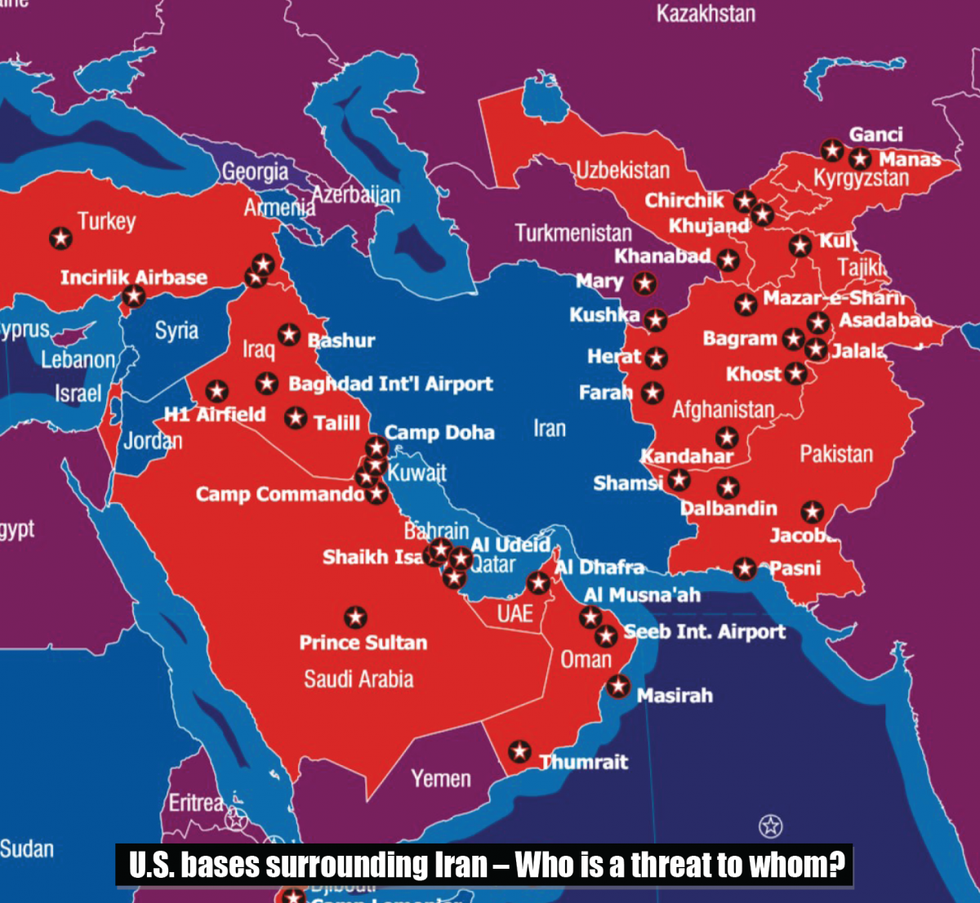
The U.S. government claims it is threatened by Iran. Yet, according to David Stockman writing in Antiwar.com, the United States surrounds Iran with forty-five U.S. bases, and Iran's defense budget of less than $15 billion amounts to just seven days of money spent by the Pentagon.
The United States, which claims Iran is supporting terrorism, continues to enable Saudi Arabia's aerial terrorism as it regularly bombs civilians in Yemen. On June 24th, a ship bound for Saudi Arabia departed from Wilmington, North Carolina carrying bombs, grenades, cartridges and defense-related aircraft. The United States also supplies weapons to Bahrain, the UAE, Sudan and other countries which actively participate in the Saudi-led Coalition making war against Yemen. The Saudi government directly supports the military government in Sudan, which recently killed at least 100 peaceful protesters who were part of Sudan's Democratic Uprising.
Rather than planning cyberattacks and new means of aggression, the United States should heed calls for dialogue and negotiation, relying on Albert Camus's conclusion to his profound anti-war essay following World War II: "The only honorable course will be to stake everything on the formidable gamble, that words are more powerful than munitions."
President Donald Trump's near-total ban on immigration to the U.S. from Muslim-majority countries, known colloquially as the "Muslim ban," is having widespread negative effects on refugees in the Middle East, according to a new report from Amnesty International.
In the new report, The Mountain is in Front of Us and the Sea is Behind Us, Amnesty interviewed nearly 50 refugees stuck in Lebanon and Jordan due to the Trump administration's Muslim ban. Hundreds of families from war-torn regions of the Arab world, from Sudan to Syria, are "locked in an impossible limbo" waiting for the U.S. government to act either way on their asylum applications.
"These are families who put their trust in the United States at their most desperate hour, and now find themselves on the brink of catastrophe through absolutely no fault of their own," Amnesty researcher Denise Bell said in a statement.
One refugee interviewed by Amnesty, named in the report as "Malik," has been waiting to go to the U.S. from Beirut after fleeing Baghdad with his family for fear of religious persecution due to their Christian faith. As Malik told Amnesty, he tried to do everything the right way, but it didn't matter:
Malik's family had gone so far as to complete trainings to prepare for their new lives in the U.S. after his case was approved. Since the Muslim Ban was signed in 2017, his case has been held up due to what he is told are "security checks," even though it was previously approved.
When asked what he would say if he could speak with President Trump, Malik said, "We are refugees. We're human refugees. We're refugees because there are difficult situations that made us flee . . . Please, so that we're able to live. We want to live; we want to live in peace."
The Trump administration has cut refugee intake into the country by 71 percent over the last three years, and for Syrian refugees, the reduction is even higher. As the report notes, "at the end of April 2019, only 219 Syrian refugees had arrived to the United States from Jordan and Lebanon this calendar year, putting the USA on pace to resettle just over 650 by the end of 2019. In contrast, in calendar year 2016, 11,204 Syrian refugees were resettled to the USA from Jordan and Lebanon."
The administration's attack on refugees is a growing problem for human rights, said Amnesty grassroots advocacy and refugee specialist Ryan Mace. Mace called on Congress to hold the White House accountable and to use the opportunity provided by the report to press for better protections for those affected by the policies.
"Congress must do its job and hold the Trump administration accountable to refugees," Mace said. "This means rejecting the president's proposed devastating cuts and instead providing life-saving humanitarian aid to refugees and displaced populations."
"The administration must ensure that the United States does not discriminate against refugees based on how they worship or where they come from," Mace added.
As Amnesty points out, it's not just the refugees in Lebanon and Jordan who are suffering. The entire program has been slowed down by the White House.
The U.S. has historically resettled the largest number of refugees annually from around the world. Since the modern U.S. Refugee Assistance Program was established in 1980, the average number of persons being resettled each fiscal year was 80,000. This changed in 2017 when one of President Trump's first acts in office was to cut the refugee admissions goal from 110,000, which President Obama set in his last year in office, to 45,000--the lowest refugee admissions cap ever set to that point. Barely 22,000 refugees were resettled by the end of FY 2018--the lowest number admitted in the history of the program. Under the current U.S. administration, refugee resettlement has dropped 71 percent in three years.
Amnesty hopes to convince the administration to take in 30,000 refugees in total in 2019 and increase that number to 95,000 in 2020.
There's a dark joke going around Baghdad these days. Noof Assi, a 30-year-old Iraqi peace activist and humanitarian worker, told it to me by phone. Our conversation takes place in late May just after the Trump administration has announced that it would add 1,500 additional U.S. troops to its Middle Eastern garrisons.
"Iran wants to fight to get the United States and Saudi Arabia out of Iraq," she began. "And the United States wants to fight to get Iran out of Iraq." She paused dramatically. "So how about all of us Iraqis just leave Iraq so they can fight here on their own?"
Assi is among a generation of young Iraqis who lived most of their lives first under the U.S. occupation of their country and then through the disastrous violence it unleashed, including the rise of ISIS, and who are now warily eying Washington's saber-rattling towards Tehran. They couldn't be more aware that, should a conflict erupt, Iraqis will almost certainly find themselves once again caught in the devastating middle of it.
In February, President Trump sparked ire by claiming that the United States would maintain its military presence--5,200 troops--and the al-Asad airbase in Iraq in order to "watch Iran." In May, the State Department then suddenly ordered all non-emergency government employees to leave Iraq, citing vague intelligence about threats of "Iranian activity." (This so-called intelligence was promptly contradicted by the British deputy commander of the U.S.-led coalition fighting ISIS who claimed that "there's been no increased threat from Iranian-backed forces in Iraq and Syria.") A few days later, a rocket landed harmlessly in Baghdad's heavily fortified Green Zone, which houses the U.S. embassy. Iraqi Prime Minister Adel Abdul Mahdi then announced that he would send delegations to Washington and Tehran to try to "halt tensions," while thousands of ordinary Iraqis rallied in Baghdad to protest against the possibility of their country once again getting dragged into a conflict.
Much of American media coverage of rising U.S.-Iranian tensions in these weeks, rife with "intel" leaked by unnamed Trump administration officials, bears a striking resemblance to the lead-up to the 2003 U.S. invasion of Iraq. As a recent Al Jazeera piece--headlined "Is the US media beating the drums of war on Iran?"--put it bluntly: "In 2003, it was Iraq. In 2019, it's Iran."
Unfortunately, in the intervening 16 years, American coverage of Iraq hasn't improved much. Certainly, the Iraqis themselves are largely missing in action. When, for example, does the American public hear about how female students in Iraq's second largest city, Mosul, heavily bombed and taken back from ISIS in 2017, have organized to restock the shelves of the once-famed library at the University of Mosul, which ISIS militants set aflame during their occupation of the city; or how booksellers and publishers are reviving Baghdad's world-renowned book market on Mutanabbi Street, destroyed by a devastating car bomb in 2007; or how, each September, tens of thousands of young people now gather across Iraq to celebrate Peace Day--a carnival that started eight years ago in Baghdad as the brainchild of Noof Assi and her colleague, Zain Mohammed, a 31-year-old peace activist who is also the owner of a restaurant and performance space?
In other words, rarely is the U.S. public allowed glimpses of Iraq that make war there seem less inevitable.
Assi and Mohammed are well accustomed not only to such skewed representation of their country in our country, but to the fact that Iraqis like them are missing in action in American consciousness. They remain amazed, in fact, that Americans could have caused such destruction and pain in a country they continue to know so little about.
"Years ago, I went to the United States on an exchange program and I discovered people didn't know anything about us. Someone asked me if I used a camel for transportation," Assi told me. "So I returned to Iraq and I thought: Damn it! We have to tell the world about us."
In late May, I spoke with Assi and Mohammed separately by telephone in English about the rising threat of another U.S. war in the Middle East and their collective two decades of peace work aimed at undoing the violence wrought by the last two U.S. wars in their country. Below, I've edited and melded the interviews of these two friends so that Americans can hear a couple of voices from Iraq, telling the story of their lives and their commitment to peace in the years after the invasion of their country in 2003.
Laura Gottesdiener:What first inspired you to begin doing peace work?
Zain Mohammed:At the end of 2006, on December 6th, al-Qaeda-[in-Iraq, the precursor to ISIS] executed my dad. We are a small family: me and my mom and two sisters. My opportunities were limited to two options. I was 19 years old. I had just finished high school. So the decision was: I had to emigrate or I had to become part of the system of militias and take revenge. That was the lifestyle in Baghdad at that time. We emigrated to Damascus [Syria]. Then suddenly, after about six months, when our paperwork was nearly ready for us to emigrate to Canada, I told my mom, "I want to go back to Baghdad. I don't want to run away."
I went back to Baghdad at the end of 2007. There was a big car bombing in Karrada, the part of the city where I used to live. My friends and I decided to do something to tell our friends that we have to work together to promote peace. So, on December 21st, on International Peace Day, we held a small event in the same place as the explosion. In 2009, I received a scholarship to the American University in Sulaymaniyah for a workshop about peace and we watched a movie about Peace Day. At the end of the movie, there were flashes of many scenes from around the world and, for just one second, there was our event in Karrada. This movie was amazing for me. It was a message. I went back to Baghdad and I spoke to one of my friends whose father had been killed. I told him it's systematic: If he's Shiite, he'll be recruited by a Shiite militia for revenge; if he's Sunni, he'll be recruited by a Sunni militia or al-Qaeda for revenge. I told him: we have to create a third option. By a third option, I meant any option except fighting or emigrating.
I spoke to Noof and she said we have to collect youth and organize a meeting. "But what's the point?" I asked her. All we had was this idea of a third option. She said: "We have to collect youth and have a meeting to decide what to do."
Noof Assi: When Baghdad was first built, it was called the City of Peace. When we first started talking to people, everyone laughed at us. A City of Peace celebration in Baghdad? It'll never happen, they said. At that time, there were no events, nothing happened in the public parks.
Zain:Everyone said: you're crazy, we're still in a war...
Noof:We didn't have any funding, so we decided let's light candles, stand in the street, and tell people that Baghdad is called the City of Peace. But then we grew into a group of around 50 people, so we created a small festival. We had zero budget. We were stealing stationery from our office and using the printer there.
Then we thought: Okay, we made a point, but I don't think people will want to continue. But the youth came back to us and said, "We enjoyed it. Let's do it again."
Laura:How has the festival grown since then?
Noof:The first year, around 500 people came and most of them were our families or relatives. Now, 20,000 people attend the festival. But our idea isn't only about the festival, it's about the world that we create through the festival. We literally do everything from scratch. Even the decorations: there is a team that makes the decorations by hand.
Zain: In 2014, we felt the first results when ISIS and this shit happened again, but this time, at the societal level, lots of groups were starting to work together, collecting money and clothes for internally displaced people. Everyone was working together. It felt like a light.
Noof:Now, the festival happens in Basra, Samawah, Diwaniyah, and Baghdad. And we're hoping to expand to Najaf and Sulaymaniyah.Over the last two years, we've been working to create the first youth hub in Baghdad, the IQ Peace Center, which is home to different clubs: a jazz club, a chess club, a pets club, a writing club. We had a women-and-girls club to discuss their issues within the city.
Zain:We had a lot of financial challenges because we were a youth movement. We weren't a registered NGO [non-governmental organization] and we didn't want to work like a regular NGO.
Laura:What about other peace efforts in the city?
Noof:In the past few years, we've started seeing a lot of different movements around Baghdad. After many years of seeing only armed actors, wars, and soldiers, young people wanted to build another picture of the city. So, now, we have lots of movements around education, health, entertainment, sports, marathons, book clubs. There's a movement called "I'm Iraqi, I Can Read." It's the biggest festival for books. Exchanging or taking books is free for everyone and they bring in authors and writers to sign the books.
Laura:This isn't exactly the image that I suspect many Americans have in mind when they think about Baghdad.
Noof: One day, Zain and I were bored in the office, so we started Googling different images. We said, "Let's Google Iraq." And it was all photos of the war. We Googled Baghdad: Same thing. Then we googled something--it's famous around the world--the Lion of Babylon [an ancient statue], and what we found was a picture of a Russian tank that Iraq developed during Saddam [Hussein]'s regime that they named Babylon's Lion.
I'm an Iraqi and I'm a Mesopotamian with that long history. We've grown up living in a city that's old and where every place, every street you pass, has a history to it, but the international media doesn't talk about what's happening on those streets. They focus on what the politicians are saying and leave out the rest. They don't show the real image of the country.
Laura:I want to ask you about the rising tensions between the United States and Iran, and how people in Iraq are responding. I know you have your own internal problems, so whatever Trump tweets on a given day might not be the biggest news for you...
Noof:Unfortunately, it is.
Especially since 2003, Iraqis have not been ones controlling our country. Even the government now, we don't want it, but no one has ever asked us. We're still paying with our blood while--I was reading an article about this a few months ago--Paul Bremer is now teaching skiing and living his simple life after ruining our country. [In 2003, the Bush administration appointed Bremer head of the Coalition Provisional Authority, which ran occupied Iraq after the U.S. invasion and was responsible for the disastrous decision to disband Iraqi autocrat Saddam Hussein's army.]
Laura:What do you think about the news that the U.S. is planning to deploy 1,500 more troops to the Middle East?
Zain: If they end up coming to Iraq, where we have a lot of pro-Iranian militias, I'm afraid there could be a collision. I don't want a collision. In a war between the United States and Iran, maybe some soldiers will be killed, but a lot of Iraqi civilians will be, too, directly and indirectly. Honestly, everything that has happened since 2003 is strange to me. Why did the United States invade Iraq? And then they said they wanted to leave and now they want to come back? I can't understand what the United States is doing.
Noof:Trump is a businessman, so he cares about money and how he's going to spend it. He's not going to do something unless he's sure that he's going to get something in return.
Laura:That reminds me of the way Trump used the rising tensions in the region in order to bypass Congress and push through an $8 billion arms deal with Saudi Arabia and the United Arab Emirates.
Noof:Exactly. I mean, he was asking Iraq to pay the United States back for the costs of the U.S. military occupation in Iraq! Can you imagine? So that's how he thinks.
Laura:Amid these rising tensions, what's your message to the Trump administration--and to the American public?
Zain:For the U.S. government, I'd say that, in every war, even if you win, you lose something: money, people, civilians, stories... We have to see the other side of war. And I'm sure we can do what we want without war. For the U.S. public: I think my message is to push against war, even against economic war.
Noof:For the U.S. government I would tell them: please mind your own business. Leave the rest of the world alone. For the American people I would tell them: I'm sorry, I know how you're feeling being in a country run by Trump. I was living under Saddam's regime. I still remember. I have a colleague, she's American, and the day Trump won the elections she came into the office crying. And a Syrian and I were in the office with her and we told her: "We've been there before. You will survive."
***
On September 21st, Noof Assi, Zain Mohammed, and thousands of other young Iraqis will crowd a park along the Tigris River to celebrate the eighth annual Baghdad City of Peace Carnival. In the United States, meanwhile, we will almost certainly still be living under the Trump administration's nearly daily threats of war (if not war itself) with Iran, Venezuela, North Korea, and god knows where else. A recent Reuters/Ipsos public opinion poll shows that Americans increasingly see another war in the Middle East as inevitable, with more than half of those polled saying it is "very likely" or "somewhat likely" that their country would go to war with Iran "within the next few years." But as Noof and Zain know full well, it's always possible to find another option...
US leaders have been threatening Iran for years, but US corporate media persistently and wrongly paint US escalations against Iran as defensive countermeasures.
George W. Bush said in 2008 that "all options are on the table" in terms of the policies the US will consider toward Iran, which was a way of saying that the US might militarily attack Iran--even a nuclear first strike would fit under "all." (Oddly, when officials talk about "all options," options that involve killing people seem to be the only kind they have in mind.)
President Barack Obama repeatedly made the same threat, vowing "we will do anything" to stop an Iranian nuclear weapons program that US intelligence agencies have long said Iran doesn't have (FAIR.org, 10/17/17). Signing a nuclear accord with Iran did not end his administration's belligerence, as Ben Rhodes, Obama's deputy national security adviser for strategic communication, repeated the threat: "The president, this president or the next president, will have all options on the table, including military ones."

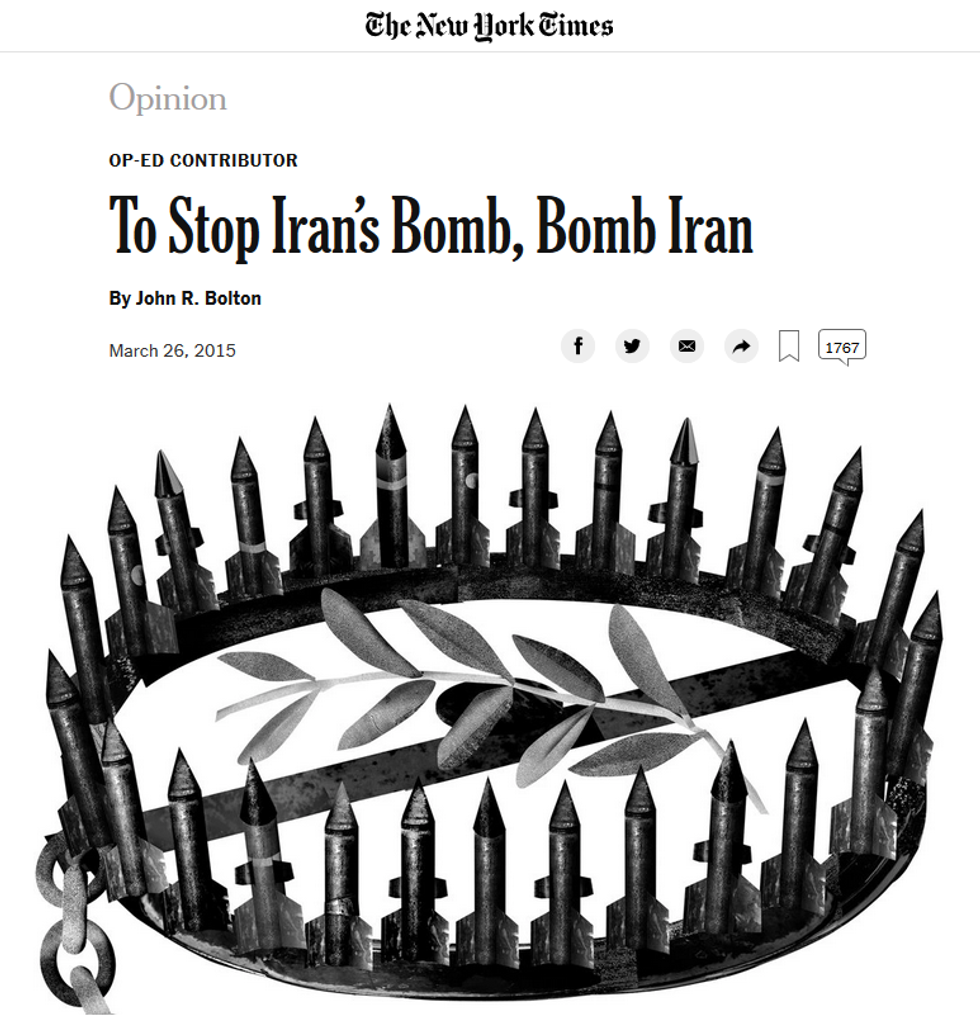
John Bolton openly urged a military attack on Iran (calling for "a thorough job of destruction"--New York Times, 3/26/15), and President Donald Trump went on to appoint him national security advisor. Secretary of State Mike Pompeo said that, you guessed it, "all options" are on the table against Iran, including military ones. Recently Trumprefused to rule out a war against Iran ("I don't want to say no, but hopefully that won't happen").
Surrounding a country with military forces is also a threat. Major US military bases have encircled Iran. The US has ships, jets, drones and tens of thousands of soldiers on Iran's doorstep--surely US media would see it as threatening if Iran deployed comparable forces to Canada, Cuba and the Gulf of Mexico. Further, the US has openly talked about drawing up plans to invade Iran.
The US has gone beyond making threats to actually carrying out attacks against the country. Sponsoring Iraq's 1980 invasion of Iran and helping Iraqi President Saddam Hussein use sarin and mustard gas in that war, as the US did, is one example. Throttling Iran socio-economically, as the US is currently doing, is another.
Nevertheless, US media have persisted in ignoring this long record of US threats and hostile actions against Iran, casting Tehran as the aggressor in its conflict with the US.
The Hill (5/13/19) published an article under the headline, "B-52s Conduct First Mission of Counter-Iran Deployment." The sources for the notion that Iran is doing something that the US needs to "counter" are such impartial observers as a statement released by the US Air Force Central Command (AFCENT) and comments from an AFCENT spokesperson.
The article moved on to treat those claims as if they merited no skepticism, branding the US's intimidation from the sky a "response:":
The B-52s were deployed to Al Udeid Air Base in Qatar last week as part of the US response to what the Trump administration described as "troubling and escalatory indications and warnings" for Iran.
From uncritically repeating the administration's interpretation of Iranian conduct, The Hill went on to absorb that worldview, describing the US sending offensive weaponry to the Gulf as a "response" to some unspecified Iranian action: "As part of the Iran response, the Trump administration also sent the USS Abraham Lincoln carrier strike group to the region."
A Foreign Policy headline (5/13/19) said "US Sends More Firepower to Counter Iran." Apart from the unimpeachable word of the Pentagon, the sole proof offered for the claim that Iran is taking actions in need of "countering" is that
Tehran issued an explicit threat to the Abraham Lincoln, which transited through the Suez Canal. In the past, a US aircraft carrier would be a threat; now, it is a "target," said Amirali Hajizadeh, head of the Revolutionary Guard's air force.
However, the "explicit threat" can be read very differently from the way Foreign Policy suggests. Here are Hajizadeh's remarks, quoted in Al-Jazeera (5/13/19), via the hyperlink in the Foreign Policy article:
"An aircraft carrier that has at least 40 to 50 planes on it and 6,000 forces gathered within it was a serious threat for us in the past. But now it is a target and the threats have switched to opportunities," said Amir Ali Hajizadeh, head of the Revolutionary Guard's air force.
"If [the Americans] make a move, we will hit them in the head," he added, according to the Iranian Students' News Agency (ISNA).
Foreign Policy's article is written as though the second half of Hajizadeh's statement--saying that Iran will defend itself if attacked by the large military force assembled on its borders--didn't exist. It's extremely misleading to call the statement as a whole an "explicit threat."
ABC used the headline (5/24/19) "1,500 More Troops and Defensive Capabilities Headed to Middle East to Deter Iran." How the US sending soldiers to the doorstep of a country that has not attacked it is "defensive," or the evidence of the need to "deter" Iran, goes unexplained, an egregious omission when one considers that there is every reason to doubt US claims that Iran is about to attack the US.

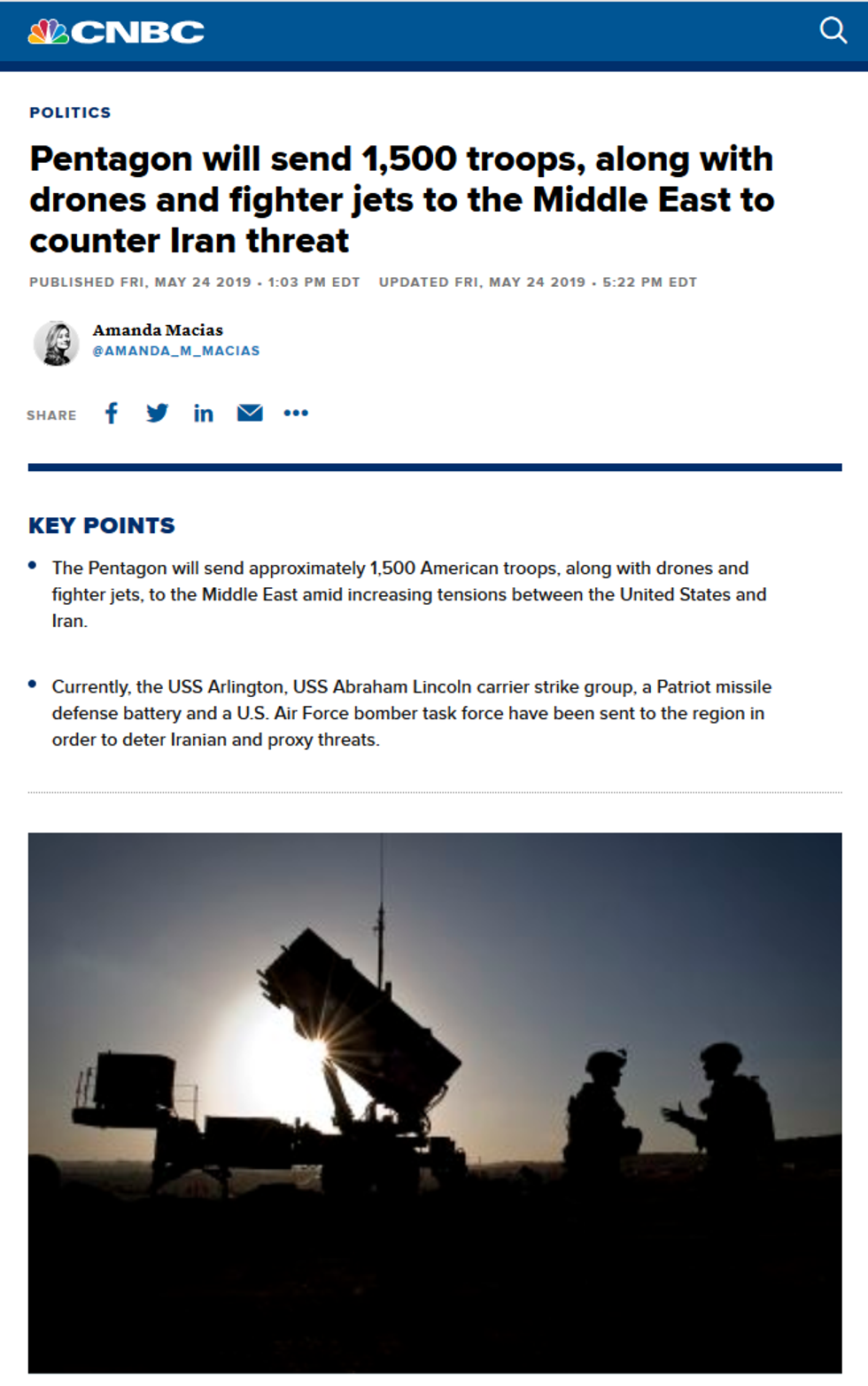
A CNBC headline (5/24/19) told readers that the "Pentagon Will Send 1,500 Troops, Along With Drones and Fighter Jets, to the Middle East to Counter Iran Threat." CNBC presents US officials' justifications for their military maneuvers as though they were facts:
Currently, the USS Arlington, USS Abraham Lincoln carrier strike group, a Patriot missile defense battery and a US Air Force bomber task force have been sent to the region in order to deter Iranian and proxy threats.
Rather than being the debatable claims of US officials, these "Iranian and proxy threats" are presented as flat descriptions of reality. The article functions as a sort of information-laundering service, turning state talking points into neutral pieces of data:
The movement of additional US forces to the Middle East is the Trump administration's latest effort to pressure Tehran over its support for weapons proliferation and extremist groups in the Middle East.
What's most remarkable about this piece is that its next two paragraphs describe US maneuvers that not only constitute a threat against Iran, but actual aggressive actions the US has taken against the country:
Earlier this month, Trump ordered new sanctions placed on Iranian metals, Tehran's largest non-petroleum-related source of export revenue. The US also took aim at Iranian oil by effectively ordering countries worldwide to stop buying Tehran's oil or face sanctions of their own.
Additionally, the US designated Iran's Revolutionary Guard as a terrorist group. Iran responded with threats to close the Strait of Hormuz, where about a third of the world's oil export vessels pass. The US then announced it was expediting the deployment of a carrier strike group equipped with bomber aircraft to the region.
The article says that the US is "counter[ing]" the Iran "threat," but offers no concrete evidence of such a threat. Meanwhile, specific hostile actions the US has taken against the country, including menacing troop movements and US government attempts to subvert the Iranian economy, are not depicted as a US threat against Iran.
Both the ABC and CNBC articles note that Vice Adm. Michael Gilday, the director of the Joint Chiefs of Staff, blamed Iran for attacks on Saudi Arabia's oil infrastructure and for a rocket that landed near the US embassy in Baghdad. Neither piece notes that US officials have said they have no evidence that Iran was behind either drone attacks on the pumping stations or the sabotage of four oil tankers, two of which were Saudi, in the Persian Gulf. Nor did either report inform their readers that the US produced no evidence that Iran was responsible for the rocket in Iraq. (Yemeni Houthis, falsely depicted as pawns of Tehran, said they carried out attacks of Saudi oil pumping stations in retaliation for the Saudi/US/UAE/UK/Canadian invasion and immiseration of Yemen.)
Iran is a threat to US interests in the sense that Iran is a barrier to full-spectrum US domination of the Middle East. But there's no evidence Iran will attack the US, which is how the word "threat" will generally be interpreted by consumers of news media.
The media's false implication that Iran is a danger to the population of the United States makes US escalations against the country appear necessary and justified, and reduces the likelihood that a sufficient number of US citizens will mobilize to stop the potential and actual harm being inflicted in their name.
As military tensions between the U.S. and Iran appeared to be gradually cooling despite dangerous provocations from the White House, President Donald Trump--who said publicly last week that he hopes there is not another war in the Middle East--took to Twitter Sunday to threaten "the official end of Iran," a remark numerous critics condemned as "genocidal."
"If Iran wants to fight, that will be the official end of Iran. Never threaten the United States again!" Trump tweeted, without specifying how Iran threatened the United States.
Matthew Gertz, a senior fellow at Media Matters for America, speculated that Trump's threat was prompted by a Fox News segment on Iran.
The U.S. president's tweet came after a rocket was reportedly fired into Baghdad's fortified Green Zone, about a mile away from the U.S. Embassy in Iraq. There is no evidence that Iran-backed forces were behind the attack, despite reported "suspicions" from Western diplomats.
"President Trump has claimed that he doesn't want war, but his bombastic rhetoric is ensuring that he walks into one."
--Jamal Abdi, National Iranian American Council
Jamal Abdi, president of the National Iranian American Council (NIAC), said in a statement late Sunday that a "similar incident" in Iraq last year "led to Bolton asking the Pentagon for options to militarily strike Iran."
"President Trump's saber-rattling about Iran has reached a dangerous new low with his threat to 'end' Iran--a country of 83 million men, women, and children," Abdi said. "There is no doubt that national security adviser John Bolton will use the slightest Iranian action--even bereft of reliable intelligence--as a pretext to push for the war he's always wanted."
"President Trump has claimed that he doesn't want war, but his bombastic rhetoric is ensuring that he walks into one," Abdi added. "If Trump is sincere about wanting diplomatic compromise, he should cease his policy of economic warfare that is strangling the Iranian people and pursue a tone of mutual respect with Tehran."
Describing Trump's tweet as "genocidal rhetoric," NIAC founder Trita Parsi outlined steps the president should be taking if he actually desires peace with Iran:
Trump's latest threat against Iran came just days after reports on U.S. intelligence challenged the White House narrative of a growing Iranian "threat" in the region, which has been used by American officials like Bolton and Secretary of State Mike Pompeo to justify aggressive posturing in the Persian Gulf.
The president's tweet also came as some corporate media outlets and commentators have portrayed Trump as a lone voice against war with Iran in a White House filled with hawks.
According to the Wall Street Journal, Iranian actions in the Middle East in recent weeks have been defensive moves in response to fears that the U.S. could be planning a military attack.
As Common Dreams reported, Iranian President Hassan Rouhani earlier this month called for diplomacy amid U.S. belligerence and urged new negotiations on the Iran nuclear accord, which Trump unilaterally violated last May.
"Since the president reneged on the Iran nuclear deal last year," said Abdi, "the administration's policies have been geared towards provoking Iran into retaliation to give cover for a perilous escalation favored by administration hawks."
"Simply stated, the current state of heightened tensions between the U.S. and Iran is exclusively due to the policies of the Trump administration, which abandoned a nonproliferation agreement that was working in favor of a so-called 'maximum pressure campaign.'"
The U.S. State Department said Wednesday that it ordered its "non-emergency" staff out of Iraq.
The alert from the department says that the evacuation order affects staff at the U.S. Embassy in Baghdad and the U.S. Consulate in Erbil, who are instructed to "depart Iraq by commercial transportation as soon as possible."
The development is the latest salvo by the Trump administration hawks beating drums for war with Iran.
President Donald Trump reportedly recently reviewed a plan from national security advisor John Bolton to threaten Iran by bending 120,000 troops to Middle East; the U.S. this week accused Iran, sans evidence, for reported attacks on Saudi and UAE oil tankers in the Strait of Hormuz; and Bolton said last week that a scheduled deployment of a bomber task force was meant to send a threat of "unrelenting force" to Iran.
The administration's narrative that there are "identified credible threats" from Iran in Iraq and Syria is not getting global buy-in.
British Maj. Gen. Chris Ghika, speaking from Baghdad, said Tuesday that "there's been no increased threat from Iranian-backed forces" in the region.
"More aggressive moves," however, have been taken--but not by Iran. The New York Times reported:
Intelligence and military officials in Europe as well as in the United States said that over the past year, most aggressive moves have originated not in Tehran, but in Washington--where John R. Bolton, the national security adviser, has prodded President Trump into backing Iran into a corner. [...]
Since May 2018, the Trump administration has withdrawn from the major powers agreement that curbed Iran's nuclear program, reimposed punishing sanctions on Tehran, demanded that allies choose between Iranian oil and doing business in the American market, and declared the Islamic Revolutionary Guards Corps a terrorist organization.
E.U. foreign policy chief Federica Mogherini said Monday that the message Secretary of State Mike Pompeo was delivered in Brussels this week was that "the most responsible attitude to take is, and we believe should be, that of maximum restraint and avoiding any escalation on a military side."
Trump, however, suggested "restraint" was not on the agenda.
Speaking to reporters Monday, the president said, "I'm hearing little stories about Iran. If they do anything they will suffer greatly."
Heidi Hess, co-director of progressive advocacy network CREDO Action, said that the adminstration's stoking of tensions should be met with congressional action.
" Donald Trump is marching the United States toward war in Iran to distract from his mounting scandals and failed administration," she said.
"Congress must assert its authority as the only body empowered to declare war," Hess added, "and prevent Trump from entangling our nation in another endless conflict overseas."
US secretary of state Mike Pompeo made a surprise four-hour visit to Baghdad on Tuesday in connection to the panic he is trying to trump up, along with US national security adviser and Sheldon Adelson plant John Bolton about Iran supposedly planning to attack US troops in the Middle East.
For his part, Iraqi prime minister Adel Abdul Mahdi said in remarks to the press that Iraq will undertake to ensure the safety of the some 5,000 US troops in Iraq, who are helping the Iraqi army mop up ISIL remnants.
At the same time, Abdul Mahdi insisted that Iraq would not participate in any economic boycott of any country, which is to say that he declined to cooperate with the Trump administration's attempts to squeeze Iran.
Iraqi sources said after the visit was over that Bolton offered to give Iraq a temporary waiver with regard to its trade ties with Iran. He may as well, since he is unlikely to get much cooperation from Shiite-ruled Iraq in the blockade on Iran.
The Trump administration has imposed an international financial blockade on Iran trade, which has no UN backing or basis in international law. Iran is in compliance with its obligations under the 2015 nuclear deal, according to UN inspectors. In contrast, the United States has breached that treaty by its blockade.
Tuesday night I watched Iranian president Hassan Rouhani give a speech in which he said that the 2015 nuclear deal is on life support, and that while Iran is not withdrawing from it, it will cease observing some self-limits it had imposed beyond the strict letter of the treaty. Iran will no longer limit enrichment of uranium to 3.67 percent (what is needed to make fuel for generating electricity). It has to be enriched to 95% for a bomb, but every increase above 3.67 percent is a tiny step toward the latter, and concerning to the world community. Rouhani said that Iran may also renovate the heavy water reactor at Arak. Heavy water reactors are much easier to use to make fissile material than light water reactors. I'm confused by this statement, since I thought bricking in the Arak proposed reactor was one of the four cardinal points of the 2015 nuclear deal.
Rouhani's plans are foolish, since they just give ammunition to the US War Party, even though they are not steps toward a bomb.
The only two countries in the greater Middle East who actually have nuclear weapons are Israel and Pakistan. Iran does not, and apparently has never intended to develop such weapons, in part on religious grounds.
Pompeo and Bolton have not only claimed credit for sending a US aircraft carrier battle group to the Gulf but they have also sent four B-52 bombers to al-Udeid Air Force Base in Qatar, in hopes of spooking the Iranians into doing something rash so that they can rally the gullible American public to a war on Iran. Qatar has correct relations with Iran, and this move puts Doha in a difficult position. Iran came to Qatar's aid in 2017 when the Saudis imposed a blockade on it, at a time when Trump was tweeting lies about Qatar and siding with the Saudis.
US intelligence sources leaked to the US press such as The Daily Beast that Bolton and Pompeo are hysterically hyping the intel, which is not as specific or threatening as they are making it out to be.
The practice in journalism is to be cautious about calling people liars, since we cannot know what is in their heads, and what they say may be incorrect but a sincerely held belief. I think George W. Bush, Dick Cheney and the rest of that crew used the reluctance of journalists to call them out as liars to political advantage, and it may have helped Bush win a second term.
So let me be clear. Mike Pompeo and John Bolton are known, serial, dedicated liars. Bolton helped lie the US into the Iraq War. Pompeo assiduously lied about the Benghazi affair. Nothing they say about Iran should be given any credence whatsoever.
The American security establishment has seldom actually understood the relationship of Iran to Iraq's Shiites. For the 8.5 years the Pentagon occupied Iraq, mostly in the Bush era, US government personnel were absolutely convinced that Shiite leader Muqtada al-Sadr was a cat's paw for Iran. But the al-Sadrs think of themselves as arch Iraqi nationalists and Muqtada's father had contested the top clerical post in Iraq with the Iranian Ali Sistani. Muqtada's followers, poor Iraqis of the cities and the south, deeply resent Iranian influence in Iraq.
On the other hand, al-Sadr is a staunch anti-imperialist, who has said that if the US ever attacked Iran, his followers would defend it. In fact, al-Sadr is upset about the US pressure on Iraq to stop doing business with Iran, and said in late April that if Iraq was going to be put in the middle of Washington and Tehran, it was better that the US embassy be closed and the US kicked out of Iraq.
Iraq does billions of dollars in trade with Iran and depends on that country for electricity in some provinces.
Al-Sadr's Sairoun Party has 54 seats in the 329-seat parliament and was a power broker who helped ease the current prime minister, Adel Abdul Mahdi, into power.
Bush's illegal war of aggression on Iraq is the gift that keeps on giving to the US fascists, since there are ways in which it now sets up Iran for similar treatment. I heard a congressman speaking on tv who had served in Iraq estimate that one-fifth of US troops killed in Iraq were killed by Iran or Iran proxies. That is such a bullshit statistic. There were never any Iranian troops in Iraq in that period, and many US troops who were killed by Shiite militias were killed by Sadrists or radical offshoots of Sadrism, which is to say, by Shiite Iraq nationalists who also disliked Iran (one group burned down the Iranian consulate in Basra). The US military also had this mysterious theory that Iraqi Sunnis could not use shaped charges against US tanks, and tended to count all shaped charge attacks as Iranian, even in al-Anbar province where there are no Shiites to speak of. The US invaded Iraq on the theory that its Sunni-dominated government was 2 years from having a nuclear weapon, but Iraqi Sunnis can't get up a shaped charge, a technology that goes back to WW II?
Besides, no US troops would have been killed at all if the then president had not given them an illegal order to go occupy somebody else's country. Using the fact that they faced resistance to this neocolonialism to stage more neocolonialism is fiendishly clever.
The Americans also assumed that Iraqi Shiites voted for fundamentalist parties because of Iranian influence on the elections, but the Da'wa (Islamic Call Party), which generally did well, was a longstanding Iraqi Shiite party representing the professional middle class and which rejected Khomeinism. Iraqis had their own reasons for voting as the did.
Ironically, the Shiite militia that the US generally got along with was the Badr Corps, which is more or less a branch of the Iranian Revolutionary Guards.
It was pro-Iran Iraqi Shiite militias, helped by small numbers of advisers from the Iranian Revolutionary Guards Corps, who did a lot of heavy lifting in defeating ISIL after the US-built Iraqi army collapsed, and it seems clear that despite denials on both sides, the US occasionally gave them air support. But Iran would have a right to be annoyed with the US for policies that led to the rise of ISIL on its borders in the first place.
Bolton and Pompeo and Trump don't actually know anything about the Middle East nor do they care about the welfare of its people. Bolton and Pompeo are warmongers and like the idea of bullying Iran, and they are also closely tied to the fascist Likud Party in Israel, which has been plumping for a war on Iran for decades. Pompeo is in the back pocket of the Koch brothers Big Oil lobby, which would benefit from higher prices if there is trouble with Iran.