SUBSCRIBE TO OUR FREE NEWSLETTER
Daily news & progressive opinion—funded by the people, not the corporations—delivered straight to your inbox.
5
#000000
#FFFFFF
To donate by check, phone, or other method, see our More Ways to Give page.
Daily news & progressive opinion—funded by the people, not the corporations—delivered straight to your inbox.
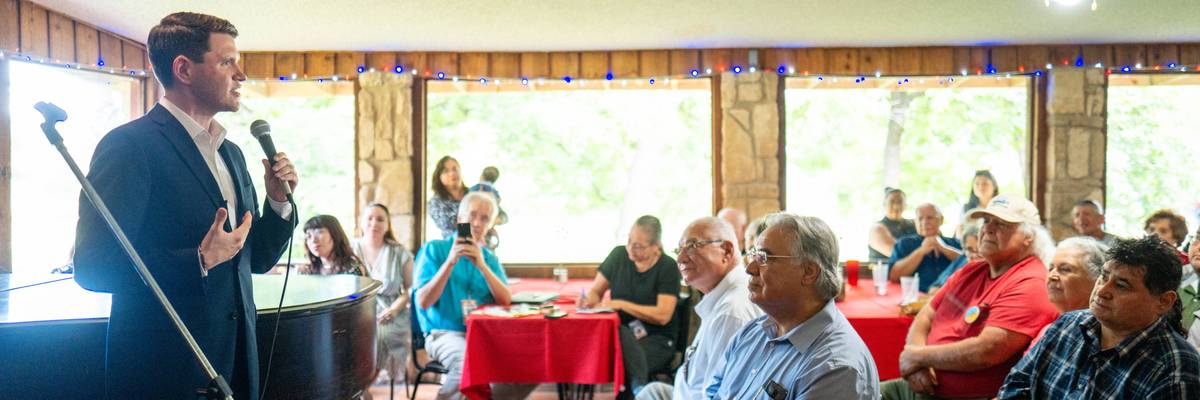
Democratic US Senate candidate James Talarico speaks during a “Talarico for Texas: Frontera Tour” campaign rally at Memo’s Restaurant on July 13, 2026 in Del Rio, Texas.
"The top 1% put the American Dream behind a paywall," said the Texas Democrat as he unveiled a framework for his economic vision.
Politicians from both sides of the aisle have come to realize in recent years that "affordability" and "cost of living" are key issues voters want to hear about on the campaign trail, with nearly all respondents to a Harris Poll last month reporting they believe the US is currently in an affordability crisis.
But on Wednesday, before 1,300 Texans in the city of Arlington, state Rep. James Talarico (D-50), the Democratic US Senate candidate, contextualized the crisis for voters.
Talarico provided a history lesson that explained how—while his opponent, Attorney General Ken Paxton, has blamed the Biden administration for rising costs and the struggles of working Texans—"this affordability crisis isn't something that happened over the last five years. This affordability crisis has been 50 years in the making."
While introducing his economic platform, "The New American Dream," Talarico held the audience's attention as he explained the Powell Memo—a document formally titled “Attack on American Free Enterprise System,” which Virginia-based corporate lawyer Lewis Powell wrote in 1971 for his client, the US Chamber of Commerce.
The memo, said Talarico, provided "a blueprint for how corporations could amass political power, reverse the gains of the Great Society and the New Deal, and rig the system for themselves."
"The Powell memo outlined a strategy. Unite corporate special interests, privilege corporate perspectives in the media, appoint sympathetic judges to the court, and buy politicians in both political parties," continued Talarico. "And it worked. Republicans and some Democrats sold the false gospel of trickle-down economics."
.@JamesTalarico: 50 years ago, a corporate lawyer named Lewis Powell circulated a memo around DC — a blueprint for how corporations could amass political power, reverse the gains of the Great Society and the New Deal, and rig the system for themselves.
The Powell memo outlined a… pic.twitter.com/ne7f23iXP3
— Team Talarico (@TeamTalaricoHQ) August 6, 2026
In the memo, Powell—who was appointed to the US Supreme Court by President Richard Nixon just months after he delivered the blueprint to the powerful Chamber of Commerce—outlined how the interests of corporate America should be framed as "individual freedom" that the country must protect.
Private companies should use political influence "aggressively and with determination" to stop "the stampedes by politicians to support any legislation related to 'consumerism' or to the 'environment,'" wrote Powell, and should show no "reluctance to penalize politically those who oppose” the corporate effort.
“Strength lies in organization, in careful long-range planning and implementation, in consistency of action over an indefinite period of years, in the scale of financing available only through joint effort, and in the political power available only through united action and national organizations," the memo argued.
"Trickle-down economics is not a theory, it is theft."
The result of that "long-range planning" and "consistency of action over an indefinite period of years," said Talarico, is the current political system—in which corporate interests pour billions of dollars into elections to support favorable candidates, Congress passes massive tax breaks for billionaires, and working families are left struggling to afford healthcare, childcare, and other essentials.
"Trickle-down economics is not a theory, it is theft," he said. "Since the late 1970s, megadonors and corporate special interests have been buying politicians in both political parties. And then those politicians turned around and rigged the economy to benefit their wealthy donors at our expense. We have an affordability crisis because we have a corruption crisis."
He added that five decades after the Powell Memo, "the top 1% put the American Dream behind a paywall"—pointing to the extreme wealth of tech CEOs like Amazon founder Jeff Bezos and SpaceX CEO Elon Musk, while "one in five Texas children live in poverty."
The American Dream has become an American Nightmare.
It’s too expensive to buy a home.
It’s too expensive to get married and have kids.
It’s too expensive to retire comfortably.
The top 1% put the American Dream behind a paywall. pic.twitter.com/gfhM2weVY0
— James Talarico (@jamestalarico) August 6, 2026
David Sirota of The Lever, whose team produced the award-winning 2024 podcast "Master Plan," which details the history and influence of the Powell Memo, applauded Talarico for speaking directly to voters about the long history behind today's "affordability crisis."
"Talarico is recounting—and promising to fight—the master plan that we exposed. And he’s making that promise in one of America’s most high-profile Senate races," said Sirota.
Talarico's event in Arlington marked the beginning of a monthlong tour across Texas in which he plans to roll out his plans to begin reversing the decades of damage done by the Powell Memo and politicians from both major parties who have prioritized corporate interests over working Americans.
The candidate's agenda includes raising the minimum wage; closing billionaire tax loopholes and ending tax breaks for the top 1% of earners in President Donald Trump's One Big Beautiful Bill Act; passing universal childcare; permanently expanding the child tax credit; passing an anti-corruption package to ban super political action committees; and providing down payment assistance for first-time home buyers.
"People are working hard every day," said Talarico. "They're playing by the rules. But those rules of today weren't written for us. They were written for billionaires."
Dear Common Dreams reader, It’s been nearly 30 years since I co-founded Common Dreams with my late wife, Lina Newhouser. We had the radical notion that journalism should serve the public good, not corporate profits. It was clear to us from the outset what it would take to build such a project. No paid advertisements. No corporate sponsors. No millionaire publisher telling us what to think or do. Many people said we wouldn't last a year, but we proved those doubters wrong. Together with a tremendous team of journalists and dedicated staff, we built an independent media outlet free from the constraints of profits and corporate control. Our mission has always been simple: To inform. To inspire. To ignite change for the common good. Building Common Dreams was not easy. Our survival was never guaranteed. When you take on the most powerful forces—Wall Street greed, fossil fuel industry destruction, Big Tech lobbyists, and uber-rich oligarchs who have spent billions upon billions rigging the economy and democracy in their favor—the only bulwark you have is supporters who believe in your work. But here’s the urgent message from me today. It's never been this bad out there. And it's never been this hard to keep us going. At the very moment Common Dreams is most needed, the threats we face are intensifying. We need your support now more than ever. We don't accept corporate advertising and never will. We don't have a paywall because we don't think people should be blocked from critical news based on their ability to pay. Everything we do is funded by the donations of readers like you. When everyone does the little they can afford, we are strong. But if that support retreats or dries up, so do we. Will you donate now to make sure Common Dreams not only survives but thrives? —Craig Brown, Co-founder |
Politicians from both sides of the aisle have come to realize in recent years that "affordability" and "cost of living" are key issues voters want to hear about on the campaign trail, with nearly all respondents to a Harris Poll last month reporting they believe the US is currently in an affordability crisis.
But on Wednesday, before 1,300 Texans in the city of Arlington, state Rep. James Talarico (D-50), the Democratic US Senate candidate, contextualized the crisis for voters.
Talarico provided a history lesson that explained how—while his opponent, Attorney General Ken Paxton, has blamed the Biden administration for rising costs and the struggles of working Texans—"this affordability crisis isn't something that happened over the last five years. This affordability crisis has been 50 years in the making."
While introducing his economic platform, "The New American Dream," Talarico held the audience's attention as he explained the Powell Memo—a document formally titled “Attack on American Free Enterprise System,” which Virginia-based corporate lawyer Lewis Powell wrote in 1971 for his client, the US Chamber of Commerce.
The memo, said Talarico, provided "a blueprint for how corporations could amass political power, reverse the gains of the Great Society and the New Deal, and rig the system for themselves."
"The Powell memo outlined a strategy. Unite corporate special interests, privilege corporate perspectives in the media, appoint sympathetic judges to the court, and buy politicians in both political parties," continued Talarico. "And it worked. Republicans and some Democrats sold the false gospel of trickle-down economics."
.@JamesTalarico: 50 years ago, a corporate lawyer named Lewis Powell circulated a memo around DC — a blueprint for how corporations could amass political power, reverse the gains of the Great Society and the New Deal, and rig the system for themselves.
The Powell memo outlined a… pic.twitter.com/ne7f23iXP3
— Team Talarico (@TeamTalaricoHQ) August 6, 2026
In the memo, Powell—who was appointed to the US Supreme Court by President Richard Nixon just months after he delivered the blueprint to the powerful Chamber of Commerce—outlined how the interests of corporate America should be framed as "individual freedom" that the country must protect.
Private companies should use political influence "aggressively and with determination" to stop "the stampedes by politicians to support any legislation related to 'consumerism' or to the 'environment,'" wrote Powell, and should show no "reluctance to penalize politically those who oppose” the corporate effort.
“Strength lies in organization, in careful long-range planning and implementation, in consistency of action over an indefinite period of years, in the scale of financing available only through joint effort, and in the political power available only through united action and national organizations," the memo argued.
"Trickle-down economics is not a theory, it is theft."
The result of that "long-range planning" and "consistency of action over an indefinite period of years," said Talarico, is the current political system—in which corporate interests pour billions of dollars into elections to support favorable candidates, Congress passes massive tax breaks for billionaires, and working families are left struggling to afford healthcare, childcare, and other essentials.
"Trickle-down economics is not a theory, it is theft," he said. "Since the late 1970s, megadonors and corporate special interests have been buying politicians in both political parties. And then those politicians turned around and rigged the economy to benefit their wealthy donors at our expense. We have an affordability crisis because we have a corruption crisis."
He added that five decades after the Powell Memo, "the top 1% put the American Dream behind a paywall"—pointing to the extreme wealth of tech CEOs like Amazon founder Jeff Bezos and SpaceX CEO Elon Musk, while "one in five Texas children live in poverty."
The American Dream has become an American Nightmare.
It’s too expensive to buy a home.
It’s too expensive to get married and have kids.
It’s too expensive to retire comfortably.
The top 1% put the American Dream behind a paywall. pic.twitter.com/gfhM2weVY0
— James Talarico (@jamestalarico) August 6, 2026
David Sirota of The Lever, whose team produced the award-winning 2024 podcast "Master Plan," which details the history and influence of the Powell Memo, applauded Talarico for speaking directly to voters about the long history behind today's "affordability crisis."
"Talarico is recounting—and promising to fight—the master plan that we exposed. And he’s making that promise in one of America’s most high-profile Senate races," said Sirota.
Talarico's event in Arlington marked the beginning of a monthlong tour across Texas in which he plans to roll out his plans to begin reversing the decades of damage done by the Powell Memo and politicians from both major parties who have prioritized corporate interests over working Americans.
The candidate's agenda includes raising the minimum wage; closing billionaire tax loopholes and ending tax breaks for the top 1% of earners in President Donald Trump's One Big Beautiful Bill Act; passing universal childcare; permanently expanding the child tax credit; passing an anti-corruption package to ban super political action committees; and providing down payment assistance for first-time home buyers.
"People are working hard every day," said Talarico. "They're playing by the rules. But those rules of today weren't written for us. They were written for billionaires."
Politicians from both sides of the aisle have come to realize in recent years that "affordability" and "cost of living" are key issues voters want to hear about on the campaign trail, with nearly all respondents to a Harris Poll last month reporting they believe the US is currently in an affordability crisis.
But on Wednesday, before 1,300 Texans in the city of Arlington, state Rep. James Talarico (D-50), the Democratic US Senate candidate, contextualized the crisis for voters.
Talarico provided a history lesson that explained how—while his opponent, Attorney General Ken Paxton, has blamed the Biden administration for rising costs and the struggles of working Texans—"this affordability crisis isn't something that happened over the last five years. This affordability crisis has been 50 years in the making."
While introducing his economic platform, "The New American Dream," Talarico held the audience's attention as he explained the Powell Memo—a document formally titled “Attack on American Free Enterprise System,” which Virginia-based corporate lawyer Lewis Powell wrote in 1971 for his client, the US Chamber of Commerce.
The memo, said Talarico, provided "a blueprint for how corporations could amass political power, reverse the gains of the Great Society and the New Deal, and rig the system for themselves."
"The Powell memo outlined a strategy. Unite corporate special interests, privilege corporate perspectives in the media, appoint sympathetic judges to the court, and buy politicians in both political parties," continued Talarico. "And it worked. Republicans and some Democrats sold the false gospel of trickle-down economics."
.@JamesTalarico: 50 years ago, a corporate lawyer named Lewis Powell circulated a memo around DC — a blueprint for how corporations could amass political power, reverse the gains of the Great Society and the New Deal, and rig the system for themselves.
The Powell memo outlined a… pic.twitter.com/ne7f23iXP3
— Team Talarico (@TeamTalaricoHQ) August 6, 2026
In the memo, Powell—who was appointed to the US Supreme Court by President Richard Nixon just months after he delivered the blueprint to the powerful Chamber of Commerce—outlined how the interests of corporate America should be framed as "individual freedom" that the country must protect.
Private companies should use political influence "aggressively and with determination" to stop "the stampedes by politicians to support any legislation related to 'consumerism' or to the 'environment,'" wrote Powell, and should show no "reluctance to penalize politically those who oppose” the corporate effort.
“Strength lies in organization, in careful long-range planning and implementation, in consistency of action over an indefinite period of years, in the scale of financing available only through joint effort, and in the political power available only through united action and national organizations," the memo argued.
"Trickle-down economics is not a theory, it is theft."
The result of that "long-range planning" and "consistency of action over an indefinite period of years," said Talarico, is the current political system—in which corporate interests pour billions of dollars into elections to support favorable candidates, Congress passes massive tax breaks for billionaires, and working families are left struggling to afford healthcare, childcare, and other essentials.
"Trickle-down economics is not a theory, it is theft," he said. "Since the late 1970s, megadonors and corporate special interests have been buying politicians in both political parties. And then those politicians turned around and rigged the economy to benefit their wealthy donors at our expense. We have an affordability crisis because we have a corruption crisis."
He added that five decades after the Powell Memo, "the top 1% put the American Dream behind a paywall"—pointing to the extreme wealth of tech CEOs like Amazon founder Jeff Bezos and SpaceX CEO Elon Musk, while "one in five Texas children live in poverty."
The American Dream has become an American Nightmare.
It’s too expensive to buy a home.
It’s too expensive to get married and have kids.
It’s too expensive to retire comfortably.
The top 1% put the American Dream behind a paywall. pic.twitter.com/gfhM2weVY0
— James Talarico (@jamestalarico) August 6, 2026
David Sirota of The Lever, whose team produced the award-winning 2024 podcast "Master Plan," which details the history and influence of the Powell Memo, applauded Talarico for speaking directly to voters about the long history behind today's "affordability crisis."
"Talarico is recounting—and promising to fight—the master plan that we exposed. And he’s making that promise in one of America’s most high-profile Senate races," said Sirota.
Talarico's event in Arlington marked the beginning of a monthlong tour across Texas in which he plans to roll out his plans to begin reversing the decades of damage done by the Powell Memo and politicians from both major parties who have prioritized corporate interests over working Americans.
The candidate's agenda includes raising the minimum wage; closing billionaire tax loopholes and ending tax breaks for the top 1% of earners in President Donald Trump's One Big Beautiful Bill Act; passing universal childcare; permanently expanding the child tax credit; passing an anti-corruption package to ban super political action committees; and providing down payment assistance for first-time home buyers.
"People are working hard every day," said Talarico. "They're playing by the rules. But those rules of today weren't written for us. They were written for billionaires."