

SUBSCRIBE TO OUR FREE NEWSLETTER
Daily news & progressive opinion—funded by the people, not the corporations—delivered straight to your inbox.
5
#000000
#FFFFFF
To donate by check, phone, or other method, see our More Ways to Give page.
Daily news & progressive opinion—funded by the people, not the corporations—delivered straight to your inbox.
Inga Sarda-Sorensen
Director of Communications
(Office) 646.358.1463
(Cell) 202.641.5592
isorensen@theTaskForce.org
The National Gay and Lesbian Task Force Action Fund again
calls for immediate repeal of the federal "Defense of Marriage Act."
The Task Force Action Fund also denounces the egregious language used
by the Department of Justice in its recent brief seeking to dismiss a
challenge to DOMA.
Statement by Rea Carey, Executive Director
National Gay and Lesbian Task Force Action Fund
"DOMA is and has always been an immoral attack on same-sex couples,
our families and our fundamental humanity. This law has only served to
discriminate against Americans and belittle our nation's heralded
values embracing freedom, fairness and justice. The Task Force Action
Fund demands President Obama and Congress immediately repeal this
hateful law, which has left a moral scar on our nation and its worthy
pursuit of equal justice for all.
"Unfortunately, the malicious and outrageous arguments and language
used in the Department of Justice's marriage brief is only serving to
inflame and malign the humanity of same-sex couples and our families.
This is unacceptable.
"This ugly chapter in our nation's history must come to an end now with the repeal of DOMA."
The National LGBTQ Task Force advances full freedom, justice and equality for LGBTQ people. We are building a future where everyone can be free to be their entire selves in every aspect of their lives. Today, despite all the progress we've made to end discrimination, millions of LGBTQ people face barriers in every aspect of their lives: in housing, employment, healthcare, retirement, and basic human rights. These barriers must go. That's why the Task Force is training and mobilizing millions of activists across our nation to deliver a world where you can be you. Join us!
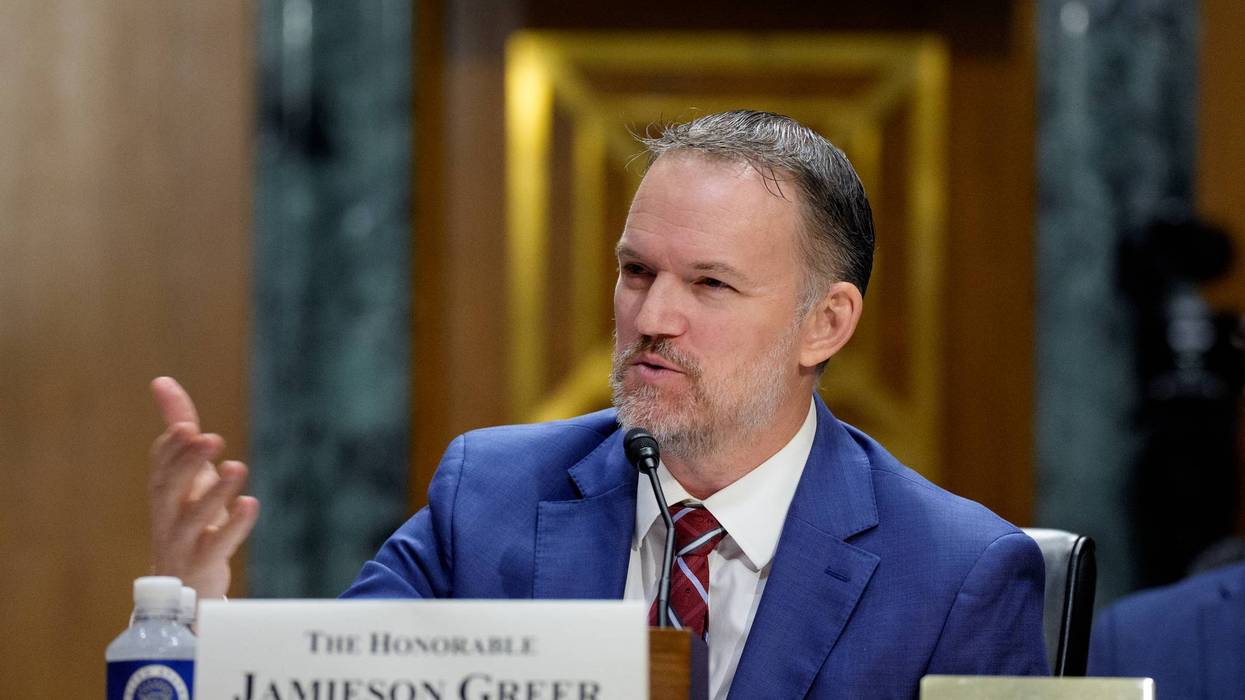
"These new tariffs are more of the same: a nationwide sales tax that will make life even harder for families already struggling under the costs of Trump’s reckless war in Iran."
President Donald Trump on Thursday unveiled a new package of tariffs targeting 60 countries that account for over 99% of US imports, a move that—if upheld in court—would cost Americans an estimated $100 billion per year in the form of higher costs.
The duties, ranging from 10% to 12.5%, were announced as part of the president's effort to maneuver around repeated court rulings against his sweeping tariffs, including by the conservative-dominated US Supreme Court. Jamieson Greer, the Trump administration's top trade official, pointed to Section 301 of the Trade Act of 1974 to justify the new tariffs, introduced with the purported goal of penalizing countries "for their failure to impose and effectively enforce a prohibition on the importation of goods produced with forced labor."
Observers questioned the administration's pretext. "Magically, the US tariff probe on forced labor practices is done perfectly in time to replace the generalized but expiring Section 122 tariffs," noted Bloomberg's Josh Wingrove, referring to the legal authority Trump cited for earlier tariffs.
Rep. Mike Levin (D-Calif.) acknowledged that "Section 301 is a law Congress passed," but added, "What was passed in 1974 was authority to respond to specific unfair trade practices after investigation."
"What is being done with it now is a tariff on 99% of American trade, set by Trump, with no expiration, no vote, and no ceiling," said Levin. "If a delegation that broad is lawful, then the tariff power in Article I means very little. The Supreme Court struck down the last version of this policy in February. The response was to avoid Congress and find a different statute and rebuild substantially the same tariffs, effective the same minute the old ones lapsed."
The list of countries targeted by the Section 301 tariffs includes Canada, Australia, Brazil, China, Mexico, Russia, Norway, the United Kingdom, and Vietnam.
Between the start of his second administration and January 2026, Trump's tariffs cost American families $1,700 each on average as importers passed burdens onto consumers in the form of higher prices. The tariffs have also hammered small businesses, increased hardship for farmers, and failed to arrest the decline of American manufacturing jobs.
The Progressive Policy Institute said Thursday that the new tariffs would "likely cost Americans $100 billion a year" collectively—though the group's trade director, Ed Gresser, said the administration's order "looks vulnerable to challenge, and courts would have good reason to strike it down."
"Its vague claims about forced labor abroad do not hold up," said Gresser. "Constitutionally, it is likely impermissible as an attempt to use a law designed for problem-solving abroad to impose a general tariff increase. And legally, Section 301 requires administrations to demonstrate ‘unreasonable acts, policies, or practices’ which impose a burden on US commerce, which this executive order fails to do. While making emotive claims about forced labor, it neither presents evidence that the listed countries are buying goods made with the use of forced labor, nor demonstrates that if they were, this would impose the statutorily required ‘burden on US commerce.’"
Rep. Brendan Boyle (D-Pa.), the top Democrat on the House Budget Committee, said in a statement that "these new tariffs are more of the same: a nationwide sales tax that will make life even harder for families already struggling under the costs of Trump’s reckless war in Iran."

"The October 2025 ceasefire has led to measurable gains in humanitarian access and overall conditions across the Gaza Strip. However, the situation remains deeply fragile."
Although the Gaza Strip is no longer officially enduring famine, a majority of Palestinians there are suffering "crisis or worse" levels of hunger in an emergency that is expected to worsen in the coming months if Israel's bombardment and siege—which many experts say is a key component of an ongoing genocide—continue.
The Integrated Phase Food Security Classification—which ranks food security levels on a scale of 1 to 5—on Thursday published an analysis showing that from mid-April to the end of June, more than 1.2 million people, or 59% of Gaza’s population, were experiencing IPC Phase 3 (crisis) or worse levels of food insecurity. This included about 212,000 people in IPC Phase 4 (emergency). All five Gaza governorates were classified as being in Phase 3.
"After two years of conflict, the October 2025 ceasefire has led to measurable gains in humanitarian access and overall conditions across the Gaza Strip," IPC said in a statement. "However, the situation remains deeply fragile, with civilians continuing to endure harsh conditions."
#Gaza Strip The Oct 2025 ceasefire has led to measurable gains in humanitarian access & conditions across the Gaza Strip, yet the situation remains deeply fragile. 1.4 million people are facing high levels of acute food insecurity through Dec 2026. More: www.ipcinfo.org/ipcinfo-webs...
[image or embed]
— The Integrated Food Security Phase Classification (@theipcinfo.bsky.social) July 23, 2026 at 5:43 AM
This marks an improvement from a year ago, when a "worst-case scenario" was developing into a Phase 5 (catastrophe) famine that was formally declared by the IPC in August 2025. At least hundreds of Palestinians, many of them children, have died from malnutrition since Israel launched its US-backed war on Gaza in retaliation for the Hamas-led attack of October 7, 2023.
The IPC declared last December that while Gaza was no longer in a famine, the situation remained critical for the war-ravaged Palestinians there. The new IPC report warns that two-thirds of Gaza's population are projected to face Phase 3 crisis conditions by the end of the year.
The organization also said that 74,200 Palestinian children under the age of 5 in Gaza will likely need treatment for acute malnutrition through next April.
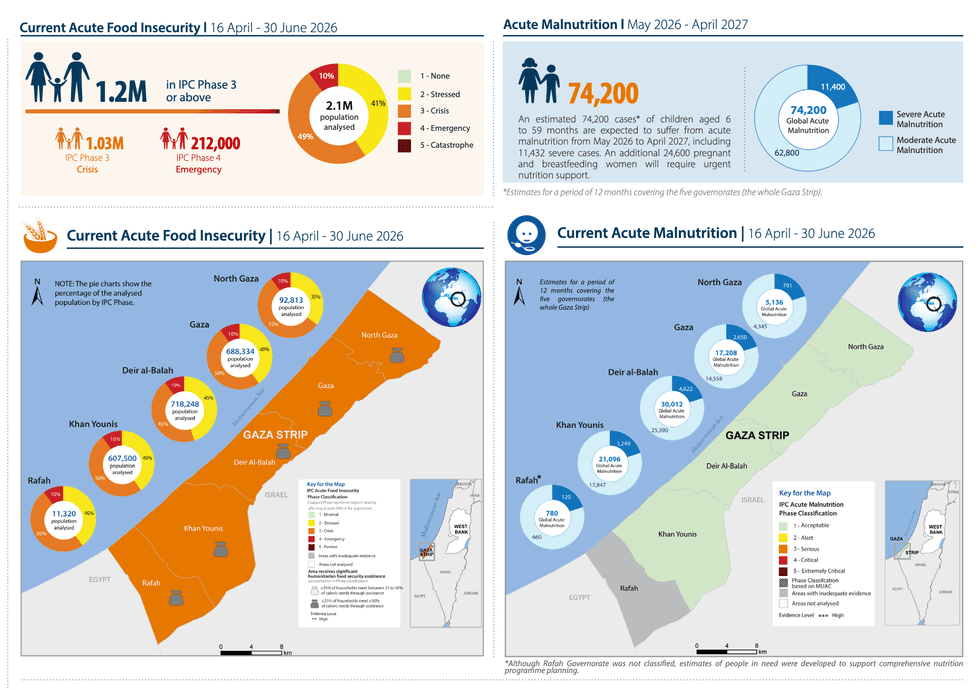 (Image by Integrated Phase Food Security Classification)
Responding to the new IPC data, United Nations Children's Fund Executive Director Catherine Russell said Thursday that “acute malnutrition has fallen, but many children are still going hungry, and some children may never fully recover from prolonged lack of proper nutrition."
"This progress shows that when humanitarian access improves and aid gets through, children can be pulled back from the brink," she added. "But it rests on a supplementary feeding program that doesn’t reach all children, and where funding is running out."
Israeli forces have killed or wounded more than 250,000 Palestinians since then, and forcibly displaced, starved, or sickened over 2 million others since then, resulting in worldwide allegations of genocide embodied in an International Court of Justice case filed by South Africa at the end of 2023 and now formally supported by nearly 20 nations.
Leading global famine experts accused Israel of deliberately starving Palestinians in Gaza. The International Criminal Court arrest warrants issued in late 2024 for Israeli Prime Minister Benjamin Netanyahu and Yoav Gallant, his former defense minister who ordered the "complete siege" of Gaza, accuse the pair of crimes against humanity and war crimes, including murder and forced starvation.
Like many members of their public, Israeli and US officials under both the Biden and Trump administrations initially denied that Israel was starving Gazans. However, Israeli officials warned in private that Gaza was facing starvation, while US President Donald Trump, Vice President JD Vance, and other administration figures have acknowledged that Palestinians were starving to death in the strip. That did not stop them from continuing to give billions of dollars in US armed aid to Israel.
In response to the new IPC report, acting United Nations World Food Program Executive Director Carl Skau said that “there is progress on food security in Gaza, but it is fragile and can easily be reversed."
"The overall humanitarian situation remains brutal: Families lack water, sanitation, and medicine," Skau added. "We need sustained access, funding, and stability so people of Gaza can begin recovery.”
The heads of various United Nations agencies concurred that a lasting peace—which Israel is not allowing as it continues bombing and besieging Gaza despite a nominal nine-month ceasefire—is imperative for that recovery.
“Food security in Gaza cannot recover unless local food production starts again and farmers, herders, fishers, and other producers can rebuild their livelihoods,” UN Food and Agriculture Organization Director-General Qu Dongyu said on Thursday. “Producers need access to farmland and the sea, and to seeds, tools, livestock supplies, and other agricultural inputs, as well as technical support."
"Restrictions on agricultural imports and humanitarian supplies must be lifted," Qu added. "Without these essentials, food production, and security will remain a pressing situation."
The IPC said that "recent gains remain fragile," and that "advancing peace plans is essential to support recovery, enable the safe return of displaced populations, and help households rebuild their livelihoods."
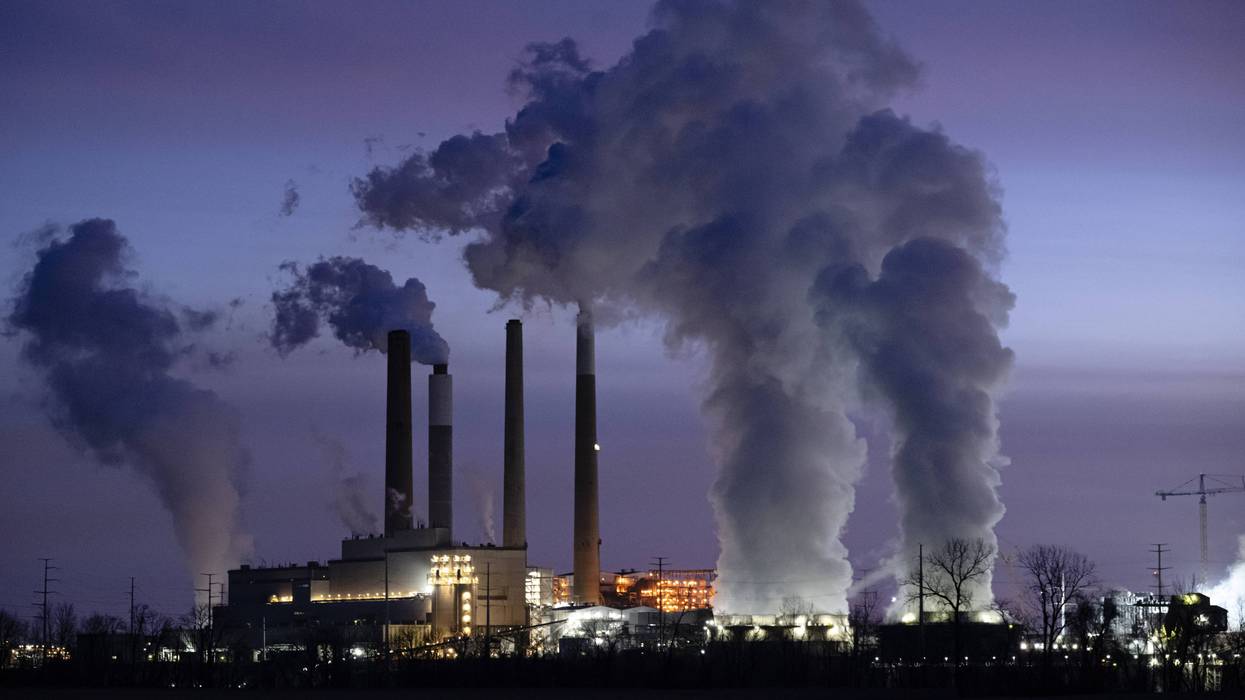
One critic of the president recently said that he's "forcing higher power bills" on Americans while "fattening the wallets of his cronies—all with billions of our tax dollars."
President Donald Trump's administration has dedicated over $1 billion to boosting the coal industry, and on Thursday announced a report about reserves beneath federally managed public lands, with Interior Secretary Doug Burgum claiming that the polluting fossil fuel "is more important than ever to the production of electricity."
The US Geological Survey (USGS) publication, titled Coal Beneath Federal Lands in the United States—Mines, Reserves, and Resources, says that "in 2024, the 34 coal mines on Federal lands produced more than 261 million short tons of coal." A short ton, the standard unit of measurement for coal in the United States, is equal to 2,000 lbs.
"These 34 coal mines control more than 4.2 billion short tons of reported coal reserves. Most of the coal mines (31) and more than 98% of the reported coal reserves are on federal lands west of the Mississippi River," according to the report. "Of all the states, Wyoming has the most coal mines on federal lands (14) and produces the most coal from federal lands."
"The USGS estimates that more than 355 billion short tons of available coal resources remain beneath federal lands in the conterminous United States," the document details. "Alaska contains substantial quantities of coal resources. The USGS estimates that Alaska has at least 140 billion short tons of identified available coal resources but may ultimately have as much as 5.5 trillion short tons of coal resources."
A US Department of the Interior statement announcing the report highlights that if the reserves accounted for in the document were produced, "that would be enough coal to supply all the nation’s needs for at least 600 years at the current rate of consumption."
Scientists have long argued that the international community must stop burning coal—plus oil and gas—to prevent a worst-case scenario future as the planet's inhabitants already face a fossil fuel-driven climate emergency and its related extreme weather.
However, climate crisis-denying Trump—who returned to the White House backed by Big Oil's campaign cash—and his Cabinet have spent his second term pushing polluting sources of energy, particularly as his illegal war on Iran drives up global prices, with oil surpassing $100 per barrel on Thursday.
Staying on message, Burgum declared in Interior's Thursday statement that "American Energy Dominance is more important than ever, and so is beautiful clean coal's role in the production of electricity needed to fuel our future prosperity."
"Thanks to the USGS's rigorous and independent assessment, we're better equipped to manage America's vast public lands responsibly while supporting energy security and economic opportunity," he continued.
Sharing the statement on the social media platform Bluesky Thursday, science journalist Emily Willingham said, "What an abuse of the USGS, the environment, and our intellects."
An ore deposit geologist named Elizabeth also ripped the statement on Bluesky, writing: "There is a lot messed up with this press release, but the thing that bothers me the most is how poorly it is written. What an embarrassment!"
The USGS report came just two days after the Energy and Labor departments signed a memorandum of understanding (MOU) creating a framework to accelerate the deployment of artificial intelligence, automation, and other emerging technologies in the mining sector.
Acting Secretary of Labor Keith Sonderling said, "It is our commitment to you that this MOU will further President Trump's promise to restore coal as a key driver of America’s energy supply chain and American coal will again be the envy of the world for generations to come."
While attacking clean energy initiatives, including offshore wind projects, the administration "has bolstered coal, the dirtiest and most expensive fossil fuel," The Guardian reported earlier this month.
According to the newspaper:
In September, the Department of Energy announced it would spend $625 million to "expand and extend the life of" coal-fired power plants, allocating $350 million to "modernize" coal plants, $175 million to fund coal projects powering rural communities, and $50 million to upgrade wastewater management systems to extend coal plants' lifespans.
Last month, the agency also set aside up to $500 million from the Defense Production Act to “expand and reinvigorate” the capacity of 13 coal plants, and to help build a coal export terminal in Oakland, California. A week later, the department announced an additional $3.6 million to "refurbish or retrofit" nine existing coal plants.
Former Democratic Washington Gov. Jay Inslee, a climate advocate and Trump critic, told the paper that the president is "forcing higher power bills" on Americans "by blocking clean energy, then he's fattening the wallets of his cronies—all with billions of our tax dollars."
"We pay more," he said, "Republicans rubber-stamp it, and Trump's donors walk off with the bag."

Not only was the press release fake, but Republican Mike Rogers didn't even endorse El-Sayed.
With less than two weeks before the critical Democratic Senate primary in Michigan, Rep. Haley Stevens is reportedly resorting to some underhanded tactics to attack her opponent, Dr. Abdul El-Sayed, by sending out an email making it appear as if he was celebrating an endorsement from their Republican rival.
Remington Hernandez, a political reporter at WWMT-TV, reported on Thursday that the Stevens campaign had sent a fake press release meant to look like it had come from El-Sayed's team.
"ENDORSEMENT ALERT: Mike Rogers Endorses Abdul El-Sayed in the Democratic US Senate Primary," the email says, beneath an "Abdul for Senate" graphic identical to the one used in his campaign communications.
The email quotes Rogers, a former Republican US congressman expected to be the GOP Senate nominee, saying he wants to face El-Sayed in the general election because he'd be easier to beat than Stevens.
“If he wins, I think we’re in good shape,” it quotes Rogers saying. "I think we’ll do well if he in fact is the nominee.”
The quote from Rogers is real. It comes from a CNN report published on Thursday about a call with supporters last month, in which he reportedly called El-Sayed "so radical" and predicted he'd "lose big parts of the west part of the state."
But it is not true, as the email claims, that Rogers had "endorsed" El-Sayed.
Ben Solis, a reporter at Michigan Advance who also received the email, noted that it appeared designed to look authentic, with multiple graphics at the bottom mimicking those El-Sayed's social media team has posted following actual endorsements.
"Is this ethical or legal to make a fake campaign endorsement ad like this?" he asked. "And even if it is, is that playing fair? Seems pretty underhanded at first glance."
Despite the criticism, Stevens has run with the quote herself as part of her pitch against El-Sayed and posted the fake graphics to her own social media accounts, claiming that Rogers was "really wanting Abdul to win this primary."
But it's also not entirely clear whether Rogers was even saying that he'd prefer to take on El-Sayed over Stevens.
The CNN article states that Rogers was "responding to a question about his campaign’s strategy for El-Sayed."
"What is Rogers supposed to say?" asked media critic Adam Johnson. "Of course he's saying they're in good shape, just as he would if he was asked about Stevens."
It's unclear what, if any, response Rogers gave to the prospect of facing Stevens. But Johnson said that on a call full of potential donors, it was probably something similar.
"Was Rogers asked about Stevens? Has anyone seen the full donor call?" he asked. "If he was asked about Stevens, do we think he said, 'Gee, golly, she is gonna be tough to beat'? Or do we think he also projected confidence he would defeat her as well because this is the thing you tell donors?"
He also pointed out that Stevens' largest source of financial backing during the race has been the American Israel Public Affairs Committee (AIPAC) super PAC, the United Democracy Project, whose two largest donors, hedge fund manager Paul Singer and WhatsApp co-founder Jan Koum, are both major supporters of Republicans who spent millions backing President Donald Trump in 2024.
"Yes, Republicans are so excited to take on El-Sayed. Stevens' two biggest backers are Republican megadonors," Johnson quipped.
While Stevens has attempted to portray her progressive opponent as less electable, an average of four recent polls from 270ToWin shows El-Sayed with a slightly larger polling lead over Rogers than she has.
An official account for El-Sayed's campaign noted that it's not the first example of deceptive tactics being used to promote Stevens.
Michigan airwaves have been blanketed by a pro-Stevens super PAC ad heavily implying that she'd been endorsed by former President Barack Obama. Though Stevens did work on the team supporting Obama's efforts to revive the automobile industry during the post-2008 financial recovery, the former president has not endorsed her Senate campaign in 2026.
"Mike Rogers has not endorsed Abdul just like President Obama has not endorsed Haley," said El-Sayed's campaign on Thursday. "But there’s so much disinformation coming out of her campaign it’s hard to tell if this is satire or just another lie unbefitting of a congresswoman."

"We are pleased that the government finally conceded that the subpoenas violated the law, but they should never have been issued in the first place," said an attorney representing The New York Times.
The US Department of Justice on Thursday withdrew its subpoenas of New York Times reporters that were heavily criticized by free press advocates.
According to the Times, Deputy US Attorney Sean Buckley told US District Judge Arun Subramanian that "the government is prepared to unilaterally withdraw the subpoenas," which were issued earlier this month shortly after the paper published a story detailing security concerns about the luxury jet the Qatari government gave to President Donald Trump.
All Rise News reported that Buckley also told the court that the DOJ made a "mistake" when it issued subpoenas to phone companies for subscriber information and toll records for phone numbers used by one reporter’s mother and by two reporters’ spouses.
“That was an error,” Buckley said of the subpoenas related to reporters' family members. “It was a consequence of trying to move quickly.”
Eric Lipton, one of the Times journalists who had been subpoenaed, wrote in a social media post that he was "glad to hear" the government's decision to back down.
"Enormous thank you to the entire NYT legal team and outside counsel that has worked with such clarity and determination to challenge this," Lipton added, "from the moment we first heard FBI agents were starting to show up at our houses."
David McCraw, the top attorney representing the Times’ newsroom, called the DOJ's decision "an important affirmation of our country’s commitment to a free press."
"We are pleased that the government finally conceded that the subpoenas violated the law, but they should never have been issued in the first place," McCraw added. "The Times and our journalists will continue to report and seek the truth without fear or favor. We will not be deterred in the face of tactics like these."
The Reporters Committee for Freedom of the Press celebrated the DOJ's subpoena withdrawal, while crediting Subramanian for pointed questioning of government lawyers.
"Targeting reporters to appease the White House has reached a dead end once again in the federal courts," the group said. "Judge Subramanian saw DOJ’s effort clearly for what it was: a brazen and careless government overreach."
The Foundation for Individual Rights and Expression described the DOJ decision as a "welcome reversal," but warned that the dangers posed to the First Amendment by the Trump DOJ were not over.
"Withdrawing the subpoenas does not erase the chilling effect of issuing them in the first place, and the DOJ should not reissue them," the group said. "Journalists should not have to choose between protecting confidential sources and facing government threats. A free press depends on reporters being able to pursue the truth, and on sources being able to share information the public has a right to know."
John Schwartz, professor at the University of Texas at Austin School of Journalism and Media, said there was a practical lesson to be learned from how the Times handled the Trump administration's efforts to force its reporters into court.
"Fight and you win," wrote Schwartz. "Always punch the bullies in the nose."

"BreakThrough News is not the first, nor will it be the last, to come under official attack," said one press freedom advocate.
Press freedom groups are issuing dire warnings on Thursday that House Republicans' efforts to subpoena the nonprofit left-wing news organization BreakThrough News represent a dangerous new step in a McCarthyite war on political dissent.
On Wednesday, Fox News reported that BreakThrough, a New York-based outlet, was one of three nonprofits that had been issued subpoenas by the GOP-controlled House Ways and Means Committee as part of an investigation into $39 million worth of donations from tech mogul Neville Roy Singham, a self-described socialist who has used his wealth to fund left-wing nonprofits.
In letters sent Tuesday, the committee, led by Rep. Jason Smith (R-Mo.), said that BreakThrough, as well as two other organizations—the People’s Forum Inc., a New York-based activist hub, and Tricontinental: Institute for Social Research—had not turned over any documents that had been requested as part of an investigation into whether rules around tax exempt status for nonprofits should be tightened to protect against foreign influence.
The committee has accused Singham, an American who now lives in Shanghai, of exploiting the tax code and using shell companies and donor-advised funds to hide foreign money that has been used to promote the interests of the Chinese Communist Party. It does not, however, make any specific accusation of legal wrongdoing.
The subpoena requires BreakThrough News to turn over records about its finances, foreign donors and grant recipients, fiscal-sponsorship arrangements, and communications with Singham and any foreign entities.
In a statement on Wednesday, BreakThrough News said it was "under attack."
"For years, Republican lawmakers have painted a target on our backs, falsely claiming that our political views and reporting are part of some foreign plot," the outlet said. "Now, the MAGA-dominated House Ways and Means Committee has issued us a subpoena—demanding internal communications, financial records and more. Make no mistake, this is a flagrant abuse of power, and a direct attack on our work as journalists and on the First Amendment generally."
BreakThrough said it does not receive any funding from foreign governments or institutions and that it already complies with all the tax and public reporting requirements that nonprofits have to follow.
"We are not charged with any crime, because our only 'crime' has been to tell the truth–by covering the activities of the Palestine solidarity movement, unmasking the truth of ICE’s terror in our streets, and exposing Washington’s crimes around the world, from Cuba to the Congo," the outlet said. "That’s the journalism they want to shut down. Their goal is to saddle us with legal proceedings and hostile media to drain our resources and stop this important work."
While the committee stated that they are investigating BreakThrough over its financing rather than its politics, letters sent to the organization have treated the content of its reporting as circumstantial evidence of malign foreign influence, referring to it as "anti-American" and claiming that its negative coverage of Israel was "sowing division within the United States."
Chip Gibbons, the policy director of the free speech advocacy group Defending Rights & Dissent, told Common Dreams that the subpoena of BreakThrough was a "deeply chilling assault on the First Amendment."
"Such tactics are, quite literally, a throwback to the House Un-American Activities Committee, which today is mostly viewed as a disgrace," Gibbons said. "I say mostly, because just three days ago [Secretary Marco] Rubio's State Department released a report preposterously attacking the US left, including some of these groups, as Cuban fronts that cited old HUAC reports."
He further emphasized in a press release that there was "no plausible need" for a news organization to provide documents as part of a broad congressional inquiry.
"The only thing these groups are accused of is essentially receiving donations from a US citizen who has been the subject of an intensive campaign of demonization," Gibbons said. "It is lawful for Americans to donate to activist causes and media projects while holding views disfavored by Congress. This is clearly not a valid legislative inquiry at all, but an attempt to intimidate and chill dissenting opinions."
Seth Stern, the chief of advocacy for the Freedom of the Press Foundation, agreed that “Congress shouldn’t be using a tax investigation as a pretext to dig through a newsroom’s internal communications or financial records.
"Freedom of the press," he said, "applies to all journalists, regardless of whether politicians like their editorial slant or their politics."
In what it has portrayed as a fight against "left-wing terrorism," the Trump administration has increasingly blurred the lines between violent activity and protected political speech that they claim "incites" violence.
National Security Presidential Memorandum 7, signed by Trump in September, designates large swathes of left-wing viewpoints on race, gender, immigration, and other topics as "indicators" of domestic terrorism that have been used to link entire groups of people to violent acts they themselves did not commit.
Rubio said last week that the administration would soon be designating more left-wing organizations as terrorist groups, while senior Trump adviser Stephen Miller said that the full force of the state would be used to "disrupt, identify, defund, de-bank, arrest, prosecute" those deemed to "foment" political violence, not just those who actually commit it.
He has previously pledged to use the law to "dismantle" organizations that use heated rhetoric to refer to their right-wing opponents, including calling them "fascist" or "authoritarian."
Nora Benavidez, senior counsel at Free Press, described the subpoena of BreakThrough as an extension of a "retaliatory ethos" Trump has taken towards critical journalists "with the goal of shutting down criticism and dissent."
She told Common Dreams, "BreakThrough News is not the first, nor will it be the last, to come under official attack for bringing people alternative and useful news coverage about ICE abuses, foreign policy, Palestinian rights, and other topics."
"Allowing a congressional committee to harass an independent newsroom with a broad subpoena sets an awful precedent," Stern said. "If lawmakers can abuse tax oversight to single out outlets whose reporting offends them today, no newsroom in America is safe from government intimidation tomorrow.”

"Trump’s decision to go to war with Iran drove up the cost of diesel fuel just as farmers were set to start their spring planting."
President Donald Trump's illegal war with Iran is putting significant financial stress on US farmers, according to a report issued on Thursday by Democrats on the Joint Economic Committee.
The report finds that US farmers spent $1.4 billion more on diesel fuel this year when planing corn, soybeans, wheat, cotton, and rice than they did a year ago, representing a 63% yearly increase.
The six states to get hit with the biggest yearly percentage increases in diesel costs all voted for Trump in three consecutive presidential elections: Florida (90.6% yearly increase in diesel costs), Alabama (86.2%), Oklahoma (85.9%), West Virginia (85.8%), Kansas (83.8%), and Indiana (79.5%).
Diesel prices in 2026 hit their peak right in the middle of planting season, and the report estimates that "the average farmer spent $1,500 more to refil their farm's onsite fuel tank... compared to the same high point during the 2025 planting season."
The report notes that it doesn't capture the full extent of economic damage caused the president's unlawful assault on Iran, as its analysis "doesn’t take into account other war-related increases such as the increased costs of running diesel generators that power some greenhouses or the increases at the pump that farmers and truckers face when they drive products to market."
The report adds that the economic pain being felt by farmers thanks to Trump's war will soon hit US grocery shoppers.
"Trump’s decision to go to war with Iran drove up the cost of diesel fuel just as farmers were set to start their spring planting," the report says. "This comes after Trump’s tariffs have already significantly increased costs for farmers and made it more difficult for them to plan for the future. These increased costs... are likely to further contribute to rising grocery costs."
According to data published by the US Energy Information Administration, diesel prices peaked in May this year when they averaged $5.60 per gallon.
While prices initially fell after Trump announced a ceasefire agreement with Iran in June, the war's resumption this month has sent them jumping upward again.
Data published by the American Automobile Association on Thursday showed that the average price of diesel in the US is now back up to $5.20 per gallon, an increase of $0.20 from one week ago.
Despite the economic turmoil caused by his illegal war of choice, Trump has shown little sign of backing off. In an interview with Axios published Thursday, the president said that he was “close” to making a decision on whether to authorize what he described as a “massive attack” on Iran that he vowed would be “bigger than ever before.”
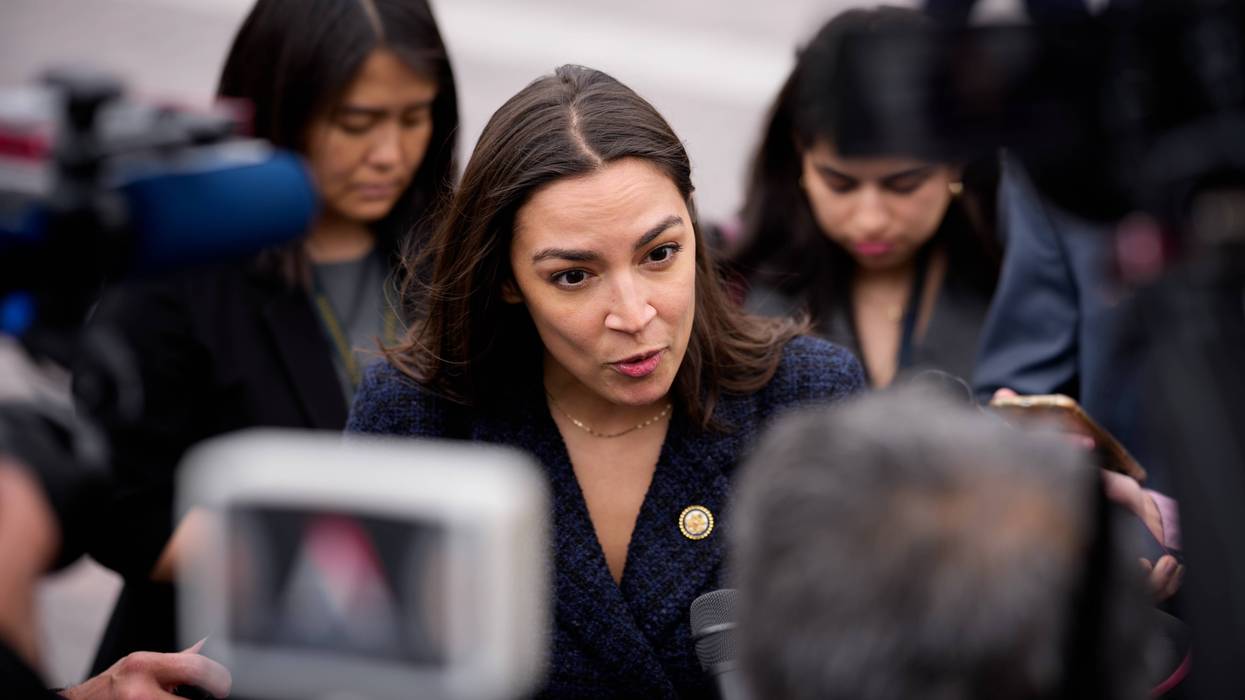
"We can’t even raise the minimum wage. Do Republicans really think this stuff is going to happen?"
Republican fearmongering that communism is on its way to the United States is a perennial feature of US political discourse—despite the fact that their warnings proved wrong in the 1930s when President Franklin Roosevelt passed Social Security and other New Deal programs and recently when Mayor Zohran Mamdani neglected to usher in a communist era in New York City, even as he moved forward with plans for universal childcare and a network of city-run grocery stores.
On Thursday, progressive Rep. Alexandria Ocasio-Cortez (D-NY) mocked the GOP's latest claims that Democratic politicians who support Medicare for All and other broadly popular universal proposals are putting the US on what House Speaker Mike Johnson (R-La.) recently called a "dark road of death to communism."
"We can’t even raise the minimum wage. Do Republicans really think this stuff is going to happen?" Ocasio-Cortez told a reporter on Capitol Hill after they'd asked whether the recent victories of democratic socialists and other progressives could end up "as full-blown communism."
Reporter: Isn’t there concern that this slippery slope to socialism inevitably ends up as full-blown communism?
AOC: I mean, no. I think that’s very silly. We can’t even raise the minimum wage. Do they really think communism is going to happen? No. They’re trying to scare people… pic.twitter.com/RiFhqpwd6T
— Acyn (@Acyn) July 23, 2026
With 78% of Democratic voters supporting an expansion of the Medicare program to everyone in the US—which would end healthcare's treatment as a for-profit endeavor in the US and put the medical system on equal footing with those in other wealthy countries—a number of Democratic House candidates who support the proposal have won primary races in recent months, including Melat Kiros in Colorado, Claire Valdez in New York, and Adam Hamawy in New Jersey. In Michigan, US Senate candidate Abdul El-Sayed, a Medicare for All advocate, has polled ahead of his centrist opponent Rep. Haley Stevens in numerous recent surveys.
As Republicans aim to maintain control of the Senate and House in the midterm elections—having ripped nutrition assistance and Medicaid away from millions of Americans, driven up healthcare costs for people who have insurance through the Affordable Care Act, supported the invasion of Iran as it has sent gas prices soaring, backed billions of dollars in Pentagon spending and military aid for Israel as Americans struggle to afford essentials, and supported a president who says he doesn't "think about Americans’ financial situation"—they've attempted to revive old claims that the new crop of progressive Democrats "are a danger to you and your family," as Johnson said this week.
The House speaker called the progressive primary winners "crazy little mini-Mamdanis who are popping up all around the country," while House Republican Conference Chair Lisa McClain (R-Mich.) warned that "the radical left feels they need to hide what their policies are... Let’s call it what it is: It’s communism.”
Ocasio-Cortez, who is said to be a potential 2028 presidential or Senate candidate, called the warnings "very silly" and suggested they came from lawmakers who are dead-set against healthcare being treated as a right in the US instead of a profit-making business.
"They’re trying to scare people because they don’t want us talking about the fact that we all have a right to healthcare," said the congresswoman. "So they want to call everything they don’t like communist because if people actually wake up to the fact that their elected officials are screwing them over when they get here, then they’re going to realize they deserve better and that healthcare as a right isn’t crazy, it isn't pie-in-the-sky."
"They want to call this stuff communist because they don’t want us to realize that the rest of the developed world has guaranteed healthcare," she added. "So they want to call it communist because they don’t want you to know that Germany, Italy, the UK, Canada—everybody else—has it better than us, and we spend the most money for the worst care in the modern, developed world."
In another interview Thursday, Ocasio-Cortez expanded on her condemnation of Republicans' healthcare policies.
"This administration is killing Americans," she said. "They are killing people by taking away their healthcare. They are killing women by having them bleed out in parking lots. They are killing seniors by imposing cuts to Medicaid and to Medicare recipients... The fact of the matter is they are for UnitedHealth. They are for Big Pharma. They are for these corporations, and they are cutting your healthcare."
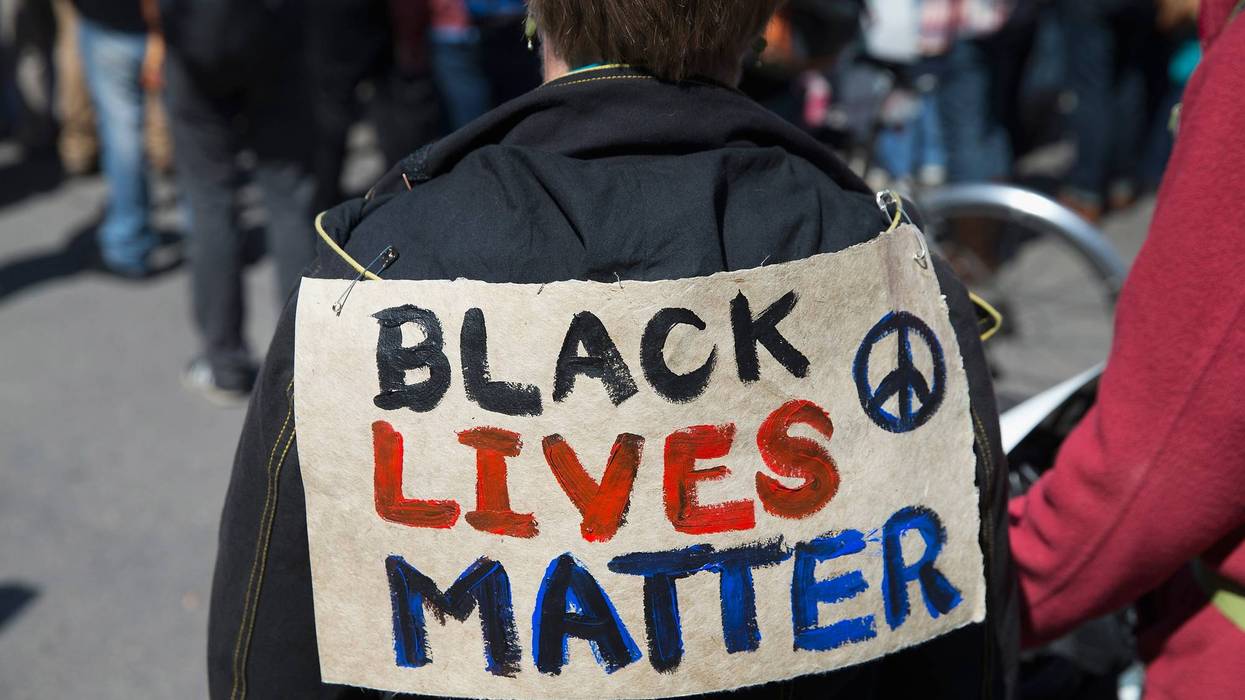
Noting that "this is not the first, not the second, but the third life that was taken" by police in the area, one local candidate declared that "this is no longer an accident or a tragedy. It is a choice."
WARNING: The following article contains graphic content that some people may find disturbing…
Protesters have taken to the streets in Madison, Wisconsin since Wednesday afternoon to decry violence by law enforcement, especially against people of color, since police fatally shot a man, whom they said had a knife, while attempting to arrest him in an intersection.
"Madison Police Department officers typically don't wear body cameras," The Cap Times reported, and MPD Chief John Patterson said there are no bodycam videos of the shooting. However, bystander footage swiftly spread online, spurring alarm and outrage.
The footage shows four officers trying to wrestle a Black man—identified by residents and multiple elected officials as Corey Ruiz—to the ground. At least one officer shouts "taser," and three gunshots can be heard when Ruiz is already on the ground.
Patterson said during a Wednesday press conference that an officer deployed a taser, but was "unsuccessful," and an officer injured by the knife "fired his weapon" at the intersection of South Baldwin and Williamson, or "Willy," around 1:30 pm Central time.
The police chief did not name any of the officers—who were placed on administrative leave after the killing—and did not confirm Ruiz's identity, only describing him as a man in his 30s. However, he said that "I want to take a moment to honestly and sincerely offer my heartfelt sympathies to his family for this loss."
Patterson also acknowledged that the deadly shooting "occurred in a neighborhood that has experienced a lot of trauma in the past." As Madison-based Isthmus detailed, "Tony Robinson was shot and killed by Madison police officer Matt Kenny in 2015 a block and a half away; Paulie Heenan was fatally shot by a police officer in 2012, on nearby South Baldwin Street."
Noting that "this is not the first, not the second, but the third life that was taken" by police in the past couple of decades, Juliana Bennett, a democratic socialist running to represent District 76 in the Wisconsin State Assembly, said that "this is no longer an accident or a tragedy. It is a choice."
In addition to community members, people around the world who have seen the various videos of the shooting—that "looks like a gang execution" by police, according to one critic—are demanding the arrest of the officer who fired the shots on Wednesday.
"Madison police killed Corey Ruiz, shooting him three times in the head at point-blank range after tasing him, while he was constrained on the ground," said the Party for Socialism and Liberation on social media. "Despite MPD's attempts to distort the truth, the people of Madison immediately took to the streets to demand transparency and justice."
"Corey Ruiz's life matters, and he should be alive today! The police and ICE are the biggest threats to public safety!" the party continued, referring to US Immigration and Customs Enforcement, which has also fatally shot several people nationwide this year. "The cops who carried out this execution in broad daylight should be jailed! End all racist police terror!"
As The Cap Times detailed:
Protesters who first gathered on Williamson Street chanted, "Arrest that cop." They later marched to the Capitol, where they took over the area where the Wisconsin Chamber Orchestra typically performs during the free weekly summer series Concerts on the Square.
Joe Loehnis, CEO of the Wisconsin Chamber Orchestra, announced the orchestra would stand in solidarity with Madison's Black community and canceled the concert Wednesday as hundreds of people listened to protesters while waiting for the event to start. There are currently no plans to reschedule.
The concert series takes place on the lawn of the Wisconsin State Capitol. Protesters outside the building chanted, "Black Lives Matter!"
Later Wednesday, mourners gathered at the intersection—where candles and flowers were laid on the ground—and came together in song.
The memorial remained in the road as of Thursday morning, according to footage shared on social media by local press.
Among the politicians who have weighed in are Democratic Gov. Tony Evers, who said after being briefed on the shooting that "there must be transparency and accountability in any investigation moving forward."
"We will continue to keep the loved ones and family of the individual who was killed in our hearts and prayers. His life mattered," Evers added. "As folks exercise their First Amendment rights tonight and in the days ahead, we urge them to do so peacefully and respectfully."
Evers declined to seek a third term this cycle. The Democratic primary is next month. Multiple candidates running to replace him also spoke out on Wednesday. Mandela Barnes said he was "deeply disturbed and pained by the video footage," and called for an "independent and transparent" investigation.
A similarly "horrified" David Crowley said that "while the details are still emerging and a full accounting of what happened is still needed, these reports are painfully reminiscent of the tragedies we have witnessed in Kenosha, Minneapolis, and far too many communities across our country."
Candidate Joel Brennan noted that "this neighborhood carries a deep pain and a history of all too recent similar violence," and demanded a probe by the Wisconsin Department of Justice to provide the community with "a full, transparent, and independent accounting of what happened."
At the site of the shooting, another gubernatorial hopeful, Francesca Hong, faced calls from the crowd to condemn the shooting as "murder." She said into a bullhorn, "This state-sanctioned violence was an execution."
State Rep. Shelia Stubbs (D-78) said that "I am deeply saddened and disturbed to hear of the death of Corey Ruiz after he was fatally shot by a member of the Madison Police Department. This never should have happened. Mr. Ruiz should still be alive. My heart and my prayers go out to Mr. Ruiz's family, friends, and loved ones in their time of unimaginable grief. Madison has been profoundly shaken by this tragic incident."
"My thoughts are also with our community members who witnessed and were traumatized by this shocking and distressing event, especially the brave individuals who recorded footage with their phone cameras," she continued. "This is a grave example of the need for body-worn cameras. If Madison Police Department had body cameras, we wouldn't need to look to civilian footage for answers."
After pointing to her record of pushing for racial justice and "more community-based approaches to our justice system," Stubbs stressed that in the wake of this latest shooting, "it is critical that community members are kept informed and receive updates in a timely manner. There must be a thorough, impartial investigation into the circumstances that resulted in a man unnecessarily losing his life."
Madison's Democratic mayor, Satya Rhodes-Conway, said she was "angered and saddened by what happened," adding that "it's an absolute tragedy when a member of our community is killed by anyone, but especially by the police. I understand the anger, grief, and fear people are feeling—because I am feeling that too."
"The State Department of Criminal Investigation will be conducting an independent investigation, and the officers involved have been put on administrative leave until the investigation is concluded," according to the mayor. "The Madison Police Department is cooperating fully and is not in charge of the investigation."
Ruiz's family has retained civil rights and personal injury attorney Ben Crump, who has secured settlements for relatives of George Floyd and Breonna Taylor.
"The video gives us a clear picture of what happened. Corey Ruiz was tased, taken to the ground, and then he was shot multiple times at close range, including in his face," Crump said in a statement. "This case has to be examined for excessive force. It happened in broad daylight, in front of dozens of witnesses. The family deserves the truth, and the public deserves accountability."
This article has been updated with comment from Ben Crump and to correct the timeline for the three men killed.
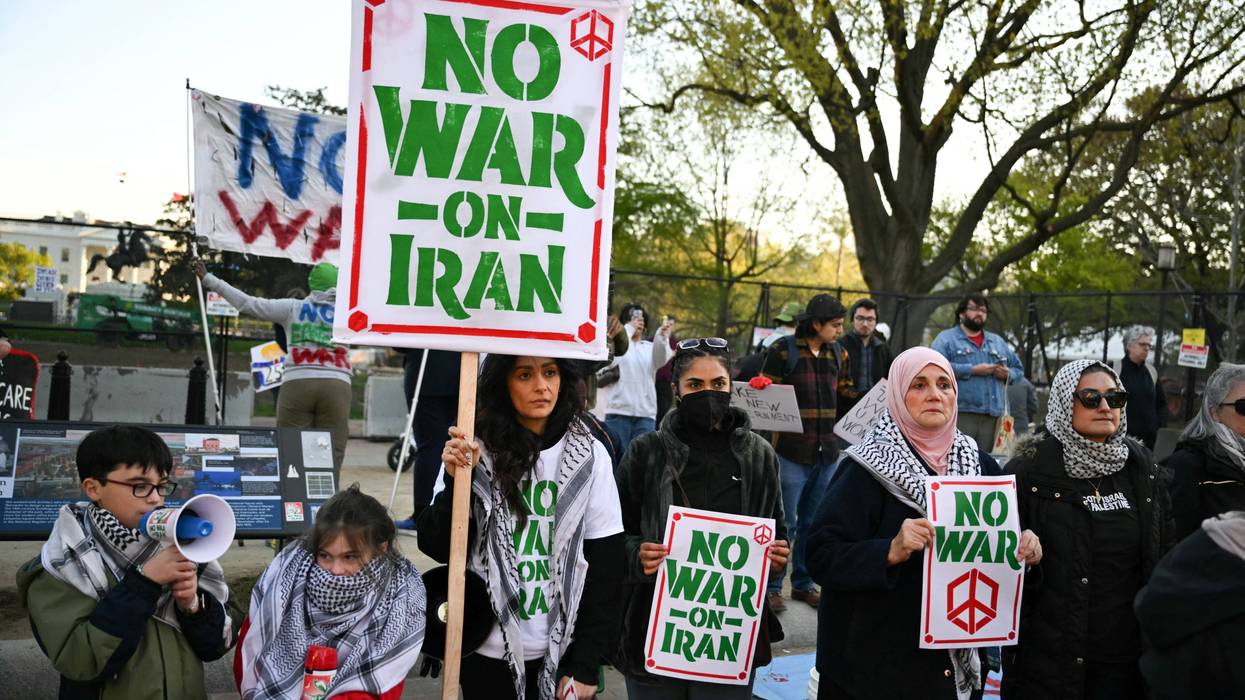
"We cannot allow this illegal, unconstitutional war in Iran to continue," said Rep. Pramila Jayapal, who introduced the House resolution.
For the second time in as many months, the Republican-controlled House of Representatives narrowly passed a war powers resolution directing President Donald Trump to end his illegal war on Iran, but later on Thursday GOP senators and Democrat John Fetterman blocked a similar measure in the upper chamber.
H.Con.Res.89, introduced by Rep. Pramila Jayapal (D-Wash.) and sponsored by 15 Democrats and one Republican, passed by a vote of 214-208, with co-sponsor Rep. Thomas Massie (R-Ky.) and three other GOP lawmakers—Reps. Tom Barrett (Mich.), Warren Davidson (Ohio), and Brian Fitzpatrick (Pa.)—breaking ranks to cast "yes" votes.
“Today’s bipartisan vote on my war powers resolution to end this war in Iran was a big victory for the vast majority of the American people who want President Trump to end this illegal war and focus on their lives right here at home," Jayapal said in a statement. "A majority of this Congress voted to end the war yet again, and sent yet another clear order to the president that Congress will not continue to tolerate this illegal war."
"The vote also put pressure on Republicans to stand up for their constituents and the Constitution," the congresswoman continued. "Out of respect for our US servicemembers, civilian lives in Iran and Lebanon, the American taxpayers, and our Constitution, we cannot allow this illegal, unconstitutional war in Iran to continue."
Massie said ahead of Thursday's vote: "American servicemen and women are dying, and gas and fertilizer prices are soaring. It’s time to end this war."
At least 18 US troops have been killed and more than 430 others have been wounded during the 145-day US-Israeli war of choice. Iran's Health Ministry said earlier this week that more than 3,500 Iranians, including at least 496 women and 384 children and infants, have been killed by US and Israeli attacks. More than 26,500 Iranians, including at least 4,000 women and 1,621 children, have been wounded.
Around 30 people have been killed by Iranian counterattacks targeting US-allied Mideast nations, while a simultaneous Israeli war on Lebanon has killed or wounded upward of 15,000 people, according to Lebanese officials.
"Trump needs to end his illegal war now," Rep. Yassamin Ansari (D-Ariz.) said on social media.
Jayapal said in her statement: “From the beginning, this war has had no clear mission, no strategy, no end goal. Congress has not been consulted. And hostilities have been driven over and over again by a president who won his election by promising to end forever wars. This administration has clearly gotten us into a war they have no clue how to get us out of."
Later on Thursday, US senators voted 47-49 against advancing a similar war powers resolution introduced by Sen. Chris Van Hollen (D-Md.) out of the Senate Foreign Relations Committee. Sen. Susan Collins (R-Maine) crossed the aisle to vote with nearly all Democratic caucus members, while Fetterman (D-Pa.) joined all other present Republicans in voting against the measure. GOP Sens. Katie Britt (Alabama), Mitch McConnell (Ky.), Lisa Murkowski (Alaska), and Rand Paul (Ky.) missed the vote.
"When are Senate Republicans going to stand up?" Senate Minority Leader Chuck Schumer (D-NY) said on the chamber floor. "Senate Republicans lose credibility with the American people with every vote they take against ending Trump's war."
Minority Leader @SenSchumer (D-NY) urges GOP to support Iran war powers resolution: "When are Senate Republicans going to stand up? … Senate Republicans lose credibility with the American people with every vote they take against ending Trump's war." pic.twitter.com/XyCTq1TdKj
— CSPAN (@cspan) July 23, 2026
During his second term, Trump has ordered US military attacks or operations in Ecuador, Iran, Iraq, Nigeria, Somalia, Syria, Venezuela, and Yemen and a campaign of high-seas boat bombings in the Caribbean Sea and Pacific Ocean. The self-described "peace president" has ordered attacks on 11 countries through his two terms in office—the aforementioned nations, plus Afghanistan, Libya, and Pakistan during his first administration.
Trump has also threatened to attack, seize, or acquire by other means Canada, Colombia, Cuba, Greenland, and Mexico. He is also reportedly weighing strikes on Mali targeting al-Qaeda-affiliated militants.
The War Powers Resolution of 1973—also known as the War Powers Act—requires the president to notify Congress within 48 hours of committing troops to military action and limit such action to 60 days, with a 30-day withdrawal period, unless lawmakers declare war or issue an authorization for the use of military force.
Congressional Democrats and legal experts have rejected Trump’s dubious argument that quitting his negotiated ceasefire with Iran resets the War Powers Resolution’s 60-day limit; absent congressional authorization, the statutory clock generally starts from the first US strike and continues uninterrupted until military action ends.
The first war powers resolutions passed during Trump's presidency came in 2019, when the House and Senate ordered the president to end unauthorized US military involvement in the Saudi-led war in Yemen. The Senate subsequently failed to override Trump's veto of the directive.
Last month, both the House and Senate passed resolutions directing Trump to halt his war on Iran. The president has almost entirely ignored the directives, prompting Rep. Gregory Meeks (D-NY)—who authored both an unsuccessful war powers resolution in a bid to stop the US boat bombings and the successful Iran order passed last month—to say Thursday that he will try to sue the administration for failing to obey Congress.
"I'm dropping a resolution today... that we should be suing the administration for not following... the resolution that was passed in both the House and Senate," Meeks told reporters outside the Capitol, where lawmakers are set to go on summer recess.
"When we get back next week, I'm going to force a vote on that, so that we can now go to the courts and sue the administration for not following the will of Congress."