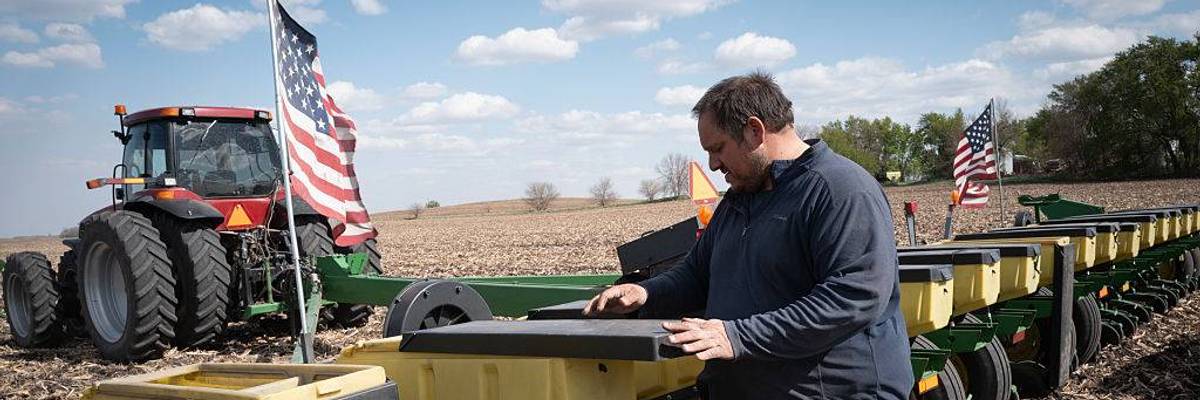
A farmer loads soybeans into his planter on May 6, 2026 near West Bend, Iowa.
Trump's Iran War Hits US Farmers With $1.4 Billion More in Diesel Fuel Costs: Report
"Trump’s decision to go to war with Iran drove up the cost of diesel fuel just as farmers were set to start their spring planting."
President Donald Trump's illegal war with Iran is putting significant financial stress on US farmers, according to a report issued on Thursday by Democrats on the Joint Economic Committee.
The report finds that US farmers spent $1.4 billion more on diesel fuel this year when planing corn, soybeans, wheat, cotton, and rice than they did a year ago, representing a 63% yearly increase.
The six states to get hit with the biggest yearly percentage increases in diesel costs all voted for Trump in three consecutive presidential elections: Florida (90.6% yearly increase in diesel costs), Alabama (86.2%), Oklahoma (85.9%), West Virginia (85.8%), Kansas (83.8%), and Indiana (79.5%).
Diesel prices in 2026 hit their peak right in the middle of planting season, and the report estimates that "the average farmer spent $1,500 more to refil their farm's onsite fuel tank... compared to the same high point during the 2025 planting season."
The report notes that it doesn't capture the full extent of economic damage caused the president's unlawful assault on Iran, as its analysis "doesn’t take into account other war-related increases such as the increased costs of running diesel generators that power some greenhouses or the increases at the pump that farmers and truckers face when they drive products to market."
The report adds that the economic pain being felt by farmers thanks to Trump's war will soon hit US grocery shoppers.
"Trump’s decision to go to war with Iran drove up the cost of diesel fuel just as farmers were set to start their spring planting," the report says. "This comes after Trump’s tariffs have already significantly increased costs for farmers and made it more difficult for them to plan for the future. These increased costs... are likely to further contribute to rising grocery costs."
According to data published by the US Energy Information Administration, diesel prices peaked in May this year when they averaged $5.60 per gallon.
While prices initially fell after Trump announced a ceasefire agreement with Iran in June, the war's resumption this month has sent them jumping upward again.
Data published by the American Automobile Association on Thursday showed that the average price of diesel in the US is now back up to $5.20 per gallon, an increase of $0.20 from one week ago.
Despite the economic turmoil caused by his illegal war of choice, Trump has shown little sign of backing off. In an interview with Axios published Thursday, the president said that he was “close” to making a decision on whether to authorize what he described as a “massive attack” on Iran that he vowed would be “bigger than ever before.”
We are at a crossroads
This country and this world are at a monumental crossroads. In a few short weeks, US voters will have an opportunity to beat back the forces of fascism and confront the billionaires who are rigging the economy, our media system, and our democracy, making it increasingly impossible for ordinary people to get by. We’re not just talking about the election. We’re talking about what must be done once these fascist elements are vanquished from power. We need a bolder set of solutions than what either major party has so far been willing to offer and a working-class movement ready to fight like hell for it. Trump didn't emerge from nowhere. The conditions that fueled MAGA authoritarianism were created by decades of radical neoliberal economic policies and a corrupt political system dominated by corporate interests. They slashed taxes on the super-rich, promising that the benefits would trickle down. They said giveaways to the corporate titans would make life more affordable for the rest of us. It was all bullshit. And when a bitter, betrayed populace searches for someone to blame, right-wing demagogues have little trouble finding scapegoats. People know when they're being lied to, but you won't hear any of this from the corporate media. Only independent journalism—powered and funded by people who believe in building a better world—can deliver truly trustworthy daily news. Our Fall Campaign is underway, and we need your help. To power our newsroom through the rest of the year, we need to raise $125,000 by midnight on October 31. So if you share our vision, please contribute whatever you can to sustain our work. |
President Donald Trump's illegal war with Iran is putting significant financial stress on US farmers, according to a report issued on Thursday by Democrats on the Joint Economic Committee.
The report finds that US farmers spent $1.4 billion more on diesel fuel this year when planing corn, soybeans, wheat, cotton, and rice than they did a year ago, representing a 63% yearly increase.
The six states to get hit with the biggest yearly percentage increases in diesel costs all voted for Trump in three consecutive presidential elections: Florida (90.6% yearly increase in diesel costs), Alabama (86.2%), Oklahoma (85.9%), West Virginia (85.8%), Kansas (83.8%), and Indiana (79.5%).
Diesel prices in 2026 hit their peak right in the middle of planting season, and the report estimates that "the average farmer spent $1,500 more to refil their farm's onsite fuel tank... compared to the same high point during the 2025 planting season."
The report notes that it doesn't capture the full extent of economic damage caused the president's unlawful assault on Iran, as its analysis "doesn’t take into account other war-related increases such as the increased costs of running diesel generators that power some greenhouses or the increases at the pump that farmers and truckers face when they drive products to market."
The report adds that the economic pain being felt by farmers thanks to Trump's war will soon hit US grocery shoppers.
"Trump’s decision to go to war with Iran drove up the cost of diesel fuel just as farmers were set to start their spring planting," the report says. "This comes after Trump’s tariffs have already significantly increased costs for farmers and made it more difficult for them to plan for the future. These increased costs... are likely to further contribute to rising grocery costs."
According to data published by the US Energy Information Administration, diesel prices peaked in May this year when they averaged $5.60 per gallon.
While prices initially fell after Trump announced a ceasefire agreement with Iran in June, the war's resumption this month has sent them jumping upward again.
Data published by the American Automobile Association on Thursday showed that the average price of diesel in the US is now back up to $5.20 per gallon, an increase of $0.20 from one week ago.
Despite the economic turmoil caused by his illegal war of choice, Trump has shown little sign of backing off. In an interview with Axios published Thursday, the president said that he was “close” to making a decision on whether to authorize what he described as a “massive attack” on Iran that he vowed would be “bigger than ever before.”
- Trump's Iran War to Spike US Grocery Costs, Threaten Global Food Crisis ›
- Trump's Iran War Has Already Cost Americans Over $40 Billion Extra on Gas and Diesel ›
- From Gas to Groceries, Rural Americans Paying Heaviest Price for Trump's Iran War ›
- Opinion | The Consuming Contradictions of Trump's Iran War | Common Dreams ›
- Opinion | How Much More Hurt Can Farmers Take Before They Abandon Trump? | Common Dreams ›
- 'Misled' and 'Strung Along' by Trump, Financial Pain of Farmers Grows as Costs Continue to Skyrocket | Common Dreams ›
President Donald Trump's illegal war with Iran is putting significant financial stress on US farmers, according to a report issued on Thursday by Democrats on the Joint Economic Committee.
The report finds that US farmers spent $1.4 billion more on diesel fuel this year when planing corn, soybeans, wheat, cotton, and rice than they did a year ago, representing a 63% yearly increase.
The six states to get hit with the biggest yearly percentage increases in diesel costs all voted for Trump in three consecutive presidential elections: Florida (90.6% yearly increase in diesel costs), Alabama (86.2%), Oklahoma (85.9%), West Virginia (85.8%), Kansas (83.8%), and Indiana (79.5%).
Diesel prices in 2026 hit their peak right in the middle of planting season, and the report estimates that "the average farmer spent $1,500 more to refil their farm's onsite fuel tank... compared to the same high point during the 2025 planting season."
The report notes that it doesn't capture the full extent of economic damage caused the president's unlawful assault on Iran, as its analysis "doesn’t take into account other war-related increases such as the increased costs of running diesel generators that power some greenhouses or the increases at the pump that farmers and truckers face when they drive products to market."
The report adds that the economic pain being felt by farmers thanks to Trump's war will soon hit US grocery shoppers.
"Trump’s decision to go to war with Iran drove up the cost of diesel fuel just as farmers were set to start their spring planting," the report says. "This comes after Trump’s tariffs have already significantly increased costs for farmers and made it more difficult for them to plan for the future. These increased costs... are likely to further contribute to rising grocery costs."
According to data published by the US Energy Information Administration, diesel prices peaked in May this year when they averaged $5.60 per gallon.
While prices initially fell after Trump announced a ceasefire agreement with Iran in June, the war's resumption this month has sent them jumping upward again.
Data published by the American Automobile Association on Thursday showed that the average price of diesel in the US is now back up to $5.20 per gallon, an increase of $0.20 from one week ago.
Despite the economic turmoil caused by his illegal war of choice, Trump has shown little sign of backing off. In an interview with Axios published Thursday, the president said that he was “close” to making a decision on whether to authorize what he described as a “massive attack” on Iran that he vowed would be “bigger than ever before.”
- Trump's Iran War to Spike US Grocery Costs, Threaten Global Food Crisis ›
- Trump's Iran War Has Already Cost Americans Over $40 Billion Extra on Gas and Diesel ›
- From Gas to Groceries, Rural Americans Paying Heaviest Price for Trump's Iran War ›
- Opinion | The Consuming Contradictions of Trump's Iran War | Common Dreams ›
- Opinion | How Much More Hurt Can Farmers Take Before They Abandon Trump? | Common Dreams ›
- 'Misled' and 'Strung Along' by Trump, Financial Pain of Farmers Grows as Costs Continue to Skyrocket | Common Dreams ›