

SUBSCRIBE TO OUR FREE NEWSLETTER
Daily news & progressive opinion—funded by the people, not the corporations—delivered straight to your inbox.
5
#000000
#FFFFFF
To donate by check, phone, or other method, see our More Ways to Give page.
Daily news & progressive opinion—funded by the people, not the corporations—delivered straight to your inbox.
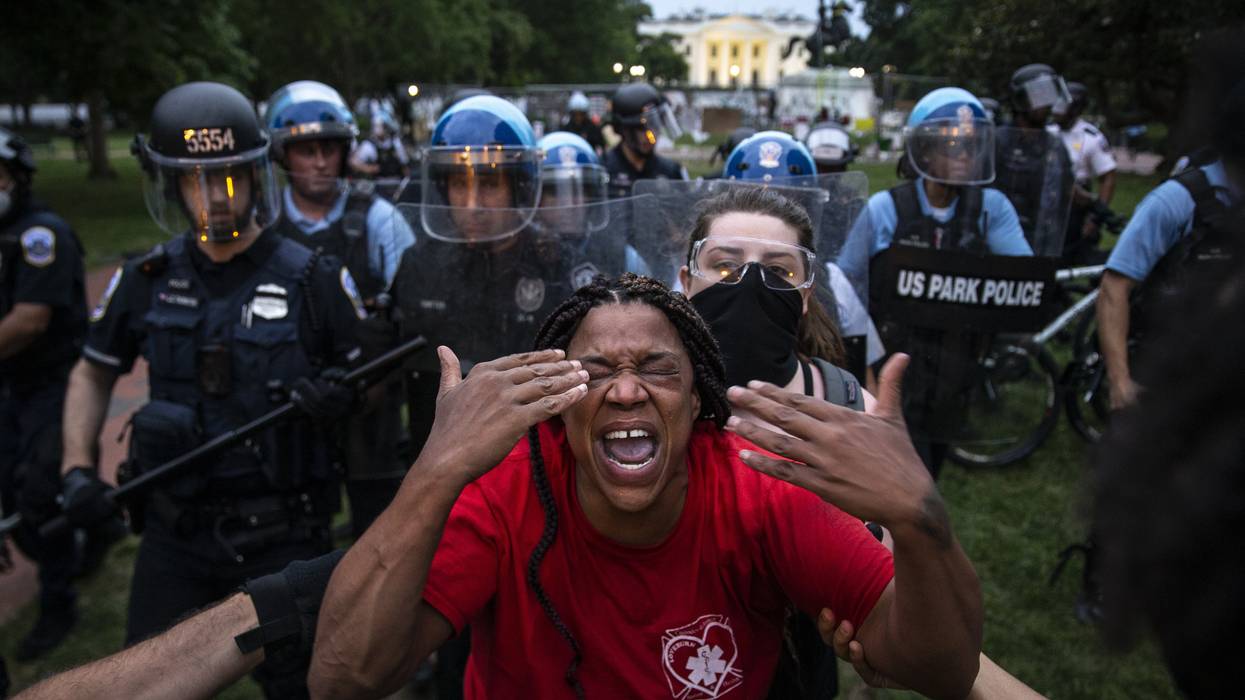
One critic called the move "an unprecedented abandonment of the Department of Justice's responsibility to enforce civil rights laws and protect communities from unlawful police abuse."
Racial justice advocates decried Wednesday's announcement by the U.S. Department of Justice that it will end law enforcement reform and accountability efforts, including the Biden administration's agreements with the cities of Minneapolis and Louisville—a move that came just days before the fifth anniversary of George Floyd's murder by a Minneapolis cop.
The Department of Justice's (DOJ) Civil Rights Division said it is dropping lawsuits against the Minneapolis and Louisville police departments and ending pending consent decrees—court-enforceable agreements under which law enforcement agencies commit to reform—with the two cities. The deals, which have been submitted to judges for approval, have been held up in federal court as the Trump administration has sought to block their implementation.
The Civil Rights Division said it "will also be closing its investigations into, and retracting the Biden administration's findings of constitutional violations on the part of," the Louisiana State Police and police departments in Phoenix; Memphis; Oklahoma City; Trenton, New Jersey; and Mount Vernon, New York.
To “disappear” DOJ findings like this is the most disturbing and disgraceful part. A key advantage of DOJ pattern & practice investigations is that DOJ has the resources to absorb the cost of generating the findings that indiv civ rights groups suing police depts find onerous & often prohibitive.
[image or embed]
— Sherrilyn Ifill ( @sifill.bsky.social) May 21, 2025 at 8:02 AM
Civil rights lawyer Benjamin Crump, who represents the families of George Floyd—murdered by then-Minneapolis police officer Derek Chauvin on May 25, 2020—and Breoanna Taylor, who was killed earlier that year by Louisville police, called the DOJ announcement a "slap in the face."
"Just days before the fifth anniversary of George Floyd's murder—a moment that galvanized a global movement for justice—the U.S. Department of Justice has chosen to turn its back on the very communities it pledged to protect," Crump said in a statement Wednesday.
"By walking away from consent decrees in Minneapolis and Louisville, and closing its investigation into the Memphis Police Department while retracting findings of serious constitutional violations, the DOJ is not just rolling back reform, it is attempting to erase truth and contradicting the very principles for which justice stands," he asserted.
"These consent decrees and investigations were not symbolic gestures, they were lifelines for communities crying out for change, rooted in years of organizing, suffering, and advocacy," Crump continued, adding that the DOJ's moves "will only deepen the divide between law enforcement and the people they are sworn to protect and serve."
Congresswoman Jasmine Crockett (D-Texas) lamented the DOJ move and accused the Trump administration of acting "like Breonna Taylor and George Floyd's lives didn't mean a damn thing."
Democratic Minneapolis Mayor Jacob Frey said his city would proceed with reforms despite the DOJ's announcement, while questioning the move's timing.
"The Trump administration is a mess. It is predictable that they would move for a dismissal the very same week that George Floyd was murdered five years ago," he said. "What this shows is that all [President] Donald Trump really cares about is political theater."
The DOJ claimed the Biden administration falsely accused the Minneapolis and Louisville police departments of "widespread patterns of unconstitutional policing practices by wrongly equating statistical disparities with intentional discrimination and heavily relying on flawed methodologies and incomplete data."
"These sweeping consent decrees would have imposed years of micromanagement of local police departments by federal courts and expensive independent monitors, and potentially hundreds of millions of dollars of compliance costs, without a legally or factually adequate basis for doing so," the agency argued.
Assistant Attorney General Harmeet Dhillon—the conspiracy theorist who heads the Civil Rights Division despite, or perhaps because of, her troubled history of working against voting, reproductive, LGBTQ+, and other civil rights—said in a statement Wednesday that her agency is ending the Biden administration's "failed experiment of handcuffing local leaders and police departments with factually unjustified consent decrees."
"Overbroad police consent decrees divest local control of policing from communities where it belongs, turning that power over to unelected and unaccountable bureaucrats, often with an anti-police agenda," Dhillon added.
"DOJ's actions today amount to a public declaration that law enforcement agencies are above the law."
Legal Defense Fund director of strategic initiatives Jin Hee Lee called the DOJ announcement "an unprecedented abandonment of the Department of Justice's responsibility to enforce civil rights laws and protect communities from unlawful police abuse."
Lee said the DOJ investigations that led to the consent decrees "revealed a litany of systemic harms to community members, whom officers are sworn to protect—from wanton violence and sexual misconduct to unlawful stops, searches, and arrests, and racially discriminatory policing."
"By abandoning its obligation to pursue legal remedies that would stem this unlawful conduct, DOJ necessarily condones it," Lee added. "DOJ's actions today amount to a public declaration that law enforcement agencies are above the law."
NAACP president Derrick Johnson said on social media, "It's no surprise that Trump's Department of Coverups and Vengeance isn't seeking justice."
"It's been five years, and police reform legislation still hasn't passed in Congress, and police departments still haven't been held accountable," Johnson added, referring to Floyd's murder. "Five years."
Furthermore, speculation is growing over the prospect of Trump pardoning Chauvin. Addressing the possibility, Democratic Minnesota Gov. Tim Walzsaid earlier this week that "if Chauvin's federal conviction is pardoned, he will still have to serve the remainder of his 22-and-a-half-year state prison sentence for murder and manslaughter."
Opponents vowed to fight the Trump administration's civil rights pushback.
"Let me be clear: We will not give up," Crump said. "This movement will not be swayed or deterred by fickle politics. It is anchored in the irrefutable truth that Black lives matter, and that justice should not depend on who is in power."
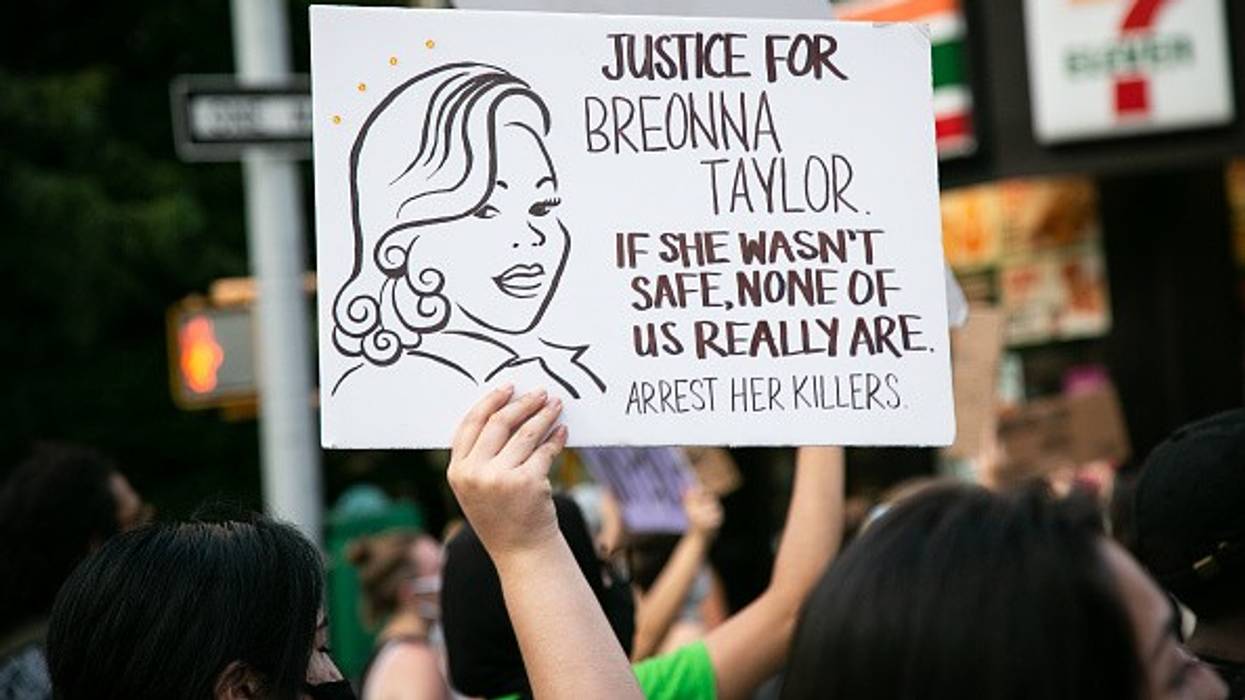
"We know it was Breonna Taylor's dream to save lives," said one rights advocate, "and this proposed legislation would do just that."
Rights advocates on Monday applauded U.S. Rep. Morgan McGarvey for taking a "bold step toward healing and justice" by introducing the Justice for Breonna Taylor Act, which would ban nationwide the kind of no-knock warrants that led to the 26-year-old woman's death in 2020.
Nearly four years to the day after Taylor was killed by police officers who forcibly entered her home in Louisville, Kentucky without warning, after allegedly lying to obtain the no-knock warrant, McGarvey (D-Ky.) joined Sens. Rand Paul (R-Ky.) and Cory Booker (D-N.J.) in proposing the bill.
Louisville and Kentucky policymakers have both prohibited or severely restricted no-knock warrants since Taylor's killing.
"Louisvillians remember Breonna Taylor and are still grieving the tragedy of her inexcusable killing by police. After Breonna's death, we passed a ban on no-knock warrants at the state and local level—if we can do this in Kentucky, we can do this nationally," said McGarvey. "The Justice for Breonna Taylor Act is going to protect people and keep our communities safe."
Under the proposal, federal law enforcement and state and local police departments that receive federal funding would be prohibited from executing no-knock warrants.
"After Breonna's death, we passed a ban on no-knock warrants at the state and local level—if we can do this in Kentucky, we can do this nationally."
Amber Duke, executive director of the ACLU of Kentucky, denounced no-knock warrants as "legalized home invasions that put lives at risk on either side of a door."
In Taylor's case, police officers used a battering ram to break down the door to the Louisville apartment shortly after midnight on March 13, 2020.
They had been investigating two men for suspected drug dealing, including one who had previously been romantically involved with Taylor and who they believed had used Taylor's apartment to receive packages.
"We know it was Breonna Taylor's dream to save lives," Duke said of the emergency room technician, "and this proposed legislation would do just that. We applaud Congressman McGarvey and the bill's co-sponsors for taking this bold step toward healing and justice."
The legislation was introduced as federal authorities announced former Officer Brett Hankison will face a jury for a third time in the case.
None of the officers involved in the shooting have ever been charged with killing Taylor, but Hankison was charged by the state of Kentucky for endangering Taylor's neighbors. He was acquitted in March 2022 and the U.S. Justice Department then charged him with civil rights violations. A federal jury deadlocked in that trial.
"He shouldn't be the only one charged," attorney Lonita Baker, who represents Taylor's mother and sister, told The Washington Post. "But the reality is that's where we stand and that's better than nothing."
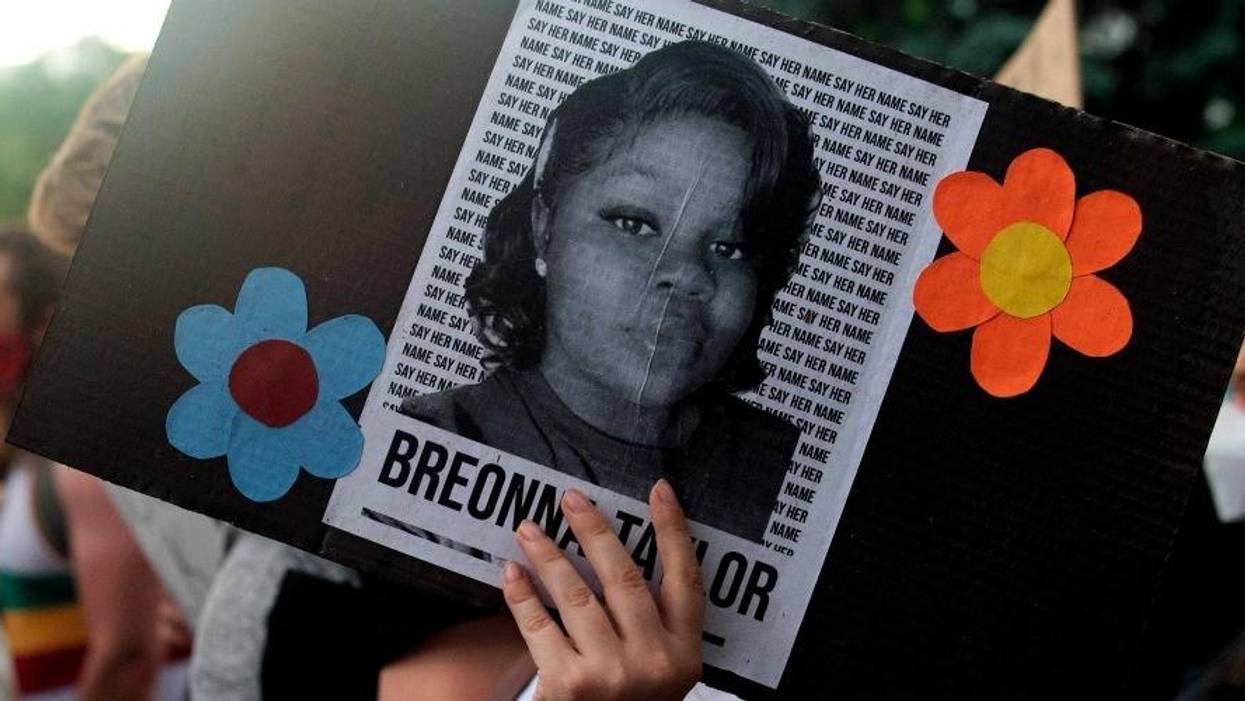
Following two years of racial justice activism, the U.S. government on Thursday charged four current and former Louisville, Kentucky officers for alleged federal crimes related to the March 2020 killing of Breonna Taylor, a 26-year-old unarmed Black woman who was shot dead in her own home during a botched police raid.
"Justice delayed is justice denied. But it's never too late to do the right thing."
Detective Joshua Jaynes, former officer Brett Hankison, former detective Kelly Hanna Goodlett, and Sgt. Kyle Meanie are facing federal charges that U.S. Attorney General Merrick Garland said include "civil rights offenses, unlawful conspiracies, unconstitutional use of force, and obstruction offenses."
The Louisville Courier Journal reports all four defendants were arrested by the Federal Bureau of Investigation.
The Justice Department alleges that Jaynes, Goodlett, and Meany violated Taylor's Fourth Amendment rights when they attempted to obtain a warrant to search her home while knowing they lacked probable cause, and that their affidavit supporting the warrant was based on lies related to alleged drug trafficking by Taylor's ex-boyfriend.
A separate indictment charges Hankison--a former Louisville Metro Police Department (LMPD) officer who was fired in July 2020 for firing blindly into Taylor's apartment-- with using "unconstitutionally excessive force during the raid on Ms. Taylor's home" by firing 10 shots into a neighboring apartment "without a lawful objective justifying the use of deadly force."
No officers have been directly charged with killing Taylor, including Myles Cosgrove, the LMPD officer who shot her and was fired nine months later.
"The federal charges announced today allege that members of a Police Investigations Unit falsified the affidavit used to obtain the search warrant of Ms. Taylor's home and that this act violated federal civil rights laws, and that those violations resulted in Ms. Taylor's death," Garland told reporters.
"Among other things, the affidavit falsely claimed that officers had verified that the target of the alleged drug trafficking operation had received packages at Ms. Taylor's address," said Garland. "In fact, defendants Jaynes and Goodlett knew that was not true."
Civil rights defenders welcomed the prospect of some justice for a police killing that fueled Black Lives Matter and other racial justice protests in 2020 and beyond.
"Today, by moving forward with criminal charges against the four police officers involved in the killing of Breonna Taylor as she slept in her bed, federal officials are recognizing what we have all known for years: Breonna Taylor should be alive today, and the people who killed her must be held accountable," Judith Browne Dianis, executive director of Advancement Project, said in a statement.
Browne Dianis continued:
Police departments across the country routinely use excessive force or murder Black people without facing accountability. These killings are horrific and unacceptable. That's why people across the country took to the streets in the uprisings of 2020, sparked by the murders of George Floyd, Breonna Taylor, and others, to urgently call for an end to police violence. They recognized that policing does not create safe communities.
It is critical to bring police to account for the use of violence against communities they have sworn to protect. And yet, these charges will not bring back Breonna and will never make her family and community whole again. To truly address the criminalization, arrests, and killings of people like Breonna Taylor, we must build a world that fundamentally values and protects Black people.
Rep. Nikema Williams (D-Ga.) tweeted that "on March 13, 2020, Breonna Taylor was murdered by Louisville law enforcement. Today is finally a step toward justice for her mother, Tamika Palmer, who led the way to ask the Justice Department to hold accountable the officers responsible. #SayHerName."
Edward Ahmed Mitchell, national deputy director at the Council on American-Islamic Relations, said in a statement, "We commend the Justice Department for pursuing federal charges against the officers involved in the killing of Breonna Taylor. When local officials like Attorney General [Daniel] Cameron fail to conduct proper investigations into police shootings, the federal government should step in to ensure accountability."
Rep. John Yarmuth (D-Ky.) tweeted: "Justice delayed is justice denied. But it's never too late to do the right thing. Despite Daniel Cameron's best efforts, accountability is finally coming for those responsible for Breonna Taylor's death. It's about damn time."
Cameron was accused of lying multiple times while attempting to explain why a grand jury did not charge any of the officers involved in Taylor's death. The state attorney general eventually admitted that he never asked the jurors to consider charging the officers with homicide.
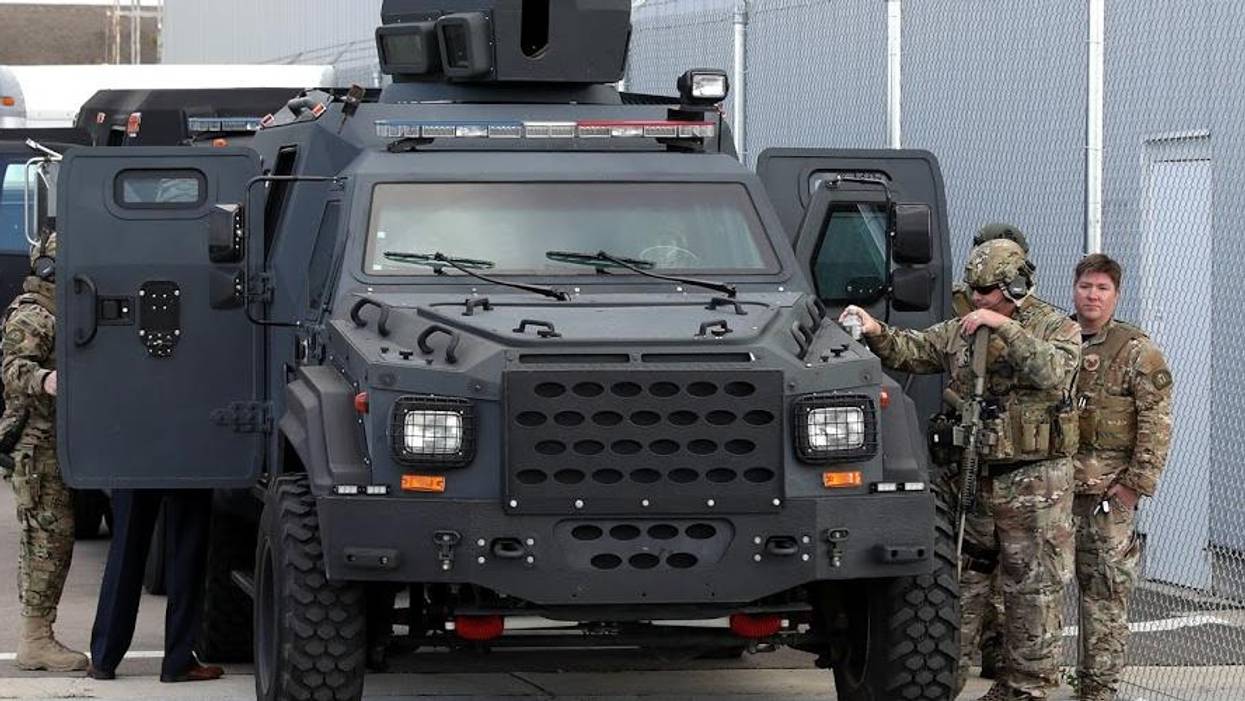
Congressional progressives this week urged top Biden administration officials to end the transfer of military weapons to local law enforcement agencies under a program that critics say disproportionately harms communities of color.
"It's time we demilitarize the police and abolish the 1033 program."
In a letter led by Rep. Ayanna Pressley (D-Mass.), Sen. Brian Schatz (D-Hawaii), and Rep. Hank Johnson (D-Ga.), the 22 lawmakers called on Cabinet members to implement part of a May executive order signed by President Joe Biden aimed at reforming federal policing standards.
"Police militarization has never made our communities safer," Pressley tweeted. "It's time to stop transferring military-grade weapons to local police."
A provision of Executive Order 14704 requires administration agency heads to review military weapons transfers to law enforcement agencies, with an eye toward prohibiting such transfers when possible.
"Militarized law enforcement increases the prevalence of police violence without making our communities safer," the lawmakers wrote in the letter.
"For example, many types of equipment transferred under the Department of Defense's 1033 program have contributed to increasingly militarized law enforcement, which has in turn led to more prevalent police violence," the signers wrote, a reference the program facilitating the transfer of military equipment to federal, state, local, and tribal police.
According to the Policing Project at the New York University School of Law, "since its inception in 1990, the 1033 program has transferred more than $7.5 billion worth of surplus military equipment to subnational policing agencies," over 11,000 of which have registered for the program.
Noting the disproportionate impact of police militarization on communities of color, the letter asserts that "when law enforcement has access to military equipment, they are more likely to use it."
"The property listed in E.O. 14074 includes firearms and ammunition of .50 or greater caliber, firearm silencers, bayonets, grenades and grenade launchers, certain explosives, tracked and armored vehicles, weaponized drones and combat aircraft, and certain long-range acoustic devices," equipment that the lawmakers assert "should be prohibited from being transferred to or purchased by law enforcement agencies either with federal funds or from federal agencies or contractors," the letter states.
Widespread public concern about the 1033 program surfaced after the 2014 police killing of unarmed Black teen Michael Brown in Ferguson, Missouri and the subsequent militarized police response to protests led by the nascent Black Lives Matter movement.
In 2015 then-President Barack Obama signed an executive order banning the transfer of tracked armored vehicles, bayonets, grenade launchers, and large-caliber weapons and ammunition. Agencies with such weapons in their arsenals were required to return them. The Pentagon said agencies returned 126 tracked armored vehicles, 138 grenade launchers, and 1,623 bayonets in response to the order.
The 1033 program was in the news again during and after the 2020 racial justice protests following more police killings of Black people, including George Floyd, Breonna Taylor, and Tony McDade.
Related Content

In the wake of the 2020 protests, Pressley introduced amendments to the National Defense Authorization Act that would have ended the 1033 program. She re-introduced the failed measures earlier this year.

Racial justice advocates welcomed Wednesday's announcement by the U.S. Department of Justice that three men imprisoned in Georgia on murder and other charges in connection with the death of unarmed Black man Ahmaud Arbery last February also have been charged with federal hate crimes and attempted kidnapping.
According to a DOJ statement, Travis McMichael, his father Gregory McMichael, and William 'Roddie' Bryan "were each charged with one count of interference with rights and with one count of attempted kidnapping."
"Travis and Gregory McMichael were also charged with one count each of using, carrying, and brandishing--and in Travis's case, discharging--a firearm during and in relation to a crime of violence," the statement added.
Echoing numerous racial justice advocates, Rep. Mondaire Jones (D-N.Y.) tweeted, "It's about damn time" in response to the DOJ announcement.
Arbery's relatives and other advocates also welcomed news of the new charges. Wanda Cooper-Jones, Arbery's mother, told CNN that the fresh indictments are "huge."
"It's one step closer to justice," she said. "They did the investigation properly and they came out with those indictments. So, my family and I were pleased."
Arbery, who was 25 years old, was jogging in the Satilla Shores neighborhood of Brunswick, Georgia on February 23, 2020 when he was confronted by Travis and Gregory McMichael, who claimed they believed Arbery may have stolen from a property under construction.
Cellphone video recorded by Bryan from his vehicle and released over two months after the killing shows Arbery jogging down the street as the McMichaels approach and confront him in their pickup truck. Travis was driving, while Gregory is seen riding in the truck bed. A struggle ensues after Travis exits the pickup with a shotgun and confronts Arbery. Three shots are then heard as Travis shoots Arbery. The younger McMichael told investigators he fired in self-defense.
According to a statement by Bryan to Georgia Bureau of Investigation agents, Travis McMichael called Arbery a "fucking nigger" as he stood over the dying man.
While observers including Atlanta Mayor Keisha Lance Bottoms called Arbery's killing a "lynching," Waycross District Attorney George E. Barnhill deemed it a "justifiable homicide," sparking widespread outrage. Following the release of Bryan's cellphone footage--and 74 days after Arbery's death--the McMichaels were arrested and charged with murder and aggravated assault. Two weeks later, Bryan was arrested and charged with murder and attempted false imprisonment.
In the past week, the DOJ's civil rights division has launched investigations of police departments in Minneapolis and Louisville, respectively where George Floyd and Breonna Taylor--both Black, and both unarmed--were killed by officers last year.
Dear Breonna,
On the date of your death, March 13, 2020, I was living in Harlem, New York; although a month later I'd be living in your city. On that night, I, like you, was mostly likely in bed with my partner, who's from Louisville too.
I read about your death two weeks later, before your story began circulating to news outlets and eventually receiving national coverage (CNN did not cover the story until a full two months later.)
2020 was ceaselessly taking other Black people, other Black women, due to the growing pandemic. I remember how visceral my fear felt. I googled Louisville, not quite sure what I was looking for, but it was there that I found the first reports of your death.
When reading these things, there never is quite disbelief, but always confusion, and I was terrified for my partner who had just traveled home to Louisville. I knew that if something happened to them, like you, news of their death by police would come late and sparingly. I've only ever read about Black mothers terrified of losing their sons at hands of the police as if you or Roxanne Moore or Tony McDade or Atatiana Jefferson or India Kager were not just as susceptible to fall by this violent illness called white supremacy.
I felt terror when I first learned that they'd murdered you and I don't think that terror has subsided. This is not in spite of the coronavirus, but neither is the national impact your death made. It is because of the coronavirus that death was becoming so tangible for me and so many others. So much so that Black folk were once again, saying "Enough!" and saying it by screaming your name.
Breonna, I grew up in a time when Black Lives Matter as a movement was just finding its footing. I was 16, too, when Trayvon Martin was murdered; when they did not mention his death at my mostly white high school I was angry and something like heartbroken, but I can't remember any other instance of police death where this overwhelming fear took over.
It would become very clear in 2020 that even though we could binge-watch "Black stories" on any streaming service, Black women were still being abused and neglected. This HuffPost video excavates "Why COVID-19 has impacted Black women so badly." According to Dr. Aderonke Peterson, 58 percent of Black women have been furloughed or laid off versus just 31 percent of white men and 32 percent of white women. Black women are also significantly less likely to have healthcare and more likely to be essential workers, with no potential for remote work, which is just one of the factors that make us more likely to be hospitalized and/or die of the disease. Not to mention the stress and trauma of it all, including a rising awareness of police killings.
I realized I don't really give a fuck what happens to the former officer charged in your death, Brett Hankison. My grief is for the life and love and potential that was strangled from so many of us. You are so much more than a race war to me.
I wish your body and life were valued enough to be regarded, let alone protected. I wish the same for my partner's Black mother whose final cause of death at just 49 years old is unknown, but who was left to develop a staph infection in her greatest time of need. I wish the same for my Black grandmother, who is still alive, but whose mind and spirit have deteriorated after years of over-medication and lack of respect for her autonomy.
I wish the same for Sharice, my partner's 16-year-old sister, who has been in our care since her mom's death, and is not receiving the support she desperately needs from her school. And Song, our five-year-old niece whose brilliant dark skin will make her a target to "authority" figures. I know you often took care of your younger sister and goddaughter.
I wish the same for Dee, our auntie, whose brother did not have the basic respect to use her chosen name at their sister's funeral. For Nina, my Black neighbor, who recently disclosed she'd been experiencing intimate partner violence. And for Cassia, our cousin, a mother of four, who was shot in the bladder while holding her infant in her own doorway.
These aggressive disrespects and violence towards Black women may seem unrelated to your death, but I don't think so. And even though it might seem like any of those 32 shots could have taken Kenneth or your white neighbors, somehow they still took you. According to the New York Times, the police only expected to find an unarmed Black woman at home...but they expected you to be home.
If I have learned not to be a fool about anything, it is that Black women and femmes are rarely protected, regardless of the setting. This is abundantly clear, and the fear that accompanies this fact shakes my Black body. I literally have no more capacity for rage, ever so malleable an emotion, unlike fear, which instead debilitates and destabilizes me and us. And I wonder, Breonna, how to come back from here?
I'll be moving in a few weeks from the West End to the South End of Louisville, your old stomping grounds. And that's not all we have in common: my father was also incarcerated for the majority of my life. Like you, who went into the medical field, I also followed in my mother's footsteps as a writer; and like you, I left college but tried my hardest to support my loved ones where I could. I know you had plans to become a nurse one day. Like you, I'm in my mid-twenties living in Louisville, just trying to figure out what my next steps will be.
Since your death: Breonna's Law, which has banned "no-knock" warrants is now law in the State. Kenneth Walker is finally free and my case with the Louisville courts, for protesting the justification of your murder, will be dismissed by the summer. The COVID vaccine is making its rounds and deaths are subsiding. We are moving out of the apartment where we woke up to a stray bullet in our wall that lodged there. Beyonce and Kamala and Oprah have rightfully said your name! I am grateful for these triumphs.
But if I'm honest, no, I don't feel safe. I find myself considering all the ways that Black girls are murdered. The slow deaths and the figurative deaths of spirit. The asthma, the whole food apartheid, the opioid addictions, the cancers coupled with neglect, the suicide. And as I wonder, Breonna, as I dream of my life, just like you did, I can't help but question whether it is not more appropriate to prepare for my own death. Who says I won't die? Who is protecting me?

Hundreds rallied in downtown Louisville, Kentucky and marched through the streets on Saturday to mark the one-year anniversary of the killing of Breonna Taylor, a 26-year-old Black woman who was gunned down in her own home by city police officers--none of whom have been charged for her death.
"This is not a celebration. This is the anniversary of something that should not have happened," one speaker said at a Louisville event, where Taylor's family, racial justice activists, and ordinary members of the community gathered to mourn the loss of Breonna and demand action from lawmakers and police departments beyond the small-scale reforms that followed the March 2020 killing.
While Louisville in June banned no-knock raids of the kind that led to Taylor's death, local activists say far more needs to be done to hold the officers responsible for Taylor's death accountable, rein in law enforcement abuses, and remedy longstanding racial injustices. But the Kentucky state legislature, controlled by Republicans, is currently more focused on passing legislation to criminalize insulting police officers.
"This is about justice. This is about our power to change this world for our children, for my daughter," Sadiqa Reynolds, president of the Louisville Urban League, told a crowd of demonstrators on Saturday. "This is so we make sure that not another person dies at the hands of the police."
Kentucky state Democratic Rep. Attica Scott, the lead sponsor of legislation that would ban no-knock raids statewide, told NPR ahead of Saturday's events that in the 365 days since Taylor's killing, "justice has not been served."
"Folks on the front lines are very clear that they are continuing to call for all of the officers involved in Breonna Taylor's murder to be fired, arrested, and charged for her murder," said Scott. "They have not wavered from those demands."
Two officers connected to the raid on Taylor's home--including the detective who investigators found fired the shot that killed Taylor--were terminated earlier this year. Brett Hankison, another officer involved in the raid, was fired last June and later charged with three counts of "wanton endangerment" for shooting into an apartment unit near Taylor's.
Hundreds of protesters, meanwhile, have been arrested at demonstrations demanding justice for Taylor and accountability for the officers who killed her.
"I can't believe it's a year later and we're still just asking people to do the right thing," Tamika Palmer, Taylor's mother, said in an interview earlier this week. "Not to say all officers are bad, but there's no accountability."
Lawmakers at the national level also marked the anniversary of Taylor's killing on social media.
"Today marks 365 days of injustice. Breonna Taylor's murder was an injustice. The ensuing cover-up was an injustice. [Kentucky Attorney General] Daniel Cameron's mockery of a grand jury hearing was an injustice," tweeted Rep. Cori Bush (D-Mo.). "The absence of charges for the officers who gunned down Breonna was an injustice. The treatment of protesters in Louisville and across the country was an injustice."
"That people no longer say Breonna Taylor's name as often as they should is an injustice," Bush continued. "A Black woman was murdered by the police in her home, in the middle of the night, and nothing has fundamentally changed. That's why we won't stop saying her name. That's why we have to legislate in defense of Black lives in Congress."

Just after a judge in Jefferson County, Kentucky ruled Tuesday that grand jury records from the case of Breonna Taylor's killing by Louisville police officers be unsealed, a grand juror spoke out anonymously against state Attorney General Daniel Cameron.
The juror released a statement saying Cameron and his team gave the grand jury no options for charges in the case other than the three wanton endangerment charges which were filed against Detective Brett Hankison last month, over his firing bullets into the apartments of Taylor's neighbors on the night of March 13.
"The grand jury didn't agree that certain actions were justified, nor did it decide the indictment should be the only charges in the Breonna Taylor case," the juror said, contradicting Cameron's earlier claims that the grand jury agreed with the charges his office filed.
Cameron has also claimed that "the grand jury was given a complete picture" of what happened at Taylor's apartment on March 13 and the charges that could possibly be filed against Hankison, Sergeant Jonathan Mattingly, and Detective Myles Cosgrove. The three officers arrived at Taylor's home with a "no-knock" warrant and forcibly entered the apartment on suspicion that she was connected to a drug operation--an allegation Taylor was later cleared of in an internal memo from the Louisville Metro Police Department.
The grand juror said Tuesday Cameron and his team never addressed the possibility of charging the officers with homicide, even though the 26-year-old Taylor was shot multiple times while she was sleeping.
"The grand jury did not have homicide offenses explained to them," the juror said. "The grand jury never heard anything about those laws. Self-defense or justification was never explained either... Questions were asked about additional charges and the grand jury was told there would be none because the prosecutors didn't feel they could make them stick."
Kevin Glogower, an attorney representing the juror, said Tuesday his client "is aggrieved... that what was presented [in grand jury proceedings] is not being publicly disclosed."
"The concern is truth and transparency," Glogower added.
In ruling that grand jury records should be unsealed in the case, which garnered national attention over the summer and has been a focus of continuing nationwide racial justice demonstrations, O'Connell rejected Cameron's claim that doing so would "destroy the principle of secrecy that serves as the foundation of the grand jury system."
"As applied in this case, this court finds that the traditional justifications for secrecy in this matter are no longer relevant," O'Connell wrote in her ruling. "This is a rare and extraordinary example of a case where, at the time this motion is made, the historical reasons for preserving grand jury secrecy are null."
The records should be released, she added, to allow the public to determine if "publicly elected officials are being honest."
"Grand juries exist to give democratic input into criminal charging decisions," tweeted University of North Carolina criminal law professor Carissa Byrne Hessick. "Attorney General Cameron not only short circuited that input, but he also misled the public."
A second grand juror indicated on Tuesday following O'Connell's ruling that they planned to speak out about the proceedings as well.

A group of activists on Wednesday sued the city of San Francisco over its police department's alleged illegal surveillance of protesters during recent racial justice demonstrations.
The Electronic Frontier Foundation (EFF) and ACLU of Northern California filed the suit (pdf) in San Francisco Superior Court on behalf of local activists Hope Williams, Nathan Sheard, and Nestor Reyes, Black and Latinx activists who organized and participated in Black Lives Matter, Defund SFPD Now, and other protests in the wake of the police killings of George Floyd, Breonna Taylor, and other Black and BIPOC people this year.
"I want the SFPD to stop spying on protestors because we have the right to organize, speak out, and march without fear of police surveillance."
--Hope Williams, lead plaintiff
Last year, San Francisco became the first major city in the nation to ban the use of facial recognition technology by police and other agencies following an 8-1 vote by the city's governing Board of Supervisors.
The lawsuit alleges the city violated its Surveillance Technology Ordinance (pdf), which also restricts police and other city agencies' power to "receive information from non-city-owned surveillance technology."
"San Francisco police have a long and troubling history of targeting Black organizers going back to the 1960s," said EFF staff attorney Saira Hussain in a statement announcing the lawsuit.
"This new surveillance of Black Lives Matter protesters is exactly the kind of harm that the San Francisco supervisors were trying to prevent when they passed a critical Surveillance Technology Ordinance last year," added Hussain. "And still, with all eyes watching, SFPD brazenly decided to break the law."
Matt Cagle, technology and civil liberties attorney for the ACLU of Northern California, said that "in a democracy, people should be able to freely protest without fearing that police are spying and lying in wait."
"Illegal, dragnet surveillance of protests is completely at odds with the First Amendment and should never be allowed," he said.
"That the SFPD flouted the law to spy on activists protesting the abuse and killing of Black people by the police is simply indefensible," Cagle added.
Williams, a community organizer and lead plaintiff in the lawsuit, said in a statement that she "took to the streets to protest police violence and racism and affirm that Black lives matter," and that "it is an affront to our movement for equity and justice that the SFPD responded by secretly spying on us."
Williams said she is suing the city to "defend the rights of protestors and hold the police accountable for breaking the law."
"I want the SFPD to stop spying on protestors because we have the right to organize, speak out, and march without fear of police surveillance," she added.
According to the suit--which calls on the city to enforce the Surveillance Technology Ordinance and for the SFPD to behave lawfully--the San Francisco Police Department tapped into a network of downtown business cameras to conduct mass surveillance of protesters in late May and early June.
EFF said in July that SFPD received live access to hundreds of cameras operated by the Union Square Business Improvement District, a special taxation zone created by the city of San Francisco but run by a private nonprofit group.
SFPD also gained access to a "data dump" of camera footage during the protests. The networked high definition cameras can zoom in on a targeted person's face to capture images that could then be analyzed using facial recognition software in contravention of local law.
Records obtained by EFF showed SFPD repeatedly requested access to footage related to alleged looting and assaults in areas where protests against police violence and racism occured after the police killings of Floyd, Taylor, and other cases around the nation.
According to EFF, "SFPD has gone beyond simply investigating particular incident reports and instead engaged in indiscriminate surveillance of protesters."

Kentucky Attorney General Daniel Cameron announced Monday night that his office will comply with a judge's order to release the recording of the grand jury's proceedings in the Breonna Taylor case by noon on Wednesday after an anonymous grand juror filed a lawsuit Monday afternoon with the Jefferson County Circuit Court demanding that the transcripts and tapes be disclosed to the public so "the truth may prevail."
"The full story and absolute truth of how this matter was handled from beginning to end is now an issue of great public interest."
--Kevin Glogower, attorney for unidentified grand juror
On Monday night, Washington Post journalist Radley Balko shared via Twitter a scanned copy of a motion (pdf) filed by a member of the Breonna Taylor grand jury asking a judge to release the complete proceedings of the case.
According to Balko, the motion "strongly suggests that Attorney General Cameron's public comments contradict what was presented to the grand jury" and "essentially accuses Cameron of hiding behind grand jury secrecy while misleading the public about evidence the grand jury actually saw."
"The Attorney General publicly made many statements that referenced what the grand jury heard and decisions that were made based on what certain witnesses said," the motion filed by the anonymous grand juror and written by attorney Kevin Glogower states. "He further laid those decisions at the feet of the grand jury while failing to answer specific questions regarding the charges presented."
Glogower continues: "Attorney General Cameron attempted to make it very clear that the grand jury alone made the decision on who and what to charge based solely on the evidence presented to them. The only exception to the responsibility he foisted upon the grand jurors was in his statement that they 'agreed' with his team's investigation that Mattingly and Cosgrove were justified in their actions."
Last week, the grand jury indicted former Louisville police officer Brett Hankison with three counts of "wanton endangerment" for firing bullets into the apartments of Breonna Taylor's white neighbors--but not her equally endangered Black neighbors--while neither sergeant Jonathan Mattingly nor detective Myles Cosgrove, the officers who fatally shot the 26-year-old emergency room technician in her home, were charged for murder.
Many commentators decried the grand jury's "outrageous and offensive" decision to only charge the one officer who missed a real human being while hitting real estate, which was described as a manifestation of valuing property over people and a racist miscarriage of justice that is one more example of a "criminal legal system... rotten to the core."
Since the grand jury failed to charge any police officers for killing Breonna Taylor, protesters across the country have taken to the streets to declare that "the whole damn system is guilty as hell," a fact not lost on the anonymous grand juror who requested that all of the transcripts and tapes be released.
Grand jurors "do not get to hide behind any entity, person, or office," the motion states, so AG Cameron's decision to use them "as a shield to deflect accountability and responsibility for these decisions only sows more seeds of doubt in the process while leaving a cold chill down the spine of future grand jurors."
Glogower argues that the nationwide expressions of a "lack of faith in the process" in the Breonna Taylor case and in "the justice system itself" render it necessary, as a matter of justice, to transform the details that AG Cameron repeatedly said would remain secret into public information through a full disclosure of the grand jury records.
"When the highest law enforcement official fails to answer questions and instead refers to the grand jury making decisions...there is a compelling public interest for these proceedings to be released," the motion states.
Louisville Courier Journal reporters Darcy Costello and Tessa Duvall shared via Twitter AG Cameron's statement written late Monday night in response to Glogower's filing, in which he reiterates that "our prosecutors presented all of the evidence" and also confirms that "the only charge recommended was wanton endangerment."
As the Courier Journal explained, the motion filed by the unidentified grand juror specifically requests that the court allow grand jurors "to discuss what didn't take place in the grand jury proceedings--including 'any potential charges and defendants presented or not presented.'"
Watch Glogower's Tuesday morning press conference, in which he explained his client's desire for both transparency and anonymity among other issues, here:
Lonita Baker, an attorney for Taylor's family, on Tuesday said: "The grand juror is limited to what they are able to say at this point, but reading between the lines, it is obvious that Daniel Cameron lied to Tamika Palmer, the citizens of Kentucky, and the world when he said the grand jury agreed that officers Mattingly and Cosgrove were justified to kill Breonna."
"The public deserves better than the word games Daniel Cameron is playing to avoid telling the truth," Baker added.
"The full story and absolute truth of how this matter was handled from beginning to end," Glogower states in the motion, "is now an issue of great public interest."