SUBSCRIBE TO OUR FREE NEWSLETTER
Daily news & progressive opinion—funded by the people, not the corporations—delivered straight to your inbox.
5
#000000
#FFFFFF
To donate by check, phone, or other method, see our More Ways to Give page.
Daily news & progressive opinion—funded by the people, not the corporations—delivered straight to your inbox.
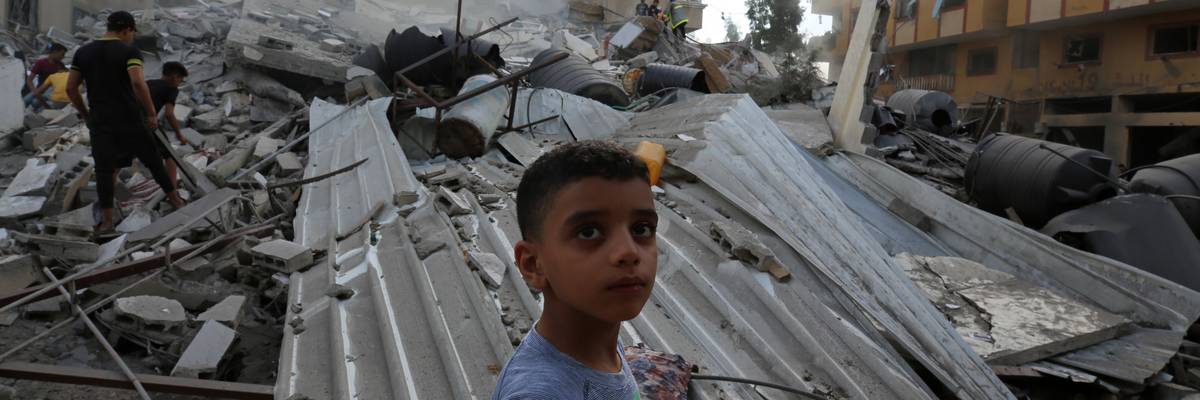
People assess the destruction caused by Israeli airstrikes in Gaza City on October 7, 2023.
"Starving 2 million people who cannot move and are under a land siege and naval blockade is genocide."
Israeli Defense Minister Yoav Gallant announced a "complete siege" of the Gaza Strip on Monday, pledging to block food and fuel from entering the occupied enclave and cut off the territory's electricity—steps that international law experts and other observers decried as a clear war crime that will devastate civilians.
"There will be no electricity, no food, no fuel, everything is closed," said Gallant.
Using rhetoric that one commentator called "blatantly genocidal," Gallant added that "we are fighting human animals and we are acting accordingly."
Israel has been imposing a land, air, and sea blockade on the Gaza Strip for nearly two decades, impoverishing much of the crowded enclave's population and denying millions sufficient access to clean water and other necessities. Children, who make up roughly half of Gaza's population, have been disproportionately affected.
An intensification of the blockade against Gaza—often described as the world's largest open-air prison—would be both unlawful and catastrophic, analysts warned.
"Starving 2 million people who cannot move and are under a land siege and naval blockade is genocide," Pakistani writer Fatima Bhutto wrote on social media. "This is a war crime."
Tom Dannenbaum, a legal scholar and associate professor of international law at the Fletcher School of Law and Diplomacy, agreed with that assessment, pointing to International Criminal Court statutes.
"Gallant is ordering a massive war crime (ICC 8(2)(b)(xxv)) and very likely a crime against humanity (ICC 7(1)(b), 7(2)(b) [extermination] / 7(1)(k) [inhumane acts])," Dannenbaum wrote. "Presence of combatants within a civilian population does not affect its civilian character (AP I 50(3)). ICC has jurisdiction."
Omar Shakir, Israel and Palestine director at Human Rights Watch, called Gallant's comments "abhorrent" and said that "depriving the population in an occupied territory of food and electricity is collective punishment, which is a war crime, as is using starvation as a weapon of war."
"The International Criminal Court should take note of this call to commit a war crime," said Shakir.
The announcement of a total blockade on Gaza comes as Israel is preparing for a ground invasion of the Palestinian territory and asking the U.S. to ramp up military support in the wake of Hamas' deadly attack on Saturday, which killed more than 700 people.
Israel has since launched a wave of airstrikes in Gaza, killing more than 500 people and injuring thousands. Dozens of Palestinians were reportedly killed Monday by an Israeli attack on Gaza's largest refugee camp.
"The intense bombardment has so far displaced more than 120,000 people in the besieged Palestinian enclave," Al Jazeera reported.
An analysis published earlier this year by the human rights group Euro-Med Monitor estimated that Israel's 16-year blockade "has impoverished more than 61% of Gaza's total population" and "left nearly 53% of the population facing food insecurity."
In a statement on Monday, the Israeli human rights group B'Tselem said that Israeli officials "who now call for killing, destroying, crushing, smashing, and even starving the residents of the Gaza Strip" in the wake of Hamas' attack "forget that this is already Israeli policy."
"At this moment, Israel is attacking in the Gaza Strip, when it is clear that once again many of the victims are civilians—including women, children, and the elderly," the group added. "Deliberate harm to civilians is always wrong and prohibited. There can be no justification for such crimes, not when they are committed as part of a struggle for freedom and liberation from oppression, and not when they are justified as a fight against terrorism."
This story has been updated to include a statement from Human Rights Watch.
Dear Common Dreams reader, It’s been nearly 30 years since I co-founded Common Dreams with my late wife, Lina Newhouser. We had the radical notion that journalism should serve the public good, not corporate profits. It was clear to us from the outset what it would take to build such a project. No paid advertisements. No corporate sponsors. No millionaire publisher telling us what to think or do. Many people said we wouldn't last a year, but we proved those doubters wrong. Together with a tremendous team of journalists and dedicated staff, we built an independent media outlet free from the constraints of profits and corporate control. Our mission has always been simple: To inform. To inspire. To ignite change for the common good. Building Common Dreams was not easy. Our survival was never guaranteed. When you take on the most powerful forces—Wall Street greed, fossil fuel industry destruction, Big Tech lobbyists, and uber-rich oligarchs who have spent billions upon billions rigging the economy and democracy in their favor—the only bulwark you have is supporters who believe in your work. But here’s the urgent message from me today. It's never been this bad out there. And it's never been this hard to keep us going. At the very moment Common Dreams is most needed, the threats we face are intensifying. We need your support now more than ever. We don't accept corporate advertising and never will. We don't have a paywall because we don't think people should be blocked from critical news based on their ability to pay. Everything we do is funded by the donations of readers like you. When everyone does the little they can afford, we are strong. But if that support retreats or dries up, so do we. Will you donate now to make sure Common Dreams not only survives but thrives? —Craig Brown, Co-founder |
Israeli Defense Minister Yoav Gallant announced a "complete siege" of the Gaza Strip on Monday, pledging to block food and fuel from entering the occupied enclave and cut off the territory's electricity—steps that international law experts and other observers decried as a clear war crime that will devastate civilians.
"There will be no electricity, no food, no fuel, everything is closed," said Gallant.
Using rhetoric that one commentator called "blatantly genocidal," Gallant added that "we are fighting human animals and we are acting accordingly."
Israel has been imposing a land, air, and sea blockade on the Gaza Strip for nearly two decades, impoverishing much of the crowded enclave's population and denying millions sufficient access to clean water and other necessities. Children, who make up roughly half of Gaza's population, have been disproportionately affected.
An intensification of the blockade against Gaza—often described as the world's largest open-air prison—would be both unlawful and catastrophic, analysts warned.
"Starving 2 million people who cannot move and are under a land siege and naval blockade is genocide," Pakistani writer Fatima Bhutto wrote on social media. "This is a war crime."
Tom Dannenbaum, a legal scholar and associate professor of international law at the Fletcher School of Law and Diplomacy, agreed with that assessment, pointing to International Criminal Court statutes.
"Gallant is ordering a massive war crime (ICC 8(2)(b)(xxv)) and very likely a crime against humanity (ICC 7(1)(b), 7(2)(b) [extermination] / 7(1)(k) [inhumane acts])," Dannenbaum wrote. "Presence of combatants within a civilian population does not affect its civilian character (AP I 50(3)). ICC has jurisdiction."
Omar Shakir, Israel and Palestine director at Human Rights Watch, called Gallant's comments "abhorrent" and said that "depriving the population in an occupied territory of food and electricity is collective punishment, which is a war crime, as is using starvation as a weapon of war."
"The International Criminal Court should take note of this call to commit a war crime," said Shakir.
The announcement of a total blockade on Gaza comes as Israel is preparing for a ground invasion of the Palestinian territory and asking the U.S. to ramp up military support in the wake of Hamas' deadly attack on Saturday, which killed more than 700 people.
Israel has since launched a wave of airstrikes in Gaza, killing more than 500 people and injuring thousands. Dozens of Palestinians were reportedly killed Monday by an Israeli attack on Gaza's largest refugee camp.
"The intense bombardment has so far displaced more than 120,000 people in the besieged Palestinian enclave," Al Jazeera reported.
An analysis published earlier this year by the human rights group Euro-Med Monitor estimated that Israel's 16-year blockade "has impoverished more than 61% of Gaza's total population" and "left nearly 53% of the population facing food insecurity."
In a statement on Monday, the Israeli human rights group B'Tselem said that Israeli officials "who now call for killing, destroying, crushing, smashing, and even starving the residents of the Gaza Strip" in the wake of Hamas' attack "forget that this is already Israeli policy."
"At this moment, Israel is attacking in the Gaza Strip, when it is clear that once again many of the victims are civilians—including women, children, and the elderly," the group added. "Deliberate harm to civilians is always wrong and prohibited. There can be no justification for such crimes, not when they are committed as part of a struggle for freedom and liberation from oppression, and not when they are justified as a fight against terrorism."
This story has been updated to include a statement from Human Rights Watch.
Israeli Defense Minister Yoav Gallant announced a "complete siege" of the Gaza Strip on Monday, pledging to block food and fuel from entering the occupied enclave and cut off the territory's electricity—steps that international law experts and other observers decried as a clear war crime that will devastate civilians.
"There will be no electricity, no food, no fuel, everything is closed," said Gallant.
Using rhetoric that one commentator called "blatantly genocidal," Gallant added that "we are fighting human animals and we are acting accordingly."
Israel has been imposing a land, air, and sea blockade on the Gaza Strip for nearly two decades, impoverishing much of the crowded enclave's population and denying millions sufficient access to clean water and other necessities. Children, who make up roughly half of Gaza's population, have been disproportionately affected.
An intensification of the blockade against Gaza—often described as the world's largest open-air prison—would be both unlawful and catastrophic, analysts warned.
"Starving 2 million people who cannot move and are under a land siege and naval blockade is genocide," Pakistani writer Fatima Bhutto wrote on social media. "This is a war crime."
Tom Dannenbaum, a legal scholar and associate professor of international law at the Fletcher School of Law and Diplomacy, agreed with that assessment, pointing to International Criminal Court statutes.
"Gallant is ordering a massive war crime (ICC 8(2)(b)(xxv)) and very likely a crime against humanity (ICC 7(1)(b), 7(2)(b) [extermination] / 7(1)(k) [inhumane acts])," Dannenbaum wrote. "Presence of combatants within a civilian population does not affect its civilian character (AP I 50(3)). ICC has jurisdiction."
Omar Shakir, Israel and Palestine director at Human Rights Watch, called Gallant's comments "abhorrent" and said that "depriving the population in an occupied territory of food and electricity is collective punishment, which is a war crime, as is using starvation as a weapon of war."
"The International Criminal Court should take note of this call to commit a war crime," said Shakir.
The announcement of a total blockade on Gaza comes as Israel is preparing for a ground invasion of the Palestinian territory and asking the U.S. to ramp up military support in the wake of Hamas' deadly attack on Saturday, which killed more than 700 people.
Israel has since launched a wave of airstrikes in Gaza, killing more than 500 people and injuring thousands. Dozens of Palestinians were reportedly killed Monday by an Israeli attack on Gaza's largest refugee camp.
"The intense bombardment has so far displaced more than 120,000 people in the besieged Palestinian enclave," Al Jazeera reported.
An analysis published earlier this year by the human rights group Euro-Med Monitor estimated that Israel's 16-year blockade "has impoverished more than 61% of Gaza's total population" and "left nearly 53% of the population facing food insecurity."
In a statement on Monday, the Israeli human rights group B'Tselem said that Israeli officials "who now call for killing, destroying, crushing, smashing, and even starving the residents of the Gaza Strip" in the wake of Hamas' attack "forget that this is already Israeli policy."
"At this moment, Israel is attacking in the Gaza Strip, when it is clear that once again many of the victims are civilians—including women, children, and the elderly," the group added. "Deliberate harm to civilians is always wrong and prohibited. There can be no justification for such crimes, not when they are committed as part of a struggle for freedom and liberation from oppression, and not when they are justified as a fight against terrorism."
This story has been updated to include a statement from Human Rights Watch.