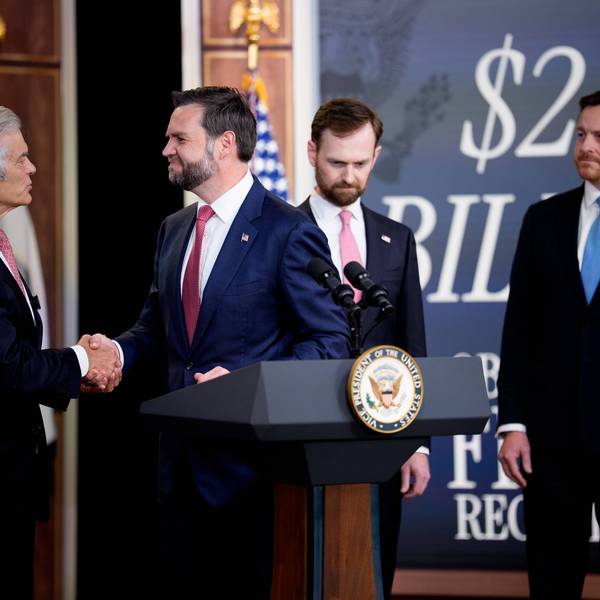
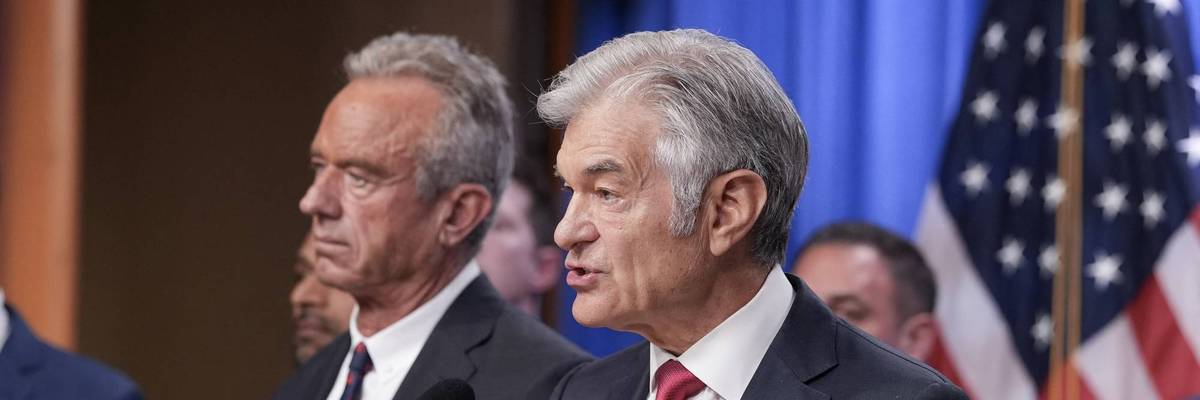
Centers for Medicare and Medicaid Administrator Mehmet Oz speaks during a press conference in Washington, DC on June 23, 2026.
With New Rules, Trump Accused of 'Coordinated Dismantling of the Medicaid Program'
One advocate warned that new Medicaid rules issued by the Trump administration would have "disastrous impacts on individuals and healthcare systems."
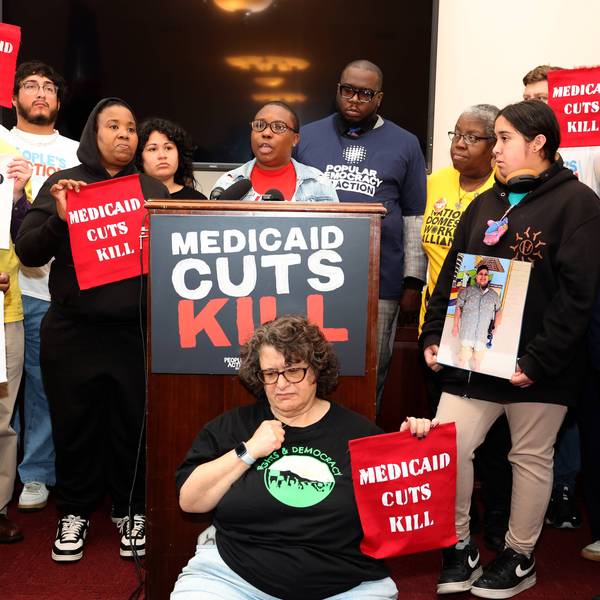
The Trump administration earlier this week unveiled a new rule that advocates said would make it harder for states to fund their Medicaid programs, compounding damage caused by expanded work requirements and other changes enacted under the 2025 Republican budget law.
The law bars states from creating new provider taxes—levies on hospitals and other healthcare providers—and limits existing ones. The new Centers for Medicare and Medicaid Services (CMS) rule, which is open for public comment until September, would codify the GOP law's changes.
Anthony Wright, executive director of Families USA, said Wednesday that the CMS rule "goes beyond the harsh restrictions already imposed by Congress to further narrow the options that states have to fund Medicaid services and providers."
"Along with Congress’ other restrictions on taxing healthcare providers—restrictions that gut Medicaid funding in all states—CMS estimates this new proposed rule will cut $198.7 billion in state Medicaid funding over 10 years," Wright noted. "This rule comes at a time when states are already under significant budgetary pressure to foot the bill for the cost of implementing complex and unnecessary work reporting requirements; in tandem with a proposed rule that slashes Medicaid provider payments and further eliminates state flexibility."
“Taken together," Wright warned, "these three rules serve as a coordinated dismantling of the Medicaid program, including its eligibility systems, payment structures and financing mechanisms, with disastrous impacts on individuals and healthcare systems."
The Republican budget measure, which President Donald Trump signed into law last summer, includes roughly $900 billion in Medicaid cuts over the next decade. Millions of Americans have lost Medicaid coverage since the GOP law took effect.
Earlier this week, the entire House Democratic caucus implored CMS to "reconsider" its recently published Medicaid work requirement rule, warning it "will create an undue burden for beneficiaries with serious healthcare needs and put people at risk of losing coverage, while also creating significant implementation challenges for states."
"This rule will require beneficiaries to frequently prove and verify their exemptions in order to maintain coverage, which will cause confusion, create bureaucratic burdens for patients seeking care, and, as a result, will lock patients out of lifesaving treatments," the lawmakers wrote. "Forcing vulnerable patients to exhaustively document their symptoms simply to maintain access to basic
healthcare is both imprudent and inconsistent with federal law."
We are at a crossroads
This country and this world are at a monumental crossroads. In a few short weeks, US voters will have an opportunity to beat back the forces of fascism and confront the billionaires who are rigging the economy, our media system, and our democracy, making it increasingly impossible for ordinary people to get by. We’re not just talking about the election. We’re talking about what must be done once these fascist elements are vanquished from power. We need a bolder set of solutions than what either major party has so far been willing to offer and a working-class movement ready to fight like hell for it. Trump didn't emerge from nowhere. The conditions that fueled MAGA authoritarianism were created by decades of radical neoliberal economic policies and a corrupt political system dominated by corporate interests. They slashed taxes on the super-rich, promising that the benefits would trickle down. They said giveaways to the corporate titans would make life more affordable for the rest of us. It was all bullshit. And when a bitter, betrayed populace searches for someone to blame, right-wing demagogues have little trouble finding scapegoats. People know when they're being lied to, but you won't hear any of this from the corporate media. Only independent journalism—powered and funded by people who believe in building a better world—can deliver truly trustworthy daily news. Our Fall Campaign is underway, and we need your help. To power our newsroom through the rest of the year, we need to raise $125,000 by midnight on October 31. So if you share our vision, please contribute whatever you can to sustain our work. |
The Trump administration earlier this week unveiled a new rule that advocates said would make it harder for states to fund their Medicaid programs, compounding damage caused by expanded work requirements and other changes enacted under the 2025 Republican budget law.
The law bars states from creating new provider taxes—levies on hospitals and other healthcare providers—and limits existing ones. The new Centers for Medicare and Medicaid Services (CMS) rule, which is open for public comment until September, would codify the GOP law's changes.
Anthony Wright, executive director of Families USA, said Wednesday that the CMS rule "goes beyond the harsh restrictions already imposed by Congress to further narrow the options that states have to fund Medicaid services and providers."
"Along with Congress’ other restrictions on taxing healthcare providers—restrictions that gut Medicaid funding in all states—CMS estimates this new proposed rule will cut $198.7 billion in state Medicaid funding over 10 years," Wright noted. "This rule comes at a time when states are already under significant budgetary pressure to foot the bill for the cost of implementing complex and unnecessary work reporting requirements; in tandem with a proposed rule that slashes Medicaid provider payments and further eliminates state flexibility."
“Taken together," Wright warned, "these three rules serve as a coordinated dismantling of the Medicaid program, including its eligibility systems, payment structures and financing mechanisms, with disastrous impacts on individuals and healthcare systems."
The Republican budget measure, which President Donald Trump signed into law last summer, includes roughly $900 billion in Medicaid cuts over the next decade. Millions of Americans have lost Medicaid coverage since the GOP law took effect.
Earlier this week, the entire House Democratic caucus implored CMS to "reconsider" its recently published Medicaid work requirement rule, warning it "will create an undue burden for beneficiaries with serious healthcare needs and put people at risk of losing coverage, while also creating significant implementation challenges for states."
"This rule will require beneficiaries to frequently prove and verify their exemptions in order to maintain coverage, which will cause confusion, create bureaucratic burdens for patients seeking care, and, as a result, will lock patients out of lifesaving treatments," the lawmakers wrote. "Forcing vulnerable patients to exhaustively document their symptoms simply to maintain access to basic
healthcare is both imprudent and inconsistent with federal law."
The Trump administration earlier this week unveiled a new rule that advocates said would make it harder for states to fund their Medicaid programs, compounding damage caused by expanded work requirements and other changes enacted under the 2025 Republican budget law.
The law bars states from creating new provider taxes—levies on hospitals and other healthcare providers—and limits existing ones. The new Centers for Medicare and Medicaid Services (CMS) rule, which is open for public comment until September, would codify the GOP law's changes.
Anthony Wright, executive director of Families USA, said Wednesday that the CMS rule "goes beyond the harsh restrictions already imposed by Congress to further narrow the options that states have to fund Medicaid services and providers."
"Along with Congress’ other restrictions on taxing healthcare providers—restrictions that gut Medicaid funding in all states—CMS estimates this new proposed rule will cut $198.7 billion in state Medicaid funding over 10 years," Wright noted. "This rule comes at a time when states are already under significant budgetary pressure to foot the bill for the cost of implementing complex and unnecessary work reporting requirements; in tandem with a proposed rule that slashes Medicaid provider payments and further eliminates state flexibility."
“Taken together," Wright warned, "these three rules serve as a coordinated dismantling of the Medicaid program, including its eligibility systems, payment structures and financing mechanisms, with disastrous impacts on individuals and healthcare systems."
The Republican budget measure, which President Donald Trump signed into law last summer, includes roughly $900 billion in Medicaid cuts over the next decade. Millions of Americans have lost Medicaid coverage since the GOP law took effect.
Earlier this week, the entire House Democratic caucus implored CMS to "reconsider" its recently published Medicaid work requirement rule, warning it "will create an undue burden for beneficiaries with serious healthcare needs and put people at risk of losing coverage, while also creating significant implementation challenges for states."
"This rule will require beneficiaries to frequently prove and verify their exemptions in order to maintain coverage, which will cause confusion, create bureaucratic burdens for patients seeking care, and, as a result, will lock patients out of lifesaving treatments," the lawmakers wrote. "Forcing vulnerable patients to exhaustively document their symptoms simply to maintain access to basic
healthcare is both imprudent and inconsistent with federal law."