SUBSCRIBE TO OUR FREE NEWSLETTER
Daily news & progressive opinion—funded by the people, not the corporations—delivered straight to your inbox.
5
#000000
#FFFFFF
To donate by check, phone, or other method, see our More Ways to Give page.
Daily news & progressive opinion—funded by the people, not the corporations—delivered straight to your inbox.

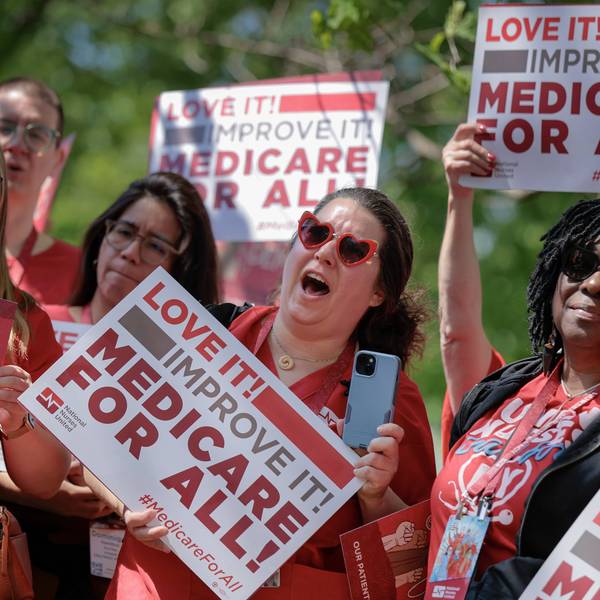
Members of National Nurses United rally with lawmakers to show their support for the Medicare For All Act on April 29, 2025.
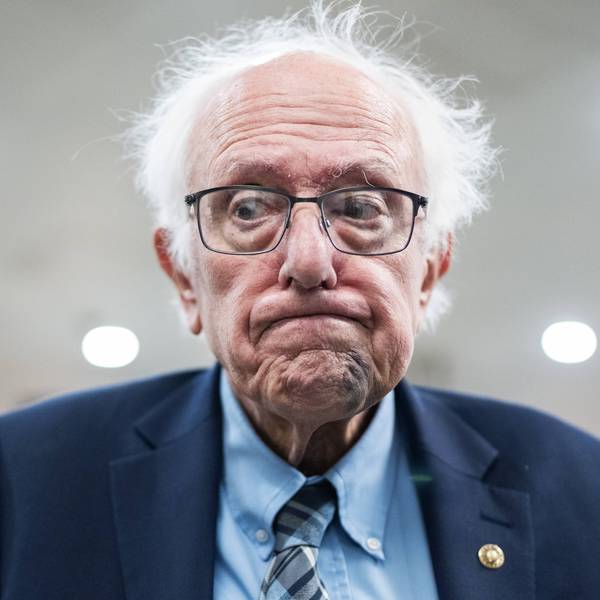
"Everybody recognizes that our current healthcare system is broken," said Sen. Bernie Sanders. "That’s why over 60% of the American people support Medicare for All."
With Affordable Care Act premiums surging and lawmakers on both sides of the political aisle scrambling to cobble together a last-minute fix, recent polling data shows that a strong majority of the American public supports a transformative proposal that few members of Congress are vocally advocating.
Data for Progress released survey results late last month showing that 65% of likely US voters—including 78% of Democrats, 71% of Independents, and 49% of Republicans—either strongly or somewhat support "creating a national health insurance program, sometimes called 'Medicare for All,' that would cover all Americans and replace most private health insurance plans."
Overall support for such a system dropped just two percentage points when survey respondents were informed that Medicare for All would replace insurance premiums with higher taxes, abolish most private insurance, and eliminate copays and deductibles. In an analysis posted last week, The Lever's David Sirota observed that those results are a shift from earlier polling showing a sharp decline in support for Medicare for All once respondents were told the proposal would wipe out private insurance.
"That might have been the end of Medicare for All for another generation—except now the ACA is epically and undeniably failing to guarantee 'affordable' healthcare," Sirota wrote. "As private health insurers are now jacking up premiums for tens of millions of Americans, a new poll shows a huge majority of Americans now want Medicare for All—even if it entails eliminating private insurers and raising taxes."
The Data for Progress survey came as Republican and Democratic lawmakers continued floating temporary, Band-Aid solutions to avert catastrophic premium increases stemming in large part from the looming expiration of enhanced ACA tax credits, which lapse at the end of the year.
A new poll released Thursday by KFF found that "six in ten adults (61%) who buy their health coverage on the ACA marketplace say it is very or somewhat difficult to afford their deductibles and out-of-pocket costs for medical care."
"When asked what they would do if the amount they pay for health insurance each month doubled, one in three enrollees (32%) say they are very likely to shop for a lower-premium plan (with higher deductibles and out-of-pocket costs), and one in four (25%) say they would be very likely to go uninsured," KFF noted.
Senate Majority Leader Chuck Schumer (D-NY) on Thursday pitched a three-year extension of the ACA subsidies ahead of a planned vote next week—a proposal that Republicans are certain to oppose.
On the Republican side, Sen. Rick Scott (R-Fla.)—who is linked to the largest Medicare fraud case in US history—is convening a group of Republican lawmakers to craft a likely dead-on-arrival ACA alternative that would implement some proposals floated by President Donald Trump, including new savings accounts that critics say would further enrich banks and insurance giants.
Scott warned in a statement to Axios earlier this week that "the more Republicans refuse to engage on this issue, the more we allow radical Democrats to lead our country on a slow creep towards the Socialist single-payer healthcare system they've always wanted."
House Speaker Mike Johnson (R-La.), meanwhile, is reportedly planning to finalize a healthcare bill early next week, though no details were immediately available.
There's also a bipartisan framework led by Reps. Josh Gottheimer (D-NJ) and Jen Kiggans (R-Va.), which calls for a one-year extension of the enhanced ACA tax credits "with targeted modifications," including intensified means-testing that would phase out the subsidies for those with incomes between 600% and 1,000% of the federal poverty level.
The Medicare for All Act, led by Sen. Bernie Sanders (I-Vt.) in the Senate and Reps. Pramila Jayapal (D-Wash.) and Debbie Dingell (D-Mich.) in the House, would have no such means-testing, guaranteeing comprehensive coverage to all for free at the point of service.
"Everybody recognizes that our current healthcare system is broken. That’s why over 60% of the American people support Medicare for All," Sanders said at a rally with nurses in the nation's capital on Wednesday. "The day will come when working-class Americans will be able to go to the doctor, dentist, or a nursing home without having to worry about the cost. We’re going to win this fight."
Dear Common Dreams reader, It’s been nearly 30 years since I co-founded Common Dreams with my late wife, Lina Newhouser. We had the radical notion that journalism should serve the public good, not corporate profits. It was clear to us from the outset what it would take to build such a project. No paid advertisements. No corporate sponsors. No millionaire publisher telling us what to think or do. Many people said we wouldn't last a year, but we proved those doubters wrong. Together with a tremendous team of journalists and dedicated staff, we built an independent media outlet free from the constraints of profits and corporate control. Our mission has always been simple: To inform. To inspire. To ignite change for the common good. Building Common Dreams was not easy. Our survival was never guaranteed. When you take on the most powerful forces—Wall Street greed, fossil fuel industry destruction, Big Tech lobbyists, and uber-rich oligarchs who have spent billions upon billions rigging the economy and democracy in their favor—the only bulwark you have is supporters who believe in your work. But here’s the urgent message from me today. It's never been this bad out there. And it's never been this hard to keep us going. At the very moment Common Dreams is most needed, the threats we face are intensifying. We need your support now more than ever. We don't accept corporate advertising and never will. We don't have a paywall because we don't think people should be blocked from critical news based on their ability to pay. Everything we do is funded by the donations of readers like you. When everyone does the little they can afford, we are strong. But if that support retreats or dries up, so do we. Will you donate now to make sure Common Dreams not only survives but thrives? —Craig Brown, Co-founder |
With Affordable Care Act premiums surging and lawmakers on both sides of the political aisle scrambling to cobble together a last-minute fix, recent polling data shows that a strong majority of the American public supports a transformative proposal that few members of Congress are vocally advocating.
Data for Progress released survey results late last month showing that 65% of likely US voters—including 78% of Democrats, 71% of Independents, and 49% of Republicans—either strongly or somewhat support "creating a national health insurance program, sometimes called 'Medicare for All,' that would cover all Americans and replace most private health insurance plans."
Overall support for such a system dropped just two percentage points when survey respondents were informed that Medicare for All would replace insurance premiums with higher taxes, abolish most private insurance, and eliminate copays and deductibles. In an analysis posted last week, The Lever's David Sirota observed that those results are a shift from earlier polling showing a sharp decline in support for Medicare for All once respondents were told the proposal would wipe out private insurance.
"That might have been the end of Medicare for All for another generation—except now the ACA is epically and undeniably failing to guarantee 'affordable' healthcare," Sirota wrote. "As private health insurers are now jacking up premiums for tens of millions of Americans, a new poll shows a huge majority of Americans now want Medicare for All—even if it entails eliminating private insurers and raising taxes."
The Data for Progress survey came as Republican and Democratic lawmakers continued floating temporary, Band-Aid solutions to avert catastrophic premium increases stemming in large part from the looming expiration of enhanced ACA tax credits, which lapse at the end of the year.
A new poll released Thursday by KFF found that "six in ten adults (61%) who buy their health coverage on the ACA marketplace say it is very or somewhat difficult to afford their deductibles and out-of-pocket costs for medical care."
"When asked what they would do if the amount they pay for health insurance each month doubled, one in three enrollees (32%) say they are very likely to shop for a lower-premium plan (with higher deductibles and out-of-pocket costs), and one in four (25%) say they would be very likely to go uninsured," KFF noted.
Senate Majority Leader Chuck Schumer (D-NY) on Thursday pitched a three-year extension of the ACA subsidies ahead of a planned vote next week—a proposal that Republicans are certain to oppose.
On the Republican side, Sen. Rick Scott (R-Fla.)—who is linked to the largest Medicare fraud case in US history—is convening a group of Republican lawmakers to craft a likely dead-on-arrival ACA alternative that would implement some proposals floated by President Donald Trump, including new savings accounts that critics say would further enrich banks and insurance giants.
Scott warned in a statement to Axios earlier this week that "the more Republicans refuse to engage on this issue, the more we allow radical Democrats to lead our country on a slow creep towards the Socialist single-payer healthcare system they've always wanted."
House Speaker Mike Johnson (R-La.), meanwhile, is reportedly planning to finalize a healthcare bill early next week, though no details were immediately available.
There's also a bipartisan framework led by Reps. Josh Gottheimer (D-NJ) and Jen Kiggans (R-Va.), which calls for a one-year extension of the enhanced ACA tax credits "with targeted modifications," including intensified means-testing that would phase out the subsidies for those with incomes between 600% and 1,000% of the federal poverty level.
The Medicare for All Act, led by Sen. Bernie Sanders (I-Vt.) in the Senate and Reps. Pramila Jayapal (D-Wash.) and Debbie Dingell (D-Mich.) in the House, would have no such means-testing, guaranteeing comprehensive coverage to all for free at the point of service.
"Everybody recognizes that our current healthcare system is broken. That’s why over 60% of the American people support Medicare for All," Sanders said at a rally with nurses in the nation's capital on Wednesday. "The day will come when working-class Americans will be able to go to the doctor, dentist, or a nursing home without having to worry about the cost. We’re going to win this fight."
With Affordable Care Act premiums surging and lawmakers on both sides of the political aisle scrambling to cobble together a last-minute fix, recent polling data shows that a strong majority of the American public supports a transformative proposal that few members of Congress are vocally advocating.
Data for Progress released survey results late last month showing that 65% of likely US voters—including 78% of Democrats, 71% of Independents, and 49% of Republicans—either strongly or somewhat support "creating a national health insurance program, sometimes called 'Medicare for All,' that would cover all Americans and replace most private health insurance plans."
Overall support for such a system dropped just two percentage points when survey respondents were informed that Medicare for All would replace insurance premiums with higher taxes, abolish most private insurance, and eliminate copays and deductibles. In an analysis posted last week, The Lever's David Sirota observed that those results are a shift from earlier polling showing a sharp decline in support for Medicare for All once respondents were told the proposal would wipe out private insurance.
"That might have been the end of Medicare for All for another generation—except now the ACA is epically and undeniably failing to guarantee 'affordable' healthcare," Sirota wrote. "As private health insurers are now jacking up premiums for tens of millions of Americans, a new poll shows a huge majority of Americans now want Medicare for All—even if it entails eliminating private insurers and raising taxes."
The Data for Progress survey came as Republican and Democratic lawmakers continued floating temporary, Band-Aid solutions to avert catastrophic premium increases stemming in large part from the looming expiration of enhanced ACA tax credits, which lapse at the end of the year.
A new poll released Thursday by KFF found that "six in ten adults (61%) who buy their health coverage on the ACA marketplace say it is very or somewhat difficult to afford their deductibles and out-of-pocket costs for medical care."
"When asked what they would do if the amount they pay for health insurance each month doubled, one in three enrollees (32%) say they are very likely to shop for a lower-premium plan (with higher deductibles and out-of-pocket costs), and one in four (25%) say they would be very likely to go uninsured," KFF noted.
Senate Majority Leader Chuck Schumer (D-NY) on Thursday pitched a three-year extension of the ACA subsidies ahead of a planned vote next week—a proposal that Republicans are certain to oppose.
On the Republican side, Sen. Rick Scott (R-Fla.)—who is linked to the largest Medicare fraud case in US history—is convening a group of Republican lawmakers to craft a likely dead-on-arrival ACA alternative that would implement some proposals floated by President Donald Trump, including new savings accounts that critics say would further enrich banks and insurance giants.
Scott warned in a statement to Axios earlier this week that "the more Republicans refuse to engage on this issue, the more we allow radical Democrats to lead our country on a slow creep towards the Socialist single-payer healthcare system they've always wanted."
House Speaker Mike Johnson (R-La.), meanwhile, is reportedly planning to finalize a healthcare bill early next week, though no details were immediately available.
There's also a bipartisan framework led by Reps. Josh Gottheimer (D-NJ) and Jen Kiggans (R-Va.), which calls for a one-year extension of the enhanced ACA tax credits "with targeted modifications," including intensified means-testing that would phase out the subsidies for those with incomes between 600% and 1,000% of the federal poverty level.
The Medicare for All Act, led by Sen. Bernie Sanders (I-Vt.) in the Senate and Reps. Pramila Jayapal (D-Wash.) and Debbie Dingell (D-Mich.) in the House, would have no such means-testing, guaranteeing comprehensive coverage to all for free at the point of service.
"Everybody recognizes that our current healthcare system is broken. That’s why over 60% of the American people support Medicare for All," Sanders said at a rally with nurses in the nation's capital on Wednesday. "The day will come when working-class Americans will be able to go to the doctor, dentist, or a nursing home without having to worry about the cost. We’re going to win this fight."