SUBSCRIBE TO OUR FREE NEWSLETTER
Daily news & progressive opinion—funded by the people, not the corporations—delivered straight to your inbox.
5
#000000
#FFFFFF
To donate by check, phone, or other method, see our More Ways to Give page.
Daily news & progressive opinion—funded by the people, not the corporations—delivered straight to your inbox.
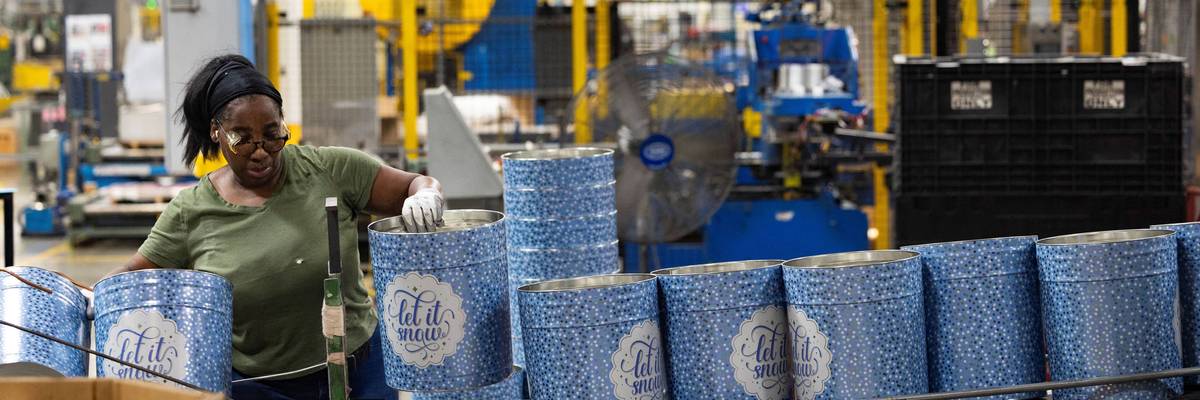
An employee of Independent Can Company works on the manufacturing line in Belcamp, Maryland, on June 25, 2025.
“There’s very little in our product portfolio that has benefited from tariffs,” said the CEO of one North Carolina-based steel product company.
US President Donald Trump pledged that the manufacturing industry would come "roaring back into our country" after what he called "Liberation Day" last April, which was marked by the announcement of sweeping tariffs on imported goods—a policy that has shifted constantly in the past 10 months as Trump has changed rates, canceled tariffs, and threatened new ones.
But after promising to turn around economic trends that have developed over decades—the shipping of jobs overseas, automation, and the obliteration of towns and cities that had once been manufacturing centers—Trump's trade policy appears to have put any progress achieved in the sector in recent years "in reverse," as the Wall Street Journal reported on Monday.
Federal data shows that in each of the eight months that followed Trump's Liberation Day tariffs, manufacturing companies reduced their workforce, with a total of 72,000 jobs in the industry lost since April 2025.
The Census Bureau also estimates that construction spending in the manufacturing industry contracted in the first nine months of Trump's second term, after surging during the Biden administration due to investments in renewable energy and semiconductor chips.
"But the tariffs haven’t helped," said Hanson.
Trump has insisted that his tariff policy would force companies to manufacture goods domestically to avoid paying more for foreign materials—just as he has claimed consumers would see lower prices.
But numerous analyses have shown American families are paying more, not less, for essentials like groceries as companies have passed on their higher operating costs to consumers, and federal data has made clear that companies are also avoiding investing in labor since Trump introduced the tariffs—while the trade war the president has kicked off hasn't changed the realities faced by many manufacturing sectors.
"While tariffs do reduce import competition, they can also increase the cost of key components for domestic manufacturers," wrote Emma Ockerman at Yahoo Finance. "Take US electric vehicle plants that rely on batteries made with rare earth elements imported from overseas, for instance. Some parts simply aren’t made in the United States."
At the National Interest, Ryan Mulholland of the Center for American Progress wrote that Trump's tariffs have created "three overlapping challenges" for US businesses.
"The imported components and materials needed to produce goods domestically now cost more—in some cases, a lot more," wrote Mulholland. "Foreign buyers are now looking elsewhere, often to protest Trump’s global belligerence, costing US firms market share abroad that will be difficult to win back. And if bad policy wasn’t enough, US manufacturers must also contend with the Trump administration’s unpredictability, which has made long-term investment decisions nearly impossible. Perhaps it’s no surprise, then, that small business bankruptcies have surged to their highest level in years."
Trump's unpredictable threats of new tariffs and his retreats on the policy, as with European countries in recent weeks when he said he would impose new levies on countries that didn't support his push to take control of Greenland, have also led to "a lost year for investment" for many firms, along with the possibility that the US Supreme Court could soon rule against the president's tariffs.
“If Trump just picked a number—whatever it was, 10% or 15% to 20%—we might all say it’s bad, I’d say it’s bad, I think most economists would say it’s bad,” Dean Baker, senior economist at the Center for Economic and Policy Research, told Yahoo Finance. “But the worst thing is there’s no certainty about it.”
Constantly changing tariff rates make it "very difficult for businesses... to plan," said Baker. “I think you’ve had a lot of businesses curtail investment plans because they just don’t know whether the plans will make sense.”
While US manufacturers have struggled to compete globally, China and other countries have continued exporting their goods.
“There’s very little in our product portfolio that has benefited from tariffs,” H.O. Woltz III, chief executive of North Carolina-based Insteel Industries, told the Wall Street Journal.
US Rep. Marcy Kaptur (D-Ohio) noted Monday that the data on manufacturing job losses comes a week after Vice President JD Vance visited his home state to tout "record job growth."
"Here’s the reality: Families face higher costs, tariffs are costing manufacturing jobs, and over $200 million in approved federal infrastructure and manufacturing investments here were cut by this administration," said Kaptur. "Ohio deserves better."
Dear Common Dreams reader, It’s been nearly 30 years since I co-founded Common Dreams with my late wife, Lina Newhouser. We had the radical notion that journalism should serve the public good, not corporate profits. It was clear to us from the outset what it would take to build such a project. No paid advertisements. No corporate sponsors. No millionaire publisher telling us what to think or do. Many people said we wouldn't last a year, but we proved those doubters wrong. Together with a tremendous team of journalists and dedicated staff, we built an independent media outlet free from the constraints of profits and corporate control. Our mission has always been simple: To inform. To inspire. To ignite change for the common good. Building Common Dreams was not easy. Our survival was never guaranteed. When you take on the most powerful forces—Wall Street greed, fossil fuel industry destruction, Big Tech lobbyists, and uber-rich oligarchs who have spent billions upon billions rigging the economy and democracy in their favor—the only bulwark you have is supporters who believe in your work. But here’s the urgent message from me today. It's never been this bad out there. And it's never been this hard to keep us going. At the very moment Common Dreams is most needed, the threats we face are intensifying. We need your support now more than ever. We don't accept corporate advertising and never will. We don't have a paywall because we don't think people should be blocked from critical news based on their ability to pay. Everything we do is funded by the donations of readers like you. When everyone does the little they can afford, we are strong. But if that support retreats or dries up, so do we. Will you donate now to make sure Common Dreams not only survives but thrives? —Craig Brown, Co-founder |
US President Donald Trump pledged that the manufacturing industry would come "roaring back into our country" after what he called "Liberation Day" last April, which was marked by the announcement of sweeping tariffs on imported goods—a policy that has shifted constantly in the past 10 months as Trump has changed rates, canceled tariffs, and threatened new ones.
But after promising to turn around economic trends that have developed over decades—the shipping of jobs overseas, automation, and the obliteration of towns and cities that had once been manufacturing centers—Trump's trade policy appears to have put any progress achieved in the sector in recent years "in reverse," as the Wall Street Journal reported on Monday.
Federal data shows that in each of the eight months that followed Trump's Liberation Day tariffs, manufacturing companies reduced their workforce, with a total of 72,000 jobs in the industry lost since April 2025.
The Census Bureau also estimates that construction spending in the manufacturing industry contracted in the first nine months of Trump's second term, after surging during the Biden administration due to investments in renewable energy and semiconductor chips.
"But the tariffs haven’t helped," said Hanson.
Trump has insisted that his tariff policy would force companies to manufacture goods domestically to avoid paying more for foreign materials—just as he has claimed consumers would see lower prices.
But numerous analyses have shown American families are paying more, not less, for essentials like groceries as companies have passed on their higher operating costs to consumers, and federal data has made clear that companies are also avoiding investing in labor since Trump introduced the tariffs—while the trade war the president has kicked off hasn't changed the realities faced by many manufacturing sectors.
"While tariffs do reduce import competition, they can also increase the cost of key components for domestic manufacturers," wrote Emma Ockerman at Yahoo Finance. "Take US electric vehicle plants that rely on batteries made with rare earth elements imported from overseas, for instance. Some parts simply aren’t made in the United States."
At the National Interest, Ryan Mulholland of the Center for American Progress wrote that Trump's tariffs have created "three overlapping challenges" for US businesses.
"The imported components and materials needed to produce goods domestically now cost more—in some cases, a lot more," wrote Mulholland. "Foreign buyers are now looking elsewhere, often to protest Trump’s global belligerence, costing US firms market share abroad that will be difficult to win back. And if bad policy wasn’t enough, US manufacturers must also contend with the Trump administration’s unpredictability, which has made long-term investment decisions nearly impossible. Perhaps it’s no surprise, then, that small business bankruptcies have surged to their highest level in years."
Trump's unpredictable threats of new tariffs and his retreats on the policy, as with European countries in recent weeks when he said he would impose new levies on countries that didn't support his push to take control of Greenland, have also led to "a lost year for investment" for many firms, along with the possibility that the US Supreme Court could soon rule against the president's tariffs.
“If Trump just picked a number—whatever it was, 10% or 15% to 20%—we might all say it’s bad, I’d say it’s bad, I think most economists would say it’s bad,” Dean Baker, senior economist at the Center for Economic and Policy Research, told Yahoo Finance. “But the worst thing is there’s no certainty about it.”
Constantly changing tariff rates make it "very difficult for businesses... to plan," said Baker. “I think you’ve had a lot of businesses curtail investment plans because they just don’t know whether the plans will make sense.”
While US manufacturers have struggled to compete globally, China and other countries have continued exporting their goods.
“There’s very little in our product portfolio that has benefited from tariffs,” H.O. Woltz III, chief executive of North Carolina-based Insteel Industries, told the Wall Street Journal.
US Rep. Marcy Kaptur (D-Ohio) noted Monday that the data on manufacturing job losses comes a week after Vice President JD Vance visited his home state to tout "record job growth."
"Here’s the reality: Families face higher costs, tariffs are costing manufacturing jobs, and over $200 million in approved federal infrastructure and manufacturing investments here were cut by this administration," said Kaptur. "Ohio deserves better."
US President Donald Trump pledged that the manufacturing industry would come "roaring back into our country" after what he called "Liberation Day" last April, which was marked by the announcement of sweeping tariffs on imported goods—a policy that has shifted constantly in the past 10 months as Trump has changed rates, canceled tariffs, and threatened new ones.
But after promising to turn around economic trends that have developed over decades—the shipping of jobs overseas, automation, and the obliteration of towns and cities that had once been manufacturing centers—Trump's trade policy appears to have put any progress achieved in the sector in recent years "in reverse," as the Wall Street Journal reported on Monday.
Federal data shows that in each of the eight months that followed Trump's Liberation Day tariffs, manufacturing companies reduced their workforce, with a total of 72,000 jobs in the industry lost since April 2025.
The Census Bureau also estimates that construction spending in the manufacturing industry contracted in the first nine months of Trump's second term, after surging during the Biden administration due to investments in renewable energy and semiconductor chips.
"But the tariffs haven’t helped," said Hanson.
Trump has insisted that his tariff policy would force companies to manufacture goods domestically to avoid paying more for foreign materials—just as he has claimed consumers would see lower prices.
But numerous analyses have shown American families are paying more, not less, for essentials like groceries as companies have passed on their higher operating costs to consumers, and federal data has made clear that companies are also avoiding investing in labor since Trump introduced the tariffs—while the trade war the president has kicked off hasn't changed the realities faced by many manufacturing sectors.
"While tariffs do reduce import competition, they can also increase the cost of key components for domestic manufacturers," wrote Emma Ockerman at Yahoo Finance. "Take US electric vehicle plants that rely on batteries made with rare earth elements imported from overseas, for instance. Some parts simply aren’t made in the United States."
At the National Interest, Ryan Mulholland of the Center for American Progress wrote that Trump's tariffs have created "three overlapping challenges" for US businesses.
"The imported components and materials needed to produce goods domestically now cost more—in some cases, a lot more," wrote Mulholland. "Foreign buyers are now looking elsewhere, often to protest Trump’s global belligerence, costing US firms market share abroad that will be difficult to win back. And if bad policy wasn’t enough, US manufacturers must also contend with the Trump administration’s unpredictability, which has made long-term investment decisions nearly impossible. Perhaps it’s no surprise, then, that small business bankruptcies have surged to their highest level in years."
Trump's unpredictable threats of new tariffs and his retreats on the policy, as with European countries in recent weeks when he said he would impose new levies on countries that didn't support his push to take control of Greenland, have also led to "a lost year for investment" for many firms, along with the possibility that the US Supreme Court could soon rule against the president's tariffs.
“If Trump just picked a number—whatever it was, 10% or 15% to 20%—we might all say it’s bad, I’d say it’s bad, I think most economists would say it’s bad,” Dean Baker, senior economist at the Center for Economic and Policy Research, told Yahoo Finance. “But the worst thing is there’s no certainty about it.”
Constantly changing tariff rates make it "very difficult for businesses... to plan," said Baker. “I think you’ve had a lot of businesses curtail investment plans because they just don’t know whether the plans will make sense.”
While US manufacturers have struggled to compete globally, China and other countries have continued exporting their goods.
“There’s very little in our product portfolio that has benefited from tariffs,” H.O. Woltz III, chief executive of North Carolina-based Insteel Industries, told the Wall Street Journal.
US Rep. Marcy Kaptur (D-Ohio) noted Monday that the data on manufacturing job losses comes a week after Vice President JD Vance visited his home state to tout "record job growth."
"Here’s the reality: Families face higher costs, tariffs are costing manufacturing jobs, and over $200 million in approved federal infrastructure and manufacturing investments here were cut by this administration," said Kaptur. "Ohio deserves better."