SUBSCRIBE TO OUR FREE NEWSLETTER
Daily news & progressive opinion—funded by the people, not the corporations—delivered straight to your inbox.
5
#000000
#FFFFFF
To donate by check, phone, or other method, see our More Ways to Give page.
Daily news & progressive opinion—funded by the people, not the corporations—delivered straight to your inbox.
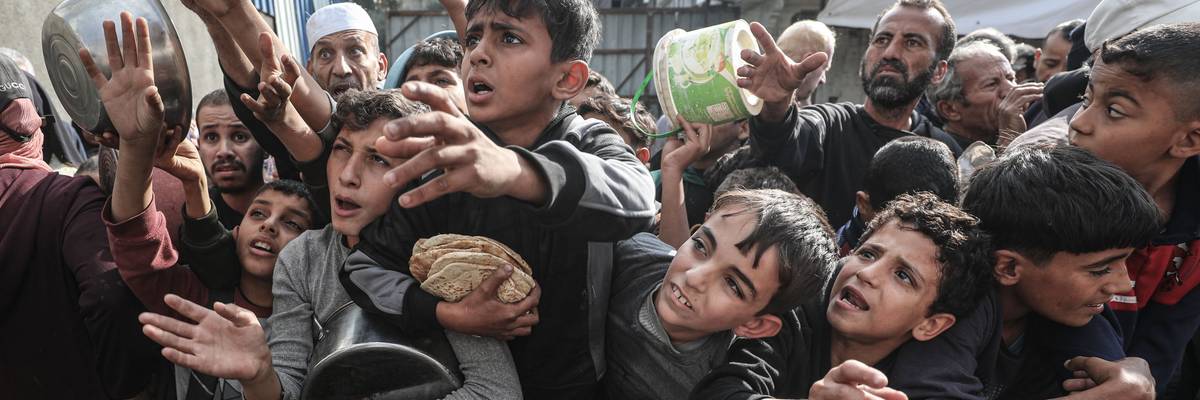
Displaced Palestinians receive food distributed by a charity organization at the Nuseirat Refugee Camp in Deir al-Balah, Gaza on December 6, 2025.
"To end this catastrophe, supplies must be let in at scale and humanitarians allowed to do their job," said the head of the United Nations agency for Palestinian refugees.
While the global initiative that tracks hunger crises concluded Friday that the Gaza Strip is no longer facing "famine," the Integrated Food Security Phase Classification report echoed warnings from United Nations leaders and humanitarian groups that "the situation remains critical" for Palestinians who have endured over two years of an Israeli assault and blockade.
Famine was declared in August, sparking a worldwide outrage over what one research group called "genocidal starvation." The new IPC report—released after an October ceasefire deal between Hamas and Israel—says that "following a significant reduction in conflict, a proposed peace plan, and improved access for both humanitarian and commercial food deliveries, food security conditions have improved in the Gaza Strip."
However, the report also notes that between mid-October and the end of November, "around 1.6 million people (77% of the population analyzed) faced high levels of acute food insecurity (IPC Phase 3 or above)," including "more than half a million people in emergency (IPC Phase 4) and over 100,000 people in catastrophe (IPC Phase 5)."
Those conditions—over three-quarters of Gaza's population at risk of famine—are expected to continue through April. In other words, as Philippe Lazzarini, commissioner-general of the United Nations Relief and Works Agency for Palestine Refugees in the Near East (UNRWA), put it, "Gaza remains in a man-made hunger crisis."
The latest IPC report "underscores how fragile the gains have been since the ceasefire began in October," he said on social media. "To end this catastrophe, supplies must be let in at scale and humanitarians allowed to do their job. UNRWA has food parcels for 1.1 million people and flour for the entire population waiting to enter the Gaza Strip."
As the Associated Press reported Friday, while Israeli government agencies rejected the IPC findings, humanitarian leaders and Palestinians have highlighted all that the people of Gaza continue to endure because of Israel's war on the strip:
"This is not a debate about truck numbers or calories on paper. It's about whether people can actually access food, clean water, shelter, and healthcare safely and consistently. Right now, they cannot," said Bushra Khalidi, Oxfam's policy lead for Israel and the occupied Palestinian territory.
People must be able to rebuild their homes, grow food, and recover, and the conditions for that are still being denied, she said.
Even with more products in the markets, Palestinians say they can't afford it. "There is food and meat, but no one has money," said Hany al-Shamali, who was displaced from Gaza City. "How can we live?"
Earlier this week, the Humanitarian Country Team of the Occupied Palestinian Territory, which brings together heads of UN entities and over 200 nongovernmental organizations, urged the international community to "take immediate and concrete actions to press the Israeli authorities to lift all impediments," including a new registration process for NGOs, that continue to undermine lifesaving operations, "or risk the collapse of the humanitarian response, particularly in the Gaza Strip."
The team emphasized that "humanitarian access is not optional, conditional, or political. It is a legal obligation under international humanitarian law, particularly in Gaza, where Israel has failed to ensure that the population is adequately supplied. Israeli authorities must allow and facilitate rapid, unimpeded passage of humanitarian relief. They must immediately reverse policies that obstruct humanitarian operations and ensure that humanitarian organizations are able to operate without compromising humanitarian principles. Lifesaving assistance must be allowed to reach Palestinians without further delay."
Israel has killed at least 70,669 Palestinians in the strip and wounded 171,165 others since launching its retaliation for the Hamas-led attack on October 7, 2023, the Gaza Health Ministry said Thursday. Experts have warned that the true death toll is likely far higher.
Winter storms are exacerbating already dire conditions in Gaza, including by damaging and destroying shelters of displaced people. Oxfam's humanitarian director, Marta Valdes García, said Friday that "with 1.6 million people found to be facing acute food insecurity... we are incredibly concerned that winter is already bringing flooding and more misery to thousands of hungry people with little or no money, who are now exposed in terrible living conditions."
Multiple infants have died of hypothermia in recent days, including a 14-day-old named Mohammed, whose family is living in a tent after being displaced from their home in the east of Khan Younis. His mother, Eman Abu al-Khair, told Al Jazeera that "I can still hear his tiny cries in my ears... I sleep and drift off, unable to believe that his crying and waking me at night will never happen again."
"His body was cold as ice. His hands and feet were frozen, his face stiff and yellowish, and he was barely breathing... I woke my husband immediately so we could take him to the hospital, but he couldn't find any means of transportation to get us there," the 34-year-old recalled. "As soon as daylight broke, we rushed with an animal-drawn cart towards the hospital... But unfortunately, we arrived too late. His condition was already critical."
Another 29-day-old baby, Saeed Eseid Abdeen, was declared dead at Nasser Hospital in southern Gaza on Thursday, according to Drop Site News and Doctors Without Borders, also known by its French name, Médecins Sans Frontières (MSF).
A fourth child has frozen to death in Gaza in just 10 days—two of them babies—as Israel continues blocking tents and winter shelter aid, despite UN supplies pre-positioned at the border that could immediately shelter more than 1.3 million displaced Palestinians.
[image or embed]
— Drop Site (@dropsitenews.com) December 18, 2025 at 7:41 PM
"Children are losing their lives because they lack the most basic items for survival," Bilal Abu Saada, nursing team supervisor at Nasser Hospital, said in a statement from MSF. "Babies are arriving to the hospital cold, with near-death vital signs: Even our best efforts are not enough. They say the war has ended, but people are still having to fight for their lives."
Dear Common Dreams reader, It’s been nearly 30 years since I co-founded Common Dreams with my late wife, Lina Newhouser. We had the radical notion that journalism should serve the public good, not corporate profits. It was clear to us from the outset what it would take to build such a project. No paid advertisements. No corporate sponsors. No millionaire publisher telling us what to think or do. Many people said we wouldn't last a year, but we proved those doubters wrong. Together with a tremendous team of journalists and dedicated staff, we built an independent media outlet free from the constraints of profits and corporate control. Our mission has always been simple: To inform. To inspire. To ignite change for the common good. Building Common Dreams was not easy. Our survival was never guaranteed. When you take on the most powerful forces—Wall Street greed, fossil fuel industry destruction, Big Tech lobbyists, and uber-rich oligarchs who have spent billions upon billions rigging the economy and democracy in their favor—the only bulwark you have is supporters who believe in your work. But here’s the urgent message from me today. It's never been this bad out there. And it's never been this hard to keep us going. At the very moment Common Dreams is most needed, the threats we face are intensifying. We need your support now more than ever. We don't accept corporate advertising and never will. We don't have a paywall because we don't think people should be blocked from critical news based on their ability to pay. Everything we do is funded by the donations of readers like you. When everyone does the little they can afford, we are strong. But if that support retreats or dries up, so do we. Will you donate now to make sure Common Dreams not only survives but thrives? —Craig Brown, Co-founder |
While the global initiative that tracks hunger crises concluded Friday that the Gaza Strip is no longer facing "famine," the Integrated Food Security Phase Classification report echoed warnings from United Nations leaders and humanitarian groups that "the situation remains critical" for Palestinians who have endured over two years of an Israeli assault and blockade.
Famine was declared in August, sparking a worldwide outrage over what one research group called "genocidal starvation." The new IPC report—released after an October ceasefire deal between Hamas and Israel—says that "following a significant reduction in conflict, a proposed peace plan, and improved access for both humanitarian and commercial food deliveries, food security conditions have improved in the Gaza Strip."
However, the report also notes that between mid-October and the end of November, "around 1.6 million people (77% of the population analyzed) faced high levels of acute food insecurity (IPC Phase 3 or above)," including "more than half a million people in emergency (IPC Phase 4) and over 100,000 people in catastrophe (IPC Phase 5)."
Those conditions—over three-quarters of Gaza's population at risk of famine—are expected to continue through April. In other words, as Philippe Lazzarini, commissioner-general of the United Nations Relief and Works Agency for Palestine Refugees in the Near East (UNRWA), put it, "Gaza remains in a man-made hunger crisis."
The latest IPC report "underscores how fragile the gains have been since the ceasefire began in October," he said on social media. "To end this catastrophe, supplies must be let in at scale and humanitarians allowed to do their job. UNRWA has food parcels for 1.1 million people and flour for the entire population waiting to enter the Gaza Strip."
As the Associated Press reported Friday, while Israeli government agencies rejected the IPC findings, humanitarian leaders and Palestinians have highlighted all that the people of Gaza continue to endure because of Israel's war on the strip:
"This is not a debate about truck numbers or calories on paper. It's about whether people can actually access food, clean water, shelter, and healthcare safely and consistently. Right now, they cannot," said Bushra Khalidi, Oxfam's policy lead for Israel and the occupied Palestinian territory.
People must be able to rebuild their homes, grow food, and recover, and the conditions for that are still being denied, she said.
Even with more products in the markets, Palestinians say they can't afford it. "There is food and meat, but no one has money," said Hany al-Shamali, who was displaced from Gaza City. "How can we live?"
Earlier this week, the Humanitarian Country Team of the Occupied Palestinian Territory, which brings together heads of UN entities and over 200 nongovernmental organizations, urged the international community to "take immediate and concrete actions to press the Israeli authorities to lift all impediments," including a new registration process for NGOs, that continue to undermine lifesaving operations, "or risk the collapse of the humanitarian response, particularly in the Gaza Strip."
The team emphasized that "humanitarian access is not optional, conditional, or political. It is a legal obligation under international humanitarian law, particularly in Gaza, where Israel has failed to ensure that the population is adequately supplied. Israeli authorities must allow and facilitate rapid, unimpeded passage of humanitarian relief. They must immediately reverse policies that obstruct humanitarian operations and ensure that humanitarian organizations are able to operate without compromising humanitarian principles. Lifesaving assistance must be allowed to reach Palestinians without further delay."
Israel has killed at least 70,669 Palestinians in the strip and wounded 171,165 others since launching its retaliation for the Hamas-led attack on October 7, 2023, the Gaza Health Ministry said Thursday. Experts have warned that the true death toll is likely far higher.
Winter storms are exacerbating already dire conditions in Gaza, including by damaging and destroying shelters of displaced people. Oxfam's humanitarian director, Marta Valdes García, said Friday that "with 1.6 million people found to be facing acute food insecurity... we are incredibly concerned that winter is already bringing flooding and more misery to thousands of hungry people with little or no money, who are now exposed in terrible living conditions."
Multiple infants have died of hypothermia in recent days, including a 14-day-old named Mohammed, whose family is living in a tent after being displaced from their home in the east of Khan Younis. His mother, Eman Abu al-Khair, told Al Jazeera that "I can still hear his tiny cries in my ears... I sleep and drift off, unable to believe that his crying and waking me at night will never happen again."
"His body was cold as ice. His hands and feet were frozen, his face stiff and yellowish, and he was barely breathing... I woke my husband immediately so we could take him to the hospital, but he couldn't find any means of transportation to get us there," the 34-year-old recalled. "As soon as daylight broke, we rushed with an animal-drawn cart towards the hospital... But unfortunately, we arrived too late. His condition was already critical."
Another 29-day-old baby, Saeed Eseid Abdeen, was declared dead at Nasser Hospital in southern Gaza on Thursday, according to Drop Site News and Doctors Without Borders, also known by its French name, Médecins Sans Frontières (MSF).
A fourth child has frozen to death in Gaza in just 10 days—two of them babies—as Israel continues blocking tents and winter shelter aid, despite UN supplies pre-positioned at the border that could immediately shelter more than 1.3 million displaced Palestinians.
[image or embed]
— Drop Site (@dropsitenews.com) December 18, 2025 at 7:41 PM
"Children are losing their lives because they lack the most basic items for survival," Bilal Abu Saada, nursing team supervisor at Nasser Hospital, said in a statement from MSF. "Babies are arriving to the hospital cold, with near-death vital signs: Even our best efforts are not enough. They say the war has ended, but people are still having to fight for their lives."
While the global initiative that tracks hunger crises concluded Friday that the Gaza Strip is no longer facing "famine," the Integrated Food Security Phase Classification report echoed warnings from United Nations leaders and humanitarian groups that "the situation remains critical" for Palestinians who have endured over two years of an Israeli assault and blockade.
Famine was declared in August, sparking a worldwide outrage over what one research group called "genocidal starvation." The new IPC report—released after an October ceasefire deal between Hamas and Israel—says that "following a significant reduction in conflict, a proposed peace plan, and improved access for both humanitarian and commercial food deliveries, food security conditions have improved in the Gaza Strip."
However, the report also notes that between mid-October and the end of November, "around 1.6 million people (77% of the population analyzed) faced high levels of acute food insecurity (IPC Phase 3 or above)," including "more than half a million people in emergency (IPC Phase 4) and over 100,000 people in catastrophe (IPC Phase 5)."
Those conditions—over three-quarters of Gaza's population at risk of famine—are expected to continue through April. In other words, as Philippe Lazzarini, commissioner-general of the United Nations Relief and Works Agency for Palestine Refugees in the Near East (UNRWA), put it, "Gaza remains in a man-made hunger crisis."
The latest IPC report "underscores how fragile the gains have been since the ceasefire began in October," he said on social media. "To end this catastrophe, supplies must be let in at scale and humanitarians allowed to do their job. UNRWA has food parcels for 1.1 million people and flour for the entire population waiting to enter the Gaza Strip."
As the Associated Press reported Friday, while Israeli government agencies rejected the IPC findings, humanitarian leaders and Palestinians have highlighted all that the people of Gaza continue to endure because of Israel's war on the strip:
"This is not a debate about truck numbers or calories on paper. It's about whether people can actually access food, clean water, shelter, and healthcare safely and consistently. Right now, they cannot," said Bushra Khalidi, Oxfam's policy lead for Israel and the occupied Palestinian territory.
People must be able to rebuild their homes, grow food, and recover, and the conditions for that are still being denied, she said.
Even with more products in the markets, Palestinians say they can't afford it. "There is food and meat, but no one has money," said Hany al-Shamali, who was displaced from Gaza City. "How can we live?"
Earlier this week, the Humanitarian Country Team of the Occupied Palestinian Territory, which brings together heads of UN entities and over 200 nongovernmental organizations, urged the international community to "take immediate and concrete actions to press the Israeli authorities to lift all impediments," including a new registration process for NGOs, that continue to undermine lifesaving operations, "or risk the collapse of the humanitarian response, particularly in the Gaza Strip."
The team emphasized that "humanitarian access is not optional, conditional, or political. It is a legal obligation under international humanitarian law, particularly in Gaza, where Israel has failed to ensure that the population is adequately supplied. Israeli authorities must allow and facilitate rapid, unimpeded passage of humanitarian relief. They must immediately reverse policies that obstruct humanitarian operations and ensure that humanitarian organizations are able to operate without compromising humanitarian principles. Lifesaving assistance must be allowed to reach Palestinians without further delay."
Israel has killed at least 70,669 Palestinians in the strip and wounded 171,165 others since launching its retaliation for the Hamas-led attack on October 7, 2023, the Gaza Health Ministry said Thursday. Experts have warned that the true death toll is likely far higher.
Winter storms are exacerbating already dire conditions in Gaza, including by damaging and destroying shelters of displaced people. Oxfam's humanitarian director, Marta Valdes García, said Friday that "with 1.6 million people found to be facing acute food insecurity... we are incredibly concerned that winter is already bringing flooding and more misery to thousands of hungry people with little or no money, who are now exposed in terrible living conditions."
Multiple infants have died of hypothermia in recent days, including a 14-day-old named Mohammed, whose family is living in a tent after being displaced from their home in the east of Khan Younis. His mother, Eman Abu al-Khair, told Al Jazeera that "I can still hear his tiny cries in my ears... I sleep and drift off, unable to believe that his crying and waking me at night will never happen again."
"His body was cold as ice. His hands and feet were frozen, his face stiff and yellowish, and he was barely breathing... I woke my husband immediately so we could take him to the hospital, but he couldn't find any means of transportation to get us there," the 34-year-old recalled. "As soon as daylight broke, we rushed with an animal-drawn cart towards the hospital... But unfortunately, we arrived too late. His condition was already critical."
Another 29-day-old baby, Saeed Eseid Abdeen, was declared dead at Nasser Hospital in southern Gaza on Thursday, according to Drop Site News and Doctors Without Borders, also known by its French name, Médecins Sans Frontières (MSF).
A fourth child has frozen to death in Gaza in just 10 days—two of them babies—as Israel continues blocking tents and winter shelter aid, despite UN supplies pre-positioned at the border that could immediately shelter more than 1.3 million displaced Palestinians.
[image or embed]
— Drop Site (@dropsitenews.com) December 18, 2025 at 7:41 PM
"Children are losing their lives because they lack the most basic items for survival," Bilal Abu Saada, nursing team supervisor at Nasser Hospital, said in a statement from MSF. "Babies are arriving to the hospital cold, with near-death vital signs: Even our best efforts are not enough. They say the war has ended, but people are still having to fight for their lives."