SUBSCRIBE TO OUR FREE NEWSLETTER
Daily news & progressive opinion—funded by the people, not the corporations—delivered straight to your inbox.
5
#000000
#FFFFFF
To donate by check, phone, or other method, see our More Ways to Give page.
Daily news & progressive opinion—funded by the people, not the corporations—delivered straight to your inbox.
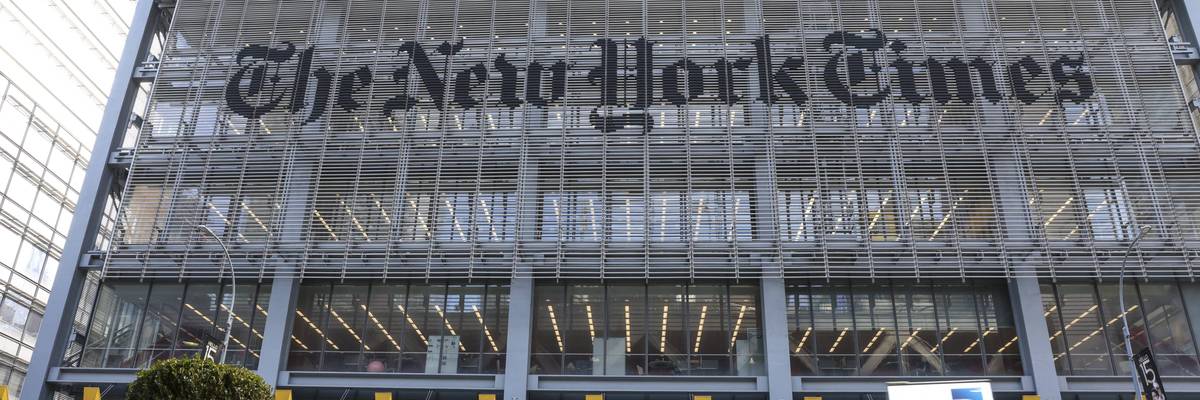
The New York Times logo is seen on the building's facade in New York City on January 22, 2026.
"This brazen act should be seen as nothing more than an attempt to prevent the public from knowing what is happening in their country by intimidating journalists from doing their jobs."
The Trump administration on Friday escalated its war with the press by subpoenaing several reporters at The New York Times days after the paper published a story on Wednesday that detailed security concerns about the luxury jet the Qatari government gave to President Donald Trump.
According to the Times, the subpoenas are attempting to force reporters to testify before a federal grand jury in Manhattan on Wednesday next week, a move that the paper describes as an "extraordinary escalation in President Trump’s efforts to threaten and intimidate independent news organizations."
The issued subpoenas do not specifically name the Times' reporting on the Qatari jet as the reason for the grand jury probe, although they were given to all four journalists—Tyler Pager, Julian Barnes, Eric Schmitt, and Eric Lipton—who reported the story.
Additionally, the Times noted, a senior official at the FBI had asked the paper to hold off publishing its story on the jet before it came out on Wednesday, citing unspecified national security concerns about its content.
David McCraw, the top attorney representing the Times' newsroom, denounced the subpoenas as an attack on the freedom of the press.
"The appearance of federal law enforcement agents on the doorstep of news reporters should shock the conscience of any American who believes in the Constitution and the press freedom it protects," said McGraw. “This brazen act should be seen as nothing more than an attempt to prevent the public from knowing what is happening in their country by intimidating journalists from doing their jobs."
It is highly uncommon for government investigators to subpoena journalists when they are probing national security leaks, as such actions are generally seen as having a chilling effect on reporters’ ability to gather information.
Rick Stengel, former under secretary of state for President Barack Obama, said that the Times' reporting on the Qatari jet, whose security upgrades are being financed with US tax dollars, is completely within the scope of constitutional protections for press freedom.
"The reporting that the Times journalists have been subpoenaed for is exactly the kind of journalism the First Amendment is designed to protect: matters involving national security and taxpayer dollars," wrote Stengel in a Saturday social media post. "Reporting that embarrasses a president is protected speech."
Fox News chief national security correspondent Jennifer Griffin also denounced the Trump administration for trying to drag reporters into a grand jury investigation.
"This action by the US government to subpoena reporters for reporting legitimate news on security concerns about Air Force One should alarm every American," Griffin wrote.
Seth Stern, chief of advocacy for the Freedom of the Press Foundation, accused the Trump administration of abusing government power not to defend national security, but to protect the president from personal humiliation.
"We've long said that when the government claims it needs to investigate journalists to protect national security, it really means its own reputational security," said Stern. "This is as clear an example as you can get. The administration's embarrassment that it reportedly charged taxpayers hundreds of millions of dollars to retrofit a flying bribe that still isn't secure enough for hostile times does not supersede the need for a free and independent press."
This is the second time in recent weeks that the Trump administration has tried to subpoena reporters to compel their testimony in grand jury investigations.
In June, the US Department of Justice issued subpoenas for national security reporters at The Washington Post and The Wall Street Journal related to national security leaks.
Subpoenas against both news organizations were withdrawn after they issued legal challenges in sealed filings.
Dear Common Dreams reader, It’s been nearly 30 years since I co-founded Common Dreams with my late wife, Lina Newhouser. We had the radical notion that journalism should serve the public good, not corporate profits. It was clear to us from the outset what it would take to build such a project. No paid advertisements. No corporate sponsors. No millionaire publisher telling us what to think or do. Many people said we wouldn't last a year, but we proved those doubters wrong. Together with a tremendous team of journalists and dedicated staff, we built an independent media outlet free from the constraints of profits and corporate control. Our mission has always been simple: To inform. To inspire. To ignite change for the common good. Building Common Dreams was not easy. Our survival was never guaranteed. When you take on the most powerful forces—Wall Street greed, fossil fuel industry destruction, Big Tech lobbyists, and uber-rich oligarchs who have spent billions upon billions rigging the economy and democracy in their favor—the only bulwark you have is supporters who believe in your work. But here’s the urgent message from me today. It's never been this bad out there. And it's never been this hard to keep us going. At the very moment Common Dreams is most needed, the threats we face are intensifying. We need your support now more than ever. We don't accept corporate advertising and never will. We don't have a paywall because we don't think people should be blocked from critical news based on their ability to pay. Everything we do is funded by the donations of readers like you. When everyone does the little they can afford, we are strong. But if that support retreats or dries up, so do we. Will you donate now to make sure Common Dreams not only survives but thrives? —Craig Brown, Co-founder |
The Trump administration on Friday escalated its war with the press by subpoenaing several reporters at The New York Times days after the paper published a story on Wednesday that detailed security concerns about the luxury jet the Qatari government gave to President Donald Trump.
According to the Times, the subpoenas are attempting to force reporters to testify before a federal grand jury in Manhattan on Wednesday next week, a move that the paper describes as an "extraordinary escalation in President Trump’s efforts to threaten and intimidate independent news organizations."
The issued subpoenas do not specifically name the Times' reporting on the Qatari jet as the reason for the grand jury probe, although they were given to all four journalists—Tyler Pager, Julian Barnes, Eric Schmitt, and Eric Lipton—who reported the story.
Additionally, the Times noted, a senior official at the FBI had asked the paper to hold off publishing its story on the jet before it came out on Wednesday, citing unspecified national security concerns about its content.
David McCraw, the top attorney representing the Times' newsroom, denounced the subpoenas as an attack on the freedom of the press.
"The appearance of federal law enforcement agents on the doorstep of news reporters should shock the conscience of any American who believes in the Constitution and the press freedom it protects," said McGraw. “This brazen act should be seen as nothing more than an attempt to prevent the public from knowing what is happening in their country by intimidating journalists from doing their jobs."
It is highly uncommon for government investigators to subpoena journalists when they are probing national security leaks, as such actions are generally seen as having a chilling effect on reporters’ ability to gather information.
Rick Stengel, former under secretary of state for President Barack Obama, said that the Times' reporting on the Qatari jet, whose security upgrades are being financed with US tax dollars, is completely within the scope of constitutional protections for press freedom.
"The reporting that the Times journalists have been subpoenaed for is exactly the kind of journalism the First Amendment is designed to protect: matters involving national security and taxpayer dollars," wrote Stengel in a Saturday social media post. "Reporting that embarrasses a president is protected speech."
Fox News chief national security correspondent Jennifer Griffin also denounced the Trump administration for trying to drag reporters into a grand jury investigation.
"This action by the US government to subpoena reporters for reporting legitimate news on security concerns about Air Force One should alarm every American," Griffin wrote.
Seth Stern, chief of advocacy for the Freedom of the Press Foundation, accused the Trump administration of abusing government power not to defend national security, but to protect the president from personal humiliation.
"We've long said that when the government claims it needs to investigate journalists to protect national security, it really means its own reputational security," said Stern. "This is as clear an example as you can get. The administration's embarrassment that it reportedly charged taxpayers hundreds of millions of dollars to retrofit a flying bribe that still isn't secure enough for hostile times does not supersede the need for a free and independent press."
This is the second time in recent weeks that the Trump administration has tried to subpoena reporters to compel their testimony in grand jury investigations.
In June, the US Department of Justice issued subpoenas for national security reporters at The Washington Post and The Wall Street Journal related to national security leaks.
Subpoenas against both news organizations were withdrawn after they issued legal challenges in sealed filings.
The Trump administration on Friday escalated its war with the press by subpoenaing several reporters at The New York Times days after the paper published a story on Wednesday that detailed security concerns about the luxury jet the Qatari government gave to President Donald Trump.
According to the Times, the subpoenas are attempting to force reporters to testify before a federal grand jury in Manhattan on Wednesday next week, a move that the paper describes as an "extraordinary escalation in President Trump’s efforts to threaten and intimidate independent news organizations."
The issued subpoenas do not specifically name the Times' reporting on the Qatari jet as the reason for the grand jury probe, although they were given to all four journalists—Tyler Pager, Julian Barnes, Eric Schmitt, and Eric Lipton—who reported the story.
Additionally, the Times noted, a senior official at the FBI had asked the paper to hold off publishing its story on the jet before it came out on Wednesday, citing unspecified national security concerns about its content.
David McCraw, the top attorney representing the Times' newsroom, denounced the subpoenas as an attack on the freedom of the press.
"The appearance of federal law enforcement agents on the doorstep of news reporters should shock the conscience of any American who believes in the Constitution and the press freedom it protects," said McGraw. “This brazen act should be seen as nothing more than an attempt to prevent the public from knowing what is happening in their country by intimidating journalists from doing their jobs."
It is highly uncommon for government investigators to subpoena journalists when they are probing national security leaks, as such actions are generally seen as having a chilling effect on reporters’ ability to gather information.
Rick Stengel, former under secretary of state for President Barack Obama, said that the Times' reporting on the Qatari jet, whose security upgrades are being financed with US tax dollars, is completely within the scope of constitutional protections for press freedom.
"The reporting that the Times journalists have been subpoenaed for is exactly the kind of journalism the First Amendment is designed to protect: matters involving national security and taxpayer dollars," wrote Stengel in a Saturday social media post. "Reporting that embarrasses a president is protected speech."
Fox News chief national security correspondent Jennifer Griffin also denounced the Trump administration for trying to drag reporters into a grand jury investigation.
"This action by the US government to subpoena reporters for reporting legitimate news on security concerns about Air Force One should alarm every American," Griffin wrote.
Seth Stern, chief of advocacy for the Freedom of the Press Foundation, accused the Trump administration of abusing government power not to defend national security, but to protect the president from personal humiliation.
"We've long said that when the government claims it needs to investigate journalists to protect national security, it really means its own reputational security," said Stern. "This is as clear an example as you can get. The administration's embarrassment that it reportedly charged taxpayers hundreds of millions of dollars to retrofit a flying bribe that still isn't secure enough for hostile times does not supersede the need for a free and independent press."
This is the second time in recent weeks that the Trump administration has tried to subpoena reporters to compel their testimony in grand jury investigations.
In June, the US Department of Justice issued subpoenas for national security reporters at The Washington Post and The Wall Street Journal related to national security leaks.
Subpoenas against both news organizations were withdrawn after they issued legal challenges in sealed filings.